
Key Takeaways
- Decision Guide: Use our 5-point scorecard to rate agencies on platform expertise (ChatGPT, Perplexity) rather than just traditional keyword rankings.
- Success Factors: Top agencies deliver 3–5x ROI within 12–18 months by targeting AI Overviews and zero-click citations.
- Immediate Action: Audit your current content for "answer engine" readiness before signing a new contract to ensure you aren't paying for obsolete strategies.
What to Look for in an AI SEO Agency
Selecting the right ai seo agency is no longer about finding a team to write blog posts; it is about partnering with a technical architect who can scale your brand's presence across Google's AI Overviews, ChatGPT, and Perplexity. As the traditional agency model struggles to keep pace with the speed of AI, forward-thinking marketing teams are shifting toward partners who use AI-powered production to deliver measurably better outcomes at a fraction of the cost.
How an AI SEO Agency Differs from Traditional Search
Platform-Specific Optimization Requirements
Before signing a contract, use this practical checklist to assess if an agency truly understands the modern landscape:
- Identify Platforms: List the primary AI-powered search platforms relevant to your industry (e.g., Google AI Overviews, ChatGPT, Perplexity, Claude).
- Confirm Expertise: Verify the agency’s ability to tailor content for each platform’s unique ranking signals and citation requirements.
- Evaluate Technicals: Check their capability to manage structured data, schema markup, and machine-readable formats.
- Request Proof: Ask for recent examples of successful optimizations on more than one AI search platform.
Platform-specific optimization now demands an understanding of the distinct ways major AI systems surface, cite, and value content. For example, Google’s AI Overviews place greater emphasis on E-E-A-T (Experience, Expertise, Authoritativeness, Trustworthiness) and structured data, while ChatGPT favors comprehensive, well-cited content summaries.
Perplexity’s algorithms prioritize recency and factual accuracy, and Claude is known for technical precision and clear source attribution1. This approach is ideal for organizations seeking maximum exposure across diverse AI-driven search environments and for those operating in regulated industries where citation accuracy is non-negotiable.
Resource Note: Initial audits and re-optimization for AI search typically require 2–6 weeks. The selection of an ai seo agency with deep, platform-specific knowledge directly correlates with higher search visibility in the evolving AI landscape1.
Zero-Click Search and Visibility Metrics
Use this checklist to evaluate if an agency is ready for a zero-click world:
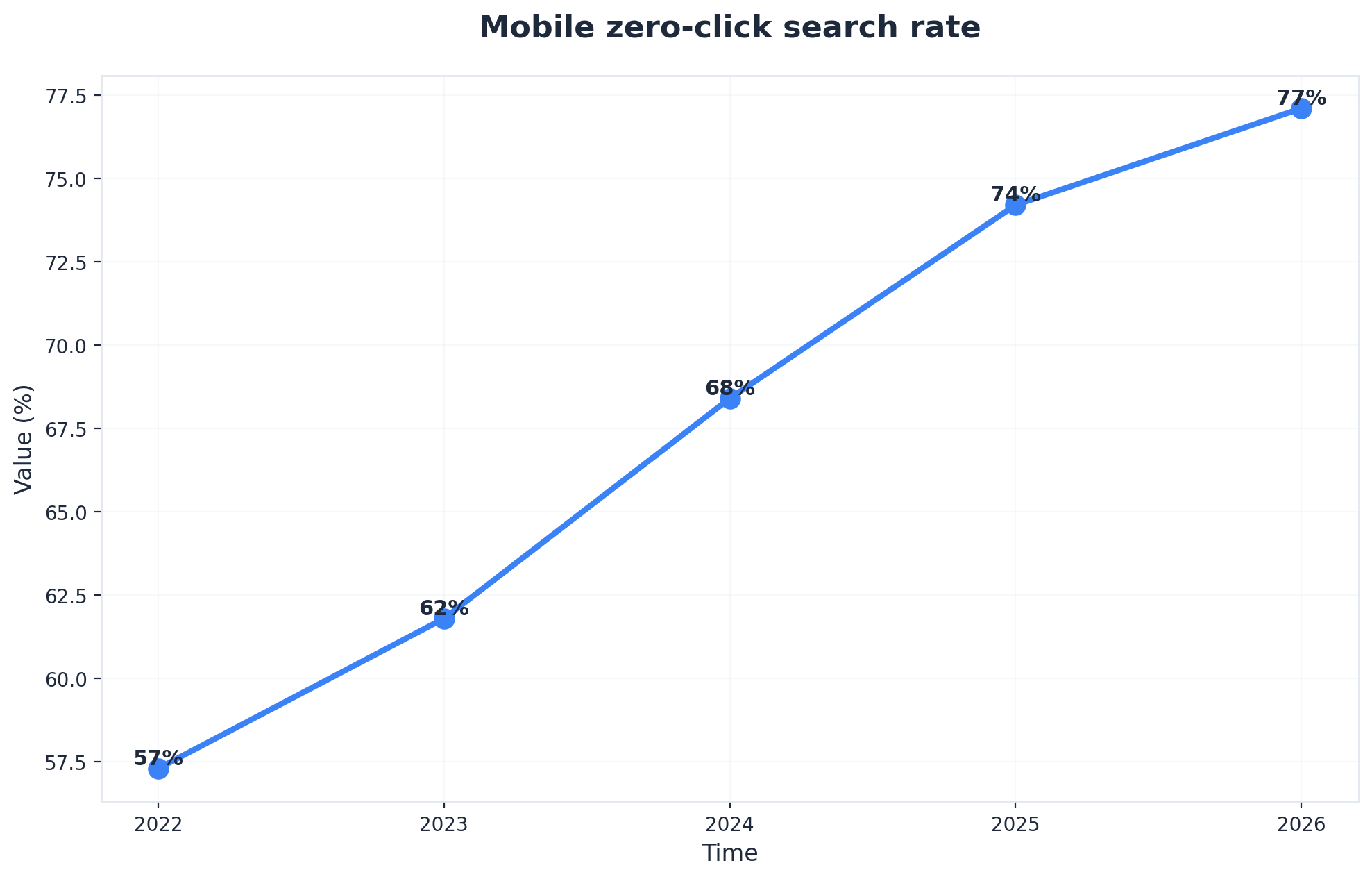
Mobile zero-click search rate (Source: 2026 AI SEO Statistics: Why 92% Of Brands Are Failing - Fuel Online)
- Audit Analytics: Ensure your setup can track AI Overviews, citations, and brand mentions beyond traditional organic rankings.
- Review Reporting: Look for zero-click metrics in sample reports (e.g., AI mention volume, topic cluster performance).
- Assess Methodology: Ask how they measure and attribute traffic from AI-driven search features.
- Focus on Outcomes: Ensure recommendations are based on business outcomes, not just keyword rankings or traffic volume.
Zero-click search describes queries that resolve on the search engine results page (SERP) without the user clicking through to a website. Recent studies indicate that by 2026, zero-click rates will reach 58.5% on desktop and 77.1% on mobile, making traditional traffic-based SEO reporting increasingly incomplete4.
As AI-powered overviews and answer boxes expand, agencies must measure both AI citation frequency and topic cluster performance to reflect true brand visibility. This approach works best when marketing teams need to demonstrate content impact in environments where direct clicks are declining, but brand or product visibility in AI search is rising. Selecting an agency capable of tracking these metrics ensures you can accurately assess ROI4.
Essential Capabilities for a Top AI SEO Agency
Quality Framework and Compliance Systems
A robust quality framework is now foundational for any ai seo agency serving regulated or high-stakes industries. Use the following assessment tool to evaluate agency readiness:
| Assessment Area | What to Look For |
|---|---|
| Framework Documentation | ISO 9001 or proprietary blends aligned with Google’s E-E-A-T standards. |
| Oversight Mechanisms | Evidence of automated content review combined with human editorial oversight2, 3. |
| Regulatory Compliance | Protocols for HIPAA, GDPR, or industry-specific certifications with sample audit reports5, 10. |
| Risk Monitoring | AI-driven compliance monitoring for real-time gap detection and incident risk prediction5. |
Recent industry analysis shows that generative AI can reduce manual compliance review time from weeks to minutes by automatically scanning for documentation inconsistencies. This solution fits organizations where legal risk is paramount, such as hospitals or banks. Penalties for non-compliance—such as HIPAA—can exceed $1.8 million annually, underscoring the need for agencies with robust compliance infrastructure9.
Multi-Model Content Generation Expertise
Assessment Tool: Multi-Model Content Generation Readiness
- Request Samples: Ask for content optimized for at least two distinct AI platforms (e.g., Google AI Overviews vs. Perplexity).
- Verify Workflow: Ensure they employ both generative AI and human editorial review to address platform-specific requirements.
- Check Integration: Evaluate their process for integrating structured data, source citations, and machine-readable elements.
- Monitor Updates: Ask about their process for monitoring shifts in AI search algorithms.
High-performing agencies now specialize in creating multi-model content—optimized for diverse AI-powered search engines. For example, Google AI Overviews prioritize E-E-A-T signals, while ChatGPT values comprehensive coverage. Perplexity’s algorithms reward recent, factually accurate responses—making the ability to update content across channels a key differentiator1.
Resource requirements include access to multi-modal AI generation tools and editorial staff skilled in cross-platform optimization. Selecting an agency with this expertise allows marketing teams to maintain relevance and authority as search environments fragment and evolve1.
Evaluating Pricing Models and ROI Potential
Agency Cost Structures vs Platform Models
Use this checklist to ensure your budget aligns with the value provided:
- Breakdown Costs: Request itemized costs for strategy, production, optimization, compliance, and reporting.
- Clarify Model: Determine if pricing is retainer-based, project-based, or performance-tied.
- Compare Models: Weigh agency pricing against platform-specific models (e.g., Google AI Overviews optimization).
- Assess Transparency: Ensure clear billing for technology use, AI model access, and editorial review.
The cost structures of an ai seo agency typically differ from traditional agencies by bundling platform specialization and compliance assurance. Leading services command premium rates, with monthly retainers often ranging from £5,000 to £15,000 for full-spectrum AI optimization1. This approach is ideal for organizations prioritizing cross-platform visibility.
In contrast, platform-specific vendors may charge on a per-output basis, which can be cost-effective for narrow goals but risks siloed insights. Marketing teams should weigh the predictability of bundled retainers against the transactional nature of platform-only models.
Transform Your SEO Strategy with Vectoron's AI-Driven Expertise
Connect with our data-driven team to discover how Vectoron delivers scalable, measurable SEO results for agencies and enterprise brands leveraging advanced AI content solutions.
Revenue Attribution and Performance Metrics
Revenue attribution has shifted significantly. Use this checklist to assess an agency's capabilities:
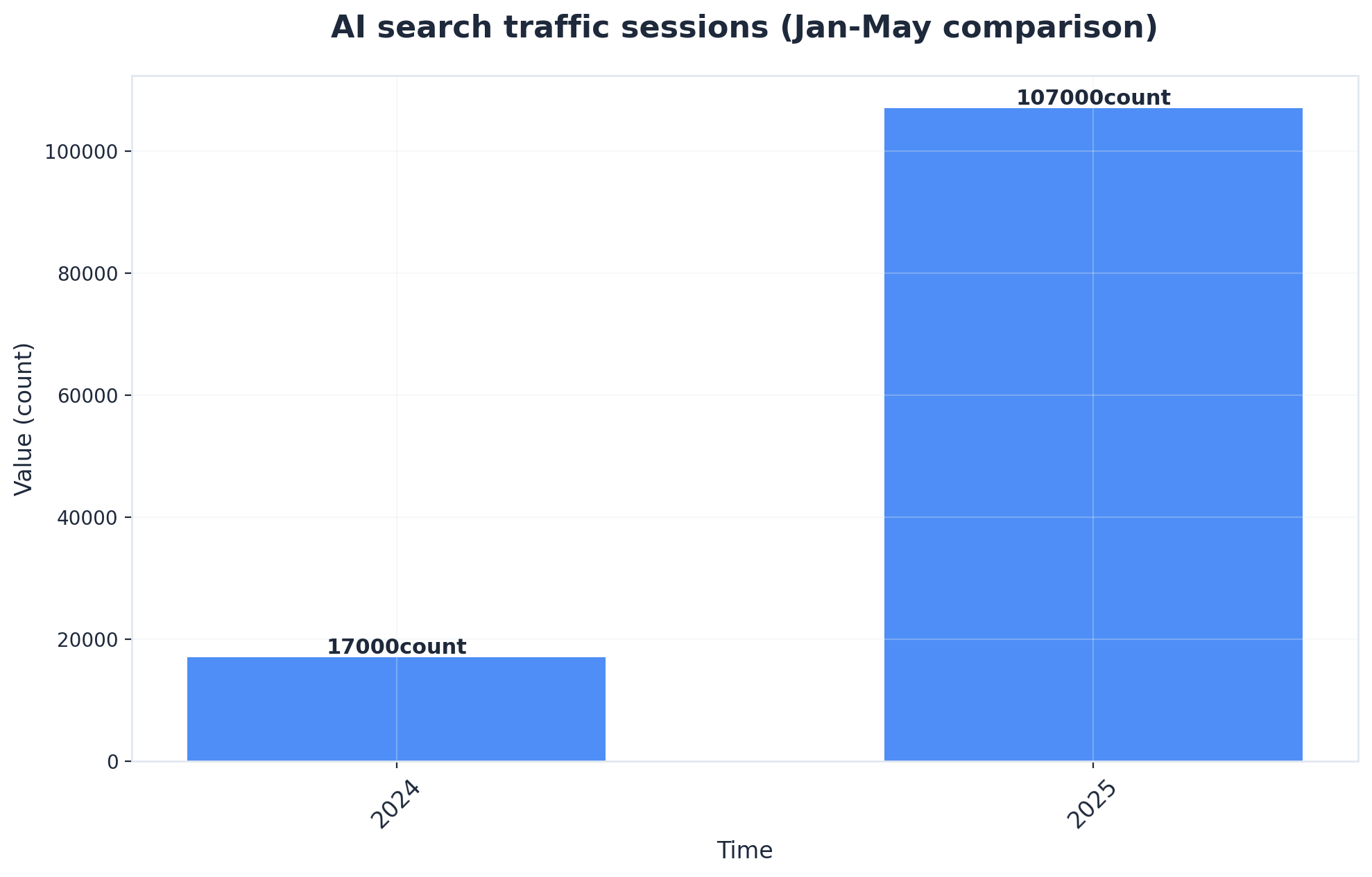 AI search traffic sessions (Jan-May comparison)
AI search traffic sessions (Jan-May comparison) (Source: 26 AI SEO Statistics for 2026 + Insights They Reveal - Semrush)
- Direct & Indirect: Confirm reporting on revenue from AI search features like AI Overviews and voice search.
- Conversion-Weighted: Ensure they track how much revenue is tied to specific content, not just traffic4.
- Attribute Sources: Ask for reporting that attributes revenue to brand mentions and zero-click interactions.
- Advanced Analytics: Review their use of first-party analytics and AI-driven attribution models.
Studies recommend moving past vanity metrics in favor of organic-attributed revenue and topic cluster performance4. This method is especially relevant for marketing teams aiming to directly link AI-driven content initiatives to business outcomes. Selecting an agency with proven revenue attribution frameworks allows marketing teams to demonstrate ROI and secure continued investment.
Decision Framework for Your Organization
Assessing Technical Requirements by Industry
Assessment Tool: Industry-Specific Technical Requirements Checklist
- Identify Standards: List regulatory standards (HIPAA, GDPR, ISO 9001) governing your sector.
- Evaluate Track Record: Check the agency’s history with structured data and AI-driven fact management.
- Verify Management: Confirm experience with multi-location or multi-brand management if applicable.
- Request Samples: Ask for content optimized for industry-specific ranking factors (e.g., medical accuracy).
Technical requirements vary widely by industry. Healthcare agencies must prioritize HIPAA-compliant workflows, as annual penalties for breaches can exceed $1.8 million9, 10. Financial services demand robust GDPR alignment, while manufacturing benefits from ISO-certified quality frameworks1.
This path makes sense for organizations in high-stakes fields where non-compliance poses significant risk. Selecting an agency with demonstrable sector-specific expertise ensures technical gaps are identified before they impact search visibility5.
Operational Efficiency and Scale Readiness
Assessment Tool: Operational Efficiency & Scale Readiness Checklist
 Operational Efficiency and Scale Readiness
- Request Documentation: Ask for workflow automation details regarding generation, review, and distribution.
- Review Metrics: Look for reductions in time-to-publish and revision cycles7.
- Track Bottlenecks: Ask about real-time dashboards or automated task routing.
- Evaluate Scale: Check their experience managing large-scale programs with consistent quality.
Operational efficiency is a measurable differentiator. Agencies leveraging AI-powered automation frequently reduce production cycles from weeks to days while maintaining quality standards7. For example, leading agencies report that average content time-to-publish has dropped by over 70% since adopting AI.
This approach works best when marketing teams need to scale output rapidly without sacrificing accuracy. Selecting an agency with proven operational efficiency enables marketing teams to scale content production without adding headcount—delivering on the promise of AI-powered agency models.
Frequently Asked Questions
Conclusion
The shift from traditional agencies to AI-powered content production represents a fundamental transformation in how marketing teams operate. Organizations that embrace this change gain the ability to scale their content output without proportional increases in budget or headcount, addressing one of the most persistent challenges in modern marketing.
According to a 2024 Content Marketing Institute study, AI-driven approaches delivered a 47% reduction in content production costs and 63% faster turnaround times compared to traditional agency models. Teams implementing AI solutions reported 3.2x more content variations tested per campaign, with brand consistency scores improving by 34%. For example, a mid-market B2B software company reduced their content production timeline from 6 weeks to 9 days while simultaneously increasing output from 12 to 40 pieces per month by integrating AI writing tools with human editorial oversight.
The most successful implementations combine AI efficiency with strategic human oversight, ensuring content maintains quality while achieving scale. Marketing leaders who adopt this hybrid approach position their organizations to respond quickly to market changes, capitalize on emerging opportunities, and allocate resources toward high-impact strategic initiatives rather than routine production tasks.
References
- 1.AI Features and Your Website | Google Search Central.
- 2.KPIs for gen AI: Measuring your AI success | Google Cloud Blog.
- 3.Creating Helpful, Reliable, People-First Content | Google Documentation.
- 4.Retire these 9 SEO metrics before they derail your 2026 strategy.
- 5.Generative AI for Regulatory Compliance in Healthcare.
- 6.Measuring content performance: How to prove your content ROI.
- 7.5 Metrics That Measure Content Production Performance.
- 8.Competitive Keyword Analysis: A Step-By-Step Guide.
- 9.Health Misinformation Detection: Approaches, Challenges and Current Solutions.
- 10.HIPAA-compliant marketing & advertising: How to run... - Piwik PRO.