
Key Takeaways
- Consolidating the agency stack around seven production jobs-to-be-done, rather than adding more tools, is where margin improvements actually surface as AI compresses delivery work.
- Keyword research and clustering engines shrink discovery from days to hours by using embeddings to group thousands of terms, shifting mid-level work into senior review.
- On-page and content optimization removes the most billable hours, letting a single senior editor process eight to twelve pieces weekly when brief, draft, and optimization tools share one pipeline.
- Technical crawl automation replaces monthly manual audits with continuous anomaly detection, root-cause clustering, and pre-drafted developer tickets that one senior specialist can oversee across a larger roster.
- Entity and answer-engine visibility tools track LLM citations and knowledge graph presence, closing a measurement gap that traditional rank trackers like Ahrefs and Semrush ignore.
- Reporting and analytics automation cuts monthly client report cycles from three days to half a day by auto-drafting narratives that specialists review for misattributed causal claims.
- A governance layer controlling data redaction, human sign-off, and audit trails is non-negotiable for healthcare, legal, and behavioral health clients under CMS guidance 2.
- Agentic orchestration unifies all seven jobs into one approval-first pipeline with shared state, unlocking the 3–5% productivity lift McKinsey ties to genuine workflow redesign 3.
Why the agency SEO stack is consolidating around jobs-to-be-done
The agencies gaining share in 2025 are not those adding another rank tracker or content brief tool to an already crowded license bill. They are the ones streamlining their stack to focus on specific production jobs that AI can compress, integrating approval into the workflow so senior specialists can dedicate hours to judgment rather than administrative tasks.
Forrester's 2024 study of US agency leaders found that over three-quarters describe generative AI as a disruption to their business, with 29% calling it a major disruption that will fundamentally change their operations 8. This indicates a significant shift in the delivery model agencies have built retainers upon. The report also highlights that smaller agencies are rapidly exploring AI to scale without increasing headcount, while larger networks are focusing on automated reporting, competitor analysis, and audience synthesis 8.
This suggests that organizing tools by brand popularity is less effective than organizing them by production jobs-to-be-done. A typical SEO retainer involves seven key jobs: keyword research, clustering, on-page optimization, technical crawl work, entity and answer-engine visibility, reporting, and cross-channel orchestration. Each job presents a different automation potential, governance risk, and impact on retainer margin when optimized or replaced.
McKinsey's 2025 survey cautions that while nearly nine in ten organizations regularly use AI, only 39% attribute any measurable EBIT impact to it, and most of those see less than 5% of EBIT tied to AI use 1. This disparity between usage and profit points to a workflow problem, not merely a tool problem. Agencies that integrate AI SEO optimization tools as mere add-ons retain their old cost structure. However, agencies that redesign their delivery workflow around each job can capture significant margin improvements. The following seven categories are structured with this principle in mind.
Keyword research and clustering engines: compressing the discovery phase
Keyword research historically consumed the first week of any new client engagement. A strategist would gather seed terms, process them through a rank tracker, export CSVs, and then spend days grouping intent and mapping topics to URLs. AI-native research and clustering engines have reduced this discovery phase from days to hours, which is where significant margin improvements are realized.
This job is now effectively handled by AI across three sub-tasks: extracting a broad range of candidate terms from live SERP and question data, grouping them by search intent and semantic proximity, and mapping these clusters to a site architecture. While traditional platforms provide the raw data, AI clustering engines use embeddings to group thousands of terms in a single pass, then rank clusters by opportunity score, competitive gap, and existing coverage. This transforms what was a manual spreadsheet task for a mid-level SEO into a review function for a senior strategist, who then accepts, rejects, or refines the AI's output.
The economic rationale supports this workflow shift. McKinsey's analysis of generative AI across 63 use cases identified marketing and sales as one of the top four value-creation functions, collectively accounting for approximately 75% of the potential annual value generative AI could add to the global economy 6. Discovery work, being a high-frequency, pattern-heavy task, is precisely the type of activity that model-based tools are designed to reshape first.
Agency owners should be aware of two operational considerations. First, cluster quality can degrade significantly in niche verticals with low search volume—such as behavioral health subspecialties or regional legal practice areas—where models may over-group based on superficial similarities and miss critical intent distinctions. A senior specialist is still necessary for refinement. Second, the time savings only materialize if the clusters seamlessly integrate into brief generation and on-page work. Research tools that merely export CSVs do not fully realize these savings. This category proves its value when clustering, brief generation, and drafting are part of a single, governed pipeline, rather than fragmented across multiple licenses.
On-page and content optimization: where specialist hours actually disappear
Among the seven production jobs in an agency retainer, on-page and content optimization typically consumes the largest portion of billable hours. This is also where AI has most significantly impacted traditional workflows. Tasks such as brief writing, meta and header optimization, internal link mapping, schema markup, entity coverage checks, and draft-to-publish revisions previously required a mid-level content strategist and an SEO editor working collaboratively. AI-native on-page tools now consolidate most of these tasks into a single reviewer role.
This category encompasses three interconnected tool types. Content optimization platforms evaluate drafts against live SERP data, identifying missing entities, related questions, and semantic gaps. Brief generators extract similar signals to produce structured outlines, H-tag scaffolding, and internal link suggestions. Draft-layer tools then use these briefs to generate initial content drafts for human editors to refine. When these three functions are fragmented across separate licenses with distinct export processes, the anticipated reduction in hours is lost to manual copy-pasting. However, when integrated into a single pipeline with an approval gate, a senior editor can process eight to twelve pieces of content weekly, a significant increase from the previous model's three.
The productivity gains are clear. In the American Marketing Association's September 2024 survey of over 1,000 marketers, nearly 90% reported using generative AI at work, with 71% using it weekly or more. Of those using AI, 85% stated that the tools had slightly or significantly increased their productivity, with content creation and SEO optimization cited as top applications 7. While these figures reflect individual marketers, they confirm that practitioners experience the most immediate impact in the on-page layer.
Two operational realities prevent this category from becoming a fully automated "fire-and-forget" process. First, quality can drift in regulated verticals. Content for behavioral health, legal, and healthcare still requires review by a subject-matter expert to identify clinically inaccurate phrasing, unverified claims, or language that violates advertising regulations. AI tools excel at scoring optimization signals but do not assess liability. Second, entity coverage on sites with limited authority can be problematic. Optimization tools often prioritize matching top-ranking pages, which for newer client sites can lead to merely imitating incumbents rather than developing distinct depth. A senior strategist must override scores when the SERP consensus does not align with the client's strategic positioning.
The practical restructuring within the delivery team involves transforming the mid-level content strategist role into a senior editor with an expanded portfolio, consolidating the SEO editor role into the same position, and reducing the freelance writer pool to specialists for regulated topics and executive thought leadership. Agencies that implement this headcount adjustment will realize margin improvements. Those that maintain their traditional organizational structure while simply adding optimization licenses will incur tool costs without recovering the associated hours.
Test AI SEO Workflows With Full Access
Experience real-time AI-driven SEO execution and publish actual campaign assets during your trial period.
Technical crawl automation: audits that run without a specialist babysitting them
Technical SEO is an area where AI's impact is subtle on the surface but profound underneath. The crawl itself still relies on established infrastructure—a spider navigates the site, collects status codes, renders JavaScript, and generates a report. However, the layer above the crawl has transformed: prioritization, root-cause analysis, and fix routing. Previously, a senior technical SEO would spend a full day per client each month analyzing Screaming Frog exports, cross-referencing Search Console coverage reports, and creating development tickets. AI-enhanced crawl tools now automate much of this analysis and ticket generation.
The compression of effort stems from three specific automations:
- Anomaly detection against the site's own baseline: the tool flags issues like a spike in soft 404s or a sudden drop in indexed pages as they occur, rather than weeks later during a monthly audit.
- Root-cause clustering: instead of a 4,000-row spreadsheet of thin content warnings, the tool groups issues by probable cause (e.g., template regression, canonical misconfiguration, faceted navigation problems), allowing a specialist to review a few patterns instead of thousands of individual rows.
- Ticket-ready output: the tool drafts development tickets complete with affected URLs, reproduction steps, and recommended fixes, requiring only approval or minor adjustments from the specialist before submission to the client's engineering queue.
Two common failure modes persist:
- On enterprise sites with extensive JavaScript rendering, the AI layer inherits the crawler's view, and a partial render can lead to confident but incorrect recommendations.
- For multi-location sites—such as DSO groups or home services franchises—the tool may over-flag near-duplicate location pages as thin content, even when such duplication is structurally appropriate.
In both scenarios, a specialist's override is essential.
The margin improvement in this area is primarily a staffing efficiency. One senior technical SEO can now manage the crawl portfolio for a client roster that previously required a technical lead plus a junior auditor, provided the crawl operates continuously and tickets are pre-drafted. Agencies still conducting quarterly manual audits are effectively paying for two positions to cover work that one can now manage.
Entity and answer-engine visibility: the category classic SEO tools still miss
Achieving a high ranking on a SERP and being cited within an AI-generated answer are now distinct objectives. A page can rank third for a high-intent query yet be absent from responses generated by LLMs like ChatGPT, Perplexity, or Google's AI Overview when a prospect asks the same question. Traditional SEO platforms excel at measuring SERP position but largely overlook LLM citation.
The gap is addressed by entity and answer-engine optimization. This work differs fundamentally from traditional SEO. A rank tracker assesses whether a URL appears in the top ten for a keyword. In contrast, an entity tool determines if the client is recognized as a distinct entity in the knowledge graph, if the entities within a page align with what a model expects for that topic, and if the site is cited when models generate answers in the client's category. For a personal injury firm in a mid-sized city, the focus shifts from "do we rank for car accident lawyer" to "when someone asks an LLM to compare firms in this metro, are we named, and with what attributes?"
This toolset involves three key sub-tasks:
- Entity coverage analysis compares entities in a client's content against those used in established citations, identifying gaps in coverage for people, places, procedures, conditions, and products.
- Citation monitoring tracks whether the client's domain or brand appears in LLM responses across a defined set of prompts, updated weekly.
- Structured data optimization enhances schema, author markup, and knowledge panel signals to provide clean sources for models.
The output feeds into the same on-page pipeline discussed earlier, but the objective shifts from SERP position to improving model recall.
Two caveats apply. Citation data can be noisy; the same prompt may yield different sources across sessions, and vendor sampling methods vary widely. It is more reliable to track trend lines than individual weekly citation counts. Additionally, this category rewards depth over breadth. A behavioral health group publishing ten authoritative pages on specific treatment modalities is more reliably cited than one with forty superficial service pages. Agencies still operating with content plans solely focused on keyword volume may find that an entity-centric view reveals unexpected coverage gaps.
Reporting and analytics automation: reclaiming the last billable hour
Client reporting is a necessary overhead for every retainer. A senior specialist typically spends the last week of each month compiling data from Search Console, GA4, rank trackers, call platforms, and CRMs, then translating it into a presentation that explains performance and outlines next steps. For a portfolio of twenty accounts, this amounts to a full-time position dedicated to formatting rather than analysis.
AI-layered reporting tools automate the assembly process, freeing up specialists for interpretation. Data pipelines automatically pull information, anomalies are flagged against the client's historical baseline, and a draft narrative links performance changes to work completed that month—such as a new cluster gaining rankings, a technical fix improving indexation, or an entity update increasing citation frequency. The specialist reviews the draft, corrects any misattributed causal claims by the model, and approves it. Report cycles that once took three days per client can now be completed in half a day.
The pressure for adoption is significant. McKinsey's early 2024 survey of global respondents indicated that 65% of organizations regularly use generative AI, nearly double the figure from ten months prior 5. Clients observing this rapid pace within their own operations expect similar acceleration from their agencies. A monthly PDF assembled manually no longer reflects senior-level work.
A critical failure mode to watch for is automated narratives confidently attributing successes to the wrong factors. For instance, a ranking gain might be credited to on-page work when the actual cause was a competitor's algorithmic penalty. The specialist review serves as a crucial guardrail, not merely a final polish.
See How Leading Agencies Streamline SEO With AI-Driven Workflows
Connect with experts to evaluate AI SEO optimization tools that measurably reduce production overhead, accelerate delivery, and maintain strict quality control across large-scale campaigns.
Governance layer: approval workflows for regulated verticals
For agencies with clients in healthcare, behavioral health, legal, or senior living, governance is not a minor detail but a foundational requirement that dictates the feasibility of using AI SEO tools. CMS guidance on responsible generative AI use explicitly states that teams must assess the legal and regulatory landscape for laws and standards concerning AI, data privacy, bias, and discrimination. Mishandling protected health information within generative tools can lead to privacy violations, regulatory penalties, and reputational damage 2. Agencies assume this risk the moment they input client data, such as patient intake information or call transcripts, into an unreviewed model.
The governance layer operates above all other tools in the stack, performing three critical functions:
- It controls what data reaches a model, applying redaction and access rules before a prompt is executed.
- It routes every AI-generated output—whether a brief, draft, meta description, schema block, ticket, or report narrative—through a designated human reviewer before publication.
- It maintains an audit trail linking each shipped asset to the reviewer, the source data, and the model version, providing the necessary evidence for compliance officers in case of a complaint.
Operationally, this transforms AI from a black box embedded within the delivery team into a managed queue with required sign-offs. A senior specialist reviews and approves, and the platform then publishes. Agencies that implement this layer can retain the productivity gains from other AI categories without incurring regulatory risk. Agencies that bypass it risk losing regulated clients before facing an audit.
Agentic orchestration: the category that redesigns the operating model
While the first six categories optimize individual jobs, agentic orchestration unifies them by collapsing the boundaries between tasks. Instead of a fragmented process where a research tool passes a CSV to a brief tool, which then passes a document to an on-page tool, and so on, orchestration platforms treat all seven jobs as a single, governed pipeline. Specialist agents monitor live client signals—such as rankings, indexation, call outcomes, and cost per lead—prioritize subsequent actions across all seven jobs, and route the work to a human reviewer through a unified approval queue.
This redesign is crucial because McKinsey's analysis of generative AI in marketing and sales estimates that it could boost sales productivity by approximately 3 to 5 percent of current global sales, but only when workflows are genuinely restructured around the technology, not when tools are merely added to existing processes 3. For an agency, this productivity range can mean the difference between a retainer clearing margin with twenty accounts per senior lead versus forty. This efficiency gain only materializes when all jobs share a common state.
The consolidation across the seven categories within a typical retainer can be visualized as follows:
| SEO Production Job | Traditional Stack Role | AI-Consolidated Role | Hours Removed per Client per Month |
|---|---|---|---|
| Keyword research | Mid-level SEO + research platform | Senior review of clustered output | 6–10 |
| Clustering & topic mapping | SEO strategist + spreadsheets | Automated with strategist override | 4–8 |
| On-page & content optimization | Content strategist + SEO editor + writer pool | Senior editor on wider portfolio | 15–25 |
| Technical crawl audits | Technical lead + junior auditor | Continuous crawl, pre-drafted tickets | 8–12 |
| Entity & answer-engine visibility | Usually unstaffed or ad hoc | Weekly citation monitoring, entity gap fills | New capability (net add) |
| Reporting & analytics | Senior specialist assembling decks | Auto-drafted narrative, specialist review | 5–8 |
| Cross-channel orchestration | Account manager coordinating vendors | Single approval queue across jobs | 4–6 |
These ranges are variables that operators can adapt to their specific delivery model, not fixed benchmarks. However, the fundamental change is consistent: mid-level production roles consolidate into senior review positions, and the account manager transitions from a traffic controller between tools to a strategic oversight role.
Two design principles distinguish orchestration platforms that deliver true compression from those that merely add another dashboard:
- Approval-first execution ensures that nothing is published without explicit human sign-off, linked to the source data and model version.
- Shared state means that the research agent, on-page agent, and reporting agent all access the same client signals—for example, a ranking win flagged by the reporting agent is the same win the on-page agent uses to prioritize next month's cluster expansion.
Platforms lacking either principle create the illusion of automation without delivering actual margin improvements.
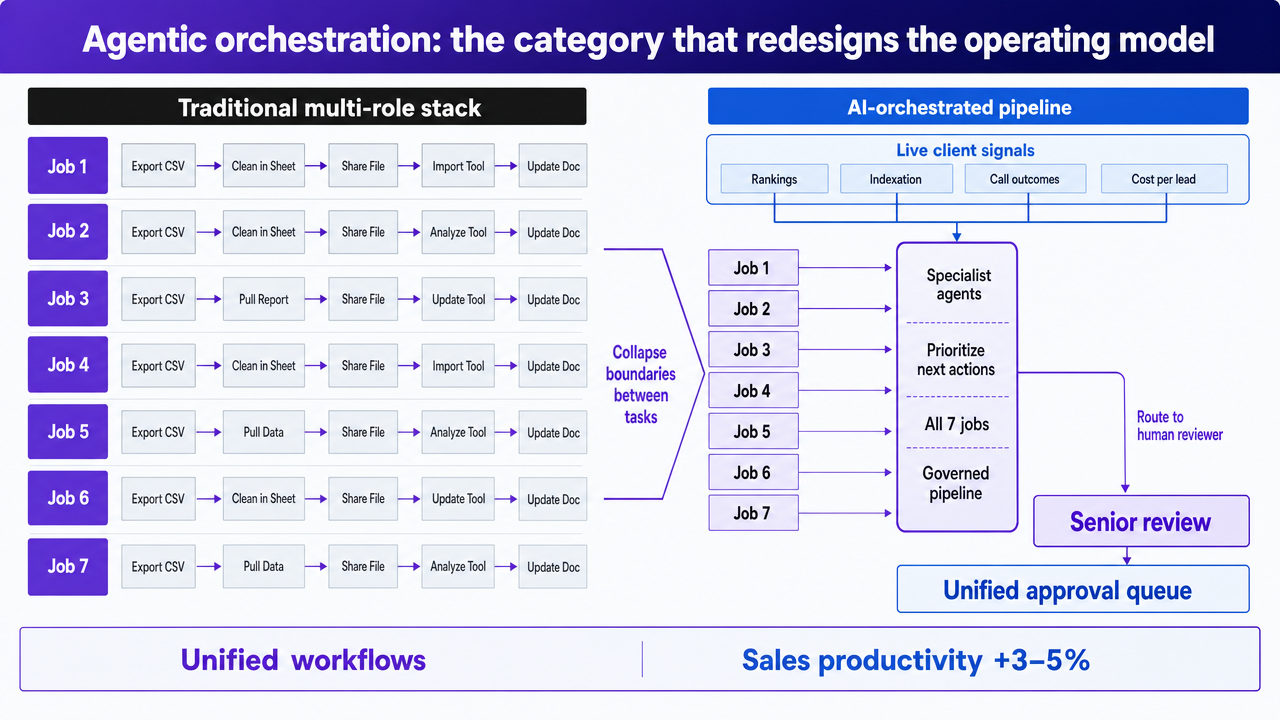 Visualize the seven SEO production jobs and how each consolidates from a traditional multi-role stack into a single senior-review role within an AI-orchestrated pipeline, directly matching the comparison table in this section
What this means for agencies over the next four retainer cycles
Agencies that restructure their delivery around these seven jobs will make two critical decisions in the coming months that will shape their 2026 P&L. The first is determining which mid-level production roles will consolidate into senior review positions, and on what timeline. The second is identifying which client segments will be transitioned to the governed pipeline first, with regulated verticals typically moved last, as the audit trail must be fully established before high-volume work flows through it.
A practical sequencing that has proven effective involves four cycles:
- In cycle one, replace the research and clustering layer while keeping other processes constant.
- In cycle two, integrate on-page and reporting into the same pipeline, ensuring the senior editor and senior specialist share a common understanding of the client's state.
- Cycle three involves layering technical crawl automation and entity monitoring, which become most effective once the on-page pipeline is operational.
- Finally, in cycle four, regulated accounts are moved onto the orchestration layer, with the approval queue and audit trail active from day one.
Agencies that bypass this sequencing and immediately adopt an orchestration layer risk tool sprawl within a single vendor. Those that follow a structured compression sequence can capture margin improvements without compromising client trust. Vectoron is one platform designed around this approval-first pipeline; ultimately, the operating model's effectiveness is more critical than the specific vendor chosen.
Frequently Asked Questions
References
- 1.The state of AI in 2025: Agents, innovation, and transformation.
- 2.Guidance for Responsible Use of Artificial Intelligence (AI) at CMS.
- 3.The economic potential of generative AI: The next productivity frontier.
- 4.The state of AI in 2023: Generative AI's breakout year.
- 5.The state of AI in early 2024.
- 6.The economic potential of generative AI: The next productivity frontier.
- 7.Generative AI Takes Off with Marketers.
- 8.The State Of Generative AI Inside US Agencies, 2024.