
Key Takeaways
- Ideation and research tools like ChatGPT, Claude, and Perplexity compress the distance from topic to brief, where briefing quality determines whether downstream drafting stays on schedule.
- Drafting and editing tools cluster around foundation models and brand-voice platforms, but the metric that matters is cost per published asset, not raw words generated.
- SEO and optimization tools like Surfer, Clearscope, Semrush, and MarketMuse touch organic sessions per asset directly, provided editors treat scores as gap signals rather than quality proof.
- Multimodal production tools across image, video, and audio turn one long-form asset into five channel deliverables when repurposing is built into the workflow instead of bolted on.
- Orchestration and governance is the lane most stacks skip, yet it decides approval latency and produces the audit trail regulated clients require before renewal.
The Stack Problem Content Managers Actually Have
Most in-house content teams do not have an AI problem. They have a stack problem.
A September 2024 survey of more than 1,000 professional marketers by the American Marketing Association found that 71% use generative AI weekly or more, and 85% of AI-using marketers report productivity gains 1. This survey measured marketer behavior, not organizational output, and the productivity claim is self-reported rather than audited. Read carefully, it says something narrower than the headline: the tools are already in the workflow, and the people using them believe they are working.
The follow-on question is the one content managers actually face at renewal time. If nearly every marketer is using at least one generative AI tool, and content creation is the top application 1, why do calendars still slip, briefs still stall, and SEO output still depend on which contractor is available that week?
The honest answer is fragmentation. A typical mid-market content team now runs a writing assistant, an SEO optimizer, an image generator, a video repurposing tool, a project tracker, and a brand-voice checker, each with its own login, billing cycle, and approval quirks. Individual tools got faster. The workflow around them did not.
The rest of this article treats "essential AI tools for content creation" as a category-mapping exercise rather than a ranked shopping list. Five workflow lanes cover every content job a marketing manager owns. Naming the right tool in each lane matters less than knowing which lane a candidate tool actually serves and which operator metric it is supposed to move.
From Pilot to Standard: How the Market Consolidated
The category matured in eighteen months. In its 2023 survey, McKinsey called generative AI's breakout year the moment when one-third of respondents said their organizations regularly used gen AI in at least one function 5. Ten months later, the same tracker put that share at 65%, with overall AI adoption reaching 72% 6. Content, marketing, and sales sat near the top of the function list in both cycles.
Two things follow from that trajectory. First, the buying question shifted. In 2023, the question was whether to run a pilot. By early 2024, the question was which workflows to redesign around tools already in daily use. McKinsey's 2025 survey reinforces the point: high-performing organizations are the ones intentionally redesigning workflows rather than bolting AI onto existing processes 7.
Second, the vendor field consolidated around recognizable categories. The early period rewarded any tool that could generate a passable paragraph. The current period rewards tools that fit a defined lane, expose an API, and respect an approval workflow. Point tools that cannot integrate are getting cut at renewal.
For a content manager, the practical implication is that a 2025 stack review is not a technology evaluation. It is a workflow audit. The tools work. The question is whether the workflow around them still makes sense once regular use, not experimentation, is the baseline.
Test AI-driven content workflows on live projects
Experience measurable content velocity gains by publishing real articles with full workflow access during your trial.
Five Workflow Categories That Cover Every Content Job
Ideation and Research: Moving From Blank Page to Brief
Ideation is the lane where AI tools produce the least visible output and the most compounding value. The job is not to generate a post. It is to compress the distance between a topic idea and a brief a writer can actually work from.
Three tools cover this category for most in-house teams. ChatGPT and Claude handle open-ended discovery, competitive teardown, and outline generation. Perplexity handles source-grounded research with citations, which matters when the topic requires factual defensibility. A third slot goes to whichever SEO research tool the team already uses, since keyword clustering and search intent mapping belong in the brief, not the draft.
The operator metric this category moves is time from topic to approved brief. Content managers who track it usually find that briefing, not drafting, is the bottleneck. A writer with a clear brief produces a passable draft in hours. A writer without one burns days on revisions the brief should have prevented.
Northwestern's Medill School notes that generative AI tools now help teams analyze competitor content strategies, including topics, formats, and performance patterns 2. That capability turns a competitive audit from a two-day project into an afternoon, which is the specific unlock ideation tools deliver.
The mistake most teams make in this lane is treating ideation output as publishable. It is not. A ChatGPT outline is a starting point for a strategist, not a deliverable for a client. Teams that keep the human editor in the ideation loop see brief quality rise. Teams that skip the editor see draft revisions balloon downstream, which erases the time savings the tool created.
Drafting and Editing: The Category Where Most Teams Started
Drafting is where nearly every content team's AI story began, and it is also where the tool market is most crowded. Content creation is consistently the top application marketers report for generative AI 1, which means this lane has the most vendors, the most feature parity, and the smallest defensible differences between products.
The category splits into two functions. General-purpose drafting runs on foundation-model interfaces like ChatGPT, Claude, and Gemini. Purpose-built content platforms like Jasper and Copy.ai sit on top of those models with brand-voice controls, template libraries, and team workflows 2. Editing tools like Grammarly handle the polish layer once a draft exists 2.
The operator metric here is cost per published asset, not words per hour. Words are cheap now. Words that meet brand voice, pass legal review, and match a specific search intent are not. A team that measures drafting productivity in output volume will overproduce mediocre content. A team that measures it in cost per published asset will notice that the expensive step is revision, not generation.
Brand voice control is the differentiator worth paying for in this lane. A foundation model produces competent, generic prose. A purpose-built platform with a trained voice profile produces prose a client's audience recognizes. For multi-location service brands running local pages across dozens of markets, that difference is the entire point.
One practical note: the drafting tools that survive the next renewal cycle are the ones with real approval workflows and version history, not the ones with the flashiest generation demos. A marketing manager who cannot show a client which human approved which sentence has a governance problem, not a productivity problem. That distinction becomes the buying question in regulated verticals.
SEO and Optimization: Where Tools Touch the Revenue Number
SEO is the category where AI tools most directly touch a number the content manager reports to leadership. Organic sessions, keyword rankings, and pipeline-attributed traffic all live in this lane, which raises the bar on what qualifies as an essential tool.
Three tools dominate the operator-relevant slots. Surfer SEO and Clearscope handle on-page optimization by scoring drafts against top-ranking competitors and surfacing missing entities. Semrush and Ahrefs handle the upstream keyword research, backlink analysis, and content gap identification that feed the calendar. A newer category, represented by tools like MarketMuse and Frase, handles topical authority modeling across a full content library rather than one page at a time.
The operator metric this category moves is organic sessions per published asset. Teams that optimize every draft against a competitor-scored target lift average session counts across the library, which is a more defensible outcome than a single hero page ranking well.
The trap in this lane is treating an optimization score as a quality signal. A draft that scores 90 on Surfer against the top ten results can still be flat, off-brand, or factually thin. The score measures topical coverage relative to competitors. It does not measure whether the piece answers the reader's actual question or reflects the client's expertise. Content managers who let the score drive final approval end up with libraries that rank briefly and convert poorly.
The version of this workflow that actually moves revenue pairs an optimization tool with an editor who has domain fluency. The tool surfaces gaps. The editor decides which gaps are worth closing and which are noise. That pairing is what separates SEO output from SEO impact.
Multimodal Production: Image, Video, and Audio at Repurposing Speed
Multimodal production is the lane most content teams under-serve, and it is the one with the biggest gap between what the tools can do and what most stacks actually use them for.
McKinsey defines multimodal AI as systems that process text, images, audio, and video together, and identifies personalized campaigns blending media types as a leading marketing use case 8. That definition matters because it separates true multimodal workflows, where one input produces coordinated outputs across formats, from stitched-together single-format tools that a human has to sequence manually.
Three tool clusters cover this category. Image generation runs on Midjourney, DALL-E, and Adobe Firefly, with Firefly holding an edge for teams that need commercial-use assurances on training data. Video production runs on Descript for repurposing long-form content into clips, Runway for generative video, and Synthesia for avatar-based explainer content. Audio production runs on ElevenLabs for voice generation and Descript for podcast editing.
The operator metric this category moves is assets produced per source piece. A single long-form article should yield a video summary, a set of social clips, a podcast segment, and a library of images before it leaves the workflow. Northwestern's Medill School frames this repurposing pattern as one of the core AI-enabled content workflows, alongside translation and text-to-media conversion 2.
Teams that treat multimodal as an afterthought publish articles and hope social picks them up. Teams that treat it as a production requirement build a repurposing pass into the workflow before the article ships. The second approach turns one editorial investment into five channel deliverables without a proportional increase in headcount.
Orchestration and Governance: The Category Most Stacks Skip
The fifth lane is the one most 'best AI tools' lists omit, and it is the one that separates a productive team from a team drowning in tabs.
Orchestration covers the layer that sits above individual tools and coordinates them into a workflow. It answers questions the point tools cannot: which piece is in which stage, who approved what, when does it publish, and what KPI moved after it shipped. Governance covers the controls that make that workflow safe to run: brand voice enforcement, human approval gates, audit trails, and data handling.
McKinsey's 2025 survey identifies intentional workflow redesign as one of the strongest contributors to meaningful business impact among AI high performers 7. That finding is the argument for treating orchestration as a category, not a nice-to-have. Teams that add AI tools without redesigning the workflow around them capture a fraction of the available value.
The tool options in this lane are thinner than in the others because the category is newer. Asana, Monday, and Airtable handle the project-tracking slice but not the AI execution slice. ClickUp and Notion have added AI features that reach further into content generation. Vectoron represents the emerging category of orchestrated AI marketing platforms, coordinating specialist strategists across content, SEO, and adjacent channels through a single approval workflow with human sign-off before execution.
The operator metric this category moves is approval latency, the elapsed time between a recommendation and a published asset. Point-tool stacks accumulate approval latency at every handoff: brief to writer, writer to editor, editor to designer, designer to publisher. An orchestrated workflow collapses those handoffs into a single review surface.
The buying question in this lane is not whether the tool generates good content. All of them do. The question is whether the tool enforces the approval discipline the team already needs and whether it produces the audit trail a regulated client requires. Those two requirements eliminate most candidates before the feature comparison begins.
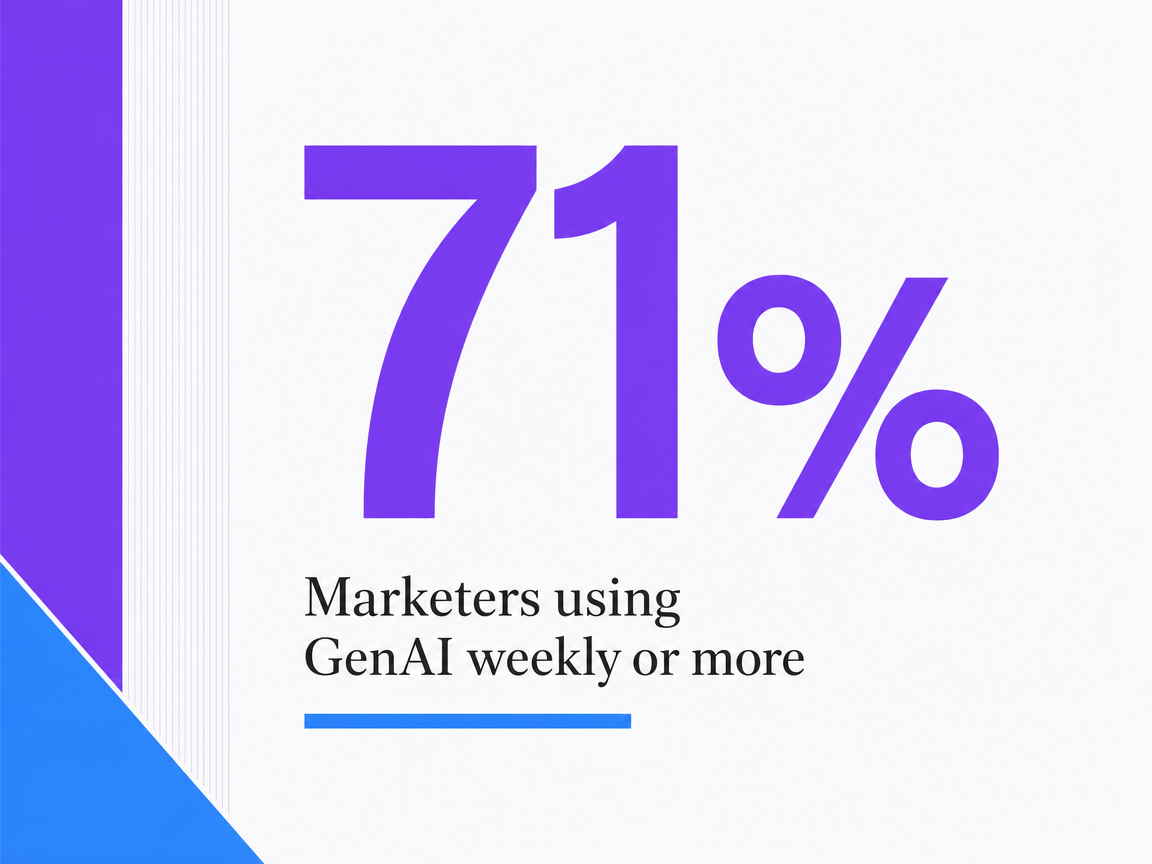 Marketers using GenAI weekly or more
Marketers using GenAI weekly or more
Governance as a Buying Criterion, Not a Feature
Governance is the line item most content managers underweight during procurement and overpay for after the first incident. In regulated verticals, it is the difference between a tool that ships and a tool that gets pulled six weeks after launch.
Harvard Law School's Center on the Legal Profession examines how AmLaw100 firms are integrating AI into research, drafting, and client communication, and raises unresolved questions about professional responsibility, liability, and pricing when AI sits inside billable work 9. Those questions do not stay inside the firm. They flow directly to the marketing team producing attorney bios, practice-area pages, and thought-leadership content, where a hallucinated case citation or an off-message claim becomes a regulatory problem, not a copy problem.
Three governance controls separate deployable tools from demo-only tools:
- Brand voice enforcement, meaning a trained profile the tool applies to every output rather than a style guide the writer is supposed to remember.
- Human approval gates, meaning no asset publishes without a named reviewer signing off inside the workflow.
- Audit trails, meaning a timestamped record of which model produced which draft, which human edited it, and which human approved it before publication.
A content manager evaluating tools for a dental support organization, a behavioral health network, or a multi-office law firm should treat those three controls as gating criteria, not tiebreakers. A tool that generates excellent drafts but cannot produce an audit trail is a liability in any vertical where a state board, a payer, or a plaintiff's attorney might later ask who wrote what.
The market has responded unevenly. Point tools optimized for solo creators rarely expose approval workflows because their buyer does not need them. Enterprise platforms and orchestrated AI marketing systems build the approval layer in because their buyer cannot ship without it. That divergence is why governance now decides renewal conversations in high-stakes verticals, well before feature comparison begins.
See How Top Brands Use AI Tools to Scale Content Production in 2025
Request a walkthrough of integrated AI workflows that accelerate content output, maintain brand standards, and deliver measurable SEO improvements—purpose-built for enterprise and agency teams navigating high-volume demands.
If You Manage Multiple Locations: The Consolidation Economics
This section shifts scope. The reader here runs marketing for a multi-location operator: a 20-office dental support organization, an 8-office law firm, a regional home services brand with a dozen service areas, or a senior living portfolio with fifteen communities. The economics of an AI content stack look different at that scale.
A single-brand team can absorb the cost of five point tools without noticing. A multi-location operator cannot. Each tool multiplies by seats, and each seat multiplies by locations that need their own brand voice profile, keyword set, and approval chain. What reads as reasonable SaaS spend at one office reads as a line-item review at twenty.
The variables that actually drive the comparison are worth naming rather than guessing. A content manager can plug their own numbers into five inputs:
- Seats needed per location
- Tools in the current stack
- Average monthly subscription per tool
- Hours of coordination overhead per week across the stack
- The fully-loaded hourly rate of the person doing that coordination
The formula is simple. Total monthly cost equals seats times locations times per-seat subscription, summed across tools, plus coordination hours times four weeks times loaded rate.
Two line items dominate that total, and neither is the software. Coordination overhead, meaning the hours a content manager spends moving assets between tools, chasing approvals, and reconciling status across platforms, usually exceeds subscription cost once the stack passes four tools. Approval latency, meaning the days a piece sits waiting for review because the workflow lives in email rather than the tool, delays revenue-tied content by weeks per location per quarter.
McKinsey's estimate that generative AI can capture 5 to 15 percent of the marketing function's total cost sets the outer bound of realistic savings from consolidation 4. That range is not a promise. It is a ceiling that assumes intentional workflow redesign, which McKinsey's 2025 survey identifies as the strongest contributor to meaningful impact among AI high performers 7. A multi-location operator that adds an orchestration layer without redesigning the approval workflow captures the low end. One that redesigns the workflow around a single approval surface captures the high end.
The practical takeaway is that the consolidation decision is not a software decision. It is a workflow decision priced in tool subscriptions. A twenty-location operator running six point tools with fragmented approval chains is paying for the tools twice: once in subscriptions, once in the manager hours spent stitching them together. Whether the second payment is worth eliminating is a question the formula above answers with the operator's own inputs, not a vendor's benchmark.
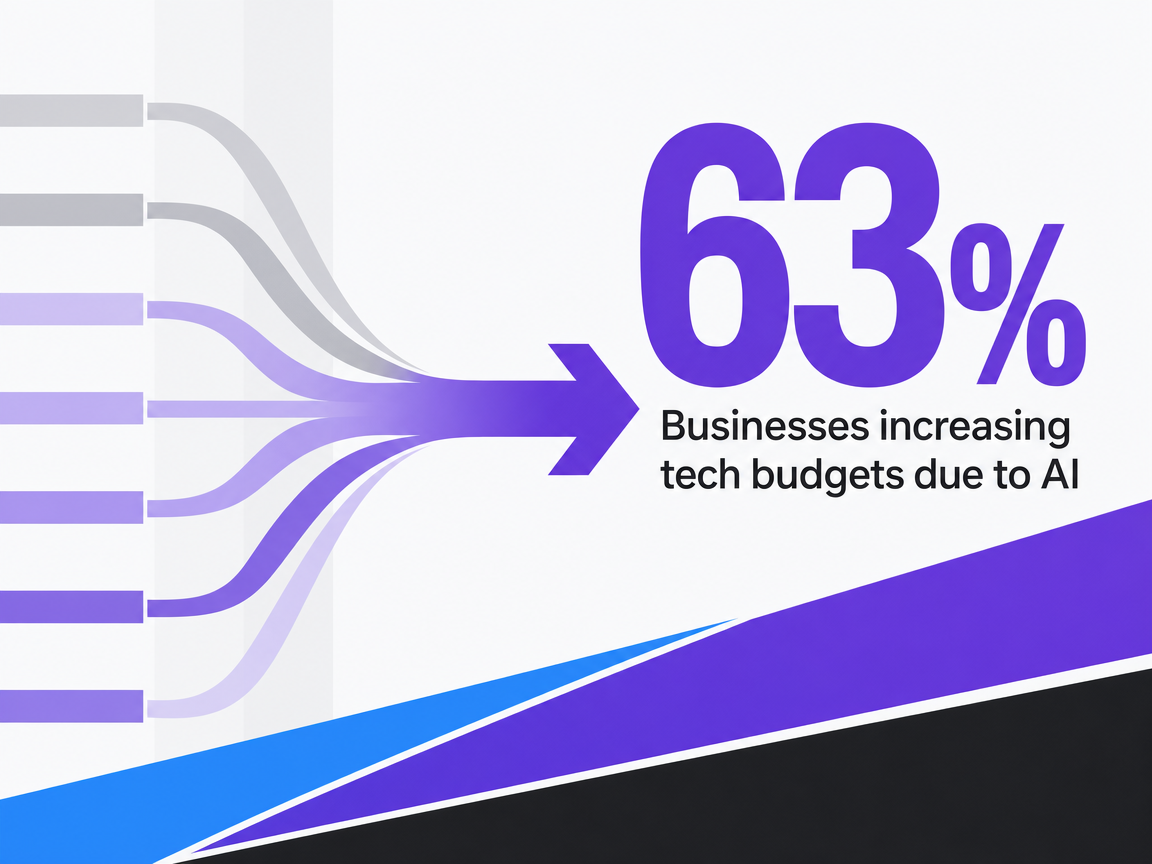 Businesses increasing tech budgets due to AI
Businesses increasing tech budgets due to AI
A Decision Framework for the Next Renewal Cycle
A content manager walking into the next renewal cycle needs a shorter checklist than the vendor decks suggest. Three questions decide most of the calls.
- Which workflow lane does this tool actually serve, and does the team already own another tool in that lane? Duplicate coverage across ideation, drafting, or SEO tools is where stack spend hides. If two tools compete for the same job, one gets cut. The survivor is the one with better approval workflow and audit trail, not the one with the flashier generation demo.
- Which operator metric will this tool move within a quarter? Cost per published asset, time from brief to publish, organic sessions per asset, and approval latency are the four that matter. A tool that cannot be tied to one of those numbers is a productivity story, not a business case. Marketers report broad productivity gains from generative AI 1, but self-reported gains do not survive a CFO review. Named metrics do.
- Does the tool respect the approval discipline the team already needs? McKinsey's 2025 survey found that intentional workflow redesign, not tool count, separates high performers from the rest 7. A renewal that adds a seventh point tool without redesigning the approval surface is a renewal that buys more fragmentation. The alternative is consolidation onto an orchestrated workflow where recommendations, human approval, execution, and KPI tracking share one surface.
Frequently Asked Questions
References
- 1.Generative AI Takes Off with Marketers.
- 2.Content Marketing and AI – Best Practices.
- 3.AI Will Shape the Future of Marketing.
- 4.The economic potential of generative AI: The next productivity frontier.
- 5.The state of AI in 2023: Generative AI's breakout year.
- 6.The state of AI in early 2024.
- 7.The State of AI: Global Survey 2025.
- 8.What is multimodal AI?.
- 9.The Impact of Artificial Intelligence on Law Firms' Business Models.