
Key Takeaways
- The production system around AI writing determines outcomes, not the model itself—teams that redesign signal intake, briefing, approval, and measurement capture two- to fivefold throughput gains while bolt-on deployments stall near 5% to 15% 1, 3.
- Calendar compression is the diagnostic that matters: pipelines moving from weeks to days 2have restructured the gates, while accelerated drafting inside unchanged briefing and review cycles leaves total cycle time roughly intact.
- Voice consistency and copyright exposure are governance problems solved upstream through codified voice specs, objective approval checklists, regenerate-on-failure rules, and per-asset documentation of human contribution 9.
- Focus next on buying the layer between foundation models and drafting utilities—signal intake, brief generation, approval queues, and measurement feedback—rather than assembling point tools or evaluating vendors whose demos end at the draft.
The production system is now the differentiator
Generative AI writing has cleared the plausibility bar. The open question for content marketing managers is no longer whether the models can draft usable copy—it is why some teams report two- to fivefold gains in creative output and 10% to 30% cost reductions 3while others see only marginal improvement after a year of experimentation.
The variable is not the model. It is the production system wrapped around it.
Teams that bolt AI onto existing briefing cycles capture drafting speed and little else. Teams that redesign the workflow—signal intake, ranked recommendations, brief generation, approval gates, publishing, and measurement feedback—move campaign timelines from months to weeks or days 2and change the underlying cost structure of content production.
This article treats AI writing software as an execution layer inside a governed loop, not as a category of drafting assistants to be compared feature by feature. The evidence base draws on Stanford HAI's adoption data, McKinsey's marketing productivity research, Pew's workplace survey on where these tools actually get used, and the U.S. Copyright Office's guidance on human authorship. The through-line: content managers who invest in the production system capture the reported outperformance. Those who invest only in the tools do not.
Where AI writing sits in the enterprise stack right now
From experimentation to routine business use
The adoption curve has already inflected. Stanford HAI's 2025 AI Index reports that 71% of respondents said their organizations used generative AI in at least one business function in 2024, up from 33% in 2023 5. That is a doubling in twelve months, measured across organizations rather than individuals, and it reframes the strategic question for content marketing managers. The tooling is no longer novel inside the enterprise stack. It is standard.
What that number does not describe is depth. Stanford measures whether generative AI touched any business function at all—a threshold low enough that a single team running a chatbot pilot qualifies the whole organization. The gap between "used" and "embedded in production" is where the real variance in outcomes lives, and it is why two content teams at similarly-sized companies can report wildly different results from the same category of software.
For content operations specifically, the practical implication is that budget approvals and stakeholder questions have shifted. Executives are no longer asking whether AI writing tools belong in the workflow. They are asking why the throughput and cost curves have not moved yet, or why they have moved less than the trade press suggested they would. The burden of proof has flipped from justifying adoption to justifying the shape of the deployment—which tools sit where in the pipeline, which decisions still route through humans, and what evidence the team can produce on quality and voice consistency at higher volumes.
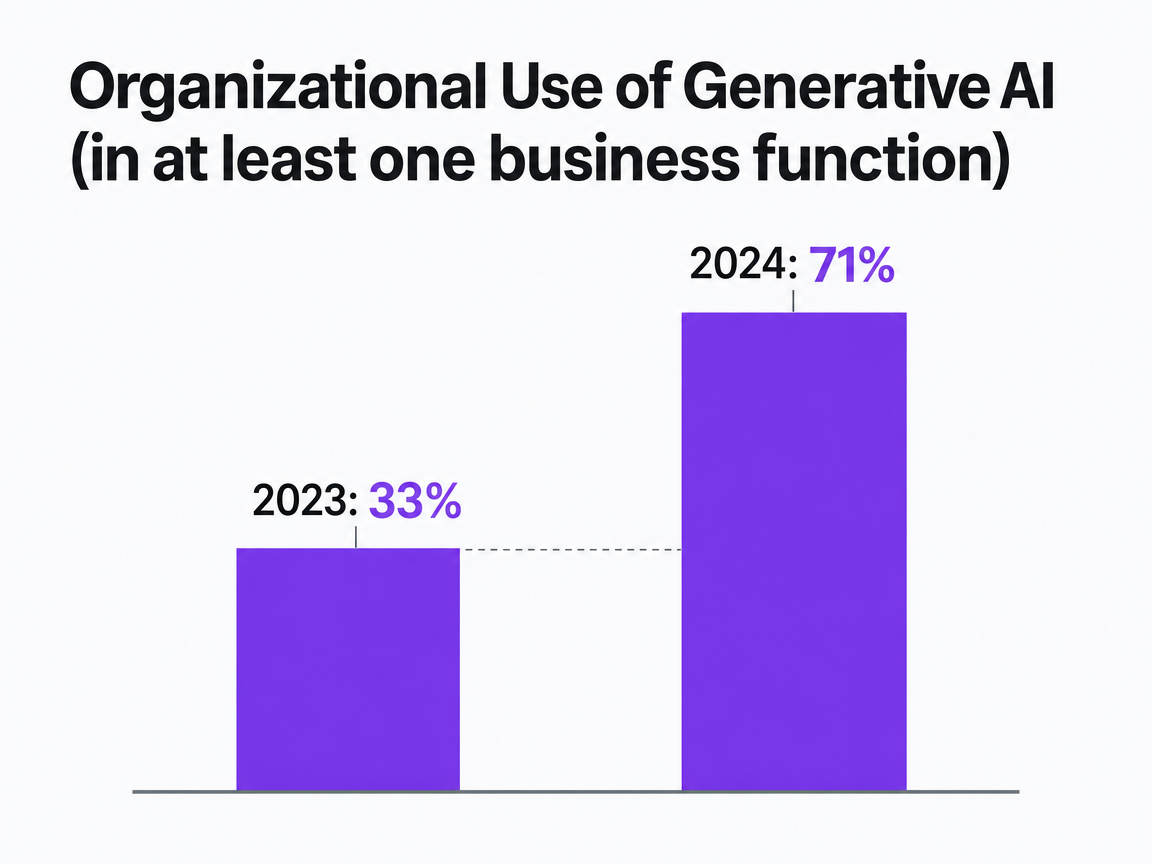 Organizational Use of Generative AI (in at least one business function)
Shows the year-over-year growth in the adoption of generative AI within business functions, according to the Stanford AI Index report.
What workers actually do with these tools
Adoption headlines obscure a more useful signal: what employees actually use AI writing tools for once they have access. Pew's 2025 workplace survey of U.S. workers who use AI chatbots on the job found that 52% apply them to editing written content and 47% to drafting reports, documents, or other written material 6. Those are the two dominant use cases. Everything else—research summarization, brainstorming, translation—trails behind.
That distribution matters because both editing and drafting are individual-contributor tasks. A writer polishing a paragraph, or generating a first pass of a section, captures personal time savings. Neither task, on its own, changes the shape of the editorial calendar or the cost per published asset. It compresses the middle of one person's workday.
The Pew data on perceived impact reinforces the point. Among workers using AI chatbots at work, 40% describe them as very or extremely helpful for doing things more quickly 6. That is a meaningful minority, not a majority, and "more quickly" is measured at the task level rather than the pipeline level. The survey does not report throughput gains, cost reductions, or output quality at scale, because those outcomes depend on how the tools are integrated—not on whether individuals find them useful for the paragraph in front of them.
Content managers reading this data should note the ceiling it implies. A team whose AI usage is confined to editing and drafting inside existing briefing cycles will see individual productivity lifts and stable pipeline economics. The larger gains reported elsewhere come from redesigning the pipeline, not from putting a better draft tool in each writer's hands.
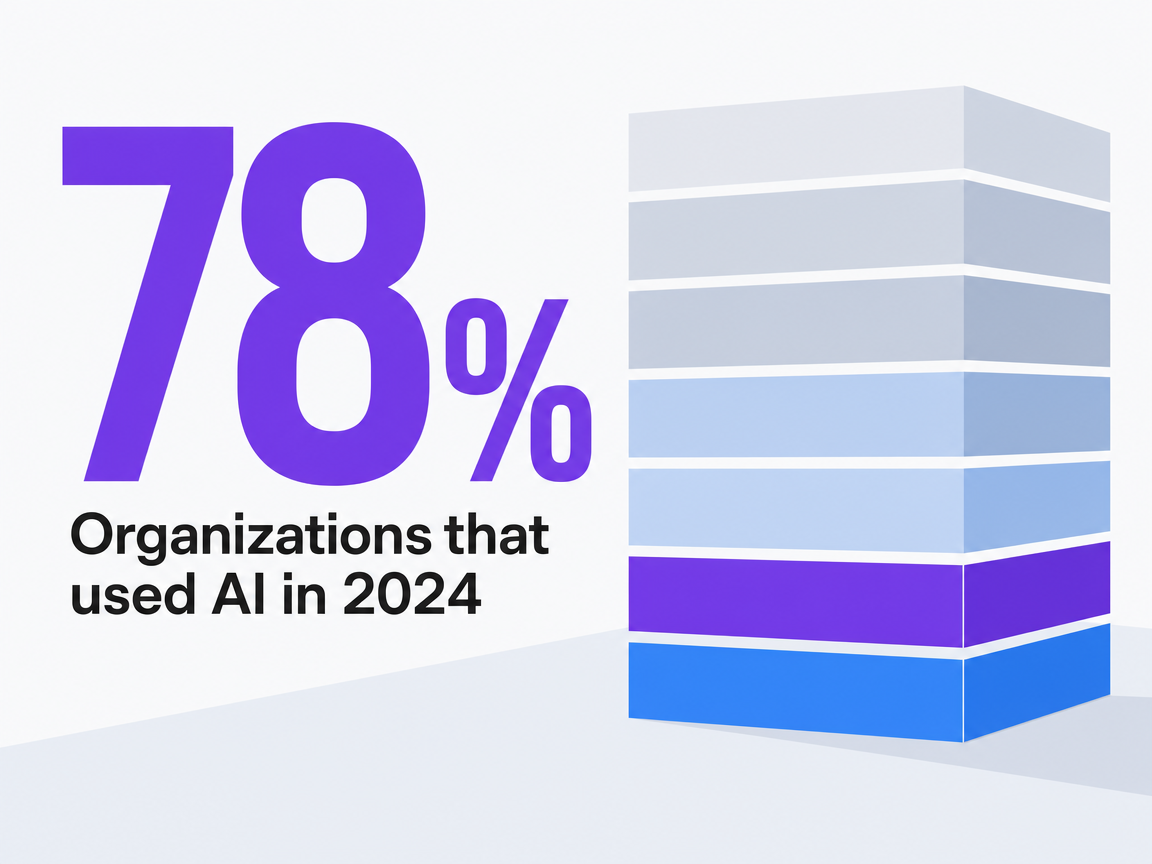 Organizations that used AI in 2024
Organizations that used AI in 2024
Drafting assistance versus embedded execution
Why bolt-on prompting produces marginal gains
The most common deployment pattern inside content teams is also the least productive one. A writer opens a chat window, pastes a brief, iterates on a draft, then moves the output back into the same editorial calendar that existed before the tool arrived. The brief still originates from a monthly planning meeting. The approval still routes through the same three stakeholders. The publishing step still waits on a CMS handoff. Only the drafting minute count changes.
This pattern is what Pew captured when it found that editing and drafting dominate workplace AI use 6. Both are task-level applications. Neither restructures the pipeline. A senior writer who previously spent four hours on a first draft may now spend ninety minutes, and that time savings is real, but it does not compound. The bottleneck moves upstream to briefing or downstream to review, and total cycle time barely shifts.
McKinsey's marketing productivity range—5% to 15% of total marketing spend 1—describes this bolt-on ceiling reasonably well. It is a directional estimate of what generative AI can contribute when applied broadly across marketing tasks, and it accounts for the reality that most organizations deploy the technology at the individual-contributor layer first. That is a meaningful gain in absolute dollars. It is not a category shift in how content gets produced.
The workflow redesign that changes the math
The teams reporting an order-of-magnitude different outcome are not using better models. They are running different pipelines. McKinsey documents two- to fivefold increases in creative productivity and 10% to 30% reductions in creative costs among organizations that embed AI inside the marketing workflow rather than layering it on top 3. Those numbers describe a different operational shape—one where AI participates in signal reading, topic selection, brief construction, drafting, variant generation, and measurement, not just the middle drafting step.
The distinction matters because the multiplier is not additive with bolt-on gains. A team that saves 30% of its drafting time by dropping a chat window into the writer's day does not thereby capture 2x throughput. It captures 30% of one step. Pipeline throughput is governed by the slowest gate, and in most content operations that gate is briefing, stakeholder alignment, or review—not first-draft production. Redesigning the workflow means moving AI into those gates: generating briefs from live search and performance data, producing multiple approval-ready variants in parallel, and routing them through a single decision point rather than a chain of sequential reviewers.
The cost band tells the same story from the other side. A 10% to 30% reduction in creative costs 3cannot come from faster typing. It comes from removing coordination overhead—fewer briefing rounds, fewer revision cycles, fewer parallel vendor relationships—while holding output quality constant through governance rather than through additional human labor at each step. Content managers evaluating AI writing software should read the productivity and cost figures together. The multiplier and the cost band describe the same operational shift measured in two different units, and neither is available to a team that treats the software as a writer's utility.
Campaign compression as the operational signal
The most reliable indicator that a content operation has crossed from bolt-on to embedded is calendar behavior. McKinsey observes that campaigns which once took months can be rolled out in weeks or days when AI is integrated into the execution layer, often with at-scale personalization and automated testing built in 2. That compression is not a productivity claim about individual writers. It is a claim about how quickly a signal—a search trend, a product update, a competitive move—can become published, measured content.
Content managers can use this as a diagnostic. A team whose average time from topic identification to published asset is still measured in weeks, despite a full year of AI tool adoption, has not redesigned the workflow. It has accelerated the drafting step inside an unchanged process. A team that has moved the same interval to days has restructured the intake, brief, approval, and publishing gates, and the AI writing software sits inside that structure rather than beside it.
Calendar compression also reveals what the throughput multiplier costs. Faster cycles demand tighter governance, not looser oversight, because the volume of decisions per week increases even as the time per decision falls. That governance question is where the next set of operational choices live.
Trial AI-driven content workflows with real publishing
Experience measurable gains in content output and approval cycles before any commitment is required.
Designing the signal-to-publish loop
Signal intake and topic ranking
A production system worth building starts before the writer opens a document. The first stage is signal intake:
- search demand shifts,
- ranking movement on tracked clusters,
- competitive publishing activity,
- product releases,
- customer-support ticket themes,
- and paid-channel performance data.
Each of these is a stream of evidence about what content should exist next. Most content teams collect these signals in separate dashboards and reconcile them monthly in a planning meeting, which is precisely the gate McKinsey identifies as the compression opportunity when it describes campaigns moving from months to weeks or days 2.
AI writing software that participates in intake rather than sitting downstream of it changes the ranking calculus. Instead of a human analyst summarizing five dashboards for a Monday standup, the system produces a ranked list of topic candidates with the underlying data attached: query volume, current ranking position, competitive gap, and expected traffic contribution. The content manager approves or reorders the queue rather than assembling it. That single move—shifting topic ranking from monthly to continuous—accounts for a significant share of the throughput gap between bolt-on and embedded deployments.
Brief generation, drafting, and the approval queue
Once a topic is ranked, the brief is the next gate. Traditional briefs take one to three days to produce because they require a human to read the SERP, extract the entity coverage competitors handle well, and translate that into an outline the writer can execute against. AI writing software collapses that interval to minutes when the brief generator has access to the same signal layer that produced the topic rank. The output is an approval-ready brief: target query, secondary queries, entity checklist, internal link candidates, and a structural outline with word-count budgets per section.
Drafting sits inside the same loop rather than beside it. The draft is produced against the approved brief, not against a chat prompt written from scratch. Variants can be generated in parallel—one voice-forward, one more technical, one optimized for a featured snippet—and routed into a single approval queue rather than three sequential review chains. The content manager reviews the queue in batches. What used to be a serial process with handoffs between strategist, briefer, writer, and editor becomes a single decision surface where the human retains approval authority at every gate but does not perform the connective labor between them.
Measurement feedback into the next cycle
The loop closes on measurement. Published assets generate ranking data, traffic, engagement, and downstream conversion signal within days to weeks, and those outputs become inputs to the next intake cycle. A cluster that underperforms its traffic forecast surfaces as a re-optimization candidate. A cluster that outperforms surfaces as an expansion opportunity, seeding sibling topics. Without this feedback layer, AI writing software produces volume without directional learning, and throughput gains erode as the calendar drifts from what the search landscape actually rewards.
Content managers building this loop should treat measurement as the constraint that governs how fast the earlier gates are allowed to run. Publishing faster than the team can read outcomes converts a production system into a firehose.
Brand voice preservation as a governance problem
Voice drift is usually diagnosed as a prompting failure. It is more accurately a governance failure. A team that produces four articles a month can hold voice consistency through a single senior editor reading every draft end to end. A team producing forty articles a month, with AI writing software generating variants in parallel, cannot. The editor becomes the bottleneck the workflow was redesigned to remove, and voice consistency erodes precisely as throughput climbs.
The fix is not a longer style prompt. It is a set of controls that make voice legible to the system and enforceable at the approval gate. That means codified voice specifications—cadence, sentence-length distribution, permitted and prohibited constructions, tonal register per content type—stored as reference artifacts the drafting layer reads on every generation, not pasted into a chat window by whichever writer happens to be on shift.
Approval design does the rest. Instead of one editor reviewing full drafts, the queue routes drafts against a voice checklist tied to the specification: five to eight objective criteria a reviewer can score in under a minute per asset. Drafts failing two or more criteria route back for regeneration rather than manual rewriting, because rewriting AI output by hand is the step that quietly reintroduces the labor the pipeline was supposed to eliminate. Pew's finding that 40% of workers using AI chatbots at work call them very or extremely helpful for working faster 6hides this trap: individual speed gains disappear when senior editors absorb the voice-consistency work downstream. Governance moves that work upstream, into the specification and the checklist, and keeps the multiplier intact.
Copyright, disclosure, and training-data exposure
Copyright exposure sits inside the same production system, not next to it. The U.S. Copyright Office's guidance is direct on one point: registration requires human authorship, and AI-generated material must be disclosed when a work is submitted for registration 7. That disclosure obligation does not scale with volume in any friendly way. A team publishing forty AI-drafted articles a month cannot treat authorship attribution as an end-of-cycle formality.
The Office's Part 2 report resolves the question content managers actually ask, which is how much human involvement preserves protection. Prompts alone are insufficient. Human-authored arrangements, selections, and modifications of AI output can qualify, and the Office has already registered hundreds of works incorporating AI-generated material—protecting only the human-authored contribution 9. The Library of Congress release accompanying the report makes the boundary explicit: mere provision of prompts does not create copyrightable authorship, but substantive editorial arrangement or modification can 8.
For a content operation, three controls follow from this:
- The editorial checklist that governs the approval gate should capture what the human contributed—structural choices, selection among variants, substantive rewrites—so authorship is documented at the moment of decision rather than reconstructed later.
- The record of AI involvement should be retained per asset, because disclosure at registration requires knowing which portions were machine-generated.
- High-value assets that a company might later assert against a competitor or infringer should route through a heavier human-authorship path than routine SEO pages.
Training-data exposure is the other half of the risk. The Copyright Office's Part 3 pre-publication report addresses the legal questions around models trained on copyrighted works, and the Office has indicated the final version is expected without substantive changes to its analysis 10. Content teams cannot resolve that debate, but they can insulate themselves from it. Vendor selection should surface how the underlying models were trained, what indemnification the provider offers, and whether outputs are screened against known training corpora. Those questions belong in procurement, not in the writer's chat window, and they are the difference between a governance posture that holds at scale and one that fails the first time a claim letter arrives.
See How Leading Brands Accelerate Content Output with AI Writing Software
Request a walkthrough of AI-powered workflows proven to increase content production speed and consistency across large teams—without expanding your writing staff or sacrificing editorial control.
If multiple locations sit under one brand: consolidation economics
A note on scope: this section addresses content managers running portfolio operations—law firms with regional offices, DSOs, senior living operators, multi-market home services brands—where the editorial calendar spans dozens of location pages, service pages, and local content variants under one governance layer. Single-brand readers can skip ahead.
The traditional agency retainer breaks in a specific way at portfolio scale. A ten-location dental group commissioning original content per market pays for redundant briefing, redundant SEO research, and redundant review cycles across near-identical service pages that differ mainly in city name, provider bios, and local proof points. Freelance rosters replicate the same overhead in a different wrapper. The unit economics degrade as the location count climbs, because coordination cost scales roughly with the number of location-market pairs, not with the number of unique content ideas.
Embedded AI writing changes which variables are fixed and which are variable. The template, entity checklist, and voice specification become fixed assets. The location-specific variables—market data, provider details, local search intent—become inputs to a generation step that runs in minutes per asset rather than days.
The table below compares the two structures using variables the reader supplies. It uses McKinsey's sourced 10% to 30% creative cost reduction range 3as the only concrete benchmark and leaves dollar figures to the operator.
| Cost driver | Traditional agency retainer | AI-augmented in-house production ||---|---|---|| Monthly fee structure | Fixed retainer $R | Platform + editorial headcount || Cost per location page | $R ÷ (articles/month) | Marginal generation + review time || Briefing cycles per asset | 1–3 rounds | 1 approval gate || Revision cycles per asset | 2–4 rounds | Regenerate on checklist failure || Time from brief to publish | Weeks | Days 2|| Creative cost trajectory at 10+ locations | Linear with location count | 10%–30% lower at held quality 3|
The operational read: portfolio operators capture the cost band earlier and more visibly than single-brand teams, because the redundant coordination the agency model charges for is exactly what the embedded workflow removes.
What to build, buy, or ignore over the next twelve months
The build-buy line for content operations has moved. Foundation models are commodity inputs; drafting utilities are commodity outputs. What remains scarce, and worth capital, is the layer between them: signal intake wired to the editorial calendar, brief generation tied to live search data, an approval queue with a voice checklist, and a measurement return path. Teams should buy that layer rather than assemble it from five point tools, and should ignore any vendor whose demo begins and ends at the drafting step.
Three twelve-month priorities follow:
- Codify the voice specification and the approval checklist before scaling volume—governance built after throughput climbs is remediation, not design.
- Treat copyright disclosure and human-authorship documentation as workflow fields, not legal afterthoughts 9.
- Measure calendar compression, not draft speed; a pipeline that has not moved from weeks to days 2has not been redesigned.
Platforms like Vectoron are built around that loop, but the decision to redesign the workflow is upstream of any tool selection.
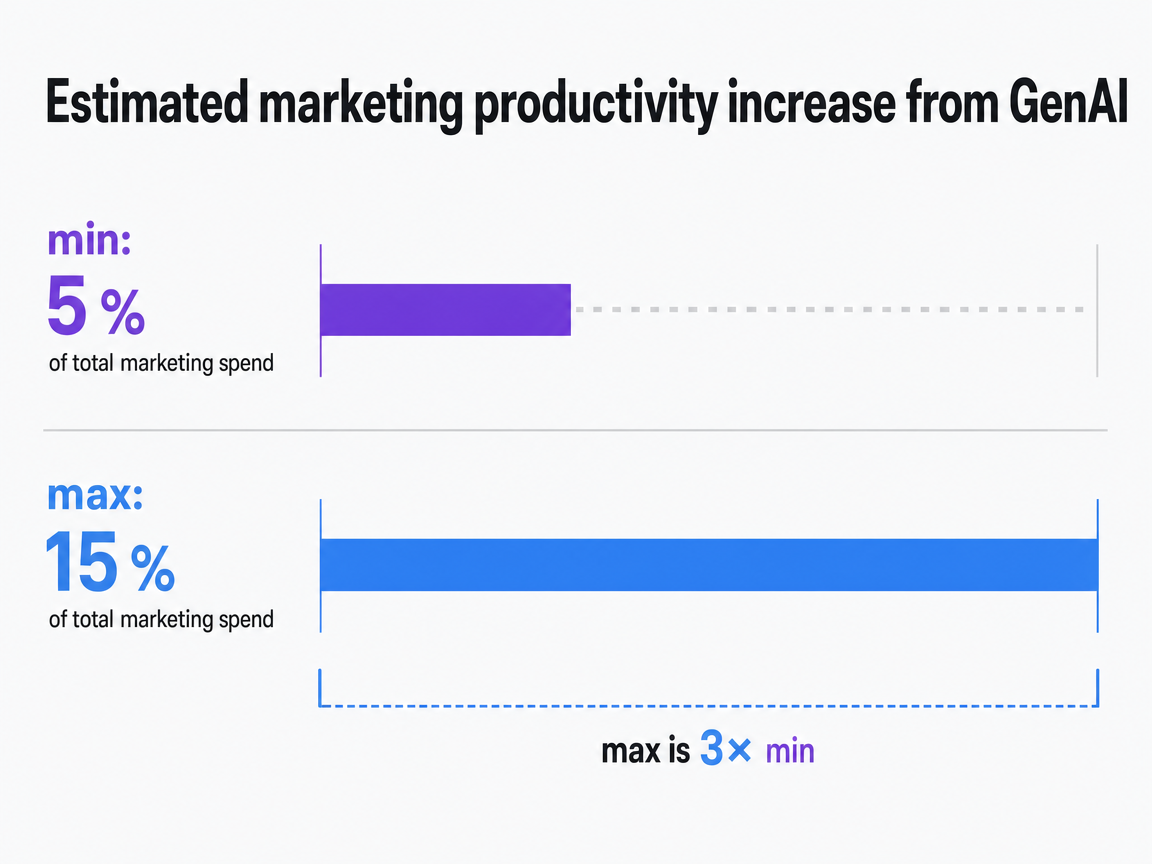 Estimated marketing productivity increase from GenAI
McKinsey's estimate of the potential productivity gain in the marketing function, measured as a percentage of total marketing spending.
Frequently Asked Questions
References
- 1.Economic potential of generative AI.
- 2.How generative AI can boost consumer marketing.
- 3.The future of marketing in the age of AI.
- 4.The 2025 AI Index Report.
- 5.CHAPTER 4: Economy.
- 6.3. Workers' experience with AI chatbots in their jobs.
- 7.Works Containing Material Generated by Artificial Intelligence.
- 8.Copyright Office Releases Part 2 of Artificial Intelligence Report.
- 9.Copyright and Artificial Intelligence, Part 2: Copyrightability.
- 10.Part 3: Generative AI Training pre-publication version.