
Key Takeaways
- Publish-ready AI content is a governance architecture, not a drafting speed problem — four controls neutralize four distinct failure modes: voice drift, hallucination, regulatory exposure, and brand harm.
- The productivity gains McKinsey documents — 2x to 5x creative output and 10-30% cost reductions 8— only materialize when brand voice, evidence, and compliance are codified as workflow inputs rather than post-draft rewrites.
- Regulation now sits at the prompt layer: the FTC's 2024 testimonial rule 1and NIST's provenance guidance 3require logged sources, named reviewers, and version-tied approvals, not end-stage legal checks.
- Content leaders should build the review architecture — codified voice, substantiation, template-level approval, and professional sign-off gates — before scaling drafting throughput, especially across multi-location or regulated portfolios.
The gap between AI drafts and publishable output
A generative model can produce a 1,200-word blog post in under a minute. Getting that draft to a state where a content manager will actually publish it under the brand's name takes considerably longer — and that gap is where most AI content strategies quietly fail.
The failure is not a prompt problem. It is a workflow problem. Draft speed has never been the bottleneck in content operations. Substantiation, brand voice consistency, legal review, and final editorial judgment are the bottlenecks, and none of those disappear when the first draft is machine-generated. In several ways they intensify: an AI draft can confidently assert a statistic that does not exist, adopt a tone that reads as generically corporate, or reproduce claims that would trigger regulatory scrutiny in verticals like law, healthcare, or behavioral health 4.
The teams reporting real gains from AI content — the two- to fivefold increases in creative productivity and 10 to 30 percent reductions in creative costs documented across McKinsey's marketing research — are not the ones using better models 8. They are the ones who built a supervised production line around the model. Brand voice is codified as a reusable asset. Evidence is checked before a draft leaves the queue. Compliance is an input to the prompt, not a firefight after publication. Human approval is a gate, not a formality.
This article treats publish-ready AI content creation as what it actually is: a governance architecture that happens to include a drafting engine. The sections that follow map the failure modes, the review layers that neutralize them, and how regulated operators run this at scale without adding headcount.
Why most AI content pipelines stall before publish
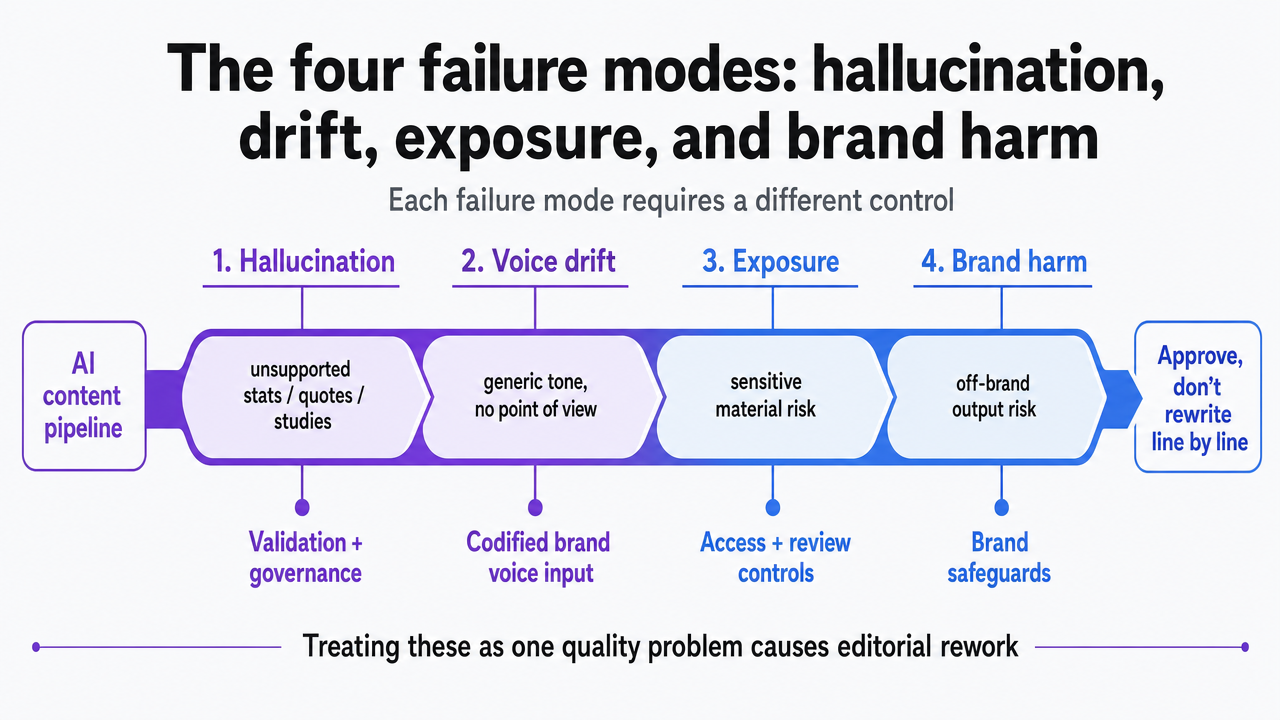
The four failure modes: hallucination, drift, exposure, and brand harm
Most AI content pipelines break in the same four places. Naming them matters because each one requires a different control, and treating them as a single quality problem is why editorial teams end up rewriting drafts line by line instead of approving them.
The first is hallucination. A model will assert a statistic, cite a study, or attribute a quote that has no basis in any source it was given. McKinsey's own guidance on gen AI marketing content flags bias, toxicity, and hallucinations as the reasons validation and governance models are non-negotiable before content ships 6. The second is voice drift. Drafts read as generically competent — subject-verb-object rhythm, hedged claims, no point of view — because no codified brand voice was provided as an input. Output regresses to the training-data mean.
The third is regulatory exposure. The FTC's 2024 final rule on fake reviews and testimonials created civil-penalty liability for AI-generated social proof that misrepresents identity or experience 1. In regulated verticals, unreviewed AI marketing content can violate professional conduct rules independent of consumer-protection law 4. The fourth is brand harm: content that is technically accurate, on-voice, and compliant, but wrong for the audience, wrong for the channel, or wrong for the moment. It clears every automated check and still damages trust when it hits the site.
Each failure has a different owner and a different control. Bundling them into "quality" is why pipelines stall.
What the productivity numbers actually require
The productivity case for AI content is well-documented and often misread. McKinsey reports that some organizations have seen two- to fivefold increases in creative productivity and 10 to 30 percent reductions in creative costs, with campaign cycles compressing from six to ten weeks down to same-day execution 8. Those numbers are real, but they describe organizations that rebuilt the workflow — not organizations that added a drafting tool to an existing one.
The distinction matters. A 2x productivity gain on a workflow where every draft still routes through the same three-round editorial revision cycle produces roughly zero net throughput improvement. The bottleneck moves from writing to reviewing, and the review queue grows proportionally to the draft rate. The 10 to 30 percent cost reduction assumes creative production, not creative approval, is the dominant cost line. In most in-house content teams, it is not.
Same-day campaign execution requires more than a fast drafting engine. It requires that brand voice, evidence sources, compliance rules, and approval routing already exist as structured assets the system can call. McKinsey frames this as the "AI-enabled content factory" — continuous generation and adaptation against codified guardrails 8. The productivity ceiling is set by whichever guardrail is missing. Teams that skip codification hit a lower multiplier, absorb the cost reduction into reviewer overtime, and keep multi-week cycles despite generating drafts in minutes.
The review architecture that makes AI content publishable
Layer one: codified brand voice as a prompt asset
Brand voice cannot live in a style guide PDF that reviewers read once and forget. When it stays there, every draft becomes a negotiation between the model's default register and whatever the reviewer remembers about tone. Drift is guaranteed.
Codification means turning voice into a structured input the drafting system reads on every generation. That includes:
- the sentence-length distribution the brand actually uses,
- the vocabulary it avoids,
- the point-of-view stance on contested topics in the vertical,
- the disclosure patterns required by legal, and
- the concrete examples of on-brand and off-brand paragraphs from prior publications.
McKinsey describes this codification as the foundation of the AI-enabled content factory: brand voice and guardrails encoded as reusable assets so continuous generation stays on-brand across channels and campaigns 8.
The practical test is whether two different reviewers, working from the same brief, get drafts that read as the same brand. If the answer requires either of them to rewrite the opening paragraph, the voice asset is incomplete. Voice codification also compounds. Once encoded, the same asset governs blog drafts, landing pages, email sequences, and social copy without a separate style briefing per format. That is what makes the two- to fivefold productivity figure defensible in practice 8 — the reviewer is checking, not rewriting.
Layer two: evidence substantiation before draft leaves the queue
Hallucination is the failure mode that most reliably kills AI content programs, and it is the one that reviewers are least equipped to catch on visual inspection. A fabricated statistic reads exactly like a real one. A misattributed quote looks correct. A study that does not exist can be described with plausible authorship, journal, and year. McKinsey is direct on the requirement: organizations must build models to validate and govern gen AI content specifically against bias, toxicity, and hallucinations 6.
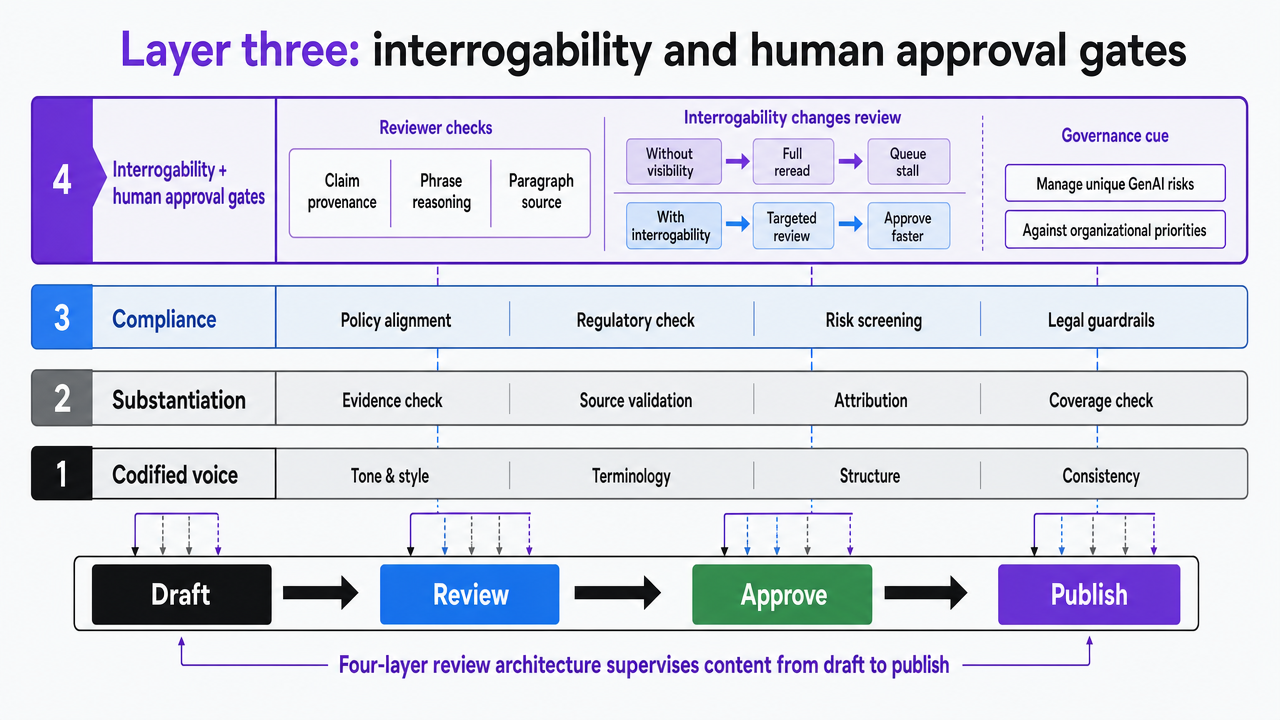
Substantiation as a workflow layer means every factual claim in a draft is tagged, traced to a source URL or internal document, and checked against that source before the draft advances to editorial review. Claims without a source get flagged for removal or rewrite, not passed along with a comment. This is where the four control layers of a publish-ready pipeline become visible as an integrated system: brand voice codification catches drift, evidence substantiation catches hallucination, compliance review catches regulatory exposure, and human approval catches brand harm. Each layer neutralizes a specific failure mode named in section 2.1, and no layer covers for another.
NIST's draft GenAI Profile reinforces the architecture from the interface side. It recommends that developers allow users to interrogate AI-generated content at granular levels — word- or object-level provenance and reasoning — so reviewers can validate before publication rather than after 3. Substantiation without interrogability turns reviewers into fact-checkers rebuilding the model's citations by hand. Interrogability without substantiation produces an audit trail for claims that were never verified. Both belong in the same layer, and the diagram of the full architecture makes clear why omitting either collapses the pipeline back into line-by-line rewriting.
Layer three: interrogability and human approval gates
Approval is where most AI content workflows either scale or quietly stall. When reviewers cannot see why a draft says what it says, approval becomes rereading the entire piece with the same scrutiny a from-scratch draft would require. The productivity multiplier evaporates in the queue.
Interrogability changes the reviewer's job. NIST's draft GenAI Profile recommends building user interfaces that let reviewers examine AI-generated content at granular levels — inspecting the provenance of a specific claim, the reasoning behind a phrase, or the source a paragraph draws from — without rerunning the entire generation 3. The Department of Commerce framed this guidance as helping organizations identify the unique risks of generative AI and manage them against organizational priorities 9, and the broader AI Risk Management Framework provides the shared language for structuring review, approval, and monitoring as governance controls rather than ad-hoc editorial checks 10.
Human approval as a gate — not a formality — means the draft cannot advance until a named reviewer signs off, and the sign-off is logged against the specific version approved. That log becomes the record that satisfies both internal accountability and external scrutiny if a claim is later challenged. Approval-first architecture is what separates AI content operations from AI content experiments: nothing publishes without a human decision, and every decision is tied to a version, a reviewer, and a timestamp. The drafting engine is fast. The gate is deliberate. Both are required.
Test AI-driven content workflows in real scenarios
Experience hands-on content production velocity with live publishing during your trial period.
Regulation as an input, not an afterthought
FTC rules on AI-generated reviews, testimonials, and avatars
The FTC's 2024 final rule on consumer reviews and testimonials, effective October 2024, made civil penalties available for knowingly using AI to generate reviews that misrepresent the identity or experience of the reviewer 1. The rule targets the entire supply chain: brands, agencies, and third parties running review-generation workflows on behalf of a brand are all in scope. For content teams, this reframes AI-assisted social proof from a creative decision to a compliance-controlled workflow input.
The interpretive guidance is more nuanced than the headline suggests. AI-generated avatars are not banned outright. The FTC's Q&A clarifies that a synthetic persona might function as a testimonial, and the prohibition attaches only when the underlying testimonial is fake or false 2. Material connections still require disclosure. Virtual influencers and AI-composed customer stories fall inside the same test: is the depicted experience real, and is the relationship transparent?
Operationally, this belongs in the compliance layer of the review architecture, not in a separate legal review at the end. Prompt templates for any content that references customer experience should require a linked source — an actual case, a documented outcome, a consented quote — before a draft advances. Testimonial-adjacent copy on landing pages, service comparisons, and success stories gets flagged for provenance the same way statistics get flagged for citations. Compliance becomes a data requirement, not a rewrite request.
NIST GenAI Profile and provenance obligations
NIST released the Generative AI Profile as NIST-AI-600-1 on July 26, 2024, extending the AI Risk Management Framework with generative-specific controls 10. The Department of Commerce framed the release as helping organizations identify the unique risks of generative AI and manage them against organizational priorities 9. The guidance is voluntary, but it has become the shared vocabulary regulators, insurers, and enterprise procurement teams increasingly reference when they ask how AI content is governed.
The Profile's most operational recommendation for content teams concerns provenance. It directs developers to build interfaces that let users interrogate AI-generated content at granular levels — word- or object-level inspection of sources and reasoning — to protect information integrity 3. RAND's analysis of information-integrity policy tracks the same direction: transparency, labeling, and detectable provenance are the safeguards regulators are converging on across jurisdictions 5.
Content operations that log which model produced which passage, against which sources, at which version, are the ones that can answer a regulator, a plaintiff, or an enterprise buyer without reconstructing the workflow from memory. Provenance is an operating input.
High-stakes verticals: the attorney review standard as a template
Legal marketing offers the clearest template for what publish-ready AI content requires in a regulated vertical, and content leaders in healthcare, dental, behavioral health, and senior living can borrow the standard directly. The Idaho State Bar's 2025 guidance is explicit: AI-generated marketing content must comply with ethical rules prohibiting false or misleading statements, and attorneys should review all AI-generated promotional materials to confirm they accurately reflect qualifications and experience 4.
The transferable principle is that a licensed professional — not the content team, and not the model — carries the final accountability for any factual representation about services, outcomes, or credentials. In dental and DSO marketing, that means a clinician signs off on procedure descriptions. In behavioral health, a licensed clinician reviews any claim about treatment approaches or outcomes. In senior living, a compliance officer reviews any statement touching care levels or regulatory certifications.
The workflow implication is that professional review is a named gate, not a stage that gets skipped when the queue fills. The reviewer's approval is logged against the version they approved. When the drafting engine produces ten times more content, the professional-review capacity becomes the throughput ceiling — and that is the correct place for the ceiling to sit.
Personalization at scale without losing the review layer
Personalization used to be a resource problem. Producing a landing page variant for each micro-segment — by geography, service line, buyer stage, or intent signal — was cost-prohibitive at the volumes that made the segmentation worth doing. Generative AI removes that constraint. McKinsey frames it plainly: gen AI lets marketers develop tailored content at scale, at lower cost, for micro-segments that manual production could never justify 7.
The operational risk is that scale multiplies exposure. A single unreviewed claim in a hero paragraph is one liability. The same claim replicated across 40 segmented landing pages is 40. The review layer cannot be the stage that gets skipped when the variant count climbs, or the failure modes named earlier — hallucination, drift, regulatory exposure, brand harm — compound in production rather than getting caught in draft.
Two structural changes keep the review layer intact under personalization load. The first is template-level approval. Reviewers approve the substrate — the claim structure, the evidence sources, the compliance disclosures, the voice pattern — and the variant fields inherit that approval. The reviewer's decision covers the class of output, not each instance. The second is exception routing: variants that fall outside the approved template's parameters get flagged for individual review rather than passing through. McKinsey emphasizes that capturing gen AI's personalization value requires reconfiguring workflows, talent, and operating models rather than layering AI onto the existing one 7. That reconfiguration is what lets throughput rise without the review layer becoming a bottleneck or a rubber stamp.
Accelerate Content Velocity with AI-Driven, Approval-First Workflows
See how enterprise teams and agencies streamline publish-ready content creation with AI specialists, unified approvals, and measurable SEO impact—without increasing headcount or compromising brand standards.
For content leaders overseeing multi-location or portfolio operations
For content leaders overseeing multi-location dental groups, law firm portfolios, home services franchises, or senior living operators, the economics of AI content shift from productivity gain to capacity consolidation. A 20-location operator running location-specific service pages, market-specific blog content, and location-owner testimonials at anything close to publish-ready quality has historically required either an agency roster or a headcount plan that does not exist in most content budgets.
The consolidation math depends on three sourced variables from McKinsey's AI marketing research:
- the 2x to 5x creative productivity multiplier,
- the 10 to 30 percent creative cost reduction, and
- campaign cycle compression from six to ten weeks down to same-day execution 8.
Expressed as production capacity per reviewer FTE — which is the ceiling that actually governs multi-location output — the difference is significant enough to change staffing models rather than just marginal cost lines.
| Production variable | Traditional agency or in-house model | AI-enabled with review architecture 8 |
|---|---|---|
| Campaign cycle time | 6–10 weeks per campaign | Same-day execution |
| Creative productivity per reviewer FTE | Baseline (1x) | 2x–5x |
| Creative cost per unit of output | Baseline | 10–30% lower |
The capacity gain is real only when the review architecture from sections 3 and 5 is already in place. Without codified voice, substantiation, and template-level approval, a portfolio operator hits the review bottleneck faster than a single-location team does, because variant volume climbs geometrically with location count. The operational question for portfolio content leaders is not whether AI content works at scale. It is whether the governance layer is built to absorb the throughput before the drafting engine is turned on.
Where approval-first AI content operations go from here
The center of gravity in AI content is moving from the drafting engine to the approval layer. Regulators are converging on transparency and provenance as the safeguards that matter, from the FTC's testimonial rule to NIST's information-integrity guidance 5. Enterprise buyers, professional licensing bodies, and insurers are asking who signed off on what, against which sources, at which version. Organizations that treat AI content as a supervised production line — codified voice, evidence substantiation, compliance as input, human approval as a logged gate — will answer those questions in seconds. Organizations that treated it as a faster writing tool will reconstruct the workflow from Slack messages.
The operational shift for content leaders is small in concept and significant in execution. Voice becomes a structured asset, not a document. Claims carry provenance, not comment threads. Compliance rules run at the prompt layer, not the pre-publish layer. Approval is a decision tied to a version, not a chat reaction. None of this requires more headcount. It requires the governance layer to be built before the throughput arrives — which is the argument the Vectoron platform is built around, and the one content leaders will make internally over the next twelve months regardless of vendor.
Frequently Asked Questions
References
- 1.Federal Trade Commission Announces Final Rule Banning Fake Reviews and Testimonials.
- 2.The Consumer Reviews and Testimonials Rule: Questions and Answers.
- 3.Draft NIST Generative AI Risk Management Framework Profile.
- 4.Generative AI in Legal Practice: A Survey of Professional and Ethical Challenges.
- 5.Generative Artificial Intelligence Threats to Information Integrity and Potential Policy Responses.
- 6.AI-powered marketing and sales reach new heights with generative AI.
- 7.The next frontier of personalized marketing.
- 8.The future of marketing in the age of AI.
- 9.Department of Commerce Announces New Guidance and Software to Help AI Developers Mitigate Risks from Generative AI.
- 10.AI Risk Management Framework | NIST.