
Key Takeaways
- Predictive lead scoring tools like 6sense, MadKudu, and HubSpot Breeze replace static MQL rules by ranking accounts on close likelihood, but only work when CRM hygiene holds up 8.
- Content production engines collapse the freelance writer, junior marketer, and SEO agency retainer into one pipeline, while editorial judgment stays in-house as the deciding factor 1.
- Personalization platforms like Mutiny and Intellimize remove the contract designer line item by shipping one adaptive experience instead of ten manually built ABM variants 17.
- SEO and SERP intelligence tools squeeze the strategic layer of agency retainers, but uniform scoring pushes real differentiation toward original research and editorial point of view.
- PPC bid and creative automation through Performance Max, Advantage+, and AdCreative.ai makes percentage-of-spend management fees hard to justify when platforms run optimization natively 4.
- Conversational and lifecycle automation tools like Intercom Fin and Customer.io replace tier-one support and variant writing, but the strategist deciding which behaviors deserve a message stays critical 5.
- Analytics copilots resolve the easy half of an analyst's queue when data models are clean, but produce fluent answers to wrong questions on poorly documented foundations.
- Agentic orchestration platforms like HubSpot Breeze, Salesforce Agentforce, and Vectoron absorb the coordination layer between tools, consolidating eight licenses and backlogs into one workflow 2.
The growth stack is consolidating around fewer, smarter systems
Marketing and sales now lead enterprise gen AI adoption, with 65% of organizations reporting regular use in at least one function in McKinsey's early-2024 survey 13. For SaaS Heads of Growth, that number lands less as a milestone and more as a procurement problem. The point-tool sprawl that began in 2023—one vendor for copy, another for scoring, a third for ad creative, a fourth for SERP research—has produced stacks that automate tasks without automating the work between them.
The teams pulling ahead are not buying more AI. They are buying less of it, more deliberately.
This shortlist groups the AI tooling that actually earns a slot in a 2025–2026 SaaS growth stack into eight job-to-be-done categories, then maps each one against a single axis: does the tool accelerate a task, or does it run a workflow? That distinction—point tool versus agentic platform—is the planning question this cycle. It determines which line items on the agency invoice stay, which collapse into software, and which categories are about to be absorbed by a layer above them. The framing throughout is what each tool removes from headcount, retainer fees, or coordination overhead, not what it adds to a feature matrix.
Why AI tooling became the operating layer, not an experiment
Adoption crossed the line from pilot to default
Private SaaS firms are no longer kicking the tires. A 2025 analysis found that 76% embed AI in their products and 69% deploy it across day-to-day operations 3. Those two numbers, together, mark the end of the pilot era. AI is not a side project sitting next to the marketing stack; it is increasingly the stack itself.
The profitability signal matters more than the adoption rate. SaaS companies running AI in operations reach breakeven or better at a 61% rate, compared with 54% for those that do not 3. Seven points of profitability spread, drawn from the same benchmark, against an audience of growth leaders being asked to defend CAC payback this cycle.
That delta reframes the procurement conversation. The question stops being whether AI tooling produces results and starts being which categories of tooling produce the cleanest operational lift. For Heads of Growth, that means treating AI selection the way a CFO treats vendor consolidation: fewer line items, tighter integration, measurable contribution to unit economics.
The economic anchor: 5–15% of marketing spend is on the table
McKinsey's economic-potential analysis put a number on what gen AI is worth inside the marketing function: productivity gains equivalent to 5–15% of total marketing spend, captured through content generation, personalization, and campaign optimization 14. That estimate spans the use cases growth teams already run, not exotic applications waiting for future tooling.
Translate the range into a planning conversation. A SaaS company spending $8M a year on marketing is looking at $400K to $1.2M of recoverable capacity inside its current budget envelope. That capacity rarely shows up as a refund. It shows up as work that no longer needs a freelancer, a junior hire, or a retainer line item.
The pressure to capture that capacity is not abstract. The 2025 B2B SaaS benchmarks from Maxio document continued compression on CAC efficiency and revenue growth metrics, which means the gap between teams that operationalize AI and teams that experiment with it widens fastest where unit economics are already tight 11. The AI layer is where that gap closes—or doesn't.
Point tools versus agentic platforms: the axis that matters in 2026
What each layer actually does
A point tool sits inside a single task. A copywriter opens a generator, drafts ten subject lines, picks one, and moves on. A demand-gen manager opens a scoring app, exports a list, and hands it to sales. The AI is sharp at the moment of use and silent the rest of the day. Value is measured in minutes saved per task.
An agentic platform sits inside the workflow. It pulls account data from GA4, Search Console, and the CRM, proposes the next set of moves across SEO, content, paid, and lifecycle, executes the approved ones, and reports back on what shifted. Deloitte frames this as the move from static software to systems that plan, execute, and optimize on their own 2. Value is measured in workflows closed, not prompts written.
The practical test for a Head of Growth: if the tool stops working tomorrow, does a task slow down, or does a function stop running? Point tools fail at the task level. Agentic platforms fail at the org-chart level.
Why agentic orchestration is pulling spend upward
The category is being funded ahead of its proof points. MarketsandMarkets projects the agentic AI market growing from $7.06 billion in 2025 to $93.2 billion by 2032, a 44.6% compound annual growth rate 10. That trajectory does not describe a niche. It describes a category absorbing budget from adjacent line items—including marketing software, agency retainers, and contract labor—faster than most planning cycles can adjust.
Deloitte's read on buyer behavior reinforces the timing. The firm projects that up to 75% of companies will be experimenting with agentic AI by 2026, with a meaningful share allocating more than half of their digital transformation budgets to AI automation 2. For growth leaders, that means the orchestration layer is not a 2028 conversation. It is the layer competitors are piloting this fiscal year while the point-tool stack keeps accumulating seat licenses.
The strategic consequence is straightforward. Each new point tool added in 2026 is a future migration cost into an orchestration layer that will likely sit above it. Heads of Growth who recognize that early stop buying horizontally and start buying vertically.
Test AI marketing workflows on live campaigns now
Run real SaaS marketing initiatives and measure time and cost savings with full-featured AI execution before you commit.
Eight AI tool categories that earn a slot in the SaaS growth stack
Predictive lead scoring: replacing static MQL rules
The first category to consolidate is the one most growth teams still run on rules written in 2019. Static MQL thresholds—form fills plus job title plus a demo request—were never accurate, and at current SDR cost loads they are expensive. A peer-reviewed B2B lead scoring model built on AI demonstrates how predictive algorithms can prioritize accounts by likelihood to close rather than by activity proxies, raising the productivity ceiling on a fixed sales headcount 8.
Representative entrants in this category include 6sense, MadKudu, and the predictive layer inside HubSpot Breeze. Each ingests CRM history, intent signals, and firmographic data to rank accounts in motion. What they replace is not a person—it is the meeting where marketing and sales argue about lead quality. When the model is trained on closed-won data, the argument collapses into a queue.
The operational caveat is unglamorous. Predictive scoring fails when CRM hygiene fails. Models trained on incomplete deal stages, missing close reasons, or inconsistent ICP tagging will confidently rank the wrong accounts first. Heads of Growth treating scoring as a procurement decision rather than a data-quality project tend to relaunch the project inside eighteen months.
Content production engines: from drafts to distribution
Content is the category where AI penetration is deepest and where the lines between tools blur fastest. The Influencer Marketing Hub benchmark reports that 44.4% of marketers have used AI for content production, the single most common application across the function 1. The AMA/Lightricks survey of more than 1,000 marketers pushes the picture further: nearly 90% have used generative AI at work, and 62% rely on chatbots like ChatGPT for content tasks 15.
Those two numbers, side by side, describe a baseline rather than a frontier. Jasper, Writer, and Copy.ai sit at the document level. Surfer and Clearscope add SEO scoring on top of drafts. The newer category—content production engines—runs the full pipeline: brief, draft, editorial review, on-page optimization, and publish, with brand voice extracted from prior assets rather than re-prompted each session.
What collapses inside this category is the freelance writer line item, the junior content marketer hire, and, in many cases, the SEO content agency retainer. The piece that does not collapse is editorial judgment. Teams that delete the editor role find out within a quarter why brand voice and topical accuracy are not features of a model—they are functions of a workflow. The engines that win are the ones that make editorial review the default state, not a manual override.
Personalization and recommendation: the next frontier moves into B2B
Personalization in B2C has been mature for a decade. In B2B SaaS, it has lagged because the data foundations were not in place. McKinsey's 2025 piece on personalized marketing argues that generative AI now changes the math, enabling end-to-end personalization across channels and journeys for organizations that invest in the data and operating-model work behind it 17. The tools handle the execution. The investment is upstream.
Mutiny and Intellimize handle website personalization for account-based plays, rewriting hero copy and CTAs per visitor segment. Recommendation engines—the same class of system that has driven consumer commerce—are migrating into SaaS lifecycle programs to suggest the next feature, the next plan tier, or the next piece of content based on in-product behavior 7.
The replacement story here is less about headcount and more about coordination. A SaaS growth team running ten ABM plays without personalization needs ten landing pages and ten email variants, all manually built. The same team with a personalization layer ships one experience that adapts. The line item that disappears is the contract designer producing variant after variant for plays that may not run a full quarter.
SEO and SERP intelligence: from keyword research to brief generation
SEO tooling was the first marketing category to absorb AI deeply, which is also why it is the first showing signs of commoditization. Semrush, Ahrefs, and Clearscope have moved from keyword databases to integrated workflows that surface gaps, draft briefs, and score on-page coverage against ranking competitors. The newer entrants—Surfer, Frase, MarketMuse—compress the time from topic identification to publishable brief from days to under an hour.
What this category replaces is the strategic layer of an SEO retainer, not the technical audit work that still benefits from human review. The agency line item for monthly keyword research, content recommendations, and competitive gap analysis is the one that gets squeezed first when an in-house growth team picks up these tools.
The risk is uniformity. When every team in a vertical runs the same SERP-scoring tool against the same ranking set, the resulting briefs converge. Differentiation in SEO content is moving back to original research, proprietary data, and editorial point of view—none of which the scoring layer can manufacture. AI tooling raises the floor here. The ceiling has to come from somewhere else.
PPC bid and creative automation: closing the loop on paid
Paid media has lived inside algorithmic bidding for years. What changed in 2024 and 2025 was the creative side. AdCreative.ai, Pencil, and the native Performance Max and Advantage+ systems inside Google and Meta now generate, test, and rotate ad variants at a velocity no human team can match. The bid algorithm and the creative algorithm finally sit in the same loop.
For SaaS Heads of Growth, the implication is that the PPC manager role is splitting. The execution layer—keyword harvesting, bid adjustments, variant testing—runs itself. What remains is strategic: which audiences to compound on, which offers to test, which landing page experience to ship against which intent. That work is closer to a growth strategist than a paid media operator.
The agency line item under pressure is the percentage-of-spend management fee, which is increasingly hard to justify when the platform's own AI does most of the optimization. CMSWire's roadmap framed this shift early, noting that AI is moving paid from intuition to data-backed forecasting across channels 4. Teams that have not renegotiated their paid retainer in eighteen months are likely overpaying for work the platforms now do natively.
Conversational and lifecycle automation: replacing tier-one touchpoints
Conversational AI moved past the scripted chatbot in 2023. The current generation—Intercom Fin, Drift, Ada—handles tier-one support, qualifies inbound demo requests, and routes complex cases to humans with context attached. Delta Capita's review of AI in digital marketing identifies real-time chatbots and conversational personalization as among the most mature applications in the current stack 5.
For SaaS specifically, the bigger play is lifecycle. Tools like Customer.io, Braze, and HubSpot's AI-augmented sequences now generate, test, and time messages against in-product behavior signals rather than calendar-based drips. The onboarding email that fires on day three of a trial is being replaced by the message that fires the moment a user hits a specific friction point inside the product.
What this category replaces is the lifecycle marketer who spent half their week writing variants and the support hire who handled repetitive inbound questions. What it does not replace is the strategist who decides which behaviors deserve a message in the first place. That decision belongs upstream, and getting it wrong means automating the wrong conversations faster.
Analytics copilots: turning GA4 and warehouse data into answers
The promise of analytics copilots is that the marketer who needs an answer no longer waits on a data team to write SQL. Tools like ThoughtSpot Sage, Hex Magic, and the native copilots inside GA4 and Looker accept natural-language questions and return charts, segments, and anomaly callouts against connected data.
The reality is more uneven. Copilots perform well when the underlying data model is clean and well-documented. They perform poorly when column names are ambiguous, when joins require business logic, or when the question itself is imprecise. The category replaces the easy half of an analyst's queue—dashboard requests, segment pulls, basic attribution checks—not the strategic half.
For Heads of Growth, the procurement question is whether the team has the data foundation to use a copilot effectively. Teams running GA4 with consistent event naming and a documented data warehouse will extract value quickly. Teams without that foundation will get fluent answers to the wrong questions.
Agentic orchestration platforms: one system, many jobs
The eighth category is the one most likely to absorb the other seven over the next planning cycle. Agentic orchestration platforms—the layer Deloitte describes as systems that plan, execute, and optimize workflows autonomously across software—are moving from concept into commercially deployed products 2. Instead of running eight separate point tools and coordinating their outputs in spreadsheets and meetings, growth teams license one system that runs the workflow across SEO, content, paid, and lifecycle from a single account-level plan.
The category is still forming, which is why naming the comparators matters. HubSpot Breeze is approaching it from the CRM side. Salesforce Agentforce is building outward from sales automation. Newer entrants like Vectoron are building the orchestration layer first, deploying specialist AI strategists for content, SEO, conversion, PPC, and backlinks that coordinate through a lead strategist and surface approval-ready work in a command center interface. Each of these takes a different path into the same destination.
What an agentic platform replaces is not a tool. It is the coordination layer between tools—the account manager, the project manager, the weekly status meeting, the handoff between the SEO agency and the content team. The economic argument is consolidation: one platform instead of eight licenses, one workflow instead of eight backlogs, one report instead of eight dashboards reconciled by hand. For Heads of Growth defending CAC payback this cycle, that consolidation is where the next round of efficiency gains lives.
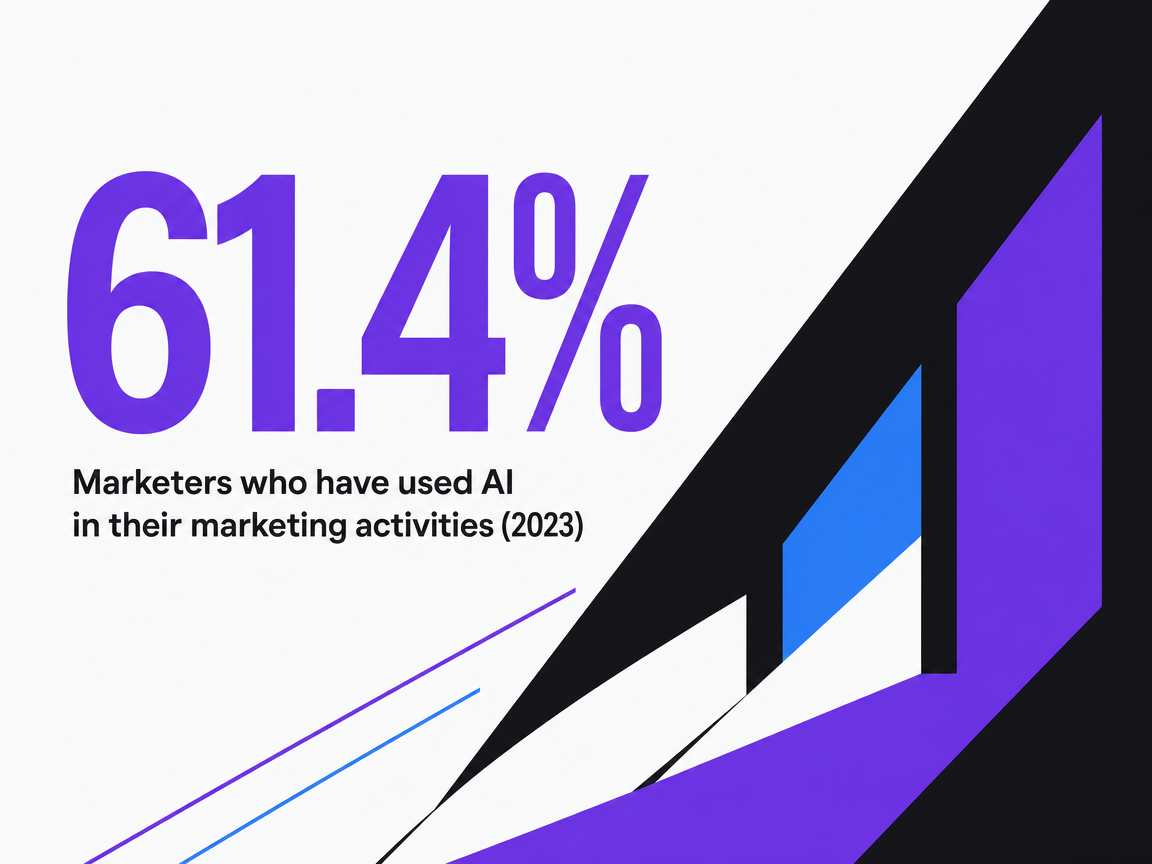 Marketers who have used AI in their marketing activities (2023)
Marketers who have used AI in their marketing activities (2023)
The agency line-item replacement view
Strip the eight categories down to what they cost a SaaS marketing P&L today, and the consolidation story gets sharper. McKinsey's economic-potential work estimates gen AI can deliver productivity equivalent to 5–15% of total marketing spend through content, personalization, and optimization 14. That capacity does not arrive as a check. It arrives as work that no longer needs an outside invoice.
Mapped against the typical SaaS marketing budget, the substitutions are specific:
| Traditional line item | AI category that absorbs it | What remains in-house |
|---|---|---|
| Content agency retainer | Content production engines | Editorial direction, original research |
| SEO retainer (research and briefs) | SERP intelligence and brief generation | Technical audits, editorial POV |
| PPC management fee (% of spend) | Native bid and creative automation | Offer strategy, audience selection |
| Freelance designers for variants | Personalization and recommendation | Brand system, hero creative |
| Account manager and coordinator | Agentic orchestration platforms | Approvals, strategic prioritization |
The column that matters is the third one. AI tooling moves the work, but it does not move the judgment. Growth leaders who treat the substitution as headcount-for-software miss the point. The substitution is retainer-for-software, with the remaining human role shifting upstream toward strategy and editorial control.
See How Leading SaaS Teams Deploy AI to Scale Campaign Execution
Request a walkthrough of the AI-powered marketing operating system trusted for multi-channel strategy, content, and PPC management—without the overhead of agency retainers or in-house hires.
What breaks: data quality, expertise, and governance gaps
The Benchmarkit 2024 B2B marketing report names the three failure modes that show up across every category above:
- Data quality
- Lack of internal expertise
- Ethics or privacy concerns
These are not edge cases. They are the reasons AI rollouts stall after the procurement signature 9.
Data quality breaks predictive scoring and personalization first. A model trained on a CRM with inconsistent stage definitions, missing close reasons, or stale account fields produces confident outputs that point sales at the wrong queue. Personalization engines fed by fragmented identity data ship variants to the wrong segments. The tool is not wrong. The substrate underneath it is.
The expertise gap is more uncomfortable. Most growth teams hired for campaign craft, not for prompt design, model evaluation, or workflow orchestration. Without someone who can audit AI outputs against business logic, the team ends up trusting the fluent answer over the correct one.
Governance is the third failure point and the one that scales worst. Agentic platforms acting across SEO, paid, and lifecycle need clear approval boundaries, audit logs, and rollback paths. Treat that work as table stakes before scope expands, not as a Q4 cleanup item.
How to sequence consolidation across the next planning cycle
Consolidation fails when it is treated as a single procurement event. The teams that get it right phase the work across three planning quarters, starting with the layer that is leaking the most cash today.
- Quarter one belongs to the line item with the loosest accountability. For most SaaS growth orgs, that is the content agency retainer or the SEO retainer, both of which compete directly with content production engines and SERP intelligence tools. Cancel one. Reinvest a fraction of the savings into editorial capacity that the model cannot replace.
- Quarter two takes on predictive scoring and PPC automation in parallel, since both depend on data hygiene work that the team should be doing anyway.
- Quarter three is when the agentic orchestration layer goes in—after the point tools have proven their data is clean enough to feed a system that runs above them.
The discipline is sequencing, not speed. Heads of Growth who buy the orchestration layer first, before the underlying data and approval workflows are in shape, end up automating coordination problems instead of solving them. Vectoron and platforms in the same category land cleanest when the substrate underneath is already running.
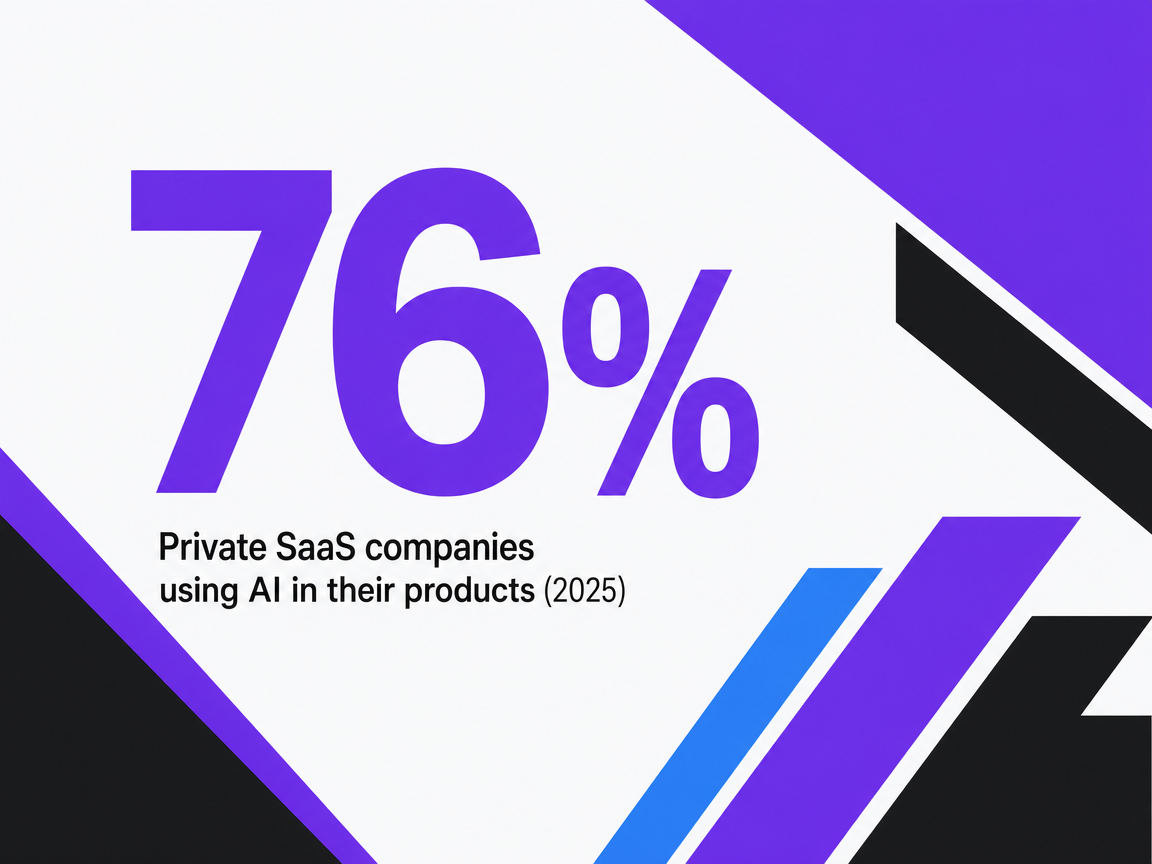 Private SaaS companies using AI in their products (2025)
Private SaaS companies using AI in their products (2025)
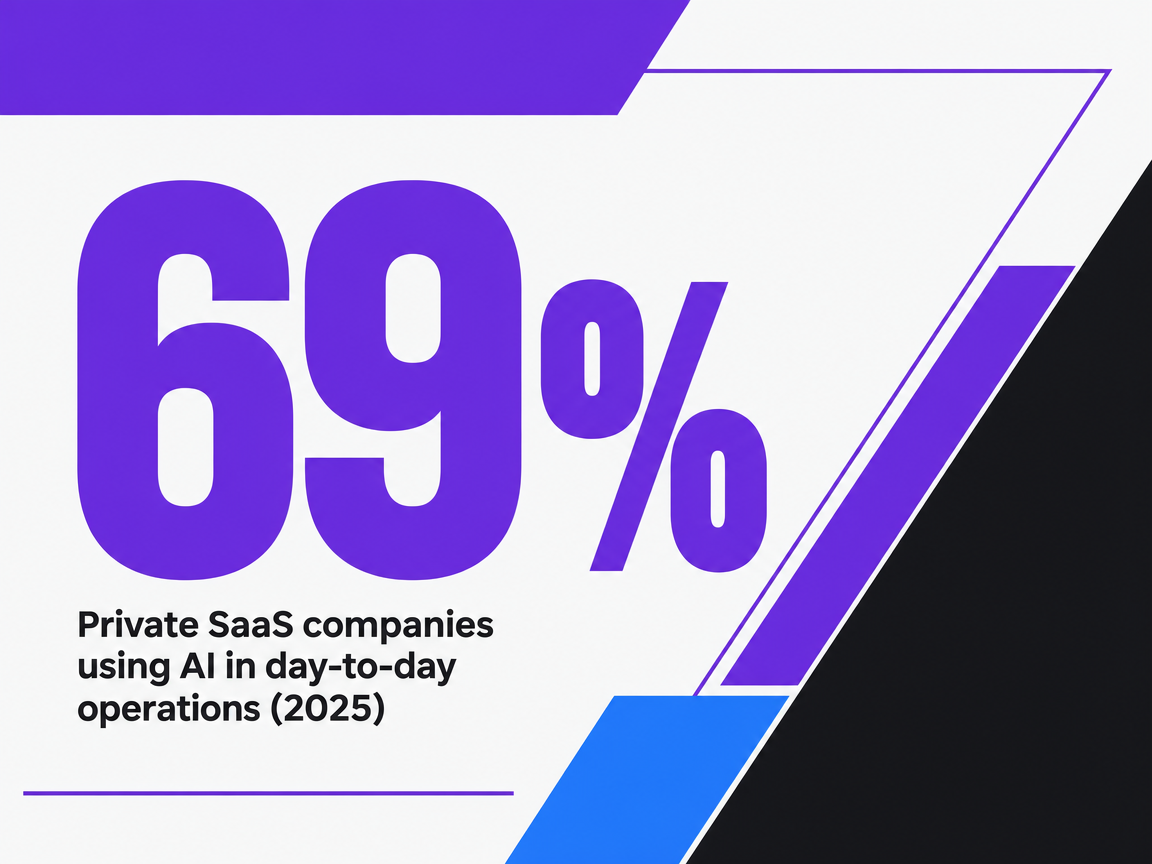 Private SaaS companies using AI in day-to-day operations (2025)
Private SaaS companies using AI in day-to-day operations (2025)
Frequently Asked Questions
References
- 1.Artificial Intelligence (AI) Marketing Benchmark Report.
- 2.SaaS meets AI agents.
- 3.AI Adoption Among Private SaaS Companies and Its Impacts on Spending and Profitability.
- 4.AI in 2024: Marketing's Mindful Machine Makeover.
- 5.Unlocking Potential: The Impact of AI on Digital Marketing.
- 6.The Role of Artificial Intelligence in Personalizing Social Media Marketing Strategies and its Impact on Customer Experience.
- 7.AI-Powered Personalization in Marketing.
- 8.The relevance of lead prioritization: a B2B lead scoring model based on artificial intelligence.
- 9.2024 B2B Marketing Benchmark Report.
- 10.Agentic AI Market Report 2025.
- 11.2025 B2B SaaS Benchmarks Report.
- 12.The state of AI in 2023: Generative AI’s breakout year.
- 13.The state of AI in early 2024.
- 14.The economic potential of generative AI: The next productivity frontier.
- 15.Generative AI Takes Off with Marketers.
- 16.Marketing Made Personal: How AI is Revolutionizing Customer Connections.
- 17.Unlocking the next frontier of personalized marketing.
- 18.Upgrading software business models to thrive in the AI era.