
Key Takeaways
- Dedicated AI citation monitors deliver strong cross-engine coverage and share of answer voice, but leave attribution gaps that require pairing with a revenue-focused layer 8.
- Legacy SEO suites with bolted-on AI modules offer consolidation and stack integration, yet under-cover ChatGPT and Gemini and rarely model pipeline contribution 5.
- Prompt-log platforms archive full response text across engines, making share of answer voice and sentiment measurable, though attribution to sales-qualified leads still requires a separate layer 1.
- Attribution layers stitch anonymous AI-referred sessions to identities and revenue, closing the 5–8x gap that last-click reporting misses on AI-influenced pipeline 9.
- Custom GA4 and Looker Studio builds fit unique client needs but suffer from inconsistent prompt sampling and analyst bottlenecks that do not scale across portfolios 2.
- Conversational analytics for chatbots and site assistants capture first-party intent signals and pipeline events that public citation trackers cannot see 7.
- Orchestration layers turn citation frequency, share of answer voice, and modeled revenue into approved briefs, schema patches, and FAQ blocks routed through Head of SEO sign-off 8.
Why AEO Reporting Breaks at the Agency Level
The gap between what a client sees in GA4 and what their audience actually experiences on ChatGPT, Gemini, Perplexity, and Google AI Overviews has become the defining reporting problem for agency SEO leads. Brightspot's analysis indicates that nearly 60% of Google searches now end with zero clicks, a significant increase from 26% in 2022, shifting operative metrics toward AI retrieval rate, citation frequency, and mention sentiment 10. This trend suggests that if more than half of query resolutions never leave the results surface, traditional click-based dashboards measure a shrinking portion of a client's actual exposure.
This pressure is particularly acute for Heads of SEO managing multi-client portfolios. Client-facing reports still emphasize sessions, keyword positions, and goal completions. However, AI-mediated discovery, which increasingly drives pipeline, often appears as direct traffic, branded search spikes, or unattributed form fills. SegmentStream's modeling found that AI search contribution to sales is roughly 5–8 times higher than what last-click attribution captures, once identity graph stitching and self-reported re-attribution are factored in 9. This modeled figure highlights the critical need for tools that can bridge this measurement gap.
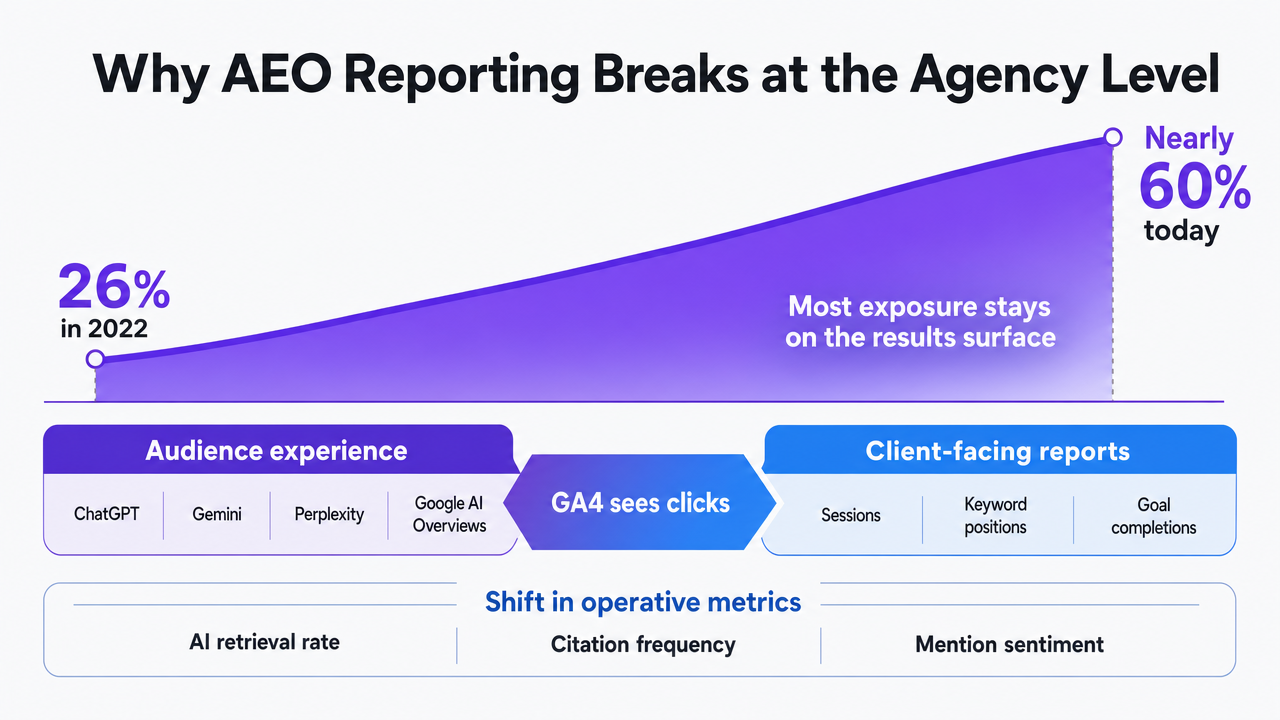 Visualize the cited growth in zero-click Google searches from 26% in 2022 to nearly 60% today, directly supporting the section's argument that click-based dashboards miss most exposure
The Six-Criteria Scorecard for Evaluating AEO Tools
What the Rubric Measures and Why Each Weight Matters
A robust AEO tool comparison requires a weighted rubric, not just a feature list. The analysis uses six criteria:
- Cross-engine citation coverage (20%)
- Attribution depth (25%)
- KPI reporting fit (15%)
- Agency multi-client workflow (15%)
- Stack integration (15%)
- Cost per tracked client (10%)
Attribution depth receives the heaviest weight because visibility without a clear path to pipeline is a vanity metric, and Heads of SEO need to demonstrate tangible ROI.
Cross-engine coverage is weighted at 20% because answer surfaces have fragmented across platforms like ChatGPT, Gemini, Copilot, and Perplexity, each synthesizing information differently. A monitor that only tracks one engine will inherently understate a brand's share of answer voice 5. KPI reporting fit, at 15%, is crucial because Monday.com's AEO framework prioritizes citations and authority in zero-click environments, meaning a tool must export these signals into client-facing views to justify its cost 1.
The remaining weights reflect operational realities. Multi-client workflow determines a tool's scalability beyond a few accounts without duplicating dashboards. Stack integration assesses whether AEO data seamlessly integrates with GA4 and existing SEO reporting tools or remains siloed. Cost per tracked client directly impacts profit margins. Pedowitz's guide notes that 40% of AEO success depends on content quality itself 6, reminding us that this rubric evaluates instrumentation, not the underlying content strategy.
The KPI Stack Clients Actually Approve
While the rubric evaluates the tool, the KPI stack focuses on client needs. Partnerize's AI visibility framework identifies four key metrics that consistently pass procurement scrutiny:
- Citation frequency across AI platforms
- Share of answer voice against competitors
- Assisted conversions from AI-referred sessions
- Revenue or pipeline attributed to AI search exposure with fractional contribution modeled 8
These metrics align with existing funnel stages that account directors already report on, facilitating easier approval.
Citation frequency confirms brand presence. Share of answer voice indicates competitive standing. Assisted conversions from AI-referred sessions link AI exposure to measurable on-site behavior visible in GA4. Finally, revenue with fractional contribution addresses the core retainer question. Ankit's framework emphasizes that AI visibility tracking gains client credibility when paired with concrete KPIs tied to downstream traffic, leads, and revenue, rather than being a standalone citation count 13. The tools discussed below are scored against this practical KPI stack.
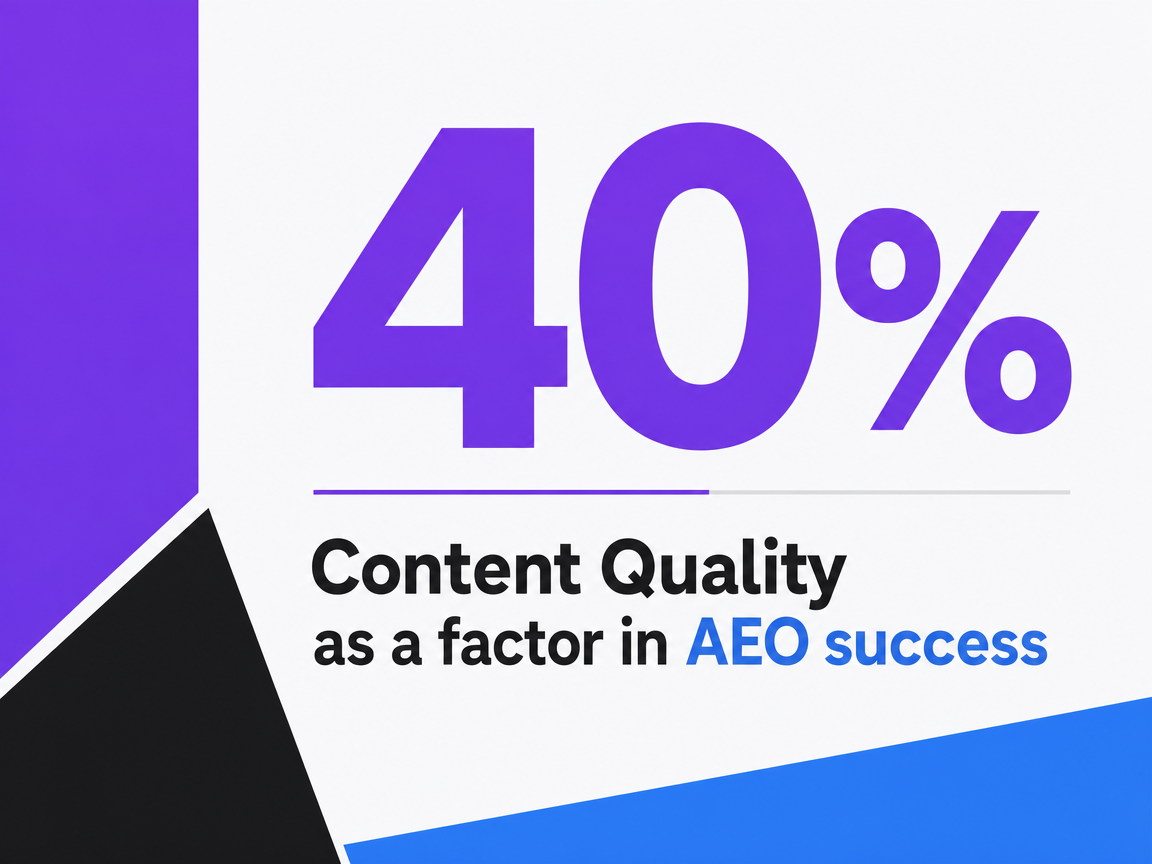 Content Quality as a factor in AEO success
Content Quality as a factor in AEO success
Dedicated AI Citation Monitors: Profound-Class Visibility Trackers
Dedicated AI citation monitors, such as Profound and its competitors, continuously prompt ChatGPT, Gemini, Perplexity, and Copilot to log brand or content citations and measure share of answer voice against specified competitors. Partnerize describes these tools as monitoring citations across major AI engines, integrating with analytics, and connecting visibility data to downstream metrics like engagement, conversion, and revenue 8.
These tools excel in cross-engine citation coverage, a 20% weighted criterion where they are designed to compete. Comprehensive coverage of ChatGPT, Gemini, and Copilot is essential, as the fragmentation across these engines means single-engine monitoring can significantly understate share of answer voice 5. KPI reporting fit is also strong, as citation frequency and share of answer voice directly align with two of the four client-approved metrics 8.
However, this category often falls short in attribution depth and multi-client workflow at agency scale. A citation count, while useful, doesn't tell a client's CFO if those citations generated pipeline. Assisted conversions and fractional revenue attribution typically require a separate tool, leaving reconciliation to the analyst. Multi-client workflow is another challenge, as per-workspace pricing and per-client prompt libraries mean managing 20 accounts can involve 20 separate configurations. Dedicated monitors effectively address the visibility aspect of the KPI stack but leave the ROI half unresolved.
Legacy SEO Suites With Bolted-On AI Answer Modules
Over the past 18 months, Ahrefs, Semrush, and similar platforms have introduced AI answer modules, integrating them into existing keyword and rank tracking workflows. The primary appeal is consolidation: a single login, seat cost, and dashboard that now flags domain appearances in Google AI Overviews or Perplexity citations alongside traditional SERP data. For agencies already subscribed to these suites, the marginal cost of the AEO module is minimal, making this category attractive.
In terms of cross-engine coverage, legacy suites generally underperform dedicated monitors. Most focus on Google AI Overviews and partial Perplexity coverage, leveraging their existing SERP crawl infrastructure. However, ChatGPT and Gemini citation tracking is often less comprehensive or absent, which is problematic given the fragmented answer landscape across distinct engines with varying synthesis behaviors 5. Attribution depth is also limited, as these modules primarily report visibility rather than modeled contribution to pipeline, thus earning less of the 25% attribution weight.
Legacy suites excel in stack integration and multi-client workflow. AEO signals appear alongside familiar domain and keyword views, and existing multi-account structures scale efficiently. Coalition Technologies advocates extending current SEO ROI formulas to include AI-influenced performance rather than overhauling the reporting stack 12. For agencies requiring unified SEO reports, this continuity is valuable, provided the AEO module supplements, rather than replaces, a dedicated monitor.
Test AEO impact tracking on real campaigns
Measure AEO-driven ROI on live client content before making any commitment.
Prompt-Log Platforms Built for Share of Answer Voice
Prompt-log platforms occupy a niche between citation monitors and attribution stacks, focusing on executing large, structured prompt panels and logging every answer verbatim. These platforms treat the answer engine as the primary unit of study. They sample a client's target queries—typically 500 to 5,000 prompts covering commercial, comparison, and vertical-specific intents—across ChatGPT, Gemini, Perplexity, and Copilot. The full response text is archived, allowing analysts to measure not only brand citation but also how the brand was described, co-occurring competitors, and weekly shifts in framing 5.
This category scores highly on cross-engine coverage and KPI reporting fit. Share of answer voice, one of the four client-approved KPIs, is a native output 8. Sentiment analysis is also supported, as the full response text enables mention-quality scoring beyond a simple cited/not-cited flag. Monday.com's AEO measurement framework, which emphasizes visibility, authority, and citation in zero-click environments, aligns closely with the output of a prompt-log archive 1.
However, prompt-log platforms have limitations in attribution depth and multi-client workflow. While they prove brand citation, they don't directly link it to sales-qualified leads. Heads of SEO using these platforms often pair them with a downstream attribution layer or accept that the deliverable is a visibility narrative, not a revenue one. Prompt library maintenance scales linearly with client count, which can become a significant workflow challenge for agencies managing more than ten accounts.
Attribution Layers That Stitch AI Exposure to Revenue
While citation counts demonstrate exposure, attribution layers quantify pipeline impact. This category bridges tracking tools and existing analytics stacks, addressing the significant discrepancy between last-click reports and actual AI-mediated discovery contributions. SegmentStream's modeling indicates that AI search contributes 5–8 times more to sales than last-click attribution captures, especially when identity graph resolution and self-reported re-attribution are incorporated 9. Without identity stitching and "how did you hear about us?" fields feeding an LLM triage layer, AI-referred sessions often appear as direct traffic, hindering retainer conversations.
Attribution layers offer capabilities that dedicated citation monitors do not. They:
- Resolve anonymous sessions into persistent identities across the customer journey
- Apply first-click credit to identity-resolved paths
- Categorize open-text attribution answers (e.g., "asked ChatGPT," "saw you in AI Overviews") into clean channel groupings for revenue reporting 9
This category excels in attribution depth, which carries the highest 25% weight. It also scores well on stack integration, as its output integrates with GA4's assisted conversions and multi-channel funnel views, familiar to client account teams 2.
Conversely, attribution layers typically underperform in cross-engine citation coverage. They quantify the revenue impact of AI exposure but rarely specify which engine produced it, which prompts triggered the citation, or how share of answer voice shifted against competitors. The operational solution is a pairing: a citation monitor provides the visibility data, an attribution layer supplies the revenue data, and together they populate the client-approved KPI stack—citation frequency, share of answer voice, assisted conversions from AI-referred sessions, and modeled fractional revenue 8.
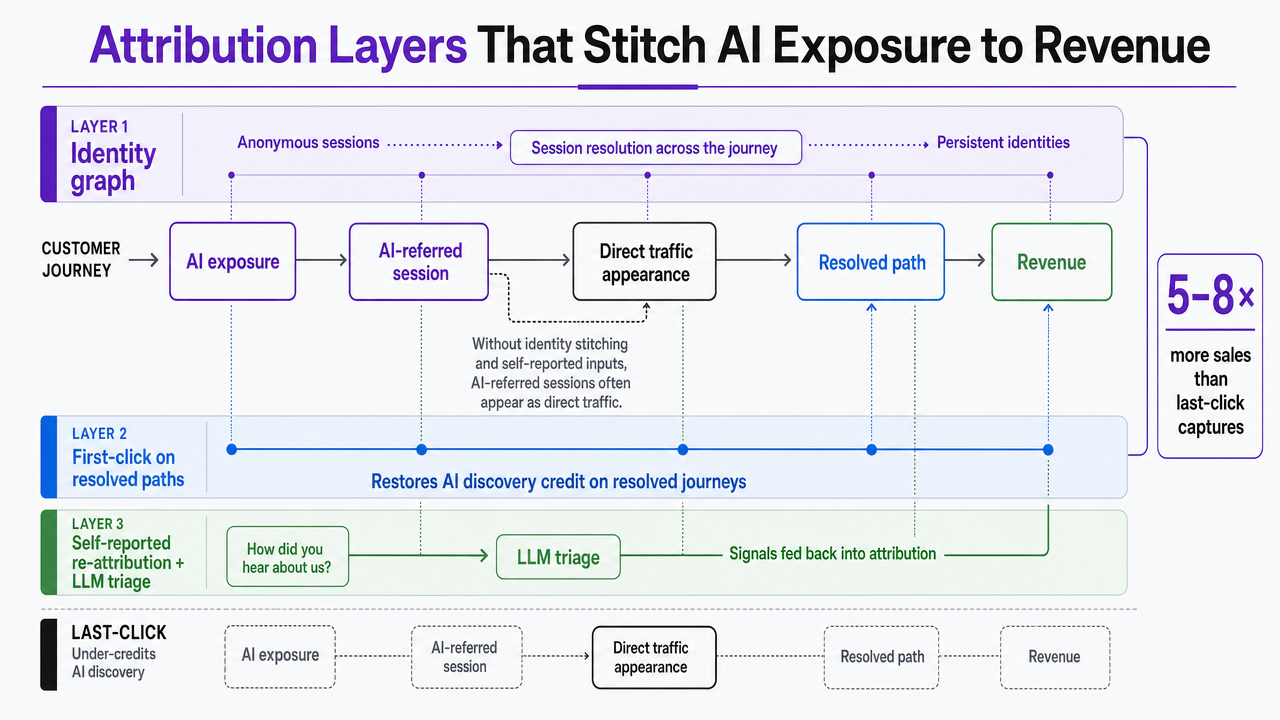 Process infographic depicting SegmentStream's three-layer attribution framework (identity graph, first-click on resolved paths, self-reported re-attribution with LLM triage) cited in this section
Custom Analytics Builds on GA4 and Looker Studio
Many agencies with senior analysts develop custom solutions, often a Looker Studio dashboard connected to GA4, Search Console, and a scraped prompt log. These are maintained through scheduled queries and informal communication channels. The appeal lies in minimal marginal software cost, data models tailored to client needs, and GA4's existing multi-channel funnel logic for assisted conversions 2. Coalition Technologies supports extending existing SEO ROI formulas to include AI-influenced performance rather than replacing the entire analytics infrastructure 12, a principle custom builds embody.
This category faces penalties on two rubric axes. Cross-engine citation coverage relies on manual prompt scraping, leading to inconsistent sampling of ChatGPT, Gemini, Perplexity, and Copilot, making share of answer voice an estimate rather than a precise measurement 5. Multi-client workflow presents a greater challenge: a custom board built for one client requires similar effort for each subsequent client, and the analyst managing the SQL becomes a single point of failure across the portfolio. Custom builds are best suited for clients with unique reporting requirements not met by commercial vendors, rather than as a default AEO instrumentation for a large client base.
Conversational Analytics for Chatbot and Assistant Surfaces
Not all AI answer surfaces are public search engines. A significant portion of client discovery occurs within enterprise chatbots, embedded site assistants, and voice interfaces that do not interact with Google or Perplexity indexes. IBM describes these systems as AI conversational layers that automate questions, integrate with business systems, and generate structured logs of every query and response 4. Dimension Labs highlights that chatbots gather information through direct interaction, creating a first-party dataset of intent signals unavailable in Search Console 7.
Conversational analytics platforms score narrowly on the rubric. Cross-engine coverage is not applicable here, as the focus is on the client's own assistant or a partner chatbot. Attribution depth is strong within this specific surface, as resolution rate, containment, and handoff-to-sales events directly link to pipeline. This category is valuable when a client operates a support or booking assistant that handles high-intent questions; overlooking this channel while tracking public AI citations can misrepresent the true answer economy for that account.
See How Leading Agencies Quantify AEO ROI Across Every Client
Connect with our team to benchmark your AEO tracking stack, explore unified reporting, and learn how agencies are scaling outcome-based attribution—without expanding headcount.
Orchestration Layers That Turn Visibility Signals Into Approved Work
Orchestration layers move beyond measurement to action. This category takes inputs like citation frequency, share of answer voice, and modeled AI-referred revenue, then routes resulting decisions—such as new answer-first briefs, schema patches, or Perplexity-specific FAQ blocks—through an approval queue before implementation. The core premise is that AEO tracking justifies its retainer only when it leads to executed actions, not just discussions.
Against the six-criteria rubric, orchestration layers score differently from visibility trackers and attribution stacks. Cross-engine coverage and attribution depth are inherited from the monitors and analytics stacks that feed the layer, rather than being built-in. This category excels in agency multi-client workflow and stack integration, areas where Profound-class monitors and custom Looker builds often fall short. A unified approval workflow for content, schema, and internal linking transforms Partnerize's KPI stack 8 from a report into an actionable task list, with the Head of SEO overseeing every recommendation. Vectoron fits into this category, serving as an orchestration and approved-action layer that consumes visibility signals from other trackers without replacing them.
If You Manage a Client Portfolio: The Consolidation Economics
For a Head of SEO managing 15, 20, or 40 accounts, the scorecard shifts. Per-seat visibility monitors, per-workspace attribution layers, and per-client Looker builds can cumulatively erode retainer profitability before the first client report is even generated. The critical question becomes the total cost of AEO instrumentation across the entire portfolio, not just per client, directly impacting the Head of SEO's profit and loss.
The economics can be clearly analyzed using variables. The total monthly AEO cost per client typically involves five inputs:
- Per-client visibility tool licensing
- Cross-engine coverage add-ons (especially for ChatGPT and Gemini)
- Attribution layer subscriptions allocated per workspace
- Analyst hours for dashboard reconciliation
- Reporting build time
Multiplying these by portfolio size and the loaded hourly rate for a senior analyst reveals the consolidation gap.
| Cost input | Per-client stack (fragmented) | Unified layer (consolidated) |
|---|---|---|
| Visibility monitor licensing | [per-seat cost] × [client count] | Workspace-based, single fee |
| Cross-engine coverage add-ons | Tier upgrade per client | Included at workspace level |
| Attribution layer allocation | Per-workspace subscription | Consumed as input, not duplicated |
| Analyst reconciliation hours | [hours/client/month] × [loaded rate] | Automated ingestion, sign-off only |
| Client reporting build time | Recurring per account | Templated across portfolio |
| Gross margin at typical retainer | Compressed by fixed reconciliation cost | Scales with account count |
Vectoron's publicly listed $599/month post-trial price serves as a benchmark for the cost of a unified execution and reporting layer compared to a fragmented stack, rather than a direct substitute for a citation monitor. The key operational insight is that reconciliation labor, not software licensing, is the primary factor determining whether AEO tracking enhances or diminishes retainer profitability 13.
Choosing the Right Combination for Your Retainer Model
No single category on the scorecard fulfills all six criteria. The practical decision for a Head of SEO involves combining two or three categories, with the retainer model dictating the optimal stack.
- Performance retainers tied to pipeline necessitate an attribution layer as the anchor, complemented by a citation monitor for visibility 9.
- Content-heavy retainers, billed on production volume, benefit from prompt-log platforms and legacy suite modules, as share of answer voice and citation frequency justify new content briefs 8.
- Managed-service retainers with 15+ accounts struggle with fragmented licensing; here, an orchestration layer proves invaluable by consuming signals and routing approved work, avoiding yet another dashboard 13.
The measurement stack is only effective when it drives approved actions. Vectoron is designed for this final handoff, transforming visibility data from a mere report into an actionable task queue that the Head of SEO can approve before implementation.
Frequently Asked Questions
References
- 1.Answer engine optimization: practical framework for 2026.
- 2.SEO Return on Investment: How to Measure and Maximize ROI.
- 3.What Is an AI Search Engine?.
- 4.Enterprise Chatbots: Benefits and Use Cases.
- 5.Best AI Search Engine Tools: Which is Best for Software Research?.
- 6.The Complete Guide to Answer Engine Optimization (AEO).
- 7.What Are Enterprise Chatbots And How Do They Work?.
- 8.How to Turn AI Search Visibility Into Measurable Marketing ROI.
- 9.How to Measure the True ROI of AI Search.
- 10.Rethinking content ROI in the age of AI.
- 11.What Is Answer Engine Optimization?.
- 12.Understanding the ROI of SEO in the AI Era.
- 13.How to Measure AI Search ROI: A Framework That Ties Visibility to ….
- 14.Evolving Health Information–Seeking Behavior in the Context of Artificial Intelligence–Powered Technologies.
- 15.Voice search optimization in digital media: challenges, use and possibilities.