
Ranking the Best AI for Business: Top 5 Tools
Key Takeaways:
- Editor's Pick: AI-powered content production platforms deliver the fastest ROI, enabling teams to scale output without adding headcount.
- Agentic AI is transforming back-office operations by automating complex, multi-step workflows rather than just simple tasks.
- Responsible AI governance is no longer optional; it is a competitive advantage that ensures compliance and builds trust.
- Skills intelligence systems help organizations identify and close talent gaps instantly using real-time data.
- Physical AI is revolutionizing logistics with robots that adapt to changing environments, boosting throughput by 30-40%.
Why 95% of Enterprise AI Pilots Fail
Finding the best AI for business is a high-stakes challenge. While the promise of transformation is real, the reality is often sobering. According to Gartner, 85% of AI projects fail to deliver value, and IBM reports that 95% of pilots never reach production. This disconnect stems from three fundamental barriers:
- Data Fragmentation: Employee and operational data is often scattered across 15-20 isolated systems, making it impossible for AI to generate reliable insights.
- Technical Complexity: Building custom solutions requires scarce talent and complex codebases (often involving
Pythonor custom APIs), leading to maintenance nightmares. - Organizational Resistance: Without buy-in, even the smartest algorithms are ignored by human decision-makers.
These hurdles explain why successful adoption is rare outside of tech giants. For most enterprises, the path to success lies not in building custom tools, but in deploying proven platforms that deliver immediate outcomes without the 18-month development cycle2.
#1: The Best AI for Business Content Production
How Multi-Stage Quality Pipelines Work
Multi-stage quality pipelines are the secret engine behind top-tier content platforms. Unlike simple chatbots, these systems break content creation into distinct phases—ideation, drafting, fact-checking, and compliance—validating each step automatically.
"Automated validation at each stage dramatically reduces manual effort and error rates, resulting in consistently higher-quality outputs compared to single-pass AI tools."
By integrating human oversight only where necessary, these pipelines allow teams to produce agency-quality work at a fraction of the cost. This hybrid approach is why specialized vendor tools succeed 67% of the time, compared to just 33% for in-house builds2, 4.
320% Lead Generation vs Traditional Agencies
When it comes to measurable outcomes, AI-powered platforms are outperforming traditional models. Marketing teams using advanced AI report a 320% increase in lead generation compared to legacy agency workflows.
| Metric | Traditional Agency | AI Content Platform |
|---|---|---|
| Lead Generation | Baseline | +320% |
| Campaign Speed | Weeks/Months | Days |
| Cost Model | High Retainer + Headcount | Scalable Software Cost |
Table 1: Comparison of Traditional Agencies vs. AI Platforms4
This efficiency allows businesses to scale their presence and test messaging rapidly, ensuring that resources are focused on what actually drives revenue4.
#2: Agentic AI as the Best AI for Business Workflows
62% of Organizations Experimenting with Agents
Agentic AI represents the next evolution of automation. Unlike rigid scripts, these autonomous agents can navigate complex, multi-step processes independently. Currently, 62% of organizations are experimenting with these tools to handle tasks ranging from customer onboarding to IT support4.
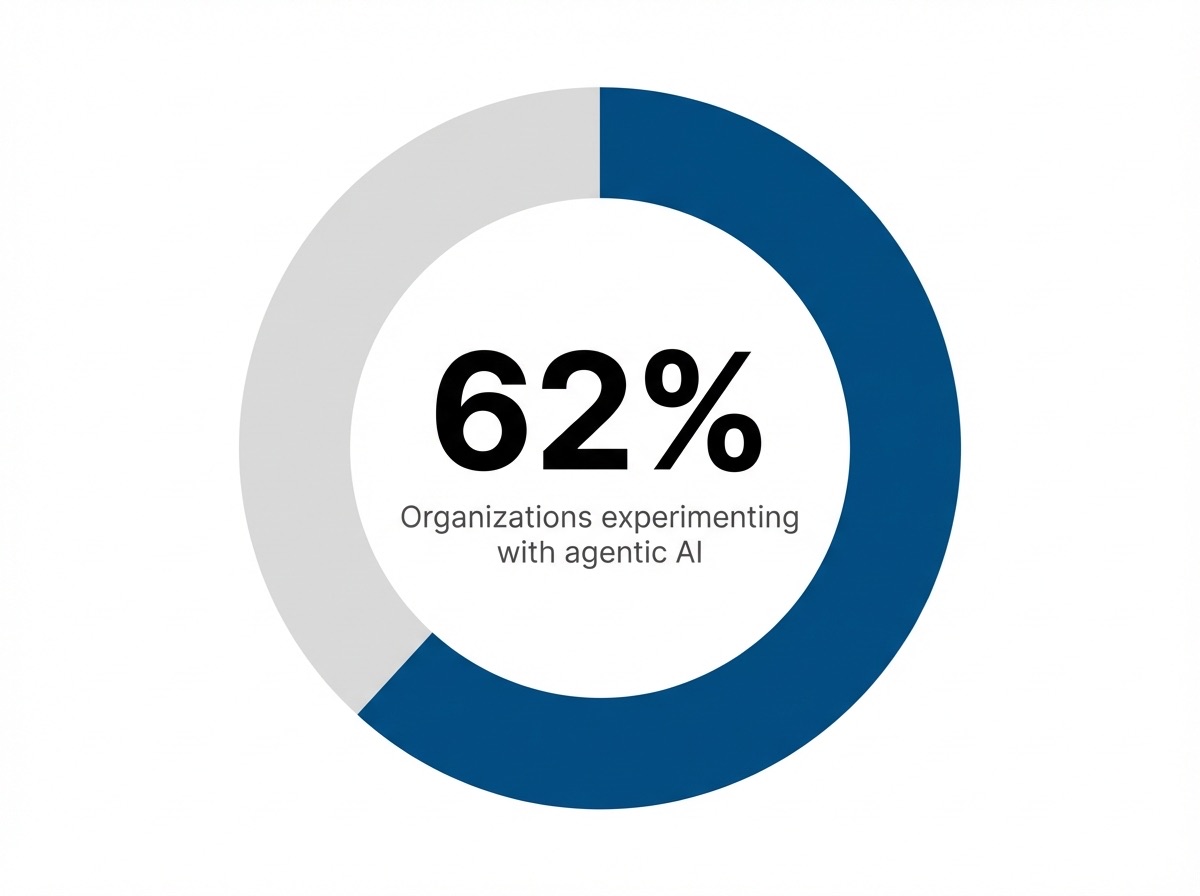 Organizations experimenting with agentic AI: 62%
While many are still in the pilot phase, the shift is clear: businesses are moving toward intelligent systems that can make decisions, not just follow rules. This capability is essential for scaling operations without adding layers of management.
Back-Office Automation Delivers Highest ROI
The most immediate value from agentic AI is found in the back office. Automating finance, HR, and procurement workflows reduces errors and accelerates processing times. MIT research indicates that these "boring" improvements often yield the highest returns, with some companies seeing 3-5x higher ROI compared to customer-facing bots2.
By letting agents handle the administrative burden, your team can focus on strategic initiatives—aligning perfectly with the goal of doing more with less.
#3: Responsible AI Governance Platforms
Compliance as Competitive Advantage
In a regulated world, compliance is a feature, not a bug. Responsible AI governance platforms turn safety into a competitive advantage. By embedding automated monitoring and bias detection, these tools allow companies to innovate faster without fear of regulatory backlash.
Executives are realizing that "safe" AI is the only scalable AI. Platforms that offer transparent documentation and real-time auditing are becoming essential for industries like healthcare and finance5.
60% of Executives Report ROI from Governance
Investing in governance pays off. Nearly 60% of executives report that these platforms directly improve ROI by reducing risk and streamlining adoption. Automated controls replace manual checks, speeding up deployment while ensuring that every output meets company standards5.
Unlock Enterprise-Grade AI Solutions for Business Growth
Connect with Vectoron’s experts to discover how top-ranked AI tools can drive efficiency, boost ROI, and power scalable digital marketing for your agency or brand.
#4: AI-Powered Skills Intelligence Systems
The skills gap is a major bottleneck for AI adoption. Traditional HR systems, with their static job descriptions, can't keep up. AI-powered skills intelligence systems solve this by analyzing actual work outputs—code commits, project documents, and communication patterns—to build dynamic talent profiles.
 Growth in worker access to AI in 2025: 50%
These systems offer three distinct advantages:
- Real-Time Visibility: See exactly what skills your workforce possesses right now.
- Internal Mobility: Match employees to projects based on capability, not just job title.
- Strategic Planning: Identify skill gaps before they impact critical initiatives.
By uncovering hidden talent within the organization, companies can reduce hiring costs and improve retention, ensuring they have the right people to drive their AI transformation7.
#5: Physical AI for Operations & Logistics
Physical AI brings intelligence to the physical world, overcoming the limitations of traditional automation. In warehouses and logistics centers, AI-powered robots now adapt to their environment in real-time, sorting inventory and optimizing routes without human intervention.
For example, robots like Boston Dynamics' Stretch can handle varying box sizes at speeds exceeding human capability. In logistics, autonomous vehicles adjust routes based on live traffic and weather data. The result is a 30-40% improvement in throughput and a safer work environment. This technology allows operations to scale capacity instantly by adding units, avoiding the delays of recruiting and training staff.
Frequently Asked Questions
Scaling AI Without Adding Headcount
The ultimate promise of the best AI for business is the ability to decouple growth from headcount. Content production is the prime example: demand has tripled, but budgets haven't. AI platforms bridge this gap, allowing small teams to produce high-quality, personalized content at a scale that was previously impossible.
 AI Adopters Reporting Quantifiable Benefits (Year-over-Year)
AI Adopters Reporting Quantifiable Benefits (Year-over-Year) (Shows the year-over-year increase in the percentage of companies identified as 'AI adopters' that reported tangible financial or productivity benefits.)
By automating the heavy lifting—whether in content creation, back-office workflows, or logistics—organizations can redirect their human talent toward strategy and innovation. This isn't just about efficiency; it's about survival. Companies that successfully integrate these tools will scale faster, cost less, and outperform competitors who are still stuck in the traditional agency model.
References
- 1.The State of AI in the Enterprise - 2026 AI report | Deloitte US.
- 2.MIT report: 95% of generative AI pilots at companies are failing | Fortune.
- 3.AI Implementation Cost vs ROI: Finding the Balance - HBS Online.
- 4.The State of AI: Global Survey 2025 | McKinsey.
- 5.PwC's 2025 Responsible AI survey: From policy to practice.
- 6.State of Enterprise AI Adoption - ISG Report 2025-2026.
- 7.How companies can use AI to find and close skills gaps | MIT Sloan.
- 8.Where Senior Leaders Are Struggling with AI Adoption, According to Research | Harvard Business Review.
- 9.The Copilot Reality Check: What Enterprise Adoption Data Reveals About the AI Boom | Forrester.
- 10.Morgan Stanley predicts AI won't let you retire early: Instead, you'll have to train for jobs that don't exist yet | Fortune.