
Key Takeaways
- A content production strategist matters because it wraps generation in research, briefs, and editorial review, producing work an in-house editor can approve in one pass rather than rewrite.
- An AI SEO analyst collapses the traditional stack by clustering topics, auditing technical issues, and mapping intent, turning raw crawl data into a prioritized editorial calendar tied to outcomes.
- A paid media operator matters because platforms already automate bidding, so human judgment concentrates on creative iteration, audience construction, and cross-channel budget reallocation the algorithms cannot see.
- A link and authority specialist compresses research and pitch drafting from days to hours, then hands personalized outreach to a human, measured by placements per hour rather than email volume.
- A social and community manager function drafts posts, listens to sentiment, and prepares replies, but only scales when the human approval loop stays fast enough to protect response times.
- Call and conversation intelligence attributes closed revenue to campaigns by scoring every inbound call, which is why it survives budget review when other line items get cut 3.
- The orchestration and approval layer is the missing piece in most stacks, reading live signals, ranking work across functions, and routing every output to a named human before execution 1.
The Scaling Gap Most Marketing Leaders Are Running Into
The question has changed. A marketing VP running a team of five no longer needs to be sold on generative AI's utility, and the shortlist of chatbots and writing assistants is not the interesting problem anymore. The interesting problem is why so much individual tool adoption produces so little enterprise leverage.
McKinsey's 2025 State of AI survey found that nearly two-thirds of organizations have not yet begun scaling AI across the enterprise, even as tool-level usage climbs 1. Individual marketers are shipping AI-assisted work every day. Their organizations are not compounding the gains.
That gap is the real subject of a serious "best AI for marketing" evaluation. Ranking chatbots by output quality answers a 2023 question. The 2025 question is which combination of tools, workflows, and approval logic lets a lean team produce coordinated output across content, SEO, paid, social, links, and call intelligence, without adding headcount and without the coordination tax of managing seven vendors. The seven categories below are framed around that operational job.
Why the Tool Question Changed: From Copy Engines to Coordinated Execution
Three years ago, a shortlist of AI marketing tools meant a shortlist of writing assistants. The differentiators were prompt quality, output tone, and how quickly a draft moved from blank page to publishable. That framing is now stale. Content generation has commoditized, and the marginal productivity gain from one more chatbot subscription is close to zero for teams already using them daily.
What has not commoditized is coordination. A VP running content, SEO, paid, social, links, and call analysis through separate vendors is still paying the same integration tax as before, only now with more logins. McKinsey's economic analysis puts marketing and sales inside the four business functions expected to capture roughly 75% of generative AI's potential value, alongside customer operations, software engineering, and R&D 8. That value does not accrue to teams that bolt a writing tool onto an otherwise manual stack. It accrues to teams that redesign the workflow so signals, decisions, and execution move through one governed loop.
The question worth asking in a 2025 budget review is narrower than "which AI writes best." It is which system reads live business data, ranks what should ship next, routes it for approval, and executes across channels without another meeting.
The Seven Specialist Functions AI Now Performs for a Lean Marketing Team
Content Production Strategist: Research, Briefs, and Long-Form Output
Content is the function where AI adoption is deepest and most mature. The American Marketing Association's survey of more than 1,000 professional marketers found that nearly 90% have used generative AI at work, 71% use it weekly or more, and 85% report at least some productivity gain 4. The dominant tools in that survey were ChatGPT (62%), Grammarly (58%), and embedded AI inside Microsoft Copilot and Canva (52%) 4. Adoption is not the constraint. Output quality control is.
A content production strategist, as a category, does more than draft. It runs upstream research, builds outlines against a target keyword and intent, cites source material, and produces long-form work ready for editorial review. The gap between a chatbot and a strategist is the presence of a brief, a source list, an editor pass, and a publishing destination. Marketers who plug a general chatbot into an unstructured workflow get faster first drafts. Marketers who wrap generation in research, style rules, and review get shippable output.
For a VP staffing this function, the practical question is whether the tool produces work an in-house editor can approve in one pass, or whether it produces work that needs a rewrite. That single ratio determines whether the productivity gain the AMA survey reports actually reaches the pipeline.
SEO Analyst: Topic Clusters, Technical Audits, and Intent Mapping
The SEO function used to require a mid-level analyst running keyword research in one tool, competitor gap analysis in a second, technical crawls in a third, and internal linking maps in a spreadsheet. An AI SEO analyst collapses that stack. It ingests a domain, pulls ranking data, clusters topics by search intent, and returns a prioritized editorial calendar tied to business outcomes rather than raw volume.
The value shows up in three places:
- Cluster construction: an AI analyst can group hundreds of query variants into thematic pillars faster than a human working from an export.
- Technical auditing: crawl output that used to sit as a 400-row spreadsheet becomes a ranked remediation list.
- Intent mapping: the analyst can label whether a query calls for a comparison page, a service page, or a diagnostic explainer, which determines what content type ships.
Stanford's 2025 AI Index documents record levels of business investment in AI and increasing embedding of AI into everyday workflow tools, which is showing up in the SEO category as native AI features inside established platforms rather than as standalone products 9. The buying decision for a VP is less about picking a new vendor and more about whether the current SEO platform's AI layer produces recommendations the team actually ships.
Paid Media Operator: Bid Logic, Creative Iteration, and Audience Testing
Paid media was the first marketing function to run on machine learning at scale. Every major ad platform now bids, targets, and creative-tests through native AI. The question for a lean team is not whether to use AI in paid, it is how much of the operator's job the platform layer has already absorbed and where a human still adds judgment.
Three tasks remain distinctly human-supervised:
- Creative iteration benefits from an AI operator that generates variants against a brand system and routes them for approval before spend hits them.
- Audience construction still needs a strategist to decide which segments matter to the business, even when the platform can lookalike-model at scale.
- Budget reallocation across campaigns and channels, particularly between brand and demand, sits above what any single ad platform's algorithm optimizes for.
McKinsey's economic analysis places marketing and sales inside the four business functions expected to capture roughly 75% of generative AI's potential value 8. Paid media, because it already runs on optimization loops, is where that value shows up fastest. The tool question narrows to whether the paid operator layer connects to the rest of the stack, or whether it optimizes a channel in isolation.
Link and Authority Specialist: Earned Coverage and Citation Building
Link acquisition has been the slowest marketing function to absorb AI, mostly because it is a relationship job dressed up as a research job. What AI accelerates is the research half: identifying reporters covering a beat, mapping citation opportunities on high-authority domains, drafting pitch angles tied to a data asset, and monitoring brand mentions that could be converted to links.
The specialist category shows up in two shapes. Some tools focus on digital PR workflows, ingesting a source list and matching pitch angles to journalists. Others focus on citation and directory management for local and multi-location operators, where consistency across hundreds of listings is the actual link-authority signal.
What AI does not automate is the outreach relationship itself. A VP staffing this function through AI should expect the tool to compress research and drafting from days to hours, then hand the personalized send to a human. The right benchmark is placements per week per hour of human time, not raw email volume.
Social and Community Manager: Scheduling, Listening, and Response
Social operates as three separate jobs bundled into one seat: content publishing, audience listening, and reply management. AI now runs meaningful portions of each. Scheduling tools generate platform-native variants from a single asset. Listening tools cluster sentiment and topic across brand mentions. Reply tools draft responses that a human approves before sending.
The Wharton executive survey found that 82% of senior leaders use generative AI weekly and 46% daily, with roughly three out of four reporting positive returns on AI investment 3. That baseline is relevant to social because it is the function where AI-drafted output is most visible to customers, which raises the stakes on approval discipline. A misfired reply is a public artifact.
For a lean team, the operational rule is that AI drafts, humans approve, and the approval loop is fast enough that response times stay competitive. A social manager function that requires four hours of review to ship an hour of output has not solved the scaling problem, it has moved it.
Call and Conversation Intelligence: Revenue Attribution From Voice
For service businesses, the phone still closes the deal. Call and conversation intelligence tools transcribe inbound calls, score them for qualification and outcome, tag the topics discussed, and attribute closed revenue back to the campaign that drove the call. That data loop is what makes cost per qualified lead a defensible metric instead of a rough estimate.
The specialist function does three things a lean team otherwise cannot afford to do manually:
- It listens to every call, not a sample.
- It flags missed opportunities, such as unanswered calls or unqualified handoffs, in near real time.
- It feeds outcome data back to the paid and content layers so bid strategies and topic priorities reflect what actually books revenue, not what generates form fills.
The Wharton survey noted that leaders increasingly evaluate AI investments on ROI, with 88% planning to increase AI spending in the year ahead 3. Call intelligence is one of the few marketing categories where ROI is directly observable at the transaction level, which is why it tends to survive budget review even when other line items get cut.
Orchestration and Approval Layer: The Function Most Stacks Are Missing
Six specialist functions produce output. Something has to decide which output ships, in what order, and under whose sign-off. That is the orchestration layer, and it is the piece most marketing stacks do not have.
McKinsey's 2025 State of AI survey found that nearly two-thirds of organizations have not yet begun scaling AI across the enterprise, even as tool-level adoption climbs 1. The reason shows up here. A team can subscribe to six AI tools and still not compound their gains, because each tool produces work in its own queue, with its own approval logic, its own reporting view, and its own definition of done. The VP ends up as the integration layer, which is exactly the job the tools were supposed to remove.
An orchestration function does four things:
- It reads live signals from calls, bookings, cost per lead, and pipeline.
- It ranks what should happen next across all six specialist areas.
- It routes each recommendation to a named human for approval before anything executes.
- It tracks KPI impact after work ships, so the next round of ranking uses actual outcomes rather than assumptions.
This is the category where standalone point tools are weakest and where the buying decision gets interesting. A VP evaluating a stack should ask which vendor's product is the approval queue that governs the others, because whichever tool holds that queue is functionally the marketing operating system.
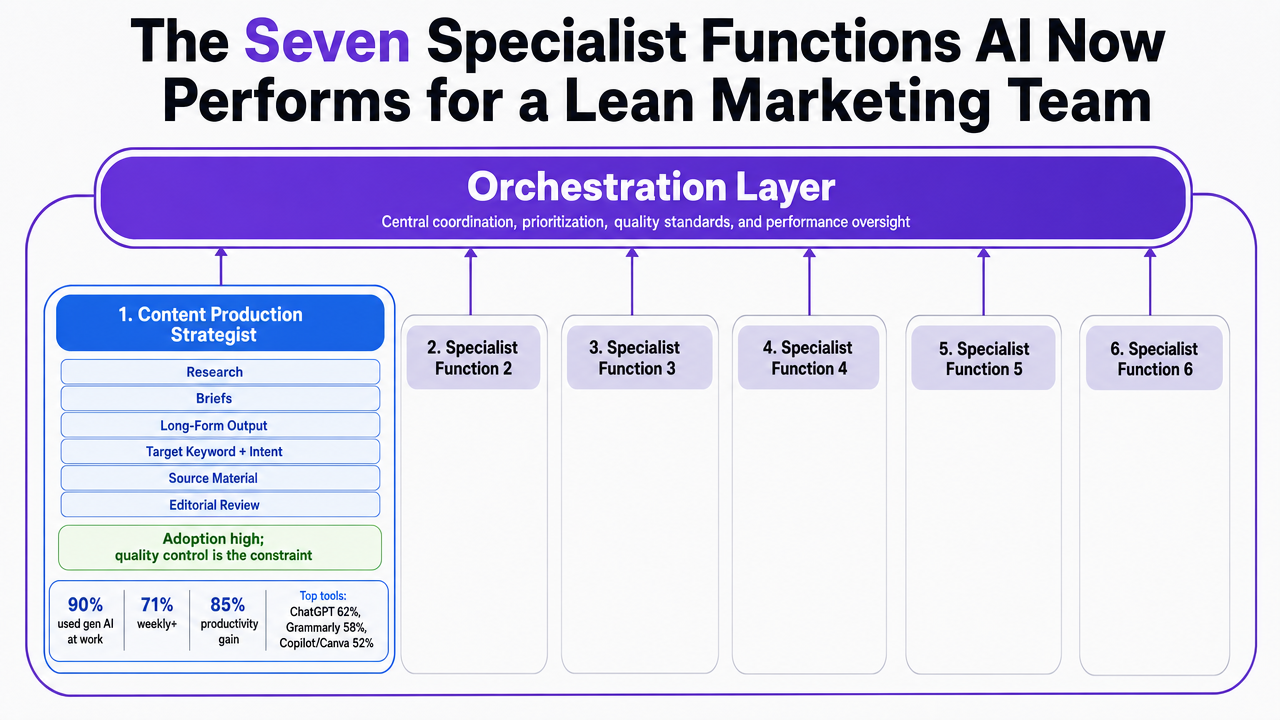 Visualize the seven specialist functions described in this section as a coordinated operating model, with the orchestration layer governing the six specialist functions that feed it
Experience AI-driven marketing execution firsthand today
Test a complete AI marketing workflow and publish live campaigns without risk or commitment.
The Productivity Math a CFO Will Actually Accept
A CFO does not approve tools. A CFO approves labor arbitrage with a defensible model behind it. The Wharton Budget Model's 2025 productivity analysis puts average labor-cost savings from current generative AI tools at roughly 25%, projected to rise to about 40% as workflows mature 7. That is the range a marketing VP should walk into a budget meeting with, because it is grounded, sourced, and unhyped.
The same analysis compiles real-world studies of generative AI performance showing task-level gains between about 10% and 55% 7. Marketing sits toward the higher end of that band for structured tasks like drafting, variant generation, and research synthesis, and toward the lower end for judgment-heavy work like brand positioning and creative direction. A defensible model averages the two rather than cherry-picking the ceiling.
The math a CFO will accept looks like this: take fully loaded cost of the specialist work being displaced or compressed, apply a 25% savings assumption in year one and 40% by year three, subtract platform cost, and show the delta net of retained human review time. Anything above that assumption needs a case study, not a pitch deck.
If You Manage Multiple Locations: Consolidation Economics for a Distributed Operator
Where Multi-Location Stacks Accumulate Cost and Coordination Overhead
The reader frame shifts here. Up to this point the argument has been written for a VP running a single-brand marketing team. Multi-location operators, from dental groups and DSOs to home services rollups, senior living portfolios, and behavioral health networks, carry a different cost structure that a single-site tool comparison misses.
Coordination overhead compounds per location, not per tool. A DSO with 40 practices does not buy one SEO subscription and one social scheduler; it buys location-specific reporting seats, listing management for every address, review response coverage across dozens of profiles, and paid campaign structures that segment by market. Each function that a single-site team runs as one workflow becomes 40 parallel workflows, and the person managing that fan-out is usually the VP or a marketing operations lead pulled off strategic work.
Duke's CMO Survey puts martech at 19.9% of the marketing budget today, projected to reach 30.9% within five years 6. For distributed operators, that share climbs faster because per-location seat costs and listing fees scale linearly with footprint while pipeline gains do not.
Point-Tool Stack vs. Unified Execution Platform: An Illustrative Comparison
The comparison below is illustrative, not a quote. Named per-tool prices for competitors are shown as ranges because vendor pricing varies by seat count, location count, and contract term. The only concrete anchor is the $599 per month trial pricing disclosed by Vectoron.
Duke's CMO Survey data frames the trajectory: martech spend at 19.9% of marketing budget today, climbing to a projected 30.9% within five years 6. That growth curve is why the stack composition decision matters more each budget cycle for distributed operators.
| Function | Point-tool stack (illustrative monthly range) | Unified execution platform (anchor) |
|---|---|---|
| Content production tool | $50–$500 per seat | Included in single platform subscription; Vectoron trial disclosed at $599/mo |
| SEO platform | $100–$800 per account | |
| Paid media management layer | $200–$1,500 per account | |
| Link and citation tool | $100–$600 per account | |
| Social scheduler and listener | $100–$800 per account | |
| Call intelligence platform | $150–$1,000 per account | |
| Orchestration and approval layer | Typically absent; VP absorbs the coordination | |
| Part-time contractor to glue it together | $2,000–$6,000 | Reduced or removed |
Two costs do not appear on any invoice. The first is switching cost between tools, measured in context loss per approval cycle. The second is the VP's time spent as the human integration layer, which the McKinsey scaling data suggests is where most AI value quietly leaks out 1. A unified platform's economics only work if it collapses both invisible costs, not just the visible seat fees.
The Regulated-Vertical Wrinkle: Legal, Dental, Behavioral Health, Senior Living
Consolidation economics look cleaner on a spreadsheet than in a legal or clinical setting. Operators in behavioral health, dental, senior living, and legal work under substantiation rules that make unreviewed AI output a liability, not just a quality risk. USC Annenberg's analysis of AI in healthcare communications notes that tools in regulated verticals have to be purpose-built for the compliance environment, with virtual agents delivering medically accurate, reviewed information rather than freely generated copy 5.
What this changes in a stack decision is the weight given to the approval layer:
- A behavioral health group cannot let a social scheduler auto-post treatment claims.
- A DSO cannot let a review-response bot make outcome promises.
- A law firm cannot let a content tool publish jurisdictional advice without attorney sign-off.
The consolidation math still favors a unified platform for these operators, but only if the platform routes every output through a named human approver before publication. Tools without that gate cost less on paper and more in exposure.
See How Leading Teams Orchestrate AI Marketing Without Expanding Headcount
Request a demo of coordinated, approval-first AI marketing workflows proven to increase pipeline efficiency across content, SEO, and paid channels—no vendor sprawl or hiring required.
A Stack-Consolidation Framework for the Next Budget Cycle
A useful consolidation framework sorts every current tool into one of four buckets before any renewal conversation starts. The buckets are:
- Keep and expand
- Keep and cap
- Absorb into a platform
- Retire outright
The decision rule for each bucket is whether the tool's output reaches a customer without a human approval step, and whether its data flows into the same queue the VP already uses to prioritize work.
Tools in the keep-and-expand bucket are usually paid media platforms and call intelligence, because their outputs are directly measurable against revenue and their optimization loops improve with more data. Tools in the keep-and-cap bucket are typically SEO platforms with mature AI layers already embedded, where switching cost exceeds marginal gain. The absorb bucket is where most stacks lose money: standalone content generators, social schedulers, and citation managers that each carry seat fees and produce output no one has time to review. The retire bucket contains any tool used less than weekly by a named owner.
Wharton's executive survey found 88% of leaders plan to increase AI spending in the next year 3. That spending compounds only when the orchestration layer is chosen first and the six specialist functions are selected to feed it, rather than the other way around.
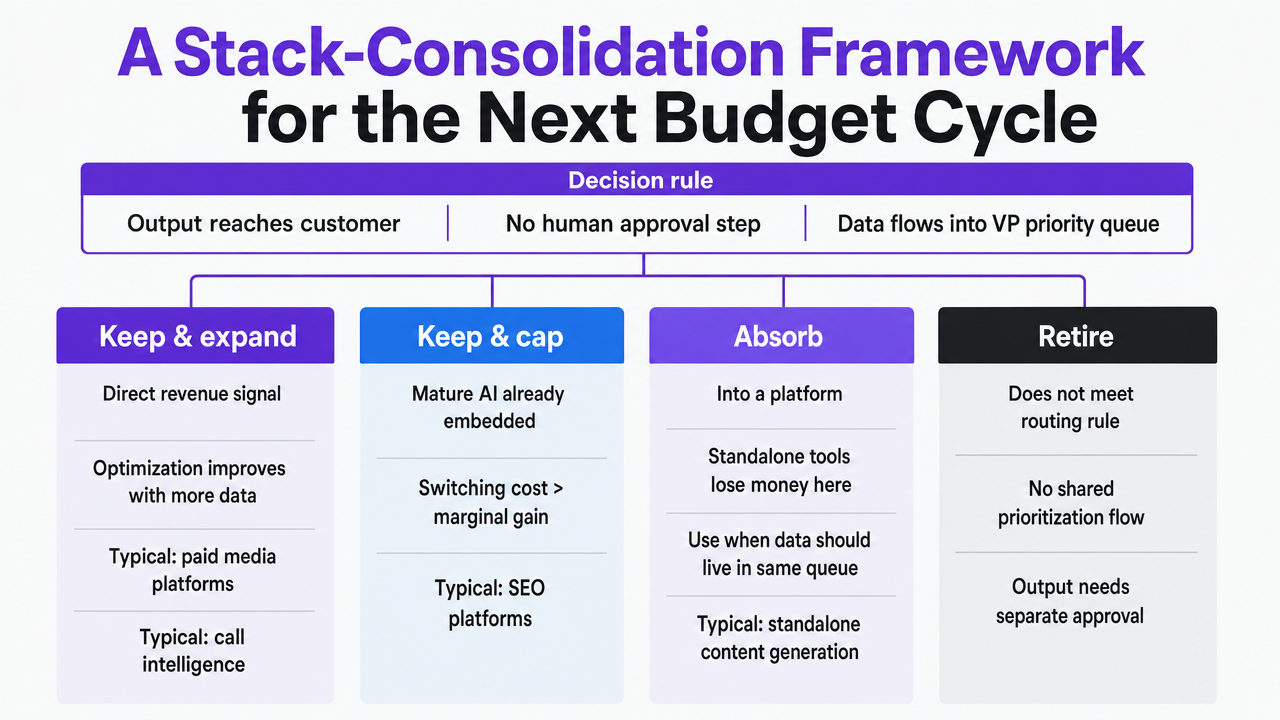 Visualize the four-bucket consolidation decision framework described in this section (keep and expand, keep and cap, absorb, retire) with the decision rule and example tools per bucket
What to Buy First, What to Retire, and Where Vectoron Fits
The sequencing question matters more than the shortlist. Buy the orchestration and approval layer first, then select the six specialist functions that feed it. That order looks backwards to most stacks, which grow by adding a content tool, then an SEO tool, then a scheduler, and finally realize no queue governs them.
Retire whichever tools sit unused by a named owner on a weekly basis, and any content generator whose output still needs a full rewrite before it ships. Cap SEO platforms with mature embedded AI rather than replacing them. Expand paid media and call intelligence, because both produce revenue-attributable data that improves every other decision in the stack.
Vectoron is built for the orchestration slot: six specialist strategists routed through a single Command Center that reads live signals, ranks work, and requires human approval before anything executes. That is the layer the McKinsey scaling data suggests most teams are missing 1.
Frequently Asked Questions
References
- 1.The State of AI: Global Survey 2025.
- 2.AI for small business.
- 3.How Are Companies Using Gen AI in 2025?.
- 4.Generative AI Takes Off with Marketers.
- 5.AI's power and potential pitfalls in revolutionizing healthcare communications.
- 6.The CMO Survey: Marketers Spend on New Technologies as They Battle Usage and Impact.
- 7.The Projected Impact of Generative AI on Future Productivity Growth.
- 8.The economic potential of generative AI: The next productivity frontier.
- 9.The 2025 AI Index Report.