
Key Takeaways
- HubSpot Marketing Hub fits teams already in its CRM, covering web, form, and CRM signals natively, but calls require integrations and AI recommendations lack a structured approval queue.
- Dreamdata excels at account-level B2B journey stitching with ML-weighted multi-touch attribution, though call conversations are not analyzed natively and no approval workflow ships with the platform.
- CallRail with Conversation Intelligence captures the phone signal most stacks ignore, transcribing and tagging calls in one to three weeks, but attribution stays last-touch or multi-touch rather than causal.
- Invoca scores every inbound call against revenue-likelihood criteria and pushes that signal back into ad platforms and CRMs, closing the loop service businesses typically leave open.
- Bizible (Adobe Marketo Measure) brings algorithmic attribution and a unified data layer for enterprise Adobe shops, but eight to sixteen week implementations and no native approval workflow limit speed-to-proof.
- Vectoron reads web, form, call, and CRM in one model with a causal attribution layer and routes AI recommendations through a native approval queue, fitting multi-location operators needing governance without engineering builds.
Why most attribution stacks fail the boardroom test
The CFO does not want a session count. The CRO does not want a ranking report. Both want to know which marketing dollars produced closed revenue last quarter, and most demand gen managers cannot answer that question with the tracking stack they inherited.
McKinsey's 2023 global survey of AI adoption captured the scale of the gap. Only 23 percent of respondents reported that at least 5 percent of their organization's EBIT was attributable to AI use, a figure that stayed essentially flat against prior years 4. The survey measured how executives themselves credited AI for earnings, not what AI technically produced, so the number reflects what leadership teams can defend with their current measurement frameworks. The other 77 percent are running AI somewhere in the business and cannot tie it to material profit.
That gap is a measurement problem more than an AI problem. Most attribution stacks were built for clicks and sessions, then patched with form fills and a CRM sync. They miss the signals that actually carry revenue intent in service businesses and mid-market B2B: phone calls, booked consultations, and CRM stage changes that happen weeks after the first touch. McKinsey notes that fragmented data and siloed operating models continue to limit the accuracy of personalization and attribution measurement across marketing functions 10.
The tools below are scored on one question: can a demand gen manager use this to show, line by line, which channels created closed-won revenue?
What 'AI mode tracking' actually means in 2025
The phrase gets used loosely. In practice, an AI mode tracking tool does three things a standard analytics platform does not: it ingests live revenue signals across channels, applies a model that estimates contribution rather than just the last click, and outputs that contribution at the level of a specific campaign, keyword, asset, or conversation.
The signals matter as much as the model. A revenue-grade stack reads web sessions, form submissions, inbound and outbound phone calls, chat transcripts, booked appointments, and CRM stage changes from opportunity through closed-won. Calls are the layer most teams skip. In service verticals where a meaningful share of qualified inquiries arrive by phone, leaving them out of the model means the channels that drive them get undercounted in every board review.
The model layer is where 2025 tools separate from 2018 tools. Last-touch attribution still ships as a default in most platforms because it is cheap to compute and easy to explain. Multi-touch models distribute credit across touchpoints using fixed rules. Causal machine learning estimates incremental lift, the closer answer to what a CFO actually asks: what would have happened without this campaign. A peer-reviewed study applying causal ML to a retailer coupon program found these techniques estimated campaign uplift more accurately than traditional observational analysis 7.
McKinsey notes that gen AI in B2B sales now powers opportunity scoring and next-best-action recommendations directly tied to win rates 9. That is the operating definition: a tool that scores live signals against revenue outcomes, not one that summarizes dashboards.
The scoring rubric: five criteria that decide revenue-grade tools
Signal coverage across web, form, call, and CRM
A tool can only attribute revenue to signals it actually reads. The first cut on any shortlist is whether the platform ingests four streams in one model:
- web sessions and source data
- form submissions with hidden UTM and referrer fields
- inbound and outbound phone calls with transcripts
- CRM stage changes through closed-won
Tools that score well on web and form but treat calls as a separate dashboard force the demand gen manager back into spreadsheet reconciliation every quarter.
McKinsey notes that fragmented data and siloed operating models continue to limit the accuracy of attribution and personalization measurement 10. Coverage gaps are the most common reason a board-ready revenue chart never gets built.
Attribution model: last-touch, multi-touch, or causal ML
The model decides what the number means. Last-touch credits the final click before conversion and systematically undercounts upper-funnel content, branded search, and inbound calls that follow a long research path. Multi-touch distributes credit across recorded touchpoints using fixed weights, which is more honest but still rule-based.
Causal machine learning estimates incremental lift by comparing observed outcomes against modeled counterfactuals. For a demand gen manager defending budget reallocation, that distinction matters: a CFO can challenge a multi-touch weighting scheme, but a causal estimate answers the only question that counts, which is what would have happened without the spend.
Tools that ship only last-touch should be scored as reporting platforms, not attribution platforms.
Time-to-first-revenue-proof and approval workflow fit
The third criterion is operational. How many weeks until the tool produces a chart a demand gen manager can put in front of finance? Platforms requiring a custom data warehouse, identity resolution build, and CRM field remapping often quote six-month implementations. That timeline kills the budget defense the tool was bought to support.
Approval workflow fit is the companion question. McKinsey's B2B sales research notes that gen AI recommendations without guardrails risk misaligning with brand or compliance requirements 9. Tools that auto-execute bid changes, audience swaps, or outreach without a human sign-off step create exposure in regulated verticals. The rubric rewards platforms that route AI-generated recommendations through an approval queue with the strategic reasoning attached, so the demand gen manager owns the call and the audit trail.
Track and Attribute Revenue Impact Instantly
Validate your marketing’s closed revenue contribution using real campaign data before making a commitment.
The six tools scored against the rubric
Comparison matrix: how the six tools stack up
The matrix below scores each platform against the four rubric criteria a demand gen manager will defend in front of finance: signal coverage across web, form, call, and CRM; attribution model type; time-to-first-revenue-proof; and approval workflow fit. The model column matters most, as tools that still ship only last-touch are scored as reporting platforms rather than revenue attribution platforms.
| Tool | Signal coverage | Attribution model | Time-to-proof | Approval workflow |
|---|---|---|---|---|
| HubSpot Marketing Hub | Web, form, CRM; call via integration | Multi-touch | 2–6 weeks | Limited |
| Dreamdata | Web, form, CRM; call via integration | Multi-touch with ML weighting | 4–8 weeks | None native |
| CallRail | Call-first; web and form via integration | Last-touch and multi-touch | 1–3 weeks | Limited |
| Invoca | Call-first; web, form, CRM via integration | Multi-touch with ML scoring | 3–6 weeks | Partial |
| Bizible (Marketo Measure) | Web, form, CRM; call via integration | Multi-touch and algorithmic | 8–16 weeks | None native |
| Vectoron | Web, form, call, CRM in one model | Multi-touch with causal layer | 2–4 weeks | Native approval-first |
HubSpot Marketing Hub with AI attribution
HubSpot is the default entry for teams already running its CRM. Marketing Hub Enterprise ships multi-touch attribution reports out of the box, with credit distributed across recorded touchpoints using rule-based and AI-assisted models. The platform reads web sessions, form submissions, email engagement, and CRM stage changes natively, which covers three of the four signals on the rubric.
The call layer is the gap. HubSpot supports inbound and outbound calls through integrations with CallRail, Aircall, and similar partners, but call transcripts and conversation intelligence sit outside the native attribution model. A demand gen manager running a service business with meaningful phone volume will need to bolt that layer on and reconcile two reporting surfaces.
Time-to-proof is short for teams already in HubSpot. Multi-touch reports populate within weeks of turning on tracking and connecting ad accounts. Approval workflow fit is limited. HubSpot automates workflow steps and lead routing, but AI-generated recommendations on budget reallocation or audience changes do not route through a structured sign-off queue. For teams in regulated verticals, that gap matters more than the feature checklist suggests.
Dreamdata for B2B multi-touch revenue attribution
Dreamdata is built for B2B teams that need to connect every marketing touch to a closed-won opportunity in the CRM. The platform stitches web sessions, form fills, ad clicks, email engagement, and CRM stage changes into account-level journeys, then applies multi-touch models with machine-learning weighting to distribute credit across the path.
The strength is depth on the journey itself. Dreamdata models long B2B cycles where a single account touches dozens of assets across months, which is exactly where last-touch attribution breaks. McKinsey's research on gen AI in B2B sales identifies opportunity scoring and next-best-action as priority use cases tied to win-rate improvement 9, and Dreamdata's account-level scoring fits that pattern.
The call signal is the weak point. Dreamdata integrates with call tracking platforms but does not analyze conversations natively, so qualified-call data has to arrive pre-scored from a separate system. Time-to-proof runs four to eight weeks once CRM and ad accounts are connected. There is no native approval workflow for AI-generated recommendations, so governance has to live in the demand gen manager's process rather than the tool.
CallRail with Conversation Intelligence
CallRail leads with the signal most attribution stacks ignore. The platform tracks inbound calls back to the campaign, keyword, ad, or landing page that produced them, then applies AI to transcribe and tag the conversation. Conversation Intelligence flags qualified leads, identifies missed opportunities, and surfaces intent signals from the call itself, which is the closest most teams get to scoring a phone inquiry the same way they score a form fill.
The American Hospital Association, citing McKinsey research, reports that generative AI has lifted call center productivity by 15 to 30 percent in the contexts studied 1. This indicates the scale of operational gain available when phone interactions are read at volume rather than sampled by hand.
The trade-off is the opposite of Dreamdata's. CallRail is call-first and integrates with web analytics, CRM, and ad platforms to round out coverage. Attribution models are last-touch and multi-touch rather than causal. Time-to-proof is fast, typically one to three weeks. Approval workflow fit is limited to lead routing rules and basic alerting.
Invoca for AI-driven call attribution and scoring
Invoca targets the upper end of the call intelligence market. The platform applies signal-level AI to score every inbound call against revenue-likelihood criteria the demand gen team defines, then routes that score back into ad platforms, CRMs, and bid management tools. The output is a phone signal that can be fed into Google Ads or Salesforce the same way a form conversion is, which closes the loop most service businesses still leave open.
The scoring layer maps to the use cases McKinsey identifies for gen AI in B2B sales, including opportunity scoring and next-best-action 9. Invoca's strength is treating each call as a structured event with a revenue probability, not a transcript to read later.
Coverage on web, form, and CRM signals comes through integrations rather than native ingestion, so the platform sits alongside an analytics stack rather than replacing it. Attribution models combine multi-touch with ML scoring on the call event itself. Time-to-proof runs three to six weeks. Approval workflow fit is partial: Invoca supports rules and alerts, but cross-channel recommendations still require manual reconciliation.
Bizible (Adobe Marketo Measure) for enterprise B2B
Bizible, now branded as Adobe Marketo Measure, is the enterprise option. The platform applies multi-touch and algorithmic attribution across web, form, ad, and CRM signals, with custom models that can weight touchpoints based on observed influence on pipeline and closed-won revenue. For organizations already standardized on Adobe Experience Cloud, the data plumbing is shorter.
The platform's algorithmic model is its strongest claim against the rubric. McKinsey's work on personalized marketing notes that fragmented data and siloed operating models limit attribution accuracy 10, and Marketo Measure addresses that by forcing a unified data layer across the Adobe stack. The depth comes at a cost. Time-to-proof typically runs eight to sixteen weeks because identity resolution, CRM field mapping, and model calibration take real engineering time.
Call signal is handled through integrations rather than native ingestion. Approval workflow fit is not a Marketo Measure strength; the tool reports on attribution but does not route AI-generated recommendations through a structured sign-off queue. The platform fits enterprise teams with engineering support and a long planning horizon.
Vectoron for AI execution plus call intelligence in one approval workflow
Vectoron enters the matrix as a category entry rather than a point tool. The platform reads four signal streams in one model: web sessions, form submissions, recorded phone calls with AI-tagged qualification, and CRM stage changes through closed-won. The call intelligence layer reads recordings, tags qualified inquiries, and flags missed opportunities, so phone signal arrives in the same attribution view as form and ad data rather than in a separate dashboard.
Attribution combines multi-touch credit distribution with a causal layer that estimates incremental lift on specific campaigns. This approach reflects academic findings that causal ML estimates campaign uplift more accurately than observational analysis 7, directly addressing the demand gen manager's board questions.
The differentiator on the rubric is approval workflow. AI-generated recommendations on budget reallocation, audience changes, content priorities, and call-handling fixes route through a structured sign-off queue with the strategic reasoning attached. Nothing executes without human approval. Time-to-proof runs two to four weeks once data sources are connected. The platform fits multi-location service operators and mid-market B2B teams that need governance without an engineering build.
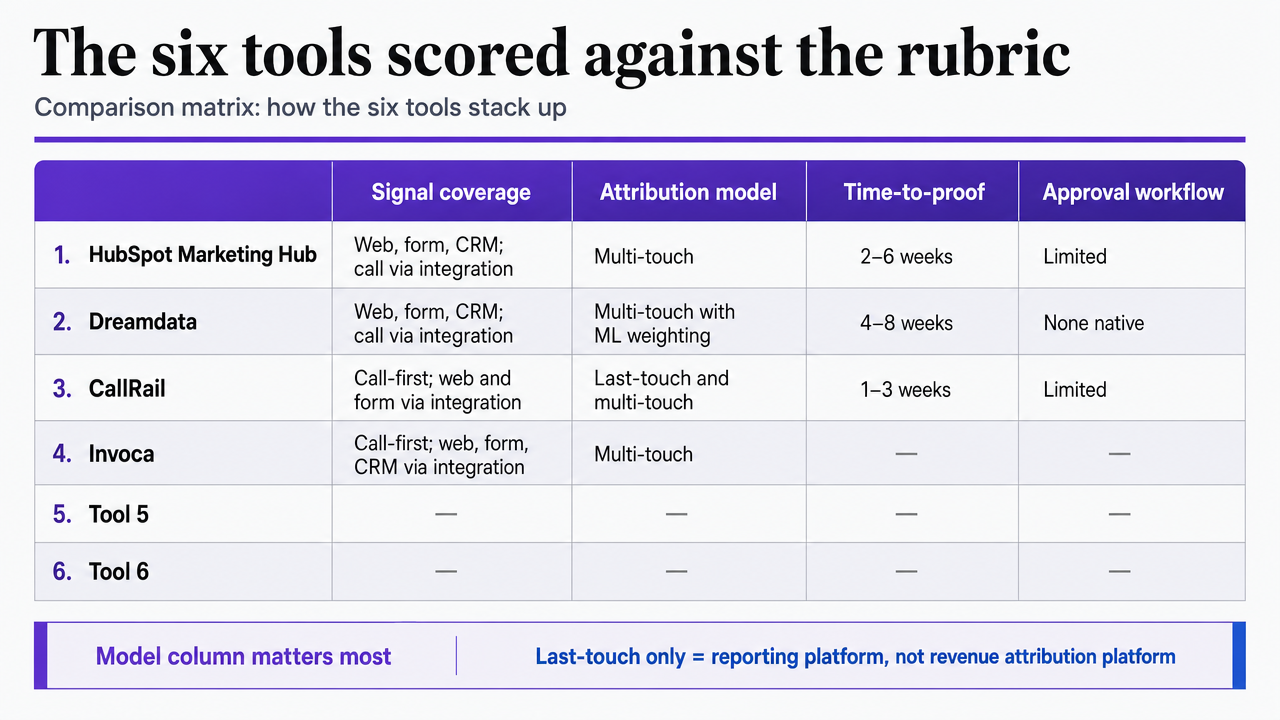 Visualize the six-tool comparison matrix already cited in the section, giving readers a scannable side-by-side of signal coverage, attribution model, time-to-proof, and approval workflow
If you manage multiple locations: per-location call economics
The framing shifts here from single-team B2B to multi-location service operators running ten, fifty, or two hundred sites under one marketing budget.
At that scale, the rubric criteria stay the same, but the math changes. Phone signal is no longer one channel among many. It is the dominant intake path at most individual locations, and the variance between sites is where revenue leaks. A demand gen manager covering a dental group, a behavioral health network, or a home services brand needs per-location call data, not a rolled-up national average that hides the worst-performing front desks.
The economics are best expressed as variables a finance partner can populate from internal data, not invented benchmarks. The per-location monthly cost of missed qualified calls follows a simple formula:
| Variable | Source |
|---|---|
| Monthly missed qualified calls per location | Call intelligence platform |
| Historical close rate on answered qualified calls | CRM |
| Average customer value or first-year revenue | Finance |
| Locations in the portfolio | Operations |
Multiplying the first three yields the revenue at risk per location per month. Multiplying by location count produces the portfolio figure. McKinsey's work on personalized marketing notes that fragmented data and siloed operating models limit attribution accuracy 10, and the same fragmentation hides per-location call leakage in roll-up reports. Scoring tools on whether they expose call performance at the site level, not just the brand level, is the operational takeaway.
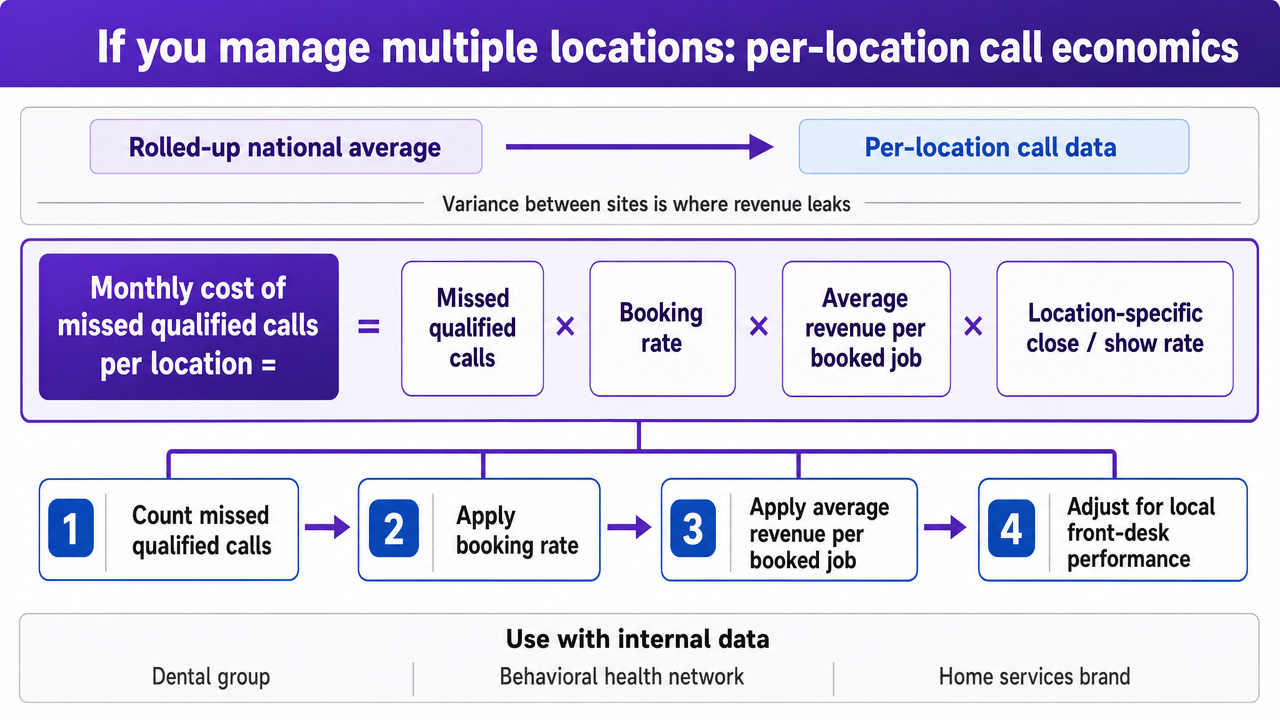 Turn the cited four-variable formula into a clear process infographic so multi-location operators can apply it directly with their own data
See How Leading Teams Attribute Revenue with AI Mode Tracking
Connect with our experts to review real implementation data, benchmark your current tracking setup, and identify measurable ways to improve attribution accuracy across your pipeline.
Governance, explainability, and the human-in-the-loop question
Compliance will ask three questions before signing off on any AI mode tracking tool, and the demand gen manager needs answers ready:
- What data does the model read?
- How does it explain its scoring decisions?
- Who approves the actions the model recommends?
The explainability question hits hardest when the tool scores calls or leads on revenue likelihood. A peer-reviewed analysis of AI in healthcare flagged opacity, lack of explainability, and possible bias as the core governance risks that have to be addressed through structured oversight 5. The same logic applies outside healthcare. If an AI tool downgrades a lead source or reallocates spend away from a campaign, the demand gen manager has to be able to explain why to a CMO or a CFO, not point at a black box.
Human-in-the-loop design is the practical answer. McKinsey's analysis of gen AI in B2B sales notes that recommendations without guardrails risk misaligning with brand strategy or compliance requirements 9. Tools that route AI-generated scoring changes, budget shifts, and outreach decisions through a structured approval queue keep the audit trail with a named person. That structure is non-negotiable in law firms, behavioral health networks, dental groups, and senior living operators, where the same call data that feeds attribution often carries regulated information.
Picking the tool you can defend in next quarter's board review
The shortlist gets shorter once the rubric is applied. Tools that read only web and form signals cannot answer the question a CRO actually asks, because phone and CRM stages carry too much of the revenue path to sit outside the model. Tools that ship only last-touch attribution generate reports, not defensible revenue claims, and the causal ML literature has been clear for years that observational last-click analysis systematically misestimates campaign uplift 7.
Three operating filters narrow the choice:
- Which signals does the platform read natively versus through integrations the demand gen team has to maintain?
- Does the attribution model estimate incremental lift or just distribute credit by rule?
- Do AI-generated recommendations route through a structured approval queue with the strategic reasoning attached, or do they execute on their own?
The board review answers itself when those three filters are honest. The chart in the deck shows closed-won revenue by channel, the model behind it is defensible to finance, and the audit trail names the person who approved each change. That is the standard Vectoron and the other revenue-grade entries on this list should be measured against.
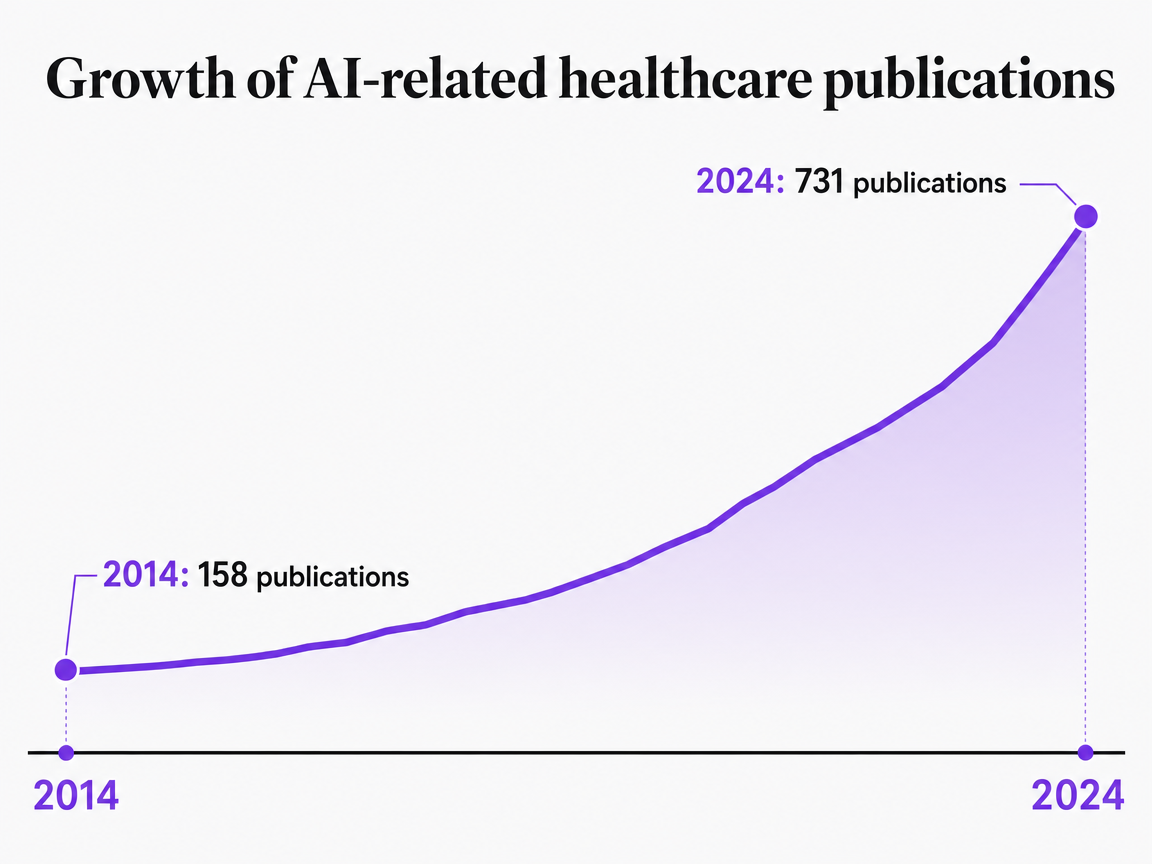 Growth of AI-related healthcare publications
Shows the number of AI-related publications in healthcare in 2014 versus 2024, indicating accelerating research interest.
Frequently Asked Questions
References
- 1.3 Ways AI Can Improve Revenue-Cycle Management.
- 2.The Impact of Artificial Intelligence on Healthcare.
- 3.Why AI is Such a Promising Tool for Eliminating a Hospital’s Revenue Leakage.
- 4.The state of AI in 2023: Generative AI's breakout year | McKinsey.
- 5.Ethical and Legal Challenges of Artificial Intelligence-Driven Healthcare.
- 6.The Legal Implications of Using AI and Algorithms to Combat Health Care Fraud and Administrative Waste.
- 7.How causal machine learning can leverage marketing strategies.
- 8.An unconstrained future: How generative AI could reshape B2B sales.
- 9.Unlocking profitable B2B growth through gen AI in sales.
- 10.The next frontier of personalized marketing.
- 11.Marketing and sales soar with generative AI | McKinsey.