
Key Takeaways
- SERP volatility watch tools like Semrush Sensor triage the day's monitoring load, showing when a rank dip is Google-wide weather versus a site-specific incident worth an analyst's hour 3.
- AI answer-engine capture across ChatGPT, Perplexity, Gemini, and Google AI Overviews requires 500 queries per platform per month per client, making 2,000 the trend-reliable floor before sampling quietly fails 6.
- Monitoring cost math breaks around 25 clients, where 50,000 monthly queries consume a full-time analyst before any recommendation is drafted, making automated triage non-negotiable past that mark.
- Unified SEO platforms move action routing by pulling answer-engine signals into the same view as rank, traffic, and content workflow, so strategists stop context-switching between dashboards 7.
- Execution-linked monitoring closes the loop from detected signal to approved, shipped work, compressing the analyst-to-strategist handoff that erodes margin per account in traditional stacks 9.
- Multi-location and regulated vertical clients multiply the query floor by location, pushing a 40-office legal account to 80,000 monthly queries and eliminating tools priced by seat or tracked keyword 6.
- A weighted rubric scoring query coverage (30%), time-to-signal (25%), action routing (20%), and margin per account (25%) survives a 40-client portfolio where feature grids collapse.
- Pilot three tools in parallel over 90 days against five representative accounts, then cut the lowest scorer rather than delaying selection for the next algorithm cycle.
Why monitoring became the bottleneck in agency SEO delivery
Delivery teams used to fail on production. A brief stalled, a writer missed a deadline, a dev queue swallowed a technical fix. Those bottlenecks still exist, but they are no longer the constraint that decides whether an agency keeps a client. The constraint has moved upstream, to the moment a signal appears and the analyst-hours required to turn it into a client-approved action.
Two forces created the shift. Search results now fragment across Google's classic SERP, AI Overviews, ChatGPT, Perplexity, and Gemini, each with its own volatility profile and citation logic. And generative AI moved from experiment to standard operating practice, with 65% of organizations reporting regular use of gen AI in McKinsey's 2024 global survey 8. Client expectations followed. A ranking dip that used to warrant a note in the next monthly report now triggers a same-week question about AI visibility across four surfaces.
That is why the observability discipline is no longer confined to infrastructure teams. The observability tools and platforms market was valued at USD 2.5 billion in 2023 and is projected to grow at a CAGR of over 10.5% through 2032 4. SEO monitoring is joining that parent trend, inheriting its vocabulary and its operator posture. For a Head of SEO running dozens of accounts, the question is no longer which rank tracker to buy. It is which monitoring layer compresses the time between signal and shipped work.
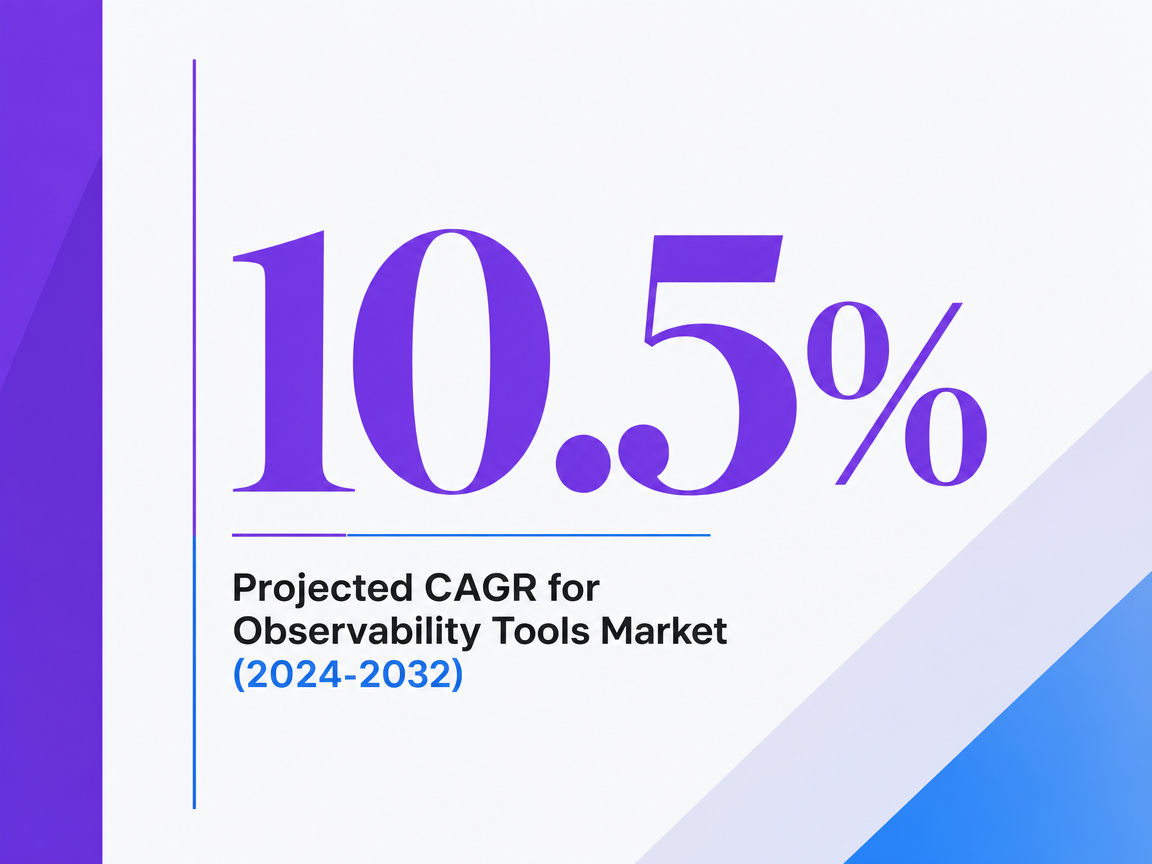 Projected CAGR for Observability Tools Market (2024-2032)
Projected CAGR for Observability Tools Market (2024-2032)
Four operator metrics that separate reporting toys from production infrastructure
Query coverage per client
Coverage is the first filter because it decides whether a tool can even see the surface where a client is losing visibility. A dashboard that samples 50 branded queries against Google is not monitoring, it is confirmation bias with a chart. Lafferty's benchmark for meaningful trend lines across AI answer engines is at least 500 queries per platform per month 6. Multiplied across ChatGPT, Perplexity, Gemini, and Google AI Overviews, that is a 2,000-query floor per client before traditional SERP coverage is added on top.
For a portfolio of 40 mid-market clients, coverage math ceases to be a feature question and becomes a procurement question. Tools that price by query volume or platform surface will show their real cost here, and tools that cap coverage will silently hide the volatility that matters most.
Time-to-signal
Time-to-signal is the interval between a ranking or citation change and the moment the responsible analyst sees it framed as an action, not a row in a report. Weekly rank pulls, still standard in many agency stacks, are structurally too slow for AI Overview churn. Semrush Sensor and similar volatility indices exist precisely because daily aggregate movement now carries more decision value than a Monday-morning position table 3.
The operator question is not "how often does the tool crawl" but "how quickly does a meaningful change reach a human who can act on it." That includes threshold logic, deduplication of noisy alerts, and correlation with traffic and engagement so the analyst is not chasing a rank drop that never touched revenue 1. Tools that alert on every twitch train teams to ignore alerts.
Action routing
A signal that lands in a shared inbox is not routed, it is buried. Action routing is the metric that measures whether the tool assigns a detected change to a named owner, a defined workflow, and a decision deadline. Most legacy rank trackers stop at the notification. The AI visibility category is moving further, with feature norms now including answer capture, citation tracking, sentiment scoring, and integration into analytics and workflow systems 5.
For an agency Head of SEO, the practical test is whether a Perplexity citation loss on a priority client generates a ticket in the strategist's queue with the query, the competing citation, and a recommended response draft, or whether it generates a Slack ping that dies over the weekend. The gap between those two outcomes is where margin leaks.
Margin per account
Margin per account is the metric that overrides every feature debate. Agencies with ambitious AI programs are reporting the largest revenue benefits in marketing and sales functions 9, but that upside only reaches the P&L when tooling reduces analyst-hours per client rather than adding a new monitoring surface on top of the existing ones. A tool that improves coverage and time-to-signal but doubles the review workload has negative margin impact.
The calculation is direct: fully loaded analyst cost per hour, multiplied by hours spent on monitoring per client per month, divided into the retainer. Tools earn their line item when they compress that ratio. Head of SEOs running 50+ accounts should benchmark this quarterly, because a tool that scaled at 20 clients often breaks the margin model at 60, either through per-seat pricing or through review overhead the vendor did not disclose.
The category map: four operator jobs, not ten feature bullets
Most listicles bury the reader in feature grids. That format collapses under agency workload, because a Head of SEO does not buy features, they buy compression of analyst-hours against a specific operator job. Sorting the market by job clarifies what each tool is actually for and where its ceiling sits.
Four jobs cover the territory.
- SERP volatility watch quantifies short-term rank movement across query groups and surfaces the days when Google itself is unstable 2.
- AI answer-engine capture tracks brand presence, citations, and sentiment across ChatGPT, Perplexity, Gemini, and Google AI Overviews, a category that has productized around answer capture, citation tracking, and sentiment scoring as its baseline feature set 5.
- Unified SEO platforms serve as the system of record where rank, traffic, and workflow live together.
- Execution-linked monitoring closes the loop by routing detected changes into ranked recommendations, human approval, and shipped work.
Each category optimizes a different operator metric. Volatility watch moves time-to-signal. Answer-engine capture moves query coverage. Unified platforms move action routing across teams. Execution-linked monitoring moves margin per account. A tool bought against the wrong job will underperform even when its feature list looks strong.
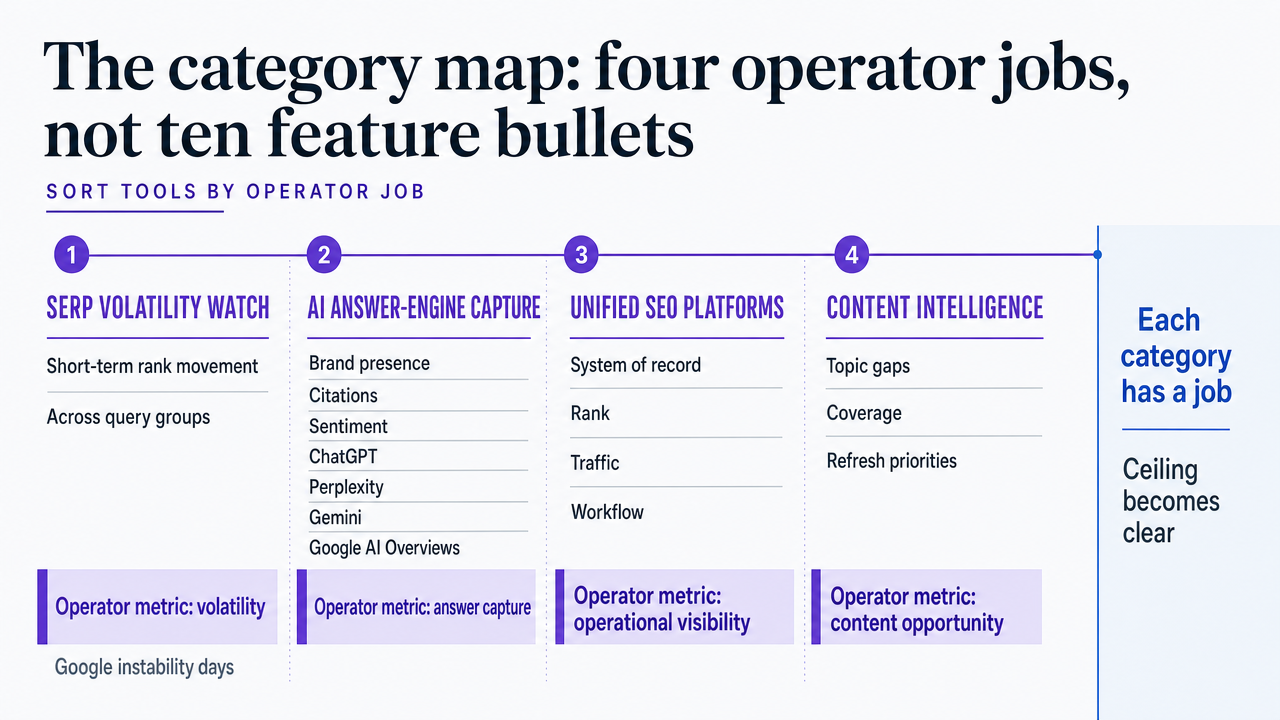 Visualize the four operator jobs framework introduced in this section, showing how each category maps to a specific operator metric
SERP volatility watch: Semrush Sensor and the volatility-index category
Volatility indices exist because a single client's rank drop rarely means what a client thinks it means. Semrush Sensor treats aggregate SERP movement as a first-order signal, giving analysts an index that quantifies how much Google is churning on a given day across search engines and verticals 3. When the index spikes, a coordinated ranking dip across a portfolio is weather, not a technical fault. When it stays flat and one client still slides, the problem is site-specific and worth an analyst's hour.
FourFront's formal definition is useful for the reader who has to defend the framework internally: SERP volatility is a measurement quantifying short-term rank changes for groups of queries over days to weeks 2. The operational value is triage. A Head of SEO running 60 accounts cannot afford to open every ranking alert with equal urgency, and a volatility score turns the inbox into a queue with clear precedence.
This category's ceiling is also its honesty. Volatility indices tell an analyst that something moved. They do not tell the analyst which query, which landing page, or which competitor took the citation. Tools in this tier work best as the top-of-funnel filter that decides whether the day's monitoring workload is a five-minute scan or a four-hour incident. Pairing the index with keyword-level rank data and traffic correlation is what converts a volatility number into a client-facing action 1.
For agency stacks, the practical placement is upstream of everything else. The volatility index runs first thing in the morning, sets the day's posture, and determines whether the AI answer-engine layer and the unified platform get a routine sweep or an escalation.
Test AI-driven search monitoring across real campaigns
Evaluate measurable SEO impact with live data on your actual client projects during your trial period.
AI answer-engine capture: what a 500-query-per-platform floor actually costs you
The answer-engine layer is where most agency stacks are quietly underinvested. Traditional rank trackers were built for a world with one dominant surface and ten blue links. That world is gone for a growing share of commercial intent queries, and the tools built for it cannot see the citations, sentiment, or brand mentions that decide whether a client shows up inside a ChatGPT reply or a Google AI Overview.
Lafferty puts a concrete floor on what meaningful monitoring looks like: at least 500 queries per platform per month to generate reliable trend lines, paired with real-time answer capture, unlinked citation detection, sentiment scoring, and brand accuracy checks 6. That floor is the sizing anchor every Head of SEO should run their portfolio math against, because the number scales linearly with clients and multiplicatively with platforms.
The arithmetic is unforgiving.
- A single client tracked across ChatGPT, Perplexity, Gemini, and Google AI Overviews requires 2,000 monitored queries per month at the minimum trend-reliable threshold.
- A 10-client book needs 20,000.
- A 25-client mid-size portfolio needs 50,000.
- Fifty clients push the requirement to 100,000 monthly queries.
- A 100-client agency lands at 200,000 across the four answer engines 6.
Those numbers are the volume driver behind every procurement conversation in this category, and they are the reason vendor pricing that looks reasonable at 10 clients often becomes prohibitive at 50.
The feature set the category has standardized around reinforces the volume problem. Answer capture, citation tracking, sentiment analysis, and analytics integrations are now table stakes across the AI visibility tools reviewed in the market 5. What separates production-grade tools from demo-grade ones at agency scale is not the presence of these features but whether the tool can execute all of them across 100,000+ monthly queries without degrading refresh cadence or forcing analysts to sample.
Sampling is where quiet failure happens. A tool that advertises Perplexity coverage but samples 50 queries per client per month across a 25-client portfolio is delivering roughly 5% of the volume Lafferty identifies as the trend-reliable floor 6. The dashboards will look full. The trend lines will be noise. Head of SEOs evaluating this tier should ask for the actual query volume per client per platform in writing, not the marketing page's coverage claim.
Monitoring cost math per client portfolio
The volume math from the previous section becomes a labor math the moment an agency tries to review it. Here is a working model for a Head of SEO to run against their own portfolio, using Lafferty's 500-queries-per-platform-per-month floor across ChatGPT, Perplexity, Gemini, and Google AI Overviews 6. The variables below are labeled assumptions, not vendor pricing.
Assumptions: 500 queries per platform per client per month 6, four AI answer engines tracked, and an analyst review pace of 15 minutes per 100 monitored queries (this rate is an operational assumption the reader should replace with their own team's measured pace). At that pace, one client generates 2,000 monitored queries and roughly 5 hours of monthly review before any traditional SERP work is added.
| Clients | Monthly queries | Analyst hours/mo | Analyst hours/wk ||---------|-----------------|------------------|------------------|| 10 | 20,000 | 50 | ~12.5 || 25 | 50,000 | 125 | ~31 || 50 | 100,000 | 250 | ~62 || 100 | 200,000 | 500 | ~125 |
At 25 clients, monitoring alone consumes close to a full-time analyst before any recommendation is drafted or approved. At 50, it takes 1.5 heads. At 100, three. Those are the inflection points where per-seat tool pricing and manual review workflows stop being additive and start compounding against margin.
The operational conclusion is that tools which do not automate at least the triage step, either through volatility scoring 2, 3or through ranked-recommendation output, cannot hold their line item above the 25-client mark. Head of SEOs should model their own analyst pace against this table before the next renewal cycle and treat the ratio as the primary cost signal, not the vendor's per-seat quote.
Unified SEO platforms: when the monitoring layer has to live inside the system of record
Volatility indices and answer-engine trackers surface signals. A unified SEO platform is where those signals become work assigned to a strategist alongside the rest of the client's organic footprint. Forrester's position is that SEO tooling now functions as a core marketing system rather than a tactical add-on, giving marketers unified visibility, workflow management, and performance tracking across organic channels 7. For an agency Head of SEO, that framing decides whether monitoring runs as a standalone tab or as the top of a workflow that ends in a client deliverable.
The operator metric this category moves is action routing. Rank, traffic, technical health, backlink data, and content briefs already sit in the same platform for most mid-sized agencies. When AI answer-engine signals land in a separate dashboard, strategists context-switch between systems and lose the correlation that makes a signal actionable. Pulling a Perplexity citation loss into the same view as the affected landing page's organic traffic curve and pending content updates is what converts a monitoring alert into a routed ticket.
The ceiling on this category is honesty about what platforms cover natively. Most incumbent SEO platforms bolted AI visibility onto existing rank-tracking architecture, and query coverage across ChatGPT, Perplexity, and Gemini often lags the standalone AI visibility vendors 5. The practical stack for a 40-plus-client portfolio is usually a unified platform as the system of record, with a specialist AI visibility tool feeding it through API. Client reports then aggregate visibility scores and conversion-linked metrics rather than raw rank tables 10, which is the format most agency clients now expect regardless of how many surfaces the underlying monitoring touches.
Execution-linked monitoring: closing the loop from signal to approved action
The three categories above surface signals. This one ships work. Execution-linked monitoring treats a detected volatility spike, a lost Perplexity citation, or a Google AI Overview swap as the trigger for a ranked recommendation that a strategist approves before anything publishes. The operator metric it moves is margin per account, because it collapses the analyst-hours between signal and shipped work into a single governed loop.
The workflow is straightforward on paper and rare in practice.
- Monitoring layer detects a change.
- Volatility scoring 2, 3and traffic correlation 1filter noise from incident.
- A specialist strategist receives a ranked recommendation with the affected query, the competing citation, the priority landing page, and a proposed response.
- A human approves, rejects, or edits.
- Approved work executes.
- KPI impact routes back to the client report as a visibility score movement rather than a raw rank change 10.
The reason this closed loop matters for agency economics is that it removes the two costliest handoffs in traditional monitoring stacks: the analyst-to-strategist briefing and the strategist-to-production queue. McKinsey's 2025 survey found that organizations with ambitious AI programs report the largest revenue benefits in marketing and sales 9, and the mechanism is exactly this compression of the review-to-execution interval. Head of SEOs evaluating this tier should ask vendors to demonstrate the path from a specific signal to an approved, shipped change, timed end-to-end, not just the dashboard.
See How Top Agencies Automate Search Monitoring and SEO Execution
Request a walkthrough of AI-driven search monitoring built for agencies managing multiple clients—track rankings, surface opportunities, and coordinate approvals without growing your team.
If you manage multi-location or high-stakes vertical clients
A shift in scope before this section develops: the reader running a portfolio of law firms with 40 offices, a DSO with 120 practices, or a home services franchisor across three states is not operating on the same monitoring math as a single-brand SaaS account. Query sets fragment across geography, each location generates its own citation pattern in ChatGPT and Perplexity, and the 500-queries-per-platform-per-month floor 6now multiplies by location as well as by client.
A 40-office legal client tracked across four answer engines lands at 80,000 monitored queries per month before any national head-term coverage is added. That volume alone eliminates most tools that price by seat or by tracked keyword rather than by query throughput. Head of SEOs serving behavioral health, senior living, or dental groups should ask vendors for per-location query economics in writing.
Regulated verticals add a second filter. Sentiment scoring and brand accuracy checks 6carry more weight when a Perplexity answer paraphrases a treatment claim or misstates a firm's practice area. Client reports for these accounts should surface visibility scores tied to conversion pages 10, not raw rank across a diluted keyword universe.
A scoring rubric you can run against three tools this quarter
Feature grids do not survive contact with a 40-client portfolio. A working rubric does. The version below scores any candidate tool on the four operator metrics established earlier, weighted for how they actually move agency P&L. Run it against the incumbent rank tracker, one AI visibility specialist, and one execution-linked option before the next renewal.
| Metric | Weight | What to measure ||--------|--------|-----------------|| Query coverage per client | 30% | Actual monthly queries per platform, in writing, against the 500-per-platform floor 6|| Time-to-signal | 25% | Interval from detected change to a framed action, filtered by volatility scoring 3and traffic correlation 1|| Action routing | 20% | Whether signals become owned tickets with recommended responses, not shared-inbox pings 5|| Margin per account | 25% | Analyst-hours per client per month against retainer, benchmarked quarterly 9|
Score each tool 1 to 5 per metric, multiply by weight, and cut anything below 3.5. Client reports should aggregate visibility scores and conversion-linked outcomes rather than raw rank tables 10, which means the rubric's output must map cleanly to what the client already reads on Monday.
The forward decision: what to pilot before the next algorithm cycle
Google will ship another core update. ChatGPT will change how it surfaces citations. Perplexity will renegotiate publisher deals. None of that is a reason to delay tool selection, it is the reason to compress the pilot window to one quarter and run three tools against the same client cohort with the same operator rubric.
A workable pilot picks five accounts that represent the portfolio's coverage complexity, ideally one multi-location legal or DSO client, one behavioral health or senior living account, and three single-brand accounts. Run the incumbent rank tracker, one AI visibility specialist, and one execution-linked platform in parallel for 90 days. Score each on query coverage, time-to-signal, action routing, and margin per account. Cut the lowest.
Agencies that treat monitoring as production infrastructure, not reporting, are the ones with room to shape what execution-linked tooling like Vectoron becomes next.
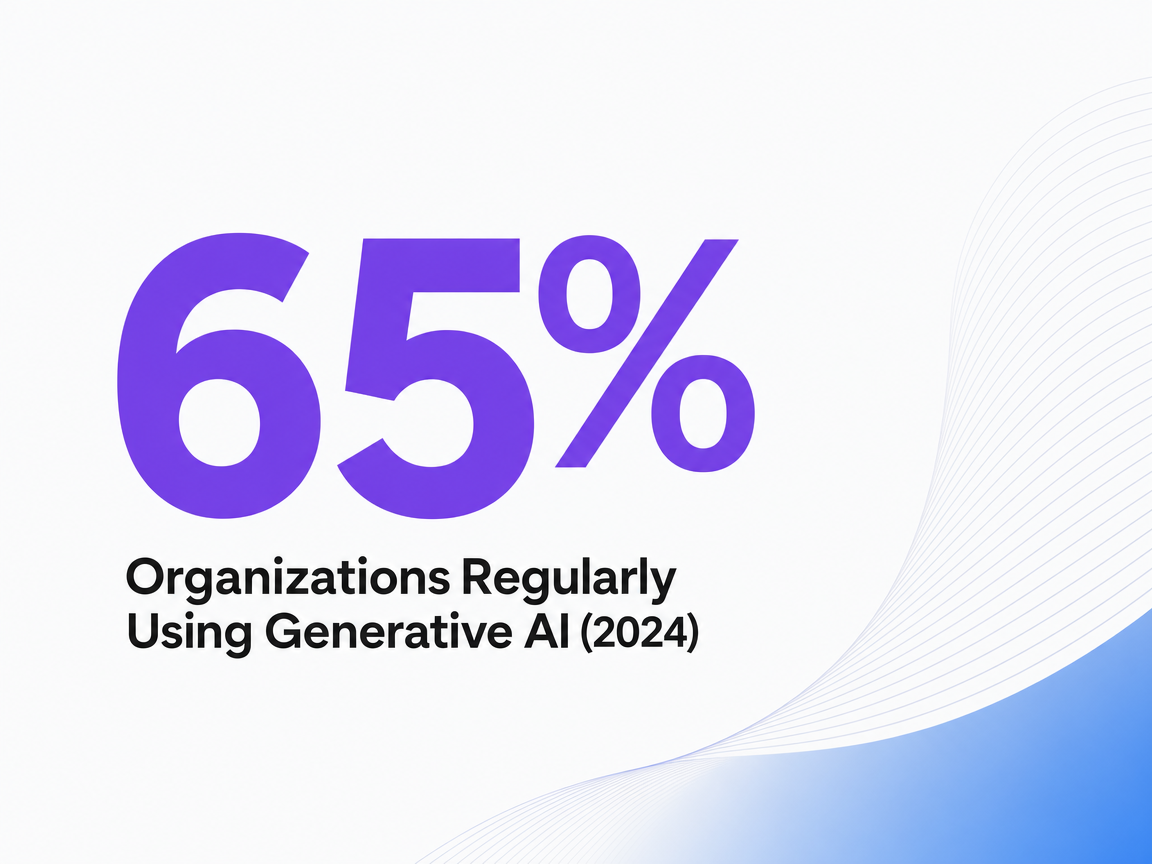 Organizations Regularly Using Generative AI (2024)
Organizations Regularly Using Generative AI (2024)
Frequently Asked Questions
References
- 1.SERP Volatility: How To Deal With SERP Rank Changes.
- 2.What is SERP Volatility and Why Does it Matter?.
- 3.Semrush Sensor: Tracking SERP Volatility.
- 4.Observability Tools and Platforms Market Size, Report 2024-2032.
- 5.The 12 Best AI Visibility Monitoring Tools in 2026.
- 6.Best AI SEO Tools 2026: Top AI Search Monitoring Platforms.
- 7.Every Company Needs An SEO Platform.
- 8.The state of AI in early 2024.
- 9.The State of AI: Global Survey 2025.
- 10.How to Make a Meaningful SEO Report.