
Key Takeaways
- Keyword rank reports no longer answer what clients ask, because AI summaries now dominate the surface buyers actually see when researching brands and competitors.
- AI Overview monitors track Google's generative surface, where a study of 1,000 commercial terms found generative elements displayed on 86.8% of queries 2.
- LLM prompt trackers sample ChatGPT, Perplexity, Gemini, and Copilot on cadence, treating session-level variance as signal averaged across repeated pulls rather than noise 9.
- Hybrid SEO plus AIO platforms consolidate rank tracking with AI Overview detection in one dashboard, but cross-engine LLM sampling depth trails purpose-built specialist trackers.
- Execution-integrated systems route visibility gaps directly into briefs, drafts, and technical tickets through approval workflows, collapsing the analyst distance between detection and shipped fix.
- An agency-scale scorecard weighs multi-client workspace architecture, prompt library governance, citation attribution accuracy, white-label reporting, and handoff to production over solo-consultant feature lists.
- Semrush and Ahrefs extend rank-tracking pipelines into AI Overview detection quickly, but native prompt sampling across ChatGPT, Perplexity, and Gemini remains thinner than specialist tools.
- Profound and Peec AI treat conversational surfaces as the primary measurement object, reporting share of voice inside answers rather than position on results pages.
- Otterly.AI and AthenaHQ differentiate through prompt library versioning and inspectable attribution logic that resolves paraphrased mentions and parent-domain citations defensibly.
- SE Ranking's AI tracker fits mid-market agencies weighting Google visibility, but hits a depth ceiling when reporting shifts to citation share inside conversational answers.
- Vectoron routes visibility signals through a Command Center where ranked recommendations pass human approval before briefs, drafts, and technical fixes execute across the pipeline.
- The tracking-to-execution gap erodes margin because AI Overviews cut organic CTR by 47% on affected pages, and manual remediation across 40 accounts compounds analyst hours 10.
Why keyword rank reports stopped answering the client's real question
The question landing in agency inboxes has changed. Clients no longer open the monthly review by asking where they rank for a head term. They ask whether their brand shows up when a prospect types the same question into ChatGPT, and why a competitor gets cited in the AI Overview above the fold. A blue-link position report cannot answer either question.
The trajectory behind that shift is documented. McKinsey estimates that roughly 50% of Google searches already surface an AI-generated summary, with the share projected to exceed 75% by 2028 as generative interfaces become the default entry point to the web 4. This projection reframes what a rank tracker is actually measuring: a slice of the SERP that continues to shrink beneath the AI answer.
For an agency running 15 to 80 accounts, the operational consequence is immediate. Retainer conversations are no longer defended by position gains on tracked keywords when the tracked keyword returns an AI summary that cites three other domains. Reporting decks built around ranking distributions look increasingly detached from what buyers experience on the page.
Rank tracking still has a job. It measures a diminishing surface accurately. The gap is that clients are asking about a second surface — generative answers across Google, ChatGPT, Perplexity, Gemini, and Copilot — and most agency stacks were built before that surface existed. The rest of this analysis walks through the tool categories that close the gap and the criteria that separate a dashboard from a delivery system.
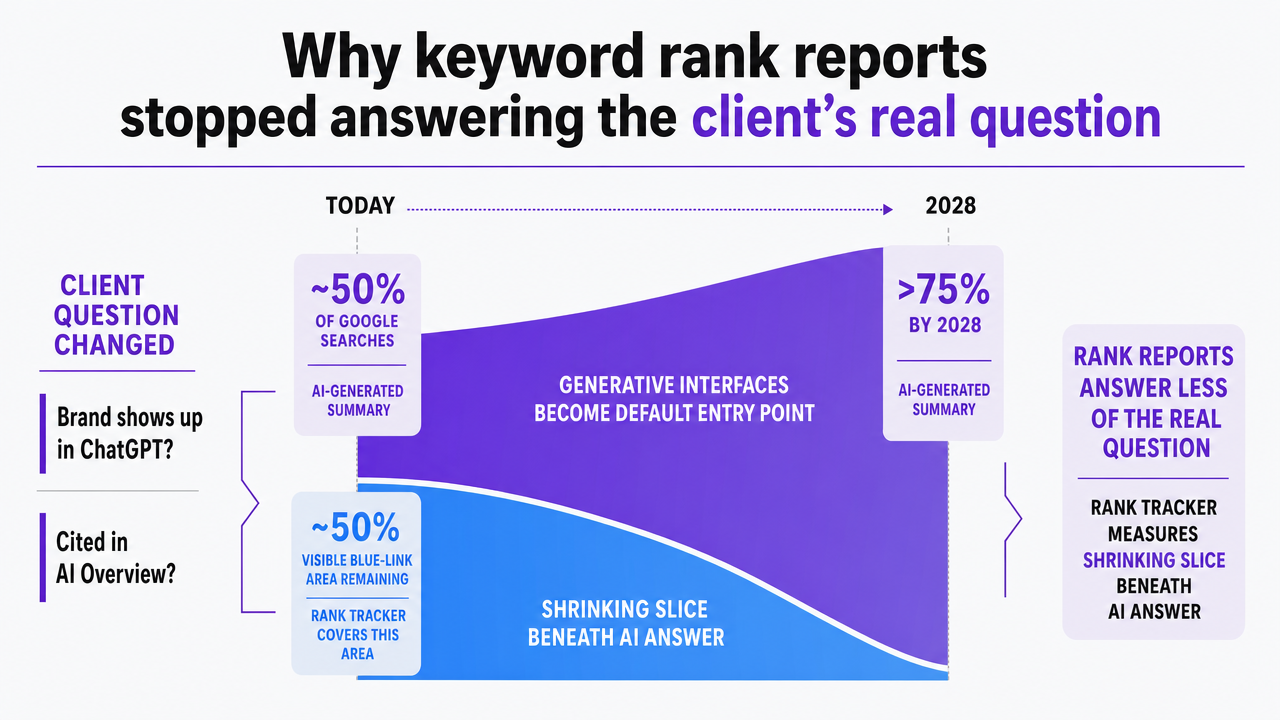 Visualize the projected growth of AI summaries in Google search, directly supporting the McKinsey statistic cited in this section
A four-archetype taxonomy for AI search tracking tools
AI Overview monitors: measuring citation share inside Google's generative surface
The first archetype narrows the aperture to a single surface: Google's AI Overviews and the broader Search Generative Experience. These monitors pull queries at scheduled intervals, capture whether an AI-generated element rendered, and log which domains were cited inside the summary. Output looks less like a rank report and more like a citation ledger.
The case for treating this as its own tool category rests on prevalence. In a study of 1,000 commercial terms, Google displayed a Search Generative element for 86.8% of them — a rate that turns commercial-intent visibility into a first-order metric rather than an experimental one 2. Informational queries trigger generative elements at a materially different frequency, which is why segmentation by query intent belongs inside the monitor itself, not in a downstream spreadsheet.
For agency use, the operational value shows up in two places: identifying which commercial keywords have already lost their traditional CTR pattern, and flagging which competitor domains keep appearing as cited sources. Tools in this archetype are narrow by design. They rarely score prompt variance across other LLM interfaces, and they do not resolve the question of what content changes will convert a citation gap into a citation.
LLM prompt trackers: sampling ChatGPT, Perplexity, Gemini, and Copilot at scale
LLM prompt trackers exist because Google is no longer the only surface a client asks about. This archetype runs curated prompt libraries against ChatGPT, Perplexity, Gemini, and Copilot on a repeating cadence, then parses the responses for brand mentions, recommendation position, and cited URLs. The measurement problem is different from Google Overview monitoring in two respects: the output is conversational rather than structured, and it varies across sessions even when the prompt is held constant.
Brandcamp Digital's framework describes the discipline required to make the data trustworthy: prompt design, multi-platform testing, visibility scoring, and pattern analysis run together rather than in isolation 9. Session-level variance is treated as a signal to average across repeated pulls, not as noise to explain away.
User behavior justifies the investment. Pew reports that 31% of Americans interact with AI at least several times a day, up from 22% in February 2024 15. For an agency book weighted toward high-consideration verticals, that adoption pattern means a meaningful share of prospect research now happens inside an interface no Google-only tool observes. Prompt trackers give the account team a defensible answer when a client asks whether the brand appears in ChatGPT.
Hybrid SEO plus AIO platforms: bolting generative visibility onto legacy rank stacks
The hybrid archetype covers the incumbent SEO suites that added AI visibility modules on top of an existing rank-tracking and site-audit core. The pitch is consolidation: one login, one billing relationship, one reporting layer that shows keyword positions next to AI Overview presence and, in some cases, LLM citations. The reality is uneven feature depth. AI Overview detection is typically more mature than cross-engine prompt sampling, because the former reuses SERP-scraping infrastructure the vendor already operated.
Salesforce's guide frames this consolidation appetite directly, arguing that AI-powered tools can automate keyword research, content optimization, and link building so teams reallocate hours toward strategic planning 5. Hybrid platforms lean into that pitch by exposing AI visibility inside the same dashboards analysts already open every morning.
For agency operators, the hybrid archetype is attractive when the client book already runs on Semrush or Ahrefs and the migration cost of a separate specialist tool outweighs the depth trade-off. It becomes less attractive when clients start asking specifically about ChatGPT or Perplexity share of voice, where the specialist trackers still hold a measurable edge.
Execution-integrated systems: closing the loop from visibility gap to published asset
The fourth archetype treats tracking as the front end of a production pipeline rather than a reporting endpoint. These systems ingest AI visibility signals — missing citations, competitor mentions, prompts where the brand does not surface — and route them into briefs, drafts, and technical fix tickets that move through an approval workflow before publishing. The dashboard is still there; the difference is what happens after a gap is identified.
Techgenies describes the underlying logic: AI-driven SEO uses machine learning, natural language processing, and predictive analytics to automate and optimize search strategies, and pairing those tools with agile methods is what turns measurement into throughput 8. Significa reinforces the content-side requirement, noting that Generative Engine Optimization focuses on creating content that is structured, citable, and easy for AI to summarize and recommend 7. Execution-integrated systems collapse those two ideas — signal detection and citable output — into a single governed loop.
For a Head of SEO managing 15 to 80 accounts, this archetype changes the delivery economics. The analyst hours that used to sit between a visibility report and a published fix become the software layer, while human approval is preserved at the decision points that matter for client trust. The rest of this analysis returns to that gap in more detail.
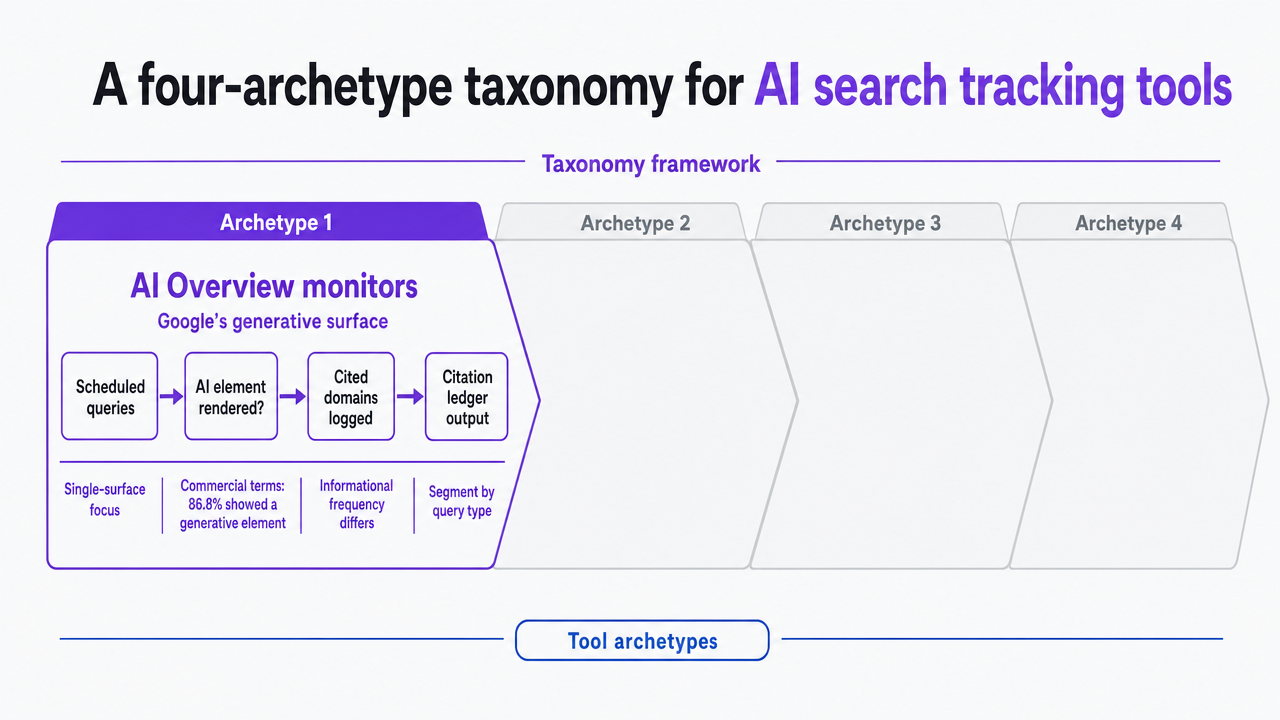 Process infographic visualizing the four tool archetypes described in the section as a comparison framework
The agency-scale scorecard: what actually matters at 15 to 80 client accounts
Feature checklists written for solo consultants and in-house SEOs miss the criteria that decide whether a tool survives contact with a client book. The scorecard below is the one an agency Head of SEO can defend to a CFO and an account team at the same time.
Multi-client workspace architecture. : Separate workspaces per client with role-based access, cross-workspace reporting for the leadership view, and API access for downstream reporting. Tools that treat every client as a flat project folder collapse under 40 accounts.
Prompt library governance. : Version-controlled prompt sets, per-vertical templates, and scheduled reruns that hold prompt wording constant while sampling response variance. Brandcamp's framework treats repeated testing and pattern recognition as core rather than optional, because AI outputs shift between sessions 9. A tool without versioning cannot support that discipline.
Citation attribution accuracy. : How the platform resolves brand mentions when the LLM paraphrases, misspells, or cites a parent domain rather than the specific page. Accuracy claims should be inspectable, not asserted.
White-label reporting. : Client-facing exports with the agency's brand, delivered without an analyst rebuilding slides. Reporting time per client is where margin leaks first.
Handoff to production. : Whether visibility gaps flow into briefs, tickets, or approval queues, or stop at a dashboard export. Google's own guidance frames AI search visibility as an outcome of unique, non-commodity content 3. If the tool cannot route a signal toward that content, the analyst still owns the entire distance between report and remediation.
Test AI-Driven SEO Tracking on Live Campaigns
Validate AI search tracking accuracy and workflow efficiency using your own active SEO projects during the trial.
Named tools evaluated against the four archetypes
Semrush and Ahrefs: incumbent SEO suites extending into AI visibility
Semrush and Ahrefs anchor the hybrid archetype for most agencies because the client book already lives inside one or the other. Both vendors added AI Overview detection to existing SERP-scraping pipelines, which is why coverage of Google's generative surface arrived faster than cross-engine LLM sampling. Analysts get AI Overview presence, cited-domain lists, and keyword position in the same view.
Depth drops off outside Google. Native prompt sampling across ChatGPT, Perplexity, and Gemini remains thinner than what purpose-built trackers ship, and citation attribution inside conversational outputs is still catching up to what the specialist archetype treats as table stakes. The trade-off is consolidation cost against measurement precision on non-Google surfaces.
For a Head of SEO defending a 40-account renewal cycle, these suites earn their seat when clients accept Google-weighted AI reporting and the reporting layer already produces client-ready exports. When account managers start fielding specific ChatGPT questions, the archetype ceiling shows up quickly.
Profound and Peec AI: purpose-built LLM answer trackers
Profound and Peec AI sit inside the LLM prompt tracker archetype and treat conversational surfaces as the primary object of measurement rather than a secondary module. Both platforms run curated prompt sets against ChatGPT, Perplexity, Gemini, and Copilot on scheduled intervals, then parse responses for brand mentions, recommendation order, and cited URLs. The reporting object is share of voice inside answers, not position on a results page.
The methodology assumption matters. Brandcamp's framework treats session-level variance as signal to average across repeated pulls rather than noise to explain away 9. Purpose-built trackers operationalize that by holding prompt wording constant and sampling across time windows, which is how the data becomes defensible in a client review.
Where these tools stop is the handoff. A citation gap in Perplexity for a commercial term returns a well-scored dashboard entry, not a brief. Agencies pair them with production tools or eat the analyst hours between visibility and remediation.
Otterly.AI and AthenaHQ: prompt-set governance and citation attribution
Otterly.AI and AthenaHQ compete inside the same LLM prompt tracker archetype but lean harder on the governance layer that separates a repeatable measurement discipline from a screenshot habit. Both emphasize prompt library versioning, per-vertical templates, and attribution logic that handles paraphrased brand mentions and parent-domain citations rather than assuming clean string matches.
The attribution work is where the archetype differentiates internally. LLMs paraphrase, misspell, and occasionally cite a root domain when the underlying source is a specific article. A tracker that scores only exact matches will underreport visibility; one that scores every fuzzy variant will overstate it. Inspectable resolution logic is what makes the number defensible to a client who asks how a mention was counted.
Google's own guidance frames AI visibility as an outcome of unique, non-commodity content 3. Governance-forward trackers surface which prompts already reward that content and which do not, but the remediation still runs on a separate track.
SE Ranking's AI tracker: mid-market hybrid entry
SE Ranking's AI tracker occupies the hybrid archetype at a price point built for agencies running mid-market client books rather than enterprise brands. The pitch is familiar: rank tracking, site audit, and AI Overview visibility inside one workspace with multi-client access baked in from the start.
Feature depth follows the pattern the archetype produces. Google-surface coverage is the strongest layer, cross-engine LLM sampling exists but trails the specialist tools, and reporting exports are structured for white-label delivery without heavy analyst rebuild. For agencies whose clients weight Google visibility over ChatGPT share of voice, that trade-off holds.
The archetype ceiling still applies. When the reporting question shifts from AI Overview presence to citation share inside conversational answers, the mid-market hybrid tier reaches a depth limit that a purpose-built tracker clears.
Vectoron: execution-integrated tracking with a production handoff
Vectoron sits inside the execution-integrated archetype rather than the tracker categories above. Visibility signals — missing citations, competitor mentions, prompts where the brand does not surface — feed a Command Center that routes ranked recommendations through human approval before content briefs, drafts, and technical fixes execute across the pipeline. The dashboard is not the endpoint; the approved brief is.
The design maps to the automation-plus-agile framing that Techgenies describes, where machine learning and predictive analytics turn measurement into throughput when paired with governed iteration 8. Approval-first workflow preserves the judgment layer that agency Heads of SEO cannot outsource, while the software layer absorbs the analyst hours that used to sit between a visibility gap and a published fix.
For a Head of SEO managing 15 to 80 accounts, the archetype changes what the tool is being bought for. Tracking is the input; delivery capacity per client is the output.
The tracking-to-execution gap that quietly erodes agency margin
Measurement without remediation is where retainer math breaks. Late-2025 studies cited by Yotpo document a 47% reduction in organic click-through rates on pages where an AI Overview is present, measured against the traditional CTR pattern for the same result positions 10. The number describes lost clicks on already-earned rankings, not a ranking loss — which is why a rank tracker showing steady positions can coexist with a client's traffic curve bending downward.
The operational trap for agencies is that visibility tools surface the gap without closing it. A specialist tracker flags twelve commercial terms where the AI Overview cites three competitor domains and omits the client. An analyst exports the finding, drafts a brief, routes it to a writer, waits for revisions, hands it to the technical SEO for schema updates, and schedules publication. Three to five weeks of analyst hours sit between the dashboard alert and the remediated page. Multiply across 40 accounts and the margin compression is measurable before the next quarterly review.
The category direction points toward collapsing that distance. Techgenies frames the pairing directly: machine learning and predictive analytics automate the optimization layer, and agile iteration turns detection into throughput 8. What agencies are buying in an execution-integrated system is not more accurate measurement — the specialist trackers already produce that. They are buying the analyst hours back. When a citation gap generates a ranked, approvable brief instead of a dashboard row, the retainer defends itself by shipping fixes at a cadence a manual pipeline cannot match.
Consolidation economics: pricing the discrete stack against an integrated platform
A discrete AI search tracking stack rarely lives in one contract. A typical agency configuration runs:
- a rank tracker for legacy keyword coverage,
- an AI Overview monitor for Google's generative surface,
- an LLM prompt tracker for ChatGPT and Perplexity share of voice,
- a reporting layer for white-label exports, and
- a separate production stack for briefs, drafts, and technical fixes.
Each line item carries its own seat pricing, its own onboarding cost, and its own analyst hours to keep the data reconciled.
The variables that actually decide the math sit inside the agency, not on a vendor price sheet. Four inputs drive the comparison:
T : tools per client
R : fully loaded blended analyst rate per hour
H : hours per client per month spent stitching reports and moving signals into production
N : account count
Monthly cost of the discrete stack resolves to roughly (T × per-seat license) + (N × H × R). The analyst-hour term is where the discrete configuration quietly outgrows the license fees at 40-plus accounts.
An execution-integrated platform changes what the second term measures. Instead of paying analyst hours to move a citation gap from dashboard to brief, the software layer routes ranked recommendations into an approval queue and shrinks H toward the decision points a human still owns. Vectoron's post-trial pricing anchors at $599/month per workspace from the supplied brand context; competitor pricing is not modeled here because reliable public figures were not supplied.
The decision worksheet below uses variables only:
| Input | Discrete stack | Integrated platform |
|---|---|---|
| License lines per client | T (typically 3–5) | 1 |
| Analyst hours per client per month | H (report stitching + handoff) | H′ (approval decisions only) |
| Monthly software cost | ∑ per-seat licenses | $599/workspace (post-trial anchor) |
| Variable cost driver | N × H × R | N × H′ × R |
Salesforce frames the underlying labor reallocation directly: AI-powered tools automate keyword research, content optimization, and link building so teams shift hours toward strategic planning 5. Consolidation economics is where that reallocation shows up on the P&L.
See How Leading Agencies Automate Search Tracking at Scale—With Full Oversight
Request a walkthrough of enterprise-grade AI search tracking workflows designed to deliver transparent, multi-client SEO reporting and automated execution—without increasing headcount or losing control.
Governance and substantiation: reporting AI visibility claims that hold up
Selling AI visibility as a service creates a substantiation problem the account team owns before the client does. The FTC's Operation AI Comply, announced in September 2024, targeted companies using AI to power deceptive or unfair conduct — including unsubstantiated performance claims dressed up in AI language 13. Reporting that a tracker "increased ChatGPT citations by 40%" without a documented prompt set, sampling cadence, and attribution rule is the exact posture that invites scrutiny.
NIST's AI Risk Management Framework and its generative AI companion profile give agencies a governance vocabulary that clients and legal reviewers already recognize. The framework is voluntary, but it sets expectations around reliability, transparency, and accountability that map directly to how a visibility number gets produced 12, 14. For an agency, that translates into three artifacts kept alongside every client report:
- the prompt library version used during the measurement window,
- the sampling schedule and pull count per prompt, and
- the attribution rules that resolved paraphrased or parent-domain mentions.
Numbers without those artifacts are opinions.
Governance is not a separate deliverable. It is what makes the retainer defensible when a client's general counsel asks how the citation-share figure was calculated.
A 90-day standardization plan across a client book
Standardizing AI search tracking across 15 to 80 accounts fails when it starts as a tool procurement decision. It works when it starts as a sequencing decision. The plan below assumes a Head of SEO already runs a rank tracker and a production stack, and now needs to bolt visibility measurement onto both without stalling delivery.
- Days 1–30: baseline and prompt library. Segment the book by vertical, then build a prompt library of 20–40 commercial and consideration-stage prompts per vertical, versioned and dated. Run a first pull across ChatGPT, Perplexity, Gemini, and Google AI Overviews to establish citation share, competitor mentions, and gap prompts. Brandcamp's framework treats repeated testing and pattern recognition as core rather than optional 9; the baseline is the first repetition, not a one-time audit.
- Days 31–60: reporting cadence and attribution rules. Lock the sampling schedule, publish attribution rules for paraphrased and parent-domain mentions, and ship the first white-label report per client. Google's guidance to focus on unique, non-commodity content 3 becomes the scoring rubric analysts apply to gap prompts.
- Days 61–90: production handoff. Route the top three citation gaps per account into approved briefs and technical tickets. By day 90, the retainer conversation shifts from position charts to citation deltas tied to shipped work.
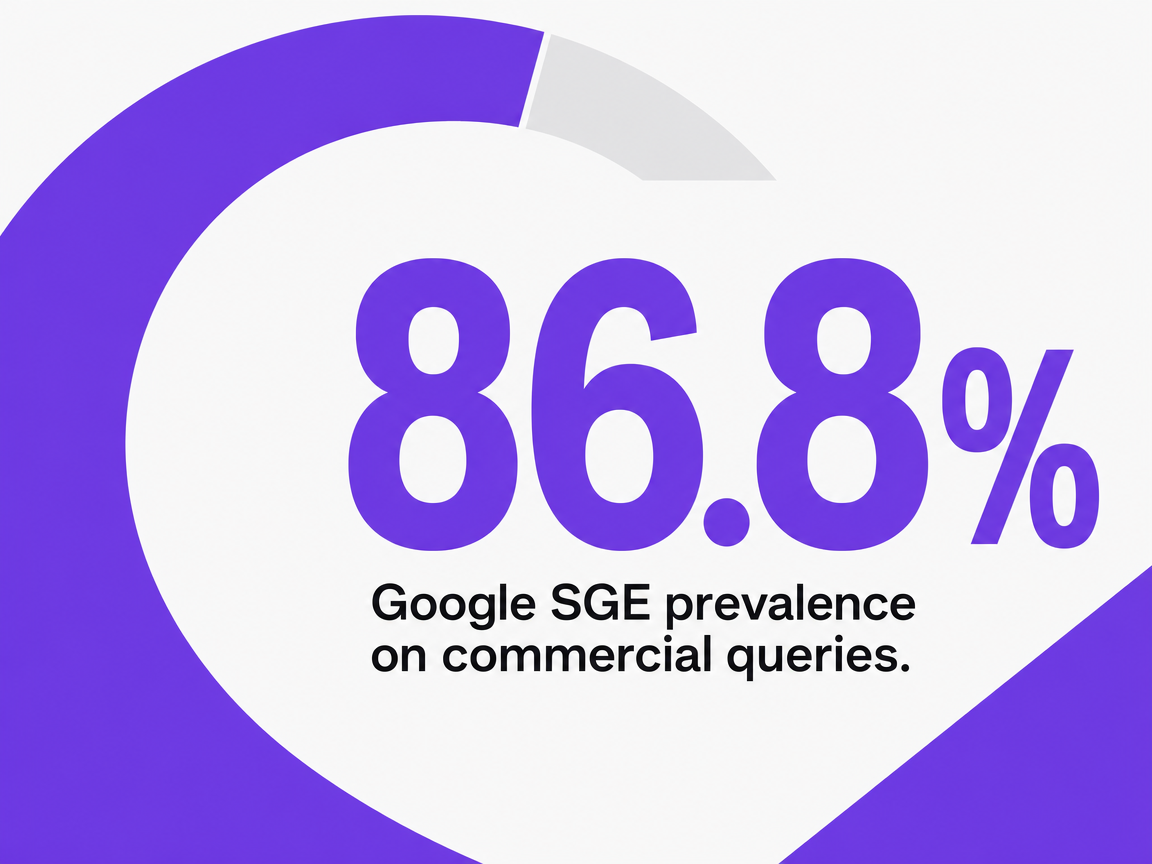 Google SGE prevalence on commercial queries
Google SGE prevalence on commercial queries
Frequently Asked Questions
References
- 1.Google SGE Organic Traffic Impact Divided By Verticals [Data Study].
- 2.Search Generative Experience Statistics & Use Cases | SGE Statistics.
- 3.Top ways to ensure your content performs well in Google's AI search.
- 4.Winning in the age of AI search.
- 5.AI for SEO: Your Guide for 2026.
- 6.The AI Search Shift: Why Your SEO Strategy Needs an Update.
- 7.SEO vs AI Search in 2025: Why you need both to stay visible..
- 8.AI SEO Tools Scale Agile Solutions for Enterprise Growth.
- 9.How To Rank With AI Search & Track Competitor Rankings In AI Search Results.
- 10.Best AI Search Engines 2026: Top 10 & Strategies.
- 11.8 SGE SEO Tips for Google's Search Generative Experience.
- 12.Artificial Intelligence Risk Management Framework: Generative Artificial Intelligence.
- 13.FTC Announces Crackdown on Deceptive AI Claims and Schemes.
- 14.AI Risk Management Framework.
- 15.Key findings about how Americans view artificial intelligence.
- 16.Evolving Health Information-Seeking Behavior in the Context of ....