
Key Takeaways
- Profound delivers enterprise-grade citation logs across major AI engines, making it the strongest signal layer for onboarding diagnostics and weekly reporting, though remediation handoff remains manual.
- AthenaHQ's structured prompt-library tooling exploits mention-trigger patterns like the 69.71% rate for 'best' queries 17, making it ideal for category-level diagnostics at engagement kickoff.
- Peec AI covers the cross-engine monitoring floor at favorable seat economics, fitting mid-market accounts where baseline visibility pulses matter more than deep citation provenance.
- Otterly.AI specializes in sentiment and position tracking, surfacing drift before traffic moves 12, which matters because misattribution can damage brand equity more than absence 1.
- Bluefish AI crosses into GEO suite territory by flagging schema and entity gaps, leveraging the fact that 81% of AI-cited pages include schema markup 1.
- Scrunch AI ties optimization workflows directly to citation lift rather than mention count, surfacing repeatable plays that align with content patterns proven to boost retrieval 5.
- Vectoron operates as the execution layer, ranking remediation by client priority and shipping content, schema, and citation updates through a governed approval workflow that closes the weekly loop 10.
The 16% Tracking Gap Is the Agency Wedge
McKinsey's analysis of AI search found that only 16% of brands systematically track AI search performance, even as roughly half of surveyed consumers now intentionally seek out AI-powered search engines for discovery 14. For an Agency Head of SEO managing a portfolio of clients, that gap is the entire pitch. The other 84% of brands are running blind on a channel their customers are actively using, and CMOs who notice the discrepancy will route budget toward agencies that can already measure it.
The arbitrage is sharper than typical SEO white space because the measurement discipline is still forming. Practitioners have warned that drops in LLM visibility often go undetected until traditional traffic, demand, or referral signals decline weeks later 12. By that point, the conversation with the client is reactive. An agency that runs weekly prompt audits across ChatGPT, Gemini, and Perplexity catches sentiment drift and citation loss before the GA4 line moves, which reframes the relationship from reporting vendor to strategic monitor.
The selection problem is real. The category now includes pure prompt-monitoring trackers, GEO optimization suites, and execution-layer platforms that act on visibility data, and most agencies are evaluating them as if they were interchangeable 11. They are not. The next seven sections score specific tools against a five-factor rubric and map each to an agency operational use, so the shortlist holds up under CMO scrutiny rather than under vendor marketing.
Three Tool Archetypes That Should Shape Your Shortlist
Pure Trackers, GEO Suites, and Execution Platforms
- The vendor landscape has split into three functional archetypes, and conflating them is the most common mistake on agency RFPs. Pure trackers focus on one job: query a defined prompt set across ChatGPT, Gemini, Perplexity, and Google AI surfaces, then log mentions, citations, position, and sentiment in a structured database. They are the closest analog to a rank tracker, optimized for cross-engine monitoring and prompt management rather than content production 12. Output is a time series of visibility data, not a remediation plan.
- GEO optimization suites layer recommendations on top of that measurement. They surface which pages an AI engine cited, identify entity gaps, flag schema and citation-worthy asset opportunities, and tie each metric to a corrective action so the dashboard drives content decisions rather than just charts 10. The value sits in the diagnosis-to-brief handoff, but the brief still needs a human or another system to ship the work.
- Execution-layer platforms close that loop. They ingest visibility signals, rank remediation by client priority, and produce or update the underlying content, structured data, and citation assets through an approval workflow. Practitioner roundups describe this category as adjacent to specialized AI visibility platforms rather than a substitute for them, since the measurement and action layers solve different problems 9, 11.
Why Mixing Archetypes Beats Picking a Winner
Agencies that standardize on a single archetype hit a predictable wall. A tracker-only stack produces weekly slide decks but no remediation velocity, so client retention erodes once the CMO asks what changed after the report. A suite-only stack diagnoses but stalls in production queues, particularly across a portfolio where prompt sets, entity maps, and content backlogs multiply by client count.
The four-metric, three-engine, weekly cadence that current frameworks recommend assumes someone or something is acting on the data within the same cycle 10. Pairing a tracker for raw signal, a GEO suite for diagnosis, and an execution platform for content and entity remediation lets each tool do what it was built for. The agency cost of running all three is lower than the cost of forcing one category to cover work it was not designed for, particularly when analyst hours are the binding constraint on margin per account.
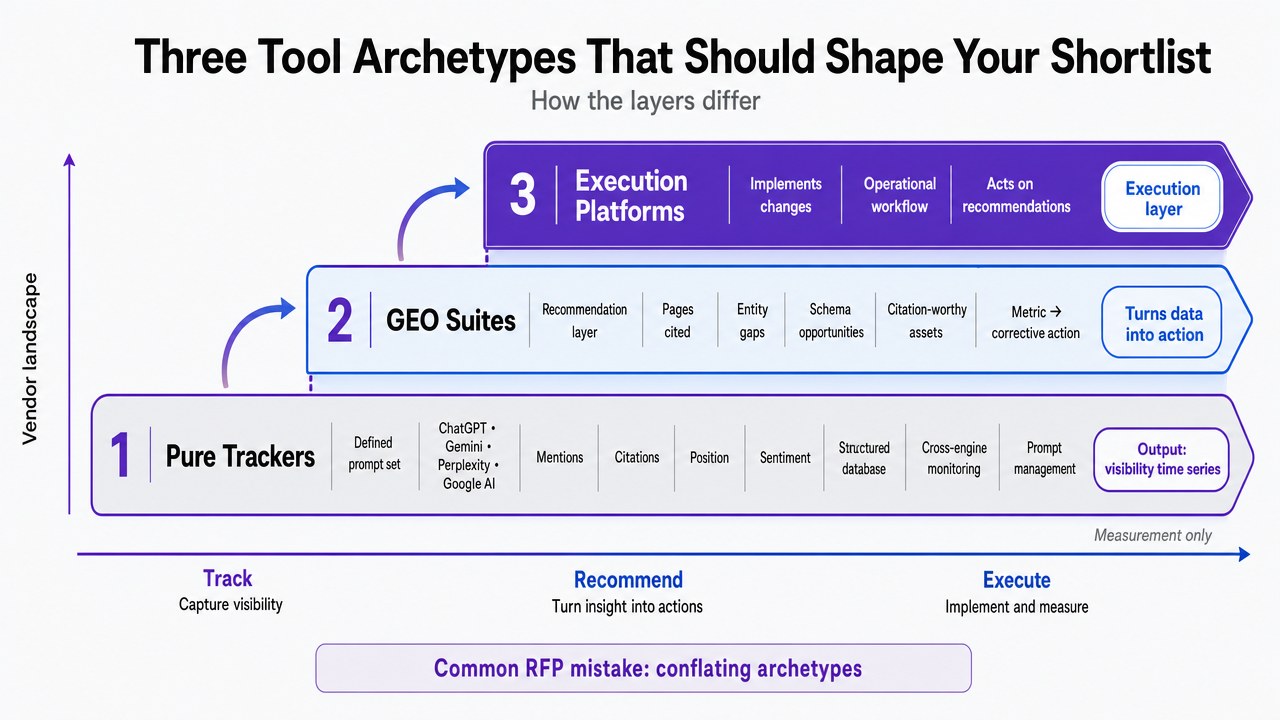 Visualize the three distinct tool archetypes (Pure Trackers, GEO Suites, Execution Platforms) and how they layer together, directly supporting the section's framework explanation
The Scoring Rubric: SoV × Position × Citation Authority × Sentiment × Consistency
Practitioner frameworks have converged on a five-factor composite for AI visibility: Share of Voice × Position × Citation Authority × Sentiment × Consistency 2. The multiplicative structure matters more than the components themselves. A brand can dominate share of voice in Perplexity, hold the third or fourth position in every answer, and still score poorly because position acts as a discount on raw mention volume. One weak factor compresses the composite, which is closer to how CMOs actually experience AI visibility than a flat mention count.
Each component answers a distinct question. Share of voice measures what percentage of relevant AI answers reference the brand against the named competitor set. Position captures where the brand appears in the response, since first-named entities carry disproportionate weight in user recall. Citation authority logs which domains the engine actually links to in support of the answer, which is the closest signal to whether owned content is being retrieved or whether third-party reviews and editorial are doing the work. Sentiment flags whether the surrounding language is favorable, neutral, or negative, with negative or inaccurate attribution often more damaging than absence 1. Consistency tracks how stable those four readings are across repeated runs, which is where stochastic model behavior shows up.
A separate measurement framework recommends running those four metrics across at least three AI engines weekly, with the prompt set split between branded, category, and use-case intent, and tying each metric to a specific corrective action rather than a dashboard tile 10. That cadence becomes the operational floor for tool selection. Anything that cannot run a defined prompt library across ChatGPT, Gemini, and Perplexity on a weekly loop, log citations and sentiment per run, and surface a delta against the prior week fails the rubric before feature comparisons begin. The seven reviews that follow apply this lens directly, scoring each tool on what it measures, how reliably it captures consistency across runs, and whether the output is structured for the corrective-action handoff the framework demands.
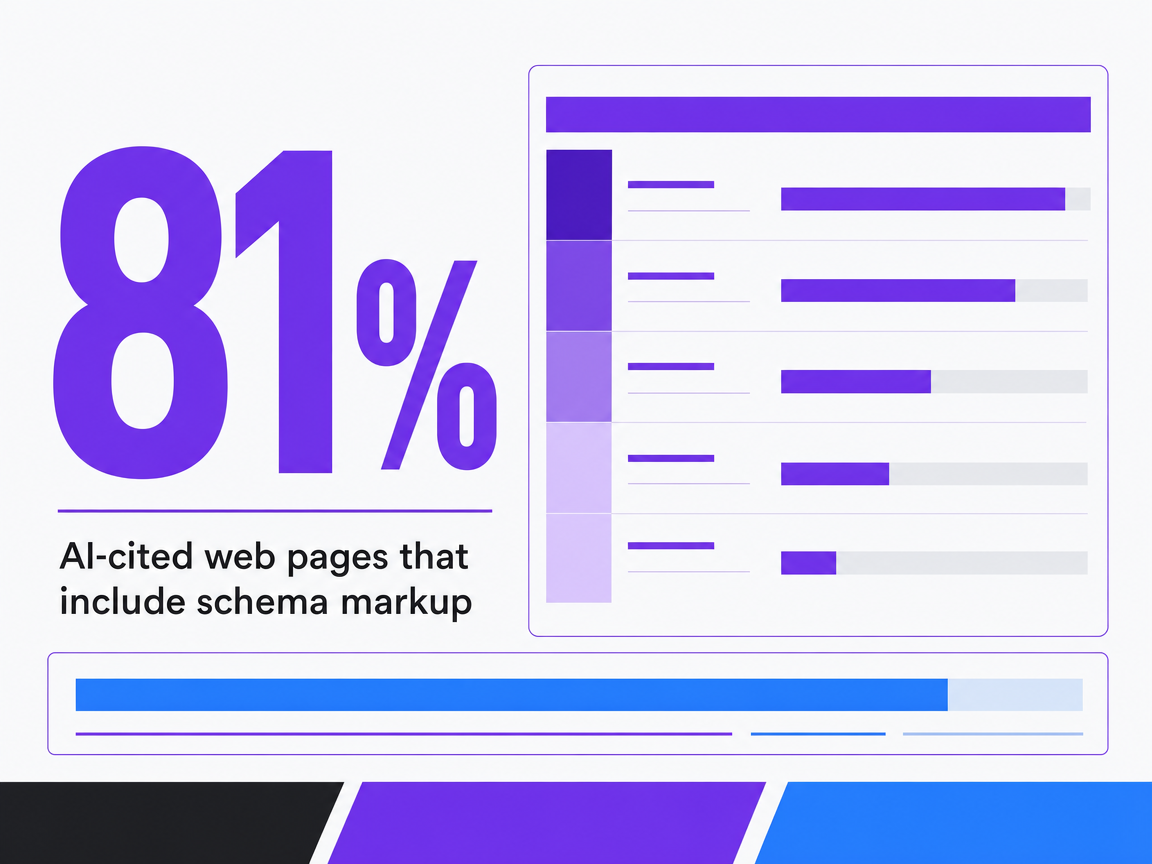 AI-cited web pages that include schema markup
AI-cited web pages that include schema markup
Test AI visibility insights on live campaigns
Track real rankings and surface actionable data using your own content and domains during the trial period.
Seven Tools, Scored Against the Rubric
Profound — Enterprise Tracker With Deep Citation Logs
Profound sits firmly in the pure tracker archetype, optimized for agencies that need defensible citation data across ChatGPT, Gemini, Perplexity, and Google AI surfaces. Its strength is the citation log itself: every AI response captured is broken into the cited domains and URLs that supported the answer, which gives an analyst the raw material to separate owned-content retrieval from third-party editorial influence 1. That distinction is what most CMO conversations stall on.
Where Profound earns its place on a shortlist is engine coverage and run frequency, the operational floor any tool must clear to fit a weekly four-metric, three-engine cadence 10. Where it falls short of the rubric is on the corrective-action handoff. The platform reports what changed; the agency still has to translate citation gaps into content briefs and entity edits. Practitioner roundups place it in the upper tier for accuracy and prompt management among the dedicated visibility category 9. Use it as the signal layer for client onboarding diagnostics and weekly reporting, then pair it with a system that closes the action loop.
AthenaHQ — Prompt-Library Depth for Category Diagnostics
AthenaHQ leans into prompt engineering as the core competency. Agencies building category-level diagnostics for new clients benefit most here, because the platform supports large, structured prompt libraries that blend branded queries with category and use-case intent—the three-way split current frameworks recommend 10. Prompt-pattern research matters in this context: analysis of LLM mention triggers found that 69.71% of prompts containing the word "best" produced brand mentions, with trust-coded modifiers like "trusted" and "reliable" lifting mention likelihood further 17. AthenaHQ's library tooling is built to exploit that pattern systematically rather than ad hoc.
The trade-off is depth over breadth of action. Sentiment scoring and position tracking are present, but optimization recommendations are thinner than a full GEO suite delivers. Treat AthenaHQ as the diagnostic engine at the front of a client engagement, not the system that ships remediation.
Peec AI — Lightweight Cross-Engine Monitoring
Peec AI is the option agencies reach for when seat economics matter more than feature depth. Cross-engine monitoring across ChatGPT, Gemini, and Perplexity is the core offering, with mention logs, basic position tracking, and weekly delta reports that satisfy the minimum cadence the measurement framework demands 10. For a 20-client book where most accounts need a baseline visibility pulse rather than category-level diagnostics, Peec covers the floor.
The rubric exposes its limits on citation authority and consistency. Citation logs are shallower than enterprise trackers offer, and stochastic variance across reruns is harder to surface without manual exports. Agencies that standardize on Peec usually do so for the long tail of mid-market accounts and reserve a deeper tracker for the named-competitor sets where citation provenance drives the CMO conversation. Practitioner comparisons place it among the accessible end of the dedicated visibility category 9.
Otterly.AI — Sentiment and Position Tracking for Weekly Cadence
Otterly.AI scores well on two of the five rubric factors specifically: sentiment and position. The platform's sentiment classifier tags each captured mention as favorable, neutral, or negative and flags drift week over week, which matters because misattribution or negative framing in AI answers can damage brand equity more than absence does 1. Position tracking captures whether the brand is named first, mid-response, or buried in a list, which compresses the composite score when the brand consistently appears late.
For agencies running weekly reporting cadences across a client portfolio, Otterly's strength is that sentiment drift triggers a remediation conversation before traffic moves 12. Citation authority logging is present but less granular than enterprise trackers, and the optimization layer is light. Position it as the sentiment-and-position specialist inside a stack, not the standalone system of record.
Bluefish AI — GEO Suite With Remediation Recommendations
Bluefish AI crosses the line from tracker into GEO optimization suite. The platform ingests visibility data and surfaces specific recommendations: entity gaps, schema markup opportunities, citation-worthy asset targets, and content briefs tied to the prompts where the brand underperforms. That diagnosis-to-brief handoff is what the measurement framework calls for when it insists on tying each metric to a corrective action rather than a dashboard tile 10.
Where Bluefish strengthens an agency stack is on the schema and entity side. Research indicates that 81% of web pages cited by AI engines include schema markup, which makes structured data one of the highest-leverage levers a GEO suite can flag 1. The remaining gap is execution. Bluefish identifies the work; analyst hours or a downstream production system still have to ship it. For agencies running a 20-client book, the bottleneck moves from diagnosis to throughput once a GEO suite is in place.
Scrunch AI — Optimization Workflows Tied to Citation Lift
Scrunch AI's differentiator is the way it ties optimization workflows directly to citation lift rather than to mention count. The platform tracks which content edits, structured data additions, and third-party placements precede increases in citation authority across engines, then surfaces those patterns as repeatable plays. That orientation matches research showing quotes, statistics, source citations, and technical terms measurably boost brand visibility in retrieval-augmented chatbots 5.
The platform overlaps with Bluefish on diagnostic features but pushes harder on the experiment-tracking side, which matters for agencies trying to prove GEO impact to skeptical CMOs. Consistency scoring across reruns is present but not as developed as the pure trackers in this list. Scrunch fits the optimization layer of an agency stack where the work to be done is known and the question is which interventions actually move citation share within a measurement window.
Vectoron — Execution Layer Between Measurement and Content Action
Vectoron belongs in the execution-layer archetype rather than the tracker or suite categories. The platform ingests visibility signals from upstream measurement tools, ranks remediation by client priority, and produces or updates the underlying content, structured data, and citation assets through a Command Center approval workflow where every recommendation routes for human sign-off before execution. That structure addresses the throughput gap a GEO suite leaves open once diagnoses pile up across a 20-client book.
Against the five-factor rubric, Vectoron is not the system of record for share of voice, position, citation authority, sentiment, or consistency scoring—those readings come from a paired tracker. Its contribution is downstream: tying each metric movement to a specific corrective action, then shipping that action through a governed loop, which is what current measurement frameworks demand of any tool claiming to drive decisions rather than dashboards 10. Practitioner roundups frame execution platforms as complementary to specialized visibility trackers rather than substitutes 9, 11.
Stacking Tools Across a 20-Client Book
Agency margin lives or dies on analyst hours per account. The weekly four-metric, three-engine cadence current frameworks call for sets the labor floor: defined prompt sets must run across ChatGPT, Gemini, and Perplexity every seven days, with citations and sentiment logged per run and each metric tied to a corrective action 10. The question is which stack configuration absorbs that workload at 20 clients without breaking the P&L.
Three stack scenarios sketch the trade-off. Each assumes roughly 40 to 60 prompts per client per week, three engines covered, and the same weekly cadence. The pricing column is intentionally blank because vendor rates vary by seat count and prompt volume and should be requested directly.
| Stack Scenario | Engines Covered | Prompts / Client / Week | Analyst Hours / Client / Month | Remediation Throughput |
|---|---|---|---|---|
| Tracker only | 3 | 40–60 | 6–8 | None — reports without action |
| Tracker + GEO suite | 3 | 40–60 | 4–6 | Briefs produced, production manual |
| Tracker + GEO suite + execution platform | 3 | 40–60 | 1.5–3 | Approved actions ship inside the same weekly loop |
The tracker-only stack looks cheapest until the math runs out to 20 clients: 120 to 160 analyst hours per month spent producing slides that do not change what gets shipped. Adding a GEO suite trims the diagnostic load but moves the bottleneck to brief throughput, since remediation still queues against finite content production capacity. The third configuration is the only one where the corrective-action requirement built into the measurement framework actually closes inside the weekly cycle 10. Margin per account improves not because tools are cheaper, but because analyst time shifts from reporting to judgment on what to approve.
See How AI-Driven Visibility Tracking Accelerates Scalable SEO Performance
Request a tailored walkthrough of multi-channel AI visibility tracking designed for agencies managing high-volume client portfolios. Evaluate actionable reporting and workflow integration for scaling SEO oversight without additional headcount.
What a Composite Score Can Hide
The five-factor composite is useful precisely because it forces trade-offs into a single number, but that compression is also where the methodology breaks. Practitioners building the SoV × Position × Citation Authority × Sentiment × Consistency formula have flagged that a single score can mask divergent realities: a brand can post a stable composite week over week while citation authority quietly collapses and sentiment compensates, or vice versa 2. Agencies that report only the headline number give CMOs a moving average and lose the diagnostic signal underneath.
Stochastic model behavior compounds the problem. The same prompt run three times against ChatGPT can return three different brand sets, three different citation lists, and shifted sentiment framing. Consistency scoring is the rubric's attempt to surface that variance, but it does not eliminate it—it quantifies it. Tools that report a single weekly score without exposing per-run variance encourage false precision in client decks.
Prompt-set bias is the third blind spot. Mention-trigger analysis found that 69.71% of prompts containing the word "best" produced brand mentions, with trust-coded modifiers lifting that rate further 17. A prompt library skewed toward "best" queries inflates share of voice without reflecting how customers actually phrase questions. The fix is straightforward: report the composite alongside its components, expose per-run variance, and audit prompt-library composition quarterly so the score reflects category reality rather than the prompts that flatter it.
Picking the Right Two or Three for Your Stack
The shortlist collapses to a simple question: which two or three tools cover signal, diagnosis, and action without duplicating spend. For most agency portfolios, the answer is one tracker with deep citation logs and engine coverage, one GEO suite that ties metric movement to specific corrective actions, and one execution-layer platform that ships the work inside the same weekly cycle the measurement framework requires 10.
Sequence the build by client risk, not feature wishlist. Named-competitor accounts where citation provenance drives the CMO conversation justify a deeper tracker like Profound paired with a GEO suite such as Bluefish or Scrunch. Mid-market accounts running on baseline visibility pulses pair a lighter tracker with the same execution layer, since the throughput gain compounds across the book. Sentiment-sensitive verticals add Otterly as the drift sensor, given that misattribution in AI answers can damage equity more than absence does 1.
The disqualifier is straightforward. Any tool that cannot run a defined prompt library across at least three engines weekly, log per-run variance, and hand off a corrective action fails before the demo ends. Everything else is sequencing.
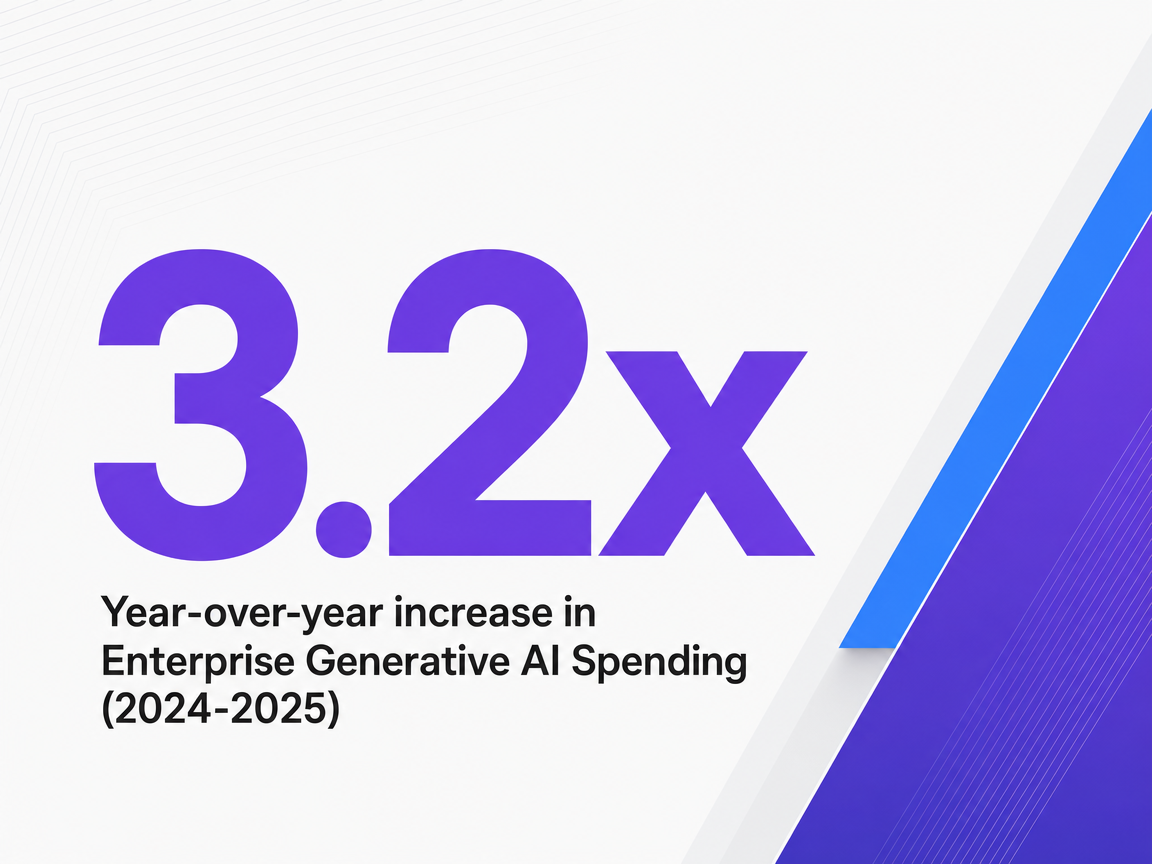 Year-over-year increase in Enterprise Generative AI Spending (2024-2025)
Year-over-year increase in Enterprise Generative AI Spending (2024-2025)
Frequently Asked Questions
References
- 1.Brand Visibility in the Age of AI: What It Is, Why It Matters, and How to Measure It.
- 2.AI Search Visibility Tracking 2025: Proven.
- 3.Measuring Brand Impact in an LLM-First world.
- 4.How to Improve Brand Visibility in AI Search.
- 5.AI Search Optimization Guide: Boost Brand Visibility on LLMs.
- 6.2025: The State of Generative AI in the Enterprise.
- 7.The State of AI: Global Survey 2025.
- 8.350+ Generative AI Statistics [January 2026].
- 9.Best Tools for Tracking Brand Visibility in AI Search (2025).
- 10.AI Brand Visibility: A 2026 Measurement Framework.
- 11.5 Best Generative Engine Optimization Tools in 2026.
- 12.Choosing an AI Brand Visibility Monitoring Tool in 2026.
- 13.The State of AI in the Enterprise.
- 14.Winning in the age of AI search.
- 15.SEO Statistics 2025: GEO, AEO, and Search Optimization Data.
- 16.AI Search Enhances LLM Brand Visibility – Optimize Now.
- 17.Ultimate Guide to LLM Tracking and Visibility Tools 2026.