
Key Takeaways
- Bing AI Performance in Webmaster Tools is the only platform-native citation report, exposing total citations, cited pages, grounding queries, and a timeline across Copilot experiences 1.
- Microsoft Advertising's AI Performance dashboard extends the same citation infrastructure into paid, letting agencies map coordinated coverage gaps between organic and advertising placements in Copilot 3.
- Discovered Labs' manual framework defines AI Share of Voice as brand citations divided by AI Overviews triggered times 100, giving agencies a defensible ground truth for Google 8.
- Ahrefs Brand Radar automates AI Overview citation sampling at scale, catching long-tail retrieval patterns and competitor mentions that manual audits routinely miss 6, 7.
- SE Ranking's LLM visibility module tracks citation presence across multiple AI interfaces, giving portfolio agencies one consistent query workflow rather than reconciling three interface-specific trackers.
- PartnerStack-style manual audits prioritize citations over mentions and deliver screenshot-backed evidence, making them ideal for pre-pitch work and quarterly sanity checks on automated samplers 13.
- Vectoron closes the workflow gap by reading grounding queries and citations into approval-first content briefs, letting SEO leads scale delivery across 15 to 80 accounts without adding analysts 10, 15.
The Measurement Asymmetry Every Agency Stack Has to Solve
Google and Microsoft have taken opposite positions on what site owners get to see. Bing's AI Performance report, launched in public preview in early 2026, exposes total citations, cited pages, grounding queries, and a citation timeline across Microsoft Copilot and partner AI experiences 1, 2. Google, by contrast, treats AI Overview and AI Mode appearances as extensions of standard organic reporting and confirms only that a page must be "indexed and eligible to be shown in Google Search with a snippet" to appear as a supporting link 12. No separate impression count. No dedicated click stream. No citation timeline.
That asymmetry is the single most important fact for anyone building an AI visibility stack in 2026. On Bing, the measurement is native and structured; on Google, it has to be reconstructed from sampled queries and manual audits. Any tool evaluation that ignores this split ends up comparing platform-native data against inferred data as if they were the same signal.
The practical consequence for agency delivery is straightforward. One layer of the stack reads what Microsoft already publishes. Another layer samples what Google refuses to publish. A third layer feeds both back into content production so citation data changes what gets written next.
How the Seven Tools Split Into Three Functional Layers
The seven tools worth standardizing on in 2026 do not compete head-to-head. They occupy three distinct layers, and confusing the layers is how agencies end up paying twice for the same signal.
Layer one is platform-native citation reporting: Bing AI Performance in Webmaster Tools and the sibling Microsoft Advertising AI Performance dashboard. Both pull directly from Microsoft's own infrastructure and expose total citations, cited pages, and grounding queries across Copilot and partner AI experiences 1, 3. There is no equivalent on the Google side, which is why layer one is a two-tool layer, not a four-tool one.
Layer two is citation samplers. These tools solve for the Google gap by running scheduled query sets against AI Overviews and other LLM interfaces, then logging whether a domain appears as a cited source. The math behind them is the AI Share of Voice formula: brand citations divided by total AI Overviews triggered, multiplied by 100 8. Ahrefs Brand Radar, SE Ranking's LLM visibility module, and structured manual audit playbooks all live here.
Layer three is the workflow layer. It reads grounding queries and citation data as inputs to content briefs, closing the loop between what AI systems retrieve and what production actually ships next 10, 15.
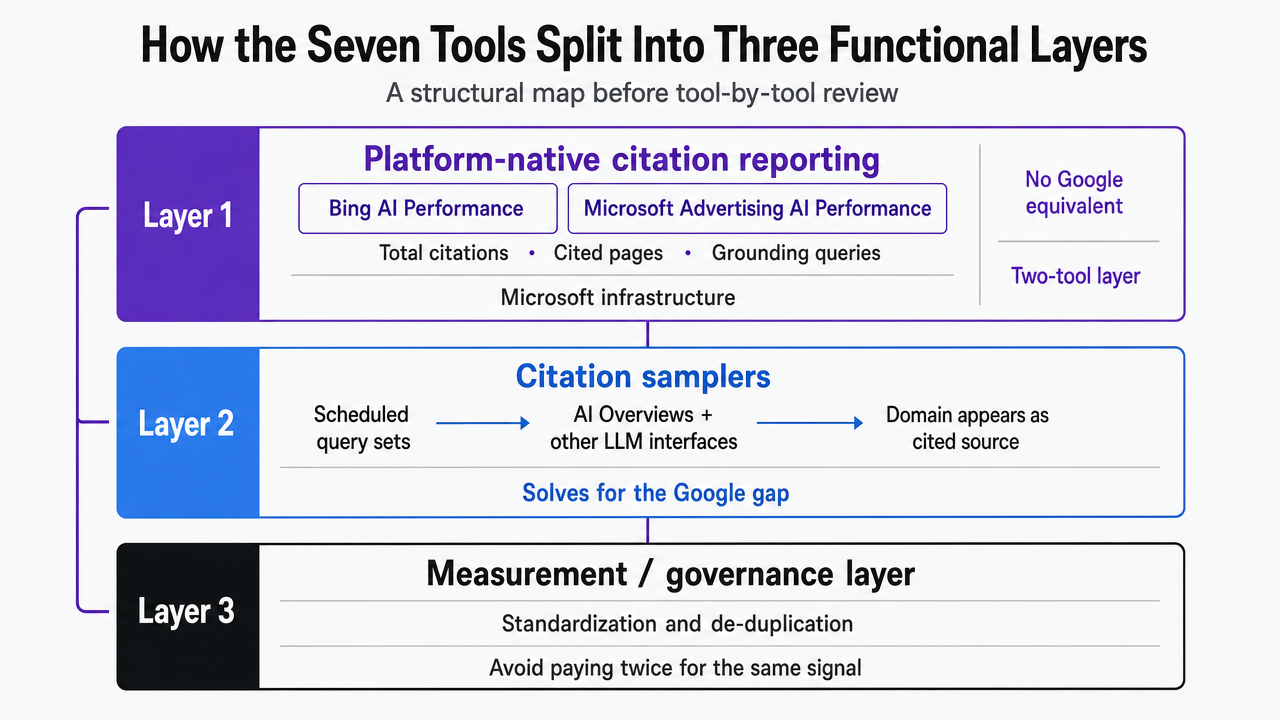 Visualize the three-layer functional model that organizes the seven tools reviewed, giving readers a structural map before the tool-by-tool deep dives
Layer 1: Platform-Native Citation Reporting
Bing AI Performance in Webmaster Tools
Bing AI Performance is the first and, as of early 2026, only platform-native report that tells site owners when their content is cited inside AI-generated answers. The report surfaces four core dimensions: total citations, cited pages, grounding queries, and a citation timeline across Microsoft Copilot and partner AI experiences 1, 2. For agency teams that have spent a decade reconciling Search Console impressions with rank tracker positions, this is the closest thing to a canonical source of AI visibility data currently on offer.
The operative word is visibility. The report does not include clicks. One early practitioner review put it bluntly:
"this report only measures visibility. There are no clicks. NO CLICKS"
7. That distinction matters for how agencies package the data. A rising citation count proves a page is being retrieved and referenced by an LLM; it does not prove downstream sessions, conversions, or pipeline. Client dashboards should present AI Performance next to organic engagement, not blended into it.
The grounding queries list is the most operationally valuable output. It captures the retrieval language LLMs actually use to surface a domain, which often differs from the keywords ranked in traditional SERPs 15. Agencies can export those queries and route them into content briefs the same week.
One meaningful constraint: there is no public API for AI Performance data as of early 2026, which forces manual export for any client that wants the numbers inside a BI stack 11. That limits how far a single analyst can scale reporting across a large book of business.
Microsoft Advertising AI Performance Dashboard
Microsoft extended the same citation-based measurement into its advertising stack in March 2026, releasing an AI Performance dashboard that shows advertisers where their brand appears across generative AI search experiences 3. The dashboard reads from the same citation infrastructure that powers the Webmaster Tools report, so paid and organic teams inside an agency finally share a common visibility signal rather than arguing over separate spreadsheets.
The practical use case is coordinated coverage analysis. When a client's brand shows up in Copilot answers for one set of grounding queries organically and a different set through advertising placements, the dashboard exposes the gap. Agencies can then decide whether to close it with a content investment on the SEO side, a bid adjustment on the paid side, or both.
Microsoft positions the dashboard as giving
"key visibility and insights to understand how [your] content is cited in generative AI search experiences"
3. Read that carefully: cited, not clicked. The same measurement ceiling that applies to Webmaster Tools applies here. Advertisers who expect the dashboard to attribute revenue to AI citations will be disappointed; those who use it to map brand presence across Copilot alongside impression share and conversion data will get real strategic value.
For agencies running paid and organic under one roof, the dashboard is the cheapest way to bring media and SEO teams into a single AI visibility conversation without buying a third-party tool.
Test AI visibility tracking on real campaigns now
Measure actual search position gains and content impact using your own data throughout the trial period.
Layer 2: Citation Samplers That Fill the Google Gap
Discovered Labs' AI Share of Voice Framework
The most rigorous public methodology for tracking Google AI Overview citations does not come from a SaaS vendor. It comes from a B2B agency, Discovered Labs, which published a manual sampling framework built around three KPIs: AI Trigger Rate, AI Citation Rate, and AI Share of Voice. The last one is the metric agency leaders are most likely to be asked about in a QBR, and it has a specific formula: brand citations divided by total AI Overviews triggered, multiplied by 100 8.
The framework runs on a weekly cadence. Analysts define a fixed question set per client, run each query in incognito, and log four fields:
- whether an AI Overview appeared,
- whether the client's domain was cited,
- which competitors were cited, and
- the citation position.
Over eight to twelve weeks the log produces a defensible trend line for a channel Google refuses to instrument directly.
The strength of the approach is transparency. Every number in the client report traces back to a query, a timestamp, and a screenshot. The weakness is scale. Ten clients running fifty tracked queries each is five hundred manual searches a week, and the sample stays a sample no matter how disciplined the process is 8. Most agencies use this framework as the audit backbone underneath whatever automated sampler they buy, because it defines the ground truth the automated tool has to be checked against.
Ahrefs Brand Radar for AI Overview Presence
Ahrefs Brand Radar productizes what the Discovered Labs framework does manually. It monitors when a brand or domain surfaces inside AI Overviews and adjacent LLM answer surfaces at a scale no analyst pod could match by hand, using scheduled query fan-outs rather than one-off searches.
The honest framing of what Brand Radar and its category peers solve for comes from Ahrefs itself: accurately measuring clicks from AI Overviews is nearly impossible because Google folds AI Overview data into standard organic reporting, leaving citation counts, mentions, and keyword filters as the only workable proxies 6, 7. Brand Radar leans into that constraint. It reports on presence, not performance, and treats citation share as the primary output.
For an agency stack, the value is coverage breadth. A tool that samples thousands of queries against a client's category vocabulary catches long-tail retrieval patterns that a manual audit will miss. It also flags competitor citations the client did not know to look for, which is often the finding that unlocks a strategy conversation.
The limits are the ones every sampler shares. The query set is only as good as the analyst who built it, the sample cannot represent every user's personalized AI Overview, and citation counts still say nothing about downstream clicks or pipeline. Agencies that present Brand Radar output as a traffic metric will get burned in the second review meeting.
SE Ranking's LLM Visibility Tracking
SE Ranking's LLM visibility module takes the same citation-sampling logic and extends it across multiple AI interfaces rather than concentrating on Google AI Overviews alone. That cross-platform framing is the practical differentiator for agencies whose clients want a single answer to "where do we show up in AI" without buying three separate trackers.
The measurement model is consistent with the wider category. Scheduled queries run against LLM-based answer surfaces, and the tool records whether the client domain is cited, how often, and against which competing sources. Reporting rolls those signals into a visibility score that behaves like a traditional share of voice metric, which makes it easier to slot into existing client dashboards without inventing a new chart type.
The operational fit for a portfolio agency is straightforward. One tracker, one query configuration workflow, one export format across every client account, rather than reconciling outputs from a Google-only tracker and a separate ChatGPT-only tracker. That matters more than any single feature when the head of SEO is trying to keep reporting hours per account under a hard budget.
The caveats repeat. The sample is a sample, personalization affects reproducibility, and the tool measures citation presence rather than click-through. Treat the visibility score as a directional trend indicator alongside Bing's platform-native citation counts 6, 7.
PartnerStack-Style Manual Audit Playbooks
Not every client account justifies a paid sampler subscription. For the long tail of a book of business, or for a fast pre-pitch audit, a structured manual playbook still holds up. The PartnerStack thirty-minute audit is the cleanest public example: run a fixed set of category prompts across AI Overviews and major LLM interfaces, then log mentions, citations, sentiment, and competitor presence in a shared sheet 13.
The useful discipline in that playbook is its hierarchy of metrics. Citations rank above mentions because citations link back to the domain and drive traffic, while mentions only reference the brand by name without a source link 13. Agency reports that blur the two inflate visibility numbers and set clients up to ask why the traffic never materialized.
Manual audits have one advantage automated samplers cannot match. Every finding comes with a screenshot and a prompt, which is what a skeptical CMO actually wants to see when the AI visibility line item hits the invoice. Used as a quarterly sanity check on top of an automated tool, the manual audit keeps the sampler honest and gives new-business teams a fast, defensible artifact for pitches.
Layer 3: The Workflow Layer That Consumes Citation Data
Grounding Queries as Content Brief Inputs
A grounding query is not a keyword. It is the grouped representation of the retrieval language an LLM uses to surface and cite a page, exposed inside Bing's AI Performance report and useful mainly as raw material for the next content brief rather than as a reporting line 10, 15. That distinction matters because agencies that treat grounding queries as another rank-tracker input miss what they actually change: the words on the page.
Where those words sit on the page is the operational hinge. A CXL analysis of 100 AI Overview citations found that 55% of citations come from the top 30% of a page, with the remainder spread across the middle and lower sections 16. The sample is small and secondary, so the number should be treated as directional rather than definitive, but the pattern lines up with how retrieval systems score passages: the answer language has to appear early, in plain prose, near the phrasing the LLM used to retrieve the page.
The workflow that follows is concrete:
- Export grounding queries from Bing weekly,
- cluster them against existing URLs,
- route the mismatches into content briefs as required opening paragraphs and H2 language, and
- check whether the same queries start appearing in Google AI Overview samples over the next four to eight weeks.
That loop is what turns citation reporting from a dashboard into a production input.
Vectoron as the Brief-to-Publish Connector
The workflow layer is where most agencies quietly lose the game. Citation data lands in one tool, briefs live in a second, drafts move through a third, and by the time a page ships, the grounding query that triggered the work is three weeks stale. Vectoron sits in that gap. It reads citation and grounding-query inputs, ranks which pages need rewriting or extension, drafts the brief with the retrieval language in the opening section, and routes every recommendation through a human approval step before anything publishes.
The design point worth naming is approval-first automation. Nothing ships without sign-off, and each recommendation carries the reasoning behind it, which is what lets a head of SEO scale delivery across 15 to 80 accounts without adding analysts to babysit output. Google's own 2026 guidance is that AEO and GEO are still SEO, rooted in core ranking systems 4, 5. A workflow platform that treats citation data as another SEO signal, not a separate discipline, matches how the underlying systems actually behave.
Compact Comparison Matrix: Layer, Primary Metric, Limitation, Agency Use
The seven tools sort cleanly once layer, primary metric, and hard limitation are placed side by side. The matrix below is capability-only; no pricing is included because the supplied research does not benchmark it, and any dollar figure attached here would be invented.
| Tool | Layer | Primary Metric | Key Limitation | Best Agency Use |
|---|---|---|---|---|
| Bing AI Performance (Webmaster Tools) | Platform-native | Total citations, cited pages, grounding queries, timeline 1 | No clicks, no public API as of early 2026 7, 11 | Canonical citation baseline per client |
| Microsoft Advertising AI Performance | Platform-native | Brand citations across Copilot for paid and organic surfaces 3 | Visibility, not conversion attribution 3 | Coordinated paid-organic coverage gap analysis |
| Discovered Labs framework | Citation sampler (manual) | AI Share of Voice: citations / AI Overviews triggered × 100 8 | Manual sampling, hard to scale 8 | Audit backbone and ground truth |
| Ahrefs Brand Radar | Citation sampler (automated) | AI Overview citation share and mentions 6 | Sampled, no click data 6, 7 | Broad Google-side presence tracking |
| SE Ranking LLM visibility | Citation sampler (automated) | Cross-platform visibility score across LLM answer surfaces | Sampled, personalization-affected | Single-tool coverage across multiple LLMs |
| PartnerStack-style manual audit | Citation sampler (manual) | Citations over mentions, sentiment, competitor presence 13 | Point-in-time snapshot 13 | Pre-pitch audits and quarterly sanity checks |
| Vectoron | Workflow / production | Grounding queries and citations routed into approved briefs 10, 15 | Depends on upstream citation data quality | Brief-to-publish loop across a client portfolio |
Read the matrix vertically before horizontally. Two platform-native rows, four samplers, one workflow layer. Any stack that duplicates within a layer is paying twice for the same signal.
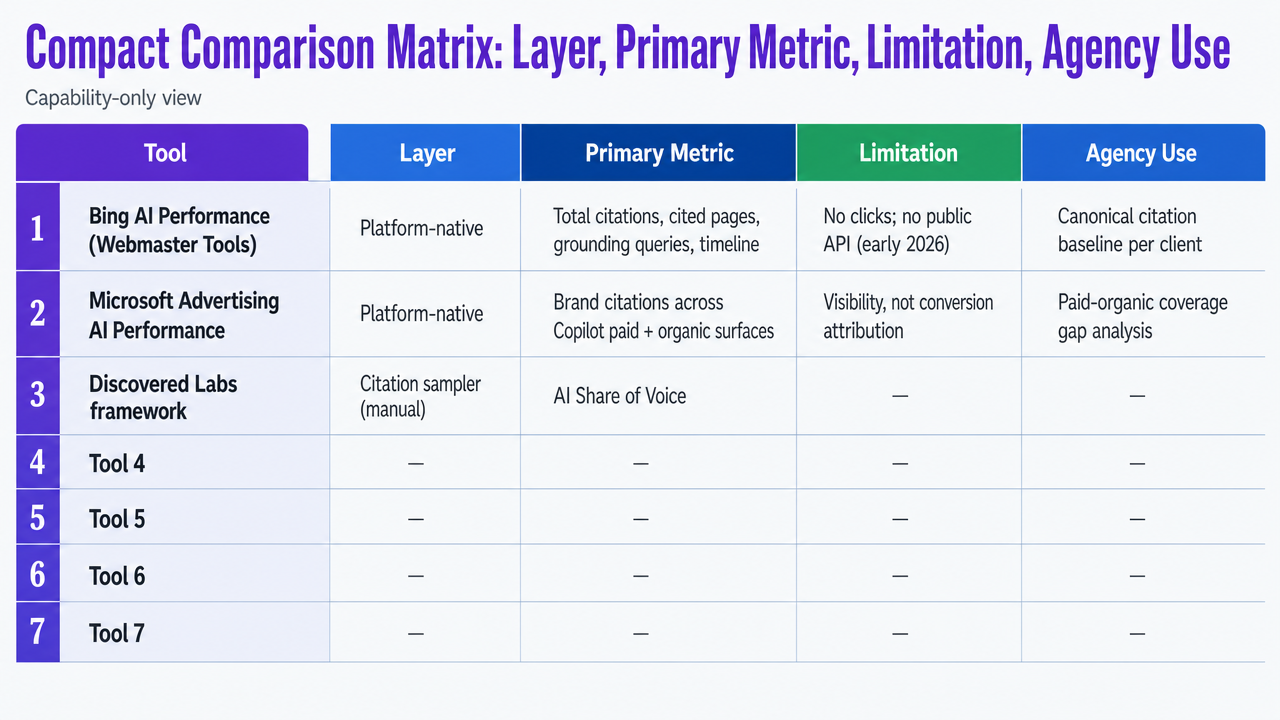 Reinforce the comparison table with a scannable visual matrix mapping each of the seven tools to its layer, primary metric, and best agency use, letting readers absorb the stack at a glance
See How Leading Agencies Track and Scale SEO Visibility with AI in 2026
Get a firsthand walkthrough of AI-powered visibility tracking platforms used by top agencies to benchmark, monitor, and optimize search performance across high-stakes verticals—without increasing specialist headcount.
What These Tools Cannot Do, and How to Set Client Expectations
Every tool in this stack measures presence. None of them measure performance in the way a client actually thinks about it. Ahrefs' own framing is that accurately measuring clicks from AI Overviews is nearly impossible because Google folds AI Overview data into standard organic reporting, leaving citation counts and mentions as the only workable proxies 6, 7. Bing publishes citation totals but no click stream 7. Sampled Google trackers report visibility scores against a query list an analyst built, not against every user's personalized answer panel.
Three limitations should be named in every client kickoff:
- Citation counts do not attribute revenue; a rising trend proves retrieval, not pipeline.
- Sampled data is directional by construction, and any two tools sampling different query sets will report different visibility scores for the same brand in the same week.
- Platform coverage is uneven. Bing exposes native citation data; Google exposes almost nothing beyond supporting-link eligibility inside standard organic reporting 12. ChatGPT and Perplexity have to be inferred from third-party sampling.
The cleanest way to package this is a two-tier client report: platform-native citation counts as the audited number, sampled visibility scores as the directional trend, and a separate organic performance section that carries the click and conversion data. Blurring those tiers is what causes the awkward third-quarter conversation about why AI visibility went up and traffic did not.
If You Run a Portfolio of 15 to 80 Client Accounts
Scope shift: this section is for the head of SEO carrying a portfolio, not the in-house lead running one brand. At portfolio scale, the constraint is analyst hours per account, not tool selection. A defensible minimum stack looks like this: Bing AI Performance connected for every client that owns a Webmaster Tools property, one automated citation sampler standardized across the book so query configuration and export formats stay consistent, and one workflow layer that turns grounding queries into approved briefs without an analyst rekeying data between systems 1, 10, 15.
Three operational rules keep the model from collapsing:
- Do not stack two samplers in the same layer; the outputs will disagree and burn hours on reconciliation.
- Reserve the Discovered Labs manual framework for QBR-tier accounts and pre-pitch audits, not weekly reporting 8.
- Accept that the Bing API gap forces manual export until Microsoft ships one, and price the reporting line accordingly 11.
Agencies that wire citation data directly into the brief-to-publish loop, rather than treating it as a standalone dashboard, are the ones that scale delivery without adding analysts. That is the loop platforms like Vectoron are built to close.
Frequently Asked Questions
References
- 1.AI Performance - Bing Webmaster Tools.
- 2.Introducing AI Performance in Bing Webmaster Tools Public Preview.
- 3.See how you're showing up in AI search.
- 4.Optimizing your website for generative AI features on Google Search.
- 5.Google's New AI Search Guide Calls AEO And GEO 'Still SEO'.
- 6.What Bing's AI Citations Mean for Search Visibility in 2026.
- 7.Bing's AI Performance Report Is a Start.
- 8.Google AI Overviews citation tracking: How to measure your visibility.
- 9.Bing's Game-Changing AI Performance Report.
- 10.How to Use Bing's New AI Performance Report to Get More LLM Citations.
- 11.Bing Webmaster Tools AI Performance report. Is there an API?.
- 12.AI Features and Your Website | Google Search Central | Documentation | Google for Developers.
- 13.How to Audit Your Brand's AI Visibility in 30 Minutes - PartnerStack.
- 14.What Is Generative Engine Optimization? - Coursera.
- 15.How to track your AI visibility with Bing - CXL.
- 16.Where Google AI Overviews Cite From: A 100-Page Study - CXL.