
Key Takeaways
- Profound replaces the manual citation audit by running structured prompt sweeps across ChatGPT, Gemini, Claude, Perplexity, and Grok, returning a consistent longitudinal dataset instead of a screenshot library 4.
- Semrush AI Visibility Toolkit earns its slot when the suite is already paid for, because it removes a reconciliation step by laying citation status next to existing crawl and keyword data 1.
- Surfer + AI Mode rewrites the content optimizer brief around LLM-readable signals — semantic chunking, entity definitions, answer-shaped passages — so pages get cited, not just ranked 9.
- AlsoAsked and Frase-class intent engines absorb the junior strategist's PAA scrape and topic-clustering work, matching expert-level categorization on qualitative SERP data in one pass 13.
- Vectoron sits above the other four as an approval-workflow layer, routing ranked recommendations against live business signals through a single human sign-off so approval capacity, not analysis, becomes the bottleneck 12.
The Head of SEO's New Two-Report Problem
A Head of SEO running delivery across 20 client accounts now owes two reports where one used to be enough. The first is the familiar one: organic rankings, technical health, conversion attribution, content velocity. The second is newer and louder in every QBR — how often the client's brand surfaces inside ChatGPT, Perplexity, Gemini, and Google AI Overviews, in what context, and against which competitors 4.
Neither report is optional anymore. Enterprise SEO analytics has quietly absorbed AI answer-engine visibility as a required dimension alongside organic traffic, conversions, and crawl health 1. The problem is that the second report does not slot neatly into the first. It uses different data sources, different prompt sets, different update cadences, and a different definition of "ranking" altogether.
The instinct is to add another tool. That instinct is usually wrong. AI features have become table stakes across more than fifteen SEO platforms, which means the differentiation no longer lives in feature lists — it lives in which combination actually removes hours from a delivery roster 2.
This shortlist is built around that constraint. Five platforms, each picked for what it consolidates rather than what it adds: an AI-visibility tracker, a full SEO suite with AI layered in, a content optimizer that reads the way an LLM reads, an intent engine, and the approval-workflow layer that holds the other four accountable to a human sign-off.
The Agency Operating Model Behind Tool Selection
Why Software Choice Is Now a Systems-Design Decision
The job description for an experienced SEO has quietly rewritten itself. Recent industry analysis pegs the new role mix at roughly 50% strategist, 30% systems designer, and 20% operator — the operator share having absorbed most of the displacement caused by AI agents handling audits, reporting, and bulk recommendation generation 6.
That split matters for tool selection because it changes the question being asked. A 100% operator buys software that does a task faster. A 30% systems designer buys software that fits inside an architecture: shared dimensions across clients, consistent prompt sets, citation status feeding back into the same KPI surface as organic rankings 1. Those two buyers will choose differently even when looking at the same demo.
The second order effect is what gets evaluated. Feature checklists collapse when AI capabilities are already standard across more than fifteen SEO platforms 2. A real evaluation now asks how a tool changes the shape of the delivery roster — which recurring deliverable it eliminates, which specialist hours it frees, which manual report it makes obsolete. Anything that doesn't move one of those numbers is a feature, not a decision.
This reframes the head-of-SEO procurement conversation. The question is no longer "which platform has the best AI visibility tracking" but "which combination of platforms lets one senior strategist credibly own twice as many clients without quality drift." Tool selection becomes a workload graph problem. The metric is hours saved per client per month, and the role composition split is what makes that metric the only one worth defending in a budget review.
Hours Per Client, Before and After: A Portfolio Economics Read
A note on scope: this section narrows from the general agency frame to multi-client portfolio operators — Heads of SEO accountable for ten to thirty active accounts, where small per-client time savings compound into a meaningful capacity decision.
The pre-LLM baseline for a mid-complexity client typically breaks down across three recurring deliverables: the classic SEO audit and technical review, the new AI-visibility report covering ChatGPT, Perplexity, Gemini, and Google AI Overviews, and recommendation triage that turns both into a prioritized backlog. Without LLM-backed tooling, the second deliverable is mostly manual prompt sweeps and citation screenshots, and the third lives in spreadsheets.
The table below uses variables rather than fixed numbers, since complexity ranges widely by vertical and account size. The point is the shape of the shift, not a vendor benchmark.
| Recurring deliverable | Before LLM analysis software | After LLM analysis software ||---|---|---|| Classic SEO audit + technical review | Baseline hours (H₁) | ~0.4–0.6 × H₁ || AI-visibility report (4+ engines) | Mostly manual (H₂) | ~0.2–0.3 × H₂ || Recommendation triage + client routing | Spreadsheet-led (H₃) | Queue-led, ~0.5 × H₃ |
The consolidated read: when bulk analysis is automated and recommendations land in a ranked queue, the per-client hour load contracts unevenly. AI-visibility reporting compresses the most because it was the youngest workflow with the least tooling, and recommendation triage compresses less because human approval still belongs there 5.
Two external signals reinforce the direction. Teams that adopted AI content tools report producing roughly 4.1x more published content per marketer per month than pre-adoption baselines, per HubSpot AI Trends 2026 as aggregated by industry trackers 10. And worker access to AI rose by 50% in 2025, with the share of enterprises running a high proportion of AI projects in production expected to double, per Deloitte's State of AI in the Enterprise report 12. The productivity ceiling is moving; the agencies that don't redesign their hours-per-client model will be the ones absorbing the gap as margin loss.
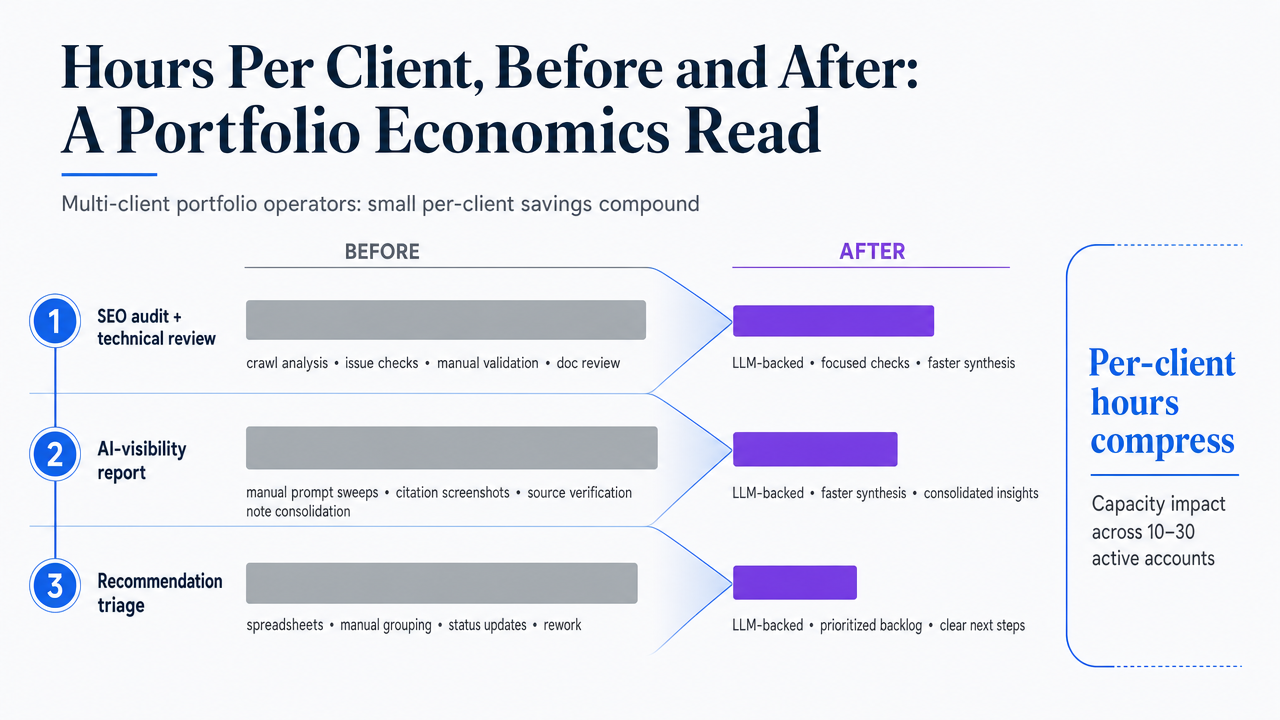 Visualize the three recurring deliverables and their before/after hour-load shift described in the section's table, making the workload compression tangible
The Three Buckets You Actually Need (And Why One From Each Is Enough)
Industry analysis of the current AI SEO landscape sorts platforms into three working buckets:
- Content optimization tools that score and rewrite pages against LLM-readable criteria,
- Full SEO suites that have layered AI features onto their existing crawl and rank infrastructure, and
- The newer AI-visibility (also called GEO) trackers that monitor whether a brand actually surfaces inside ChatGPT, Perplexity, Gemini, and other answer engines 3.
That taxonomy is the structural argument behind this shortlist. Each bucket answers a different question. Content optimizers answer is this page legible to the systems that summarize it. Full SEO suites answer what is happening to organic performance across thousands of URLs. AI-visibility trackers answer when our client gets mentioned inside an AI answer, what does the model actually say, and against whom 4.
An agency Head of SEO running a multi-client roster needs one strong pick from each. Two from any bucket is overlap dressed as coverage. Three is a procurement problem: redundant seat licenses, duplicate dashboards, and specialists toggling between near-identical screens to produce the same client deliverable twice.
The overlap penalty is real. Two AI-visibility trackers will return slightly different prompt sweeps, force a reconciliation step, and quietly add an hour per client per month to no one's benefit. Two content optimizers will fight over scoring methodology in the production workflow. Two SEO suites means paying twice for crawl data that already disagrees at the edges.
The fifth pick is structural rather than categorical: a workflow layer that sits above all three buckets and routes their output into a single approval queue. Without that layer, the three-bucket stack still generates three streams of recommendations that a senior strategist has to manually reconcile before anything reaches a client. With it, the buckets do their job and the human stays in the decision seat — which is the only configuration that scales past fifteen accounts without quality drift.
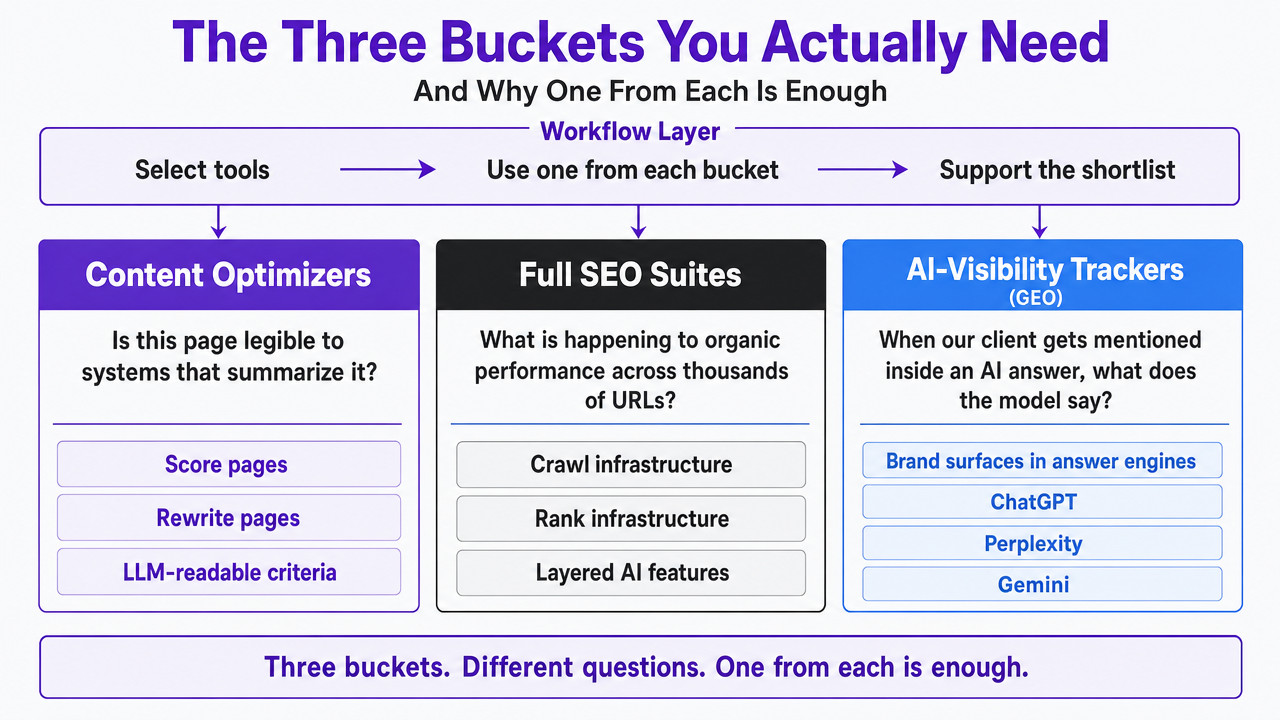 Visualize the three-bucket taxonomy plus the workflow layer above them, supporting the section's framework for tool selection
Trial Full-Scale LLM SEO Analysis and Execution
Validate LLM-driven SEO workflows on real client projects before making any commitment.
Profound: The AI-Visibility Tracker That Replaces Manual Citation Audits
Start with the deliverable this category is built to kill: the spreadsheet where a junior strategist pastes screenshots of ChatGPT and Perplexity answers, tags whether the client's brand appeared, and notes which competitor showed up instead. That deliverable exists at most agencies. It takes between two and six hours per client per month and produces a report no one fully trusts because the prompt set is inconsistent and the engines drift week to week.
Profound is the cleanest example of the AI-visibility (GEO) tracker bucket — the newest of the three platform categories that have crystallized in 2026 3. It runs structured prompt sweeps across ChatGPT, Gemini, Claude, Perplexity, and Grok, maps where a brand surfaces, captures exactly how each model describes it, and benchmarks that presence against named competitors 4. The output is not a screenshot library. It is a longitudinal dataset with the same shape every week: engine, prompt class, citation status, competitor share of voice, and verbatim model description.
The agency consolidation read is narrow and useful. Profound replaces the manual citation audit and the ad-hoc prompt sweep entirely. It does not replace the SEO suite, the content optimizer, or the intent engine — and pretending otherwise is how stacks get bloated. What it adds to the reporting layer is a citation-status dimension that slots into the same KPI surface as organic rankings, which is the architectural move enterprise analytics already expects in 2026 1.
The operational shift is in who runs the report. A junior used to assemble it; now a senior reviews a generated one. That is the role-composition change in miniature — operator hours collapse, strategist hours stay, and the deliverable improves because the prompt set is finally consistent across clients.
Semrush AI Visibility Toolkit: The Suite Play When You're Already Paying for the Suite
The question with the suite-plus-AI bucket is rarely whether the AI module is best-in-class. It almost never is. The question is whether the marginal cost of activating it inside a platform the agency already pays seats for beats the cost of a second standalone vendor that the team will then have to reconcile against the suite's organic data anyway 2.
Semrush's AI Visibility Toolkit is the canonical example. It maps brand presence inside ChatGPT, Gemini, Perplexity, and other AI interfaces and lays that signal next to the same crawl, keyword, and position data the agency is already pulling for organic reporting 4. The integration is the point. Citation status becomes a shared dimension alongside page type, market, and query class — which is the architectural shape enterprise SEO analytics is moving toward in 2026 anyway 1.
The agency consolidation read: this pick replaces the standalone rank tracker, the technical audit tool, and the ad-hoc spreadsheet that tried to bolt AI-visibility onto the weekly client report. It does not replace a dedicated GEO tracker like Profound at depth — the prompt sweeps are shallower, the competitor mapping less granular, and the verbatim model descriptions less complete. For agencies serving clients where AI-citation share is the headline metric, the standalone tracker still earns its seat.
The operating-model implication is the part most procurement reviews miss. If the suite is already in the stack, the AI Visibility Toolkit removes a reconciliation step rather than adding a tool — one login, one export schema, one set of client IDs. For a Head of SEO running fifteen to thirty accounts, that consolidation is usually worth more than a 10-15% depth advantage from a second platform that needs its own onboarding, its own API mapping, and its own line item in the monthly invoice.
Surfer + AI Mode: Content Optimization Where the LLM Reads What You Ship
The content optimizer bucket has spent five years scoring pages against SERP competitors. That game still matters, but it now runs in parallel with a different one: whether the page is legible to the retrieval and summarization systems that feed AI answer engines 8. A page can rank in position three and still get skipped by a Perplexity citation pass because its structure, entity coverage, or passage boundaries don't read cleanly to the model doing the summarizing.
Surfer's AI Mode is the cleanest example of the content optimizer bucket adapting to that second game 3. The classic SERP-comparison scoring is still there, but the optimizer now also evaluates structural signals that matter to LLM retrieval:
- clear semantic chunking,
- explicit entity definitions,
- structured headings, and
- answer-shaped passages that an AI engine can lift without rewriting 9.
The output is a single brief that targets both audiences instead of two separate workflows.
The agency consolidation read is specific. Surfer-class optimizers replace the page-level brief, the on-page audit, and the editor's manual checklist for AI-readability — three deliverables that used to live in three different documents. They do not replace the AI-visibility tracker, because scoring a page for legibility is not the same as measuring whether the model actually cites it. The two tools answer adjacent questions and should not be confused at the procurement stage 3.
The operational shift is in editorial review. With the optimizer reading the way an LLM reads, the senior strategist's role compresses from rewriting drafts to approving structural calls — entity coverage, passage-level clarity, schema choices — that the optimizer surfaces in a single pass.
See How Leading Agencies Streamline LLM-Driven SEO Analysis at Scale
Request a walkthrough of AI-powered SEO workflows used by digital agencies to automate analysis, prioritize actions, and accelerate delivery—without increasing headcount or losing strategic oversight.
AlsoAsked / Frase-Class Intent Engines: Where LLMs Beat Your Junior Strategists
Intent discovery is the workflow where junior strategists used to spend their Tuesday afternoons. The sequence ran predictably:
- Pull the SERP,
- scrape People Also Ask,
- cluster the questions by topic,
- map each cluster to a brief,
- hand it to editorial.
That sequence ran four to eight hours per client per planning cycle, and the output quality scaled with how senior the analyst happened to be.
An MIT Sloan study found that fine-tuned large language models performed as well as expert analysts at identifying and categorizing customer needs from qualitative data like product reviews — a narrow finding tied to categorization tasks on review corpora, but a direct read on the work intent engines do across SERPs and forum threads 13. AlsoAsked and Frase-class platforms operationalize that finding: they ingest question chains, related searches, and SERP language, then return clustered intent maps that would have taken a junior strategist most of a day to assemble manually.
The consolidation pressure behind this category is sharp. The share of blog content created without AI assistance has collapsed from 65% to 5%, and 98% of marketers plan higher AI SEO spend in 2026 11. Classic research workflows are not being augmented — they are being absorbed into LLM-backed tools that produce the deliverable in one pass.
The agency consolidation read: an intent engine replaces the manual PAA scrape, the topic-clustering spreadsheet, and the first-draft brief outline. It does not replace the content optimizer that scores the finished page, and it does not replace the AI-visibility tracker that measures whether the page eventually gets cited. The senior strategist's job compresses to validating the cluster map and approving the brief — the part the MIT Sloan researchers explicitly flagged as still belonging to humans 13.
Vectoron: The Approval-Workflow Layer Over the Other Four
The other four picks each kill a specific deliverable. None of them solve the problem that emerges when all four are running at once: three or four streams of ranked recommendations landing in a senior strategist's inbox every week, each in a different schema, each demanding triage before a single one reaches the client.
That reconciliation step is where agency margin quietly leaks. Four signals, one client, one senior strategist, and no shared queue — which means the strategist becomes the integration layer, manually:
- A GEO tracker flags a citation gap.
- The SEO suite flags a technical regression.
- The content optimizer flags a passage-level rewrite.
- The intent engine flags a new cluster.
Vectoron sits in a different structural position than the other four. It is not another analysis tool competing with Profound on prompt-sweep depth or with Semrush on crawl coverage. It is the approval-workflow layer that ingests recommendations from specialist analysis sources, ranks them against live business signals — qualified calls, bookings, cost per lead, pipeline — and routes each one through a single human sign-off before execution. AI handles the research, ranking, and bulk drafting; humans handle validation and approval, which is the division of labor the scaling literature consistently endorses 5.
The agency consolidation read: Vectoron replaces the manual triage spreadsheet, the cross-tool reconciliation meeting, and the ad-hoc "who approved this" audit trail. It does not replace the analysis tools that feed it — and the design assumes it won't. The architectural argument is that as worker access to AI rose 50% in 2025 and production-grade AI projects are expected to double per Deloitte's State of AI in the Enterprise report, the bottleneck moves from analysis capacity to approval capacity 12. A queue, not another dashboard, is what scales past twenty clients without quality drift.
Governance, Reporting Architecture, and the Multi-Client Reality
One Reporting Layer, Not Five Dashboards
The fastest way to break a multi-client reporting model is to let each tool ship its own dashboard to its own client portal. Profound exports citation status one way. The SEO suite exports rankings another. The content optimizer exports legibility scores in a third schema. The intent engine emits cluster maps as JSON. Five logins, five definitions of "visibility," and a senior strategist spending Friday afternoons stitching screenshots into a deck.
The architectural fix is the same one enterprise SEO analytics has converged on: a single reporting layer with shared dimensions — page type, market, template, query class, and now engine and citation status — that every tool feeds into via ETL rather than presents directly to the client 1. The tools become data sources. The reporting layer becomes the one surface a client sees.
That collapses two costs at once. Reconciliation hours disappear because the dimensions are defined once, not per vendor. And client trust improves because the AI-visibility number on slide four matches the organic ranking number on slide three — same client ID, same week, same query class. One layer, four tools underneath it.
If You Manage a Multi-Client Portfolio: Governance Before Volume
A scope marker: this section is for Heads of SEO accountable for ten or more client accounts, where a single bad LLM-generated recommendation can ship across the portfolio before anyone catches it.
Governance is not a compliance exercise here. It is the thing that decides whether scaling to thirty clients increases margin or quietly destroys it. The NIST AI Risk Management Framework defines four functions worth borrowing wholesale:
Govern : who owns each decision
Map : what the tool actually does and where it can fail
Measure : how accuracy and drift are tracked
Manage : what gets escalated, paused, or rolled back 14
The companion playbook translates those into operational actions an agency can adopt without a legal team 16.
The practical version for a multi-client portfolio: a named owner per tool, a documented prompt set per engine, a sampled human review on every LLM-generated client deliverable, and a rollback path when an AI-visibility report contradicts itself week over week. Volume comes after that, not before. Agencies that invert the order ship faster for a quarter and spend the next two quarters cleaning up.
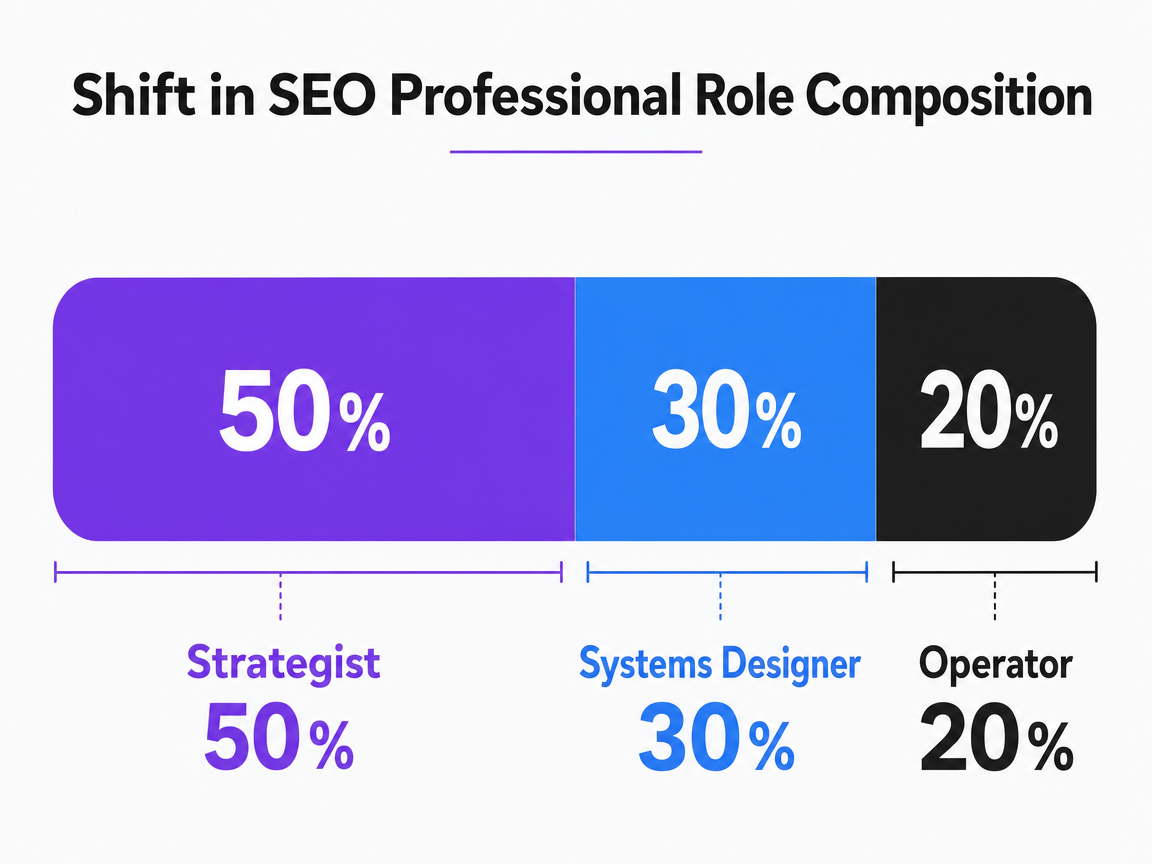 Shift in SEO Professional Role Composition
Describes the evolving composition of an SEO professional's role, emphasizing a shift towards strategy (50%) and system design (30%) over manual operation (20%).
Frequently Asked Questions
References
- 1.Enterprise SEO Analytics: A Complete Guide for 2026.
- 2.AI SEO Tracking Tools 2026: Comparative Analysis of Over 10 Platforms.
- 3.AI Tools for SEO: Platforms to Watch.
- 4.Best AI SEO Tools 2025 – Top 10 Platforms for AEO, ChatGPT & LLM.
- 5.AI SEO at Scale Without a Marketing Team (2026 Guide).
- 6.How AI Agents Make SEOs More Valuable (Not Less!).
- 7.Best Enterprise SEO Tools for 2024: Choosing the Right One.
- 8.When Search Engine Services meet Large Language Models.
- 9.Large Language Model LLM SEO | Strategies for Optimizing Website Visibility and Ranking in AI Search.
- 10.AI Marketing Statistics 2026: 200+ Adoption Insights.
- 11.50+ Content Marketing Statistics to Watch.
- 12.The State of AI in the Enterprise - 2026 AI report.
- 13.Large language models can help professionals identify customer needs.
- 14.Artificial Intelligence Risk Management Framework (AI RMF 1.0).
- 15.Biden-Harris Administration Announces New NIST Public Working Group on Generative AI.
- 16.Playbook.