
Key Takeaways
- Profound excels at prompt-set monitoring across major engines, making it a strong fit for agencies needing scalable prompt coverage across portfolios of eight to twelve client brands.
- AthenaHQ specializes in citation share and source position auditing, surfacing which third-party domains crowd clients out of AI answers in commercial verticals.
- Peec AI offers broader engine coverage and stronger non-English handling, suiting agencies servicing European clients where AI Overview rollout timing differs by region.
- Otterly.AI provides lightweight, accessible mention surveillance, working best as an entry-level data source under a tiered productized AI visibility deliverable.
- Semrush AI Toolkit bundles AI visibility into an existing SEO platform, offering near-zero onboarding cost and consolidated reporting for agencies resistant to vendor sprawl.
- Ahrefs Brand Radar pairs citation tracking with backlink data, shortening the loop between earning a digital PR placement and seeing it cited by answer engines.
- Vectoron represents the execution-coupled category, routing tracking signals into ranked recommendations and approval-gated production work rather than ending in static reports 7.
Why rank trackers stopped telling the whole story
Organic search clicks have fallen 42% since Google AI Overviews began expanding across U.S. results, according to a Q4 2025 report cited by Search Engine Land that measured logged clickstream data against pre-Overview baselines 3. That single figure reframes the work agencies sell. Position 3 still exists. It just produces fewer outcomes when an Overview, a Perplexity citation block, or a ChatGPT answer resolves the query before a click happens.
Rank trackers were designed for a world where the SERP was the destination. They report cleanly on what they were built to see: keyword positions, SERP features, share of voice inside the ten blue links. They do not see whether a brand was named in an AI Overview, whether it was cited as a source in a Perplexity answer, or whether ChatGPT recommended a competitor for a high-intent comparison prompt.
For agency Heads of SEO, the gap between what clients are asking and what classic reporting can answer is widening every quarter. Clients want to know why traffic dropped on informational queries that still rank in the top three. They want to know whether their brand appears when a buyer asks an AI assistant for a shortlist. Those are different questions, and they need a different measurement layer sitting alongside the rank tracker, not replacing it.
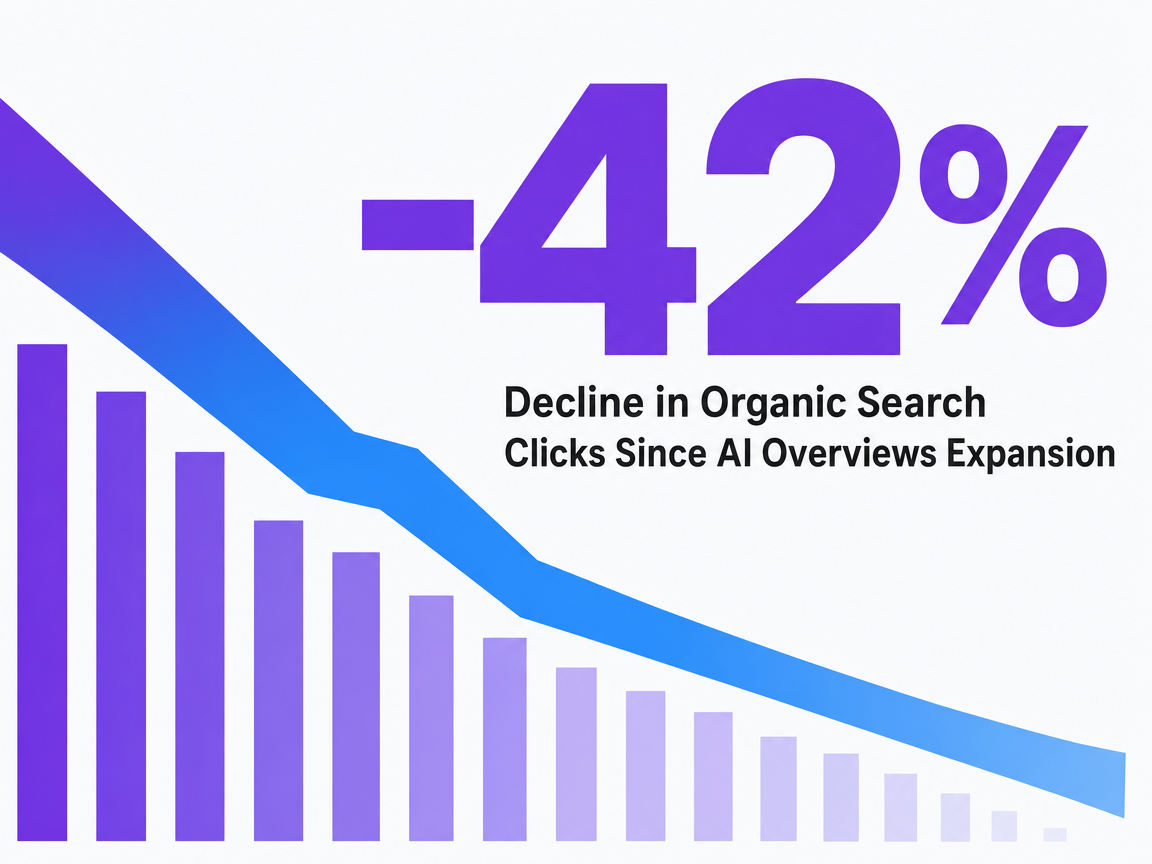 Decline in Organic Search Clicks Since AI Overviews Expansion
Decline in Organic Search Clicks Since AI Overviews Expansion
What an LLM SEO tracker actually has to measure
The four-layer measurement stack: prompt coverage, citation share, source position, recency
Useful LLM tracking resolves into four measurable layers, and the order matters:
- Prompt coverage answers the first question a client will ask: across the universe of prompts a buyer might use, how many produce an answer that mentions the brand at all?
- Citation share narrows from mention to attribution: when the brand is named or its content is used, is it the cited source or the unattributed background?
- Source position records whether the brand appears as the first cited source, a mid-list reference, or a tail citation.
- Recency captures how fresh the cited material is and whether updates trigger re-inclusion.
These layers map directly onto what answer engines reward. A 252,000-trial analysis of competitive citation behavior across AI answer engines found that topical relevance and list position were the dominant drivers of being cited first, with explicit price signals and recent timestamps providing consistent secondary lift 1. The study isolates citation order as a measurable variable, which is why source position belongs in the stack as its own layer rather than being folded into a generic visibility score.
A visibility framework that also references emerging GEO measurement methodology treats these four layers as orthogonal rather than substitutes 12. A brand can hold strong prompt coverage with weak citation share, or strong citation share buried at position four. Agencies need each layer reported separately so client conversations move from "are we visible" to "where in the answer, how often, and how recent."
Why citation share is not a rebranded ranking metric
Citation share looks like share of voice in a rank tracker. It is not. A 55,936-query analysis comparing source coverage and citation bias across six LLM-based and traditional search systems found that the set of sources surfaced in AI answers diverges meaningfully from the set ranked highly in classic SERPs 13. Pages that win the tenth-position click in Google can be entirely absent from a Perplexity answer on the same query. Pages that never crack page one can be cited by ChatGPT as the primary source.
The practical consequence for agencies: citation share has to be measured against the universe of cited sources for a prompt, not against the universe of ranked URLs for a keyword. Two clients can hold identical keyword positions and still post different citation shares because answer engines weight third-party authority, structured data, and content recency differently than crawl-and-rank systems do 11.
Scoping the exposure surface across answer engines
The exposure surface is larger than Google AI Overviews alone, but Overviews set the baseline. Aggregated clickstream data places AI Overviews on 13.14% of U.S. desktop searches 8, with secondary statistics putting prevalence at roughly 13% of global searches and 16% of U.S. desktop keywords 9. Informational queries draw Overviews more often than commercial ones, which shifts where the visibility risk concentrates by client vertical 10.
Agencies tracking only Google miss the prompt-level behavior that ChatGPT, Perplexity, Gemini, and Claude generate for high-intent comparison queries. A defensible measurement scope covers at least three engines and segments prompts by intent class, so that informational coverage gaps and commercial shortlist absences surface as separate problems rather than one blended number.
Evaluation criteria built for agency delivery, not solo brands
Most public comparisons of LLM SEO trackers grade tools on dashboard polish and prompt-set size. Those criteria suit a single in-house team watching one brand. Agency delivery has a different shape, and the evaluation criteria have to follow.
Five criteria carry disproportionate weight when a tracker has to survive a multi-client portfolio:
- Workspace isolation: separate environments per client with role-based access, so an analyst on Account A cannot see prompt sets or competitor lists from Account B.
- Prompt-set scalability: the ability to load, version, and refresh hundreds of prompts per client without per-prompt pricing that breaks at portfolio scale.
- White-label reporting: exportable views that fit existing client decks without manual rebuilds each cycle.
- Competitive citation auditing: not just whether competitors appear, but at what source position and against which third-party citations, since answer engines lean on authoritative outside sources in commercial queries 11.
- Execution integration: whether tracker output can route into a content or PR workflow, or whether it dead-ends in a PDF.
A tracker that scores high on all five compresses delivery hours. One that scores high on the first two and fails the last three forces the agency to absorb the integration cost as billable margin.
Test Real LLM SEO Tracking Workflows Instantly
Run live LLM SEO experiments and validate their impact with full platform access before committing.
Seven LLM SEO trackers, compared on what matters
Profound: prompt-set monitoring at scale
Profound positions itself around prompt-level monitoring across ChatGPT, Perplexity, Gemini, and Claude, with a workflow built for teams that want to operate on hundreds or thousands of prompts rather than a curated handful. The product's strength sits at the first layer of the measurement stack: prompt coverage. Analysts can load prompt sets segmented by intent class, schedule refreshes, and watch how mention rates move as model versions update.
For agency delivery, the prompt-set scalability is the standout feature. A portfolio managing eight to twelve client brands can sustain distinct prompt libraries per account without the per-prompt economics breaking. Citation auditing exists but reads as secondary to mention tracking, which means competitive source-position analysis often requires manual export and reconstruction. Workspace isolation supports multi-client setups, though white-label reporting depth varies by plan tier per published market comparisons 5. Treat Profound as a strong observation layer for agencies that already have a content production engine sitting next to it.
AthenaHQ: citation auditing and competitive share
AthenaHQ leans hard into the second and third layers of the stack: citation share and source position. The product captures which URLs answer engines actually cite for a given prompt, which competitor sources appear in the same answer, and where each source lands in the cited order. That orientation aligns with the empirical finding that list position is one of the strongest drivers of being cited first in AI answers 1.
Agencies running competitive audits as a recurring deliverable get the most out of AthenaHQ. The platform makes it straightforward to show a client which third-party domains are crowding them out and how often a competitor's earned media coverage is doing the citation work. That matters in commercial verticals where answer engines lean on authoritative outside sources rather than brand-owned pages 11. Prompt-set scale is more modest than Profound's, and execution integration is effectively absent: findings exit as reports, not as routed work.
Peec AI: multi-engine answer capture for European markets
Peec AI's differentiator is breadth of engine coverage and stronger handling of non-English markets, which matters for agencies servicing clients with European footprints. Market comparisons place it among the newer entrants positioning explicitly against U.S.-centric tools 5. The product captures full answer text across multiple engines, which supports prompt coverage and citation share analysis on the same query path.
Where Peec AI fits agency work cleanly: clients with multi-country reporting requirements, where AI Overview rollout timing and language coverage differ by region 10. Workspace isolation is present, though competitive citation auditing depth trails AthenaHQ. The platform reads as a generalist tracker rather than a specialist in any single measurement layer, which suits agencies that prefer one tool covering several engines over best-in-class coverage of one.
Otterly.AI: lightweight brand mention surveillance
Otterly.AI runs a narrower playbook: scheduled prompts against major engines, mention detection, and sentiment-adjacent flags. Pricing bands reported in market comparisons place it among the more accessible entrants in the category 5, which makes it a candidate for agencies that want to layer AI visibility reporting onto smaller client retainers without committing to a full enterprise tracker.
The tradeoff is depth. Otterly handles the prompt coverage layer adequately but offers less granularity on source position and citation share than tools built around competitive audits. White-label exports exist; execution integration does not. For an agency Head of SEO building a tiered service menu, Otterly works as the entry-level data source under a productized AI visibility deliverable, with a heavier tracker reserved for accounts where the citation-share narrative drives retainer expansion.
Semrush AI Toolkit: bolted onto an existing SEO stack
The Semrush AI Toolkit is the path of least resistance for agencies already standardized on Semrush across client accounts. It bundles AI visibility tracking into the existing platform, which means analyst onboarding cost is close to zero and reporting flows into decks that clients already recognize. Market roundups treat Semrush's entry, along with Ahrefs', as a signal that AI visibility tooling has crossed into the mainstream SEO platform category 4.
The limitations are predictable for a bolted-on module. Prompt-set scalability is constrained relative to specialist tools, and citation auditing does not match the depth of AthenaHQ for competitive source-position work. The advantage is integration: keyword data, backlink profiles, and AI visibility metrics sit in one workspace, which simplifies the analyst workflow when correlating classic SEO movement with answer-engine inclusion. For agencies that resist vendor sprawl, the Toolkit is the safest portfolio-wide default even when a specialist would score higher on any single measurement layer.
Ahrefs Brand Radar: visibility tracking next to backlink data
Ahrefs Brand Radar takes a similar bundle-into-the-stack approach, with a backlink-data adjacency that the Semrush module lacks. Brand Radar tracks mentions and citations across answer engines while sitting next to Ahrefs' link index, which lets analysts correlate which third-party domains driving citations also appear in the client's referring-domain profile. That adjacency matters because answer engines in commercial queries lean toward authoritative third-party sources 11.
For agencies running digital PR and link-earning as part of the retainer, Brand Radar shortens the loop between earning a placement and watching it appear as an AI citation. Prompt-set scale is moderate. Workspace structure follows Ahrefs' existing project model, which agencies already operate at scale. The execution integration story is the same as Semrush's: the tool reports, the team acts. Brand Radar is the strongest fit when link acquisition is the lever the agency uses to influence the citation-share layer.
Vectoron: the execution-coupled category
The seventh slot is a category, not a feature list. The first six tools are observation layers: they tell an agency what answer engines are doing, and the agency's team translates that into briefs, content, outreach, and updates. The execution-coupled category collapses that handoff. Tracking signals route into ranked recommendations, recommendations route into production work, and production work routes through an approval queue before publishing.
The practical implication for an agency Head of SEO: instead of an analyst exporting a citation-share gap report and assigning content tickets manually, the system surfaces the gap, drafts the response, and waits for sign-off. Market analysis frames this as a distinct tool class from observation-only trackers, with platforms like Vectoron operating in this approval-gated execution space 7. The category is younger and the comparison set is smaller, but for agencies trying to expand AI visibility as a service line without adding specialist headcount, execution-coupled tools change the unit economics of delivery in a way observation tools cannot.
Mapping the seven tools: observation-only vs. execution-coupled
The seven tools split cleanly on two axes that matter for agency delivery. The horizontal axis separates observation-only platforms from execution-coupled systems: does the tool report what answer engines are doing, or does it route findings into production work under an approval gate? The vertical axis separates single-brand orientation from multi-client portfolio support: was the platform built for one in-house team, or for an analyst running ten accounts in parallel?
Placing the named tools against those axes yields a recognizable distribution. Otterly.AI and Peec AI sit in the observation-only, single-to-mid-brand quadrant, suitable as entry-level data layers. AthenaHQ anchors observation-only with stronger multi-client citation auditing. Profound extends observation-only into portfolio-scale prompt monitoring. Semrush AI Toolkit and Ahrefs Brand Radar occupy observation-only territory with the practical advantage of sitting inside platforms agencies already license at scale, which is why market roundups treat them as the mainstream default 4. Vectoron occupies the execution-coupled, multi-client quadrant largely on its own, with the broader comparative analysis confirming that approval-gated execution is a distinct tool class rather than a feature on an observation platform 7.
The quadrant a tool occupies determines what an agency has to staff around it. Observation-only requires analyst hours to translate findings into work. Execution-coupled compresses that handoff into the platform itself.
 Improvement in AI Search Visibility (Case Study)
Improvement in AI Search Visibility (Case Study)
If you manage multiple client brands: the agency economics of LLM tracking
The audience shifts here from single-brand operators to agencies running portfolios of eight, ten, or fifteen client accounts in parallel. The economics change with that shift, because the cost of LLM tracking does not scale linearly with client count.
Four variables drive the math:
- Prompt set size per client
- Refresh frequency
- Number of client brands under management
- Number of competitor brands tracked per client
A boutique running four clients with 100 prompts each on weekly refresh produces 1,600 prompt executions per week. A mid-sized agency running twelve clients with 300 prompts each on daily refresh produces 25,200 executions per day. Vendor pricing bands reported in recent market comparisons confirm that specialist tools price on prompt volume and engine coverage, with execution-coupled platforms structured differently because they bundle production work alongside tracking 5, 4.
| Variable | Boutique portfolio | Mid-sized portfolio ||---|---|---|| Client brands tracked | 4 | 12 || Prompts per client | 100 | 300 || Competitor brands per client | 3 | 5 || Refresh cadence | Weekly | Daily || Analyst hours per cycle | Low | Material |
The hidden cost is analyst translation time. Observation-only trackers produce findings that an analyst still has to convert into briefs, outreach lists, and content tickets. At twelve accounts on a daily refresh, that translation work becomes the binding constraint on margin long before license fees do.
See How Leading Agencies Automate LLM SEO Tracking at Scale
Connect with our team to review real-world workflows for multi-client LLM SEO monitoring, approval-first automation, and data-backed insights that drive measurable efficiency for agencies and enterprise marketing teams.
What these trackers still cannot tell you
Every tool in the comparison set has blind spots that matter for client conversations. Three are worth naming before an agency builds a service line on top of them.
Causal attribution to revenue is the first. Trackers can show that a brand's citation share rose from 12% to 28% in a prompt set, but none of them can yet tie that movement to a booked call or a closed deal with the same fidelity GA4 offers for organic clicks. The measurement community is still working on visibility frameworks that connect AI inclusion to downstream outcomes 12.
Conversational follow-up is the second. Buyers rarely stop at the first prompt. They refine, push back, ask for alternatives. Current trackers sample single-prompt outputs, not multi-turn sessions, which means the visibility picture is a snapshot of opening answers rather than the conversation that produces a decision.
Model-version drift is the third. Citation behavior changes when underlying models update, and active optimization of those outputs is a documented risk vector 2. Trackers report what is happening; they do not predict when the next update will move the floor.
How to bill AI visibility as a defensible service line
Pricing AI visibility as a discrete deliverable matters more than which tracker an agency licenses. Bundling it invisibly into an existing retainer surrenders the margin the new work creates. Naming it as a line item with its own scope, cadence, and metrics turns it into a defensible expansion of the contract.
Three pricing models hold up in practice:
- A fixed monthly fee tied to prompt-set size and engine coverage works for retainer clients who want predictable reporting.
- A tiered model layers entry-level mention tracking, mid-tier citation auditing, and senior-tier execution-coupled production, each with its own SLA.
- A performance overlay charges a base fee plus a variable component tied to movement in citation share or source position, which aligns incentives when the client wants outcomes rather than dashboards.
The reporting cadence sells the line item. Monthly delivery covering prompt coverage, citation share, source position, and recency keeps the deliverable visible and the metrics legible to clients who already understand rank-tracker reports 6. Agencies that productize this layer now defend retainers as classic organic clicks compress.
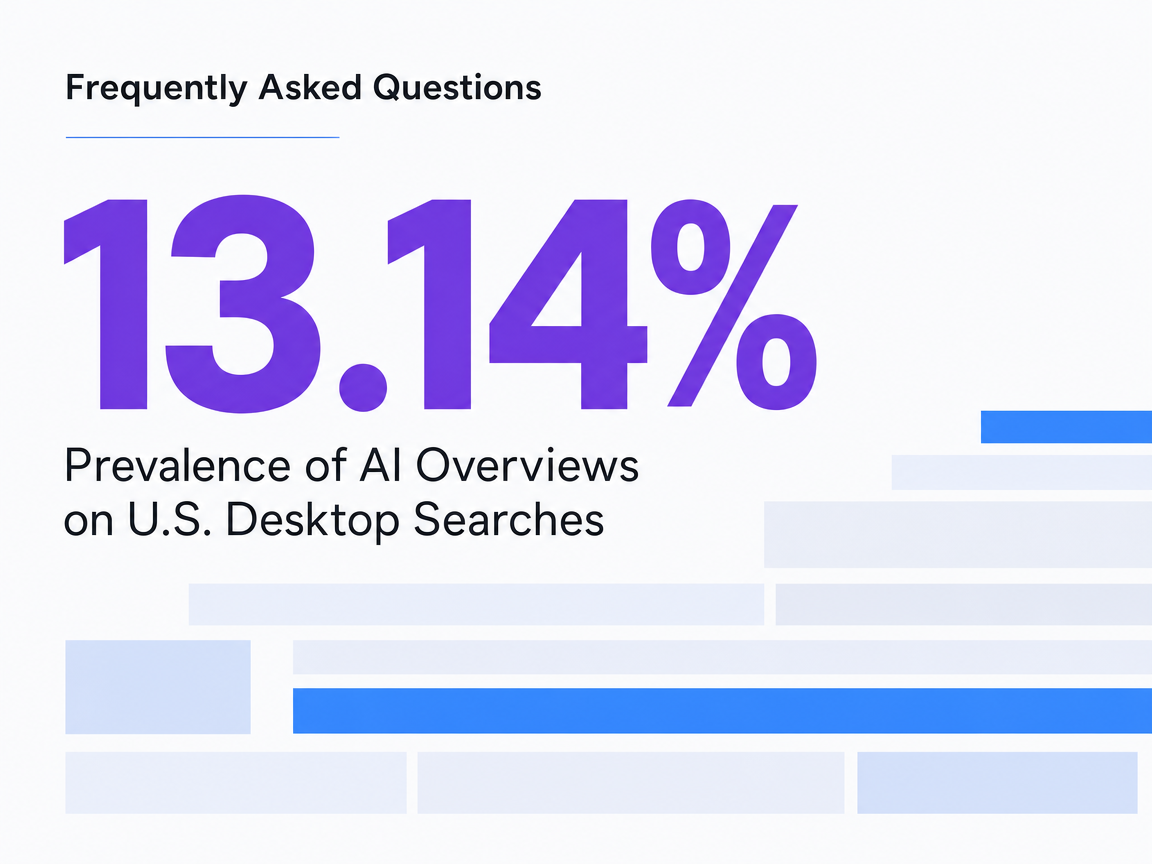 Prevalence of AI Overviews on U.S. Desktop Searches
Prevalence of AI Overviews on U.S. Desktop Searches
Frequently Asked Questions
References
- 1.What Gets Cited: Competitive GEO in AI Answer Engines.
- 2.Manipulating Large Language Models to Increase Product Visibility.
- 3.Google AI Overviews cut search clicks 42%: Report.
- 4.The 8 best AI visibility tools in 2026.
- 5.7 LLM SEO Tools Compared: Which One is Right for Your Business?.
- 6.Tracking Success with AI Visibility & Search: A Quick Guide.
- 7.AI SEO Tracking Tools 2026: Comparative Analysis of Over 10 ....
- 8.Google AI Overviews: Key CTR and Traffic Insights.
- 9.Google's AI Overview Statistics (2025).
- 10.Google AI Overviews: What's Changing for SEO & SEA in 2025.
- 11.Benchmarking Brand Notability for UK iGaming Entities in AI Search.
- 12.Measuring Visibility in AI Search (GEO).
- 13.Source Coverage and Citation Bias in LLM-based vs. Traditional ....
- 14.The Relevance of SEO in the Age of AI and Large Language Models (LLMs).