
Key Takeaways
- Profound delivers enterprise-grade multi-engine parsing across ChatGPT, Claude, Gemini, Perplexity, and AI Overviews, justifying its price for agencies running 30+ accounts that need defensible cross-engine data 3.
- AthenaHQ centers on prompt library governance and named-competitor share-of-voice broken out per engine, suiting agencies willing to actively maintain their tracked question sets 4.
- Peec AI covers the five baseline engines at a mid-market price point, fitting agencies with 20 to 60 small and mid-market accounts that cannot absorb enterprise tooling 9.
- SE Ranking folds AI Overview deployment monitoring into an existing SEO suite, ideal for Google-centric client bases that want blue-link position and AI presence on one row 7.
- Vectoron sits on the execution side, routing visibility signals into content briefs and approval workflows so agencies can act on tracker findings without adding analyst headcount 11.
Why AI visibility tracking became a standard agency measurement layer
Agency Heads of SEO no longer treat LLM visibility as a side experiment running in parallel to rank tracking. It has moved into the core measurement layer because the demand-side numbers are too large to ignore. McKinsey projects that by 2028, roughly $750 billion in U.S. revenue will route through AI-powered search 13. That figure reframes the work: agencies are not optimizing for a secondary surface, they are reporting on a primary one.
The operational consequence is structural. A book of 30 clients now requires monitoring across ChatGPT, Claude, Gemini, Perplexity, and Google AI Overviews, with each engine producing different answer formats, source selection logic, and citation behavior 1. Spreadsheets and one-off prompt tests do not scale to that surface area, and traditional rank trackers built around blue-link SERPs miss most of it 4.
What an agency leader actually needs is a measurement layer that produces defensible numbers across the portfolio: how often each client brand appears in AI answers, whether those appearances include a clickable citation or only a mention, and how share of voice compares to named competitors 2. The five tools profiled below are evaluated against that operating reality, not a feature checklist. Before naming them, a rubric is required, because engine coverage, citation parsing, prompt library depth, and data collection method differ enough across vendors to change which platform belongs in which agency stack.
The evaluation rubric before the shortlist
Engine coverage and the data-collection method behind it
Coverage breadth is the first filter, and it has two layers. The first is which engines a tool actually queries: ChatGPT-only platforms miss the majority of the AI search surface, while serious contenders track ChatGPT, Claude, Gemini, Perplexity, and Google AI Overviews as a baseline, with Copilot and Meta AI emerging on the edge 2, 4. An agency reporting on a regional law firm and a multi-location dental group cannot rely on a single-engine view; the answer mix differs by query type and vertical.
The second layer is how each engine's data gets collected. Tools either hit official APIs where available or run headless browser automation against the consumer interfaces, and the choice has measurable consequences for data fidelity 8. API collection is more stable but constrained by what each provider exposes. Headless browser monitoring captures what real users see, including UI-level features and citation links, but introduces breakage risk every time an interface updates 6. Agency Heads of SEO evaluating vendors should ask, engine by engine, which method is used and how often snapshots refresh, because that combination governs whether weekly client reports reflect reality or stale captures.
Citations versus mentions: the distinction that drives attribution
A brand can appear in an AI answer two ways, and they are not equivalent for revenue. A citation includes a clickable source link back to the brand's domain; a mention names the brand inside the answer text without a link 1. Citations route traffic and support attribution in analytics; mentions build assisted awareness but do not generate a measurable session.
Generic listicles often blur the two into a single "presence" metric, which collapses the data an agency needs to defend reporting. A high mention rate with low citation rate signals that models recognize the brand but are sourcing competitors for the linkable reference, a content and entity problem with a specific fix. A high citation rate concentrated on a few pages signals over-reliance on hero assets and a thin supporting corpus 2. Tools worth shortlisting parse responses to separate citation URL, anchor text, and position from mention-only references, then roll those into share-of-voice views that name competitors rather than abstract them 3, 5.
Prompt library depth, discovery, and parsing fidelity
The prompt library is the asset that determines whether a tracker produces strategic data or noise. Enterprise-grade platforms maintain industry-relevant question sets, execute them against multiple engines on a schedule, and parse each response for mentions, citation sources, position within the answer, sentiment, and competitive presence 3. Shallow libraries miss the long tail where buying intent actually lives.
The Medill Spiegel Research Center analyzed more than 1,000 sources surfaced inside Google AI Overviews to understand how source selection reshapes brand visibility 14. The takeaway for prompt library design is operational: AI Overviews pull from a wider and more varied source set than blue-link results, which means a library built only around head terms will miss the entity associations and long-tail prompts that drive citation decisions. Agencies should pair tool-discovered prompts with real GA4 query data and synthetic long-tail variants to cover the actual answer surface 6.
Parsing fidelity is the other half. A library of 5,000 prompts is worthless if the parser cannot reliably distinguish a competitor mention from a brand mention, or attribute a citation URL to the right entity. Vendors should be asked for parsing accuracy benchmarks per engine, not aggregate claims 4.
Hallucination and source verification as a tool criterion
Models invent citations. A peer-reviewed biomedical study of GPT-4o, evaluating citation behavior across topics with varying public awareness, found that citation fabrication and outright errors were common overall, though less frequent for topics with broader scientific consensus and stronger prompt specificity 15. The study is biomedical, not SEO, but the mechanism is general: when a model lacks confident grounding, it confabulates a plausible-looking source.
For tracking tools, this turns hallucination detection into a non-negotiable feature 4. A platform that reports a brand was "cited" without verifying the URL resolves to a real page on that brand's domain inflates visibility numbers and erodes client trust the first time someone clicks through. Agency Heads of SEO should require URL resolution checks, citation-to-domain matching, and flagging of fabricated or misattributed sources as part of the standard parse, not an enterprise add-on.
Competitive share of voice and recommendation depth
Raw mention counts do not survive a client review. What does is a share-of-voice view that names the three to five competitors the client already benchmarks against, broken down by engine and prompt cluster 2, 5. That format converts AI visibility into the same competitive frame as organic rankings, which is what the report defends.
Recommendation depth is the next filter. Tools that stop at dashboards leave the analytical work on the agency's plate; tools that link a low citation rate to specific content gaps, entity mismatches, or schema issues compress the cycle from observation to action 4. The agency-grade choice produces a ranked work queue, not just a chart.
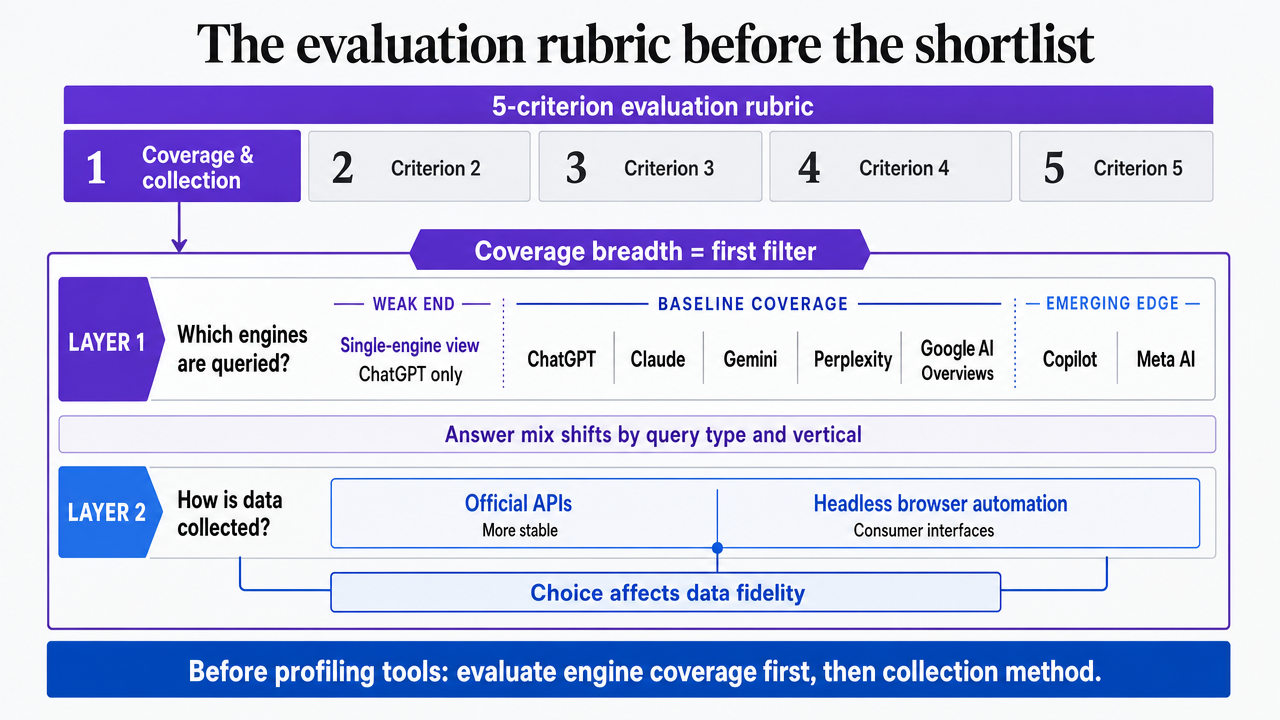 Visualize the five-criterion evaluation rubric the section walks through, giving readers a scannable framework before the tool profiles begin
Profound: enterprise multi-engine tracking with deep prompt parsing
Profound positions itself at the enterprise end of the market, where the deciding factor is rarely the dashboard's polish and almost always the depth of the prompt library and the quality of response parsing behind it. The platform maintains industry-relevant question sets, fires them against ChatGPT, Claude, Gemini, Perplexity, and Google AI Overviews on a recurring schedule, and parses each response for brand mentions, citation sources, position within the answer, sentiment, and competitive presence 3. That parsing model is the operational asset, not the visualization layer on top.
For an Agency Head of SEO running multi-engine reporting across a client portfolio, three behaviors matter:
- Profound's coverage extends across the engines that actually produce the bulk of AI answers, so reports do not leave Google AI Overviews or Perplexity as gaps that competitors will surface in a pitch 2, 4.
- The platform treats citation parsing as distinct from mention detection, which means share-of-voice views can separate clickable references from text-only brand appearances rather than collapsing both into a single presence score 1.
- Prompt discovery is automated rather than left to analyst keyword work, which compresses the time required to stand up a new client account.
The trade-off is buyer profile. Enterprise depth pulls enterprise pricing, and Profound is built for teams measuring AI visibility as a primary KPI, not as an add-on to a legacy SEO suite 3, 9. Agencies running 30 or more accounts that need defensible cross-engine data, parsing accuracy benchmarks per platform, and a recommendation layer that links low citation rates to specific content and entity actions will find the depth justifies the line item. Smaller portfolios chasing a single-engine view will overpay for capacity they do not consume.
Test LLM SEO tracking with live publishing access
Evaluate real-time AI visibility metrics and publish test content with full tracking during your trial.
AthenaHQ: prompt library governance and competitive benchmarking
AthenaHQ approaches LLM tracking from the governance side. Its core argument is that an agency cannot defend AI visibility numbers across a client portfolio without a documented prompt library that names which questions are tracked, why each one was included, and how it maps to a buyer-journey stage. That governance discipline is the differentiator buyers are starting to ask for, since shallow libraries are a known weakness in tools that bolt LLM tracking onto a legacy SEO suite 3.
Coverage extends across ChatGPT, Claude, Gemini, Perplexity, and Google AI Overviews, with response parsing built to separate citation URLs, mention-only references, and competitor appearances inside the same answer 2, 5. The competitive benchmarking layer is where the platform earns its category placement: share-of-voice reporting is built around named competitors per client, not a generic peer set, and each engine's data is reported separately rather than averaged into a single index that obscures where the gaps are 4. For an agency report defending why a regional client is losing ground inside Perplexity but holding share inside ChatGPT, that engine-level breakout is the difference between actionable analysis and a flat dashboard.
Prompt discovery is automated, drawing from real query data and synthetic long-tail expansion so the library grows with the client's actual search surface rather than sitting static after onboarding 6. The trade-off is operational overhead on the agency side. Governance only works if someone owns the library, reviews additions, and retires prompts that have stopped producing signal. Agencies that treat the prompt library as a maintained asset rather than a one-time setup will get the full value; those expecting set-and-forget tracking will find the depth underused.
Peec AI: affordable multi-LLM coverage for mid-market portfolios
Peec AI sits in the category most agency leaders actually need to fill: a mid-market platform that covers the engines that matter without the enterprise price tag attached to deeper parsing suites. Coverage spans ChatGPT, Claude, Gemini, Perplexity, and Google AI Overviews, which is the minimum baseline for a tool worth deploying across a client portfolio in 2026 2, 4. ChatGPT-only trackers leave too much of the answer surface uncovered to defend in a quarterly review 4.
The platform's positioning fits agencies whose books skew toward small and mid-market clients where the per-account budget cannot absorb enterprise tooling, but where reporting still needs to name competitors, separate citation URLs from text-only mentions, and produce share-of-voice views per engine rather than averaged into a single index 5, 9. Data collection leans on a mix of API endpoints where exposed and browser-based capture for the rest, which is the standard tradeoff at this tier and a point worth pressing the vendor on directly, since collection method governs how often weekly snapshots actually reflect what users see 6, 8.
Two limits shape where Peec AI fits in the stack:
- Parsing depth and recommendation layers are lighter than what Profound or AthenaHQ deliver, which means the analyst workload of translating data into content and entity actions stays on the agency side 3, 4.
- Prompt discovery is functional but benefits from manual augmentation with GA4 query data and synthetic long-tail expansion 6.
For an Agency Head of SEO standardizing AI visibility reporting across 20 to 60 mid-market accounts, the platform delivers the coverage breadth needed to retire single-engine trackers without forcing a budget conversation that smaller clients will not survive.
SE Ranking AI Visibility Tracker: AI Overview deployment monitoring inside an existing SEO suite
SE Ranking takes a different route to the shortlist. Rather than launching as a purpose-built LLM visibility platform, it adds AI visibility tracking to an established SEO suite that agencies already use for rank tracking, backlink monitoring, and site audits. For an Agency Head of SEO whose team is fluent in one toolset and reluctant to absorb a second login per client, that consolidation is the headline argument 9.
The AI Visibility Tracker focuses on what most agency reports actually need from Google's surface: how often AI Overviews trigger for tracked keywords, which sources are pulled into those answers, and how that deployment rate varies by query cluster and vertical 7, 12. Pairing deployment rate with the existing rank tracker produces a single view where a keyword's blue-link position, AI Overview presence, and citation behavior sit on one row. That is the report format clients respond to, because it answers the question they actually ask: where are we showing up, and where are we losing ground.
The limits are worth naming. Multi-engine coverage outside Google AI Overviews is thinner than what dedicated platforms like Profound or AthenaHQ provide, so Perplexity, Claude, and ChatGPT-specific reporting will not match the depth of a specialist tool 2, 4. Parsing of citation versus mention is functional rather than the differentiator the platform leads with 1. The fit is straightforward: agencies whose client base lives primarily inside Google's ecosystem, who want AI Overview monitoring folded into the SEO suite they already run, and who plan to add a specialist multi-engine tracker only for the accounts where Perplexity or ChatGPT share of voice has become a board-level question.
See How Top Agencies Track LLM SEO Performance at Scale
Request a walkthrough of unified LLM SEO tracking workflows designed for agencies managing multi-client portfolios—see how to centralize reporting, automate insights, and maintain oversight across all AI-driven campaigns.
Vectoron: connecting AI visibility signals to content and approval workflows
Vectoron enters this shortlist on a different axis. The four platforms above answer the question of what is happening inside AI answers; Vectoron answers what an agency does next once a citation gap, mention-only pattern, or entity mismatch has been identified. It is an execution-layer platform built around six specialist AI strategists covering content, SEO, PPC, backlinks, social, and call intelligence, with every recommendation routed through a Command Center approval workflow before anything publishes.
The relevance to LLM SEO tracking sits at the handoff. AI visibility data is only as valuable as the production cycle that responds to it, and the gap between dashboard insight and published change is where agency hours leak. A low citation rate on a cluster of buyer-intent prompts identified inside a tracker like Profound or AthenaHQ becomes a content brief, an entity update, or a schema fix. Vectoron's content strategist consumes those signals, ranks the work, and produces drafts the agency reviews and approves before publication, which is the workflow Google's own guidance on AI-assisted content supports when the output is original, helpful, and held to E-E-A-T standards 11, 10.
The platform is not a replacement for a dedicated tracker. Agencies still need engine-level parsing, citation-versus-mention separation, and competitive share-of-voice views from a Profound, AthenaHQ, Peec AI, or SE Ranking 2, 5. What Vectoron addresses is the analyst hour problem on the other side of the dashboard: the briefing cycles, status meetings, and vendor handoffs that scale linearly with client count and force agencies to add headcount or cap their book. For an Agency Head of SEO who has already standardized AI visibility reporting and now needs the execution layer to keep pace without doubling the team, the approval-first model is the fit.
If you manage 20 to 100 client accounts: the consolidation math
The economics change when an agency crosses roughly 20 active clients. Below that threshold, a per-client tracker bolted onto each engagement is tolerable. Above it, the math stops working: every additional client adds another seat, another prompt library to maintain, another set of weekly snapshots to reconcile, and another analyst hour to translate raw mentions into a report a client will read.
A defensible cost model uses variables rather than invented vendor numbers, because pricing transparency varies widely across the AI visibility category and most platforms quote agency-seat pricing only on request 4. The three variables that move the line item are:
X — client count : The number of active accounts an agency tracks.
Y — prompts tracked per client : The size of the prompt library maintained for each account.
Z — engines covered per prompt : The number of LLMs each prompt is fired against.
Total monitored query volume scales as X × Y × Z per refresh cycle, which is the figure vendors actually price against.
| Cost driver | Separate per-client trackers | Consolidated AI visibility layer |
|---|---|---|
| Seat licenses | X seats, billed per client account | Single agency workspace, multi-client |
| Prompt library governance | Y prompts maintained X times | Y prompts maintained once, cloned per client |
| Engine coverage | Z engines, often partial per tool | Z engines unified under one parser |
| Analyst hours per report | Scales linearly with X | Scales with template count, not client count |
| Pricing transparency | Published per-seat tiers | Request agency-seat pricing directly 4 |
The headcount-avoidance argument follows the same logic. Prompt library governance and automated response parsing collapse the analyst hours required per client report, because the library is maintained once and applied across accounts rather than rebuilt per engagement 3. Agency Heads of SEO running 20 to 100 accounts should request multi-seat pricing from each shortlisted vendor with X, Y, and Z specified, then compare against the loaded cost of the analyst hours a consolidated layer removes from the weekly cycle.
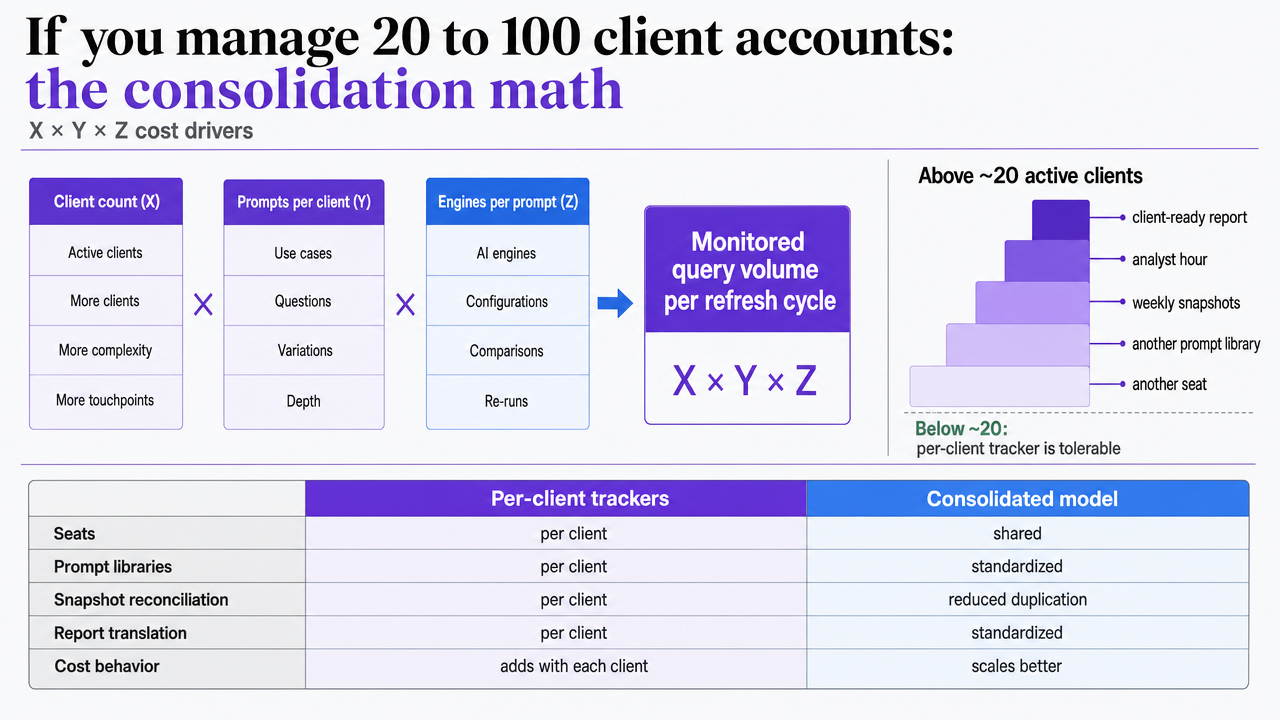 Translate the X <i> Y </i> Z cost-driver framework and the side-by-side comparison table into a clear visual that reinforces the consolidation argument
What this shortlist still cannot tell you
No shortlist resolves the question of which prompts inside a tracker actually correlate to revenue for a given client. That mapping is agency work, not vendor work. A tool can report citation rate against a 5,000-prompt library, but the prompts that move pipeline for a regional law firm differ from those that move pipeline for a multi-location dental group, and no platform ships with that calibration pre-built 3, 6.
The other gap is durability. Engine interfaces change, API access shifts, and parsing logic that worked in one quarter can drift the next, which is why product update velocity matters as much as feature depth at purchase 4, 8. A platform that ships fixes within days of a ChatGPT or AI Overviews UI change protects the data; one that lags by weeks quietly degrades client reports.
E-E-A-T sits in the same blind spot. Trackers measure outcomes, not the experience, expertise, and recognition signals that determine whether a brand gets cited in the first place 10. Closing that loop, from measurement to content production held to Google's people-first standard 11, is where agency execution capacity decides the result.
Frequently Asked Questions
References
- 1.Top Tools for Tracking AI Visibility.
- 2.Best LLM Optimization Tools for AI Visibility in 2026.
- 3.Best LLM Visibility Tracking Tools for Enterprise Teams (2026).
- 4.Top AI Visibility Tracker Tools in 2026: In-Depth Comparison.
- 5.14 Best AI Search Visibility Tools for Tracking LLM Mentions.
- 6.Ultimate Guide to LLM Tracking and Visibility Tools 2026.
- 7.15 Best LLM Monitoring Tools for Brand Visibility in 2026.
- 8.LLM Visibility Tracking Tools 2026: 12 Tested.
- 9.The 8 best AI visibility tools in 2026.
- 10.An EEAT Checklist for AI Search - SALT.agency®.
- 11.Google Search's guidance about AI-generated content.
- 12.Best Google AI Overviews Trackers: 10 Tools To Choose From.
- 13.Winning in the age of AI search - McKinsey.
- 14.Google AI Overviews Decoded - Medill Spiegel Research Center.
- 15.Influence of Topic Familiarity and Prompt Specificity on Citation Fabrication in GPT-4o.