
Key Takeaways
- Google Search Console's generative AI performance reports give the only free first-party view of AI Overview impressions and clicks, but cover no other LLM surfaces.
- Classic rank platforms like Ahrefs, Semrush, and Similarweb remain valuable because first-page rankings correlate with AI citations 72% of the time 3.
- AI citation trackers such as Profound, Otterly, and AthenaHQ are the only category that fully addresses citation share of voice, source URL, and sentiment across ChatGPT, Perplexity, Gemini, and Copilot 10.
- Looker Studio offers a low-cost DIY unification layer that combines Search Console, Analytics, and AI citation feeds into one operator view, though it requires ongoing engineering upkeep.
- Brand monitoring crossovers add sentiment fidelity for AI-generated descriptions, making them most useful for regulated or reputation-sensitive industries rather than core visibility measurement.
- Pipeline attribution platforms like Dreamdata and HockeyStack close Layer 3 by tying LLM referral sessions to CRM revenue, treating AI traffic as an incremental organic channel 4.
- Vectoron acts as an execution and approval layer on top of measurement, routing AI strategist recommendations through a Command Center so signals from trackers become shipped work tied to KPIs.
Why Rank Tracking Stopped Explaining Organic Pipeline
Rank still matters, but its predictive power has shifted. A top Google position once directly correlated with clicks and pipeline. Now, it primarily indicates whether a brand will be included in an AI-generated answer, which may not result in a direct click.
A study of over 400 keywords by Grow & Convert revealed that brands ranking on the first page of Google were mentioned by AI search tools 72% of the time. This rate increased to 77% for brands in the top three positions, with Perplexity reaching 82% 3. This demonstrates that classic rank is now a leading indicator of AI visibility, rather than a direct outcome metric.
This shift impacts traditional reporting. A VP might maintain strong rankings and content velocity, yet see sessions decline as AI Overviews and assistant answers absorb clicks. Google's Search Console now provides dedicated views for impressions and clicks within generative AI features, distinguishing this exposure from traditional search 2.
The reporting challenge has evolved from "are we ranking" to whether ranking leads to citation, citation to a visit, and the visit to pipeline. This three-layer test is used to evaluate tools in the following sections.
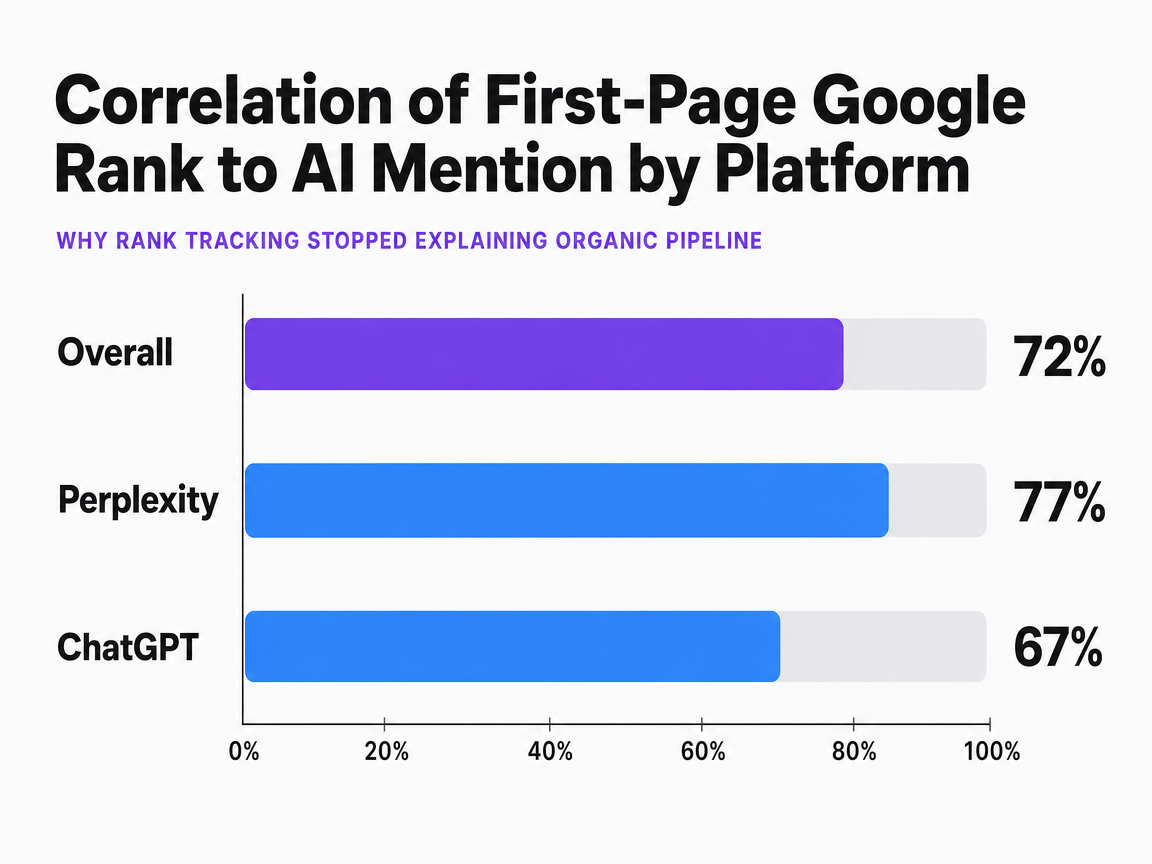 Correlation of First-Page Google Rank to AI Mention by Platform
Shows the percentage correlation between a brand ranking on the first page of Google and being mentioned by various AI tools for the same keyword, based on a Grow & Convert study.
The Three-Layer Test Every Tracker Should Pass
Layer 1: Rank and Index Coverage
Rank tracking forms the foundational layer because AI answer engines still rely on Google's index. If a page isn't crawled, ranked, or technically eligible, it won't appear in ChatGPT, Perplexity, or AI Overviews 9.
A tracker passes Layer 1 if it reports keyword positions, indexation status, crawl errors, and bot access, including whether AI crawlers like GPTBot or PerplexityBot are blocked by robots.txt 9. MarketVantage's scorecard model identifies this as Technical Health and Visibility, essential preconditions for subsequent layers 7. Neglecting this layer means optimizing for citations on pages that search engines cannot reliably index.
Layer 2: AI Citation and Share of Voice
Layer 2 is where many traditional SEO platforms fall short. GrowByData defines AI search visibility through three key signals:
- citation share of voice
- source URL inclusion
- sentiment across major AI platforms like ChatGPT, Perplexity, Google AI Overviews, and AI Mode 10
A tracker that only reports "mentions" without detailing the URL or competitive share provides an incomplete picture.
Duane Forrester's GenAI KPI framework emphasizes that AI share of voice and content contribution to AI answers should be standing dashboard metrics, not just part of quarterly audits 5. Google's Search Console generative AI performance reports offer a baseline for AI Overviews, which trackers should integrate 2. A Layer 2 pass means the tool can answer: who was cited, which URL was used, and how the brand was described.
Layer 3: Pipeline Attribution
Citation without pipeline is a vanity metric. Layer 3 connects AI visibility to tangible demand: sessions, conversions, booked calls, and revenue. It treats LLM referrals as a measurable channel.
Amsive's multi-site study found that LLM referral traffic converted at similar rates to standard organic traffic, without a consistent uplift 4. This sets the expectation that a tracker should prove AI exposure generates incremental sessions that convert at organic-equivalent rates. Brafton's guidance suggests combining Search Console, Analytics, and AI visibility sources for a unified Layer 3 view 1. A tracker passes Layer 3 if a VP can trace an AI citation to a session, a lead, and a pipeline outcome within a single view.
Test AI-powered SEO tracking strategies this week
Experience live pipeline impact by publishing real content and tracking results in your own environment.
The Seven Tools, Scored Against the Three Layers
Google Search Console with Generative AI Performance Reports
Search Console is the only free tool providing first-party data directly from Google's AI answer engine. Its generative AI performance reports offer dedicated views of impressions and clicks from AI features in Google Search, allowing separate analysis of the AI Overviews channel 2.
Layer 1 (Rank and Index): Full pass. It natively provides indexation status, crawl errors, position data, and AI bot accessibility signals.
Layer 2 (AI Citation): Partial. Search Console reports impressions and clicks within AI Overviews but does not cover ChatGPT, Perplexity, Gemini, or Copilot. It also lacks information on how the brand is described in the generated answer, which GrowByData identifies as a core AI visibility signal 10.
Layer 3 (Pipeline): None on its own. Integration with Analytics is necessary to link AI-surface impressions to sessions and conversions.
Search Console serves as the baseline that other tools should ingest, not duplicate. Marketing teams paying vendors to re-report this free data are funding redundancy, not an upgrade.
Classic Rank and Visibility Platforms (Ahrefs, Semrush, Similarweb)
Incumbent SEO platforms excel in Layer 1 and are integrating AI overview tracking into their existing rank reports. Their strength lies in breadth: extensive keyword universes, backlink analysis, competitive share-of-voice, and SERP feature coverage that identifies AI Overviews for tracked terms.
Layer 1: Full pass. Rank, indexation diagnostics, backlink authority, and competitive visibility are their core competencies.
Layer 2: Partial. Most now flag AI Overview presence, and some surface ChatGPT or Perplexity mentions. However, few comprehensively report citation share of voice, source URL pulled, and sentiment—the three signals GrowByData deems essential for AI visibility 10. Forrester's GenAI KPI framework treats AI share of voice as a continuous metric 5.
Layer 3: None. Pipeline attribution falls outside this product category.
The Grow & Convert correlation data supports keeping these platforms, as classic rank remains a leading indicator of AI mentions 3. The strategy is to use one of these platforms, not multiple, and not expect them to fully close the loop on AI answer surfaces.
AI Citation Trackers (Profound, Otterly, AthenaHQ)
This new category emerged to query major AI engines like ChatGPT, Perplexity, Gemini, and Copilot at scale. Tools like Profound, Otterly, and AthenaHQ run prompt panels, identify brand citations, capture source URLs, and score sentiment over time.
Layer 1: Light. These tools generally assume rank tracking is handled elsewhere.
Layer 2: Full pass. This is their primary function. The best tools report all three GrowByData signals: citation share of voice, source URL inclusion, and sentiment across the four major AI surfaces 10. Brafton notes that AI citation measurement still relies on prompted queries and SERP-style sampling, making methodology transparency crucial 1.
Layer 3: None. Sessions and conversions occur downstream of the citation event and are outside their data model.
Operators should consider two points: the prompt set defines the product, so a tracker monitoring 50 prompts differs significantly from one monitoring 500. Second, sentiment scoring is directional but not yet precise enough for revenue forecasts. Choose a tracker with transparent prompt methodology and updated AI engine coverage.
Looker Studio as the DIY Unification Layer
Looker Studio is not a tracker but an affordable way to unify existing tracking tools into a single operator view. Brafton's AI visibility guidance suggests pulling Search Console, Analytics, and AI visibility sources into a dashboard that combines keyword performance, content engagement, and AI citation patterns 1.
Layer 1: Inherited from Search Console and connected rank platforms.
Layer 2: Inherited from the AI citation tracker feed, assuming API connection or scheduled export.
Layer 3: Partial. Analytics provides session, conversion, and goal data; a CRM connector bridges the gap to pipeline. The MarketVantage four-scorecard model—Visibility, Engagement, Authority, Technical Health—provides a structured framework for the dashboard 7.
The main trade-off is the build cost. A Looker unification layer requires a data engineer or senior analyst, ongoing maintenance for API changes, and discipline to prevent model drift. Teams with in-house capacity gain flexibility at a lower cost than a unified vendor, while others may incur significant contractor expenses.
Brand Monitoring Crossovers (Brandwatch-style sentiment for AI answers)
Enterprise brand monitoring platforms, long used for quantifying mentions and sentiment across social media, news, and forums, are now being applied to AI-generated answers. Here, sentiment scoring on how a brand is described is as crucial as the citation itself.
Layer 1: None. These tools do not track rank or index health.
Layer 2: Partial. They excel in sentiment and narrative tracking—the third GrowByData signal—and are valuable for identifying inaccurate or negatively framed AI descriptions 10. Coverage of citation share of voice and source URL inclusion is generally weaker than dedicated AI citation trackers.
Layer 3: None.
These crossovers are most valuable for brands in regulated or reputation-sensitive industries where the wording of an AI answer has significant implications. For pure visibility measurement, a dedicated AI citation tracker often covers more of Layer 2 at a lower cost. The decision hinges on whether sentiment fidelity justifies an additional tool license or if the AI citation tracker's sentiment module suffices.
Pipeline Attribution Platforms (Dreamdata, HockeyStack)
Layer 3 is often the quietest part of LLM SEO tracking discussions. Pipeline attribution platforms like Dreamdata and HockeyStack connect session-level behavior to CRM opportunities, booked calls, and revenue. As LLM referral traffic appears as a distinct source in Analytics, these platforms can isolate its contribution to the pipeline.
Layer 1: None.
Layer 2: None. These tools track AI referrals after they occur, not the citations that generated them.
Layer 3: Full pass. Multi-touch journeys, channel grouping, and revenue attribution are their core offerings.
Amsive's multi-site study provides a realistic expectation: LLM referral traffic converted at similar rates to standard organic, without consistent uplift 4. A VP defending organic budget should frame AI referrals as an incremental organic channel, not a source of higher-intent traffic. The focus for attribution should be volume contribution and assisted-conversion lift, rather than an unsupported premium conversion rate. Pairing one of these platforms with an AI citation tracker completes the loop.
Vectoron: The Execution and Approval Layer
The preceding tools identify what is happening, but none execute the work to change it. Vectoron fills this gap as a unified AI marketing execution platform, sitting atop the measurement stack not as a tracker, but as an execution and approval layer.
Layer 1: Ingested. Rank, indexation, and crawl signals feed the recommendation engine, rather than residing in separate reports.
Layer 2: Ingested. AI citation share of voice, source URL inclusion, and sentiment serve as inputs for prioritizing content 10.
Layer 3: Ingested and acted upon. Live pipeline data—qualified calls, bookings, cost per lead—informs which recommendations are prioritized, and every approved action is tracked back to its KPI impact.
Vectoron's operating model is its differentiator. Specialist AI strategists for content, SEO, backlinks, PPC, social, and call intelligence analyze signals from trackers, prioritize actions, and route decisions through a Command Center for human approval before execution. Forrester's GenAI KPI framework advocates for AI share of voice and content contribution to AI answers as live operating metrics 5. An execution layer like Vectoron translates these metrics into approved, shipped work, which is the only stage that drives pipeline.
What These Tools Still Can't Measure
Every tracker has blind spots that marketing teams must address. Three notable limitations exist.
First, summarization opacity. While Search Console reports impressions within AI Overviews, neither it nor third-party trackers reveal the exact wording used to describe a brand in the generated answer 2. Operators can see they were cited but not precisely how their content was paraphrased, which paragraph was used, or if competitor framing was blended in.
Second, sentiment precision. AI citation trackers and brand monitoring tools score sentiment, but this scoring is directional. Linking a sentiment shift directly to revenue remains an inference, not a precise measurement.
Third, the prompt-set ceiling. A tracker's knowledge is limited by its prompt panel. Real users employ conversational, long-tail variants that no panel can fully cover.
Where trackers fall short, two on-page strategies are proven to boost citation rates. Research shows that backing claims with references and statistics increases AI citation chances by approximately 40%. Additionally, content structured in 120–180 word sections between headings is about 70% more likely to be cited by ChatGPT than content in very short blocks 8. These are actionable steps to take while measurement capabilities evolve.
See How Leading Teams Operationalize LLM SEO Tracking—Without Expanding Headcount
Request a walkthrough of unified AI-driven SEO monitoring and reporting workflows designed to eliminate vendor friction and enable full-funnel pipeline tracking for multi-location or enterprise-scale brands.
If You Manage Multiple Locations: Stack Economics vs. Unified Workflow
For a single-brand VP, a four-tool stack might be justifiable. However, for multi-location operators—like a DSO with 40 practices, a franchisor with 80 territories, or a law firm with a dozen offices—the costs compound per location, domain, and user. The integration burden also increases, often requiring additional headcount.
GrowByData's three-layer view establishes the minimum coverage required across all locations: citation share of voice, source URL inclusion, and sentiment across ChatGPT, Perplexity, Google AI Overviews, and AI Mode 10. The question becomes whether multiple tools or a single unified workflow achieves this at a lower total cost.
Comparing costs, expressed as variables:
| Cost Component | Stacked Point Tools | Unified Workflow |
|---|---|---|
| Rank tracker | Per-seat license × seats × 12 | Included |
| AI visibility tracker | Per-domain fee × locations × 12 | Included |
| Analytics / attribution layer | Per-location reporting tier × 12 | Included |
| Content audit tool | License × 12 | Included |
| Integration & maintenance | Analyst or contractor hours × 12 | Included |
| Execution layer | Not included — separate agency or in-house cost | Included |
| Indicative monthly floor | Sum of the above | $599/mo (Vectoron, post-trial) |
For multi-location operators, per-domain fees scale linearly, quickly making stacked economics unsustainable; a 40-location DSO pays the AI visibility fee 40 times. The integration line is often underestimated—maintaining API alignment across four vendors is ongoing analyst work, not a one-time setup. A unified workflow consolidates these costs into a single subscription and integrates execution into the measurement loop.
How to Sequence a Tracking Stack That Defends Organic Budget
The order of implementation is crucial for VPs needing to defend organic budgets quickly. A stack should produce defensible answers in three motions, not require a six-month integration plan.
- Motion one: activate the free baseline. Enable Google Search Console's generative AI performance reports, separating AI Overview impressions and clicks from traditional search 2. Integrate with Analytics to establish a session and conversion line for the AI Overview channel from day one. This forms the baseline for all subsequent investments.
- Motion two: add one Layer 2 tracker and one rank platform. Select an AI citation tracker that reports citation share of voice, source URL, and sentiment across ChatGPT, Perplexity, AI Overviews, and AI Mode in a single view 10. Maintain one classic rank platform for its predictive signal, as Grow & Convert's correlation data confirms its continued value 3. Structure the dashboard using the four-scorecard model—Visibility, Engagement, Authority, Technical Health—to provide a clear board report 7.
- Motion three: close Layer 3 before the next budget discussion. Connect referral, session, and CRM data to report LLM traffic as an incremental organic channel with organic-equivalent conversion rates, which is a realistic claim supported by data 4. The argument for budget defense is not that "AI traffic converts better," but rather, "AI surfaces are absorbing demand previously counted as clicks, and here is the citation share, referral volume, and pipeline they generated this quarter." This sequence allows the stack to demonstrate value within one reporting cycle.
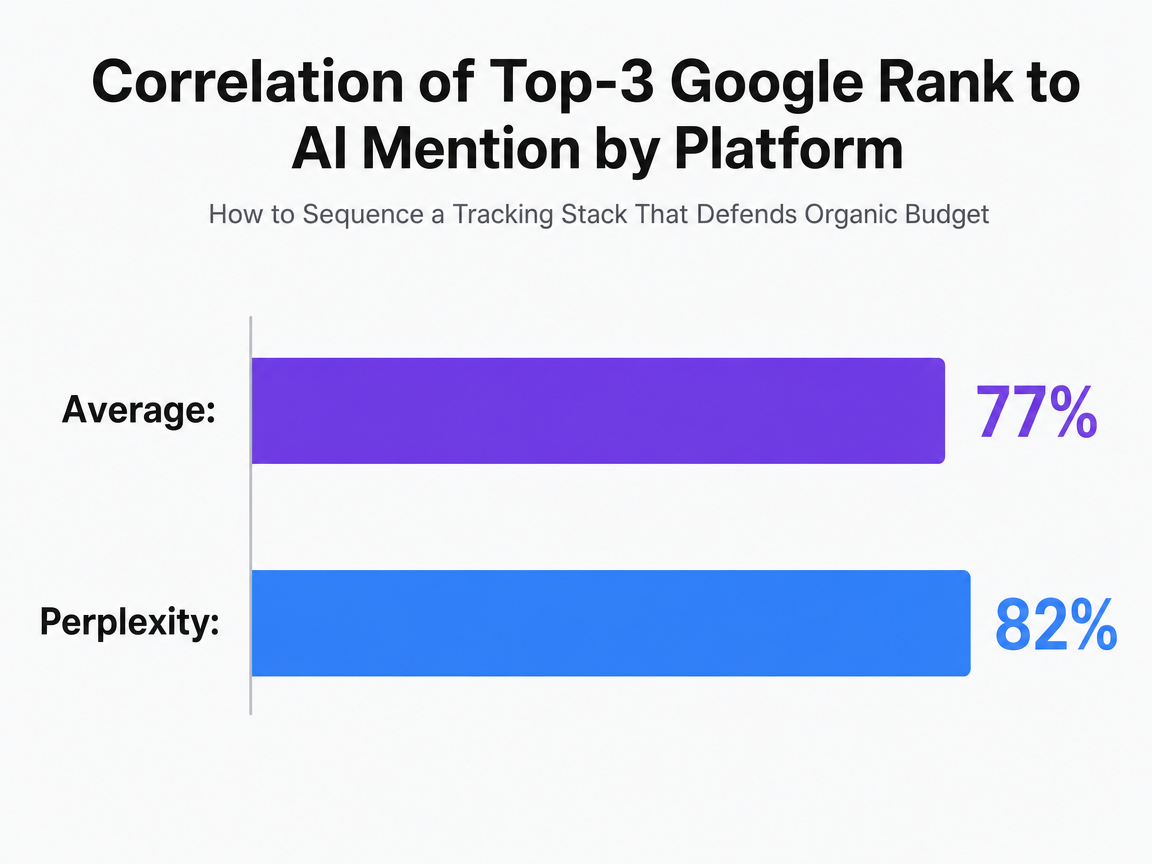 Correlation of Top-3 Google Rank to AI Mention by Platform
Shows the increased correlation when a brand ranks in the top three positions on Google, broken down by average and specifically for Perplexity, based on a Grow & Convert study.
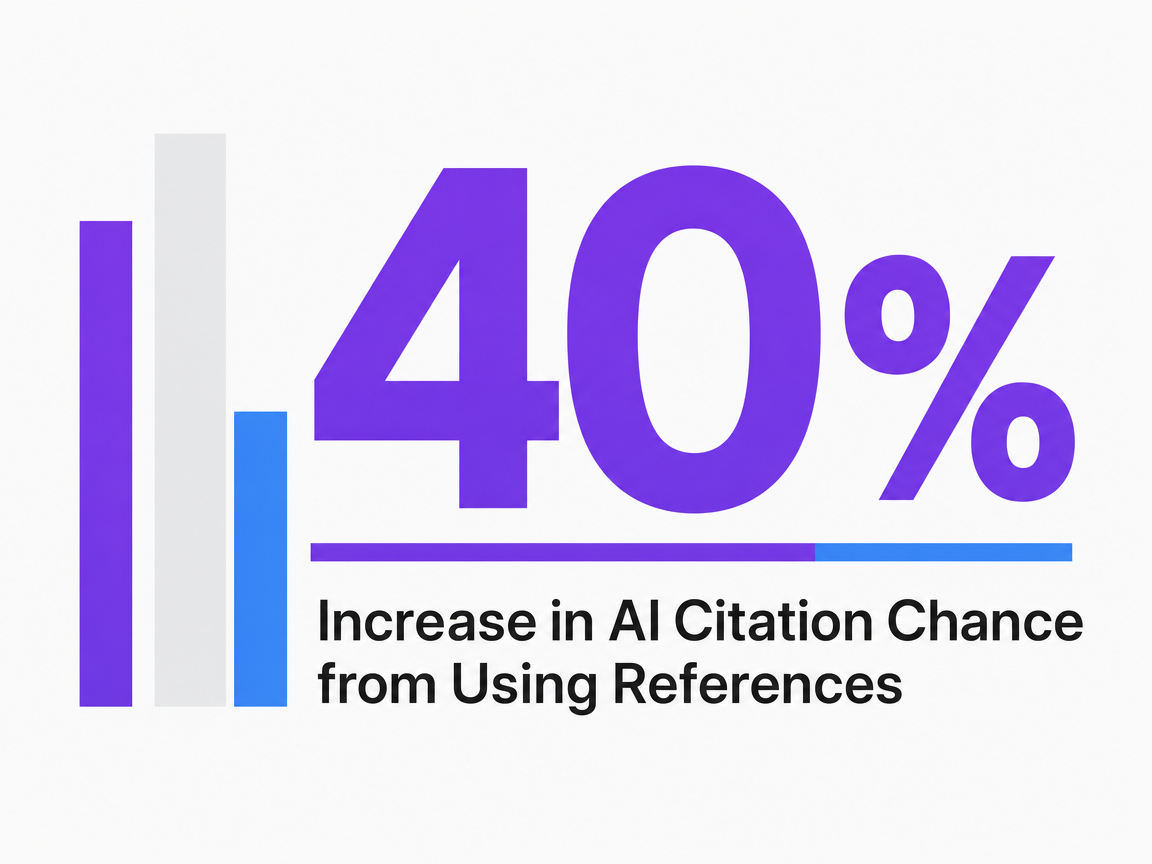 Increase in AI Citation Chance from Using References
Increase in AI Citation Chance from Using References
Frequently Asked Questions
References
- 1.AI Visibility Guide: Get LLMs To Recognize Your Brand.
- 2.Introducing Search Generative AI performance reports in Search Console.
- 3.Does Google SEO Affect LLM Optimization? We Analyzed 400+ Keywords.
- 4.Does LLM Traffic Convert Better Than Organic? A New Data-Backed Study.
- 5.12 New KPIs for the GenAI Era: The Death of the Old SEO Dashboard.
- 6.The Influence of Large Language Models on Organic Traffic and SEO Engagement.
- 7.Measuring Success: Key SEO Metrics to Track with AI.
- 8.GEO for PR: 2026 Strategic AI Search Guide.
- 9.AI Search in 2026: The Complete Guide to SEO and GEO.
- 10.AI Search Visibility in 2026: The Complete Guide.