
Key Takeaways
- HubSpot Blog Ideas Generator quickly unblocks stalled calendars for small teams, but its pattern-driven headlines require separate SEO validation before they can guide serious editorial planning.
- AnswerThePublic organizes autocomplete data into question clusters that mirror how buyers query LLMs, making it valuable for answer-engine mapping though it lacks intent scoring or prioritization.
- Semrush Topic Research speeds triage through volume-anchored subtopic cards with difficulty scores and related questions, though its results stay tied to indexed search rather than emerging LLM prompts.
- Ahrefs Content Explorer surfaces competitive gaps by filtering high-performing web content, rewarding teams willing to invest time in structured exploration over rapid batch ideation.
- ChatGPT with custom instructions scales branded ideation and is already used for topics by 45% of familiar US adults 9, but lacks search grounding and site-inventory awareness.
- MarketMuse scores topics against complete-coverage models and flags existing pages, best suited to teams that manage content as tagged inventory within defined topic clusters.
- Vectoron treats ideation as part of a governed pipeline linking signals, briefs, drafts, and measurement, replacing multiple tools rather than supplementing a single step.
Why Topic Ideation Became the Bottleneck in Content Ops
Content teams often find themselves overwhelmed not by a lack of tools, but by the sheer volume of ideas that need sifting. A content manager juggling keyword exports, competitor analyses, and internal suggestions is performing triage, not strategic planning. This bottleneck often stalls editorial calendars.
The rapid advancement of AI-assisted ideation has transformed the landscape. McKinsey's 2024 survey revealed that generative AI adoption in marketing and sales more than doubled from the previous year, making it a leading enterprise use case 7. Marketing and sales are also among the first functions where organizations deploy gen-AI 7. Ideation is a primary application: Forrester's research indicates that 45% of US online adults familiar with ChatGPT are likely to use it for generating topic ideas 9. This means general-purpose models are already serving as de facto topic generators, regardless of official team sanction.
This presents a unique challenge for content managers. The difficulty is no longer generating ideas, but effectively filtering them against critical criteria like search demand, buyer intent, brand voice, and existing content coverage before a brief is even sent to a writer. The following seven tools are evaluated based on their ability to streamline this crucial filtering step, rather than just the sheer volume of ideas they can produce.
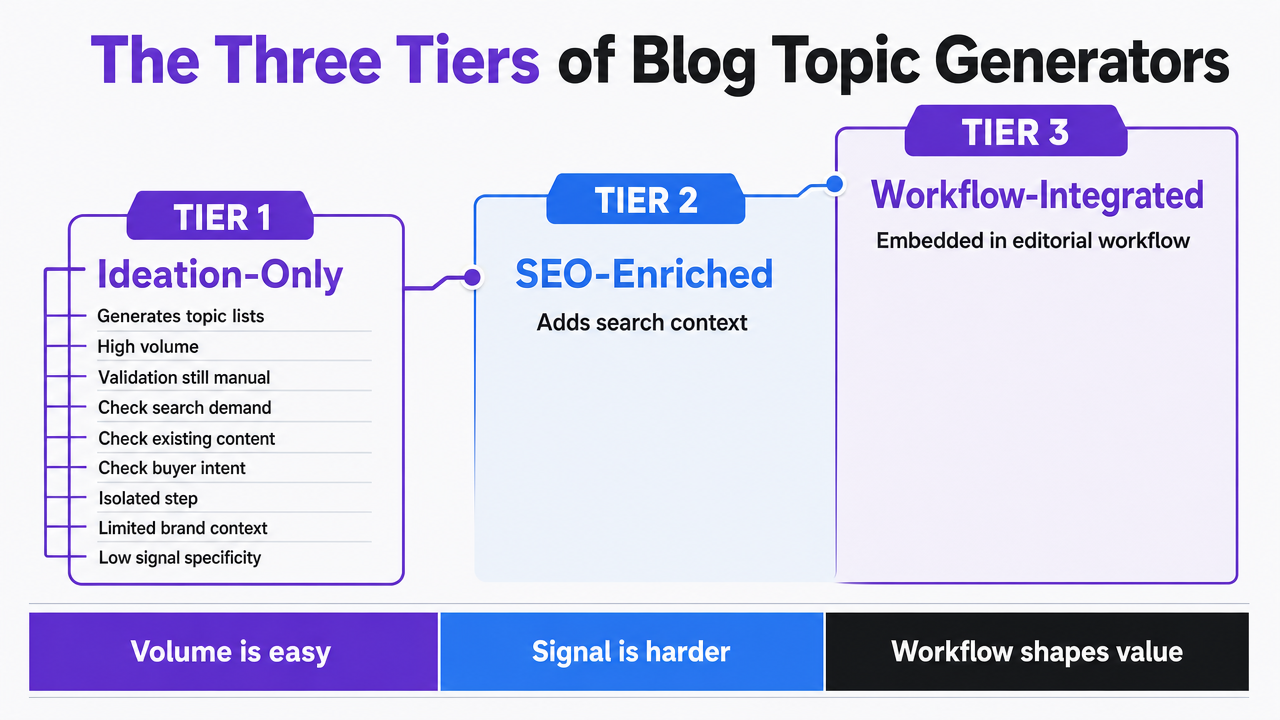
The Three Tiers of Blog Topic Generators
Ideation-Only Tools: Volume Without Signal
Ideation-only tools primarily generate lists of topics. A simple prompt yields numerous suggestions, but the content manager still bears the responsibility of validating each idea against search demand, existing content, and buyer intent. These tools function much like a digital brainstorming whiteboard, treating topic generation as an isolated step.
Their output often lacks specificity because the models typically have no insight into a brand's unique positioning, existing website content, or the precise queries a target audience uses. Forrester's analysis of AI writing assistants highlights that productivity gains from these tools are heavily dependent on the surrounding editorial workflow, not just the raw output 10. Generating volume is straightforward; discerning valuable signal is not.
SEO-Enriched Tools: Topics Tied to Search Demand
The middle tier integrates search data into the ideation process. Topics are presented with estimated search volumes, difficulty scores, related queries, and sometimes even SERP previews. This allows content managers to filter by intent or cluster, then export a prioritized list for their editorial calendar. This tier represents the current operational standard for many in-house teams.
However, their scope is limited. Ideation anchored solely to search volume assumes traditional search engine results pages (SERPs) remain the primary discovery channel. This overlooks the fact that nearly all business buyers now utilize generative AI throughout their purchasing journey 12. Topics optimized purely for keyword volume may miss the nuanced, question-based prompts that answer engines prioritize. Forrester advises mapping authoritative content directly to the questions buyers are actually asking 1.
Workflow-Integrated Platforms: Ideation as Part of a Continuous Pipeline
The most advanced tier views topic generation as an integral component of a governed content pipeline. This pipeline spans from signal detection through brief creation, drafting, publishing, and performance measurement. McKinsey describes this architecture as AI agents continuously monitoring LLMs, search, and social ecosystems to identify emerging trends and intent shifts, then generating, testing, and optimizing relevant content for both human and AI consumption 11. In this model, ideation evolves from a periodic workshop into a continuous input stream.
For content managers, the key difference lies in the origin and flow of topics. Workflow-integrated platforms draw insights from live signals, existing site inventory, and audience data. Candidate topics are then routed through an approval process before entering production. Managers transition from sifting through lists to approving or rejecting ranked recommendations directly linked to specific outcomes. This fundamental shift distinguishes the third tier and serves as the primary comparison point for the tool reviews that follow.
Evaluation Criteria That Matter to Content Managers
Feature lists can be misleading. A tool might boast numerous ideation modes yet still produce topics unsuitable for a content manager's brief. The true differentiators between useful and noisy tools revolve around five core questions.
- Does the tool capture intent, not just keywords? Forrester's guidance for answer engines emphasizes that authoritative content must address the questions buyers ask, not just the head terms they type 1.
- Is the output presented in a format that facilitates editorial review, meaning topics include sufficient context (angle, audience, supporting evidence) to move directly into a brief? Forrester's research on AI writing assistants found that productivity gains are realized only when robust editorial workflows are built around the tool 10.
- Does the tool acknowledge existing site inventory, avoiding suggestions for topics already well-covered?
- Can it maintain brand voice, either through custom instructions, style memory, or human approval gates?
- Does ideation integrate with downstream execution—briefs, drafts, publishing, and measurement—or does it end with a simple CSV export?
Each of the seven tools below is assessed against these practical criteria, not just their marketing claims.
Test AI-driven blog ideation in real time
Rapidly generate and publish SEO-focused blog topics using live trial access to a full-scale content engine.
The Seven Tools
HubSpot Blog Ideas Generator: Fast Starter for Small Teams
HubSpot's free generator is a prime example of an ideation-only tool. Users input a few nouns, and the tool quickly generates headline suggestions based on common blog templates like listicles, how-to guides, and question-led titles. Output is nearly instantaneous and doesn't require an account for its basic functionality.
Its strength lies in quickly unblocking a stalled editorial calendar. A small team facing a deadline can generate multiple headline options in minutes. However, it does not validate these ideas against search demand, competitor coverage, or buyer intent. The topics are pattern-driven, not signal-driven.
For content managers with limited resources, its honest use case is as a source of initial inspiration. Generate a list of headlines, then use a separate SEO tool to verify volume and intent before briefing. Treating HubSpot's output as a starting point rather than a final calendar helps avoid the generic titles often produced by ideation-only tools.
AnswerThePublic: Question-Mapped Ideation for Answer Engines
AnswerThePublic aggregates autocomplete data from search engines and organizes it into question clusters (who, what, why, how, comparisons, prepositions). For content managers focused on creating answer-engine-ready topics, this structure more closely reflects how buyers query LLMs than a standard keyword volume export.
The tool's output aligns with Forrester's recommendation to map authoritative content to buyer questions and structure it for both traditional search and generative answer engines 1. A single seed keyword can reveal dozens of question variations, each a potential topic or FAQ entry. This volume is particularly relevant given Forrester's finding that approximately nine out of ten B2B buyers now use generative AI throughout their purchasing process, expecting precise, citation-worthy answers 12.
Its limitation is the lack of validation. AnswerThePublic identifies questions but doesn't score them for intent depth, commercial value, or competitive density. Content managers typically pair it with a keyword tool or integrate it into a broader ideation workflow. On its own, it's a discovery tool, not a prioritization engine.
Semrush Topic Research: Search-Volume-Anchored Clusters
Semrush's Topic Research feature presents subtopic cards clustered around a seed term. Each card includes volume estimates, difficulty scores, related headlines from ranking pages, and question variations. This tool firmly belongs in the SEO-enriched tier and is a go-to for content managers accustomed to keyword-first ideation.
Its primary advantage is triage speed. A manager can quickly review numerous subtopic cards, filter by volume or difficulty, and export a prioritized list for their calendar within an hour. The inclusion of related-question panels partially addresses the answer-engine gap by surfacing query variations similar to those found in tools like AnswerThePublic.
The inherent limitation is that topics remain tied to indexed search behavior. Emerging queries, brand-specific angles, and prompts unique to LLM sessions are typically not reflected in Semrush's output. For teams whose audience heavily relies on AI-assisted research, Semrush's results may require additional validation through question-focused sources before briefs are finalized.
Ahrefs Content Explorer: Competitive Gap Ideation
Ahrefs Content Explorer offers a distinct approach to ideation. Instead of generating topics from a seed keyword, it allows content managers to search the web's indexed content by phrase, filter by traffic, referring domains, and publish date. This helps identify high-performing content from competitors that the manager's site currently lacks.
This competitive-gap analysis is its unique selling proposition. A manager can pinpoint successful pages in related domains, group them by theme, and reverse-engineer the topic strategy that led to their success. While an SEO-enriched tool, it places a stronger emphasis on competitive intelligence than pure keyword expansion.
The operational consideration is time investment. Content Explorer rewards thorough exploration and structured filtering more than rapid, batch ideation. A manager planning a substantial quarterly content schedule will dedicate significant hours to this tool. For teams willing to make that investment, the resulting topics often carry a stronger commercial signal than those derived solely from volume-based exports.
ChatGPT with Custom Instructions: General-Purpose Ideation at Scale
Forrester's data indicates that 45% of US online adults familiar with ChatGPT are likely to use it for generating topic ideas 9, making it the most widely adopted topic generator by sheer usage. Content managers leveraging ChatGPT with custom instructions can embed brand voice guidelines, audience descriptions, tone constraints, and forbidden topics directly into the system prompt. This allows for high-volume topic generation within a defined context.
The use of custom instructions significantly enhances output quality compared to raw prompts. A custom-instructed model can produce topics that adhere to editorial standards, are grouped by funnel stage, and formatted as brief-ready tables. Forrester's evaluation of AI writing assistants underscores that productivity gains are achieved when clear editorial workflows are established around the tool, and custom instructions represent a lightweight form of such a workflow 10.
However, ChatGPT still lacks inherent search-demand grounding and awareness of existing site inventory. Topics generated may appear suitable but sometimes duplicate previously published content. Content managers use it as an ideation partner, not a system of record, and typically pair it with an SEO tool for validation before approving briefs.
MarketMuse: Intent-Scored Topics Tied to Content Briefs
MarketMuse evaluates topics against a comprehensive model of what a complete page on that subject should cover. It then generates briefs detailing subtopics, entities, and questions a draft needs to address. This tool operates at the high end of the SEO-enriched tier and borders on workflow-integrated, as ideation and brief generation occur within a unified interface.
Its key advantage is the depth of intent analysis. A topic score reflects not only search volume but also the completeness of coverage compared to ranking pages. This helps content managers determine whether a topic warrants a new post, an update to an existing page, or an expansion of a content cluster. The tool also identifies existing site pages to prevent duplicate content.
The trade-off is complexity. MarketMuse is most beneficial for teams that manage content as a structured inventory, tag pages by topic cluster, and consistently maintain this taxonomy. A small team without this discipline might benefit from the briefs but less from the inventory model. For content managers ready to operate at a cluster level, MarketMuse streamlines ideation and brief creation into a single process.
Vectoron: Workflow-Integrated Topic Generation
Vectoron embeds topic generation within a comprehensive, governed pipeline that seamlessly connects signal detection, brief creation, drafting, publishing, and measurement. This architecture aligns with McKinsey's vision of continuous growth marketing, where AI agents continuously monitor LLMs, search, and social ecosystems to identify emerging trends and intent shifts, then generate, test, and optimize content for both human and AI audiences 11.
For a content manager, the practical benefit lies in how topics are sourced and advanced. A dedicated Content strategist presents ranked topic recommendations derived from live search signals, existing site inventory, and audience data. Each recommendation is accompanied by clear reasoning: target queries, identified content gaps, and expected impact on downstream metrics. Managers approve or reject these recommendations from a central Command Center; approved topics automatically proceed to brief creation, eliminating manual handoffs.
The primary consideration is scope. Vectoron is designed to replace multiple disparate tools rather than merely supplement one. Teams already invested in a stack of tools like Semrush, ChatGPT, and MarketMuse should weigh the benefits of consolidation against switching costs. However, teams building content operations from the ground up, or those struggling with inefficient handoffs, will immediately realize the workflow advantages.
The Cost of Ideation: A Variable Framework
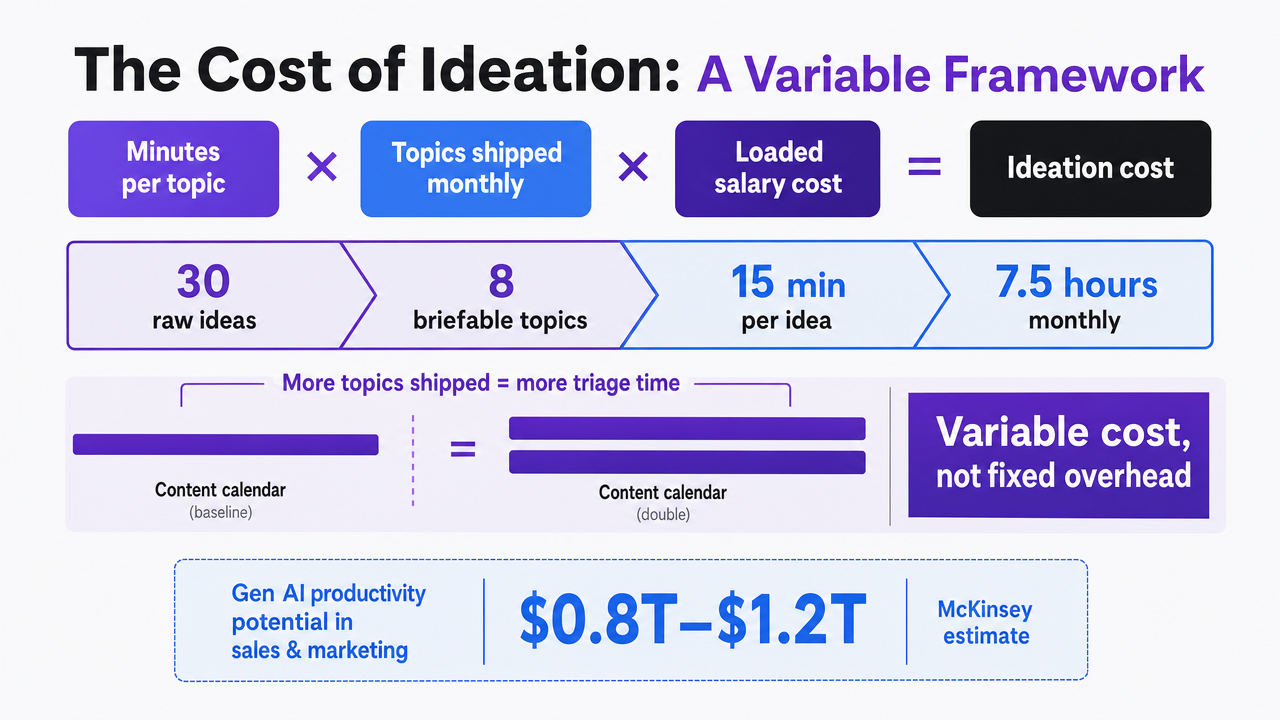
The cost of ideation is often underestimated because it rarely appears as a distinct line item. The true expense is time: the minutes spent per briefable topic, multiplied by the number of topics shipped monthly, and then by the fully loaded salary cost of the individual performing the sorting. For instance, a content manager filtering thirty raw ideas down to eight briefable topics, spending fifteen minutes per idea, dedicates seven and a half hours monthly to triage alone. Doubling the content calendar doubles this time investment.
This variable cost framework is crucial because the potential productivity gains are substantial. McKinsey estimates that generative AI could unlock an additional $0.8 trillion to $1.2 trillion in productivity across sales and marketing functions 6. While a single content team won't capture this at scale, the underlying mechanics apply directly: tools that reduce triage time translate into either more topics shipped with the same headcount or the same output at a lower cost.
The practical calculation for tool selection is straightforward. Estimate the current minutes spent per briefable topic, then project how much a candidate tool could reduce that time. Multiply the time saved by the monthly topic volume and compare this against the tool's cost. Ideation tools that fail to demonstrate a significant reduction in triage minutes rarely justify their license fees based on volume alone.
Matching Tool Tier to Team Maturity
Tool selection is more closely tied to content operations maturity than to team size. A three-person team with a mature editorial workflow, including tagged inventory and defined intent clusters, can fully leverage a tool like MarketMuse. Conversely, a five-person team lacking such discipline might find greater value in a combination of Semrush and a custom-instructed ChatGPT.
One-person teams publishing four to six posts monthly typically require little more than an SEO-enriched tool paired with a free ideation source. AnswerThePublic combined with HubSpot's generator can cover most needs at no license cost, with keyword validation handled by an existing SEO tool. At this scale, the primary triage bottleneck is human attention, not tool capability.
Teams publishing twelve to twenty posts monthly, managing freelance writers, and reporting on SEO metrics to leadership often quickly outgrow SEO-enriched tools. This maturity level is where workflow-integrated platforms become invaluable. When ideation, brief creation, and publishing are unified within a single approval flow, the significant "handoff tax" that consumes a content manager's week is eliminated. The critical question isn't which tool has the most features, but which tier effectively removes the specific bottleneck currently hindering the editorial calendar.
See How Leading Teams Automate Blog Ideation for Consistent SEO Gains
Connect with our specialists to benchmark your current content workflow and discover data-backed methods to generate high-impact blog topics at scale—without adding headcount or losing editorial control.
Failure Modes to Watch For
Topic Drift From Brand Voice
Ideation tools lacking voice constraints often produce topics that sound generic, mirroring common blog patterns rather than reflecting a brand's unique angle. For example, a financial services team might receive generic "5 tips" listicles, despite their brand differentiation lying in regulatory nuance. Forrester's assessment of AI writing assistants emphasizes that productivity gains depend on clear editorial workflows and governance, not just raw output 10. Mechanisms like custom instructions, style memory, and approval gates are essential to prevent this drift.
Low Intent Overlap With Buyer Questions
Volume-first ideation tends to surface topics people search for, but not necessarily the specific questions buyers ask during a decision-making process. A tool might generate numerous keyword-anchored ideas yet miss the precise comparisons, objections, or use-case questions that arise in an LLM session. Forrester's answer engine guidance is clear: authoritative content must be mapped to the actual questions buyers ask, not just the head terms they type 1. Content managers should audit a sample of generated topics against real sales call transcripts or support tickets before approving the calendar.
Duplicate Coverage Across Existing Pages
A costly failure mode is publishing new content that competes with an already ranking page on the same site. Ideation tools without awareness of existing site inventory might suggest a topic covered eighteen months prior, leading the new post to cannibalize the older one in search results. The solution lies upstream: maintaining a tagged content inventory that any topic generator can reference, or utilizing a platform that directly ingests the sitemap. Without this check, increased ideation velocity can inadvertently become a cannibalization engine rather than a growth lever.
Where Topic Generation Is Heading Next
The trend in topic generation is moving away from batch ideation towards continuous content pipelines. McKinsey's concept of continuous growth marketing describes AI agents that monitor LLMs, search, and social ecosystems, then generate and optimize content for both human readers and machine intermediaries 11. This transforms topic generation from a periodic workshop into a live feed of ranked recommendations driven by intent shifts.
Two significant secondary effects emerge from this shift. First, answer engine coverage becomes a primary input, especially as Forrester highlights that business buyers now expect authoritative, citation-worthy answers on demand 2. Second, approval, rather than ideas, becomes the scarce resource. A content manager's role evolves from generating candidates to governing what gets published. Tools that reduce approval friction while simultaneously enhancing the intent-fit of every recommendation will retain their value. Vectoron is designed with this shift in mind, and the category will continue to move in this direction, whether individual teams consolidate now or later.
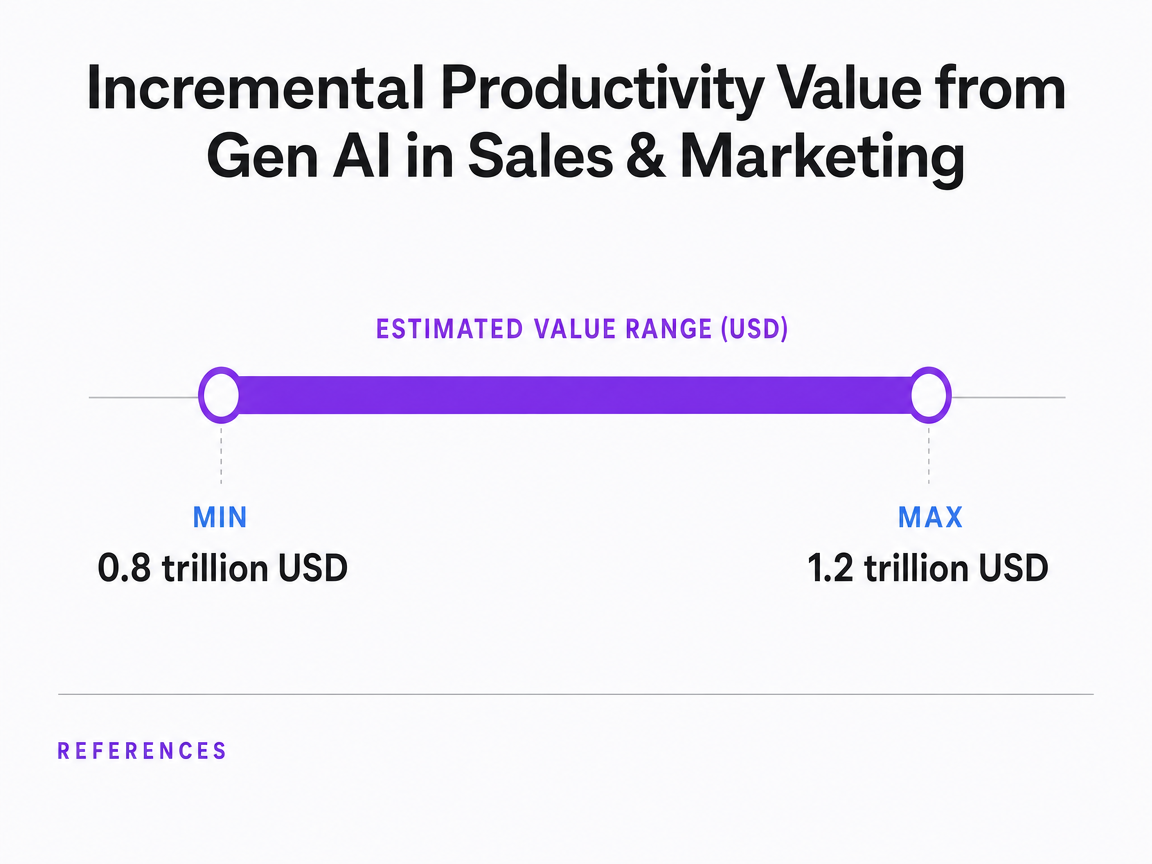 Incremental Productivity Value from Gen AI in Sales & Marketing
The estimated incremental productivity value in trillions of U.S. dollars that generative AI could unlock across sales and marketing functions, according to McKinsey.
Frequently Asked Questions
References
- 1.The Marketer's Guide To Answer Engine Optimization.
- 2.Win Visibility In AI Search With Answer Engine Optimization.
- 3.Economic potential of generative AI.
- 4.Marketing and sales soar with generative AI.
- 5.How generative AI can boost consumer marketing.
- 6.Harnessing generative AI for B2B sales.
- 7.The state of AI in early 2024.
- 8.Gen AI's ROI.
- 9.Efficiency Or Cheating? ChatGPT Users Seek The Upper Hand.
- 10.The Role of AI Writing Assistants in Modern Marketing.
- 11.The future of marketing in the age of AI.
- 12.How Can B2B Marketers Adapt To Changing Search Behaviors?.
- 13.The economic potential of generative AI: The next productivity frontier (June 2023).