
Key Takeaways
- Generative engines evaluate content through three gates—retrieval, selection, and citation—which converts AI visibility into distinct technical, content, and authority problems agencies can engineer against 1, 2.
- Pages structured as question-answer-evidence-source units win citations because engines quote passages, not pages, and Google AI summaries typically cite three or more sources per answer 6.
- Defensible AI-assisted delivery requires three artifacts behind every page: a substantiation record, a disclosure log, and a human authorship register mapped to NIST GenAI risk categories 11, 12.
- Industrialize stable, verifiable work like location pages and schema maintenance; keep humans on YMYL, original research, and executive thought leadership where authorship and defensibility are the actual product 4, 8.
The Retrieval Shift Redefining Agency SEO Deliverables
Something changed in the client conversation this year. Executives stopped asking about rankings and started asking whether ChatGPT and Google's AI summaries were quietly erasing their organic funnel. The question is fair, and the honest answer reframes what an SEO agency actually delivers.
Generative answer engines do not read the web the way a ranking algorithm ranks it. They retrieve passages, select a small set of them, and cite a few sources inside a synthesized response. The unit of value has shifted from a blue link to a cited passage. NIST's Generative AI Evaluation program treats this selection and citation behavior as measurable, not mystical, which matters because it means agencies can build against a testable target rather than guessing at model preferences 1, 2.
Marketing and sales already lead enterprise generative AI adoption, so clients arrive with expectations formed by their own internal pilots 9. What they need from an agency head is not another prompt library. They need an operating model that decides what gets industrialized, what stays human, and how AI-assisted output survives editorial, legal, and brand review across a client book.
The rest of this piece lays out that model in three layers: retrieval-optimized structure, evidence-grade substantiation, and a governance workflow that separates human authorship from machine assistance.
What Generative Engines Actually Reward
Retrieval, Selection, and Citation: The Three Gates
A page has to clear three separate gates before it shows up inside a ChatGPT answer or a Google AI summary. Miss any one and the content is invisible, regardless of how it ranks on a classic results page.
- The first gate is retrieval. The engine has to find the passage, which means the URL must be crawlable, the passage must be indexable, and the surrounding markup must be legible to a retrieval system that reads in chunks rather than pages.
- The second gate is selection. Among the retrieved candidates, the model picks a small set to ground its response, favoring passages that answer the query directly and carry markers of source credibility.
- The third gate is citation, where the engine decides which of the selected passages to name in the visible output.
NIST's Generative AI Evaluation program treats each of these behaviors as testable rather than opaque, and its 2024 text-to-text pilot documents the benchmark design used to score how models retrieve, select, and cite 1, 2. That framing matters for agency planning because it converts a fuzzy conversation about "AI visibility" into three engineering problems with distinct fixes. Retrieval is a technical SEO problem. Selection is a content problem. Citation is a brand and authority problem.
On-Page Structure That Survives Summarization
Generative engines quote passages, not pages. The structure that survives summarization is the one that hands the model a self-contained answer plus the evidence to trust it.
The pattern is straightforward: an H2 phrased as the user's question, a direct answer in the first sentence beneath it, the supporting evidence in the next two or three sentences, and an attributed source. A law firm bankruptcy page asking "How long does Chapter 7 stay on a credit report?" should answer "Ten years from the filing date" in the first line, then cite the Fair Credit Reporting Act, then explain the practical implications. A DSO location page asking "Does this office accept Delta Dental PPO?" should say yes or no in one sentence and list the accepted plans in the next. Anything that requires the model to synthesize across paragraphs adds friction at the selection gate.
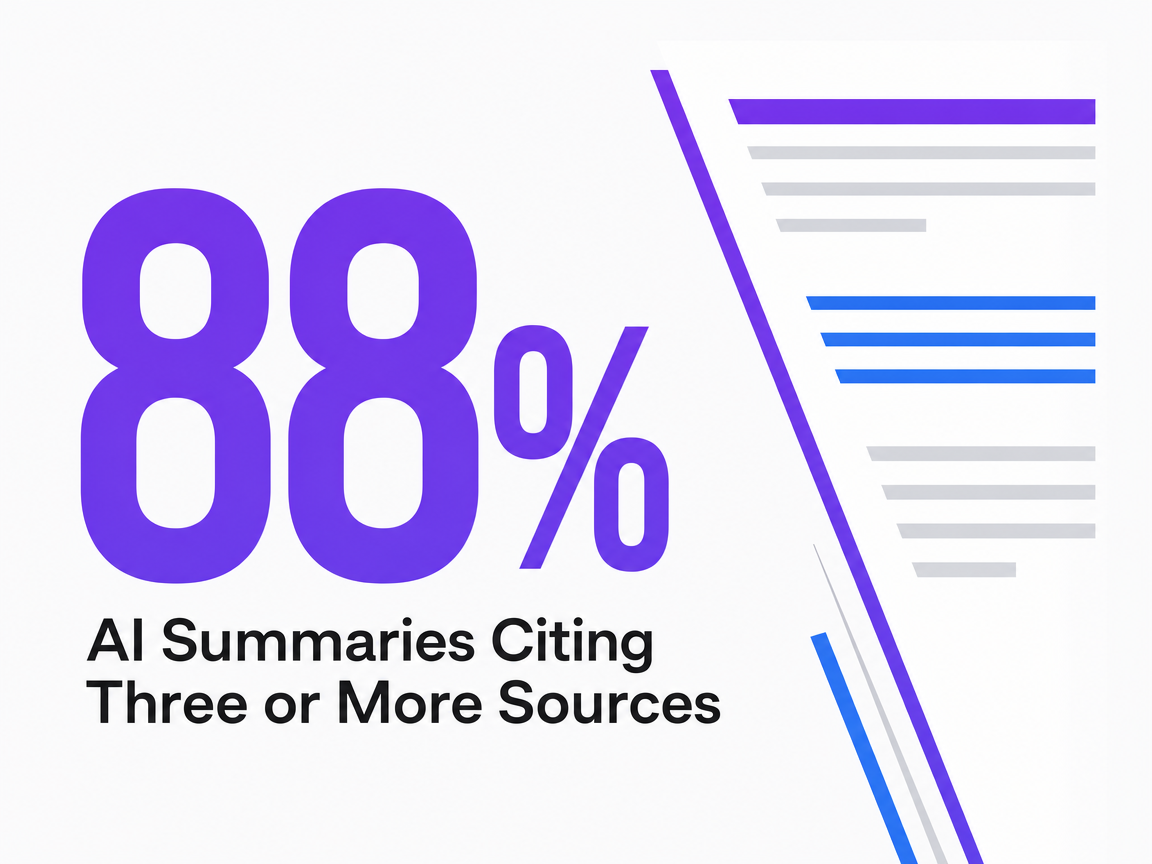
Pew's March 2025 browsing panel of 900 U.S. adults found that 88% of Google AI summaries cited three or more sources, which means the engine is actively assembling a short list of contributors per answer rather than picking one winner 6. Citation share becomes a countable KPI: how often does a client domain appear inside that short list for its priority questions? Pages built as question-answer-evidence-source units get counted. Pages built as long narrative essays usually do not.
 AI Summaries Citing Three or More Sources
AI Summaries Citing Three or More Sources
Rebuilding the KPI Stack When Clicks Compress
From Sessions to Citation Share and Assisted Conversion
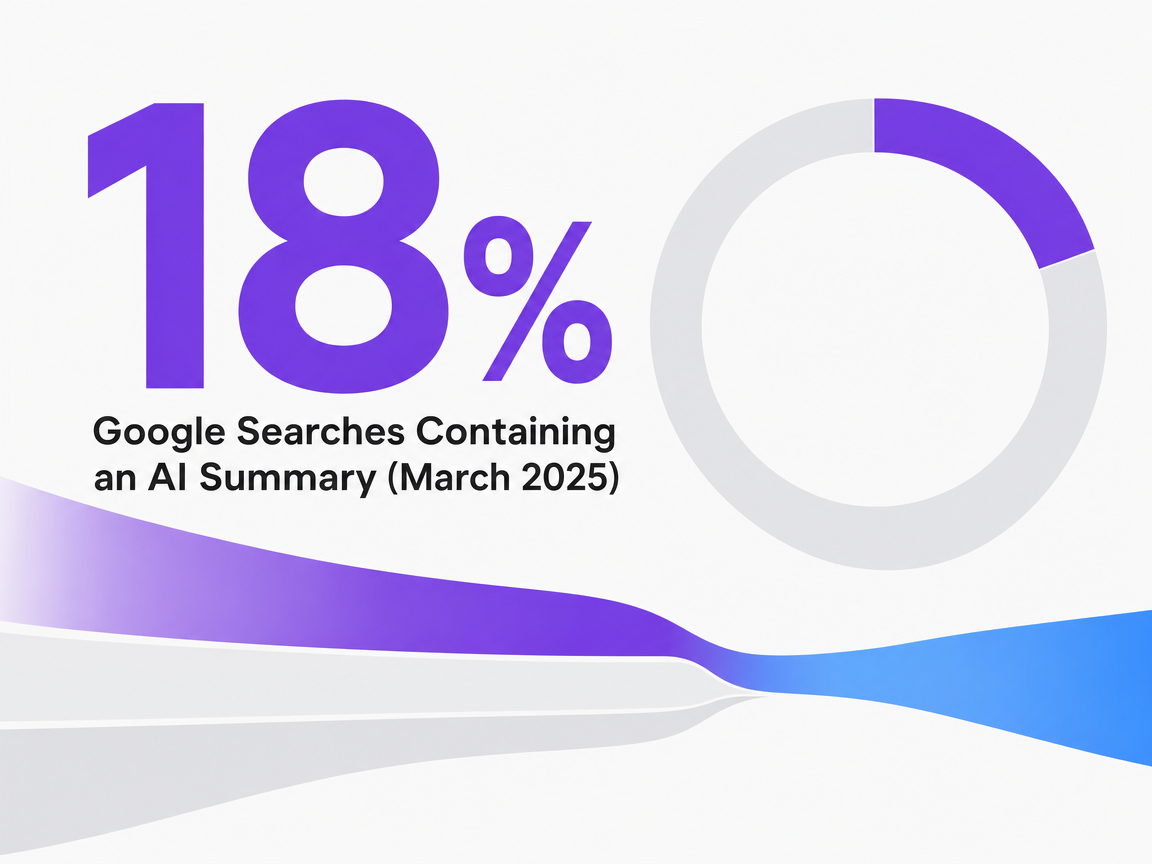
Organic sessions are becoming a lagging, partial signal. Pew's July 2025 analysis of a 900-adult U.S. browsing panel, measured in March 2025, found that Google users clicked a traditional result in 8% of visits when an AI summary appeared, compared with 15% of visits when no summary appeared 6. That is the economic hinge for every KPI conversation an agency head is about to have with a client. The click did not vanish; it moved inside the answer.
Rebuilding the KPI stack starts with three replacements:
- Citation share tracks how often a client domain appears inside AI-generated answers for its priority queries, sampled on a fixed cadence across ChatGPT, Google's AI Overviews, and Perplexity.
- Answer surface coverage tracks the percentage of a client's target question set where any AI engine surfaces a cited response, with or without the client.
- Assisted conversion tracks the share of pipeline where the first touch was an AI answer citation rather than a clicked session, reconciled through direct-traffic spikes, branded search lift, and form-source attribution.
These are not vanity metrics. They are the operational proxies for the traffic that used to arrive as a session and now arrives as awareness formed inside a summary. Ranking reports still belong in the deliverable, but they should sit below the citation-share dashboard, not above it.
 Google Searches Containing an AI Summary (March 2025)
Google Searches Containing an AI Summary (March 2025)
Prevalence Framing: How Often AI Answers Actually Appear
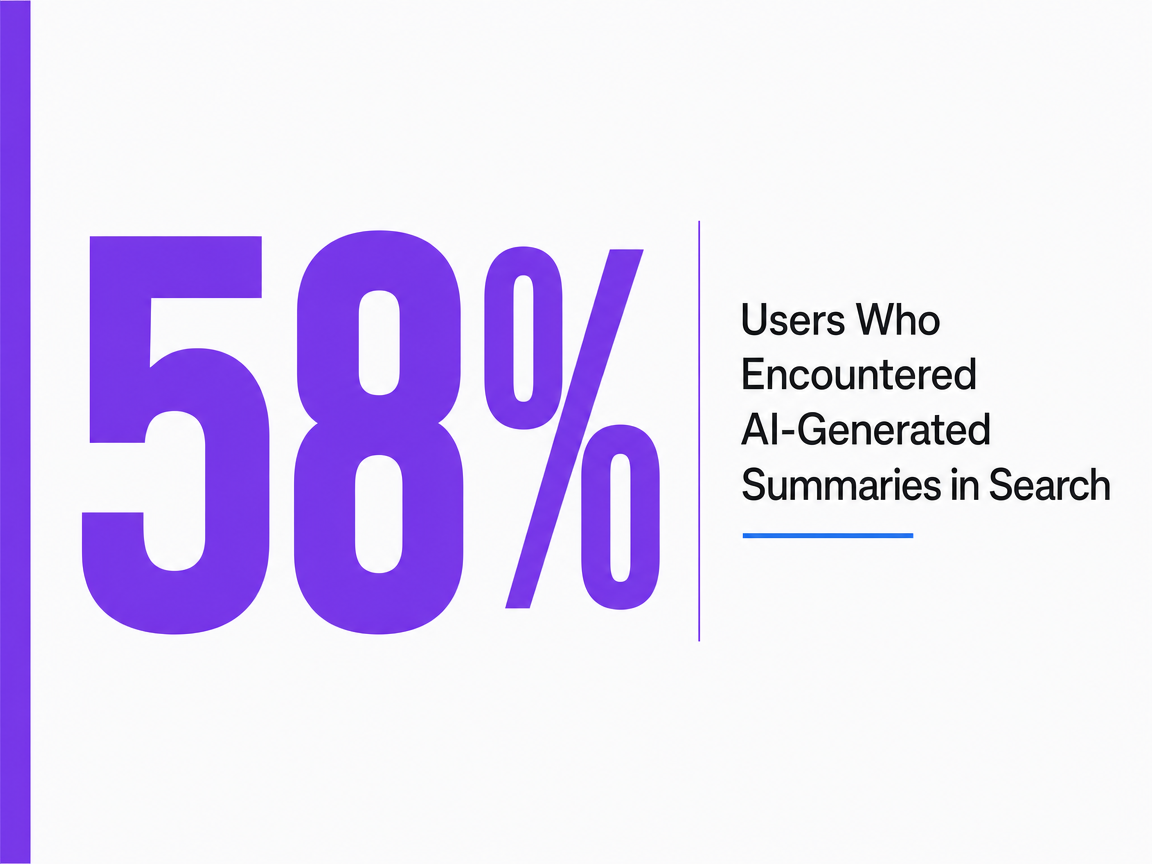
Before an agency sells citation share as a KPI, executives will ask how big the surface actually is. The honest answer is that it varies by query class, but the direction is clear. Pew's earlier metered-panel study, drawn from real browsing sessions over a month-long window, found that 58% of respondents ran at least one search that produced an AI-generated summary 7. Majority exposure, not fringe exposure.
That prevalence figure reframes the client conversation in two ways. First, it validates spending review cycles on question-shaped content even for accounts where AI summaries feel rare, because the client's audience is likely encountering them elsewhere in the buying journey. Second, it sets a realistic ceiling on citation-share ambition. Not every query triggers an AI answer, so the target metric should be citation share within triggered queries, not across the entire keyword universe. Sampling has to reflect that distinction, or the dashboard will punish content that is doing exactly what it should.
Test AI-driven SEO workflows with real content
Experience hands-on execution of your SEO content strategy in a live environment before committing long term.
The Governance Layer: Making AI Output Defensible
Substantiation, Disclosure, and the Human Authorship Log
Every AI-assisted deliverable that leaves the agency should carry three artifacts behind it: a substantiation record, a disclosure entry, and a human authorship log. None of these are new concepts. What is new is the volume of output that has to pass through them once a production line includes generative drafting.
Substantiation is the file that documents the evidence behind every factual claim in a piece of content. For an AI-assisted draft, that means the editor working the piece has to verify each statistic, quote, and technical assertion against a named source before publication, not after. A Minnesota Law faculty analysis found that GPT-4 operating without retrieval context was unreliable on law-review lookup tasks, but performed substantially better when given the underlying documents 10. The operational takeaway is that substantiation is not a QA step; it is the raw material the model needs to produce anything worth publishing.
Disclosure is the client-facing record of where AI was used in the deliverable, at what stage, and under what supervision. Copyright Office guidance requires applicants to identify AI-generated material that is more than de minimis and to exclude it from any authorship claim 4. Agencies that ship AI-assisted content without an internal disclosure trail are transferring that reconciliation problem to the client's legal team.
The human authorship log names the editor responsible for the final published version, the substantive edits they made, and the sources they verified. That log is what converts an AI draft into a human-authored deliverable of record.
Mapping NIST GenAI Risks to Approval Gates
The NIST AI Risk Management Framework, extended in July 2024 by the Generative AI Profile, catalogs 12 risk categories and just over 200 suggested actions for organizations deploying generative systems 11, 12. Agencies do not need to implement all 200. They need to translate the categories that touch content production into concrete gates inside an approval workflow.
Four risk categories map most directly to SEO delivery:
- Confabulation, the NIST term for hallucinated facts, maps to the substantiation gate: no claim ships without a verified source.
- Information integrity, which covers misleading or fabricated content, maps to the editorial gate where a named human reviews and signs off.
- Intellectual property risk maps to the disclosure gate and to a training-data policy that prohibits pasting confidential client material into public model interfaces.
- Data privacy maps to the input-handling gate, which governs what client data can be sent to which model tier.
Each gate has a binary output: approved or returned. That structure matters because it converts NIST's voluntary guidance into something an agency lead can audit and a client can review. The GenAI Profile is explicit that mitigation should align to an organization's goals and priorities rather than a one-size template 11, which gives agencies room to calibrate gate strictness by vertical. A home services client and a behavioral health client do not need the same threshold, but they do need the same gate structure.
Copyright and FTC Exposure in AI-Assisted Deliverables
Two federal exposures deserve direct attention before an agency scales AI-assisted production across a client book. Both are already active enforcement or registration issues, not future scenarios.
The first is copyright registration. The U.S. Copyright Office has stated that works lacking human authorship will not be registered and that applicants must exclude AI-generated material that is more than de minimis from any authorship claim 4, 5. For an agency, this affects any deliverable a client may later want to register or defend as original: long-form guides, original research reports, and proprietary methodology pages. The human authorship log described earlier is what preserves registrability, because it documents the specific human contribution that qualifies for protection.
The second exposure is FTC enforcement on deceptive AI-assisted content. Operation AI Comply, announced in September 2024, targeted schemes including AI-generated fake reviews and misleading claims 3. The relevant categories for SEO teams are testimonials, review summaries, comparative claims, and any authored persona presented as a real expert. An AI-drafted testimonial that is not backed by a real customer and a genuine statement is not a gray area. Agencies producing review-adjacent content for legal, health, or home services clients should treat FTC endorsement rules as a hard gate inside the same approval workflow, not a separate compliance conversation.
YMYL as the Stress Test: Law, Health, and Regulated Verticals
If the operating model holds up in legal and health accounts, it holds up anywhere. YMYL verticals are where retrieval, substantiation, and governance collide inside a single deliverable, which is why they are the honest stress test for any AI-assisted SEO program.
The Harvard Journal of Law & Technology digest on AI Overviews and law firm visibility makes the standard explicit: legal information is treated as YMYL content because inaccuracies can cause users to lose rights, miss deadlines, or misunderstand legal obligations, and pages lacking clear signals of expertise and authorship may be treated as lower quality even when the underlying information is accurate 8. That last clause is the operational trap. A technically correct AI-drafted page can still lose the citation gate if the byline, credentials, and source attribution are thin.
The retrieval-reliability problem compounds the authorship problem. The Minnesota Law faculty analysis referenced earlier found GPT-4 unreliable on law-review lookup tasks when operating without grounding documents 10. Extend that to a behavioral health intake page or a DSO clinical FAQ and the risk shape is the same: fluent output, wrong citation, real consequences.
Three concrete controls carry the weight in YMYL delivery:
- Named-attorney or licensed-clinician bylines on every substantive page, with credentials and jurisdiction or license number where applicable.
- Source-grounded drafting where the editor supplies statutes, clinical guidelines, or payer policies to the model before generation, not after.
- A stricter substantiation gate that rejects any citation the editor cannot open and verify.
Bankruptcy filing timelines, medication interaction claims, and insurance coverage statements do not ship on the same threshold as a home services blog post. Same workflow, different gate strictness—and that calibration is what makes the model defensible when a client's general counsel asks how the content got made.
See How Leading Agencies Operationalize ChatGPT SEO at Scale
Request a walkthrough of advanced AI-driven workflows that streamline SEO production, automate approvals, and maintain oversight—purpose-built for agencies managing high-volume, multi-client portfolios.
If You Manage a Client Portfolio: Operating Model Economics
Four Models for AI-Assisted SEO Production
The framing shifts here from single-account delivery to portfolio economics. An agency head running 10 to 100+ accounts is not choosing a tool; they are choosing an operating model that determines cost per client, throughput, and how much governance surface the delivery leader has to personally maintain.
Four models are visible in the market right now. The traditional agency pod pairs an account strategist with freelance writers and editors, producing roughly 4 to 12 pages per client per month at a fully loaded cost that typically runs into four figures monthly per account. Governance is strong on the editorial side but has no native AI controls, and citation share is not measured. The in-house SEO team using ad-hoc ChatGPT shifts drafting to prompts run by individual specialists, lifts throughput to 15 to 30 pages, and drops direct cost, but governance surface collapses to whatever each specialist remembers to check. Substantiation and disclosure become inconsistent by design.
The agency with point AI tools bolted on adds a drafting tool, a rank tracker, and maybe a schema generator to the pod model. Throughput improves and per-page cost drops, but governance is still enforced through spreadsheets, and NIST GenAI Profile risk categories such as confabulation and information integrity remain unaddressed at the workflow level 11. The unified approval-first AI platform routes drafting, substantiation, disclosure, and publishing through one workflow with a named human approver at each gate. Vectoron's platform enters this category at a $599/mo post-trial rate, which is the only concrete anchor in the comparison; the other columns are ranges because portfolio economics vary too much by vertical mix to publish a single figure.
Choosing Where to Industrialize and Where to Keep Humans
The industrialize-or-keep-human decision is not a philosophical one. It is a routing rule applied at the deliverable level, and portfolio leads should write it down before scaling any AI-assisted production.
Three categories industrialize cleanly:
- Location and service pages with stable inputs
- FAQ modules built from a client's own intake data
- Internal-link and schema maintenance
All are high-volume, low-variance work where a generative pipeline with a substantiation gate outperforms a freelance pod on cost and consistency. Three categories should stay human-led:
- Original research and proprietary data pages need human authorship for copyright registration and analyst judgment 4.
- YMYL substantive pages in legal, health, and financial verticals need named-expert bylines and source-grounded drafting supervised by a qualified editor 8.
- Executive thought leadership needs a human voice that survives scrutiny from the person whose name is on it.
The rule underneath is simple. Industrialize where inputs are stable and evidence is verifiable. Keep humans on anything where authorship, judgment, or defensibility is the actual product.
A 90-Day Rollout for Agency Heads
A rollout that survives the first client escalation is sequenced by risk, not by enthusiasm. The following schedule assumes an agency head is introducing AI-assisted production across an existing client book without pausing delivery.
- Days 1–30: Instrument and audit. Stand up citation-share sampling across ChatGPT, Google AI Overviews, and Perplexity for a fixed question set per client. Baseline answer surface coverage and assisted conversion attribution. Audit the current content stack for retrieval fitness: question-shaped H2s, direct-answer leads, and source attribution. This is a measurement month, not a production change.
- Days 31–60: Build the governance spine. Draft the substantiation checklist, disclosure log, and human authorship register. Map the NIST GenAI Profile risk categories that touch content—confabulation, information integrity, IP, and data privacy—to named approval gates with binary outputs 11, 12. Route one low-risk content category, typically location or service pages for non-YMYL clients, through the new workflow as a controlled pilot.
- Days 61–90: Expand and calibrate. Extend the workflow to FAQ modules and schema maintenance. Hold YMYL accounts on the stricter gate with named-expert bylines and source-grounded drafting 8. Report citation share and assisted conversion to clients alongside rankings. By day 90, the operating model is documented, audited, and defensible—which is the deliverable executives actually asked for.
 Users Who Encountered AI-Generated Summaries in Search
Users Who Encountered AI-Generated Summaries in Search
Frequently Asked Questions
References
- 1.Generative Artificial Intelligence Evaluation Program (GenAI).
- 2.2024 NIST GenAI (Pilot Study): Text-to-Text Evaluation Overview and Results.
- 3.FTC Announces Crackdown on Deceptive AI Claims and Schemes.
- 4.Works Containing Material Generated by Artificial Intelligence.
- 5.Artificial Intelligence and Copyright.
- 6.Do people click on links in Google AI summaries?.
- 7.Most respondents encountered at least some AI-related content during the month.
- 8.AI as the New Front Door to Legal Services: What Google's AI Overview Means for Law Firm Visibility and Professional Responsibility.
- 9.The state of AI in 2023: Generative AI's breakout year.
- 10.Legal Scholarship Through the Lens of Generative AI, Darkly.
- 11.AI Risk Management Framework | NIST.
- 12.Department of Commerce Announces New Guidance Tools 270 Days Following President Biden’s AI Executive Order.