
Key Takeaways
- AI-mediated search is reshaping visibility because a brand's own domain often supplies only 5% to 10% of the sources an AI answer draws on 1, making traditional rank tracking an incomplete signal.
- Agencies should separate enterprise SEO platforms, generative engine optimization tools, and AI marketing execution platforms, since each answers a different question about client visibility and cost per account.
- Enterprise SEO platforms from the Forrester Wave cohort consolidate audits and reporting well 10, but were not built to measure citation share inside LLM answers where client KPIs now live.
- Generative engine optimization tools track citation share and prompt-level appearances across ChatGPT, Perplexity, Gemini, Claude, and AI Overviews, capturing the broader source surface enterprise crawlers miss 1.
- AI marketing execution platforms coordinate production and approvals across channels, addressing how many accounts one specialist can run rather than how visible any single client is 11.
- Score every shortlisted tool on four axes: AI visibility measurement, production throughput per specialist, attribution to booked revenue, and approval governance, using real client data instead of vendor demos.
- Model ROI with Forrester's Total Economic Impact structure 4rather than vendor calculators, naming benefits in client revenue units and including coordination hours as a real cost line.
- Discount vendor ROI claims against McKinsey's finding that only 39% of respondents attribute any EBIT impact to AI, with most reporting under 5% traceable to AI use 9.
The category agencies are still comparing has already moved
Most tool comparisons circulating inside agency Slack channels still evaluate keyword rank trackers, crawlers, and content briefs against each other. That comparison assumes the search interface a client's buyer touches is a ten-blue-links results page. It increasingly is not.
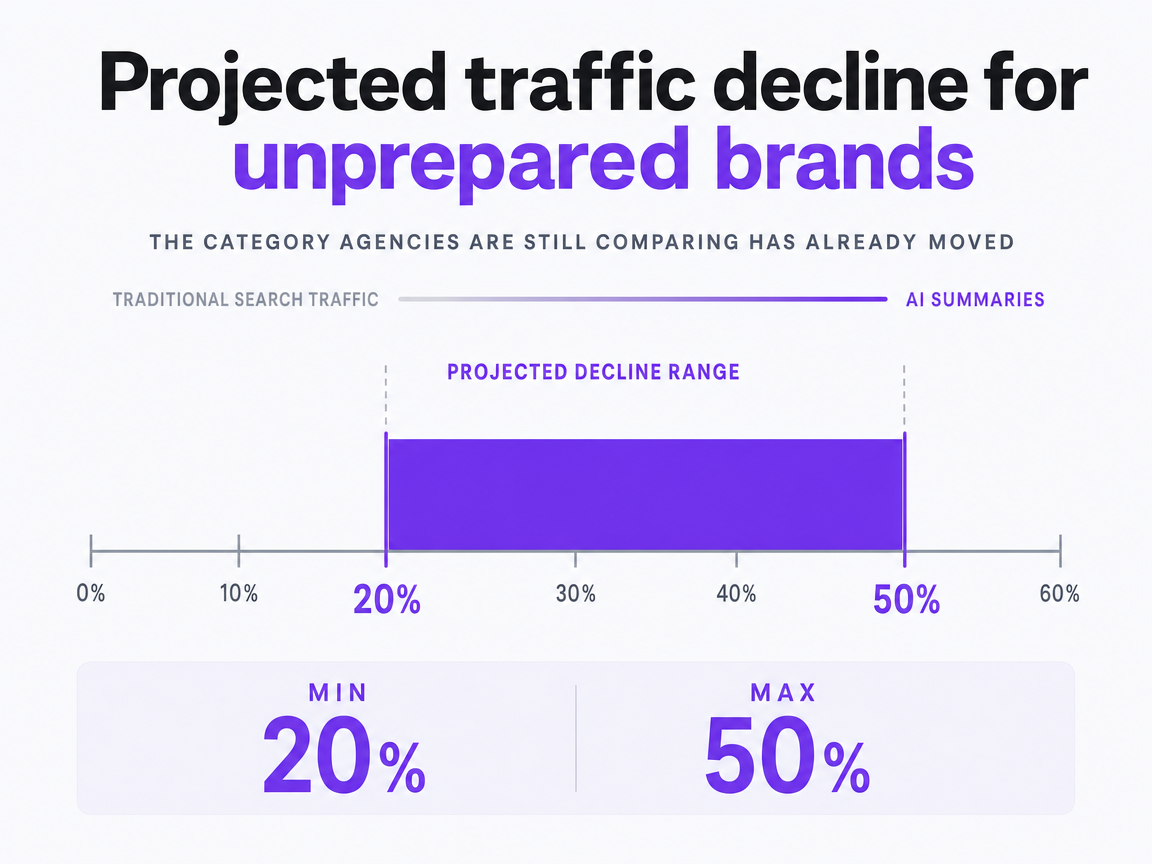
McKinsey projects that brands unprepared for AI-mediated search could see traffic from traditional search channels decline by 20% to 50% as AI summaries absorb more of the query surface, and that only about 16% of brands systematically track how they appear inside AI search at all 1. The projection is a McKinsey scenario tied to US revenue flows, not a measured decline across every vertical, but the direction of travel is the point. A brand's own domain often accounts for just 5% to 10% of the sources an AI answer draws on 1, which means visibility now depends on where an answer engine sources context, not just where a page ranks.
That reframes the buying question. An SEO director comparing platforms for a 40-account book is no longer choosing between crawlers with slightly different UX. The decision spans three distinct tool categories with different pricing logic, different KPIs, and different implications for how many accounts a single strategist can carry. The rubric in the sections that follow treats those categories separately, then scores each on the four dimensions that actually move an agency's P&L: AI visibility measurement, production throughput per specialist, attribution to booked revenue, and approval governance.
 Projected traffic decline for unprepared brands
McKinsey projects that brands unprepared for AI search may see a 20-50% decline in traffic from traditional search channels as user behavior shifts to AI summaries.
Three tool categories agencies keep conflating
Vendor decks flatten this market into a single shelf. It is not one shelf. Three distinct categories now sit under the label "AI search optimization," each priced differently, each answering a different question about client visibility.
The first category is the enterprise SEO platform cohort Forrester has evaluated for years—BrightEdge, Conductor, Moz, Searchmetrics, SEMrush, seoClarity, Siteimprove—built to manage traditional SEO at scale across cross-functional teams 10. The second is generative engine optimization tooling, a newer category focused on citation share inside LLM answers and prompt-level visibility, responding to Forrester's point that rankings and CTR are losing signal as AI snippets absorb the query 6. The third is AI marketing execution platforms, which coordinate production across channels rather than measuring search alone 11.
Conflating them produces the wrong shortlist. The subsections below score each on what it actually does, what it does not, and where it sits in an agency's cost per account.
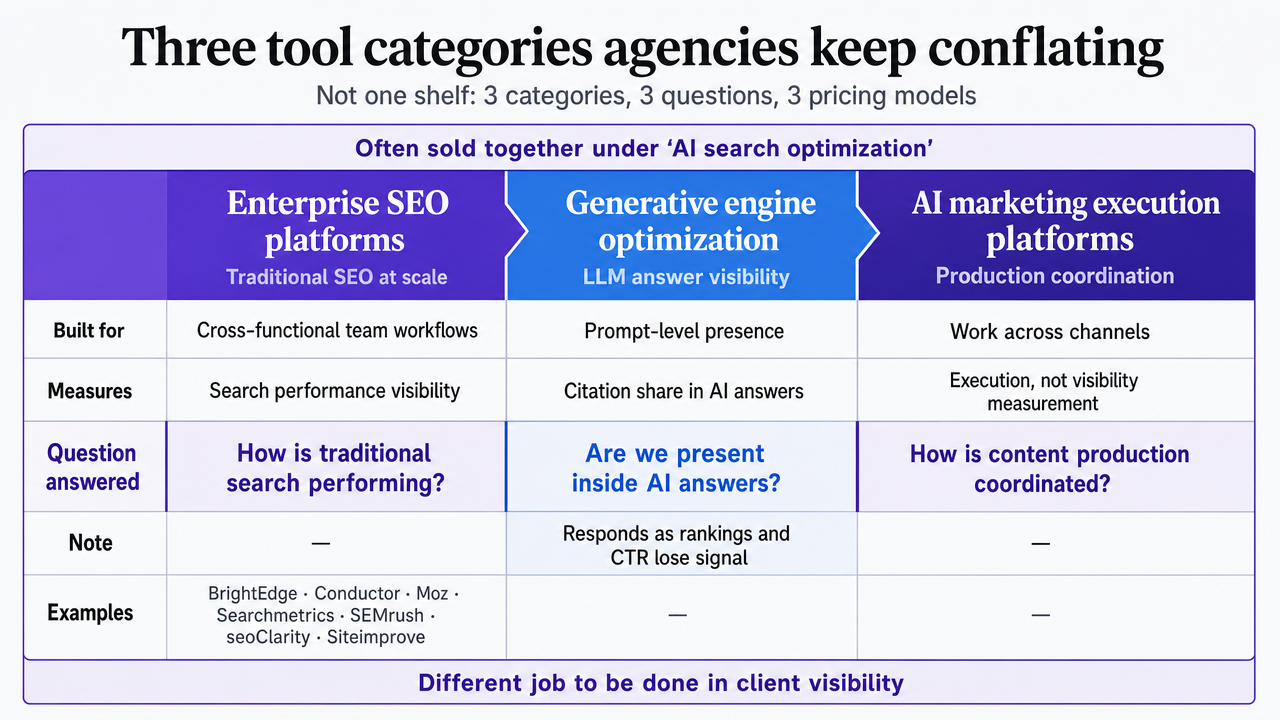 Clarify the three distinct tool categories described in this section and what each one measures, since the article's central framing is that agencies conflate them
Enterprise SEO platforms: BrightEdge, Conductor, seoClarity, and the Wave cohort
This category is mature, well-instrumented, and largely built for a pre-LLM query surface. Forrester's Wave-evaluated cohort—BrightEdge, Conductor, Moz, Searchmetrics, SEMrush, seoClarity, and Siteimprove—was designed to help marketers manage SEO at scale across cross-functional teams, with each vendor bringing distinct strengths in crawling, keyword intelligence, content briefs, and reporting 10.
These platforms excel at consolidating technical audits, rank tracking, and site-health monitoring across large domain portfolios. They also provide the workflow layer that keeps content, development, and analytics teams aligned. For an agency managing 40 accounts, this consolidation streamlines reporting cycles and reduces the coordination burden Forrester identifies as a significant drag on SEO ROI 7.
However, they were not built to measure citation share within generative AI outputs like ChatGPT, Perplexity, or Google's AI Overviews at the prompt level. Forrester's analysts note that rankings and CTR are losing signal as AI snippets absorb queries 6. This means the KPIs these platforms optimize are increasingly devalued by clients. While some vendors have introduced AI-visibility modules, their depth varies, and pricing structures still primarily reflect traditional rank-and-crawl functionalities.
Generative engine optimization tools: citation share and prompt-level visibility
This is the newest cohort, and often missing from agency tech stacks. GEO tools track a client brand's appearance within answers generated by ChatGPT, Perplexity, Gemini, Claude, and Google's AI Overviews, and measure its frequency across a defined set of prompts. The primary metric here is citation share, not rank position.
McKinsey's GEO framework positions this as a distinct capability because a brand's own domain typically contributes only 5% to 10% of the sources an AI answer uses. Publishers, user-generated content, and affiliate sites can contribute over 65% in some categories 1. A tool limited to crawling only the client's site cannot capture this broader surface. GEO tools directly instrument this by running scheduled prompts against LLM endpoints and logging cited sources.
This category is nascent, lacking a definitive Forrester Wave, and feature depth varies significantly. Agencies should evaluate vendors based on prompt-set governance, model coverage, refresh cadence, and the ability to export citation data for integration with traditional SEO reporting. Forrester's observation that rankings and CTR are losing signal underscores the necessity of this tool category in modern agency stacks 6.
AI marketing execution platforms: production and coordination across channels
The third category is not a search tool. AI marketing execution platforms operate above the SEO and GEO layers, coordinating content production, publishing, and cross-channel workflows. This enables a single strategist to manage more accounts by reducing the briefing and handoff overhead that erodes gross margins.
Forrester's Experience Optimization Wave highlights the rationale: leading solutions ingest data, generate insights, and deliver personalized digital experiences across channels in a continuous loop, moving beyond a siloed view of search 11. Harvard's Professional & Executive Education blog further supports the production aspect, noting AI's role in reducing time spent on repetitive content, email, and social tasks while maintaining human oversight on quality 3. This category addresses a different question than the first two: not "how visible is the client," but "how many accounts can one specialist actually run."
While feature sets vary, effective platforms in this category share three key traits: an approval workflow that ensures human review before content ships, integration with the citation and rank data generated by the first two categories, and attribution capabilities that link back to booked revenue rather than just surface-level metrics.
Test AI-driven search optimization across live campaigns
Experience measurable efficiency gains by publishing production-ready SEO content on active client projects during your trial.
A four-axis rubric that replaces the feature matrix
Feature matrices often favor vendors with the longest checklist, which doesn't necessarily indicate which platform will improve gross margin per account. The four axes below are quantifiable metrics an SEO director can present to a CFO. Each maps to a benefit or cost line in Forrester's Total Economic Impact model for SEO programs 4 and can be scored using actual client data, not just vendor demonstrations.
Score every shortlisted tool on all four axes. A platform that excels in one area but fails in another is a point solution, not a foundational stack component.
Axis 1: AI visibility measurement (citation share, prompt coverage, snippet inclusion)
This axis evaluates a tool's ability to answer a client's core question: how often does our brand appear within the AI-generated answers buyers are consuming? Traditional rank position is an outdated proxy for this surface. Forrester's analysts explicitly state that rankings and CTR are losing signal as AI snippets absorb queries 6.
Three sub-metrics distinguish robust solutions:
Citation share : Citation share measures the percentage of tracked prompts where the client's domain is cited as a source in platforms like ChatGPT, Perplexity, Gemini, Claude, or Google's AI Overviews.
Prompt coverage : Prompt coverage assesses how many client-relevant prompts the tool monitors and its refresh cadence.
Snippet inclusion : Snippet inclusion determines if the brand appears directly within the AI answer body, not just in the source list.
The structural importance of this axis is highlighted by the fact that a brand's own domain typically provides only 5% to 10% of AI answer sources, with publishers, UGC, and affiliates often contributing over 65% in some categories 1. A platform unable to visualize this source distribution cannot effectively score on this axis.
Axis 2: Production throughput per specialist
This axis measures the key variable impacting gross margin per account: how many client accounts a single strategist can manage without compromising content quality. The focus here isn't on writing speed, but on the ratio of specialist hours to approved, shipped output across an entire book of business.
MIT Sloan's analysis of The CMO Survey provides a benchmark for achievable throughput gains. Marketing leaders using AI report a 6.2% increase in sales productivity, a 7% increase in customer satisfaction, and a 7.2% reduction in marketing overhead costs. Notably, 60.4% of surveyed companies had used AI in marketing for less than a year 2. These figures establish a realistic ceiling for what an SEO director should expect from a tool in its first year. Vendors claiming 10x or 40x productivity should be evaluated against this established range, not their own demo videos.
Score this axis based on three factors: shipped assets per specialist per month, the number of revision cycles before approval, and the tool's ability to reduce briefing and handoff times. Forrester emphasizes that SEO's coordination tax, not software costs, is often the largest hidden expense within an agency 7.
Axis 3: Attribution to booked revenue, not rankings
This third axis represents what clients truly value. Score each tool on its capacity to trace an AI-influenced session to a tangible business outcome—such as a form submission, a qualified call, or a signed contract—rather than merely a ranking change or session count.
Forrester's Total Economic Impact model for SEO programs explicitly quantifies benefits in terms of increased site traffic, improved conversion rates, and paid media savings, all tied directly to the revenue line instead of intermediate metrics 4. While Forrester's analysis showed a composite organization achieving a 611% ROI on its SEO program, this is a modeled result for a representative company, not a universal outcome 5. The consistent takeaway is the methodology: define the benefit, define the cost, and link both to a booked revenue event.
AI search complicates attribution because a citation in Perplexity or an AI Overview mention rarely provides a clean referrer. Tools should be scored on their ability to connect citation events to downstream conversions—using UTM strategies, server-side logging, or CRM handoffs—rather than treating visibility as an end in itself.
Axis 4: Approval governance and coordination overhead
This fourth axis is crucial for the success of the other three. A tool might flawlessly measure citation share but still erode margins if every asset it produces requires extensive briefing, Slack discussions, and multiple revision rounds before publication.
Forrester argues that SEO solutions prove their worth by reducing effort and de-risking cross-functional collaboration, not by merely adding another dashboard 7. Score each tool on approval queue depth, the number of handoffs between recommendation and published asset, and whether human sign-off is an integrated step or an afterthought. A platform that publishes content without approval is a liability in regulated industries; conversely, one that demands approval at every micro-step negates the coordination efficiencies it's meant to provide.
The practical test is straightforward: count the number of individuals who must touch a single blog post, schema update, or citation-tracking prompt from ideation to publication. If this number exceeds three, throughput will suffer significantly.
See How AI Search Tools Impact Real Agency ROI—Get Custom Insights
Request a tailored analysis of AI search optimization platforms for your agency, with benchmarks on cost efficiency, workflow impact, and content quality—based on current industry data.
Modeling ROI with Forrester's TEI method instead of vendor calculators
Vendor ROI calculators often begin with a predetermined answer. Forrester's Total Economic Impact model, however, starts from the financial ledger. This distinction is vital when a shortlist decision must withstand a CFO's scrutiny.
The TEI framework quantifies four key elements over a defined analysis period: benefits, costs, flexibility, and risk 4. For a search program, benefits are expressed in revenue terms—incremental site traffic converted at a measured rate, improved conversion on existing traffic, and paid media savings from organic and AI-cited coverage displacing bought clicks 4. Costs include platform licenses, agency fees, and the internal hours a client's team spends on briefing, reviewing, and publishing. Risk adjustments discount each benefit line based on the probability it won't materialize. Forrester's analysis showed a composite organization achieving a 611% ROI on its SEO program using this method 5—a modeled figure for one representative company, cited for its methodology rather than the specific number.
When applied to an AI search tool shortlist, this model enforces three disciplines that vendor calculators often omit:
- Benefits must be named in the client's revenue units, not just sessions or citations.
- All costs, including the coordination hours Forrester identifies as the largest hidden drag on SEO returns 7, must be included.
- A discount must be applied for the probability that a new measurement surface—like citation share or prompt coverage—will take several quarters to stabilize before clean attribution is possible.
Scoring shortlisted platforms against this ledger often reorders their perceived value.
Why most reported AI ROI is thinner than vendor decks claim
Vendor slides typically highlight the highest-performing examples, while population data reveals a different story.
McKinsey's State of AI 2025 survey found that only 39% of respondents attribute any level of EBIT impact to AI, and among those, most report that less than 5% of their organization's EBIT is traceable to AI use 9. This global, cross-industry baseline should inform any SEO director's expectations in vendor meetings. It doesn't negate AI's value but provides a realistic denominator against which a 611% modeled SEO ROI 5 or a 6.2% productivity lift 2 should be interpreted.
Two main factors compress reported returns:
- AI adoption is still young: MIT Sloan's data indicates that 60.4% of companies had used AI in marketing for less than a year at the time of measurement, meaning they are still early on the payoff curve 2.
- Attribution mechanisms are still evolving, which Forrester identifies as a central measurement challenge for AI-influenced search 6. A citation within a Perplexity answer that eventually leads to a branded search and a form fill rarely comes with a clear referrer.
The operational takeaway is clear: discount vendor ROI claims based on the likelihood that measurement infrastructure is not yet fully in place. Require any shortlisted tool to demonstrate its attribution capabilities before showcasing its claimed outcomes.
If you manage multiple client accounts: consolidation economics
This section addresses SEO directors managing 15 to 80 client accounts, where gross margin per account is a primary concern. At this scale, tool selection becomes a labor equation, not just a feature comparison.
A fragmented tech stack may appear reasonable on paper but becomes expensive on the P&L. Separate licenses for an enterprise SEO platform, a GEO citation tracker, AI writing seats, a project management layer, and freelance production capacity each incur their own coordination costs. Every additional tool adds another handoff. Forrester argues that coordination effort, not software cost, is typically the largest hidden drag on SEO returns, and that effective solutions reduce effort across cross-functional work 7. MIT Sloan/CMO Survey data provides a directional benchmark for consolidation's impact: marketing leaders using AI report a 7.2% reduction in marketing overhead costs, though 60.4% of surveyed companies had used AI in marketing for less than a year 2.
The following worksheet models the difference, using named variables and Forrester's Total Economic Impact structure as the underlying method 4.
| Line item | Fragmented stack | Unified execution platform |
|---|---|---|
| Tool licenses per account/month | Sum of enterprise SEO + GEO tracker + AI writers + PM tool | Single platform fee, agency-supplied |
| Specialist hours per account/month | X hours | X minus throughput gain (benchmark: up to ~7% overhead reduction 2) |
| Fully loaded hourly cost | Y | Y |
| Approval/QA hours per account/month | Z, multiplied by handoff count | Z, with native approval workflow |
| Derived cost per account | Licenses + (X × Y) + (Z × Y) | Licenses + ((X − savings) × Y) + (Z × Y) |
Two principles ensure the model's accuracy. First, include all coordination hours, not just billable production time. Second, discount throughput gains by the probability that the initial two quarters are spent on measurement setup rather than margin capture, a pattern consistent with MIT Sloan's adoption-payoff curve 2. Apply this worksheet across the entire client portfolio, not just one representative account; fragmented stacks tend to appear cheapest for a single account but most expensive for 40.
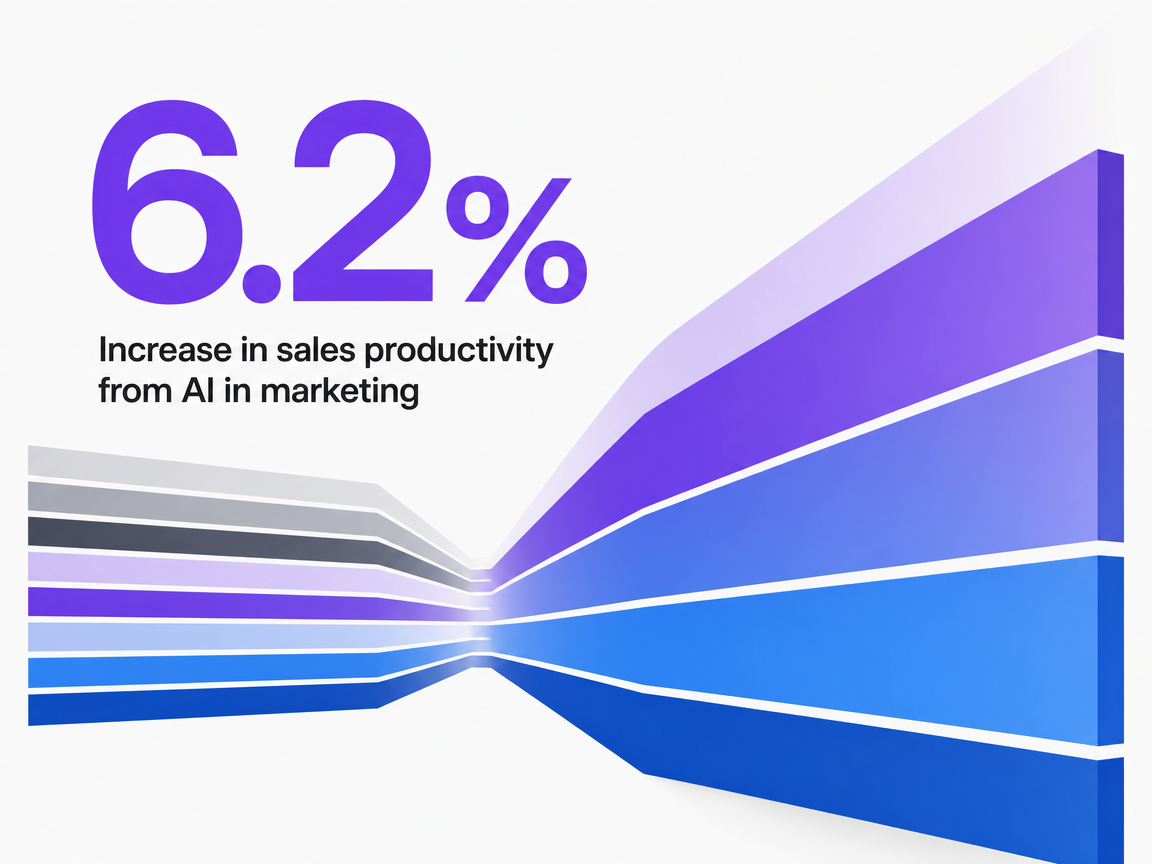 Increase in sales productivity from AI in marketing
Increase in sales productivity from AI in marketing
Where AI leverage actually compounds inside an agency
AI's returns are not evenly distributed across an agency's workflow. Its leverage is greatest where repetition is highest and judgment is lowest, a narrower scope than many vendor presentations suggest.
McKinsey's economic potential research indicates that approximately 75% of generative AI's projected annual value is concentrated in marketing and sales, customer operations, software engineering, and R&D 8. Within an agency, this translates to specific high-leverage functions: first-draft content creation, technical audits, schema and metadata production, prompt-set maintenance for citation tracking, and reporting assembly. These are tasks where a specialist's time yields minimal strategic value and where AI-assisted workflows offer the most significant throughput gains. Harvard's Professional & Executive Education blog echoes this, highlighting AI's role in reducing time on repetitive content, email, and social tasks while preserving human oversight for quality 3.
Conversely, AI leverage does not compound in functions agencies often attempt to automate, such as client strategy calls, positioning arguments, and the nuanced judgment calls embedded in approval queues. Tools should be evaluated accordingly. A platform earns its value by shifting hours from repetitive tasks, not by promising to replace strategic functions.
A shortlist test: applying the rubric to a real evaluation
The rubric proves its worth when applied to a specific shortlist. Consider a common agency scenario: an SEO director evaluating three finalists—an enterprise SEO platform from the Forrester Wave cohort 10, a GEO citation tracker, and an AI marketing execution platform such as Vectoron—for a 40-account book with a focus on regulated verticals.
Evaluate each platform against the four axes using actual client data, not demo data:
- For AI visibility measurement, ask the enterprise platform to report citation share across ChatGPT, Perplexity, and Google's AI Overviews for a 200-prompt set; if it cannot, that axis belongs to the GEO tool.
- For production throughput, measure shipped, approved assets per specialist per month over a 60-day pilot, benchmarking against the 7.2% overhead-reduction range documented by MIT Sloan 2.
- For revenue attribution, require each vendor to link a citation or ranking event to a booked conversion within the client's CRM before the pilot concludes.
- For approval governance, count the number of individuals involved in a single asset's journey from recommendation to publication.
The finalist that excels across all four axes is rarely the one with the most extensive feature matrix. Instead, it's the platform whose financial ledger withstands Forrester's TEI structure 4 when loaded with real coordination hours.
Frequently Asked Questions
References
- 1.Winning in the age of AI search.
- 2.When AI Investments Pay Off in Marketing.
- 3.AI Will Shape the Future of Marketing.
- 4.The ROI Of SEO.
- 5.You Can Quantify The ROI Of SEO.
- 6.Generative AI Has Answers, But SEO Practitioners Are Still Guessing.
- 7.SEO Must Solve Its Marketing Problem.
- 8.The economic potential of generative AI: The next productivity frontier.
- 9.The State of AI: Global Survey 2025.
- 10.Every Company Needs An SEO Platform.
- 11.Key Insights From The Forrester Experience Optimization Solutions Wave, Q4 2024.