
Key Takeaways
- Treat AI-assisted content as an operating-model redesign, not a tooling upgrade: only 28 percent of organizations have rewired workflows around AI, and the rest see gains stall 8.
- Split work by task, not by role—delegate pattern tasks like drafting, repurposing, and synthesis to AI, and keep angle selection, source verification, and voice decisions with senior specialists.
- Build the workflow around three load-bearing approval points: the brief, the draft against the brief, and the publish gate, with logged prompts and drafts to satisfy Copyright Office authorship expectations 4.
- Hire fewer, more senior operators rather than more juniors, since AI-assisted non-experts still trail trained specialists by roughly 13 percent on quality 13.
The production line has changed, most teams haven't
Adoption is not the story anymore. Restructuring is. McKinsey's 2024 state of AI survey found that reported generative AI adoption in marketing and sales more than doubled from 2023 to 2024, the largest jump of any business function 7. That signal is unambiguous: content teams have tools. What they mostly do not have is a redesigned production line.
The companion finding from McKinsey's marketing research puts the gap in numbers. Only 28 percent of surveyed organizations report a fundamental rewiring of their teams and workflows around AI 8. The remaining 72 percent are bolting chatbots and drafting assistants onto editorial processes built for a slower, human-only cadence. Output rises modestly. Quality control strains. Brand voice drifts. The gains stall because the workflow was not the constraint the tools were designed to solve.
This article treats AI-assisted content creation as an operating-model question rather than a tooling question. The sections that follow map which tasks reward speed and which reward judgment, how to structure an approval-first workflow, what the throughput math actually shows, where the expertise ceiling sits, and how governance from NIST and the U.S. Copyright Office should shape editorial controls. The reader who finishes with a production line worth scaling is the one who moved from the 72 to the 28.
What high-performing content teams actually delegate to AI
The tasks that reward speed versus the tasks that reward judgment
Content work splits cleanly into two categories once a team looks at it as a production line. One category rewards speed: generating draft variants, restructuring long-form into short-form, summarizing research, producing meta descriptions, drafting alt text, cutting a webinar transcript into a blog outline, translating a case study into three audience-specific rewrites. These are pattern tasks. They are bounded, well-specified, and cheap to review. AI closes the distance between a blank page and a working draft in minutes rather than hours.
The other category rewards judgment: deciding what to publish and why, mapping a topic to a stage of the funnel, choosing an angle that fits the brand's point of view, verifying claims against primary sources, editing for voice, and making the call on whether a piece is worth shipping. These are not slow because the writer is slow. They are slow because the decision matters. Delegating them to AI produces the failure mode most teams have already lived through: generic content that reads competent, ranks nowhere, and quietly erodes brand trust.
The useful framing is task-level, not role-level. A senior editor still writes the thesis paragraph, still picks the sources, still signs off on the headline. The same editor lets AI produce five headline variants, three intro drafts, and a first-pass outline against the brief. Speed handles volume. Judgment handles selection. The production line works when the two are separated by explicit approval points rather than blended into one hybrid step.
Where AI earns its keep in the editorial calendar
The market has already answered the question of whether marketers use these tools. An American Marketing Association survey of more than 1,000 marketers in 2024 found that nearly 90 percent had used generative AI tools, 71 percent used them weekly or more often, and 85 percent of AI-using marketers reported that the tools had slightly or significantly increased their productivity 9. Content creation and writing were the leading application categories. The behavior is normalized. What separates a working editorial calendar from a chaotic one is which slots on the calendar the AI is actually filling.
Five slots show up consistently in high-performing operations:
- Upstream ideation: clustering keyword data, drafting topic hypotheses against search intent, and producing outline variants for an editor to choose from. Forrester's data on US agencies shows the same pattern outside in-house teams, with 74 percent of agency decision-makers using generative AI to ideate creative concepts 11.
- First-draft production against a locked brief.
- Format transformation: turning a 2,000-word pillar into a LinkedIn carousel, an email sequence, and a set of pull quotes.
- Research synthesis, where the AI summarizes primary sources the editor has already vetted.
- Quality-adjacent tasks: schema markup drafts, FAQ generation from existing copy, and internal link suggestions ranked by relevance.
What does not belong on the calendar as AI-owned work: original interviews, executive point-of-view pieces, regulated claims, and anything where a hallucinated citation or a fabricated statistic would create legal or reputational exposure. Those stay with humans, and the calendar should mark them that way at the assignment stage rather than at the review stage.
Designing the approval-first workflow
Five stages: signal, recommendation, human approval, execution, measurement
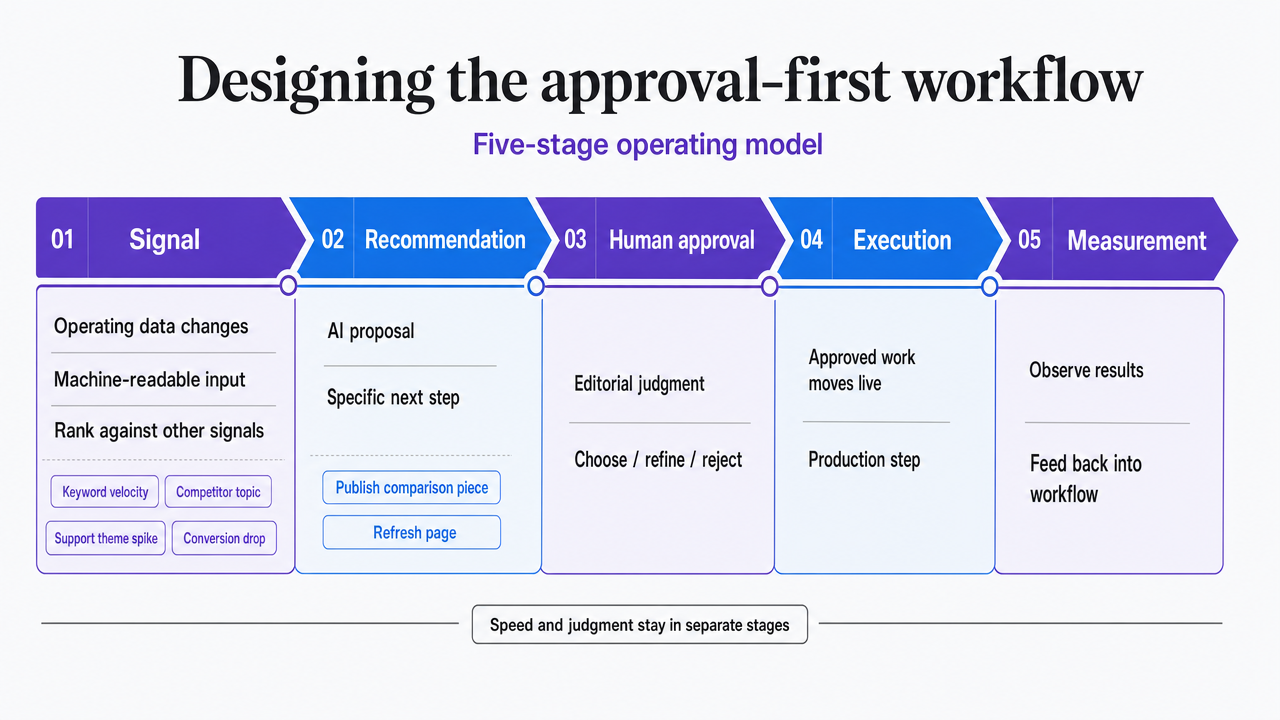
A working AI-assisted production line runs on five distinct stages, each with its own inputs, outputs, and owner. The stages exist to keep speed and judgment from colliding inside a single hybrid step, which is where most bolted-on AI workflows fail.
- Stage one is signal. Something in the operating data changes: a keyword cluster gains velocity, a competitor publishes on a topic the team has been circling, a support ticket theme spikes, a landing page's conversion rate drops. The signal is machine-readable input. It does not require a human until it has been ranked against other signals competing for the same editorial slot.
- Stage two is recommendation. The AI produces a specific proposal against the signal: publish a comparison piece targeting this query cluster, refresh this pillar with three new sections, cut this webinar into a five-post sequence. The recommendation includes the reasoning, the estimated effort, and the assets that already exist to support it. This stage is where the tool has to show its work, not just its output.
- Stage three is human approval. A specialist reviews the recommendation, edits the brief, and either releases it into production or sends it back with notes. This is the non-negotiable stage. NIST's generative AI profile specifically calls out approval and control design as core actions for managing generative AI risk in operational workflows 1.
- Stage four is execution. Approved briefs move into AI-assisted drafting, formatting, and repurposing against locked constraints. The specialist is out of the loop until the output returns for a second, narrower approval on the finished asset.
- Stage five is measurement. Published assets feed back into stage one as new signals, closing the loop. AI RMF 1.0 frames this feedback discipline as part of the measurement and management functions that make an AI system accountable rather than just active 2.
Where specialists intervene and where the system runs
Intervention points should be scarce and load-bearing. Three of them carry most of the weight.
The first is the brief. A specialist writes or edits the brief before drafting begins: audience, angle, sources the AI is allowed to cite, sources it must not, brand voice constraints, and the specific claim the piece is being published to support. Every downstream error the team catches at review is usually traceable to a brief that was too loose. Tightening the brief is cheaper than editing five drafts.
The second is the draft approval. The specialist reads the returned draft against the brief, not against a blank standard. The question is not whether the draft is good in the abstract but whether it delivers what the brief specified. Rejections at this stage should return with a structured note, not a rewrite, so the system learns from the correction rather than absorbing the specialist's labor invisibly.
The third is the publish gate. Fact checks, source verification, disclosure language, and any regulated-claim review live here. Forrester's data on agency workflows shows generative AI already handling 59 percent of audience-insight summarization and 49 percent of performance summarization at the agency level 11, which means the upstream analytical work reaching the publish gate is often AI-assisted too. The gate is where a human confirms the piece is defensible before it ships.
Between those three points, the system runs. Variant generation, formatting, schema drafts, and internal repurposing do not need a human in the loop as long as the outputs re-enter the approval queue before anything reaches an audience.
Accelerate content output with real-time publishing
Test-drive AI-driven content creation and publish live assets during your trial—no commitment required.
Throughput math: what the productivity gains actually look like
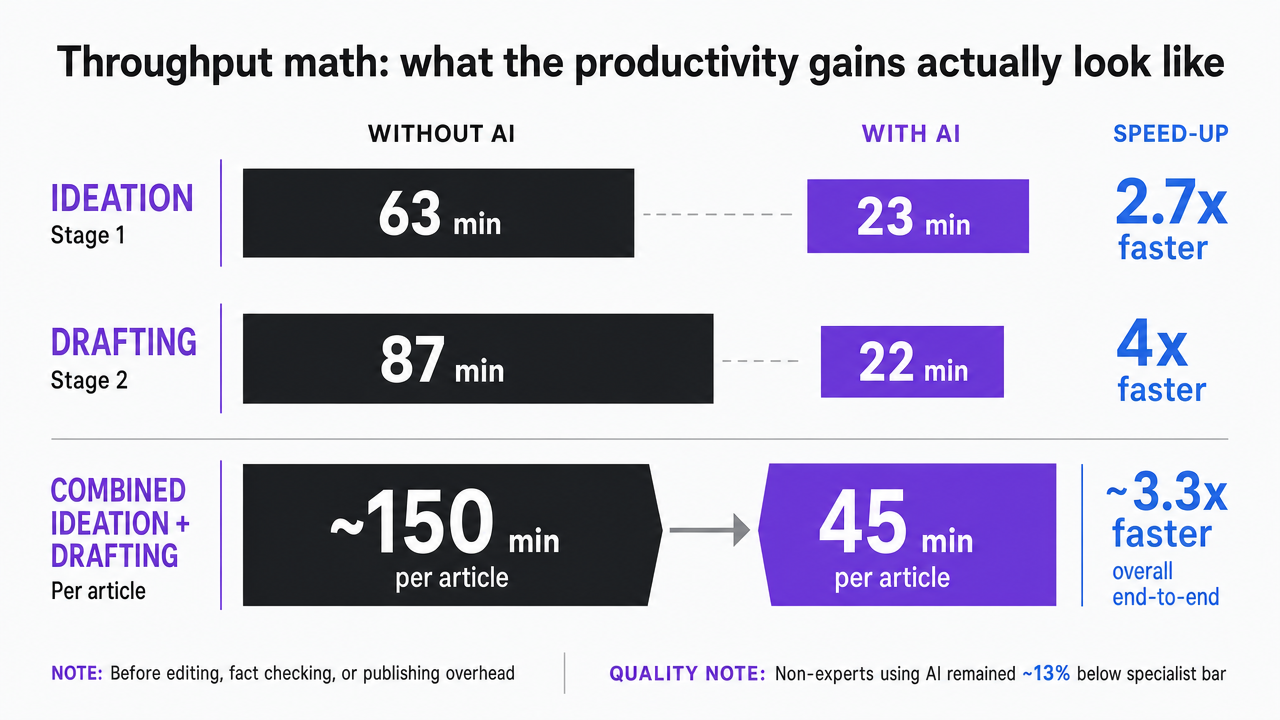
The clearest experimental evidence on AI-assisted content productivity comes from a Harvard Business School–linked study that measured how long specific content tasks took with and without generative AI. Ideation dropped from 63 minutes to 23 minutes. Drafting dropped from 87 minutes to 22 minutes. Non-content experts using AI still produced articles roughly 13 percent below the quality bar set by trained specialists 13.
Those two numbers translate into concrete throughput math for a content operation. Ideation runs about 2.7 times faster. Drafting runs about 4 times faster. Combined, the ideation-plus-drafting phase compresses from roughly 150 minutes to 45 minutes per article, before any editing, fact checking, or publishing overhead. A specialist who used to produce two long-form drafts a day can, in principle, produce five or six against the same input budget.
The operational catch is that the compressed hours land upstream, not downstream. Editing, source verification, and the publish gate do not scale at the same rate. A team that quadruples draft volume without expanding editorial review capacity produces a backlog, not a throughput gain. The realistic multiplier a content manager should model is closer to 2x to 2.5x published output per specialist, not the raw 4x drafting speedup, because the human approval stages remain the binding constraint.
Two other adjustments matter. First, the productivity gain is largest on well-specified pattern tasks and smallest on original analysis, which means the mix of assignments on the calendar determines the realized multiplier. Second, the 13 percent quality gap between AI-assisted non-experts and trained specialists 13 means the throughput math only holds if the humans still holding the pen are the right ones. The next section examines that expertise ceiling and what it implies for how a scaling team should hire.
The expertise ceiling and what it means for hiring
The same Harvard Business School–linked experiment that produced the throughput numbers also delivered the caution that content managers should read twice. Marketing specialists using generative AI performed close to the level of professional web analysts on analytical writing tasks, but non-content experts using the same tools produced articles that still trailed trained specialists by roughly 13 percent on quality 13. AI lifts the floor. It does not raise the ceiling.
That finding rearranges the hiring conversation. The instinct after seeing 2x-plus throughput gains is to reduce senior editorial headcount and replace it with cheaper generalists armed with prompts. The evidence points the other way. The specialists who already know what a strong angle looks like, which sources to trust, and where a draft is bluffing are the ones AI amplifies most cleanly. Generalists using AI produce more words per hour, but the words carry the quality gap into every publish gate downstream.
A scaling team should hire fewer, more senior operators rather than more junior ones. One senior strategist who can direct AI across ideation, drafting, and repurposing generates more defensible output than three junior writers each running their own prompts. Budget that would have funded additional headcount is better spent on the platform layer that gives senior operators leverage: brief templates, voice guardrails, source libraries, and an approval queue that keeps their judgment applied at the points where it actually changes the outcome.
Governance borrowed from NIST and the Copyright Office
Adapting the NIST AI RMF and GenAI Profile to editorial workflows
Content teams do not need a new governance framework. Two federal documents already do most of the work if they are read as editorial controls rather than compliance paperwork.
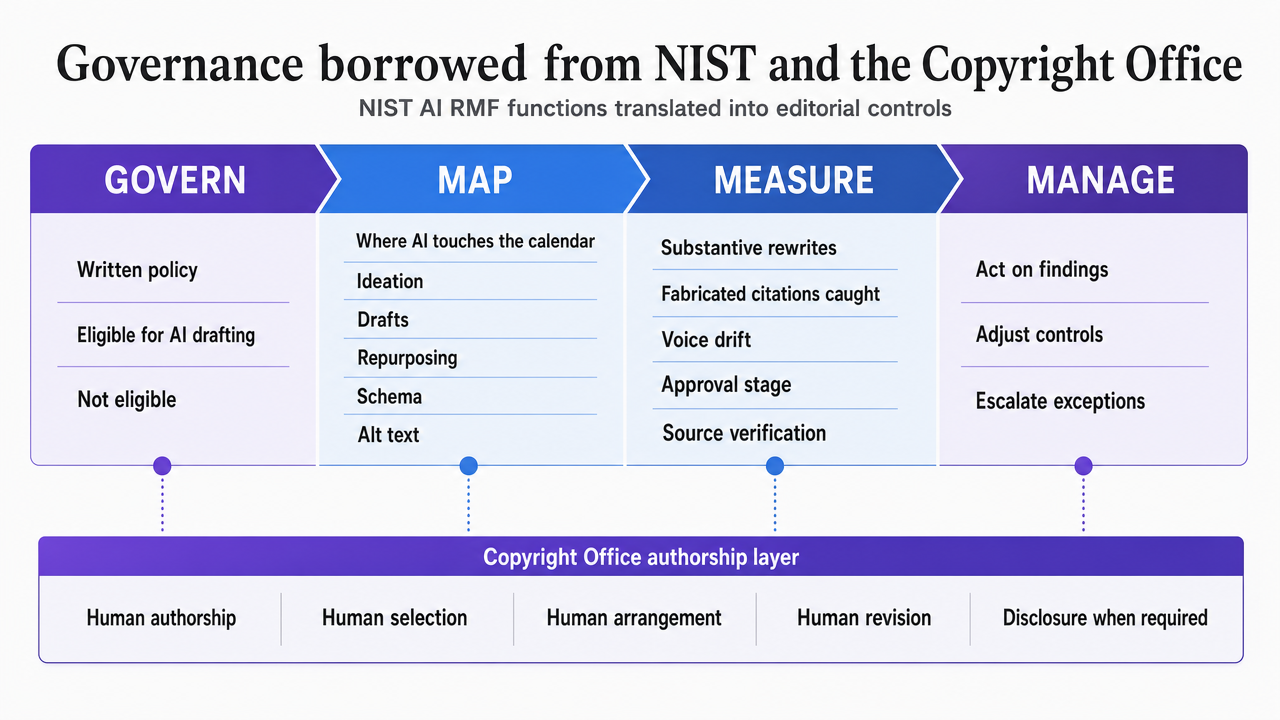
The first is NIST's AI Risk Management Framework, which organizes trustworthy AI practice around four functions: govern, map, measure, and manage 2. Translated into an editorial context:
Govern : the written policy that says which content types are eligible for AI drafting and which are not.
Map : the inventory of where AI touches the calendar: ideation, drafts, repurposing, schema, alt text.
Measure : the tracking of what percentage of published pieces required substantive rewrites at the approval stage, how often source verification caught fabricated citations, and where voice drift showed up in performance data.
Manage : the routing rule that pulls a specific content type out of the AI-assisted queue when measurement shows the failure rate is too high.
The second is NIST's Generative AI Profile, released as a companion in 2024, which names the risks specific to generative systems and proposes actions for managing them in operational workflows 1. For content teams, the load-bearing actions are three:
- Define the human approval point in writing,
- Document what the AI produced versus what the human edited, and
- Log the source material the AI was given so a hallucinated citation can be traced back to its origin.
None of this requires new tooling. It requires the approval queue and the brief template to carry the metadata that governance auditors, or a future in-house counsel, will eventually ask for.
Authorship, ownership, and registration for AI-assisted work
The U.S. Copyright Office has now spoken clearly enough that content teams can plan around it. In its January 2025 update, the Office confirmed that AI outputs are protectable only where a human author has determined sufficient expressive elements in the work 3. The accompanying Part 2 report reiterates that human authorship remains essential for copyright protection in the United States and rejects the idea that a separate framework is needed for purely AI-generated material 5. Registration guidance issued in 2023 fills in the operational detail: applicants must identify the human authorship contributions and exclude more-than-de-minimis AI-generated content from the authorship claim 4.
What this means for a working editorial calendar is narrower than the headlines suggest. A piece drafted from an AI outline, rewritten by a specialist, restructured for angle, sourced with human-verified citations, and edited for voice is protectable on the strength of the human contributions. A piece where the AI produced the text and a human tightened the grammar is not, at least not for the AI-generated portions. The difference is documented at the workflow level, not at the publish button.
Three operational habits keep the ownership question defensible:
- Retain the brief, the prompt history, and the pre-edit AI draft alongside the published version, so the human contribution can be shown rather than asserted.
- Mark any piece where the AI-generated portion exceeds a de-minimis share, and route those pieces through a heavier rewrite before publication if registration matters.
- Treat licensing warranties from vendors as a floor, not a ceiling: the Copyright Office's position governs regardless of what a tool's terms of service claim about ownership of outputs.
See How Leading Teams Accelerate Content Output with AI Coordination
Request a walkthrough of how AI-driven workflows can increase content velocity and SEO impact—while maintaining oversight and brand consistency across all channels.
If you manage multiple locations: operator economics of the AI-augmented model
The audience shifts here. This section is for marketing managers running content across multiple locations, franchises, or a portfolio of practices, where the cost question is not whether to use AI but how to compare an agency retainer against an in-house strategist paired with an AI production platform.
The comparison has three cost drivers that matter and two that get overweighted.
- The three that matter: cost per published asset, monthly output per location, and the time from signal to publish.
- The two that get overweighted: seat licenses on individual tools, and one-off setup fees that amortize quickly across a year of publishing.
A multi-location operator with, say, twelve locations does not need twelve editorial calendars. It needs one governed workflow that produces location-variant assets from a single approved brief.
The productivity multipliers documented in the Harvard Business School–linked experiment set the ceiling on what the in-house model can realistically compress: roughly 2.7x on ideation and 4x on drafting, with the caveat that editorial review remains the binding constraint and the realized multiplier on published output lands closer to 2x to 2.5x per specialist 13. Those numbers, not vendor claims, should drive the model.
| Cost driver | Traditional agency retainer + in-house editor | Senior in-house strategist + AI production platform | Source or assumption |
|---|---|---|---|
| Ideation time per asset | Baseline (approx. 63 min) | Approx. 23 min (2.7x faster) | HBS-linked experiment 13 |
| Drafting time per asset | Baseline (approx. 87 min) | Approx. 22 min (4x faster) | HBS-linked experiment 13 |
| Realized published output per specialist | Reader's current monthly baseline | 2x to 2.5x baseline | Modeled from 13, adjusted for editorial review as binding constraint |
| Cost per published asset | Reader's current fully loaded cost | Reader's baseline divided by realized multiplier, plus platform cost | Reader-supplied variable |
| Location variants per approved brief | Per-variant billable | Repurposing handled inside execution stage | Workflow assumption |
The model is worth running against real numbers rather than reading as a conclusion. A manager who knows the current cost per published article and the current monthly output per location can drop those figures into the two right-hand columns and see whether the AI-augmented line clears the retainer line at their volume. For most multi-location operators the crossover happens earlier than the retainer proposal suggests, because the agency model bills per asset while the in-house model amortizes platform cost across the entire calendar.
Building the operating model without expanding headcount
The through-line of the preceding sections is that scaling content is a workflow problem before it is a tooling problem. The teams McKinsey identifies as the 28 percent rewiring their operations are not the ones with the most seats on the most tools 8. They are the ones who separated speed tasks from judgment tasks, put approvals at the load-bearing points, and pushed governance into the brief rather than the review.
A content manager who wants to double output without doubling headcount has three moves worth making before adding another writer:
- Redraw the calendar by task type: mark which assignments are AI-owned execution against a locked brief and which stay human-led end to end.
- Install the three intervention points that carry the weight: brief approval, draft approval against the brief, and the publish gate.
- Log what the AI produced, what the human edited, and which sources fed the draft, so the authorship documentation the Copyright Office expects 4 is a byproduct of the workflow rather than a separate project.
The platform layer that makes this practical is an AI marketing execution system built around approval-first automation, where specialist strategists propose, humans approve, and the system executes. Vectoron is one such platform. The operating model, not the software, is what moves a team from the 72 to the 28.
Frequently Asked Questions
References
- 1.Artificial Intelligence Risk Management Framework: Generative Artificial Intelligence Profile.
- 2.Artificial Intelligence Risk Management Framework (AI RMF 1.0).
- 3.NewsNet Issue 1060 | U.S. Copyright Office.
- 4.Works Containing Material Generated by Artificial Intelligence.
- 5.Copyright and Artificial Intelligence, Part 2: Copyrightability.
- 6.The Fed - Measuring AI Uptake in the Workplace.
- 7.The state of AI in early 2024: Gen AI adoption.
- 8.The future of marketing in the age of AI.
- 9.Generative AI Takes Off with Marketers.
- 10.Navigating Gen AI’s next wave: Wharton AI Initiative 2024 Report.
- 11.US Agencies Are Currently Leading Generative AI Adoption.
- 12.The state of AI in 2023: Generative AI’s breakout year.
- 13.Gen AI Boosts Productivity, But Can't Turn Novices Into Experts.