
Key Takeaways
- AI marketing is the use of machine learning, predictive analytics, NLP, and generative models to coordinate both decision-making and execution across the acquisition program 1.
- Four functions carry the operational weight—segmentation, personalization, content generation, and predictive optimization—and they compound only when run against a shared data spine rather than as isolated tools 11.
- The human role shifts from channel execution to strategic supervision: setting constraints, approving direction, and auditing outputs, with AI augmenting managers rather than replacing them 4.
- Point-tool sprawl creates a coordination tax that scales with each location or brand, while a unified decision-and-execution layer removes the handoffs that generate decision latency and duplicated work 10.
A Working Definition for Operators, Not Glossaries
AI marketing is the use of artificial intelligence—machine learning, predictive analytics, natural language processing, and generative models—to enhance marketing decision-making and execution across the acquisition program 1. That is the working definition. It is intentionally narrower than "any marketing task touched by AI" and broader than "the LLM features inside a single tool."
For a VP of marketing running SEO content, paid media, and link acquisition against one revenue number, the operative word in that definition is and. AI marketing is both the decision layer (what to target, what to write, what to bid, what to optimize next) and the execution layer (producing, deploying, and measuring the work). When those two layers run on shared data and shared goals, AI marketing functions as an operating model. When they run on disconnected point tools, it is just automation with a chatbot bolted to the front.
The distinction matters because the research consensus treats AI as an augmentation of marketing managers rather than a replacement for them 4. The job changes from channel execution to strategic supervision—approving direction, judging outputs, and reallocating budget against signals the system surfaces.
What AI Marketing Actually Coordinates
The Four Core Functions: Segmentation, Personalization, Generation, Prediction
The empirical literature on AI marketing converges on four functions that carry most of the operational weight: audience segmentation, personalization, content generation, and predictive optimization 11. Each one existed in some form before machine learning entered the stack. What changed is that AI shifted these functions from rule-based, batch-style work to continuous, data-driven processes that improve as more signal arrives.
Segmentation moves from static lists defined by firmographic filters to dynamic cohorts shaped by behavioral signal. Models cluster accounts by intent, engagement velocity, and stage progression rather than by industry code alone. Personalization extends that segmentation into the message itself—subject lines, on-page copy, ad creative variants, and channel sequencing tuned to the cohort the model has identified 4. The Davenport framing treats segmentation and personalization as the two functions where AI has the longest empirical track record in marketing 4.
Content generation is the newer entrant. Generative models now produce copy, briefs, visuals, and structured page assets in minutes rather than hours, which is what allows the other three functions to keep pace at scale 5. Predictive optimization closes the loop: forecasting which keywords, audiences, creative variants, or landing pages will produce the highest expected return, then reallocating spend and effort accordingly 11.
Treated as four disconnected tools, these functions still deliver point gains. Treated as one coordinated layer running against a shared data spine, they compound. A segmentation model that informs the generative brief that feeds the personalized landing page that the predictive bidder pushes traffic toward is a different operating model from four vendors with four dashboards.
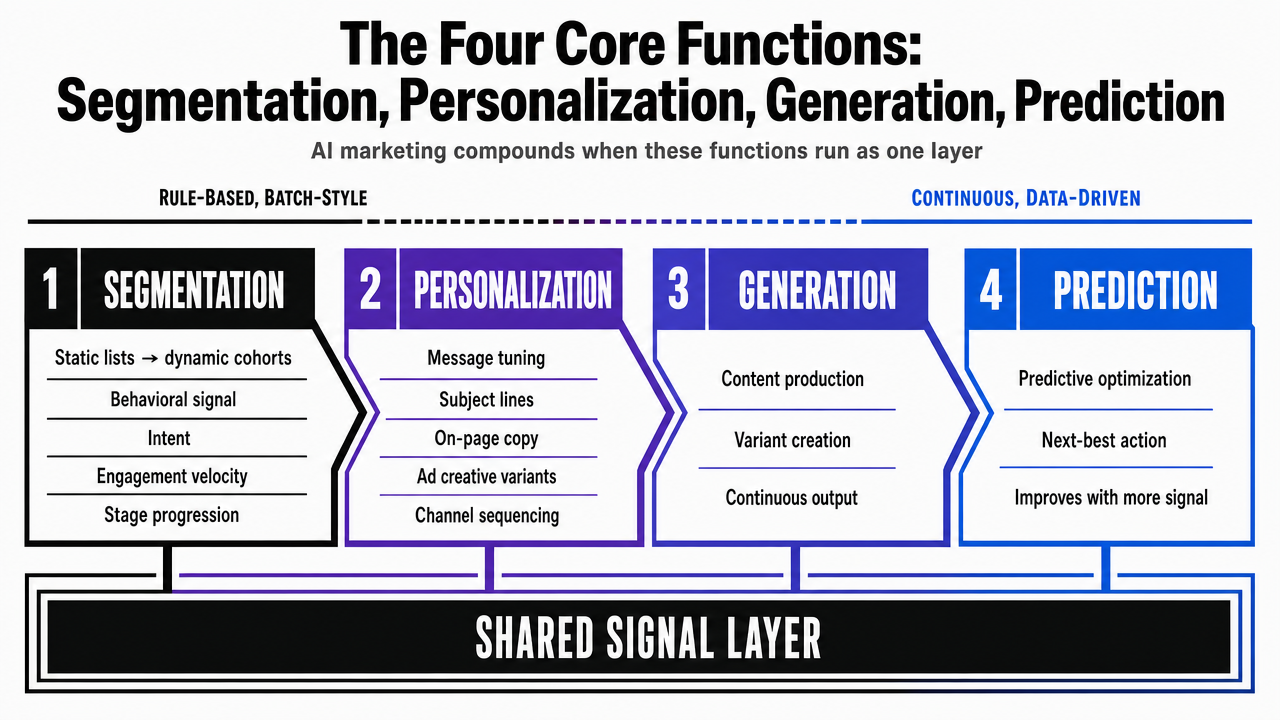 Visualize the four core functions of AI marketing as a coordinated framework, directly supporting the section's central claim that segmentation, personalization, generation, and prediction compound when run as one layer
Decision Layer vs. Execution Layer
A useful way to read AI marketing is as two stacked layers that share the same data. The decision layer answers questions: which segments to pursue this quarter, which keywords are worth net-new content, which ad groups are underperforming their expected CAC, which landing pages should be rewritten before more traffic is sent to them. These are pattern-recognition and forecasting problems, which is where machine learning and predictive analytics earn their keep 11.
The execution layer answers a different question: how to ship the work the decision layer just prioritized. That includes generating the brief, drafting the page, producing the ad variants, deploying the bid changes, and instrumenting the measurement 5. Generative models and workflow automation handle most of this layer, but they are downstream of the decisions, not a substitute for them.
The common failure mode is treating execution-layer tools as if they were the whole stack. A generative writing tool with no decision layer feeding it produces fluent content against the wrong topics. A bidding algorithm with no shared view of content quality optimizes toward whatever pages exist, not the ones that should. Coordinating both layers against one acquisition plan is what separates AI marketing as an operating model from AI marketing as a collection of features.
The Human Role: Strategic Supervisor, Not Channel Executor
The augmentation thesis runs through the research consistently: AI marketing performs better when it extends the judgment of human managers rather than replaces them 4. The work that disappears is the manual production tier—pulling reports, drafting first-pass copy, building keyword lists, rewriting meta descriptions one page at a time. The work that grows is supervisory: setting the strategy the system optimizes against, judging whether the outputs match brand and audience, and reallocating budget when the system surfaces a shift in performance 5.
For a VP of marketing, this changes what the team actually spends time on. Channel managers stop being executors of repetitive tasks and start being reviewers of AI-generated direction. Editorial review becomes a quality gate rather than a production bottleneck. Analytics moves from after-the-fact reporting to live decision input that the system already acts on.
The skill profile shifts with it. The literature flags an emerging premium on people who can frame prompts, audit model outputs, govern data inputs, and translate strategy into the constraints an AI system can optimize within 12. The headcount question stops being "how many writers and analysts" and becomes "how many supervisors per channel," which is a much smaller number.
What AI Marketing Is Not
Not Marketing Automation With an LLM Bolted On
Marketing automation platforms route a known contact through a pre-built sequence based on triggers a human defined in advance. The logic is deterministic: if the lead downloads the whitepaper, send email two on day three. AI marketing operates on a different premise. It infers what should happen next from patterns in the data rather than executing rules a marketer wrote last quarter 4.
The difference shows up across four dimensions:
- Decision-making in marketing automation is rule-based and static; in AI marketing it is model-based and updated as new signal arrives 11.
- Content production is templated and merge-tag driven in automation; in AI marketing it is generated against briefs and adapted to cohort context 5.
- Channel coordination in automation is sequence-bound within one tool; in AI marketing it is optimized across channels against a shared objective 11.
- The learning loop in automation is a quarterly A/B test reviewed by a human; in AI marketing the model reallocates against outcomes continuously 4.
A marketing automation platform with a generative writing feature is still marketing automation. Adding an LLM to a rules engine does not change the underlying decision logic—it just makes the messages inside the existing sequences faster to draft.
Not a Generative Content Tool, Not a Recommendation Engine
A generative writing tool produces copy on demand. A recommendation engine ranks items for a known user. Both are AI. Neither is AI marketing on its own.
Generative tools sit inside the execution layer. They compress drafting time from hours to minutes for copy, briefs, and visuals 5, which is necessary to keep pace with continuous campaigns but not sufficient to run one. Without a decision layer telling the generator which topics, which audiences, and which intents to write against, the output is fluent volume rather than directed volume.
Recommendation engines are the inverse problem. They optimize a single surface—a product grid, a content feed, a next-best-action slot—using behavioral signal from users already in the funnel 11. They do not decide which acquisition channels deserve more budget, which keyword clusters warrant new pages, or which ad creative to retire. They optimize within the funnel; AI marketing has to optimize the funnel itself.
Calling either one "AI marketing" inflates the category and obscures what coverage is actually missing from the stack. The honest framing: both are components, not the operating model.
Not the AI Features Already Inside Your Stack
Most marketing tools now ship AI features. The CDP has predictive lead scoring. The ad platform has automated bidding. The CMS has a content assistant. The email tool has subject-line generation. Each feature is useful inside its own product, but the sum of those features is not an operating model.
The reason is data isolation. Each tool's AI optimizes against the signal that tool can see 10. The bid algorithm does not know which landing pages the SEO team plans to rewrite next month. The content assistant does not know which keyword clusters the paid team is already buying. The lead-scoring model does not know which backlink targets are in flight. Local optimization at each tool produces global incoherence at the program level.
AI marketing as defined here requires the signal to be shared across the decision layer, not split across vendor boundaries 11. Features inside point tools are a useful input. They are not the system.
Experience AI-driven marketing execution firsthand
Deploy live AI-powered campaigns and measure real acquisition impact in your first week, risk-free.
Why the Operating-Model Framing Matters Now
Adoption Has Crossed From Experiment to Function
The operating-model framing is not theoretical. By 2023, roughly one-third of organizations surveyed by McKinsey reported using generative AI regularly in at least one business function, with marketing and sales among the leading application areas less than a year after most tools became broadly available 7. That is a faster move from novelty to standing workflow than enterprise software typically sees, and it changes the question a VP of marketing is being asked at the budget table.
The question is no longer whether AI belongs in the marketing function. It is whether the function is organized to use it as more than a productivity feature. McKinsey's survey scope is worth noting: it measured regular use in at least one function, not enterprise-wide scaling, and most respondents flagged governance and integration as unresolved 7. That gap—between point-of-use adoption and program-level coordination—is precisely the gap the operating-model framing addresses.
The research literature on AI marketing reflects the same trajectory, having shifted from conceptual debate to empirical work on specific applications like recommendation systems, conversational agents, and predictive analytics now embedded in active campaigns 11.
Market Scale and Decision-Speed Signals
The financial scale of the category has caught up with the adoption curve. The global market for AI in marketing is valued at roughly $26 billion and is projected to surpass $217 billion by 2034, an eightfold expansion across the decade 12. That figure tracks vendor revenue across the full stack—segmentation, personalization, generative content, predictive analytics, and the workflow tooling that connects them—rather than a single category of software.
The operator-level signal sits alongside it. Among marketers already using AI, 90% report that it helps them make faster decisions and 91% report that it helps uncover insights more quickly 12. Those figures come from self-reported survey data on practitioners who have already deployed AI in their workflows, so they describe the experience of adopters rather than the population of marketers as a whole. The direction of the signal is still meaningful: where AI is in the workflow, decision latency drops and pattern recognition improves.
For a VP reshaping budget, the combination matters more than either number alone. Capital is flowing into the category at a rate that will keep producing new tools every quarter, and the marketers already using the existing ones report compressed decision cycles. A program organized around fragmented tools will absorb the spend without capturing the speed advantage. A program organized as a coordinated decision-and-execution layer captures both.
How AI Marketing Unifies SEO, Paid, and Content as One Program
Shared Data Spine Across Channels
The unifying mechanism in AI marketing is not a feature. It is a data spine—one set of signals that the decision layer reads from and that every execution channel writes back to. Without it, the operating-model claim collapses into marketing language. With it, SEO content, paid media, and link acquisition stop competing for credit and start optimizing against the same forecast.
In practice, the spine collects search intent and ranking data, ad auction and conversion data, on-page engagement, and downstream pipeline signal in one place. Models trained on that combined view can decide which keyword clusters justify net-new content, which of those clusters are cheaper to acquire through paid in the short term, and which pages need link equity before either investment pays back 11. The same forecast that prioritizes a content brief informs the bid strategy on the related ad group and flags the backlink targets most likely to lift the cluster's organic position.
The architectural pattern matches what McKinsey describes in adjacent domains: AI delivers compounding value when it is organized around shared domain models and intelligent agents rather than deployed as isolated point solutions 10. For a marketing program, that means one view of the customer, one forecast of channel return, and one queue of prioritized work that flows out to the channel-level execution.
The Coordination Tax of Point-Tool Sprawl
The alternative is the stack most marketing teams already operate. An SEO platform recommends content topics from its own keyword index. A paid platform optimizes bids inside its own auction data. A backlink tool ranks targets from its own crawl. Each tool's AI is competent inside its boundary. None of them see the other channels' signal, which means none of them are optimizing the program 10.
The cost shows up as coordination work. Channel leads meet weekly to reconcile what the tools recommended against what the team can actually ship. Briefs are rewritten because the paid team is already buying terms the content team planned to target. Link campaigns chase pages that the SEO roadmap is about to retire. The literature flags this fragmentation directly: AI marketing research has moved toward integration across customer touchpoints precisely because channel-isolated deployments leave value on the table 11.
The augmentation thesis sharpens the point. AI performs best when it extends managerial judgment across the full program rather than running four parallel optimizations the manager has to stitch together 4. The coordination tax is not a soft cost. It is decision latency, duplicated work, and budget that gets allocated to whichever channel had the loudest dashboard that week. A unified data spine removes the tax by removing the handoffs that generate it.
See How AI Marketing Platforms Coordinate SEO, PPC, and Backlinks for Measurable Impact
Request a walkthrough of AI-driven marketing orchestration—demonstrating unified strategy, content workflows, and campaign automation purpose-built for agencies and multi-location brands.
If You Manage Multiple Locations or Brand Portfolios
Where the Coordination Tax Compounds Across Locations
The audience shifts here. Most of this article assumes a single acquisition program at the brand level. The next two subsections address operators running multiple locations or brand portfolios under one marketing function—multi-location healthcare groups, multi-brand SaaS holdcos, and agency teams executing across client accounts. The economics work differently for them.
Coordination tax in a single-brand program is annoying. In a portfolio, it multiplies. Each location or brand has its own keyword footprint, its own paid auctions, its own landing pages, and often its own local intent signals. When AI features sit inside isolated point tools, the marketing team ends up running the same four-tool reconciliation exercise once per location. Twenty locations means twenty parallel optimizations the manager has to stitch together, and the handoffs that generate the tax scale linearly with the footprint 10.
The literature flags this directly: AI marketing produces value when it integrates across customer touchpoints, not when it is deployed channel-by-channel in isolation 11. Portfolio operators feel the gap first because their coordination surface is larger than the tools were designed to address.
Fragmented Tools vs. Unified Operating Model: A Coordination View
The cost shows up in three variables operators can actually measure: number of channels coordinated per location, decision latency between signal and action, and how much of the program is governed by one shared forecast versus several local ones. Below is a coordination view, not a pricing comparison.
| Variable | Fragmented point tools | Unified operating model |
|---|---|---|
| Channels coordinated per location | SEO, paid, content, links optimized in separate tools per site | All channels run against one forecast per account |
| Decision latency | Weekly reconciliation meetings per brand or location | Continuous reallocation as signal arrives 4 |
| Forecast scope | Local to each tool's own data view | Shared domain model across the portfolio 10 |
| Human role | Channel executors stitching outputs together | Strategic supervisors approving direction 4 |
The adoption context matters here. Marketing and sales were among the leading functions for generative AI uptake in 2023 7, which means portfolio operators are now buying into a category where point-tool sprawl is the default purchase pattern. Choosing a unified decision-and-execution layer is the operational decision that prevents the coordination tax from scaling with the footprint.
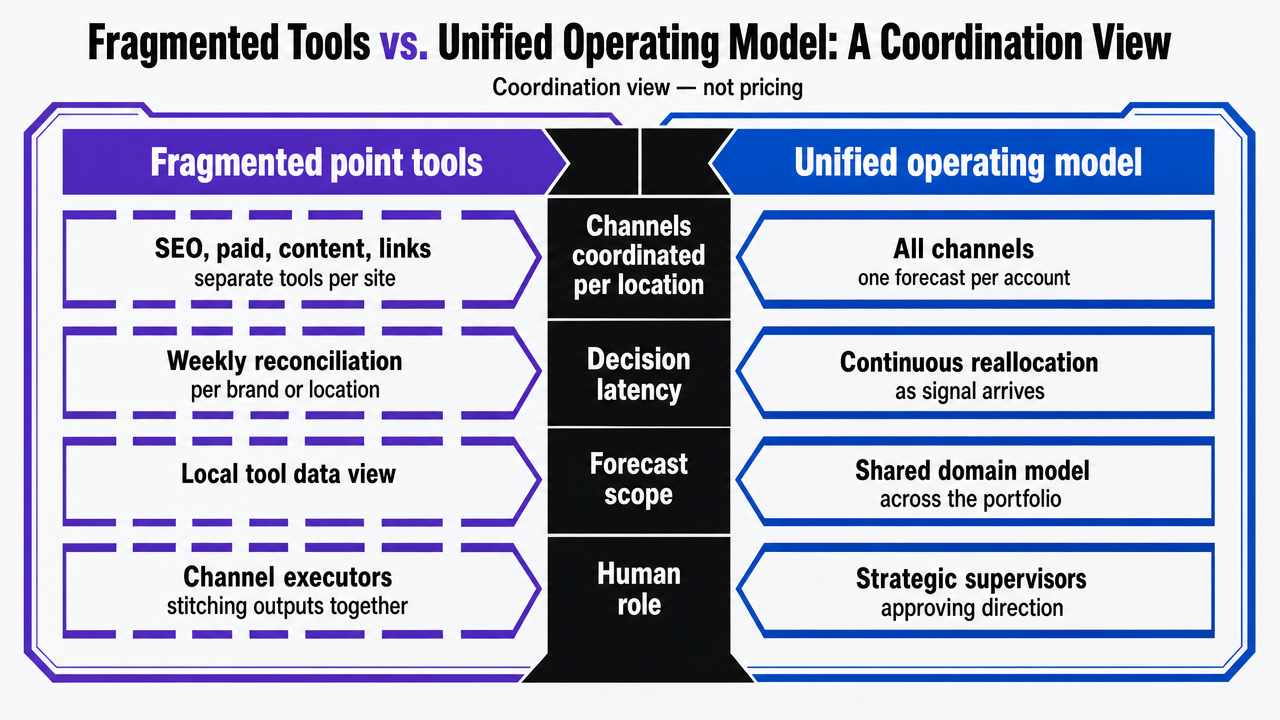 Render the section's coordination comparison table as a side-by-side visual contrast, directly supporting the operator-facing argument about point-tool sprawl versus a unified operating model across locations
What Changes Inside the Marketing Org
The org chart bends before the headcount does. When the decision-and-execution layer runs continuously, the work that used to fill a channel manager's week—pulling weekly reports, briefing freelancers, hand-tuning bids, reconciling dashboards across tools—stops being the job 5. The job becomes setting the constraints the system optimizes within and approving direction when the model surfaces a meaningful shift.
Three changes show up first:
- Editorial review compresses into a quality gate on AI-generated briefs and drafts rather than a production line that originates them 5.
- Analytics moves upstream: instead of explaining last quarter's variance, analysts shape the inputs and guardrails the decision layer reads from.
- Channel specialists consolidate into supervisors who own outcomes across SEO, paid, and content rather than executing inside one tool 4.
The skills demand follows the same arc. Practitioners who can frame prompts well, audit model outputs against brand and audience, govern data inputs, and translate strategy into machine-readable constraints command a premium 12. The augmentation thesis holds at the team level as much as the individual one—AI marketing performs better where human judgment is concentrated on direction and quality rather than dispersed across manual production 4. A platform like Vectoron is built for that team shape: fewer executors, more supervisors, one program.
Frequently Asked Questions
References
- 1.Leveraging Artificial Intelligence in Marketing for Social Good—An Ethical Perspective.
- 2.Adoption of artificial intelligence in healthcare: survey of health system leaders during the early generative AI era.
- 3.The Role of AI in Hospitals and Clinics: Transforming Healthcare in the Digital Era.
- 4.How artificial intelligence will change the future of marketing.
- 5.AI Will Shape the Future of Marketing.
- 6.The Role of Artificial Intelligence in Personalizing Social Media Marketing: Opportunities and Challenges.
- 7.The state of AI in 2023: Generative AI's breakout year.
- 8.Harnessing AI to reshape consumer experiences in healthcare.
- 9.Generative AI in healthcare: Adoption matures as agentic AI emerges.
- 10.The coming evolution of healthcare AI toward a modular architecture.
- 11.AI in Marketing: Literature Review on Focus Areas and Issues.
- 12.Understanding AI in Digital Marketing: Key Roles and Responsibilities.