
Key Takeaways
- Keyword Insights' free tier automates semantic clustering and SERP-similarity checks, recovering three to five hours per onboarding, though batch caps limit agencies past six active projects.
- ChatGPT with a structured prompt library classifies SERP intent across ranking URLs and features, but rate limits and context windows constrain simultaneous multi-client classification runs.
- Frase's free plan scrapes SERPs, extracts headings, and drafts outlines, cutting brief prep time, yet its low monthly document cap covers only one to two clients.
- NeuronWriter scores drafts against competitor entity footprints in real time, replacing manual gap analysis, but tight query allowances make multi-language audits unsustainable on the free tier.
- Screaming Frog's free edition crawls 500 URLs, sufficient for small sites to surface status codes, canonicals, and metadata issues in under 45 minutes.
- Merkle's Schema Markup Generator plus Gemini scaffolds JSON-LD from source pages, though hallucinated GTINs and ratings require Rich Results Test validation before deployment.
- InLinks' free tier builds entity-driven internal link maps that avoid anchor-text stuffing, but project and URL caps restrict use to single small-footprint sites.
- Perplexity Pages and Otterly.ai log which sources answer engines cite for target queries, giving citation visibility that manual screenshotting cannot sustain across 20 clients.
- Looker Studio with Gemini extensions consolidates Search Console, GA4, and Bing data and drafts KPI commentary, though attribution errors demand strategist override before client delivery 10.
- Free tools stop at coordination: 160 monthly artifacts across eight tools and 20 clients require an approval-first workflow layer that free tiers cannot provide 6.
Which specialist hours free AI tools actually recover
The Head of SEO's primary challenge isn't tool selection but optimizing specialist utilization. For agencies managing numerous active sites, margin erosion stems from repetitive subtasks between strategy and publication, such as query grouping, SERP intent tagging, brief construction, entity gap checks, schema validation, crawl triage, and monthly reporting.
Pew's 2025 survey on AI chatbot use in the workplace highlights this. Among workers using AI chatbots, 57% use them for research, 52% for editing, and 47% for drafting written content 1. These activities constitute a significant portion of billable SEO production time in mid-size agencies.
This overlap underscores the importance of free AI SEO tools. Their purpose isn't to replace a strategist's judgment on topics or client authority but to automate the intermediate tasks that consume senior specialist time, tasks that junior staff might perform too slowly to meet delivery schedules.
Each of the nine tools discussed below is evaluated based on its ability to recover specialist hours at specific pipeline stages and where its free tier becomes insufficient for agency-level operations.
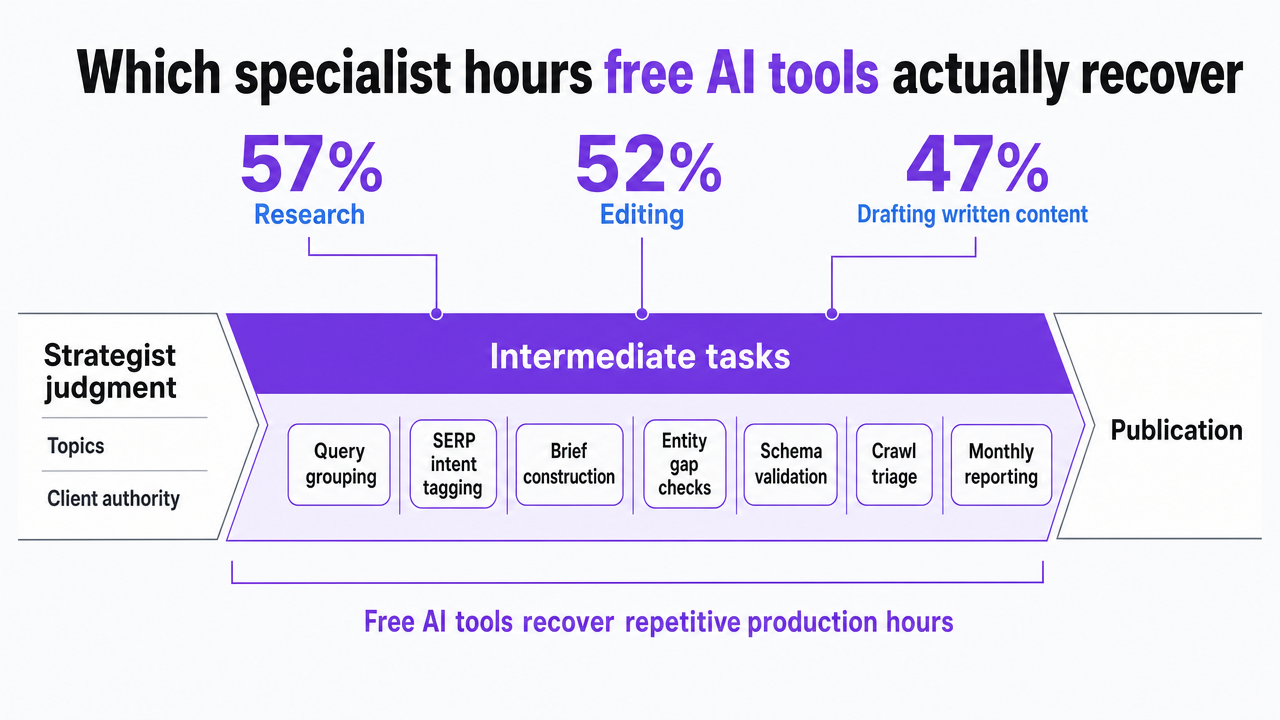 Visualize the Pew data on how workers actually use AI chatbots, which directly supports this section's argument about which SEO subtasks are candidates for automation
How the nine tools map to the agency delivery pipeline
Each tool addresses a distinct stage of the delivery pipeline:
- Keyword Insights handles clustering.
- ChatGPT with a structured prompt library manages SERP intent classification.
- Frase assists with briefing.
- NeuronWriter optimizes drafts and entity coverage.
- Screaming Frog conducts technical crawls.
- Schema Markup Generator combined with Gemini facilitates structured data.
- InLinks maps internal linking.
- Perplexity Pages and Otterly.ai track answer-engine visibility.
- Looker Studio with Gemini extensions covers reporting.
The ninth stage—coordination and approval—is where free tools fall short, necessitating a paid workflow solution.
Forrester's 2025 report on generative AI in US marketing agencies indicates a consistent barrier: agencies adopt point tools faster than they establish the workflow governance needed to integrate them 8. The pipeline map presented here forms the framework for the subsequent discussion.
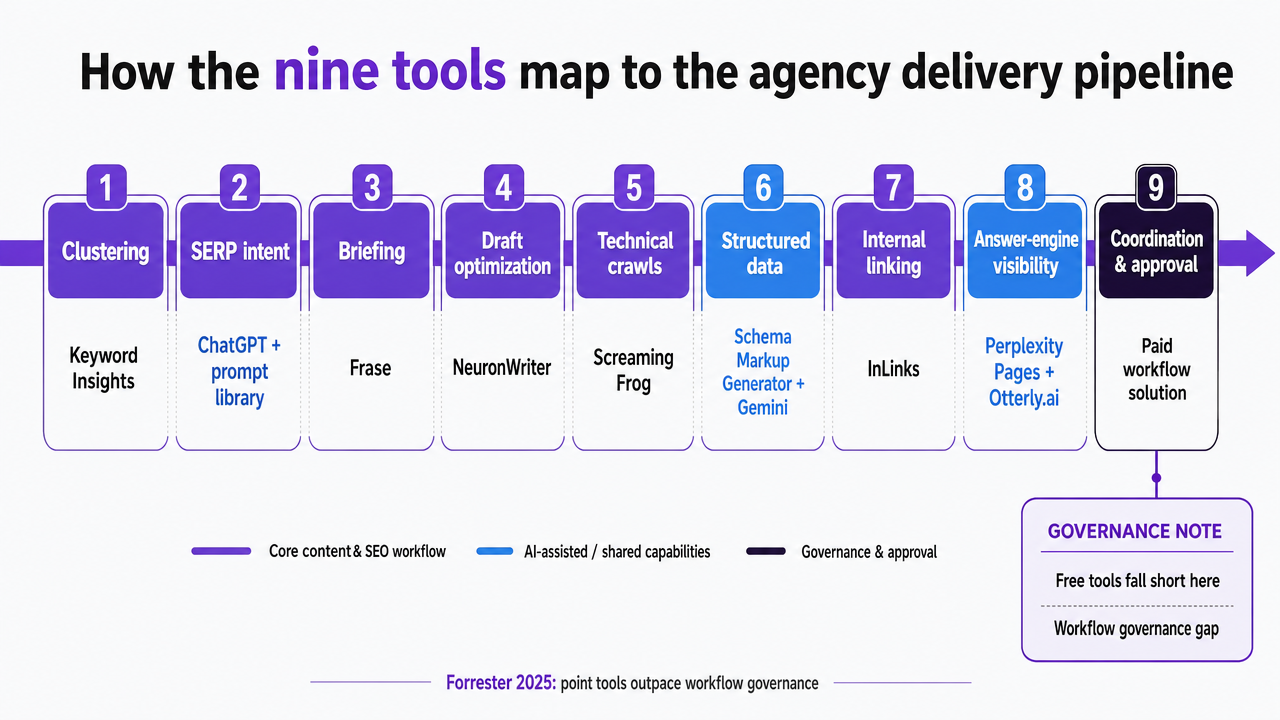 Process infographic visualizing the nine-stage agency delivery pipeline described in this section, mapping each tool to its stage
Keyword clustering and query grouping: Keyword Insights free tier
Query clustering is a prime candidate for automation. Manually grouping 400 seed terms into intent-aligned clusters can take a senior SEO three to five hours per client onboarding, a task that recurs with every topic expansion. Keyword Insights' free tier performs semantic clustering on a limited batch of queries, conducts a SERP-similarity check, and provides groups categorized by parent topic and general intent.
While the output isn't immediately shippable—a specialist must still reconcile clusters with existing URL inventories, mitigate cannibalization, and determine pillar versus supporting pages—the tool automates the mechanical work of pulling live SERPs, calculating URL overlap, and proposing initial groupings. This aligns with Pew's finding that 57% of AI chatbot users apply them to research tasks 1.
The free tier quickly becomes restrictive for agencies. Batch caps are low, meaning a single mid-size e-commerce client can exhaust a month's allowance in one clustering run. Multi-market clients with localized queries require separate jobs. Agencies managing more than six or seven active clustering projects monthly will hit these limits, leading to work queues or the need for a paid license.
SERP intent classification: ChatGPT with a structured prompt library
SERP intent tagging can consume significant specialist time. ChatGPT's free tier, when used with a well-maintained prompt library, can automate much of this. A structured prompt that analyzes the top ten ranking URLs, their SERP features, and the target query can classify intent (informational, commercial investigation, transactional, or navigational) and suggest format recommendations and dominant sub-intents.
This provides a preliminary tag, not a definitive one. Specialists must still verify against live SERPs, identify mixed-intent queries the model might misinterpret, and override classifications when client positioning contradicts observed patterns. Prompt libraries require version control and storage in a shared repository; ad-hoc prompting leads to inconsistent outputs and degrades QA.
The free tier's limitations include rate limits and context windows. Agencies performing intent classification for multiple clients simultaneously may encounter throttling. Long SERP payloads can be truncated if raw HTML is pasted instead of cleaned excerpts. Pew's research shows that 52% of workers use chatbots for editing and 47% for drafting 1, making intent classification—essentially structured editing of SERP data—a natural fit for AI.
Content briefing: Frase free plan
Briefing is a major time sink for senior specialists. A team producing 40 to 60 briefs monthly spends an average of 45 minutes per brief gathering top-ranking URLs, extracting subheadings, identifying questions from People Also Ask, and drafting outlines. Frase's free plan streamlines this by scraping top SERP results, extracting headings and outlines, surfacing common questions, and generating a draft outline that strategists can edit rather than create from scratch.
The output serves as a starting point, not a final brief. Specialists must add client-specific positioning, internal linking targets, E-E-A-T signals relevant to the vertical, and tone constraints that automated tools cannot infer. Frase eliminates the mechanical extraction—the copy-paste-and-tag work that would otherwise occupy a junior for 20 to 30 minutes before a senior even reviews the document.
The free tier's limitation is document volume. Frase caps free accounts at a small number of documents per month, which for a mid-size agency covers only one to two clients' briefing needs. Teams managing six or more active content clients will quickly exhaust this allowance, leading to account rotation (a QA risk) or the need for a paid upgrade for one operator.
Test AI SEO workflows on live projects risk-free
Deploy and measure real SEO content output across client sites before making a commitment.
Draft optimization and entity coverage: NeuronWriter freemium
Draft optimization is crucial for content quality and search performance. NeuronWriter's freemium plan automates the mechanical aspects: it analyzes competing pages for a target query, extracts co-occurring entities and terms, and scores a draft against this semantic footprint in real time. This provides specialists with a live coverage gauge, eliminating manual gap analysis across multiple browser tabs.
The output is diagnostic, not prescriptive. A strategist must still decide which entities align with the client's positioning and which are irrelevant. Forrester's analysis emphasizes that AI-powered search requires content to provide credible, context-rich, intent-driven answers and appear in sourcing and citations 9. NeuronWriter identifies the entity set; the specialist determines their strategic placement.
The free tier has a small monthly query allowance and a strict cap on active documents. Teams conducting entity audits on more than a few pages per month will quickly deplete the allowance. Multi-language clients consume the budget faster as each market requires separate analysis. Agencies often resort to rotating logins, which introduces QA vulnerabilities.
Technical crawling and log-adjacent audits: Screaming Frog free edition
Technical audits are essential but time-consuming. Screaming Frog's free edition crawls up to 500 URLs, suitable for typical local service businesses, small SaaS marketing sites, or single practice locations. For these sites, the free tier covers a full technical pass, identifying status codes, redirect chains, canonical mismatches, indexability flags, orphaned templates, missing metadata, and duplicate title patterns. A specialist can review this data in 30 to 45 minutes, significantly less than the two hours a manual process would take.
The output is raw diagnostic data, not a complete audit. A strategist must interpret this data in conjunction with the client's index coverage in Search Console, log files (if available), and commercial priorities. For instance, a 301 chain on a low-traffic legal disclaimer requires different triage than a canonical loop on a high-value "money page," a distinction only a human can make.
The 500-URL cap limits the free edition's utility for agencies. Multi-location clients with numerous city pages and extensive blog archives quickly exceed this limit. Enterprise e-commerce sites are entirely out of scope. Agencies performing technical passes on more than a few small sites monthly typically upgrade at least one seat to a paid license for larger crawls.
Schema generation and validation: Schema Markup Generator plus Gemini
Structured data generation is a task where junior specialists can quickly produce output, but senior specialists often spend hours correcting errors. Merkle's Schema Markup Generator provides mechanical scaffolding for common types (Organization, LocalBusiness, Article, FAQ, Product, HowTo) by populating validated JSON-LD templates from form fields. Combining this with Gemini's free tier automates the interpretive work: extracting entities from a source page, resolving nested properties like sameAs and areaServed, and generating a draft that aligns with the client's actual business rather than a generic template.
The output requires review. Gemini may confidently fabricate a GTIN, invent an aggregateRating for a page without reviews, or apply a Physician schema to a service line page instead of a person. A specialist must validate the draft using the Rich Results Test and Schema.org validator before deployment. The free tier's limitation becomes apparent with multi-location clients: 40 city pages, each requiring a distinct LocalBusiness block, can overwhelm Gemini's context handling, forcing agencies to script generation externally or use a paid schema tool with bulk export capabilities.
Internal link mapping: InLinks free tier
Internal linking is a stage where junior specialists can inadvertently create "anchor-text debt," requiring significant senior specialist time to rectify. InLinks' free tier connects to a small site, extracts the entity graph across indexed pages, and proposes internal links between semantically related URLs using anchor text derived from entities rather than exact-match keyword stuffing. This provides specialists with a topical link map instead of a speculative spreadsheet.
The output is a proposal, not a final decision. A strategist must ensure suggested links respect the site's silo structure, that "money pages" receive authority from supporting pages, and that proposed anchor text doesn't overwrite manually placed links crucial for conversion paths. Entity-driven anchors also need a QA pass for brand voice, as InLinks may suggest accurate but overly clinical phrasing unsuitable for a consumer-facing site.
The free tier caps project count and URL volume per project, making it suitable only for single-site, small-footprint operations. Multi-location clients with numerous city pages and extensive blog archives exceed the free scope. Agencies performing link mapping for more than one or two sites monthly will quickly reach these limits.
Answer-engine visibility: Perplexity Pages and Otterly.ai free tracking
Answer-engine visibility is a newer production stage often audited manually. This involves opening Perplexity, ChatGPT, and Google's AI Overviews, typing branded and unbranded queries, and screenshotting results. This process is unsustainable for a portfolio of 20 clients. Perplexity Pages, used as a query surface, allows specialists to observe which sources the engine cites for a target query and which entities anchor the response. Otterly.ai's free tracking tier monitors a small set of prompts across LLM answer engines, flagging when a client's domain appears in a citation set.
The output is a citation log, not a ranking report. A strategist must interpret why a competing domain earns a citation—often due to entity depth, structured data quality, or third-party corroboration—and translate this into content or authority adjustments for the client's site.
Forrester emphasizes that AI-powered search requires content to answer buyers' questions with credible, context-rich, intent-driven answers and appear in sourcing and citations, not just blue-link rankings 9. Otterly's free tier has a low prompt count per project, meaning agencies typically track five to ten priority queries per client and rotate the set monthly. Beyond this, coverage gaps quickly accumulate.
See How Top Agencies Automate SEO Execution Without Expanding Teams
Discover how leading agencies leverage AI-powered workflows to operationalize SEO at scale, reducing manual overhead and maintaining strategic oversight across multiple client accounts.
Reporting and measurement: Looker Studio with Gemini extensions
Monthly reporting consumes significant senior specialist time and often results in unread dashboards. Looker Studio remains free, and Gemini extensions within its connector layer now automate the interpretive step previously requiring human effort. It pulls data from Search Console, GA4, and Bing Webmaster into a single canvas, then generates written commentary against quarterly KPI targets. This provides specialists with a draft narrative alongside charts, eliminating the need to start from a blank text block.
The output is a preliminary draft, not a client-ready report. Gemini might incorrectly attribute a traffic drop to a Google update when a client's own noindex push is the cause, or summarize a rankings gain without noting that the winning query cluster represents only 3% of the pipeline. Northwestern Medill's best practices advocate for rigorous attention to attribution, engagement, and return in AI-driven measurement, warning that misused tools can degrade content quality 10. A strategist must override the narrative before it is presented to the client.
The free tier's limitations include connector count and refresh frequency at portfolio scale. Agencies with over 20 active clients will experience throttling and need to move to a paid data layer.
Coordination and approval workflow: where free tools stop
While the preceding tools recover specialist hours within individual stages, none address the time lost between stages. A clustering export must be transferred to the briefing operator, a brief to the drafter, a draft to the on-page specialist, then the technical auditor, schema builder, internal-link mapper, and finally the reporting analyst. Each handoff risks context loss, version drift, and unconfirmed changes.
Free AI tools exacerbate coordination challenges. A team using eight point tools across 20 clients generates approximately 160 monthly artifacts—clustering exports, briefs, coverage reports, crawl diagnostics, schema drafts, link proposals, citation logs, dashboards. No free tier tracks which artifact belongs to which client, who last modified it, or whether it received human approval. McKinsey's 2025 global survey found that most organizations struggle to scale AI beyond piloting because use-case gains don't compound without a governing workflow layer 6.
This represents the ninth slot in the pipeline map, where free tools are inadequate. Paid coordination platforms exist because the volume of artifacts generated by an AI-assisted team exceeds what free tiers can manage. Vectoron addresses this gap by providing an approval-first workflow that routes all AI-generated recommendations—across content, SEO, PPC, backlinks, social, and call intelligence—through a single Command Center for human sign-off before execution.
Governance: the approval gate before AI output ships
Every tool in the pipeline produces output that requires specialist review before deployment. This review constitutes the governance layer, an area often underinvested in by agencies. A clustering export with a hallucinated parent topic, a Frase outline misinterpreting commercial intent, a Gemini-drafted schema with a fabricated aggregateRating, or a Looker narrative incorrectly attributing a traffic dip—each of these can ship without an approval gate, transferring liability to the agency, not the tool vendor.
NIST's AI Risk Management Framework emphasizes incorporating trustworthiness into AI systems, with suggested actions across the workflow 4. For an agency delivery pipeline, this means no AI-generated artifact should reach a client site without a named human reviewer, a timestamped approval, and a fallback mechanism if the output fails QA. This gate is a mandatory step in the production checklist for every tool listed.
Three approval-gate rules are essential for scalability:
- The reviewer must be a different operator than the one who prompted or ran the tool, to prevent errors from compounding under deadline pressure.
- Every artifact needs a version stamp linked to the client, stage, and tool, enabling traceability of downstream defects.
- The approval record must persist outside the tool itself, as free-tier accounts often lack reliable audit history.
Consolidation math: point-tool stack vs. coordinated workflow
A point-tool stack saves hours within each stage, but coordination costs consume those savings between stages. For a mid-size agency using eight free AI tools across 20 clients, estimated monthly savings per client are:
- 3 hours for keyword clustering
- 2 hours for SERP intent classification
- 4-5 hours for briefing
- 3 hours for draft optimization and entity coverage
- 1.5 hours for eligible technical crawls
- 2 combined hours for schema and internal linking
- 1 hour for answer-engine tracking
- 3-4 hours for reporting
This totals 19 to 21 hours reclaimed per client per month on paper.
However, these paper savings are diminished by handoff inefficiencies. Version drift across tools, artifact retrieval from free-tier accounts lacking persistent audit history, and Slack-based coordination between operators can claw back an estimated 6 to 9 hours per client per month. This reduces net recovery to approximately 10 to 13 hours, still meaningful but about half of the promised savings.
McKinsey's 2025 global survey found that AI benefits at the use-case level do not scale to enterprise-wide impact without a governing workflow layer 6. A coordinated approval workflow closes this handoff gap by centralizing the artifact, reviewer, version stamp, and approval record. This shifts the math: the 19 to 21 hours of stage-level recovery remain, but the coordination tax drops to roughly 2 to 3 hours per client per month, increasing net recovery to 16 to 18 hours.
Across a 20-client portfolio, this difference amounts to 60 to 100 specialist hours per month, equivalent to a full-time employee the agency avoids hiring.
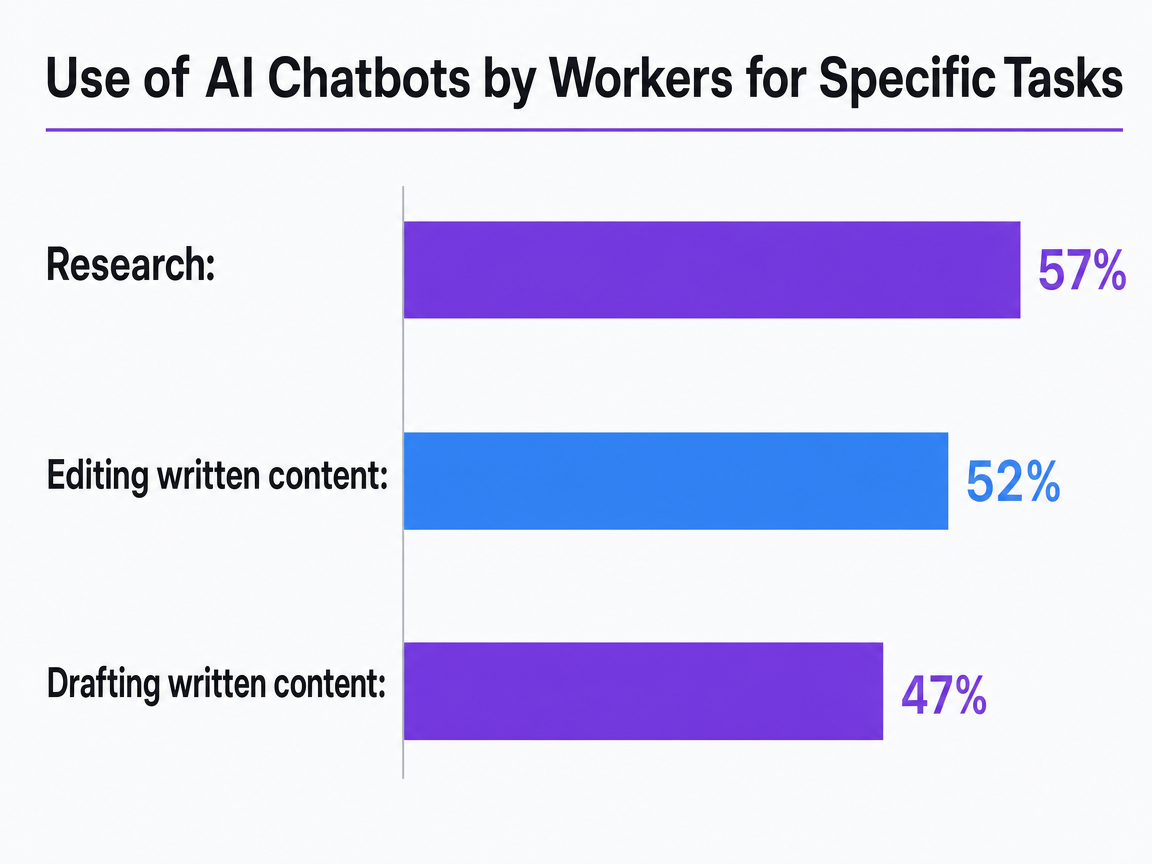 Use of AI Chatbots by Workers for Specific Tasks
Breakdown of how workers who use AI chatbots apply them to different work-related tasks like research, editing, and drafting.
Frequently Asked Questions
References
- 1.3. Workers' experience with AI chatbots in their jobs.
- 2.How the US Public and AI Experts View Artificial Intelligence.
- 3.Which U.S. Workers Are More Exposed to AI on Their Jobs?.
- 4.AI Risk Management Framework | NIST.
- 5.Draft NIST Guidelines Rethink Cybersecurity for the AI Era.
- 6.The State of AI: Global Survey 2025 - McKinsey.
- 7.Winning in the age of AI search.
- 8.The State Of Generative AI Inside US Marketing Agencies, 2025.
- 9.Impact And Opportunity For AI-Powered Search In B2B Marketing.
- 10.Content Marketing and AI – Best Practices.
- 11.Artificial Intelligence Risk Management Framework (AI RMF 1.0).
- 12.Playbook - AIRC - NIST AI Resource Center.
- 13.AI RMF - AIRC - NIST AI Resource Center.