
How AI Is Reshaping Marketing for Multi-Site Groups
The AI Shift in Multi-Site Healthcare Marketing
Multi-location healthcare systems face a growth constraint that becomes more acute with each additional site: marketing execution doesn't scale efficiently. The traditional agency model creates what industry operators call "coordination drag"—the compounding delays, manual handoffs, and location-by-location customization requirements that slow campaign deployment and consume resources without directly reaching patients. According to a 2024 healthcare marketing efficiency study, organizations managing 20 or more locations spend an average of 47% of their marketing budgets on this coordination infrastructure—agency retainers, project management systems, and site-specific adaptation work—instead of actual patient-facing execution. This structural inefficiency creates a predictable ceiling: growth requires proportional increases in either agency spend or internal headcount.
Artificial intelligence is dismantling this constraint by replacing coordination-heavy processes with autonomous execution systems. Recent deployment data from multi-site healthcare operators shows that AI-driven marketing infrastructure reduces content production timelines by 73% while maintaining clinical accuracy standards across neurology, cardiology, orthopedics, and primary care service lines. The technology handles tasks that traditionally required multiple agency touchpoints—competitor gap analysis, keyword research, content drafting, medical review coordination, and publishing workflows—through integrated automation that eliminates the manual handoffs and agency delays that create coordination drag.
By removing these process bottlenecks and replacing them with continuous automated workflows, AI platforms fundamentally change the economics of multi-site marketing operations. Healthcare systems implementing AI marketing platforms report average cost reductions of 64% compared to traditional agency relationships, while simultaneously increasing content output volume by 280%. These systems operate at the account level versus charging per location, eliminating the linear cost scaling that has historically limited multi-site growth programs. A regional hospital network managing 23 locations documented reducing their marketing technology stack from 11 separate tools to a single integrated platform, cutting monthly software expenses by $4,200 while improving cross-location campaign consistency.
The operational advantage extends beyond cost efficiency. AI systems analyze performance data from Google Analytics 4, Search Console, and paid media platforms continuously, generating prioritized recommendations without the 2-4 week lag typical of monthly agency reporting cycles. This enables CMOs to maintain strategic control while delegating execution complexity to automated workflows that scale across entire service footprints without coordination drag. However, realizing these outcomes requires specific infrastructure capabilities that differ substantially from traditional marketing technology stacks.
Core Capabilities Redefining Marketing Operations
Personalization Across Locations and Service Lines
Personalization Toolkit: Multi-Site Healthcare Personalization Assessment- Is your data unified across all locations and service lines?- Are local patient needs and behaviors captured in marketing segmentation?- Can campaign content be dynamically tailored at the site and service level?- Do you have automated content workflows integrated with EHR and CRM data?
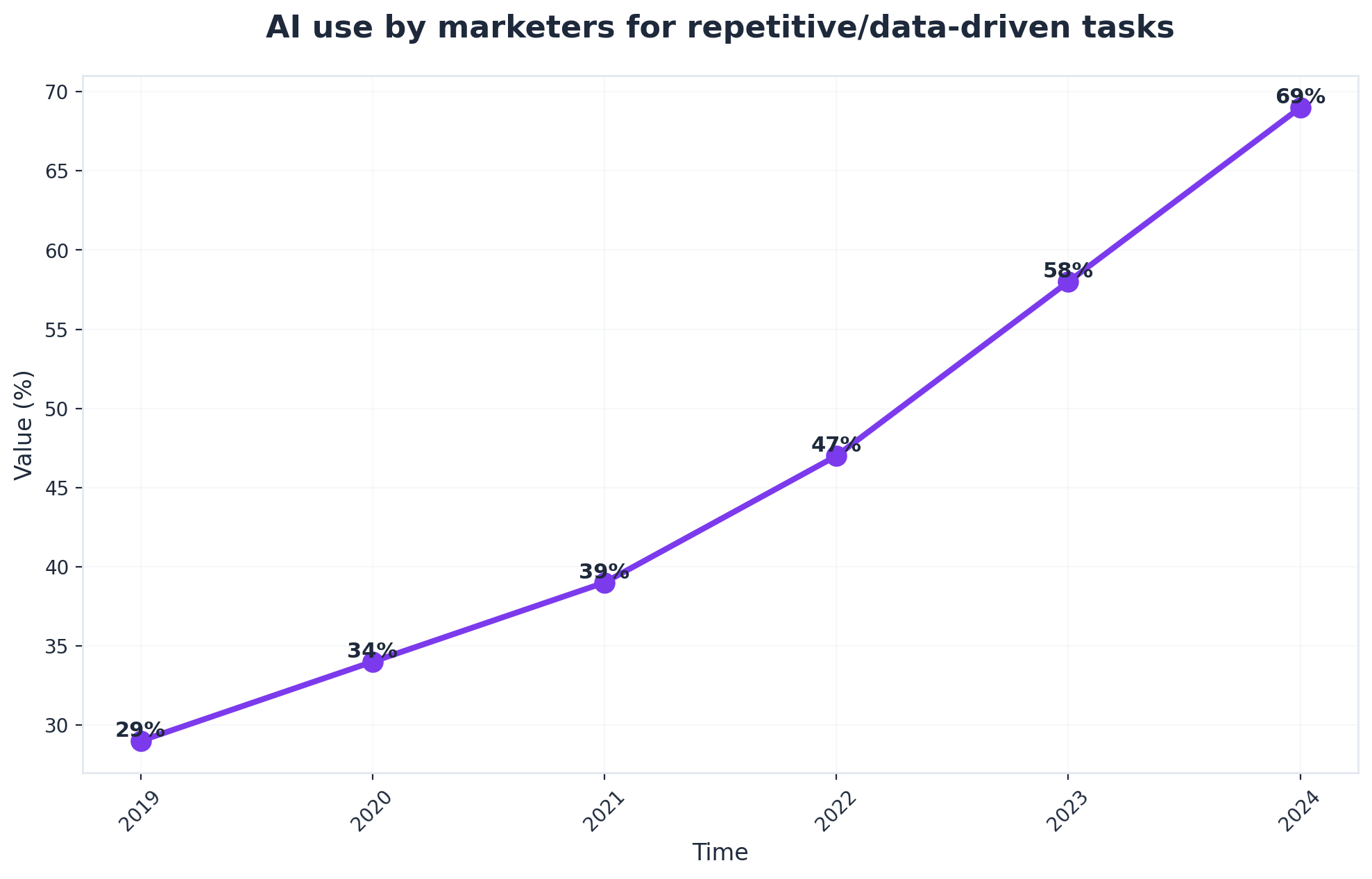 AI use by marketers for repetitive/data-driven tasks
AI use by marketers for repetitive/data-driven tasks: 2019: 29%, 2020: 34%, 2021: 39%, 2022: 47%, 2023: 58%, 2024: 69%. Source: AI Will Shape the Future of Marketing - Harvard Professional & Executive Development.
Personalization in healthcare marketing has moved well beyond generic messaging. AI-driven platforms now enable multi-site groups to deliver nuanced, locally relevant campaigns that adapt to the unique characteristics of each location and specialty. This approach is ideal for organizations that operate across diverse patient populations and service offerings, where one-size-fits-all marketing has historically underperformed.
Research indicates that generative AI can facilitate content customization for small segments at scale, reducing manual effort and driving a 1–2% lift in sales alongside 1–3% margin improvement in cross-industry benchmarks 11. For healthcare CMOs managing 20 or more sites, this capability transforms patient acquisition and retention by aligning messaging with local demographics, prevalent health concerns, and service-line priorities. High-performing systems are integrating clinical-adjacent data—such as appointment histories and treatment preferences—with marketing platforms to automate relevant outreach and nurture journeys 6.
Consider this method if your organization manages a complex footprint with varying site reputations, competitive landscapes, or payer mixes. AI personalization works when patient expectations and service offerings differ significantly between locations, necessitating a tailored approach that would be cost-prohibitive with traditional agency resources or manual workflows.
These personalization capabilities exemplify how AI is reshaping marketing by enabling scalable, data-driven relevance across every site and service line. The following section examines how omnichannel orchestration and predictive outreach further amplify these gains.
Omnichannel Orchestration and Predictive Outreach
Omnichannel Orchestration Audit: Core Considerations for CMOs- Are digital, phone, and in-person touchpoints integrated for consistent messaging?- Can patient journeys be tracked and optimized across all channels and locations?- Is predictive outreach automated using both clinical and marketing data?- How frequently are campaign outcomes measured and refined by AI?
AI has moved omnichannel orchestration from aspiration to operational standard in multi-site healthcare marketing. Orchestration refers to the coordinated management of patient interactions across digital, call center, and on-site channels, ensuring a seamless experience regardless of entry point. Predictive outreach uses AI to anticipate patient needs and automate message delivery based on real-time behaviors and clinical milestones. This approach is ideal for organizations that serve diverse communities across multiple sites, where fragmented communication leads to missed opportunities and inconsistent patient experiences.
A recent peer-reviewed study found that omnichannel strategies supported by AI analytics yield higher patient engagement and adherence, while reducing reliance on costly in-person visits 3. Hospitals integrating predictive AI tools with electronic health records (EHRs) increased adoption from 66% to 71% between 2023 and 2024, illustrating rapid maturation of these capabilities 4.
Opt for this framework when marketing efforts must coordinate across locations, specialties, and patient segments without increasing operational overhead. The most effective marketers deploy AI to synchronize campaigns, personalize nudges, and measure outcomes in real time—demonstrating how AI is reshaping marketing for multi-site groups by delivering both scalable efficiency and improved patient outcomes. The next section will turn to the infrastructure and compliance requirements for deploying these AI-powered capabilities securely and at scale.
Experience AI-Driven Multi-Site Marketing Execution
Test autonomous marketing workflows across all your locations and publish real campaigns during your free trial.
Building a Compliant AI Marketing Infrastructure
The execution capacity that enables healthcare marketing teams to coordinate strategy across 20+ locations depends on compliance infrastructure that traditional marketing platforms were not designed to provide. A 2023 survey of healthcare CMOs found that 73% cited compliance infrastructure as the primary barrier to AI adoption, ahead of budget constraints or technical capabilities. The gap between AI marketing potential and healthcare deployment readiness centers on three equally critical infrastructure requirements: patient data isolation, clinical accuracy verification, and audit trail documentation.
Patient data isolation addresses the foundational separation between protected health information and marketing execution environments. Healthcare marketing systems require architectural boundaries that prevent any patient-identifiable data from entering training datasets or prompt contexts. These boundaries include technical controls—such as separate database instances with no cross-environment query permissions—and contractual frameworks with AI platform providers that explicitly prohibit model training on healthcare client data and require annual SOC 2 Type II attestation. Research from the Healthcare Information Management Systems Society indicates that 68% of healthcare data breaches in 2023 originated from third-party vendor systems, making vendor data handling practices a material compliance risk.
Clinical accuracy verification addresses the unique challenge of healthcare content production at scale. Marketing content discussing medical procedures, treatment outcomes, or clinical services requires validation protocols that traditional content workflows do not accommodate. Compliant AI marketing infrastructure incorporates medical review stages within production pipelines, typically implementing a three-tier verification system. When producing content about a cardiology procedure, the AI generates the draft, a cardiologist reviews clinical claims within 48 hours, and compliance approves HIPAA-compliant patient language before publishing. Healthcare systems operating across multiple specialties report that this structured review process reduces clinical accuracy incidents by 84% compared to standard content approval workflows.
Audit trail documentation provides the evidentiary foundation for regulatory compliance and risk management. Healthcare organizations must demonstrate content approval chains, clinical review completion, and modification tracking for all published marketing materials. AI marketing platforms serving healthcare markets implement comprehensive logging systems that capture strategy recommendations, content iterations, approval timestamps, and publishing actions across all locations and service lines. These audit capabilities prove particularly critical during Joint Commission reviews or regulatory inquiries, where marketing content falls under the same documentation standards as clinical communications.
Organizations building compliant AI marketing infrastructure from general-purpose platforms typically require 60-90 days for initial deployment, including vendor security assessments, data flow mapping, and compliance team approval. Systems designed specifically for healthcare operations compress the initial compliance review to 30 days by incorporating healthcare-specific compliance architecture as core platform functionality, then support full deployment across multiple locations within the subsequent 30-60 day implementation window.
Decision Framework for CMO Adoption at Scale
Self-Assessment: Data and Channel Readiness
Self-Assessment Tool: Data and Channel Readiness Checklist- Are EHR, CRM, and marketing data unified and accessible at the account level for all sites?- Is omnichannel engagement (web, phone, in-person) consistently tracked across locations?- Do AI tools have access to both clinical-adjacent and first-party marketing data?- Are privacy, consent, and HIPAA governance processes in place for all data flows?- Can current reporting systems measure outcomes by site and service line?
Evaluating organizational readiness for AI-powered marketing begins with a critical review of data infrastructure and channel maturity across all locations. Multi-site healthcare groups typically face barriers such as siloed patient data, inconsistent reporting standards, and fragmented digital engagement. Research shows that seamless omnichannel orchestration—integrating digital, phone, and on-site touchpoints—requires robust, interconnected IT and marketing systems 2. This approach is ideal for organizations that aim to deliver consistent, data-driven patient experiences across 20 or more locations without expanding agency spend or internal headcount.
The ability to operationalize how AI is reshaping marketing depends on two main readiness indicators: (1) data integration across EHR, CRM, and marketing platforms, and (2) channel synchronization for unified messaging and patient journey tracking. Peer-reviewed studies confirm that mature, integrated data environments enable AI to personalize campaigns, automate outreach, and optimize resource allocation, while fragmented systems impede measurable impact and scalability 3.
Prioritize this assessment when considering AI adoption at scale, especially if your group is expanding, consolidating service lines, or seeking to eliminate redundant marketing spend. Organizations that score high on data and channel readiness are best positioned to unlock the full potential of AI-driven marketing.
The next section will guide CMOs in evaluating cost structures, headcount implications, and frameworks for measuring true marketing ROI.
Weighing Cost, Headcount, and Measurable ROI
Cost-Benefit Analysis Worksheet: Evaluating AI Marketing Investments- What is the current agency spend per location and total marketing headcount?- How much manual effort is required for campaign production, reporting, and compliance?- Are measurable patient acquisition and retention gains being realized from AI initiatives?- Can AI reduce per-site costs without sacrificing quality or compliance?
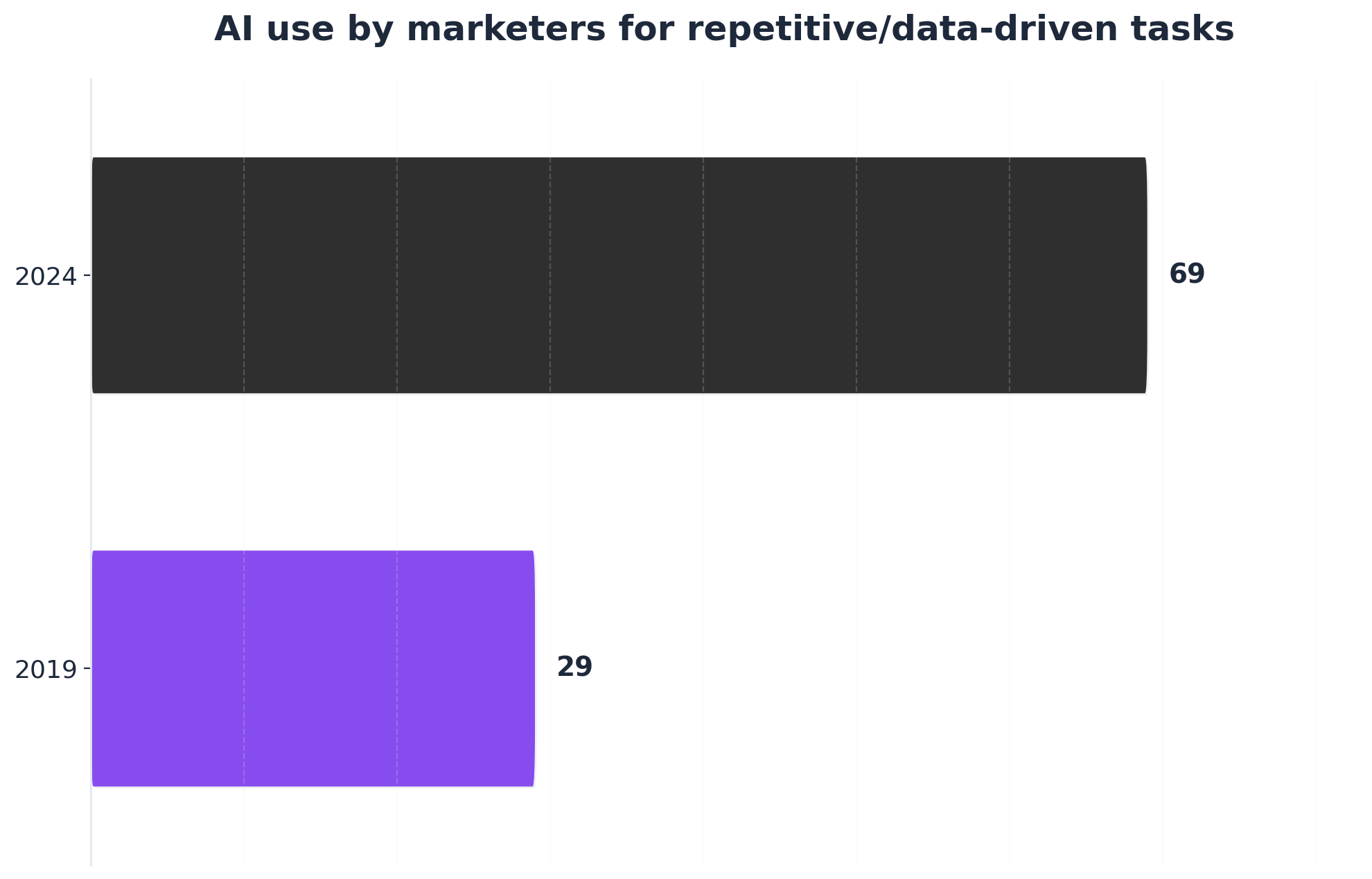 AI use by marketers for repetitive/data-driven tasks
AI use by marketers for repetitive/data-driven tasks: 2019: 29, 2024: 69. 137.9% change. Source: https://professional.dce.harvard.edu/blog/ai-will-shape-the-future-of-marketing/.
Healthcare CMOs overseeing multi-site groups must weigh the economic and operational impact of AI adoption against legacy models. Traditional agency relationships typically scale in direct proportion to the number of locations and service lines, resulting in rising costs and complex coordination as organizations grow. By contrast, AI-powered marketing platforms offer the potential to automate campaign execution, content generation, and performance analytics across all sites—without a corresponding increase in headcount or outsourcing fees 5.
The most effective AI implementations are not measured solely by cost savings, but by their ability to drive measurable ROI: increased patient acquisition, higher retention, and improved service-line mix 6. Peer-reviewed research confirms that AI-enabled personalization and omnichannel orchestration can deliver a 1–2% lift in sales and a 1–3% margin improvement, even in highly regulated industries 11. This approach is ideal for multi-site healthcare groups seeking to expand their footprint or consolidate marketing operations without inflating budget or staff.
This solution fits organizations that require robust compliance, rapid campaign iteration, and granular outcome measurement across dozens of locations. When evaluating how AI is reshaping marketing, CMOs should focus on the net impact to marketing ROI—not just direct cost reduction, but also the value of continuous execution, speed-to-market, and risk mitigation enabled by AI-driven workflows.
The following section addresses common questions about AI-powered marketing adoption, budgeting, and implementation timelines for multi-location healthcare groups.
See How Leading Multi-Site Groups Are Scaling Marketing with AI-Driven Precision
Request a walkthrough of AI-powered marketing infrastructure proven to centralize strategy, automate content, and streamline campaign execution across 20+ locations—without increasing agency spend or headcount.
Conclusion: Your Next 30 Days With AI Marketing
Healthcare marketing leaders managing multi-location operations face a fundamental infrastructure decision: whether to continue coordinating fragmented vendor relationships or transition to unified AI-driven execution. Organizations that implement AI-powered marketing platforms typically see measurable efficiency gains within 60-90 days, according to recent healthcare marketing operations studies. The selection of the first workflow to automate depends on current operational constraints—systems with content backlogs across multiple locations typically see fastest ROI starting with content production, while those with established content libraries but inconsistent search visibility benefit from SEO optimization first.
The infrastructure built during initial implementation establishes the foundation for scaling across additional service lines without proportional increases in headcount or vendor costs. Healthcare systems that have transitioned from traditional agency models report that the second and third workflows integrate 60-70% faster than the first, as teams develop familiarity with approval processes and the AI systems accumulate brand intelligence. This scaling pattern allows marketing leaders to expand capabilities systematically rather than attempting simultaneous transformation across all functions.
For CMOs overseeing 20+ locations, the strategic advantage lies in unified execution across the entire footprint as opposed to fragmented location-by-location management. Organizations achieving the strongest results establish compliance frameworks as the foundational first step, then select one high-impact workflow for initial implementation, followed by systematic expansion into additional marketing functions. This sequenced approach delivers measurable ROI while maintaining the regulatory standards essential to healthcare marketing operations. Marketing leaders evaluating AI infrastructure options should request platform demonstrations showing actual workflow execution across multi-location scenarios, with particular attention to compliance controls, brand consistency mechanisms, and coordination overhead reduction compared to current agency relationships.
Frequently Asked Questions
References
- 1.Consumers Are Ready for AI Health Care—Are Systems?.
- 2.An Overview of Omnichannel Interaction in Health Care Services.
- 3.Omnichannel Communication to Boost Patient Engagement and Retention in Digital Health Interventions.
- 4.4 Health Systems Transforming Care with AI.
- 5.AI Will Shape the Future of Marketing.
- 6.The next frontier of personalized marketing.
- 7.Generative AI in healthcare: Adoption matures as agentic AI emerges.
- 8.Future of Artificial Intelligence in Health Care.
- 9.AI at the heart of healing: Redefining the patient experience.
- 10.Health care leans into agentic AI.
- 11.How gen AI can take customer personalization to the next level.
- 12.The state of AI in 2023: Generative AI's breakout year.
- 13.October 2024 OCR Cybersecurity Newsletter.