
Key Takeaways
- Rank trackers still report positions accurately but miss three critical signals: whether an Overview triggered, if the client was cited, and whether that citation drove clicks.
- Scope AI Overview exposure before rebuilding the stack, since Overviews appear on roughly 4.5% to 12.5% of queries and vary sharply by vertical 6.
- Average position and account-wide CTR mask two distinct realities because lower-ranked results absorb heavier CTR losses when Overviews push them down the page 5.
- Layer four signals onto existing data—Overview trigger frequency, citation presence, citation share, and AI-affected CTR—to replace rank-only reporting without new vendors 7.
- Audit eligibility first, since pages must be indexed and snippet-eligible to appear in Overviews, and skip disavowed tactics like llms.txt files or content chunking 1.
- Rebuild content templates around answer-first passages of 40 to 60 words, question-shaped H2s, and single-topic depth rather than broad listicle coverage 13.
- Redesign QBR decks so Overview trigger rate and citation share lead the report, with average position demoted to a supporting metric for the quiet cohort.
- Roll out in 30-60-90 day phases: segment the book by exposure, instrument the exposed cohort, then automate manual QA to protect accounts-per-strategist economics.
What rank trackers stopped seeing when Overviews moved above the fold
Rank trackers still report accurate positions, but they cover a smaller portion of the visible SERP than before. When an AI Overview appears above organic listings, position one is no longer the top of the page. The Overview itself synthesizes content from multiple sources, rather than a single featured snippet 3. Consequently, a page ranking first on a query with an Overview may still be below an AI-generated summary that has already answered the searcher's question.
This shift creates a gap where agency reporting can lose credibility. A weekly rank export might show a client's target keywords holding steady at positions two through five, while sessions on those same URLs decline. This happens because Google's goal for Overviews is to reduce search "legwork" and keep users on the SERP 4. The rank tracker isn't wrong; it's simply answering a different question than what's now critical for visibility.
Three key signals fall outside the typical rank tracker's scope:
- whether an Overview triggered for a query,
- if the client's domain was cited within it, and
- if that citation was expanded or clicked.
These insights aren't found in standard Semrush position reports or STAT delta emails. Instead, they require SERP scrapes, Google Search Console (GSC) filters, and manual quality assurance (QA), which most agency workflows haven't yet systematized.
This guide will detail how to instrument these new signals, what to de-emphasize in client reports, and how to adapt content templates to prioritize citation over mere ranking.
Sizing the problem before rebuilding the stack
Before an agency overhauls its measurement stack, it's crucial to understand the actual scope of the SERP affected by AI Overviews. Studies indicate that AI Overviews appear in approximately 4.5% to 12.5% of queries, with most measurements under 10% overall 6. This range varies by methodology, geography, and query type. It's important to note that this doesn't mean a client's entire keyword list will see Overviews on one in ten terms; some verticals are more impacted, while others are barely affected.
Accurate scoping is vital for two reasons. First, it provides a realistic internal narrative. This isn't a SERP-wide extinction event, and presenting it as such in a Quarterly Business Review (QBR) will undermine trust if a client's analyst performs their own spot-check. Second, it directs where measurement efforts should be concentrated. Informational, question-based, and comparison queries are most likely to trigger an Overview, which often aligns with the top-of-funnel content agencies frequently produce.
Operationally, this implies a triage step rather than a complete stack rebuild for every account. An agency managing 40 clients doesn't need AI-aware tracking for all 20,000 keywords. Instead, it needs to segment the keyword universe into "Overview-exposed" and "Overview-quiet" subsets. The exposed subset should then be instrumented with the four signals discussed later. This segmentation is more cost-effective than blanket coverage and provides a defensible number for QBRs: "Overviews trigger on X% of your tracked keywords, and here's what happened specifically to those."
Agencies that skip this scoping step risk over-investing in AI tracking for accounts where it has minimal impact on the profit and loss (P&L), while under-investing in clients whose entire content library falls within the exposed query class.
Why average position and CTR became partial signals
The uneven CTR hit across positions when an Overview appears
Historically, position one captured most clicks, position two a smaller share, and anything below position five received minimal traffic. This distribution changes significantly when an AI Overview appears. Research indicates that Click-Through Rate (CTR) declines are not uniform across the SERP: top-ranking pages experience a hit, but lower-ranked results suffer heavier CTR losses because the Overview and higher-ranking listings push them further down the visible page 5. Position seven on an Overview-triggered query occupies a different space than position seven on a clean SERP.
This asymmetry disrupts how most agency dashboards summarize performance. A weighted average CTR across a tracked keyword set will obscure the impact on queries where an Overview compressed results below the fold, and it will also mask queries where no Overview appeared and CTR remained stable. The result is a seemingly reasonable headline number that hides two distinct performance realities within the same account.
The reporting solution is segmentation before summarization. Divide the keyword set based on Overview presence, then report CTR by position within each segment. For Overview-quiet queries, the classic CTR curve still largely applies, and average position remains a reliable metric. For Overview-triggered queries, position is less important than citation status, and CTR should be interpreted within specific position bands rather than as an account-wide average. Analysts conducting QBRs need both perspectives presented together, otherwise, a client's own spot-check could contradict the agency's narrative.
What classic ranking factors no longer guarantee
The second issue is causal. While backlinks, keyword-optimized title tags, and internal link equity still influence organic rank, they no longer guarantee visibility within an AI-generated summary. Analysis of AI Overviews confirms that traditional ranking factors like backlinks and keyword optimization do not assure inclusion in the AI-generated module 8. Overviews synthesize passages from multiple sources based on extractability and topical relevance to the specific question, not solely on the strongest domain.
This has significant implications for agency deliverables. A page might climb from position four to position two due to a link-building campaign, yet still lose sessions if the Overview above it cites two competitors and completely bypasses the client. The rank improvement is real, but the traffic outcome can be worse than the rank chart suggests.
Therefore, average position should be demoted from a headline to a supporting metric for Overview-exposed queries. It still tracks the underlying search auction but no longer reliably predicts whether Google's model will select the client's URL for summarization. The next section will cover the four signals that do.
Test AI-driven SEO insights on live rankings
Experience real-time AI overviews and publish content using your actual keyword and ranking data.
The four-signal measurement layer that replaces rank-only reporting
Replacing rank-only reporting doesn't require a new tool, but rather layering four specific signals onto existing data. Recommendations for AI Overview measurement include tracking citation share, clicks from citation expansions, and changes in organic CTR for queries with Overviews, in addition to monitoring which queries trigger them 7. Each signal addresses a distinct question and can be sourced from data an agency already collects.
The first signal is Overview trigger frequency, which acts as a gatekeeper. It answers: what percentage of the client's tracked keywords generate an AI Overview? This requires a SERP scrape, either from a rank tracker that flags SERP features or a lightweight scraping layer. This signal is crucial for segmenting keywords into exposed and quiet buckets, a prerequisite for the reporting cuts discussed earlier.
Citation presence is the binary follow-up: when an Overview triggers, is the client's domain among the cited sources? This also comes from the SERP scrape, but focuses on the citation list within the Overview module, not the blue-link positions below it. This is a per-query yes/no that aggregates into a percentage across the exposed subset.
Citation share provides a competitive view. Across all Overview-triggered queries, what percentage of citation slots does the client's domain occupy relative to competitors? This metric should replace average position on QBR slides, as it directly measures success in capturing the prime real estate above position one.
AI-affected CTR is the fourth signal, linking measurement back to traffic. This uses GSC data, filtered to the exposed keyword subset, and compared period-over-period against the quiet subset as a control. This comparison isolates the Overview effect from broader seasonality or algorithmic fluctuations, which a single account-wide CTR number cannot achieve.
These four signals don't necessitate a new vendor. A rank tracker with SERP feature detection, a SERP scraping feed, and GSC provide all necessary inputs. The change lies in the reporting logic: segmenting by Overview presence, logging citations per query, calculating citation share, and analyzing CTR for the exposed cohort. This logic needs to be systematized by agencies scaling beyond a few accounts, rather than managed manually per client.
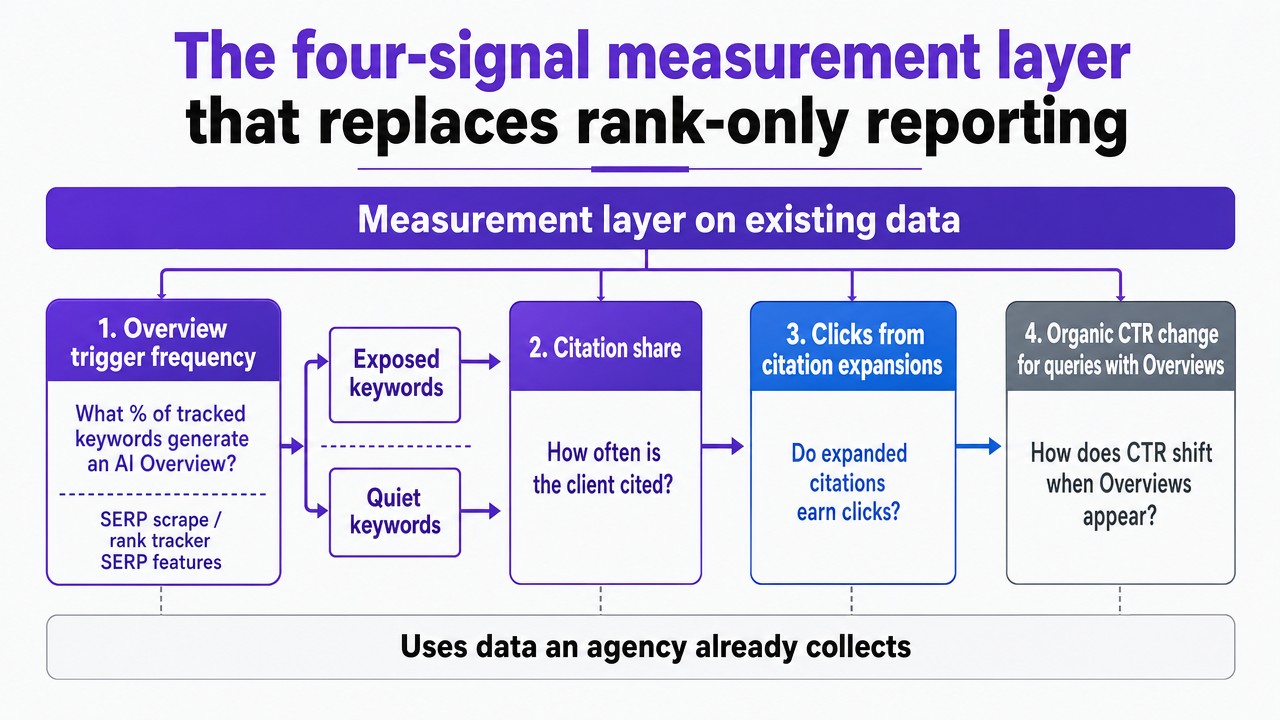 Visualize the four measurement signals that replace rank-only reporting, directly supporting the section that enumerates them
Eligibility and extractability: what Google actually rewards
Two Google properties define the rules for AI Overviews, and agencies should review them before modifying content templates. Google's Search Central guidance on AI features states that a page must be indexed and eligible to appear in Google Search with a snippet to be considered for generative AI features 1. This clarifies that there's no separate AI index, parallel eligibility system, or privileged submission channel. If a page isn't snippet-eligible today, it won't be Overview-eligible either.
This framework provides an immediate audit for agencies. Pages excluded by noindex, blocked by robots directives, gated behind login walls, or containing nosnippet tags on potentially citable passages are disqualified before extractability even becomes a factor. Running this audit on a client's top Overview-exposed URLs often reveals self-inflicted problems that no amount of content restructuring can fix.
Google's optimization guide is equally clear about what doesn't help. It explicitly advises site owners to disregard tactics like content chunking, creating llms.txt files, and pursuing inauthentic mentions to influence AI summaries 1. Agencies that have added these items to client roadmaps are billing for work Google has publicly disavowed. The Search Central page reiterates that standard Search Essentials are the baseline for AI feature participation, and content appearing in Overviews must meet Google's existing technical and quality requirements 2.
What remains crucial is extractability, which differs from eligibility. Eligibility is binary and largely technical. Extractability, however, concerns whether a specific passage on a page is structured clearly enough for Google's model to incorporate it into a synthesized answer. This is where content templates become vital, as explored in the next section.
Content templates built for citation, not just ranking
Extractability is a structural characteristic of a page, not merely a copywriting style. Google's models select passages that answer a specific question concisely (one or two sentences), appear under a heading matching the searcher's phrasing, and contain enough entity context to be understood independently. This differs from the long-form, keyword-dense templates many agencies still use. To improve extractability, a useful rewrite recommends short answer passages, H2s that mirror user language, and structured formats like steps, tables, and one-sentence definitions to increase the likelihood of being cited 7.
The template shift begins at the top of the page. The first passage below the H1 should directly answer the query, ideally in 40 to 60 words, without introductory context or brand framing. An answer-first structure is a consistent recommendation for generative search tactics and aligns with how Overviews are assembled from discrete, self-contained passages 13. Agencies retrofitting older content often find the answer already exists on the page, but buried deep within a historical section.
The second template change involves subheading discipline. H2s and H3s should be phrased as actual questions searchers type, not as internal content categories. For example, "How much does commercial roof replacement cost in Michigan?" is more effective than "Pricing considerations" for the same passage, as it matches the query surface Google's model scans.
Third, prioritize specificity over breadth. Overviews favor specialized, niche-specific content that directly answers user questions, benefiting authoritative sources and penalizing the generic listicle format prevalent in agency deliverables for years 12. A 2,400-word "ultimate guide" covering fifteen subtopics is less likely to secure citation slots than a 900-word page that answers one question in depth. Agency content briefs should specify the single question a page addresses, the exact H2 phrasing, and the passage-level answer format. This is a template change, not a volume change, and it's where AI-aware content production platforms can automate the per-brief workflow.
See How AI Overviews Deliver Live Ranking Intelligence—Without Manual Tracking
Get a walkthrough of automated AI-driven rank insights and live SERP analysis for all clients, streamlining reporting and surfacing opportunities with measurable impact—no traditional tracker required.
The before/after client report
The most effective way to operationalize the four-signal layer is to redesign the weekly or monthly client deliverable itself. Most agency reports still begin with a keyword-count summary, an average position line chart, and a CTR table. This structure was designed for a SERP where the top organic result was the top of the page. It no longer accurately reflects what a client's audience sees on Overview-triggered queries.
A typical "before" layout leads with average position across the tracked keyword set, followed by CTR by position band, then session and conversion data from analytics. Overview presence is either absent or relegated to an appendix. The "after" layout retains the same underlying data but reorders and segments it. Slide one now presents the Overview trigger rate across the tracked set and citation share within the exposed subset. Slide two splits CTR into two cohorts—exposed and quiet—allowing the client to understand the context for each keyword. Average position moves to slide three as a supporting metric for the quiet subset, where it still reasonably predicts traffic.
Two new additions are essential for the updated report. First, a per-query citation log for the top twenty Overview-exposed keywords, detailing which competitor domains appeared alongside the client. Second, a delta view comparing citation share period-over-period, which serves as the closest AI-era equivalent to the familiar rank movement chart. Both are derived from the SERP scrape feeding the measurement layer, not from new vendor contracts.
If you manage 10-80 client accounts: measurement stack economics
This section shifts focus from single-account instrumentation to the portfolio-level economics an agency head must justify to a CFO. Implementing the four-signal layer is straightforward for one client, but scaling it across 40 or 60 accounts becomes a staffing decision.
The legacy stack is priced per seat and per hour. A rank tracker seat costs $X per client per month, depending on the vendor and keyword volume, a line item most agencies already carry. The compounding factor is the human time required: pulling Overview screenshots, manually logging citation lists, reconciling GSC exports with tracked keywords, and rebuilding QBR decks for exposed versus quiet cohorts. At Y analyst hours per client per month, a 40-account book quickly requires a full-time equivalent (FTE) before any strategic work even begins.
| Cost line | Legacy rank-only stack | AI-aware measurement layer |
|---|---|---|
| Rank tracker seat | $X per client / month | $X per client / month (unchanged) |
| Manual Overview QA | 0 hours | Y hours per client / month if run by hand |
| Report build time | Z hours per client | Z hours per client (template reused) |
| Marginal cost to add a client | 1 seat + Z hours | 1 seat + Z hours if the layer is automated |
The primary benefit is accounts per strategist, not just tooling cost savings. Agencies that systematize the SERP scrape, citation log, and cohort segmentation into a single reporting pipeline eliminate the Y hours per client, achieving near-zero marginal analyst time per added account. This efficiency allows for client retention without increasing headcount.
Two caveats are important. Overview trigger rates vary significantly by vertical, so the Y-hour estimate should be sampled per client before calculating a book-wide figure 6. Additionally, the seat cost only remains constant if the existing rank tracker already flags SERP features; otherwise, an upgrade or a separate scraping feed will alter the $X line item.
A 30-60-90 day rollout across the book of business
The rollout sequence is more critical than the choice of tools. Agencies attempting to instrument every account simultaneously often get bogged down with high-volume clients and neglect smaller ones. A phased plan, prioritized by exposure risk, leads to faster completion and reportable results by the next QBR cycle.
- In the first 30 days, conduct a segmentation pass across the entire client portfolio. Extract each client's tracked keyword set, identify terms that currently trigger an Overview, and rank accounts by their share of exposed keywords. The outcome is a two-column list: clients with significant Overview exposure and clients where classic rank reporting remains sufficient. Only the first group requires the four-signal layer in the subsequent phase.
- Days 31 to 60 are dedicated to the exposed cohort. Implement the SERP scrape for their keyword sets, log citation lists per query, and rebuild one client's QBR deck using the "after" layout described previously. Use this as a reference template, then replicate the structure across the rest of the cohort. Concurrently, begin content template revisions for the top ten Overview-exposed URLs per account, prioritizing answer-first passages and question-shaped H2s 13. Do not modify reports for the quiet cohort yet.
- Days 61 to 90 complete the process. Compare citation share period-over-period for the exposed cohort, remove average position from the headline slot in their reports, and document which template changes correlated with citation gains. This phase also involves automating the manual QA hours logged during phase two, transitioning to AI marketing execution platforms such as Vectoron to manage per-client reporting.
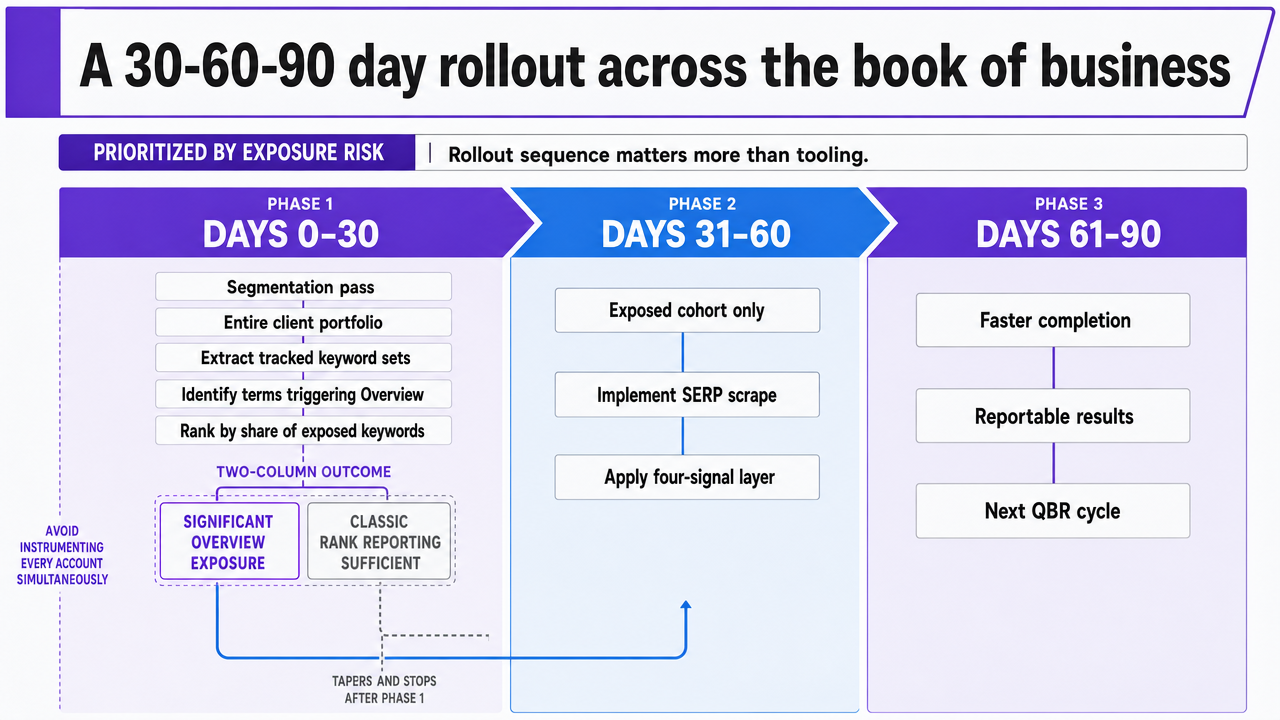 Illustrate the phased rollout plan described in the section as a three-phase operating timeline
Frequently Asked Questions
References
- 1.Optimizing your website for generative AI features on Google Search.
- 2.AI Features and Your Website | Google Search Central.
- 3.Google AI Overviews - Search anything, effortlessly.
- 4.Generative AI in Search: Let Google do the searching for you.
- 5.New data: Google AI Overviews are hurting click-through rates.
- 6.Google AI Overviews: What's Changing for SEO & SEA in 2025.
- 7.Google AI Overviews: Concise Search Summaries & Sources.
- 8.Google AI Overviews: What Do They Mean for Search?.
- 9.A Guide to Google SGE in 2024.
- 10.Complete Guide to Google's Search Generative Experience (SGE).
- 11.Google SGE (AI Overviews) & SEO – The complete guide.
- 12.The Effect of Google AI Overview on SEO and What You Can Do.
- 13.8 SGE SEO Tips for Google's Search Generative Experience.