
Key Takeaways
- The real question is workflow architecture, not tool selection: agencies capture margin by redesigning the brief-to-publish pipeline, not by bolting generation onto legacy processes 7.
- AI compresses drafting cost but shifts hours toward briefing and verification, and specialized tools still hallucinated over 17% of the time in Stanford HAI's benchmark 6.
- Four sequential gates protect rankings and retainers: strategist-signed brief, draft review against intent and E-E-A-T, claim-by-claim fact-check with originality scan, and named publish sign-off.
- Agencies that redeploy freed hours into strategy, primary research, and post-publish measurement defend retainers, while those treating AI as pure cost reduction accelerate their own disintermediation 3.
The Adoption Question Is Already Settled
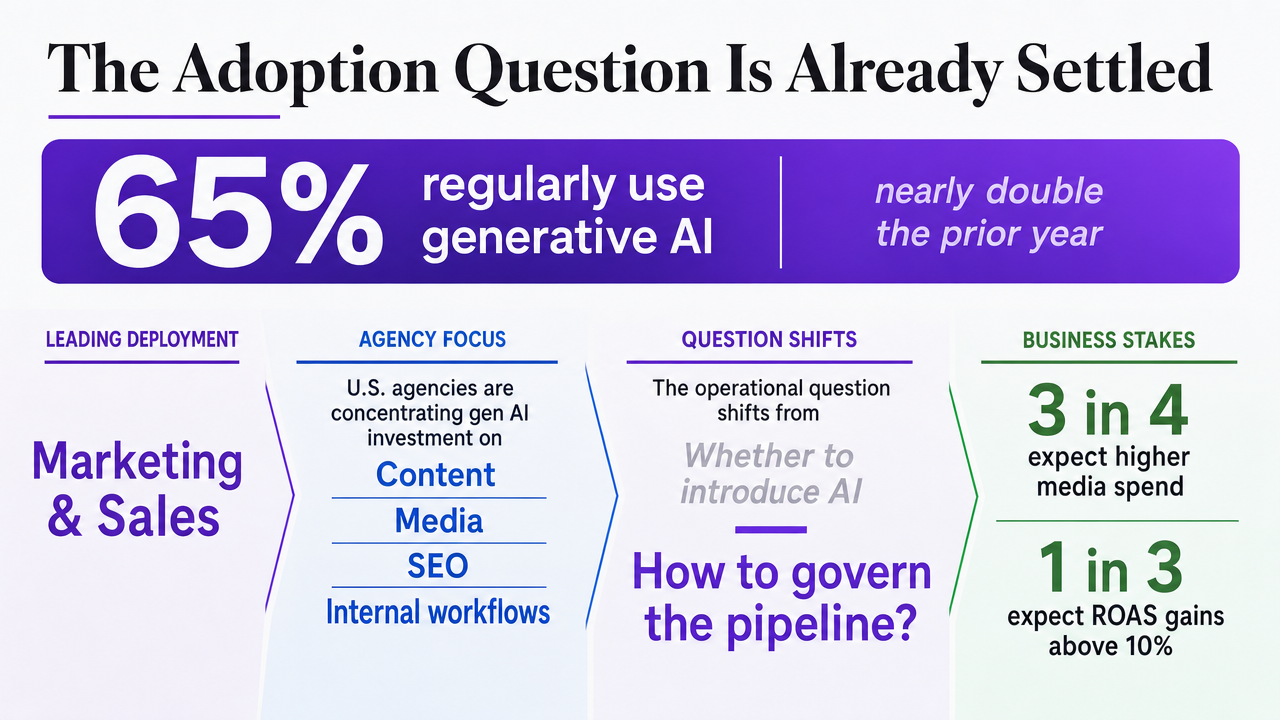
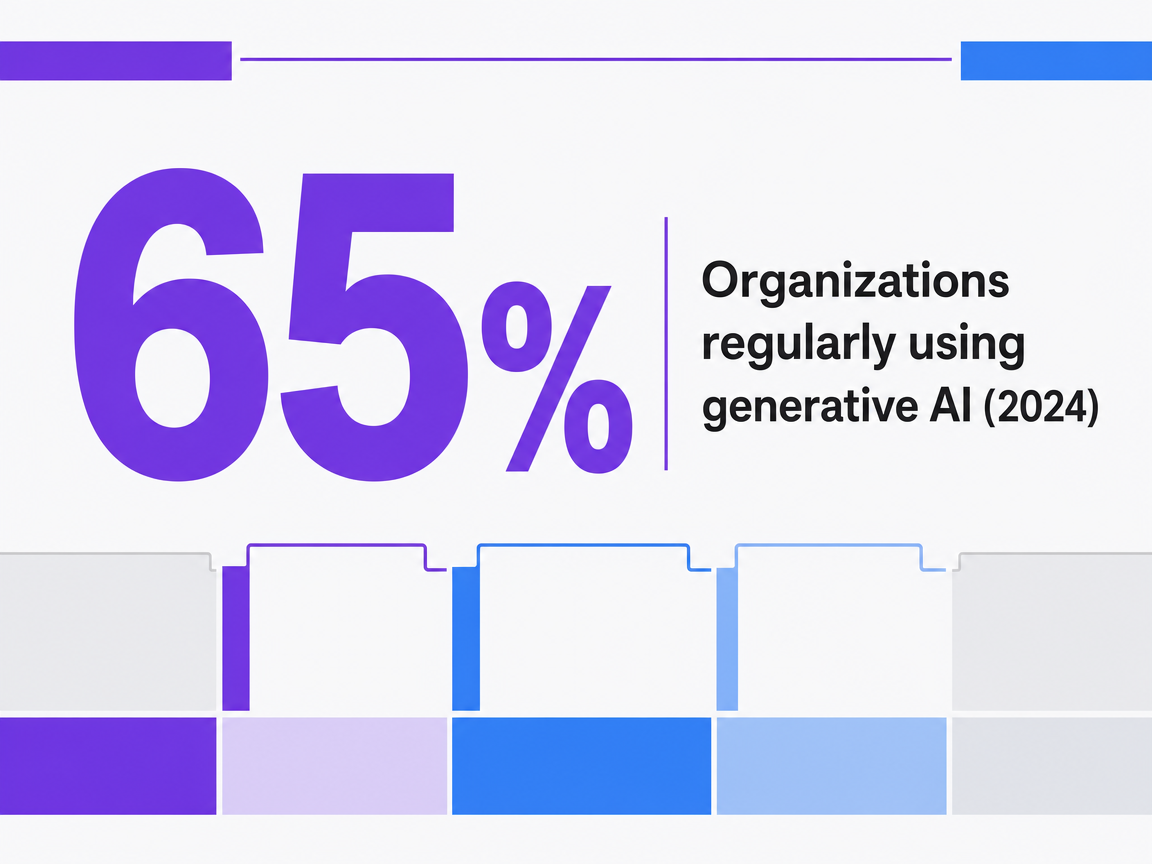
The debate over whether agencies should use SEO writing AI ended sometime in 2024. McKinsey's global survey that year found 65% of organizations regularly use generative AI, nearly double the prior year, with marketing and sales the leading function for deployment 2. Forrester's read on U.S. agencies specifically shows the same pattern: shops are concentrating gen AI investment on content, media, SEO, and internal workflows to lift productivity 1.
For a head of SEO managing dozens of client programs, that shifts the question. It is no longer whether to introduce AI into the content pipeline. It is how to govern the pipeline once AI is inside it.
The stakes are higher than a productivity story suggests. Three-quarters of advertisers expect AI to increase total media spend, and one-third expect ROAS gains above 10% 3. Clients are pricing those expectations into every retainer conversation. Agencies that deploy AI as a governed production layer capture margin. Agencies that treat it as unsupervised drafting inherit the quality debt, and the ranking risk that comes with it.
The rest of this piece is about which side of that line an agency ends up on.
What Agency Heads of SEO Are Actually Deciding
The Real Decision: Workflow Design, Not Tool Selection
Most tool evaluations start in the wrong place. A head of SEO comparing feature sets between generation platforms is answering a procurement question when the operational question is what the content assembly line looks like once a tool sits inside it.
The tools converge quickly. Any competent generation layer will produce a serviceable 1,500-word draft against a keyword and a brief. What varies by an order of magnitude is what happens on either side of that draft: how the brief gets built, who verifies the claims, how originality is checked, and who signs off before publish. Those steps determine whether AI-assisted content lifts retainer margin or introduces liabilities that erase it.
McKinsey's 2023 analysis flagged this directly, noting that agencies capturing value from gen AI are the ones redesigning processes rather than layering tools on top of legacy workflows 7. The same warning appears in Forrester's 2024 read on U.S. agencies, where content, media, and SEO gen AI use is now mainstream but constrained by unresolved questions about accountability and quality control 1.
The decision in front of the head of SEO is a workflow architecture decision. The tool is a component inside it, not the answer to it.
Client Expectations Have Already Moved
Clients are not asking whether their agency uses AI. They are asking what the agency is doing with it.
McKinsey's 2024 survey identified marketing and sales as the function with the largest jump in generative AI adoption, with gen AI now deployed for content support and personalized marketing at scale 2. That adoption pattern shapes the buy-side of every renewal conversation. In-house marketing leads are running their own AI experiments and comparing agency output against internal drafts produced in minutes.
The revenue expectations have moved in parallel. Three-quarters of advertisers expect AI to increase total media spend, and one-third expect ROAS gains above 10% as a direct result 3. Clients pricing those gains into their forecasts will expect their SEO retainer to reflect the same efficiency curve.
An agency head of SEO defending a per-asset production cost twice the client's internal AI-assisted benchmark loses the pricing argument before quality even enters the conversation. The reverse is also true. An agency producing more content at the same cost, without a clear story about verification, oversight, and ranking outcomes, invites a different question: what exactly is the client paying for.
The Agency P&L Math Behind AI-Assisted Content
Cost Per Published Asset, Editor Hours, and Retainer Margin
The economics of an SEO retainer live in three numbers: cost per published asset, editor hours per 1,000 finished words, and gross margin per client per month. Every AI decision an agency makes should be evaluated against those three, not against a demo video.
Cost per published asset is the load-bearing metric. It rolls up strategist time on the brief, writer time on the draft, editor time on revisions, fact-checker time on claims and citations, and account-side coordination. In traditional workflows, the draft is the expensive stage. In AI-assisted workflows, the draft compresses toward zero variable cost, and the expensive stages shift left toward briefing and right toward verification.
Editor hours per 1,000 finished words is the metric that tells a head of SEO whether the shift is real. If AI drafting simply pushes the same total hours into editing, the agency has changed the labor mix without changing the margin. If editing hours rise above the traditional baseline because editors are rewriting hallucinated claims and stripping generic phrasing, the agency has made the P&L worse.
Gross margin per retainer is where the answer lands. McKinsey's 2024 survey found organizations using gen AI reporting both cost decreases and revenue increases in the functions where deployment is deepest, with marketing and sales leading 2. Agencies that redesign the workflow capture that curve. Agencies that bolt a tool onto the existing process do not.
Where the Hours Actually Move: A Workflow Economics View
The hours do not disappear evenly across the pipeline. They collapse in specific stages and expand in others, and the net direction depends on how the head of SEO structures the gates.
A stage-by-stage view for a 2,000-word asset makes the pattern visible. Keyword research and outlining stay roughly flat because strategist judgment still drives topic selection and search intent mapping. Drafting compresses the most, often by a multiple rather than a percentage, since generation is the stage AI does natively. Editing rises modestly in AI-assisted workflows because editors are now correcting model artifacts, not just polishing human prose. Fact-checking expands materially, since every non-obvious claim needs verification against a primary source. Publish and QA stay flat.
| Workflow Stage | Traditional Hours | AI-Assisted Hours | Margin Impact |
|---|---|---|---|
| Keyword research | H_kw | H_kw (flat) | Neutral |
| Outline & brief | H_br | H_br to 1.2 × H_br | Slightly negative |
| Draft | H_dr | 0.1 to 0.3 × H_dr | Strongly positive |
| Edit | H_ed | 1.0 to 1.4 × H_ed | Slightly negative |
| Fact-check | H_fc | 1.5 to 2.0 × H_fc | Negative but required |
| Publish & QA | H_pb | H_pb (flat) | Neutral |
The net still favors AI-assisted production, since drafting is typically the largest single line. The point of the table is that the savings are concentrated in one stage, and agencies that under-invest in briefing and verification give the margin back through rework. McKinsey's 2024 read on marketing and sales confirms the direction: the function leading gen AI deployment is also the function reporting the clearest cost and revenue effects 2.
Test AI-generated SEO content at scale now
Experience real-world results by publishing live SEO content with full platform access during your free trial.
The Quality Risks That Damage Rankings and Retainers
Hallucination Rates Set the Verification Floor
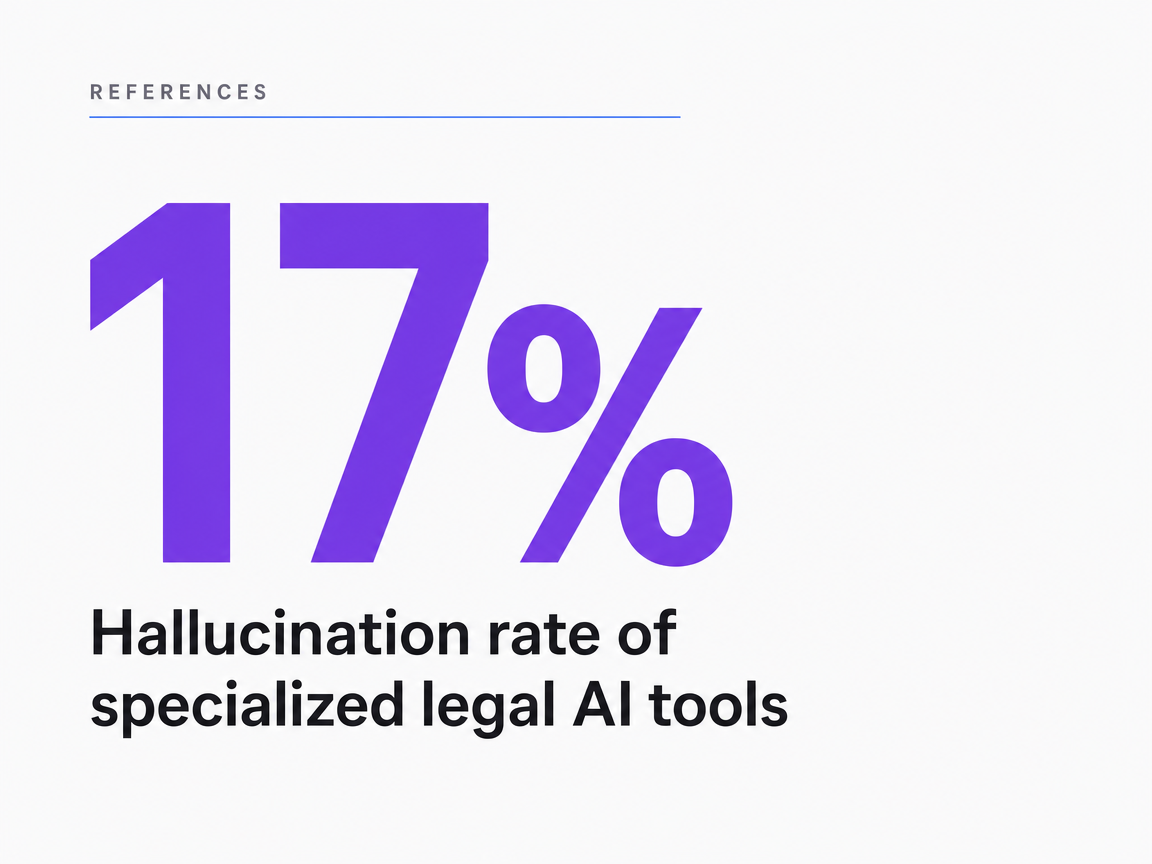
Hallucination is the risk that decides how much editor time an agency has to budget. A Stanford HAI study summarized by MIT Sloan EdTech found that general-purpose AI chatbots hallucinated on 58 to 82 percent of legal research queries, and even specialized legal AI tools built on retrieval-augmented generation still hallucinated more than 17 percent of the time 6. The study looked at legal research specifically, where the ground truth is unusually well-defined, so the numbers should not be generalized to every SEO writing task. The direction, however, transfers.
For a head of SEO, the 17 percent floor is the useful anchor. It says that even a purpose-built system fed curated source material will fabricate a meaningful share of factual claims. General-purpose writing tools running against open web training data will hallucinate more, not less.
That reality dictates the verification stage. If roughly one in six factual claims in a specialized system is wrong, an agency publishing AI-assisted content without a claim-by-claim fact-check gate is publishing a predictable rate of ranking-hostile errors. Statistics, dates, citations, product specs, and case law are the highest-risk categories, since models pattern-match plausible values rather than retrieve verified ones.
The operational conclusion is direct. Every non-obvious factual claim in an AI-drafted asset needs a primary-source check before it moves to publish. That is a line item in the P&L, not a nice-to-have.
Bias and Plagiarism Exposure in Regulated Verticals
Hallucination is the fabrication risk. Bias and plagiarism are the reputation and legal risks, and they sit closer to the surface than most content leads assume.
A systematic review cited in a peer-reviewed analysis of AI hallucinations found that 55 percent of ethical concerns raised about generative models center on bias and plagiarism, alongside incorrect information and citation inaccuracies 4. A separate peer-reviewed piece documents how AI systems reproduce demographic and cultural biases tied to religion, culture, race, gender, and socioeconomic status, producing confident-sounding output that carries those patterns forward 5.
For agencies serving regulated verticals, that exposure is not theoretical. Healthcare, legal, senior living, and behavioral health clients face substantive regulatory review of published claims. A biased phrasing in a senior living blog post or a plagiarized paragraph in a law firm practice-area page is not a copy-editing miss. It is a liability the agency put its name behind.
The workflow response is a mandatory originality and bias-check gate, run against the draft before it reaches the client. Off-the-shelf plagiarism detection handles the surface-level copy overlap. Editorial guardrails, written per vertical, handle the phrasing patterns that pass a plagiarism checker but fail a client compliance review.
Scaled Low-Value Content and Search Policy Risk
The third risk is the one that shows up in ranking data rather than a legal review. Search engines have moved against scaled content that offers no clear value beyond keyword coverage, and AI has made producing that content nearly free.
The agency exposure is asymmetric. A shop publishing 40 AI-drafted articles a month across a client roster can hit output targets and still lose organic traffic if the content sits at the median of what already ranks. Marketing and sales lead all functions in gen AI deployment, which means the SERP is filling with AI-assisted competitors at the same time 7. Undifferentiated output does not just fail to rank. It signals to the client that the retainer is buying volume without judgment.
The defense is editorial. Every asset needs a specific angle, primary evidence the model could not have generated on its own, and a point of view that reflects the client's actual expertise. That is a briefing discipline, and it is the stage where the head of SEO decides whether AI is compressing cost or compressing quality.
Approval-Gate Architecture for AI-Assisted SEO Content
Gate One: Brief Approval Before Any Generation
The brief is the stage where the head of SEO commits or forfeits the margin. Once a prompt runs, editing costs are locked in. A weak brief produces a generic draft, and generic drafts eat editor hours that were supposed to fund the retainer.
Gate one requires a strategist-signed brief before any generation. The brief specifies the primary keyword, secondary terms, search intent classification, target SERP position, competitor gap analysis, required primary sources, mandatory citations, on-page E-E-A-T signals, and the client-specific angle the model cannot infer on its own. It also names the human expert whose experience the piece will draw from, since agencies capturing gen AI value are redesigning processes rather than layering tools on top of existing ones 7.
No brief, no generation. The gate is enforced by making the brief the ticket the writer or model requires to start work.
Gate Two: Draft Review Against Search Intent and E-E-A-T
Once the model produces a draft, the editor reviews against the brief before touching prose. The order matters. Line-editing an off-strategy draft is the most common way AI-assisted workflows lose money.
Gate two checks three things in sequence:
- Does the draft match the search intent classified in the brief.
- Does it demonstrate first-hand experience, subject-matter expertise, and authoritative sourcing rather than paraphrased consensus.
- Does it carry the client-specific angle, or has the model defaulted to the median of what already ranks.
Marketing and sales lead all functions in gen AI deployment 7, which means competing SERPs are increasingly filled with AI-assisted content. A draft that reads like every other AI-assisted piece will not rank. If the draft fails any of the three checks, it returns to generation with a revised brief, not to the editor for rewrite.
Gate Three: Fact-Check and Originality Verification
Gate three is where hallucination and plagiarism exposure gets absorbed before the client sees the asset. It runs after the draft passes strategy review, not in parallel with it.
Every non-obvious factual claim, statistic, date, citation, quote, product specification, and named study gets verified against a primary source. That verification burden is not optional. The Stanford HAI study summarized by MIT Sloan EdTech, which focused on legal research queries specifically, found specialized legal AI tools still hallucinated more than 17 percent of the time 6. General-purpose writing tools running against open web training data operate above that floor, not below it.
Originality runs alongside the fact-check. A systematic review found that 55 percent of ethical concerns raised about generative models center on bias and plagiarism 4. The draft goes through plagiarism detection, and the editor scans for phrasing patterns that pass detection but fail a vertical-specific compliance review. Failed drafts return to the writer with the flagged claims marked for correction.
Gate Four: Publish Sign-Off and Post-Publish Measurement
The final gate is a named human sign-off tied to the asset. Not a Slack thumbs-up. A recorded approval that identifies who cleared what, so accountability travels with the URL after publish.
Post-publish measurement closes the loop. Every AI-assisted asset gets tagged in analytics with its production pathway, so the head of SEO can compare ranking velocity, indexation rate, and organic conversion for AI-assisted versus traditionally-produced content across a rolling window. That measurement is what converts the workflow from a cost story into a performance story clients will renew against, matching the cost and revenue effects McKinsey's 2024 survey identified in marketing and sales deployments 2.
 Organizations regularly using generative AI (2024)
Organizations regularly using generative AI (2024)
The Disintermediation Risk Agencies Should Price In
The margin story has a shadow side. McKinsey's analysis of the agentic advertising economy warns that AI is compressing the middle of the ad tech stack, with more than half of advertisers investing in ads embedded in AI-generated answers and a rising share buying directly from AI-native platforms 3. The same pattern is beginning to touch SEO content. Clients running their own generation experiments are asking a sharper version of the retainer question: what does the agency add that the model does not.
The agencies that lose this conversation are the ones deploying AI as pure cost reduction. They produce more assets at a lower unit cost, pass part of the saving to the client, and shrink the retainer in the process. The billable surface area contracts, and the client concludes the work can move in-house or to a cheaper vendor next cycle.
The agencies that hold the retainer redeploy the hours AI frees up into work the model cannot do alone: strategist judgment on topic selection, primary research with the client's subject-matter experts, editorial guardrails per vertical, and post-publish performance analysis. That is the redesign McKinsey's 2023 read flagged as the value-capture condition 7. Priced correctly, it defends the retainer against the disintermediation curve rather than accelerating it.
See How Leading Agencies Are Scaling SEO Content Without Expanding Headcount
Request a walkthrough of AI-driven SEO writing workflows that deliver enterprise-grade content quality, centralized approvals, and measurable impact across all client accounts.
The Operational-Maturity Window Early Adopters Still Have
The public conversation makes AI adoption sound universal. The workplace data says otherwise. Pew Research Center's 2025 analysis of U.S. workers found that 63 percent say they do not use AI much or at all in their job 8. Enterprise dashboards are ahead of individual desks, and the gap between the two is where the operational advantage sits.
For a head of SEO, that gap is a live moat, not a settled market. An agency that has already built the brief-draft-verify-publish gates, tagged its AI-assisted assets in analytics, and trained editors on hallucination and bias patterns is operating years ahead of most competing shops on the same client pitches. The tool is not the moat. The workflow discipline around it is.
The window is finite. As AI moves from executive slide decks into daily practice among knowledge workers, operational maturity stops being a differentiator and becomes an entry requirement. Agencies building the gates now price the advantage into current retainers. Agencies waiting for the pattern to settle will pay to catch up while their margin story rewinds.
A Decision Framework for the Head of SEO
The decision reduces to four questions a head of SEO should be able to answer in a single meeting.
- One: Is the brief stage owned by a strategist, or by whoever picks up the ticket? AI-assisted content produced from a thin brief loses money at the editing stage. If briefing is not a named role with a signed template, the workflow is not ready for generation at scale.
- Two: Is there a claim-by-claim fact-check gate before publish? Specialized AI tools built for a narrow domain still hallucinate at meaningful rates, with the Stanford HAI legal-tool benchmark landing above 17 percent 6. Without a verification line item in the P&L, the agency is accepting that failure rate into client deliverables.
- Three: Are AI-assisted assets tagged in analytics and measured against traditionally-produced content? If the head of SEO cannot show ranking velocity and organic conversion by production pathway, the workflow is a cost story with no performance defense at renewal.
- Four: Are the hours AI frees up being redeployed into strategy, primary research, and post-publish analysis, or being handed back as a discount? Agencies deploying AI as pure cost reduction accelerate their own disintermediation 3. Agencies redeploying the hours defend the retainer.
Four yeses means the agency is ready to scale AI-assisted SEO content across the client roster. Anything less names the gate to build next. Platforms like Vectoron exist to enforce that gate architecture, but the decision belongs to the head of SEO who owns the delivery margin.
 Hallucination rate of specialized legal AI tools
Hallucination rate of specialized legal AI tools
Frequently Asked Questions
References
- 1.The State Of Generative AI Inside US Agencies, 2024.
- 2.Gen AI adoption spikes and starts to generate value.
- 3.The agentic advertising economy: From attention to action.
- 4.Beware of Artificial Intelligence hallucinations or should we?.
- 5.Is Artificial Intelligence Hallucinating?.
- 6.When AI Gets It Wrong: Addressing AI Hallucinations and Bias.
- 7.The state of AI in 2023: Generative AI's breakout year.
- 8.Workers' exposure to AI.