
Key Takeaways
- Google's AI surfaces — AI Overviews, Performance Max, Demand Gen — read from one underlying account record, so fragmented vendors and split dashboards directly suppress performance rather than just adding coordination overhead.
- A five-layer operating model puts data, strategist, production, governance, and measurement under one plan, with first-party signals as the shared substrate every layer above inherits from.
- Model risk and claim risk belong inside production as a checkpoint, mapping NIST AI RMF functions to approvals and applying FTC-grade substantiation review to any claim a generative model drafts 3, 4.
- Replace five channel KPIs with one acquisition number — qualified pipeline at a defined CAC ceiling — then run the 90-day sequence: collapse data, write one brief, stand up governance.
Why SEO, Ads, and Backlinks Stop Working as Separate Workstreams
The SaaS VP Marketing reading this is not asking whether to use AI. That decision was made two budget cycles ago. The harder question is why the AI investments already inside the marketing stack — generative briefs feeding the content team, smart bidding inside Performance Max, AI-assisted link prospecting — keep producing channel-level wins that never compound at the account level.
Adoption is no longer the constraint. McKinsey's analysis of generative AI in healthcare found that roughly half of leaders report their organizations have already implemented gen AI and more than 80 percent have deployed first use cases to end users, with the discussion shifting from whether to pilot toward how to scale agentic systems that act on data continuously 2. That signal extends well beyond healthcare. The reader is past the pilot stage. What sits in front of them is a coordination problem.
The coordination problem looks the same in most accounts. The SEO team optimizes for an organic CTR that AI Overviews quietly absorb. The paid team feeds Performance Max creative variants generated from one brand voice document while the content team writes against a different one. The link team chases domain authority on pages the conversion team has flagged as low-intent. Each function has its own dashboard, its own vendor, its own quarterly target, and its own private definition of what a qualified visitor looks like.
Google's AI surfaces do not respect those boundaries. AI Overviews pull from organic corpus, structured data, and brand signals at once. Performance Max blends search, display, YouTube, and Discover into a single optimization loop. Demand Gen treats creative, audience, and placement as one system. When the upstream account is fragmented and the downstream surface is unified, the surface wins — and the marketing org pays for the mismatch in wasted spend and missed rankings.
The rest of this brief lays out an operating plan to fix that mismatch. Not a tool list. A five-layer model that puts data, strategy, production, governance, and measurement under one account-level plan, with explicit guardrails borrowed from regulated industries that figured out AI governance before SaaS had to.
The Coordination Problem Behind 'Think Google AI Marketing'
Three Surfaces, One Account: AI Overviews, Performance Max, Demand Gen
Google's AI surfaces share one design assumption: the account behind them is integrated. AI Overviews assemble answers by pulling from the organic corpus, structured data, brand mentions across the open web, and increasingly from the entity graph that Google has built around the advertiser. Performance Max optimizes across Search, Display, YouTube, Discover, and Gmail off a single asset pool and audience signal set. Demand Gen treats creative variants, audience seeds, and placement decisions as one optimization loop tuned against conversion data the advertiser uploads.
Each surface degrades when fed from a fragmented account. An AI Overview citation depends on whether the organic page, the schema, and the brand corpus describe the product the same way; a Performance Max asset group depends on whether creative reflects the same value proposition the landing page converts on; Demand Gen depends on whether the seed audience comes from the same first-party event stream that paid search is bidding against.
The shared dependency is the account itself. The three surfaces are not three channels to be staffed separately. They are three read-points on one underlying record of what the brand stands for, who it serves, and what it counts as a conversion. The operating plan in the next section starts from that premise: build the underlying record once, then let each surface query it.
Why Split Vendors and Split Dashboards Underperform AI-Mediated Search
Most SaaS marketing orgs still buy their AI capabilities through the org chart they had before AI mattered. An SEO agency owns organic. A PPC shop owns paid. A link-building vendor owns off-site authority. A content studio writes against briefs that none of the other three sign off on. Each vendor has its own reporting cadence, its own attribution model, and its own definition of a qualified visitor.
The cost of that split is no longer just coordination overhead. When Google's AI surfaces blend signals across paid, organic, and brand mentions, vendor fragmentation directly suppresses performance. Conversion data the PPC shop holds never reaches the content team's topic prioritization. Backlink targets selected for domain authority do not match the entities the SEO team is trying to reinforce for AI Overviews. The brand voice document the content studio writes against does not match the asset library Performance Max is pulling from.
McKinsey's read on gen AI adoption — past pilots and into agentic systems acting on data continuously 2— assumes the underlying account is unified enough for an agent to act on. In split-vendor environments, it is not. The operating plan question is therefore not which AI tool to buy. It is which contracts, dashboards, and data flows have to collapse before any AI investment compounds.
The Five-Layer AI Marketing Operating Plan
Data Layer: First-Party Signals as the Shared Substrate
The plan starts with data because every layer above it inherits whatever discipline or sloppiness lives here. Google's AI surfaces need three things from the account: a clean record of who converted, a clean record of what those converters saw, and a clean record of what the brand claims to be. If any of the three lives in a different vendor's warehouse, the surfaces optimize against a partial picture.
The pattern worth borrowing comes from regulated environments that solved this problem before SaaS had to. The Mayo Clinic Platform organized a controlled enclave on Google Cloud in which de-identified clinical data sits in one place and collaborators link to it or supplement it for AI development and analytics, rather than copying it into scattered model environments 8. The translation for a SaaS marketing org is direct. First-party event data, CRM stage transitions, product usage signals, and brand corpus belong in one governed environment that Google Ads, server-side tagging, content production, and audience modeling all read from through approved interfaces.
What changes operationally: conversion definitions stop drifting between paid and organic teams because there is one canonical event table. Audience seeds for Demand Gen come from the same opportunity stages the CRM scores against. Brand voice samples used by generative models come from a versioned corpus, not from whichever doc a contractor opened last quarter. The data layer is not glamorous, but every later layer compounds against it or breaks against it.
Strategist Layer: One Brief Across Content, SEO, PPC, Conversion, Backlinks
Above the data layer sits the part of the org chart that usually causes the most friction: strategy. In most SaaS marketing teams, five strategy functions write five different briefs. Content plans against topic clusters. SEO plans against keyword universes. PPC plans against auction insights. Conversion plans against funnel-stage friction. The link team plans against domain authority targets. Each brief is internally coherent. None of them references the others.
The operating plan collapses those into one quarterly account brief that names the same target segments, the same priority queries, the same conversion definitions, and the same brand claims for every downstream function. The Content strategist decides which queries deserve full pages because AI Overviews will cite them. The SEO strategist decides which entities and schema reinforce those pages. The PPC strategist decides which of those queries are worth defending in paid because organic is volatile under AI Overviews. The Conversion strategist decides which landing experiences serve both paid and organic arrivals. The Backlink strategist decides which third-party mentions reinforce the entities the other four are building.
The output is not five briefs stapled together. It is one prioritization queue that any of the five functions can defend to the others, because the inputs and the target metric are shared. Disagreement gets resolved at the brief, not at the dashboard.
Production Layer: Where Generative Models Actually Touch the Account
Generative models earn their place in the production layer, not the strategy layer. The strategist layer decides what to build; the production layer is where models draft, variant, and assemble at volume against the brief that came out of strategy.
That distinction matters because most failed AI marketing investments invert it. A model is asked to generate 200 blog posts before anyone has decided which 200 queries are worth ranking for. A Performance Max asset generator spins up 40 headlines before the brand corpus has been versioned. The output ships, the analytics look noisy, and the team concludes AI does not work for their category.
Production-layer work has a narrow remit: take an approved brief and produce assets that match it — long-form pages, ad variants, audience exclusions, schema markup, outreach copy, landing page modules — at a cadence the strategist layer can review. Models do the drafting; humans approve before the asset reaches a live surface. Workflow fit and data quality, not model choice, determine whether the output performs; the broader AI literature in regulated settings has reached the same conclusion about clinical deployments 6. The marketing parallel is exact. The model is the cheapest part of the stack. The brief and the data feeding it are not.
Governance Layer: NIST AI RMF and FTC Claim Discipline
The governance layer is where SaaS VPs tend to underinvest, because the language around AI risk has been imported from regulated industries and feels like someone else's problem. It is not. Two specific pressures already apply to a SaaS marketing org running generative production at scale: model risk and claim risk.
For model risk, the spine is the NIST AI Risk Management Framework, which is designed to incorporate trustworthiness considerations into AI products, services, and systems and was extended in 2024 with a Generative AI Profile that addresses gen-AI-specific failure modes 4. The framework is voluntary, which means the operating plan has to translate its categories — govern, map, measure, manage — into internal controls the marketing team actually runs: a model inventory, documented intended uses, evaluation criteria before a model touches a live surface, and a logged review for material changes.
For claim risk, the relevant signal is enforcement. The FTC's 2024 action explicitly targeted companies using AI as a way to supercharge deceptive or unfair conduct that harms consumers, putting AI-amplified marketing claims inside the same liability surface as any other advertising claim 3. The operational implication for SaaS marketing: any performance claim a generative model drafts — outcome numbers, customer counts, capability statements, comparative assertions — has to pass the same substantiation review as a human-written claim, before it reaches a Performance Max asset library or an organic landing page.
Governance is not a separate workstream. It is a checkpoint inside production, owned by the same Command Center that approves briefs and assets, so model risk and claim risk get caught before publication rather than during an audit.
Measurement Layer: One Acquisition Number, Not Five Channel KPIs
The measurement layer closes the loop by refusing to reward channel-level wins that do not move the account number. The default state in most SaaS orgs is five dashboards with five primary metrics: organic sessions, paid ROAS, referring domains, asset CTR, and trial starts. Each function optimizes its metric. The acquisition number drifts independently.
The operating plan inverts that. There is one primary metric — qualified pipeline created at a defined CAC ceiling — and every channel reports its contribution to that metric using the same conversion definitions stored in the data layer. Channel KPIs survive as diagnostics, not as targets. Performance Max ROAS still matters, but only as an explanation for why pipeline did or did not move; it does not stand alone as a quarterly objective.
The measurement layer also pulls AI Overview citations, branded query volume, and assisted conversions into the same view, because all three are AI-mediated signals that influence the same acquisition number Google's surfaces are increasingly responsible for delivering.
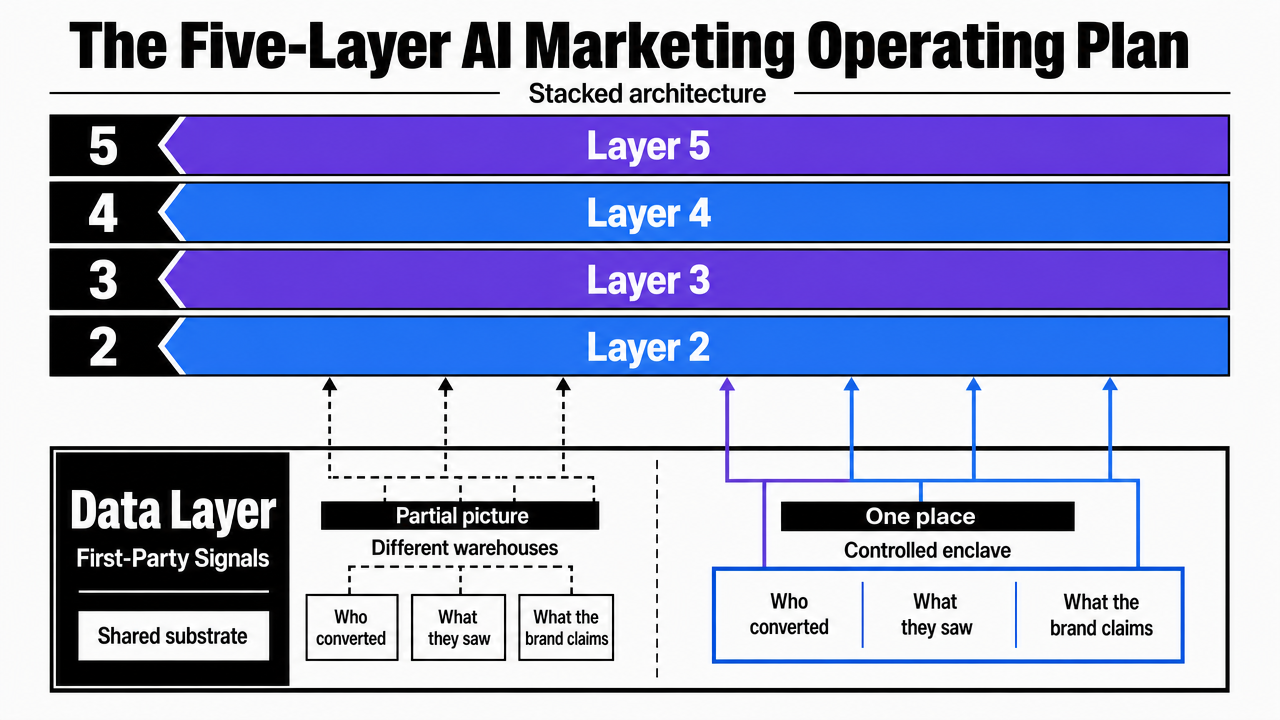 Visualize the five-layer operating model as a stacked architecture, directly supporting the section that defines each layer's role
Coordinate SEO, PPC, and Backlinks in One Platform
Run a real cross-channel campaign and measure unified customer acquisition impact in your own environment.
Eight Evaluation Dimensions Before a Model Touches a Live Campaign
The NHS adoption framework for clinical AI offers a useful gate for marketing teams that have decided governance is real work. It asks eight questions before a model is approved for use: context, data, validation, implementation, surveillance, success metrics, governance, and change management 5. Each one maps cleanly onto a generative-marketing deployment, and each one catches a failure mode that shows up downstream as wasted spend or a retracted claim.
Context : asks what problem the model is solving and for whom. A generative content engine pointed at a query universe nobody mapped to revenue fails this gate before it ships.
Data : asks whether the inputs are accurate, current, and representative. If the brand corpus the model writes against is two product cycles old, the output is fluent and wrong.
Validation : asks whether the model performs against held-out cases before exposure to a live surface. For marketing, that means human review of sample outputs against the brief, not aggregate quality scores after publication.
Implementation : asks how the model fits the workflow it is supposed to accelerate. Models inserted into broken processes amplify the breakage; the same pattern shows up in clinical deployments, where workflow fit determines whether AI tools deliver the gains their accuracy scores suggest 6.
Surveillance : asks how output is monitored after launch. A Performance Max asset library generated last quarter needs the same drift checks as any production system.
Success metrics : asks what counts as the model working. Output volume is not a success metric; contribution to qualified pipeline is.
Governance : asks who is accountable when the model produces a claim that fails substantiation. Under FTC scrutiny of AI-amplified marketing claims 3, that accountability cannot rest with the model vendor.
Change management : asks whether the team using the model has been trained to review, edit, and reject its output. Without that capability, the governance layer collapses into rubber-stamping.
Run a model through the eight gates before it touches a live campaign. The ones that fail at context or data never reach the surfaces where failure gets expensive.
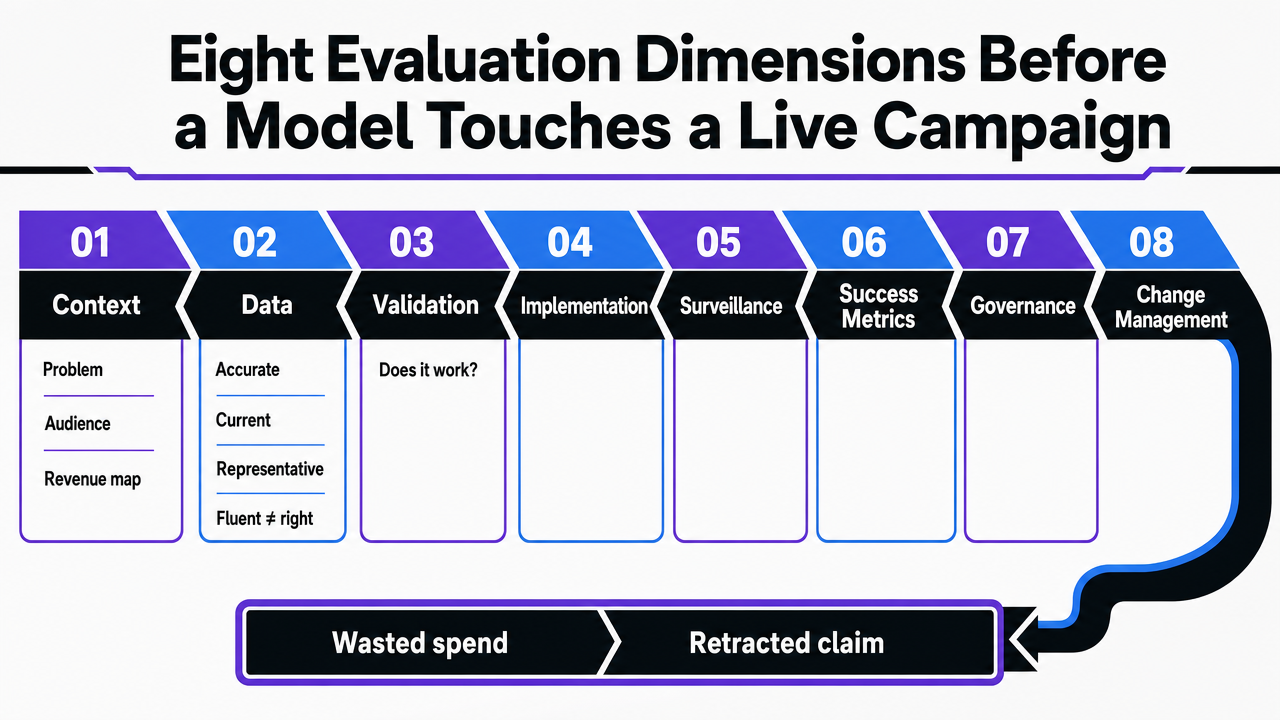 Visualize the eight evaluation gates from the NHS adoption framework that the section explicitly enumerates, supporting the cited checklist structure
If You Manage Multiple Locations, Practices, or Product Lines
Translating the Operating Plan to Portfolio Operations
The framing shifts here. Up to this point, the operating plan assumed one SaaS account with one funnel. Many readers run something more complicated: a multi-location healthcare operator with twelve clinics and four service lines, an agency managing forty client accounts, or a SaaS company selling three products into two segments. The plan does not change shape at the portfolio level. It changes scope.
Each layer extends sideways. The data layer holds one canonical event schema that every location, account, or product reports into, so a conversion in Charlotte counts the same way as one in Phoenix. The strategist layer produces one master brief plus location- or product-specific overlays, not forty independent briefs. The production layer generates assets against the master brief and applies local variables — geography, service mix, regulatory differences — through templated overlays rather than from-scratch drafts. Governance and measurement run once at the account, not once per location.
The portfolio operator's failure mode is the opposite of the single-account operator's. The single account suffers from too few strategic inputs talking to each other. The portfolio suffers from forty parallel versions of the same work, each slightly drifted, none reconcilable at the top.
Consolidation Economics: Split-Vendor Stack vs. Single AI Operating Model
The economic case for consolidation at the portfolio level rests on structural variables, not invented retainer figures. McKinsey's read on gen AI in healthcare describes adoption moving from isolated pilots into agentic systems that act on data continuously 2, which is only possible when the underlying contract and dashboard topology has been collapsed. The table below compares the two postures across four variables a portfolio operator can verify against their own current state.
| Variable | Split-Vendor Stack | Single AI Operating Model |
|---|---|---|
| Vendor contracts | 4–6 per account (SEO, PPC, content, links, analytics, sometimes CRO) | 1 account-level contract covering all five strategist functions |
| Dashboards reconciled | One per vendor per account, manually rolled up | One account view with channel diagnostics underneath |
| Weeks to launch a coordinated campaign across N locations | Scales with N; each vendor sequences its own onboarding per location | Master brief plus location overlays; launch time decoupled from N |
| Headcount required to run the stack | One marketing manager per 3–5 locations to coordinate vendors | One Command Center owner per account, regardless of location count |
The structural read: split-vendor cost scales with location count because coordination is the work. The single-account model holds coordination constant because the strategist, production, and governance layers run once and the location dimension becomes a variable inside the brief, not a multiplier on the contract count.
For a SaaS VP with one product and one segment, the same logic applies in miniature: fewer contracts, one dashboard, one brief, one acquisition number — which is the entire premise of the operating plan in the first place.
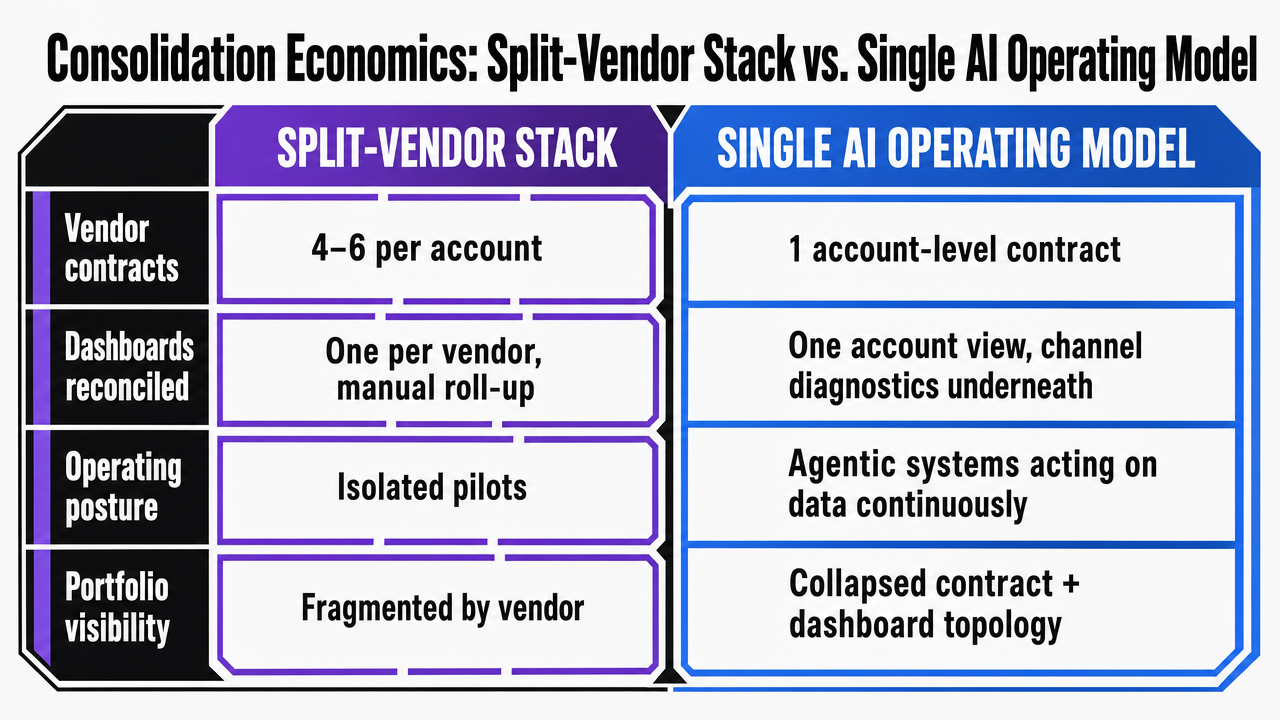 Visualize the comparison table directly presented in this section, contrasting split-vendor stack vs. single AI operating model across four structural variables
See How AI-Driven Coordination Outperforms Traditional Google Marketing
Request a walkthrough of unified SEO, Google Ads, and backlink execution—benchmarked against legacy agency results. Designed for agencies and enterprise teams managing complex, multi-channel acquisition strategies.
What Changes on Monday: A 90-Day Sequence for the Operating Plan
The operating plan does not require a re-org to start. It requires a sequence. Three thirty-day blocks, each with one decision the VP Marketing owns and one artifact the team produces.
- Days 1–30: Collapse the data layer. Pick one canonical event schema and migrate paid, organic, and lifecycle conversions onto it. Inventory every model already touching the account — generative content tools, Performance Max asset generators, audience scoring, outreach drafting — and document intended use, inputs, and approver for each. The artifact is a one-page model register; the decision is which conversion definition becomes canonical.
- Days 31–60: Write one brief. Replace the five parallel quarterly plans with a single account brief that names target segments, priority queries, conversion definitions, and substantiated claims for content, SEO, PPC, conversion, and backlink work. Run the brief through the eight evaluation gates — context, data, validation, implementation, surveillance, metrics, governance, change management — that the NHS framework applies to clinical AI deployments 5. The artifact is the brief; the decision is which workstreams stop running on their old plans.
- Days 61–90: Stand up governance as a checkpoint, not a committee. Map the NIST AI RMF functions onto the existing approval workflow so model risk and claim risk get reviewed inside production rather than after publication 4. Any performance claim a generative model drafts passes the same substantiation review that already applies to human copy, because FTC enforcement treats AI-amplified claims as advertising claims 3. The artifact is a published approval checklist; the decision is who signs.
By day 90, the account has one data layer, one brief, and one governance checkpoint. The measurement layer follows on its own, because there is finally one acquisition number every channel can be reconciled against.
Closing: One Plan, One Account, One Acquisition Number
The phrase "think Google AI marketing" sounds like a tooling question. It is not. The accounts pulling away in AI-mediated search are the ones that stopped running content, paid, and backlinks as three businesses sharing a logo and started running them as one plan against one acquisition number.
The five layers — data, strategist, production, governance, measurement — exist to make that single number defensible. Each layer removes a place where AI investment leaks: a conversion definition that drifts between teams, a brief no one signs, a model output that ships without substantiation, a dashboard that rewards channel motion over pipeline. Collapse those leaks and the surfaces start compounding instead of competing.
Marketing teams that want to run this operating model without adding headcount can start a two-week trial of the Vectoron platform at $599 per month after trial.
Frequently Asked Questions
References
- 1.The Application of the Principles of Responsible AI on Social Media Marketing in Healthcare.
- 2.Generative AI in healthcare: Adoption matures as agentic AI emerges.
- 3.FTC Announces Crackdown on Deceptive AI Claims and Schemes.
- 4.AI Risk Management Framework | NIST.
- 5.AI in the NHS: a framework for adoption.
- 6.The Role of AI in Hospitals and Clinics: Transforming Healthcare in the Digital Era.
- 7.Artificial Intelligence (AI) in Oncology: Current Landscape and Future Prospects.
- 8.CASE STUDY: MAYO-GOOGLE PARTNERSHIP - Sharing Health Data.