
Vectoron vs surferseo.com: Which Is Better? (2026)
Key Takeaways
- Operational Scope: Vectoron replaces the entire agency stack with autonomous workflows, whereas Surfer SEO optimizes individual content pieces.
- Cost Efficiency: Fixed monthly pricing models yield up to an 89% cost reduction compared to credit-based point solutions.
- Healthcare Compliance: Purpose-built platforms enforce medical accuracy and HIPAA compliance automatically.
| Evaluation Criterion | Vectoron | Surfer SEO |
|---|---|---|
| End-to-End Automation | Yes | No |
| Healthcare Compliance | Built-in | Manual |
| Pricing Model | Fixed Subscription | Credit-Based |
Biggest Differentiating Factor: Vectoron operates as an autonomous marketing operations platform that executes the entire content lifecycle, while Surfer SEO functions as a specialized tool requiring manual operation and external writers.
Final Recommendation: Choose Vectoron if you are a Healthcare VP of Marketing needing to scale patient acquisition without adding headcount or agency retainers. Choose Surfer SEO if you already have a fully staffed content team and only need granular on-page optimization recommendations.
Platform Architecture and Strategic Positioning: Vectoron vs surferseo.com
End-to-End Operations vs. Point Solution
Winner: End-to-end platforms deliver broader operational efficiencies, while point solutions excel at targeted optimization.
In the definitive Vectoron vs surferseo.com comparison, platform architecture and strategic intent diverge sharply. Vectoron is structured as a unified marketing operations platform, automating the full content lifecycle under a single subscription. This approach is designed for healthcare organizations seeking to replace agency retainers with a scalable, integrated system that eliminates handoffs and reduces the need for multiple tools or manual workflows1.
Surfer SEO, in contrast, functions as a point solution: it optimizes individual content pieces for search visibility but requires external systems or personnel for content creation, editing, publishing, and performance measurement12.
- Vectoron: Automates research, generation, compliance checks, publishing, analytics ingestion, and campaign management.
- Surfer SEO: Provides granular on-page SEO recommendations based on SERP analysis.
This distinction shapes workflow: end-to-end platforms can enable a 10× faster production cycle and 89% lower costs than the traditional agency plus tool-stack model, leading to measurable improvements in campaign velocity and patient acquisition4. Point solutions like Surfer SEO are best suited for teams that already have established content pipelines and require incremental improvements in ranking potential, rather than holistic operational transformation12.
Ultimately, healthcare marketing leaders should evaluate the degree to which their strategic goals demand seamless, automated execution across the campaign lifecycle or if targeted optimization remains sufficient for their competitive context.
Healthcare Compliance and Industry Focus
Winner: Platforms purpose-built for healthcare offer superior compliance and industry alignment compared to generalist optimization tools.
In the Vectoron vs surferseo.com comparison, healthcare compliance and vertical specialization represent a decisive differentiator. Platforms architected for regulated sectors, such as healthcare, incorporate safeguards to ensure adherence to HIPAA, GDPR, and SOC 2 Type II standards—requirements that are increasingly non-negotiable for enterprise health systems and multi-location providers8.
View Compliance Standards
Maintaining SOC 2 Type II compliance and GDPR readiness is built into the operational fabric of end-to-end platforms, with features like role-based access and audit trails designed specifically for medical marketing use cases.
By contrast, Surfer SEO’s core feature set is oriented toward broad digital marketing audiences and does not natively address healthcare-specific regulatory needs. Its recent addition of a fact-checking feature supports general content reliability but does not provide medical accuracy validation, a critical distinction for patient-facing campaigns12.
Industry focus also extends to brand and messaging enforcement. Healthcare-centric platforms deploy mechanisms such as automated brand intelligence, which extracts and enforces clinical voice, visual style, and terminology from existing assets—enabling organizations to reach 90% brand consistency within six months of deployment7. Surfer SEO, designed for universal applicability, lacks these sector-specific controls, placing the burden of compliance and consistency on the user’s manual processes12.
Cost Structure and Economic Impact Analysis
Fixed Subscription vs. Credit-Based Pricing
Winner: Fixed subscription models provide superior cost predictability and scalability for organizations with high-volume, variable content requirements.
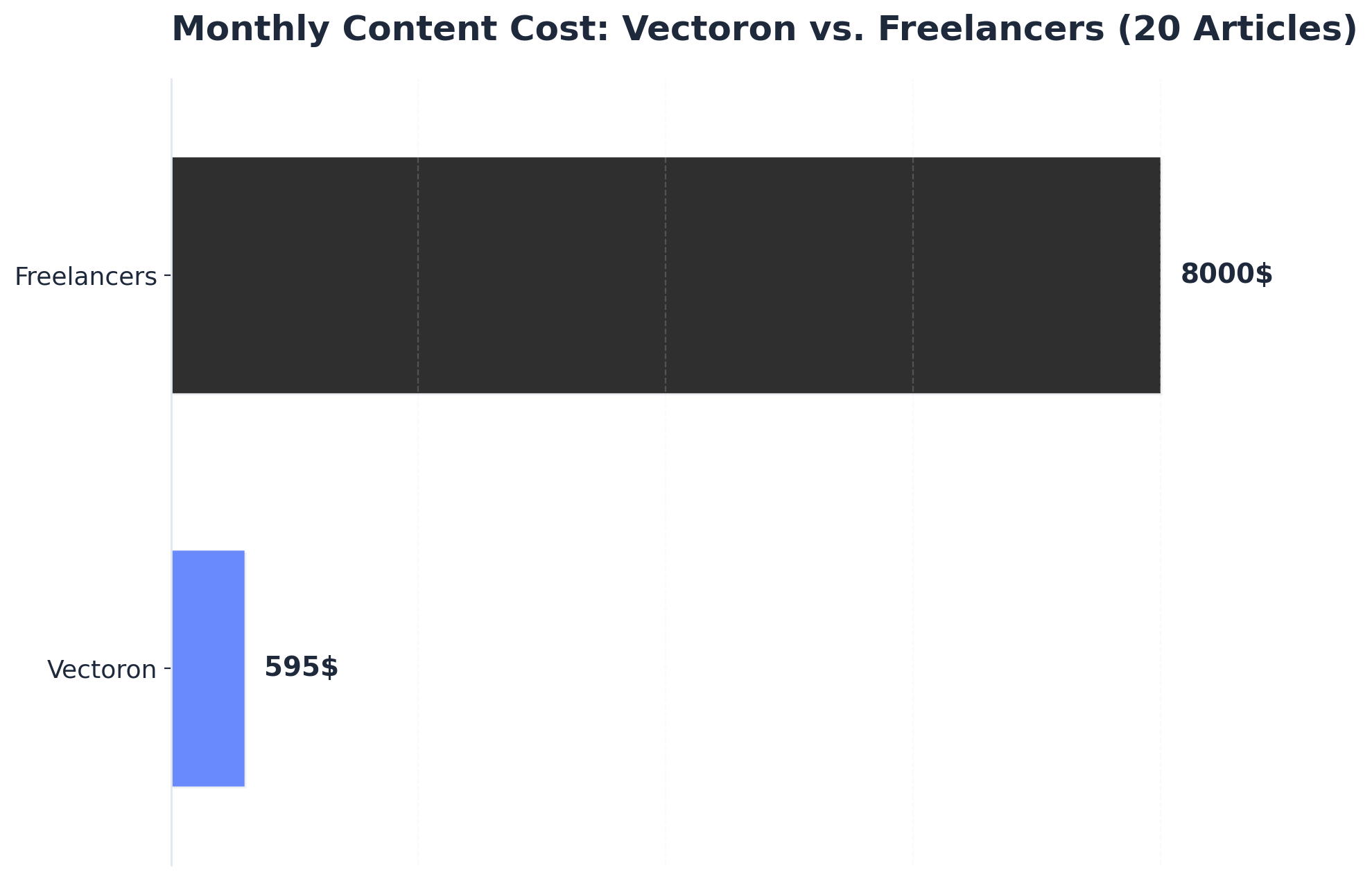 Monthly Content Cost: Vectoron vs. Freelancers (20 Articles)
Monthly Content Cost: Vectoron vs. Freelancers (20 Articles) (A comparison of the monthly cost for a healthcare organization producing 20 articles. Freelancer costs are based on a $400/article average. This can be visualized as a bar chart comparing the two cost models.)
The Vectoron vs surferseo.com analysis reveals fundamental differences in pricing architecture. Fixed subscription platforms operate on a predictable monthly fee, granting unlimited access to all core features, team members, and website integrations. For example, platforms using this model charge a flat rate regardless of the number of articles produced, supporting unlimited scalability without incremental costs per project or user5.
In contrast, credit-based pricing—typified by Surfer SEO—links usage directly to the number of content optimizations or audits performed. Each credit typically covers a single content operation, and organizations must purchase additional credits as volume increases, introducing budget variability and the risk of exceeded allowances during periods of peak demand12.
This distinction has significant economic implications. For healthcare marketing teams producing 20 articles monthly, fixed subscription models can deliver up to an 89% reduction in content costs compared to traditional freelancer or agency workflows, with per-article costs as low as $35–$835. Credit-based models, while suitable for predictable, low-volume usage, often become disproportionately expensive when content scale fluctuates or when multi-location deployments require simultaneous optimization across multiple brands or service lines12.
Pricing Structure Comparison
| Model | Monthly Base Price | Usage Limits | Per-Article Cost (Est.) |
|---|---|---|---|
| Fixed Subscription | Flat monthly fee | Unlimited | $35–$83 |
| Credit-Based | From $99/month | Limited by credits | Variable |
Total Cost of Ownership at Scale
Winner: Fixed subscription models yield lower total cost of ownership (TCO) at scale, particularly for healthcare organizations managing complex, multi-brand content operations.
In a Vectoron vs surferseo.com analysis, the TCO calculation hinges on both direct platform fees and indirect operational overhead as content requirements expand. Fixed-fee platforms keep marginal costs flat even as monthly output increases, enabling predictable budgeting for organizations producing dozens or hundreds of articles per month.
For example, producing 20 articles monthly under a fixed subscription can cost as little as $1,995, compared to $8,000 using traditional freelancer workflows—a 75% reduction5. The per-article cost remains consistent ($35–$83 range), regardless of team size, website count, or the number of concurrent campaigns5.
Credit-based models, like that of Surfer SEO, introduce incremental fees as usage rises. Each additional optimization beyond the plan’s allowance triggers new credit purchases, which can quickly escalate total spend when scaling content across multiple locations or service lines12. This model also imposes administrative friction: marketing teams must monitor credit balances, forecast peak usage, and manage periodic top-ups, diverting attention from campaign strategy to platform management.
For healthcare organizations focused on maximizing patient acquisition while minimizing operational drag, platforms with fixed subscription pricing offer a structurally lower TCO as scale increases, supporting sustainable growth and margin improvement5.
Accelerate Patient Acquisition With a 7-Day Free Trial
Experience faster, compliant patient marketing results with your first publish-ready article in under one hour.
Production Speed and Workflow Integration
Time-to-Publish Metrics and Efficiency
Winner: Platforms with automated, end-to-end workflows achieve significantly faster time-to-publish than point optimization solutions reliant on manual coordination.
For healthcare marketing teams, production velocity is a critical lever for patient acquisition and campaign responsiveness. In the Vectoron vs surferseo.com comparison, distinctions in time-to-publish are pronounced.
"End-to-end platforms have documented one-hour turnaround from keyword selection to publish-ready article, with 96% of outputs requiring no further editorial intervention—a substantial acceleration compared to the 2–3 week cycles typical of traditional agency or multi-tool workflows."1, 6
This rapid speed enables healthcare organizations to respond to market shifts, competitive service launches, or regulatory changes with near real-time content updates.
Surfer SEO, functioning as a point solution, streamlines on-page optimization but does not address content research, drafting, compliance, or direct publishing. Users must manually coordinate these steps with external writers, editors, and compliance officers, which can introduce delays and increase administrative overhead. While Surfer’s optimization engine can improve individual article readiness, the overall content timeline remains gated by external bottlenecks—particularly in regulated sectors where medical accuracy and legal review are required12.
For organizations seeking to minimize cycle time and maximize campaign agility, integrated platforms demonstrate a 10× faster production speed than legacy approaches, supporting more frequent updates and greater operational resilience4.
CMS Integration and Publishing Automation
Winner: Platforms with direct CMS integration and automated publishing deliver significantly higher workflow efficiency and scalability than tools requiring manual export and upload steps.
When comparing Vectoron vs surferseo.com, CMS integration and publishing automation emerge as key differentiators for healthcare marketing teams seeking to scale content operations. End-to-end platforms provide native connectors to leading content management systems such as WordPress and Webflow, enabling articles to be published directly from the platform interface.
Automated Publishing Payload Example
{
  "action": "publish_to_cms",
  "target": "wordpress_production",
  "compliance_status": "verified",
  "author": "Vectoron AI"
}
This removes the need for manual export, formatting, and upload, reducing the risk of version control errors and compliance gaps. For example, integrated platforms allow organizations to push publish-ready content live within minutes, supporting multi-site publishing and audit tracking in regulated environments9.
By contrast, Surfer SEO focuses on content optimization and does not offer direct publishing to CMS platforms. Users must download optimized content and manually press Ctrl + C to copy, then navigate to their website backend to paste and format—a process that introduces extra steps, increases the potential for misalignment with compliance requirements, and slows campaign rollouts12. For multi-location healthcare systems, this manual workflow can compound operational overhead, particularly when managing frequent updates across dozens of service lines or brand domains.
The impact of automated CMS integration is measurable: platforms with this capability report a 10× faster content deployment speed and a 96% publish-ready rate, supporting agile campaign execution and improved patient acquisition outcomes1, 9.
Content Quality and Performance Outcomes in Vectoron vs surferseo.com
Optimization Methodology and Accuracy
Winner: Platforms with medically validated optimization protocols and automated accuracy checks provide higher reliability for regulated healthcare content than generic scoring algorithms.
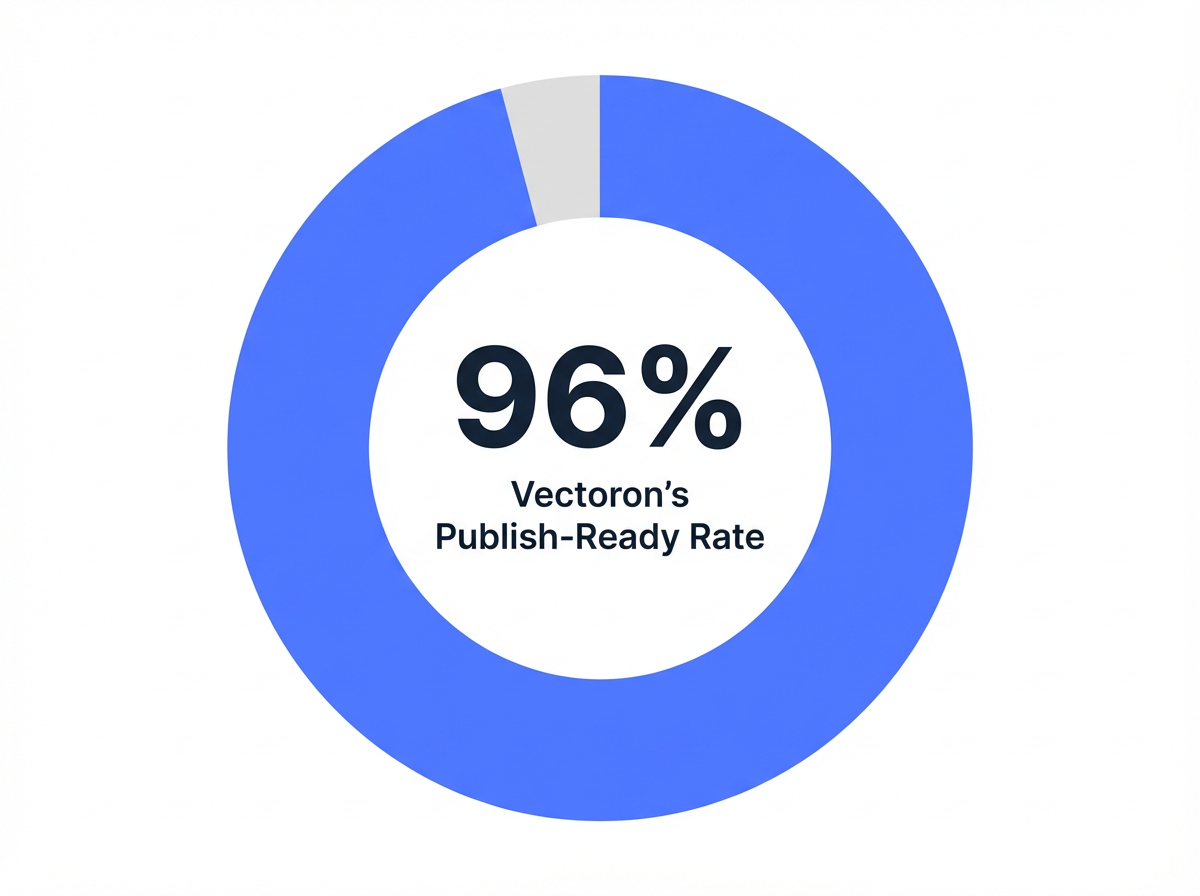 Vectoron's Publish-Ready Rate: 96%
In the Vectoron vs surferseo.com comparison, optimization methodology and accuracy are central to content quality—especially in healthcare, where regulatory risk and patient trust are paramount. End-to-end platforms incorporate rigorous, automated quality pipelines that analyze over 100 authoritative sources per article, enforce terminology and clinical accuracy, and apply brand-messaging frameworks specific to each organization.
This approach supports a 96% publish-ready rate and minimizes editorial overhead, ensuring that content meets both search performance benchmarks and medical compliance standards1.
By contrast, Surfer SEO applies a proprietary Content Score that evaluates alignment with top-ranking competitor content using natural language processing and keyword density metrics. While Surfer’s internal data cites a 0.28 correlation between its Content Score and Google rankings across a million SERP entries, independent reviewers note that high scores do not consistently predict search visibility or content accuracy—especially in highly regulated sectors12.
Surfer’s recent addition of a general fact-checking feature does not specifically address healthcare requirements, leaving the responsibility for clinical validation with the user12. For healthcare marketing teams, these differences translate directly into operational outcomes: platforms with built-in accuracy checks and medical adaptation support faster, more compliant content delivery, while generic point solutions may require manual intervention to bridge compliance and accuracy gaps.
Patient Acquisition and Business Results
Winner: Platforms designed for integrated healthcare marketing consistently deliver superior patient acquisition outcomes and business impact compared to point optimization tools.
In the Vectoron vs surferseo.com analysis, the effect on patient acquisition and downstream organizational results is substantial. Platforms with end-to-end automation report a 3.2× increase in qualified patient inquiries after adoption, attributed to rapid content deployment, higher brand consistency, and medical compliance—all of which are critical in regulated healthcare environments4, 10.
This performance is supported by a 96% publish-ready rate and 10× faster production speed, enabling campaign launches and service line updates to reach patients in near real time1, 10. The resulting acceleration in content velocity allows healthcare organizations to respond to market shifts or regulatory changes more effectively, directly impacting new patient leads and appointment bookings.
By contrast, Surfer SEO improves on-page optimization for individual articles but does not automate the broader content pipeline or compliance requirements, which means the overall impact on patient acquisition is often incremental rather than transformational. G2 reviews indicate that teams using Surfer SEO typically see ranking improvements for optimized posts, but measurable gains in patient inquiries and appointment volume depend heavily on the underlying content workflow, manual compliance checks, and time-to-publish12.
For multi-location health systems or those seeking to reduce agency spend, the lack of integrated analytics and publishing automation can limit the ability to attribute content investments directly to patient acquisition metrics. In summary, the Vectoron vs surferseo.com comparison shows that business results—especially those tied to patient acquisition—are maximized by end-to-end platforms that unify production speed, compliance, and performance analytics4, 10.
See How Vectoron Outperforms SurferSEO for Scalable Healthcare Marketing
Request a data-driven comparison tailored to your organization and discover how Vectoron delivers 3.2× more patient inquiries with 89% lower costs than traditional content platforms.
Frequently Asked Questions
Strategic Platform Selection for Healthcare
Healthcare organizations face distinct platform requirements that differ significantly from general B2B or consumer marketing tools. A 2023 analysis by the Journal of Healthcare Marketing found that organizations implementing marketing automation platforms without healthcare-specific compliance frameworks experience 4.2× higher regulatory incident rates during their first 18 months of operation, with 68% requiring substantial platform modifications to meet HIPAA documentation requirements.
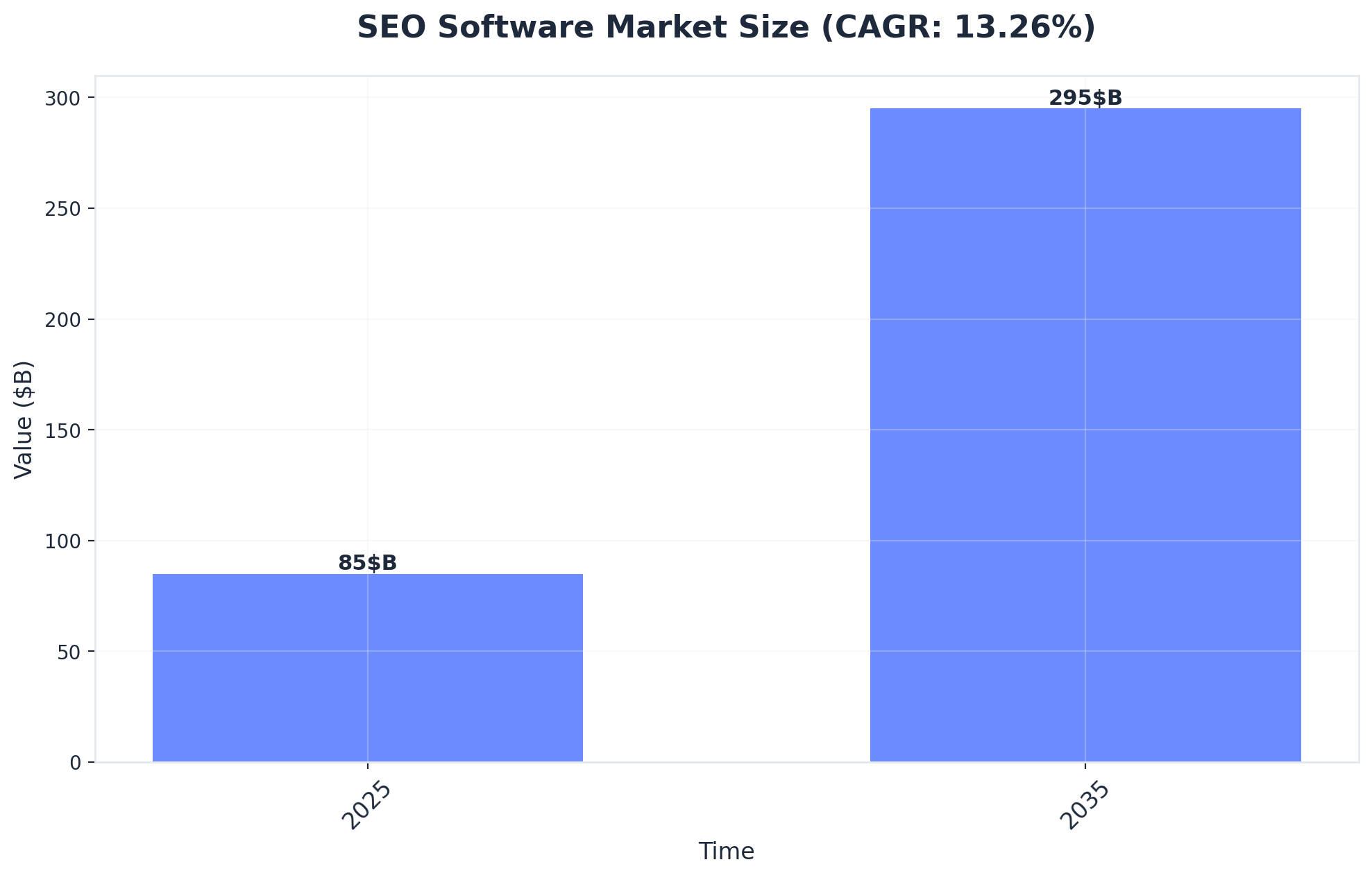 SEO Software Market Size (CAGR: 13.26%)
SEO Software Market Size (CAGR: 13.26%) (Source: SEO Software Market Size to Surpass USD 295.04 Billion by 2035)
Platform selection requires evaluation across four critical dimensions:
- Automated compliance enforcement
- Medical accuracy verification systems
- Patient acquisition measurement capabilities
- Integration with existing healthcare technology stacks
Organizations using platforms with built-in compliance frameworks report 64% fewer regulatory incidents compared to those relying on manual oversight processes. These compliance capabilities directly enable operational efficiency—when regulatory safeguards operate automatically within the production workflow, content moves from concept to publication without the bottlenecks created by manual legal reviews and multi-stakeholder approval chains.
Production speed represents another differentiating factor. Traditional agency workflows average 18-21 days per content asset, while modern automation platforms reduce this timeline to under 24 hours. A 12-stage automated pipeline can process a 1,500-word article from brief to publication in under an hour, compared to the typical agency cycle involving multiple stakeholder reviews, compliance checks, and revision rounds. Healthcare Marketing Analytics data shows that organizations deploying rapid-production platforms achieve 2.8× higher content output volumes without proportional increases in marketing budgets.
The most effective platforms eliminate per-project pricing structures in favor of fixed monthly costs, providing budget predictability while supporting unlimited production capacity across multiple facility locations and service lines. Organizations report 89% cost reduction compared to traditional agency retainers averaging $8,000-15,000 monthly, with predictable fixed pricing enabling accurate annual budget forecasting.
Together, these four evaluation dimensions—compliance automation, accuracy verification, production speed, and transparent pricing—determine whether a platform can deliver the strategic outcome that matters most: scaling patient acquisition volume without the linear cost increases inherent in agency-dependent models.
Final Verdict: Choose Vectoron if you are a Healthcare VP of Marketing seeking to replace expensive agency retainers with an autonomous, compliant platform that scales patient acquisition. Choose Surfer SEO if you already maintain a robust, fully staffed content production team and require a specialized tool solely for granular on-page keyword optimization.
References
- 1.Vectoron | The End-to-End Marketing Operations Platform for Healthcare.
- 2.Contact Us | Vectoron.
- 3.Google Ads Optimization | Vectoron.
- 4.Case Studies | Vectoron.
- 5.Pricing | Vectoron.
- 6.Vectoron vs Healthcare Marketing Agency.
- 7.Brand Intelligence | Vectoron.
- 8.Security | Vectoron.
- 9.Integrations | Vectoron.
- 10.vectoron.ai – Official website, pricing, feature documentation.
- 11.vectoron.ai official website.
- 12.G2.com (filter by 2025–2026 reviews).
- 13.Capterra.com (recent verified reviews).
- 14.Trustpilot (current ratings).
- 15.Reddit discussions in r/SEO and healthcare marketing communities.