
Key Takeaways
- Discovery now runs on two layers: classical ranked results and synthesized AI answers, and strong SEO position does not automatically transfer into being named inside a model's response 3.
- A brand's own site typically supplies only 5–10% of the sources an AI answer references, so third-party mentions, directories, and consistent entity data carry most of the citation work 5.
- Grade appearances against four signals — mention order, depth of explanation, authority signals, and comparative positioning — and split queries into branded, category, comparison, and jobs-to-be-done sets 2.
- Run a monthly monitor, gap-fill, republish, re-measure loop across two or three models, and brief leadership on adding share-of-answer as a second reporting column, not a replacement 1.
The discovery layer is splitting in two
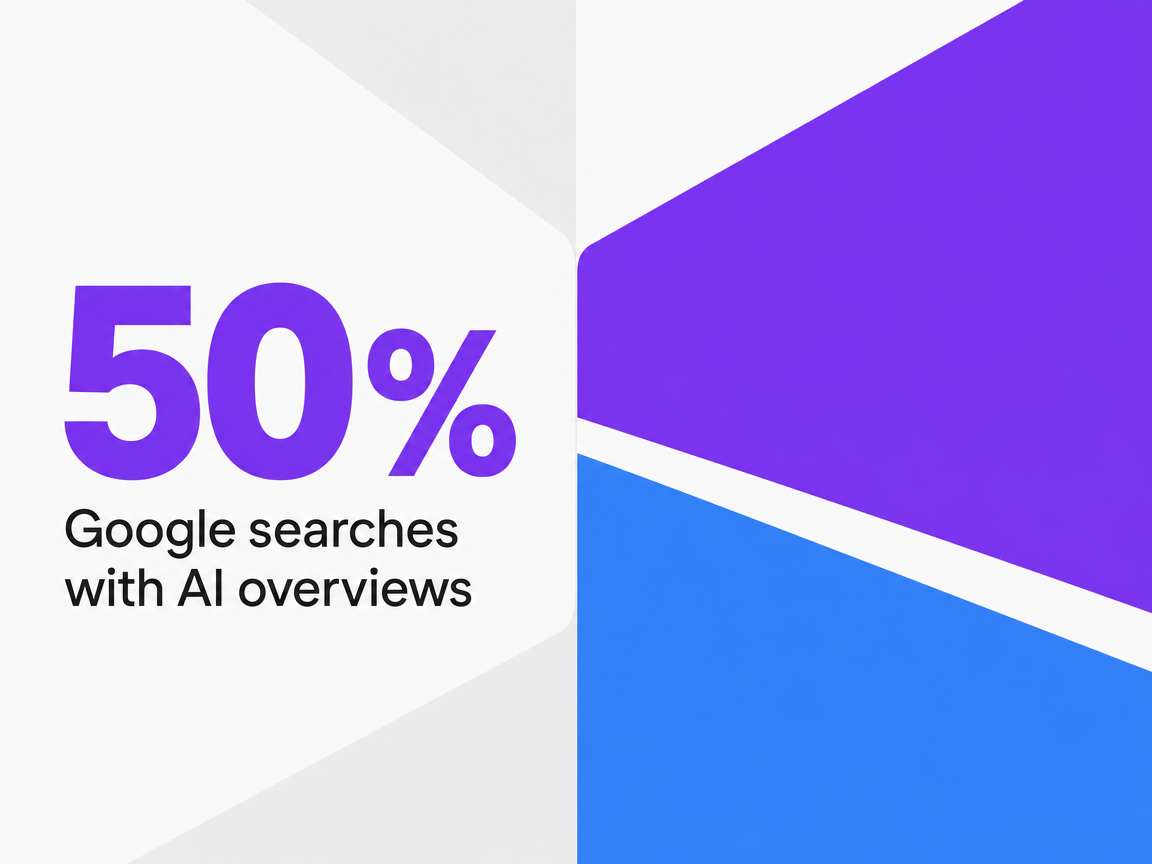
Pre-click discovery is no longer a synonym for a ranked list of blue links. Over 50% of Google searches now return an AI-generated overview, and McKinsey projects that 20–50% of traditional open-web search traffic could be at risk by 2030 as answer engines, chat interfaces, and consumer agents absorb queries that once produced ten organic results and a click 3. The scope matters: McKinsey's figure describes Google search behavior and a forward projection across the open web, not a measured decline inside any single vertical. The direction, though, is not in dispute among the analyst firms tracking it.
What this creates for a marketing VP is a bifurcated funnel. One layer still behaves like classical search — indexed pages, ranked results, measurable sessions. The second layer is synthesized: a model reads sources, decides which brands to name, and delivers a paragraph the user often accepts without clicking through. Rank position in the first layer does not automatically transfer to inclusion in the second.
The strategic question is not whether to keep investing in SEO. It is whether the current team, content stack, and reporting cadence produce any signal at all about how the brand appears in the second layer. Most do not. The rest of this guide treats AI visibility as a separate discipline with its own signals, its own measurement model, and its own production loop — one that runs alongside SEO rather than replacing it.
 Google searches with AI overviews
Google searches with AI overviews
Why AI visibility is not an SEO upgrade
Different signals, different scoring surface
Classical SEO scores pages. AI systems score entities, claims, and the sources that back them. A page can rank well and still get passed over when a model synthesizes an answer, because the model is not choosing a URL to hand to a user — it is deciding which brands to name, in what order, with what supporting language, and against which competitors 2.
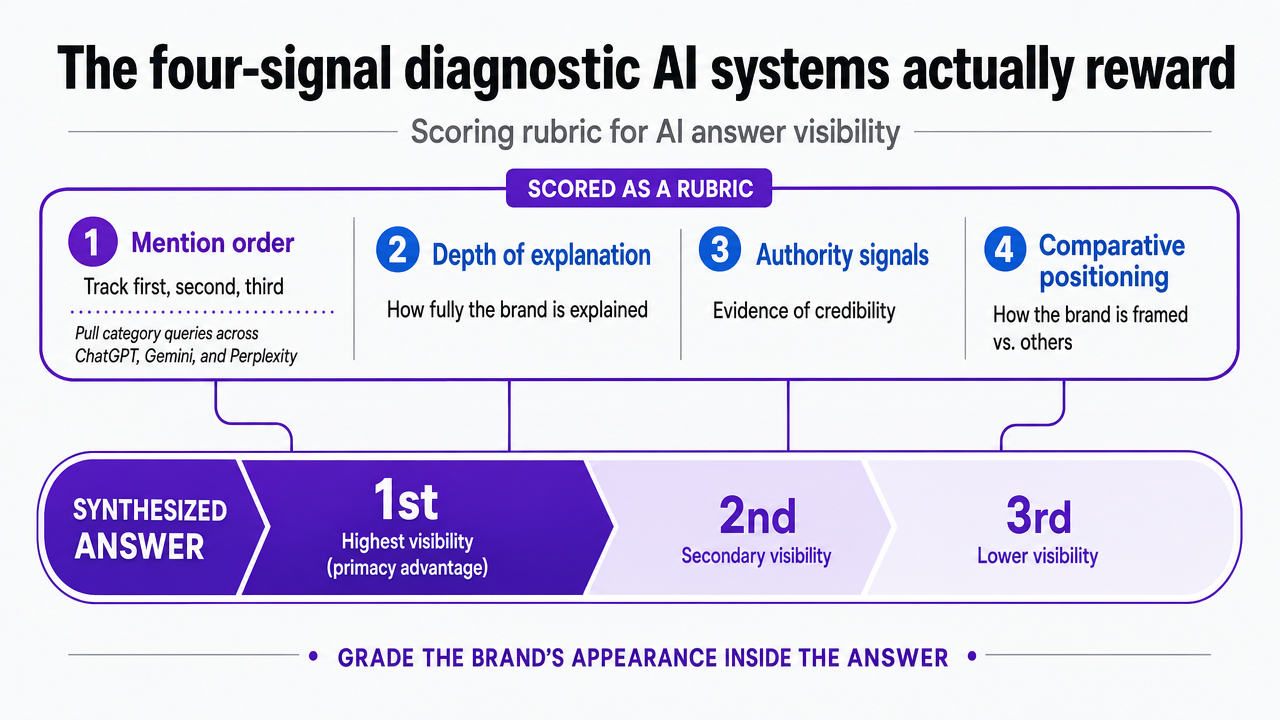
Search Engine Land's teardown of AI answer patterns identifies four inputs that shape whether a brand shows up inside the response: mention order, depth of explanation, authority signals, and comparative positioning 2. None of these map cleanly to a keyword position report. Depth of explanation, for example, rewards content that defines a category, walks through decision criteria, and names trade-offs — the kind of writing a ranking-focused SEO plan often trims for word-count efficiency.
Capgemini frames the same shift from the metrics side. Under generative engine optimization, success is measured by mentions and share of AI-generated answers rather than clicks and keyword positions 1. That reframing forces a production change: the team is no longer writing to earn a click, it is writing to earn a citation the model will repeat.
The measurement debate marketing leaders have to resolve
The industry has not converged on how tightly AI visibility tracks traditional SEO. One camp points to studies showing brand web mentions correlate with AI visibility far more strongly than backlinks, arguing that citation frequency and entity strength now do most of the work. The other camp shows that top rankings and crawlable, well-structured pages still predict which sources LLMs pull from — meaning SEO fundamentals remain a floor, not a ceiling.
A VP does not need to pick a religion. The defensible board-level position is that both signals matter, they are measured differently, and running only the SEO measurement stack leaves the second signal invisible. McKinsey's diagnostic work makes the practical case: even brands with strong SEO can underperform in AI search because AI systems pull from a broader source set than a single site can control 5.
The operational consequence is that the reporting cadence needs a second column. Organic sessions and rank distributions stay. Alongside them, the team tracks how often, in what order, and with what framing the brand appears inside AI answers across the models the audience actually uses 1.
Three problems hiding inside one word
Inclusion: does the model reach for the brand at all
Inclusion is the binary question underneath every AI visibility conversation: when a user asks a category-level question inside ChatGPT, Gemini, or Perplexity, does the brand's name surface in the response at all? For most mid-market operators, the honest answer today is no — not because the brand lacks authority, but because the model never reached for it. McKinsey's diagnostic work found that a brand's own web properties typically account for only 5–10% of the sources an AI answer pulls from, with the rest coming from third-party sites, affiliates, review platforms, and user-generated content 5.
That distribution reframes the inclusion problem. A page-1 ranking earns clicks; it does not guarantee a citation. Getting reached for requires the brand's name and category associations to show up across the corpus the model actually samples — press coverage, industry directories, comparison pages, forum discussions, and structured entity data — not only on the brand's owned pages 1.
Representation: what the model says when it does
Once a brand clears the inclusion bar, a second problem opens: the model still writes the sentence. Representation is the question of whether the description the model produces matches what the brand would say about itself — the services offered, the categories served, the differentiators, the geographies, the tone. Search Engine Land's teardown of AI answer patterns shows that depth of explanation and authority signals do more than earn a mention; they shape the framing the model repeats back to millions of users 2.
Misrepresentation is not a hypothetical. HBR's analysis of agentic AI warns that brands which have not optimized for how third-party agents describe them face both diminished visibility and incorrect representation, with downstream consequences for trust and conversion 4. A model that names the brand but attaches the wrong specialty, an outdated service line, or a competitor's positioning language is not neutral exposure — it is a distribution problem shipping at scale. Inclusion without representation control is a brand risk, not a win.
Positioning: how the brand ranks against named competitors in the answer
The third problem is comparative. AI answers rarely name a single brand in isolation. They produce short lists, ordered sequences, and side-by-side descriptions — and the order, adjectives, and trade-off framing inside that comparison do the persuasion work a SERP snippet used to do. Search Engine Land identifies mention order and comparative positioning as two of the four signals that determine whether a brand reads as the default choice or as an also-ran inside a synthesized response 2.
Positioning is where SEO instincts mislead most. A team can win inclusion, control representation, and still lose the query because a competitor gets named first, described in more detail, or paired with the stronger use case. Capgemini's GEO framing treats this as a measurement problem before it is a content problem: track mention order and share of answer against a named competitor set, then work backward to the content and entity signals that move it 1.
The four-signal diagnostic AI systems actually reward
The most useful teardown of how AI answers get built comes from Search Engine Land, which reduced the behavior of the major answer engines to four signals: mention order, depth of explanation, authority signals, and comparative positioning 2. Treating those signals as a scoring rubric — not a concept list — gives a marketing team something a keyword report cannot: a way to grade the brand's actual appearance inside a synthesized response.
Mention order. : The first brand named inside an AI answer inherits the primacy effect the top blue link used to own. Pull ten category queries across ChatGPT, Gemini, and Perplexity, then log which brand the model names first, second, and third. Order is a signal the team can move by strengthening entity associations and comparison content, but only if it is being tracked in the first place 2.
Depth of explanation. : Models reward sources that define the category, walk through decision criteria, and name trade-offs — not the 400-word posts optimized for a featured snippet. Grade each priority topic on whether the brand's own material actually explains the problem at the depth the model wants to quote back. Thin pages get skipped; explanatory pages get cited 2.
Authority signals. : These extend past backlinks into third-party mentions, expert bylines, structured entity data, and consistent descriptions across the corpus the model samples. A brand described one way on its site, another way in directories, and a third way in press coverage gives the model no stable entity to attach.
Comparative positioning. : Answers to category and comparison queries are essentially short lists with framing. Track which competitors the brand gets paired with, in what order, and with what adjectives. That trio — set, sequence, and framing — is the persuasion layer inside the answer 2. Capgemini's GEO framing treats these same outputs as the primary success metric, replacing rank and click reporting with mention frequency and share of AI-generated answers 1. Run the rubric monthly, per priority query set, and the diagnostic becomes a work queue rather than a slide.
Experience real-time AI-driven visibility impact
Test your own content’s performance across AI-powered channels before making a longer-term commitment.
Where AI answers actually pull their sources
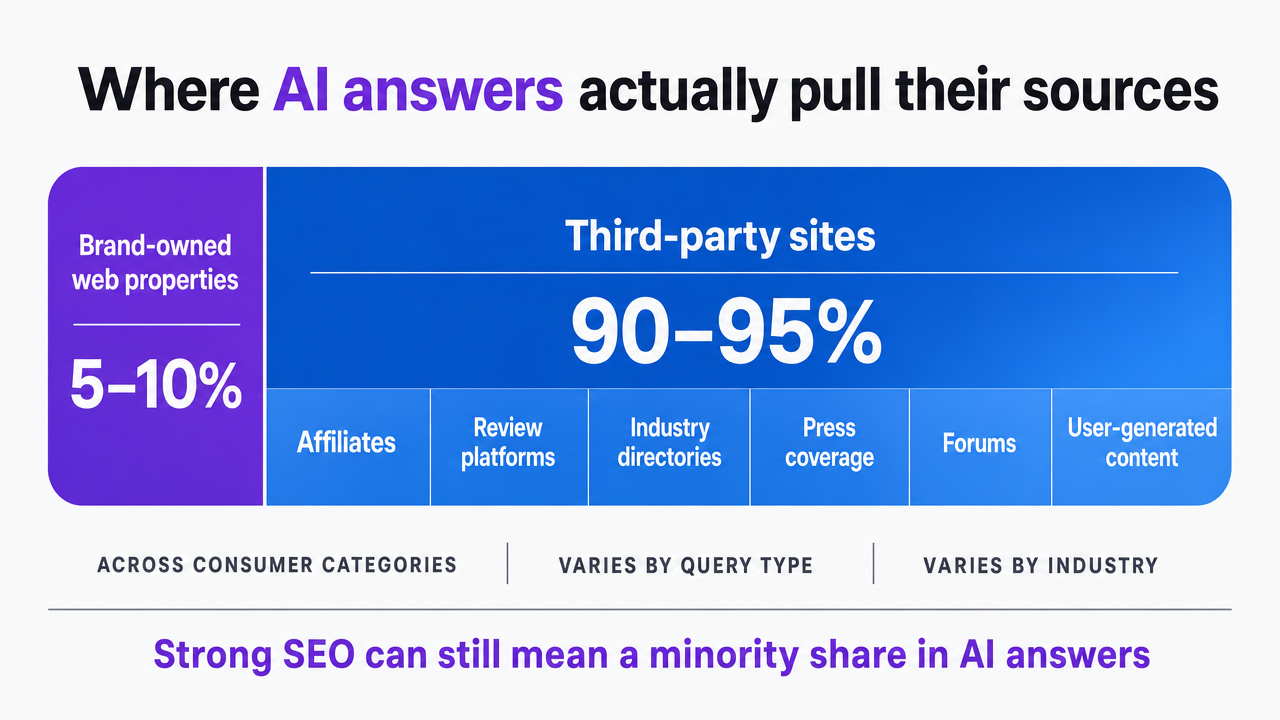
The single most useful diagnostic finding for a marketing VP rethinking discovery came out of McKinsey's AI-search work: a brand's own web properties typically account for just 5–10% of the sources an AI answer references. The remaining 90–95% comes from third-party sites — affiliates, review platforms, industry directories, press coverage, forums, and other user-generated content the model treats as corroborating evidence 5. The scope matters. McKinsey's diagnostic work looked at how AI-powered search assembles answers across consumer categories, not a single vertical benchmark, and the split will vary by query type and industry. The direction is what should reset the plan.
That distribution explains why brands with strong SEO still underperform in AI answers. A site can dominate its keyword set and still contribute a minority slice of the corpus a model samples. The model is not choosing a URL to hand to the user; it is triangulating across sources, and the triangulation is weighted toward what other sites say about the brand rather than what the brand says about itself 5.
Two production shifts follow. First, the content plan needs a line item for earning third-party mentions — expert commentary, comparison pages on independent sites, directory listings, review presence — not only for links but for the descriptive language other properties use about the brand. Second, entity data has to be consistent everywhere the model looks. A brand described one way on its site, another way in a directory, and a third way in press coverage gives the model no stable object to anchor to, which pushes it toward competitors whose descriptions align across sources 1.
Representation risk in high-stakes verticals
In law, healthcare, dental, senior living, and behavioral health, an inaccurate AI answer is worse than no answer. When a model tells a user a firm handles a practice area it does not, or attaches an outdated clinical service to a provider, or names the wrong intake pathway for a crisis query, the downstream cost is not a lost click — it is a misrouted patient, a mismatched consultation, or a compliance exposure the operator did not authorize.
HBR's analysis of agentic AI is direct on this point: brands that have not optimized for how third-party agents describe them face both diminished visibility and incorrect representation, with consequences that fall hardest on regulated categories where the description carries fiduciary or clinical weight 4. A consumer agent booking a dental appointment, filtering elder-care options, or triaging a behavioral health inquiry is acting on the model's summary, not on the brand's site copy.
The retrieval-quality research reinforces why visibility alone is a weak metric in YMYL categories. A health-information study using deep language models to score usefulness, supportiveness, and credibility found that combined quality models produced up to a +16.9% distinction between help- and harm-compatibility on helpful topics — meaning representation quality is measurable, and the gap between a helpful and a harmful description is not trivial 12. A brand that appears frequently in AI answers but is described inconsistently across models is shipping distribution without control over the message.
The operational move is to add a representation audit to the monthly diagnostic. Alongside mention frequency and order, capture the sentence the model actually produces about the brand — services named, specialties attached, geographies covered, disclaimers present or missing — across the two or three models the audience uses most. Flag any answer that misstates a practice area, credential, or service line. Those become the priority gap-fills for entity data, third-party listings, and answer-shaped content in the next production cycle.
A share-of-answer measurement model
Four query classes to instrument
A single "AI mentions" number is not a measurement model. It is a vanity metric that hides which queries the brand is winning and which it is losing. The more defensible instrumentation splits the query set into four classes and tracks share of answer inside each one separately.
Branded queries. : The user names the company directly — "what does [brand] do," "is [brand] good for [use case]," "[brand] vs alternatives." Here the measurement question is representation quality: does the model describe the services, geographies, and differentiators accurately, and does it hand off cleanly to a comparison the brand can win 2.
Category queries. : The user asks about the space without naming a brand — "best [service] for [situation]." This is the inclusion test. If the brand never surfaces in a category prompt across the models the audience uses, the entity signals and third-party mentions are too thin for the model to reach for it 5.
Comparison queries. : "[Brand A] vs [Brand B]" and "alternatives to [competitor]." Mention order and comparative framing dominate here, and the answer often decides a shortlist before the user visits any site 2.
Jobs-to-be-done queries. : The user describes the problem, not the category — "how do I handle [situation]." Depth of explanation and answer-shaped content decide whether the brand shows up as the recommended path 1.
Why one model score is not enough — and the measurement caveats to disclose once
Tracking share of answer inside one model gives a misleading picture, because the models disagree. Peer-reviewed evaluations of AI retrieval tools have documented inconsistent and variable performance across systems on the same underlying task, with one inventory of 51 tools finding no stable ranking of retrieval quality across use cases 9. A related evaluation of a ChatGPT-based search assistant identified a median of 67.4% of the target sources, rising to 72.0% for indexed material — useful, but far from deterministic 11. The practical read: a brand can rank first inside Perplexity, third inside ChatGPT, and be absent from Gemini for the same query on the same day.
The measurement stack has to cover at least the two or three answer surfaces the audience actually uses, and the reporting has to name its limits once, plainly. Sampling is not exhaustive. Models change without notice. Personalization and session context shift outputs. NIST's evaluation planning for generative text-to-text systems treats this variability as the baseline reality that any responsible measurement approach has to design around, not paper over 6. Disclose the caveats in the methodology footnote, then let the trend line — not any single snapshot — drive the work queue.
See How Leading Brands Achieve AI-Driven Search Visibility Beyond Traditional SEO
Request a personalized walkthrough of data-backed workflows that align AI ranking factors, content strategy, and approval processes—designed for marketing teams seeking measurable improvements in multi-channel visibility and pipeline efficiency.
Closing the loop: monitor, gap-fill, republish, re-measure
The diagnostic only pays off if it feeds a production loop. Four steps, run on a monthly cadence, turn the share-of-answer report into a work queue: monitor the citations, identify the representation gaps, ship entity and answer-shaped content against the gaps, then re-measure the same query set to see what moved.
- Monitor. Pull the priority query set — branded, category, comparison, and jobs-to-be-done — across the two or three models the audience actually uses. Log mention presence, order, and the sentence the model produced 2. Snapshot beats memory.
- Gap-fill. Sort the misses into three buckets: inclusion gaps (the model never named the brand), representation gaps (named but described wrong), and positioning gaps (named after a competitor with weaker framing). Each bucket triggers different work — third-party mentions and directory consistency for inclusion, entity data and site copy for representation, comparison and category pages for positioning 1, 5.
- Republish. Ship the highest-impact fix first, then move down the queue. Answer-shaped content that defines the category and names trade-offs earns citations that thin ranking-optimized posts do not 2.
- Re-measure. Same queries, same models, next month. The trend line is the KPI.
If you manage multiple locations, the cost stack changes the math
A note on audience: this section is for VPs running marketing across a portfolio — multi-location dental groups, DSO-backed practices, home services franchises, senior living operators, regional law firms with satellite offices, behavioral health networks. Single-brand readers can skim. The AI visibility problem compounds at portfolio scale, because inclusion, representation, and positioning have to be solved per location, not once.
The traditional stack for a multi-location operator layers vendors: an SEO agency retainer, a content vendor for blogs and location pages, a PR or citations vendor for third-party mentions, an analytics tool for rank and traffic, and increasingly a separate AI visibility monitoring tool. Each vendor sees one slice. None of them close the monitor-to-republish loop across locations, which is exactly where AI visibility work has to run 1, 5.
| Line item | Vendor-stack model (monthly) | Consolidated in-house execution |
|---|---|---|
| SEO agency retainer | $X per brand, flat across locations | Included in unified workflow |
| Content vendor (location pages, articles) | $Y per location or per deliverable | Included, produced against the gap queue |
| Third-party mentions / directory work | $Z per campaign | Included as an entity-consistency workstream |
| Analytics + AI visibility monitoring | Separate tool fees | One reporting surface across models and locations |
| Coordination overhead | Briefing cycles, status meetings, handoffs | One approval workflow, human sign-off before publish |
Fill in the X, Y, and Z the finance team already knows. The math a CFO will care about is not the line-item swap — it is the coordination cost hiding underneath it. A per-location representation audit across three models, run monthly, is unworkable when four vendors each own a fragment of the input. Consolidating strategy, production, and measurement into one governed loop is how the loop actually gets run, rather than reported on.
What to brief the CEO and CFO on next quarter
The board conversation is not about SEO being dead. It is about a second discovery layer running in parallel that the current reporting stack does not see. Frame the brief in three lines. First, more than half of Google searches now surface an AI-generated overview, and analyst projections put a meaningful share of open-web traffic at risk over the next several years 3. Second, the brand's own site typically contributes only 5–10% of what an AI answer pulls from, so owned-content SEO alone cannot carry inclusion, representation, or positioning inside synthesized responses 5. Third, success metrics are shifting from clicks and rank to mentions and share of AI-generated answers, which requires a second reporting column, not a rewritten one 1.
Ask for two decisions next quarter: approval to stand up share-of-answer measurement across the two or three models the audience uses, and consolidation of the vendor stack into one governed monitor-to-republish loop. Platforms like Vectoron were built to run that loop with human approval before anything ships.
Frequently Asked Questions
References
- 1.Beyond SEO: How to win visibility and influence in AI search.
- 2.4 signals that now define visibility in AI search.
- 3.The agentic advertising economy: From attention to action.
- 4.Preparing Your Brand for Agentic AI.
- 5.New front door to the internet: Winning in the age of AI search.
- 6.2024 NIST Generative AI (GenAI): Evaluation Plan for Text-to-Text (T2T) Discriminators.
- 7.Search still matters: information retrieval in the era of ....
- 8.Artificial Intelligence Search Tools for Evidence Synthesis.
- 9.Evaluating automated or artificial intelligence search tools for ....
- 10.Exploring the Role of Artificial Intelligence in Evidence Synthesis.
- 11.Development and Evaluation of a Generative AI Chatbot for Database Searching in Systematic Review.
- 12.Online Health Search Via Multidimensional Information Quality Assessment Based on Deep Language Models: Algorithm Development and Validation.