
Key Takeaways
- Jasper offers the deepest brand-voice modeling among point tools, making it a strong pick for teams whose editing capacity is the primary bottleneck and whose SEO stack is already in place.
- Copy.ai fits go-to-market teams producing high volumes of emails, ad variants, and sales assets rather than SEO-driven long-form content, but lacks a research and optimization layer.
- Surfer AI consolidates keyword research, SERP analysis, and on-page scoring inside the drafting environment, removing several handoffs for SEO-focused content managers.
- ContentShake AI is the most logical switch for teams already invested in Semrush, since it inherits that research layer and shortens the keyword-to-draft cycle.
- Vectoron coordinates content, SEO, PPC, backlinks, social, and call intelligence through a Command Center with approval-first automation, addressing coordination as the real bottleneck rather than drafting speed alone.
Why the alternative-to-Writesonic search has changed
Two years ago, comparing Writesonic alternatives focused on template libraries, output limits, and price per 100,000 words. This narrow focus no longer aligns with the actual demands on content marketing managers. The primary bottleneck has shifted from content creation to the surrounding processes: research, SEO brief development, brand review, legal sign-off, publishing, and performance measurement. A tool that only accelerates drafting does not resolve these broader issues.
McKinsey estimates that generative AI can boost marketing productivity by 5 to 15 percent of total marketing spend, a figure that encompasses the entire marketing function, not just writing tasks 2. This potential is only realized if the tool addresses more than just the drafting phase. While a standalone writing tool captures a small portion of this gain, a comprehensive workflow that integrates research, drafting, optimization, and approval captures significantly more, precisely because it eliminates the time lost in handoffs between these steps.
This shift is reflected in current search behavior. Content managers now evaluate Writesonic alternatives based on their ability to produce copy that ranks well, adheres to an established brand voice, and streamlines the review process, avoiding the need for multiple Google Docs, Slack threads, and compliance emails. The comparison is no longer between individual writing tools but between a point solution and a coordinated execution platform. The five alternatives reviewed below are assessed using operator-relevant criteria rather than a simple feature grid.
The four axes that separate a drafting tool from an execution platform
Forrester's research on marketing genAI use cases highlights four areas where early adopters achieve tangible results: advertising content development, creative brief development, email content development, and analytics 9. This list demonstrates a broad application across ideation, production, distribution, and measurement, rather than just variations of "blog drafts." A Writesonic alternative that only accelerates the production of drafts neglects three-quarters of the marketing workflow.
The five tools discussed in the next section are evaluated based on four axes derived from these operational realities:
Production velocity. : This measures how quickly an idea moves from initial research to a publishable draft, including the tool's ability to integrate keyword research, document creation, and CMS publishing. Velocity is not about words per minute, but rather the number of briefs completed per week.
Brand-voice fidelity. : This assesses whether the tool can consistently maintain a defined brand voice across numerous content pieces without extensive human editing. This is a common challenge for standalone writing tools as team scale increases beyond a single editor's capacity.
SEO workflow depth. : This criterion examines whether keyword research, SERP analysis, on-page optimization, and internal linking are integrated within the same environment as the draft, or if they require separate subscriptions and additional handoffs. Forrester includes advertising and email content alongside blog work 9, suggesting that a valuable alternative should not silo these functions.
Approval governance. : This evaluates whether the tool tracks review processes, including who reviewed what, when, and against specific brand or compliance standards. For content managers facing inquiries from legal or brand teams regarding AI risk management, this axis is becoming essential.
Each of the five alternatives scores differently on these four axes. Some are point tools excelling in one area, while others extend into a second. One platform coordinates all four within a single approval loop. The scoring prioritizes the tool's ability to reduce handoffs for a content manager, rather than just its drafting capabilities.
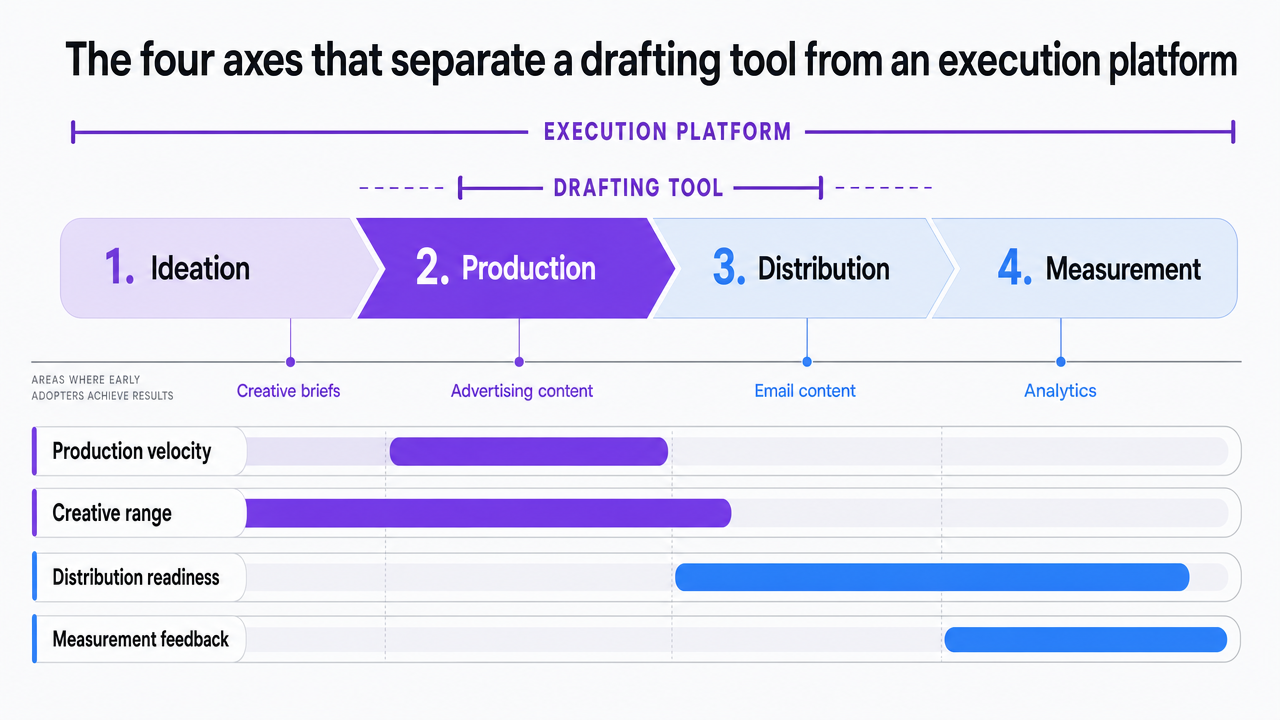 Visualize the four evaluation axes introduced in this section that structure the entire comparison of the five alternatives
The five alternatives, scored on operator axes
Jasper: brand-voice depth for teams with existing SEO infrastructure
Jasper excels in brand-voice fidelity. Its features for voice modeling, style guide ingestion, and knowledge base allow content teams to establish tone rules once and apply them consistently across many drafts, minimizing the need for human rewriting. This is particularly beneficial for content managers whose primary constraint is editing capacity.
Production velocity with Jasper is good but depends on external tools. While it handles ideation and drafting effectively, it lacks native keyword research, SERP analysis, or on-page optimization. Teams already using tools like Ahrefs or Semrush alongside Jasper can achieve an efficient workflow. However, teams expecting the writing tool to also manage SEO briefs will encounter the same handoff challenges common with Writesonic: moving between keyword tools, documents, writers, and CMS.
SEO workflow depth is moderate. Jasper integrates with SEO platforms rather than providing a built-in research layer. This design choice positions it as a component within a larger stack, rather than a central coordination platform.
Approval governance in Jasper is limited. It offers document history and team roles, but review processes often shift to Google Docs or project management tools when legal or brand teams are involved. Content managers whose brand teams are adopting frameworks like the NIST AI RMF 11 should consider this gap before making a switch.
Operator takeaway: Jasper is a strong single-purpose alternative to Writesonic for teams prioritizing brand voice, especially when SEO and approval processes are already managed by other tools.
Copy.ai: workflow automation for GTM teams beyond blog content
Copy.ai distinguishes itself among Writesonic alternatives by focusing on workflow automation, particularly for sales enablement, outbound sequences, and repeatable go-to-market tasks. This aligns with Forrester's identification of email content development as a key marketing genAI use case 9. A tool solely focused on blog posts would not address this critical area.
Copy.ai offers high production velocity for templated content such as prospecting emails, LinkedIn posts, ad variants, and sales one-pagers. While it can produce long-form blog content, this is not its core strength. Content managers whose workload primarily involves campaign assets rather than pillar pages will find Copy.ai more beneficial than those managing an SEO content calendar.
Brand-voice fidelity is sufficient for short-form content where maintaining a consistent style is less complex. However, long-form drafts may exhibit more voice inconsistencies compared to Jasper, leading to increased editing effort as content volume grows.
SEO workflow depth is Copy.ai's weakest area. It is not designed as an SEO tool, and its workflow builder does not compensate for the absence of a research and optimization layer. Teams switching from Writesonic to Copy.ai for automation will still require a separate SEO subscription and a distinct approval process.
Approval governance is managed through the workflow builder, rather than a dedicated review system. This approach works well for high-volume, low-risk assets but becomes less robust for regulated industries or brand-sensitive campaigns.
Operator takeaway: Copy.ai is a more suitable alternative to Writesonic for teams whose primary output consists of GTM and campaign assets, rather than SEO-driven long-form content.
Surfer AI: SEO-first drafting with focused governance
Surfer AI offers a contrasting approach to Jasper, with SEO workflow depth as its strongest attribute. It integrates keyword research, SERP analysis, content scoring, and on-page recommendations directly into the drafting environment. For content managers focused on organic traffic, this consolidation eliminates several handoffs typically required with a Writesonic stack.
Production velocity is high for SEO-driven long-form content. A brief can be transformed into a scored, optimized draft in a single session, without needing to switch to a separate research tool. However, Surfer's speed diminishes for tasks outside this scope, such as campaign emails, ad copy, or sales enablement, as it is not designed for these content types.
Brand-voice fidelity is functional but less sophisticated than Jasper's. While Surfer's voice controls are improving, teams with highly specific brand guidelines may still need to perform more extensive editing compared to using a voice-first tool.
Approval governance is more limited. Surfer tracks document history and supports team collaboration, but it lacks native approval routing, defined review states, or an audit trail tailored for brand or legal sign-off. Content managers whose organizations are adopting NIST AI RMF language for oversight 11 will find this gap significant.
Operator takeaway: Surfer AI is the most effective single-tool alternative to Writesonic for SEO-driven long-form content production, provided that approval routing and non-SEO content types are managed in separate systems.
ContentShake AI (Semrush): keyword-to-draft flow within an existing SEO suite
ContentShake AI is Semrush's solution for streamlining the keyword-to-draft process. For existing Semrush users, it consolidates two subscriptions into one and integrates topic ideas, competitor analysis, and keyword data directly into the drafting interface. This integration is a primary reason to choose it over Writesonic.
Production velocity is strong when the input is a Semrush-derived topic. By inheriting Semrush's research layer, ContentShake significantly shortens the brief-to-draft cycle. Teams not already using Semrush will experience less benefit, as the tool's value is directly proportional to the depth of existing Semrush suite usage.
Brand-voice fidelity is less robust compared to Jasper. ContentShake offers tone controls but does not model a codified house style with the same level of detail. Long-form output typically requires more editing to meet brand guidelines.
SEO workflow depth is inherently high. Keyword research, SERP data, and optimization scoring are all integrated within the drafting environment. Internal linking recommendations leverage the broader Semrush index.
Approval governance is minimal. ContentShake functions as a drafting surface within an SEO suite, not a review platform. Approval routing, version control against brand criteria, and audit trails must be managed externally. This is acceptable for teams whose review processes are already handled by a project management tool, but not for those seeking to consolidate the review layer.
Operator takeaway: ContentShake AI is the most logical switch from Writesonic for teams already deeply integrated into the Semrush ecosystem.
Vectoron: coordinated AI marketing execution with approval-first automation
Vectoron occupies a distinct category from the other tools. It is not merely a writer with additional features, but a coordinated AI marketing execution platform built with approval-first automation. It leverages six specialist strategists—content, SEO, PPC, backlinks, social, and call intelligence—all coordinated through a Command Center that requires human approval for every decision before execution.
Production velocity is measured across the entire production cycle, not just the drafting stage. Research, brief creation, drafting, SEO optimization, internal linking, and publishing are all managed within a single, governed loop. This design eliminates the numerous handoffs that typically consume hours in a stack involving Writesonic, Ahrefs, Google Docs, and a CMS, replacing integration complexities with inherent workflow design.
Brand-voice fidelity is enforced at the strategist layer, rather than being adjusted per document. Voice, tone, and category rules are encoded once and applied consistently across the output of every specialist. This approach allows smaller teams to scale content volume without incurring the editing burden that can reduce the velocity of tools like Jasper or ContentShake at scale.
SEO workflow depth is native to the platform. The SEO strategist conducts research, scoring, and internal linking within the same environment as the draft, and collaborates directly with content and backlink strategists, eliminating the need for separate tabs or tools.
Approval governance is where Vectoron's category shift is most apparent. Nothing is published without human sign-off, every recommendation includes its strategic rationale, and the audit trail is a core feature, not an add-on to a document editor. For content managers whose legal, brand, or compliance teams are using NIST AI RMF terminology 11, 10, the review surface is specifically designed to address these requirements.
Operator takeaway: Vectoron is the ideal choice for content managers who recognize that the primary bottleneck is coordination across content, SEO, and approval, rather than just the drafting process itself.
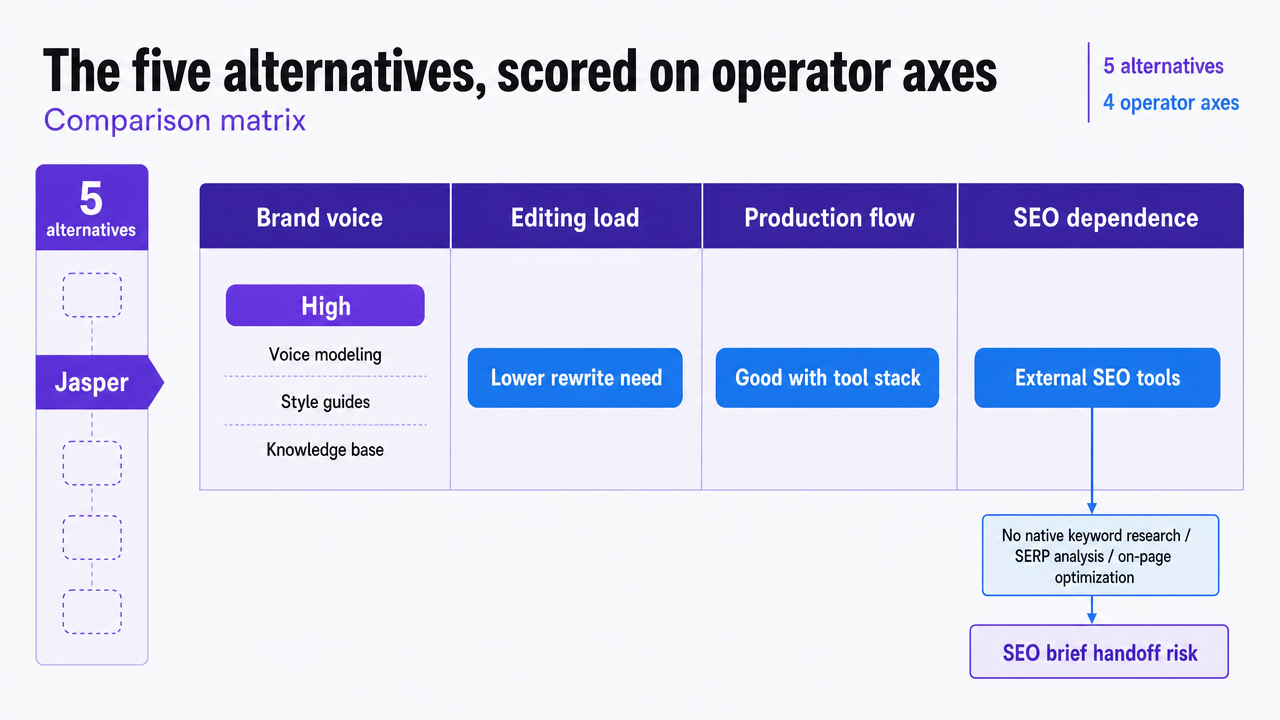 Provide a comparison matrix scoring the five alternatives across the four operator axes established in the previous section, directly supporting the detailed subsections that follow
Test AI-driven content execution with full access
Experience measurable gains in content velocity and quality using real campaigns during your 7-day trial.
Where budget actually pays back: the sales-and-marketing value pool
Tool budget allocation often follows departmental politics rather than actual value creation from genAI. This approach should be re-evaluated against underlying economic realities. McKinsey's 2025 workplace AI analysis indicates that sales and marketing account for 28 percent of the total potential economic value from generative AI across all functions 5. This is the largest share among all functional areas and explains why horizontal writing tools often yield lower ROI compared to vertical marketing platforms.
Practically, concentrating spending on tools that only accelerate drafting captures a small fraction of this 28 percent. Drafting is just one task within a value pool that also includes personalization, campaign optimization, creative brief development, email production, and analytics 9. A Writesonic-like subscription typically addresses only one of these areas. In contrast, a coordinated execution platform that manages SEO, content, and campaign work through a shared approval layer can address five.
This reframing is crucial for content managers evaluating alternatives during budget discussions. The key question is not "which AI writer costs less per 100,000 words," but rather which tool captures a larger portion of the marketing-function value pool per dollar spent, and how much of the associated coordination costs—such as project management hours, editing rework, SEO tool subscriptions, and review cycles—are absorbed rather than added.
Governance criteria most Writesonic comparisons skip
Legal, brand, and compliance teams are increasingly asking content managers new questions: who reviewed a draft, against what criteria, and whether an audit trail can be provided. Most comparisons of Writesonic alternatives overlook this aspect because it's a workflow requirement, not a feature visible in a template gallery.
The NIST AI Risk Management Framework 11, a voluntary framework for trustworthy AI, is becoming a common reference point for enterprise reviewers. NIST's Generative AI Profile extends this framework to genAI systems, offering a cross-sector resource for managing GenAI risks 10. While neither document mandates specific tools, both outline the types of questions content managers will increasingly need to answer.
Three criteria directly influence tool selection. First, review states: whether a draft maintains a defined status (drafted, reviewed, approved, published) consistently across the system, rather than relying on Slack threads. Second, reviewer accountability: whether the person who approved a piece and the criteria they applied are recorded with the asset. Third, reasoning capture: whether the AI's recommendations include the rationale behind them, allowing reviewers to evaluate the decision, not just the output.
Four of the five alternatives discussed treat these as secondary concerns. Approval routing often moves to a project tool, audit trails are limited to document history, and AI reasoning remains internal to the model. A coordinated execution platform built with approval-first automation, however, treats each of these as a fundamental component. This governance aspect is a critical consideration for content managers before making a switch.
See How Leading Brands Execute Faster With AI-Driven Content Teams
Request a walkthrough of unified AI marketing execution—compare workflows, approval controls, and measurable impact with top Writesonic alternatives for scaling content and multi-channel campaigns.
If you manage multiple locations: consolidation economics
For content managers overseeing production across multiple locations, such as dental practices, senior living communities, or home services franchises, the tool comparison changes significantly. The crucial question is not which alternative produces the cleanest paragraph, but rather how many separate subscriptions, editor relationships, and approval threads are required per location, and how quickly these costs escalate as the footprint expands.
A typical multi-location content stack often includes:
- one AI writer subscription,
- an SEO tool with per-seat pricing,
- a freelance editor shared across sites,
- a project manager coordinating briefs and reviews, and
- a separate approval process managed via email or a project tool.
Each component scales differently. Editor hours increase linearly with the number of locations. Project manager hours can increase disproportionately as cross-site review processes become more complex.
The consolidation-economics comparison, using supplied Vectoron pricing and labeled variables for the rest:
| Line item | Point-tool stack | Coordinated execution platform ||---|---|---|| AI writing subscription | 1 seat, vendor-listed rate | Included || SEO tool seat(s) | Per-seat, scales with users | Included || Freelance editor | Blended hourly rate × locations | Reduced; voice enforced at strategist layer || PM coordination | Hours/week × locations | Reduced; handoffs removed by design || Approval routing | Email or project tool | Native, per-asset audit trail || Base subscription | Sum of above | $599/mo post-trial |
The operational insight is that reclaimed hours and eliminated handoffs are more valuable than the subscription cost alone. A stack involving four vendors and three handoffs per location cannot scale to forty sites without increasing headcount. A coordinated execution platform with approval-first automation absorbs the coordination costs that a Writesonic-type tool leaves to the content manager's calendar 9.
Choosing between a point tool and a coordinated platform
The decision hinges on where a content manager's time is most inefficiently spent. If the primary bottleneck is in the drafting stage—word count, template variety, or output speed—then a more powerful point tool can provide a solution. Options include Jasper for voice-heavy long-form content, Copy.ai for high-volume GTM assets, or Surfer AI/ContentShake for SEO-driven pages. Any of these four can be a justifiable upgrade from Writesonic if the existing surrounding workflow is already efficient.
However, if the inefficiency lies in the transitions between steps—from brief to draft, draft to SEO check, SEO check to brand review, or brand review to publishing—then a better writing tool alone will not resolve the issue. Forrester's data on genAI in marketing indicates that teams achieving significant improvements in campaign efficiency are those deploying AI across the entire workflow, not just for a single task 13. This highlights a fundamental operating model decision that the Writesonic-alternative search now brings to the forefront.
A coordinated AI marketing execution platform with approval-first automation, such as Vectoron, is the appropriate solution when coordination itself is the primary constraint. The choice of subscription should follow the operating model decision, not precede it.
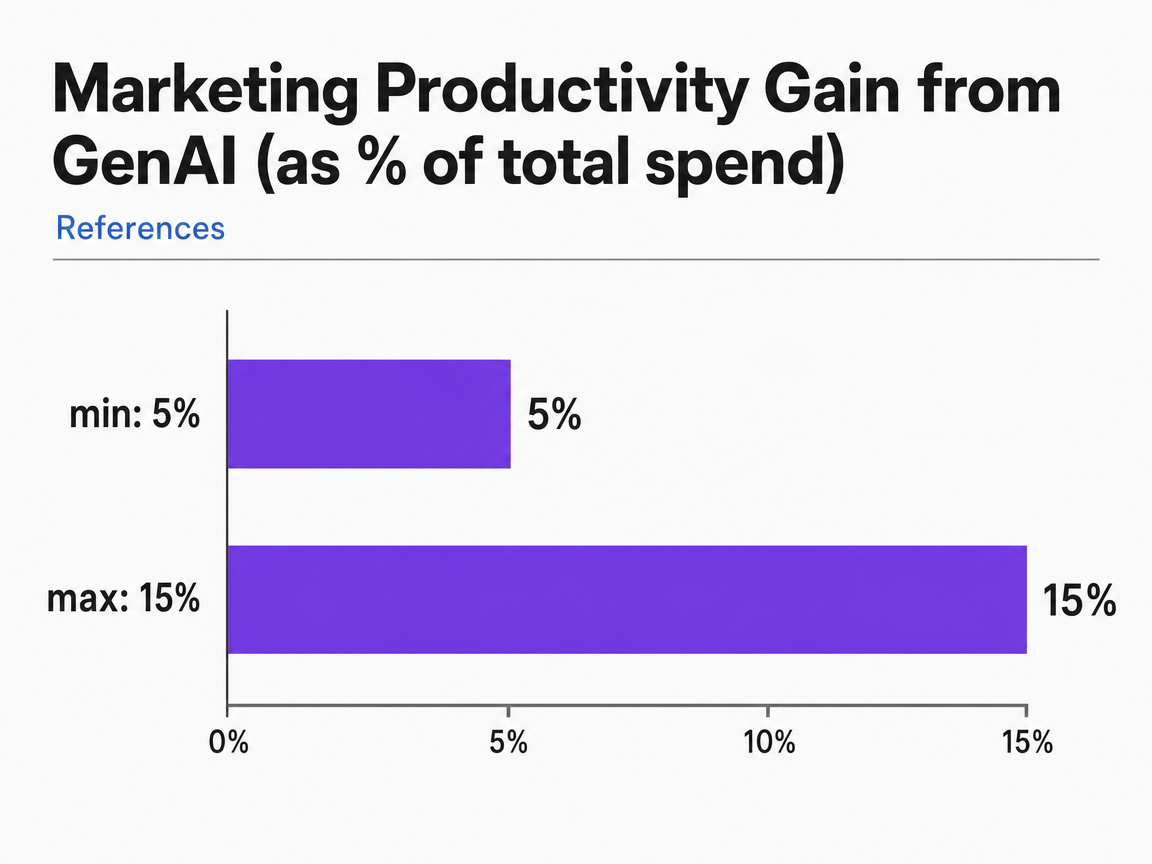 Marketing Productivity Gain from GenAI (as % of total spend)
McKinsey's estimate of the potential increase in marketing productivity, measured as a percentage of total marketing spend.
Frequently Asked Questions
References
- 1.What is ChatGPT, DALL-E, and generative AI?.
- 2.The economic potential of generative AI: The next productivity frontier | McKinsey.
- 3.How generative AI can boost consumer marketing | McKinsey.
- 4.The state of AI in 2023: Generative AI's breakout year.
- 5.AI in the workplace: A report for 2025 | McKinsey.
- 6.The Impact Of Generative AI On Customer Marketing | Forrester.
- 7.The State Of Generative AI Inside US Marketing Agencies, 2025 | Forrester.
- 8.Artificial Intelligence Market Insights, 2025 | Forrester.
- 9.Generative AI Marketing Use Cases In APAC | Forrester.
- 10.Artificial Intelligence Risk Management Framework: Generative Artificial Intelligence Profile | NIST.
- 11.AI Risk Management Framework | NIST.
- 12.The economic potential of generative AI: The next productivity frontier.
- 13.The State of Generative AI in Marketing.