
Key Takeaways
- The shortlist problem is really a workflow question: teams pulling ahead treat writing assistance as a layered system with human approval gates, not a growing pile of subscriptions.
- A 2024 review of 112 studies sorts tools into three functional categories, evaluation, feedback, and generation, each with a distinct risk profile and governance need 1.
- Layer One evaluation tools like NoRedInk and Quillbot carry the sturdiest evidence and lowest risk, making grammar and style QA the easiest place to consolidate spend 9.
- Layer Two feedback tools such as WordTune, ArgRewrite, and Paperpal improve cohesion, clarity, and fluency when pointed at existing prose rather than empty documents 6.
- Layer Three generative drafting carries the highest ceiling and the heaviest oversight burden, because models routinely produce fabricated citations and hallucinated claims that pass a casual read 3.
- Originality is a brand signal, not just a legal concern: 47% of surveyed students associate AI use with plagiarism and 49% flag originality impact 5.
- Operator literacy predicts output quality more than tool choice, with a 2025 Stanford SCALE study showing literate prompters outperform peers once AI assistance is removed 2.
- An AI-use policy should precede tool standardization, defining what is allowed at each layer, what must be verified, how disclosure works, and who signs off 4.
- Coordinating the three layers behind one approval queue and one style reference prevents the brand-voice drift that comes from stapling point tools together across separate tabs.
- The 2026 shortlist collapses to five ordered decisions: write the policy, standardize Layer One, restrict Layer Two to revision, gate Layer Three with verification, then unify approvals 7.
The Shortlist Problem Content Teams Actually Face in 2026
Most 2026 buying guides for writing assistance tools read like a spreadsheet of features. Content marketing managers do not need another spreadsheet. They need a defensible answer to a harder question: which tools belong in a governed production system, and which ones quietly introduce risk that erases the velocity gains that justified adoption in the first place?
The evidence base has matured enough to answer that question with something firmer than vendor claims. A 2024 systematic literature review of 112 studies on AI writing assistants sorts the market into three functional categories rather than a flat ranking: automated writing evaluation, automated writing feedback, and automated text generation.1 Each category carries a different risk profile, a different quality ceiling, and a different governance requirement. Treating them as interchangeable is the mistake that produces bloated tool stacks and inconsistent brand voice.
The teams pulling ahead in 2026 are not the ones with the longest list of subscriptions. They are the ones treating writing assistance as a layered workflow with human approval gates, disclosure norms, and clear ownership of the final draft. The shortlist question is really a workflow question in disguise.
This piece organizes the 2026 shortlist around that layered model, names specific tools where the research supports it, and applies an approval-first lens most competing roundups skip.
A Three-Layer Taxonomy for the Writing Assistance Stack
Why the Layered Model Beats the Feature Checklist
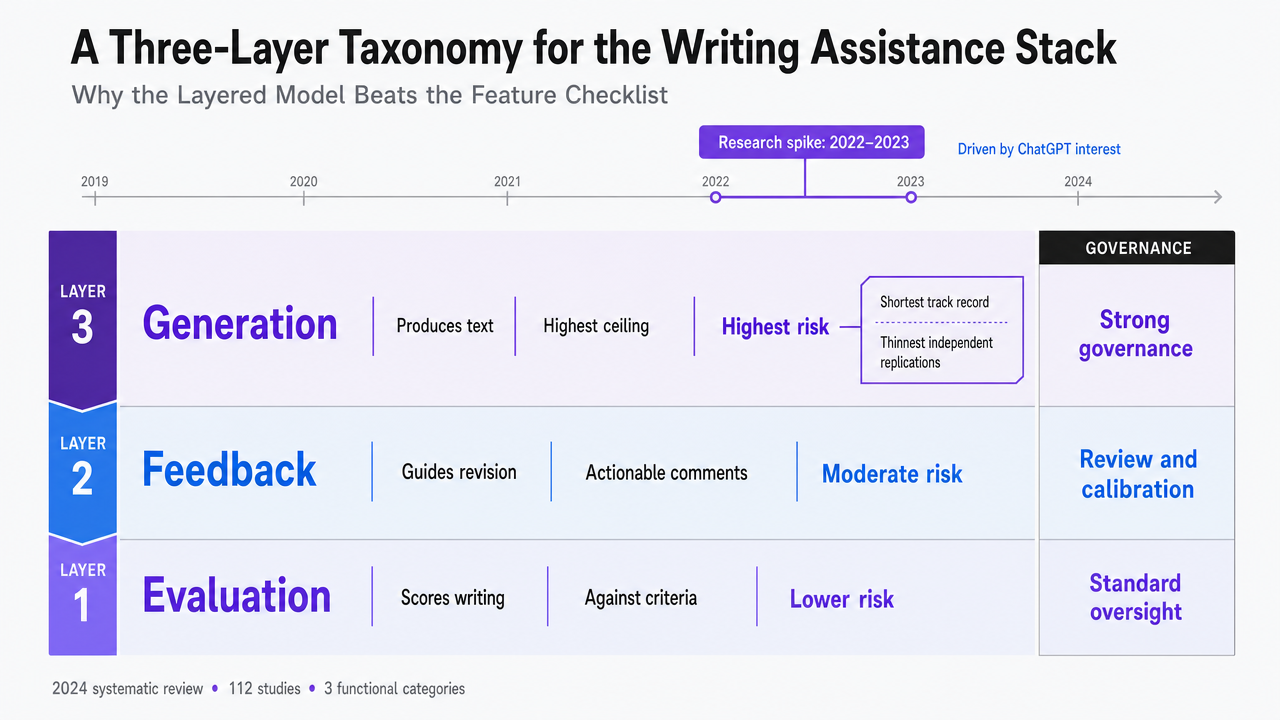
The most useful map of the writing assistance market comes from a 2024 systematic literature review that examined 112 studies and sorted the tools into three functional categories: automated writing evaluation, automated writing feedback, and automated text generation.1 The review documented a sharp spike in research activity during 2022 and 2023, driven almost entirely by the arrival of ChatGPT and the surge of interest in automated text generation tools.1 That spike matters for shortlist decisions because it means the generative layer, the one with the highest ceiling, also has the shortest track record and the thinnest set of independent replications.
The layered model is more useful than a feature checklist for a practical reason. Evaluation tools score writing against criteria. Feedback tools suggest revisions to a draft. Generation tools produce new text from a prompt. These are three different jobs with three different failure modes. A grammar checker that misses a comma is a nuisance. A generative model that invents a source citation is a brand liability. Treating both as "AI writing tools" and comparing them on features like word count or integrations obscures the risk asymmetry.
Content marketing managers can borrow the taxonomy directly. It gives every candidate tool a slot, a job description, and a governance requirement before anyone opens a demo. The rest of this article walks each layer in order, starting with the layer where the evidence is strongest and the risk is lowest, and ending with the layer where oversight matters most.
Acknowledging the Education-to-Marketing Extrapolation
One honest caveat belongs upfront. Nearly all of the peer-reviewed evidence on writing assistance tools was collected in education settings, mostly higher education, and a large share of it studies ESL learners and academic prose.1 Marketing production is a different job. Brand voice, SEO structure, conversion copy, and editorial calendars do not appear in the study designs.
The extrapolation still holds for three reasons. The mechanical gains the research documents, error correction, cohesion, vocabulary, and organization, are the same mechanical gains marketing editors ask for on every draft. The risks the research documents, hallucinations, fabricated references, overreliance, degrade marketing content the same way they degrade a term paper. And the governance patterns universities have adopted, disclosure, human vetting, and written policies, map cleanly onto the approval workflows marketing teams already run for legal and compliance review.
Where the research is silent, this piece says so rather than filling the gap with vendor talking points.
Layer One: Evaluation and QA Tools (Where the Evidence Is Strongest)
Evaluation tools score writing against defined criteria: grammar, mechanics, readability, structure, style consistency. They do not rewrite drafts and they do not generate new copy. That constraint is exactly why the evidence on this layer is the sturdiest of the three. The 2024 systematic review of 112 studies grouped automated writing evaluation tools alongside feedback tools as the categories with the most consistent positive effects on writing quality and efficiency, and with markedly fewer ethical flags than generative text tools.1
For a marketing team, the practical version of Layer One looks like a grammar and style checker running against every draft before it moves to editorial review. Named tools that show up in the empirical literature on writing assistance include NoRedInk for grammar remediation and Quillbot as a paraphrase-and-clean pass, both cited in an ERIC-indexed study of AI-powered writing tools that documented gains in error correction, cohesion, vocabulary, and organization among ESL learners.9 The extrapolation to marketing production is direct. Editors spend real hours per week on the same categories the study measured, and pushing that work to a QA layer frees senior writers for structural revision.
The governance requirement at this layer is light. Evaluation tools flag; they do not author. A team can standardize on one grammar and style engine, wire it into the CMS or the docs environment, and treat its output as advisory. There is no meaningful hallucination risk because these tools are not generating claims, and there is no meaningful originality risk because they are not producing new sentences from a prompt.
What content managers should demand from Layer One in 2026 is boring reliability, not clever features. A stable rule set, a customizable style dictionary for brand terminology, and an audit trail of what was changed and by whom. Standardize on one tool at this layer and stop paying for overlapping subscriptions. This is the layer where consolidation delivers immediate savings without a governance conversation.
Layer Two: Feedback and Editing Tools (The Cohesion and Clarity Layer)
Feedback tools sit between evaluation and generation. They read a draft, propose revisions, and often rewrite passages while leaving the underlying argument intact. This is the layer where the research shows the most interesting quality gains for content teams, because the changes happen at the sentence and paragraph level where cohesion, clarity, and rhythm are decided.
A 2023-2024 systematic review of GenAI in academic writing found measurable gains across five specific dimensions when these tools were used as revision aids: cohesion, clarity, creativity, fluency, and proficiency.6 The same review paired those gains against a defined set of risks: plagiarism, overreliance, hallucinations, bias, and unequal access.6 Content marketing managers should read those two lists as parallel columns, not as a pros-and-cons debate. The gains show up on surface features editors already spend time on. The risks show up when feedback tools are allowed to generate substantive claims rather than restructure existing sentences.
Named tools in this layer, based on the empirical writing-tools literature, include Quillbot, WordTune, ArgRewrite, and Paperpal.9 Each takes an existing sentence and offers alternatives. That framing matters. A paraphrase tool is not authoring; it is compressing, clarifying, or resequencing what a human already wrote. The failure mode is different from generative drafting, and so is the governance requirement.
The Cornell pedagogy report captured why this layer scales well:
generative AI can "allow instructors to scale constructive critiques for iterative learning and improvement in writing."8
Swap "instructors" for "senior editors" and the operational logic holds. A feedback tool can deliver a first pass of line edits across a dozen drafts in the time a senior editor would spend on one, freeing the editor to focus on argument, structure, and brand voice, the parts of the job the tool should not touch.
Two operational rules keep Layer Two productive. First, feedback tools should propose, not commit. Every rewrite lands in a suggestion pane a human accepts or rejects, the same pattern used for tracked changes. Second, feedback tools should be pointed at existing prose, not empty documents. The moment a paraphrase tool is asked to expand a bullet into three paragraphs, it has crossed into Layer Three and inherits Layer Three's risk profile. Keeping that boundary crisp is the single highest-leverage governance choice at this layer.
Test AI writing assistants on live workflows
Evaluate real-time content production outcomes with full publishing rights before making a commitment.
Layer Three: Generative Drafting Tools (Highest Ceiling, Highest Risk)
Generative drafting tools produce new text from a prompt. This is the layer everyone talks about, the layer that reset the entire market in late 2022, and the layer where the evidence base is thinnest and the failure modes are most expensive. The 2024 systematic review that mapped 112 studies flagged automated text generation as the category where ethical concerns concentrate, specifically around data bias, privacy, and academic integrity, and noted that the research spike in 2022 and 2023 was driven largely by ChatGPT rather than by a mature body of independent replication.1
Named tools in this layer, based on the empirical literature, include ChatGPT, Jenni, Copy.ai, and Essaywriter.9 Each can produce a full draft from a brief. Each can also produce content that looks fluent and is quietly wrong. A peer-reviewed synthesis of LLM-based writing tools in scholarly communication documented the specific failure pattern content teams need to plan around: plagiarism, hallucinations, and inaccurate or fabricated references.3 The fabricated-reference problem is the one that should keep marketing leaders alert. A generative model will invent a plausible-sounding statistic, a plausible-sounding source, and a plausible-sounding link, and the output will pass a casual read.
A biomedical review of AI-assisted writing drew a useful operational line. It cautioned against using generative AI to produce verbatim final content or to generate references, while endorsing its use for outlining, summarizing, clarifying drafted content, and brainstorming.10 That distinction transfers cleanly to marketing production. Generative tools are strong at the front and middle of the workflow: outlining a piece, expanding a bullet into a first draft, compressing a long transcript, and proposing alternative headlines. They are weak at the end of the workflow, where claims, citations, and named entities have to be verified.
The governance requirement at Layer Three is heavier than at the other two layers combined. Every generative draft needs a human editor who checks factual claims against primary sources, replaces any AI-produced citation with a verified one, and confirms that named products, people, and numbers actually exist. Treat generative output as a rough draft from a fast but unreliable junior writer, not as a finished asset. Standardize on one or two generative tools rather than sprawling across five, and route their output through the same editorial approval gate every human draft passes through.
The Originality and Brand Voice Question
Originality is not just a legal question for marketing teams. It is a brand signal, and readers are already primed to look for it. A study of university students' perceptions of AI-assisted writing tools found that 47% associate AI use with plagiarism and 49% focus on its impact on originality.5 The sample was academic, but the perception pattern is the one content teams should plan around. Audiences who read marketing copy carry the same suspicions into the funnel.
Two design choices matter here. The first is where in the workflow generative tools are allowed to touch brand voice. Letting a model draft an opening paragraph from a prompt produces prose that reads like every other model's prose, because the training data overlaps. Letting the same model compress an existing internal document into a shorter version preserves the voice a human wrote. The output looks similar; the originality profile is not.
The second is what the style dictionary contains. Brand terminology, banned phrases, sentence-length preferences, and voice examples belong in a shared reference that every tool at every layer reads from. Without that reference, each writer negotiates voice with a different model in a different chat window, and the aggregate output drifts toward a generic middle. Originality erodes quietly, one draft at a time, and the perception risk the survey data documented becomes a real one.
Operator Literacy Is the Variable Most Shortlists Ignore
Tool selection debates usually assume the operator is a constant. The research says otherwise. A 2025 Stanford SCALE study measured what happened to students' independent writing after AI assistance was removed and found that higher generative AI literacy predicted stronger post-AI writing performance, with the effect strongest when students interacted with passive chatbots that required active prompting rather than autocomplete-style suggestions.2 Translated to a marketing team: the writer who knows how to prompt, verify, and revise gets more out of a mid-tier tool than the writer who does not gets out of the best tool on the market.
That has direct implications for hiring, onboarding, and internal training. Screening writers on portfolio samples alone misses the variable that now predicts output quality. A short practical exercise, prompt a generative tool, critique its draft, produce a verified final version, exposes the literacy gap in twenty minutes. Teams that add this step to hiring loops stop paying senior editor rates to clean up drafts that a more literate writer would have caught before submission.
Internal training deserves the same treatment. A brief internal playbook covering prompt patterns, verification steps, and disclosure norms compounds faster than another seat license. Operator literacy is the shortlist variable that scales the value of every other tool in the stack.
See How Leading Teams Are Scaling Content with AI Writing Tools in 2026
Request a walkthrough of the latest AI-powered writing platforms engineered for agencies and enterprise marketing teams—compare workflows, approval controls, and live performance data tailored to your scale.
Governance: Writing the AI-Use Policy Before Standardizing the Tools
Tool selection is the wrong first decision. The policy is. Universities figured this out ahead of most marketing teams because the integrity stakes forced the conversation early. George Washington University's academic integrity guidelines specify that students may not submit AI-generated content as their own work unless explicitly permitted, and they preserve instructor authority to set course-level rules on what AI use looks like.4 That structure, a default rule plus delegated authority to set narrower rules by context, transfers directly to a content operation. A marketing team needs a default position on AI use, plus named owners who can set tighter rules for regulated verticals, thought leadership bylines, or executive communications.
A workable policy covers four things and no more.
- What is allowed at each layer, evaluation, feedback, and generation.
- What must be verified before publish, specifically claims, statistics, named entities, and any citation.
- When and how disclosure appears, whether in an editorial note, a byline convention, or a metadata field.
- And who owns the final sign-off on each content type.
A peer-reviewed synthesis of AI-assisted writing in scholarly communication argues explicitly for disclosure and substantial human contribution as the two non-negotiables in any responsible AI workflow.3 Marketing content is not a medical journal, but the same two principles hold under any brand-safety review.
Writing the policy before standardizing the tools inverts the usual buying sequence and produces a cleaner shortlist on the other side.
Coordinating the Three Layers Without Stapling Point Tools Together
Most content teams end up with a Layer One grammar checker, a Layer Two paraphraser, and a Layer Three generative model sitting in three different tabs, each with its own login, its own style dictionary, and its own audit trail. The stack works, but the coordination cost is real. Every handoff between layers is a place where brand voice drifts, disclosure gets skipped, and the approval gate becomes a Slack message instead of a documented decision.
The consolidation question in 2026 is not which point tool is best. It is whether the three layers share a single approval workflow, a single style reference, and a single record of what changed and who signed off. Coordination platforms that route recommendations across content, SEO, and adjacent channels through one approval queue address that gap directly. Vectoron is one example of that governed multi-specialist pattern, wiring specialist strategists into a Command Center where every draft, every rewrite, and every generative pass lands in the same human review step before execution.
The point is not the vendor. It is the workflow shape. Stapling point tools together produces velocity on paper and inconsistency in production. A single approval loop produces the audit trail marketing leaders need when governance is questioned.
A Direct Framework for Choosing the 2026 Shortlist
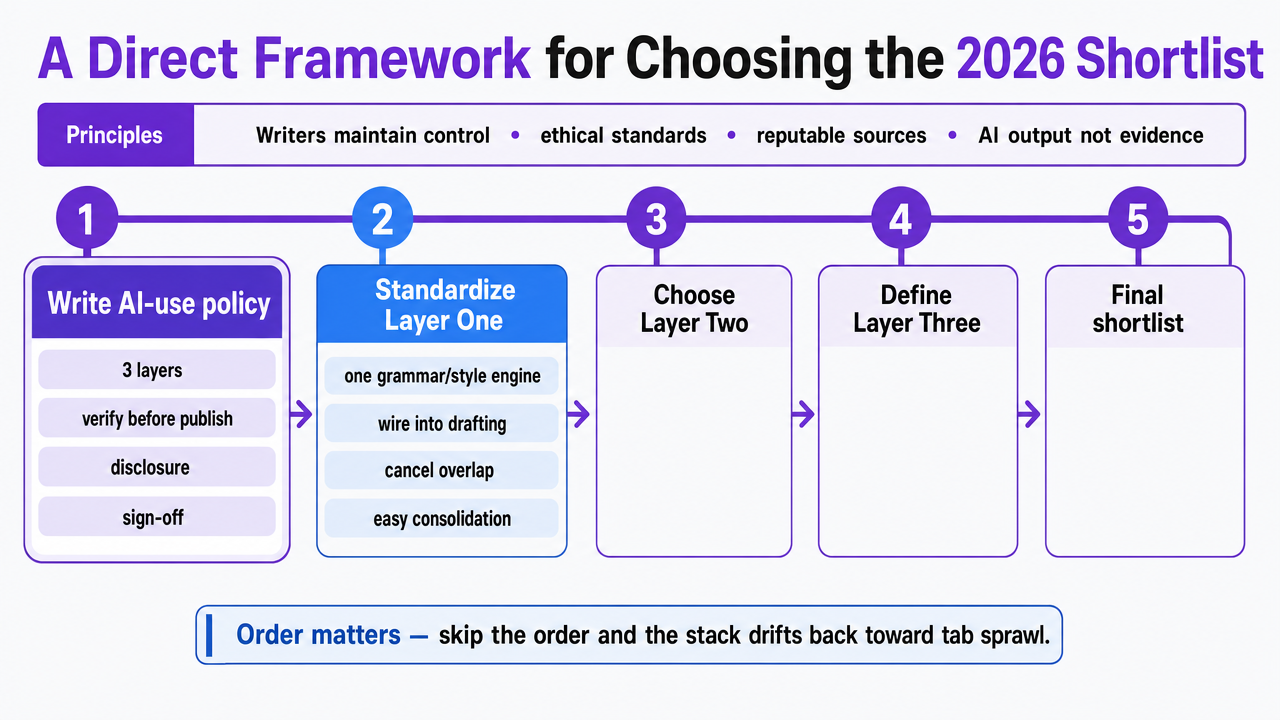
The 2026 shortlist collapses into five decisions, made in order. Skip the order and the stack drifts back toward the tab-sprawl problem this article opened with.
- Write the AI-use policy. Name what is allowed at each of the three layers, what must be verified before publish, how disclosure appears, and who signs off. A guidance-oriented review of AI in academic writing put the underlying principle plainly: writers should maintain control, uphold ethical standards, and rely on reputable sources rather than treating AI output as evidence.7 That principle is the spine of any workable policy.
- Standardize Layer One. Pick one grammar and style engine, wire it into the drafting environment, and cancel the overlapping subscriptions. This is the easiest consolidation win and it requires almost no governance conversation.
- Choose Layer Two for revision, not authoring. Point paraphrase and editing tools at existing prose and keep them out of empty documents.
- Restrict Layer Three to outlining, expansion, and compression, with mandatory human verification of every claim, citation, and named entity before publish.
- Put all three layers behind a single approval queue with a shared style reference. The workflow shape is the shortlist. The tool names are the interchangeable parts.
Frequently Asked Questions
References
- 1.The Transformative Impact of AI-Powered Writing Assistants in Education: A Comprehensive Systematic Literature Review.
- 2.Do Students Write Better Post-AI Support? Effects of Generative AI Literacy and Chatbot Interaction Strategies on Independent Multimodal Writing.
- 3.Artificial intelligence-assisted academic writing.
- 4.Generative Artificial Intelligence Guidelines (George Washington University).
- 5.AI-Assisted Writing and Academic Literacy: Investigating Students’ Perceptions and Practices.
- 6.Generative Artificial Intelligence (GenAI) for Academic Writing: A Systematic Review.
- 7.Using Artificial Intelligence (AI) for Academic Writing: How Not to Use It.
- 8.Generative Artificial Intelligence for Education and Pedagogy.
- 9.Examining the impact of AI-powered writing tools on independent academic writing.
- 10.Artificial intelligence-assisted academic writing.