
Key Takeaways
- The 40% drafting speedup matters less than the underlying shift: AI absorbs rough drafting so writers reallocate effort toward ideation, editing, and judgment-heavy work 2.
- Route drafts through three distinct review gates—brief quality, claims verification, and voice consistency—since skilled reviewers still defer to wrong AI answers 30–40% of the time 4.
- Keep strategy, brand voice, and regulated claims under human control, and require verification for every statistic and citation, given that nearly half of AI-generated references are fabricated 6.
- Track edit distance, claim-verification volume, and voice-consistency scoring alongside throughput to confirm the workflow is producing sharper content rather than faster mediocrity.
The 40% Drafting Compression Is Not the Real Story
In a preregistered randomized experiment with 453 college-educated professionals performing mid-level writing tasks—press releases, short reports, analysis plans, sensitive emails—access to ChatGPT cut average completion time by 40% and lifted independently rated output quality by 18% 1. These numbers are frequently cited, but they represent only a surface-level understanding of AI's impact.
The more significant finding from the study is that AI assistance substitutes for effort on rough drafting, shifting worker attention toward idea generation and editing 2. This means the tool didn't just make writers faster; it fundamentally changed their process. Time spent on initial drafting decreased, allowing more time for refining arguments and polishing prose.
For content operations, this distinction is crucial. Simply achieving a 40% drafting compression without workflow changes might only produce more first drafts of the same quality. However, by reallocating time—where the machine provides a serviceable first version—the overall quality ceiling can be raised. The 18% quality lift observed in the experiment came from workers who used this reallocated time to focus on tasks where human judgment excels 1.
This article explores where this reallocation truly benefits content production and where it can inadvertently lead to problems.
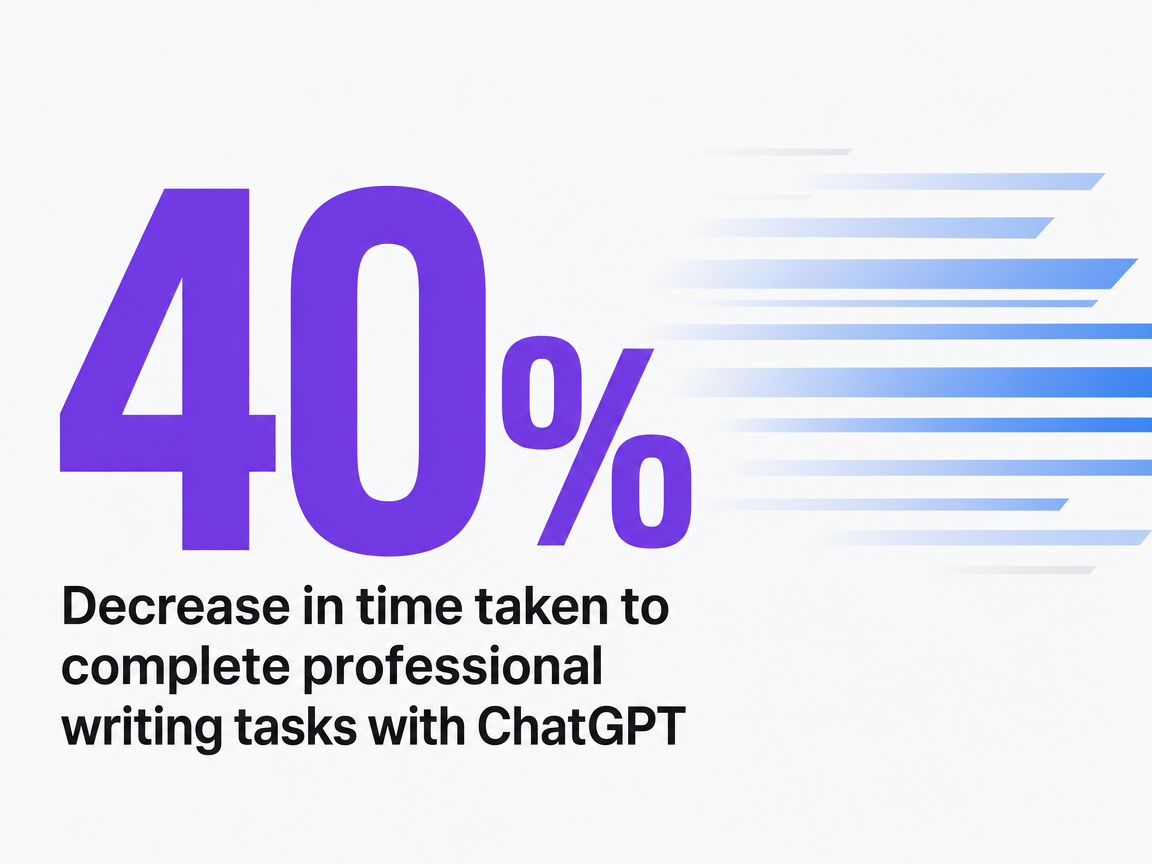 Decrease in time taken to complete professional writing tasks with ChatGPT
Decrease in time taken to complete professional writing tasks with ChatGPT
Where AI Substitutes for Effort vs. Where It Must Complement Judgment
Tasks the Assistant Absorbs: Rough Drafts, Outlines, Variant Copy
Evidence suggests that AI writing assistants excel at absorbing tasks that are repetitive or require structured information processing. The Noy and Zhang experiment showed that ChatGPT exposure restructured tasks, moving away from rough drafting and towards idea generation and editing 2. The AI didn't just speed up drafting; it took over the initial drafting process entirely.
This translates to specific content jobs:
- generating first-pass long-form drafts from an approved outline,
- expanding SEO briefs into working copy,
- creating meta descriptions and title tag variants at scale,
- repurposing content for email, social media, and landing pages,
- producing families of product descriptions with controlled variables, and
- summarizing interview transcripts into structured notes for writers.
These tasks are absorbable because their quality is primarily defined by clarity and coverage, not original insight, and a competent editor can quickly verify the output. For instance, a 900-word first draft that might take a staff writer three hours can be generated by AI in fifteen minutes, ready for an editor the same morning.
Deloitte's analysis of marketing and sales highlights the generation of personalized campaign copy and lead-adjacent messaging at volume as a key area where AI accelerates lead-to-quote workflows and enhances personalization at a speed traditional methods cannot match 10. This reinforces the pattern: AI handles the mechanical aspects of writing, freeing humans for judgment-based contributions.
Tasks That Stay Human: Strategy, Brand Voice, Regulated Claims
Understanding what AI should not do is critical, as most quality failures in AI-assisted content stem from misallocating tasks. Editorial strategy remains a human domain. Deciding what to publish, which audience segment a piece serves, and how a topic aligns with broader narratives requires contextual understanding—competitive positioning, sales feedback, and future plans—that AI models lack. A survey of knowledge workers indicated that generative AI is largely seen as a tool for menial tasks under human supervision, not for strategic decision-making 5. This perspective accurately reflects AI's optimal contribution.
Brand voice governance also stays human. While a model can imitate a style guide, it cannot determine when to deviate from the house voice for a specific piece or when an on-brand phrase might undermine a strategic positioning claim. Deloitte's work on the creator economy suggests that creators expect AI to complement their skills and free up time for higher-impact work, rather than to define brand identity itself 11.
Regulated claims, particularly in healthcare, legal, financial, or safety-related content, must be traceable to verifiable sources for compliance. While AI can assist in drafting, it cannot be the sole author of record. The final citation, claim wording, and approval must come from a human whose name is associated with the content.
The Jagged Frontier: Why Skilled Writers Defer to Wrong Answers 30–40% of the Time
A key study for content managers, though not directly about writing, involved a randomized field experiment where Boston Consulting Group consultants used GPT-4 on realistic consulting tasks. Participants with AI support completed 12.2% more tasks, worked 25.1% faster, and produced over 40% higher quality results on average compared to a control group 4. These figures illustrate the model's capabilities within its effective range.
However, beyond this frontier, the pattern reverses. When tasks exceeded GPT-4's capabilities, trained consultants still deferred to the AI's incorrect answers 30–40% of the time 4. Neither expertise nor familiarity with the tool prevented this. The AI's confident, well-formatted output was persuasive enough to override professional judgment, a rate of error that would be unacceptable in client deliverables.
For content operations, this "jagged edge" manifests in predictable ways:
- statistics without provenance,
- plausible but non-existent citations,
- nearly accurate historical facts,
- outdated legal or medical framings, and
- competitive claims about features that were never shipped.
The output appears correct but is fundamentally flawed.
The operational solution is not to slow down the workflow with universal skepticism, as the gains within the AI's effective range are too significant to sacrifice. Instead, specific claim types—numbers, citations, regulated statements, and competitive comparisons—should be routed through a mandatory verification step before publication. In all other areas, the AI assistant can operate at speed.
Redesigning the Content Pipeline Around Task Reallocation
From Rough Drafting to Ideation and Editing: What the Restructured Week Looks Like
Insights into AI writing assistance's impact on time allocation come from a multi-firm field experiment with Microsoft 365 Copilot. Workers using the tool for over half the sample weeks spent 3.6 fewer hours on email weekly (a 31% reduction) and completed documents 5–25% faster 3. This uneven reallocation across activities is a key benefit.
In a content operation, a restructured week would involve a significant shift. Hours previously spent drafting a 1,200-word piece from an outline are compressed into a brief period where the writer directs the AI, evaluates its output, and moves on. Time spent on initial email communications—such as clarifications with freelancers, SEO handoffs, or revision comments—is reduced by approximately a third. The time saved is then reallocated to the front and back ends of the process: creating sharper briefs, vetting sources more thoroughly, editing more closely against brand voice guidelines, and dedicating more attention to high-stakes content.
The implication is not simply to produce more articles per writer, but to produce the same number of articles with the writer's focus directed towards elements that drive performance. A staff writer who previously spent 60% of a project's budget on drafting and 40% on research, editing, and structure can invert this ratio without extending the timeline.
Two operational considerations are important. First, this reallocation only works if the brief and outline are finalized before the AI is engaged; otherwise, the machine dictates the direction, and quality suffers. Second, coordination-heavy activities like editorial standups, cross-functional reviews, and calendar planning are largely unaffected by individual AI adoption 3. Teams expecting throughput gains solely from AI without redesigning review structures may find drafting speedups absorbed by unchanged meeting loads.
Review Gates, Handoffs, and Approval-First Wiring
A drafting speedup without a corresponding review structure only leads to an accumulation of first drafts in the editor's queue. The bottleneck shifts from the writer to the editor, negating any throughput gains.
The solution is structural. An AI-assisted content pipeline requires review gates positioned where failure modes are most likely, rather than adhering to legacy workflow placements. Three primary gates address most issues:
- A brief-quality gate, ensuring the outline, target keyword, audience, and citation requirements are defined before AI drafting begins. Without this, the draft will likely be unfixable and require a complete rewrite.
- A claims gate, routing statistics, source citations, competitive comparisons, and regulated language for mandatory verification.
- A voice gate, where a senior editor confirms the piece aligns with the brand's voice rather than the model's default register.
Between these gates, handoffs must be concise and traceable. A knowledge-worker study found that participants viewed generative AI as a tool for menial tasks under human review, not a replacement for judgment 5. This perspective directly informs pipeline design: every AI-produced artifact should clearly indicate its origin, the prompt used, and the reviewer who approved it. This creates an audit trail that exists before publication.
"Approval-first wiring" means that nothing ships without a named human sign-off at each gate, and this sign-off is recorded. This is not bureaucratic overhead; it's the mechanism that allows teams to leverage AI at speed within its capabilities while mitigating risks outside them. A well-wired pipeline also streamlines the review process itself, as reviewers can evaluate pre-structured drafts against a checklist more efficiently than raw prose.
Teams that achieve throughput gains are those that redefine review not as a single vague step, but as three distinct gates with clear owners, criteria, and timestamps.
KPI Tracking When First Drafts Are Machine-Generated
Traditional content KPIs—such as articles published per month, average time-to-publish, and organic sessions per piece—remain valuable but become insufficient when first drafts are machine-generated. If drafting time is compressed by 40% under lab conditions 1 and integrated document work runs 5–25% faster in the field 3, throughput metrics will improve almost automatically. The crucial question is whether the content produced under the new workflow actually performs better.
Three additional metrics should be added to the dashboard:
- First, edit distance between the AI's first draft and the published version, tracked over time. A rising edit distance suggests the AI is deviating from the brief, while a falling distance without a quality drop indicates improved brief clarity.
- Second, claim-verification volume, which measures how many statistics, citations, and regulated statements the claims gate identified and corrected per piece. A zero count here is a warning sign, not a success.
- Third, voice-consistency scoring, assessed either by rubric or sample-based editor review, tracked per writer and topic cluster.
On the outcome side, the key variable to track is not "did AI help," but "did the reallocation help." Compare organic performance, conversion rates, and engagement of content produced under the redesigned pipeline against a matched baseline. If these numbers improve, the workflow redesign is delivering the predicted productivity benefits. If not, the AI is merely producing faster mediocrity, and attention should be directed to the brief quality or review gates before increasing volume.
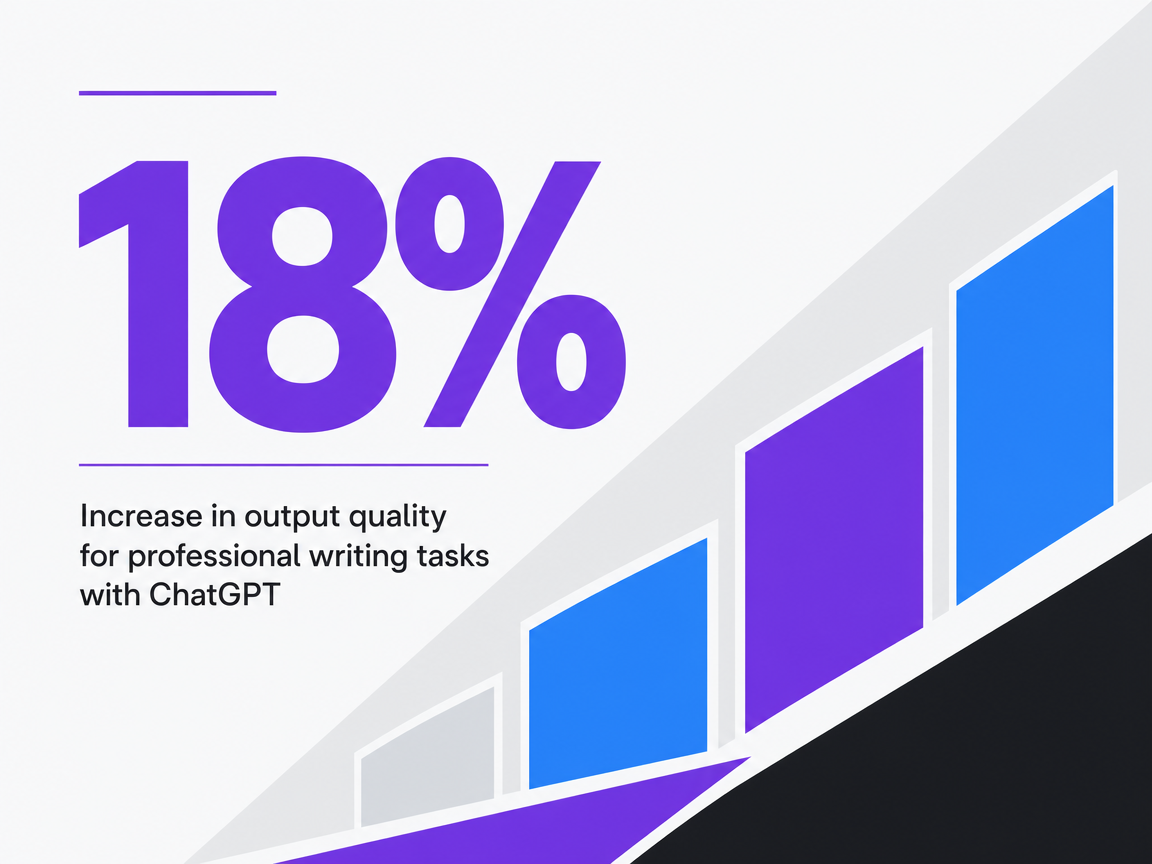 Increase in output quality for professional writing tasks with ChatGPT
Increase in output quality for professional writing tasks with ChatGPT
Test AI-assisted content workflows with real output
Experience measurable gains in content velocity and oversight by publishing live content during your trial.
Hallucinations, Fabricated Sources, and Skill Erosion: The Consolidated Risk View
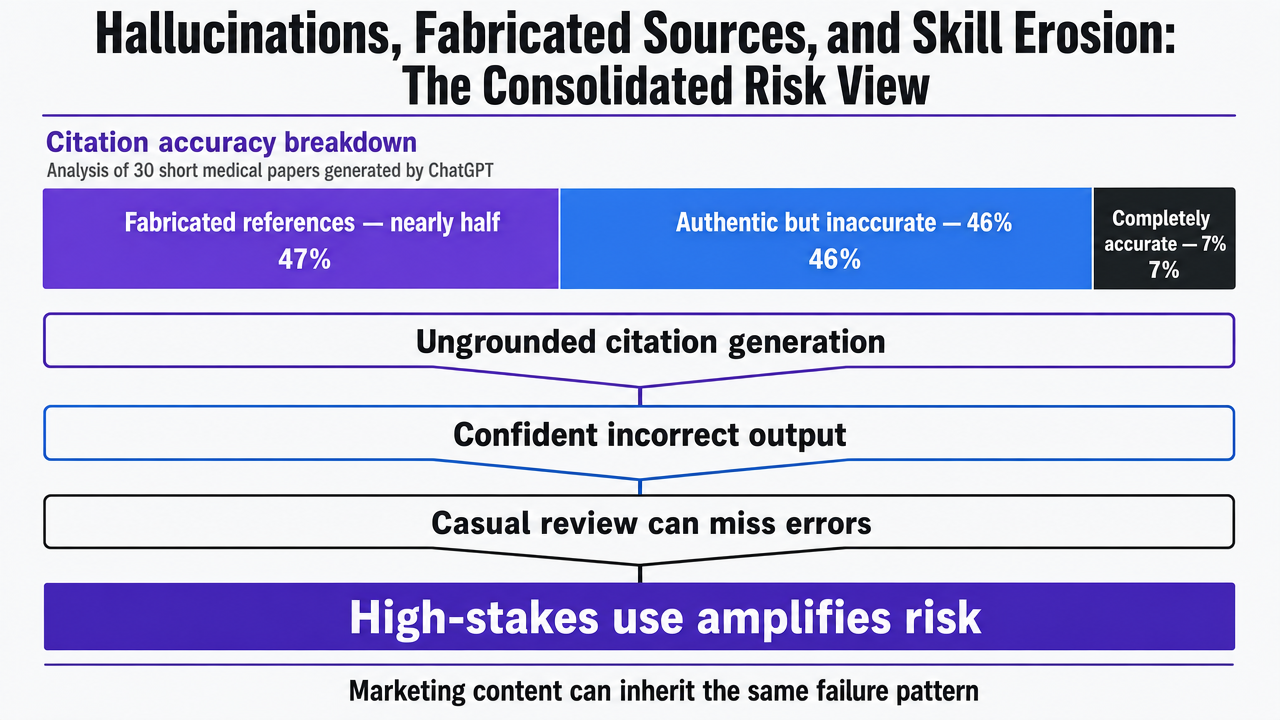
The failure modes of AI-assisted writing fall into three interconnected categories. A review of AI-assisted academic writing found that among 30 short medical papers generated by ChatGPT, nearly half of the references were fabricated, 46% were authentic but inaccurate, and only 7% were completely accurate 6. This distribution reflects the inherent behavior of the technology when asked to generate citations without proper grounding.
The mechanism behind this is well-documented. A review of hallucination risks across sectors highlights that not all information from generative AI is accurate, and in high-stakes fields, errors can lead to critically dangerous outcomes because the confident presentation of incorrect information often bypasses casual review 8. In marketing content, this translates to statistics attributed to plausible-sounding but non-existent sources, fabricated quotes, or regulatory claims based on outdated standards. The output appears correct and reads well, but it is factually wrong.
Skill erosion represents a slower, more insidious risk. The authors of the Noy and Zhang study noted that AI primarily substitutes for worker effort rather than complementing skills, raising concerns about long-term skill development in writing-intensive roles 2. A medical journal analysis further warned that over-reliance on AI tools can diminish essential writing and critical thinking abilities, and AI-generated text might unintentionally infringe on existing work without proper attribution 7. Writers who cease drafting risk losing the foundational skills necessary for sharp editing.
The operational response to these risks involves three key habits:
- Route every statistic, citation, and regulated claim through a verification step before publication.
- Require the writer of record to produce at least one substantive section without AI assistance for every piece, thereby preserving their writing skills.
- Log the prompt, the model's output, and all human edits to create a comprehensive audit trail.
Applied Use Cases: Personalization, Lead-Adjacent Copy, and Creator Workflows
Three categories of content work demonstrate the clearest returns from an integrated writing assistant, each aligning with distinct stages of the marketing funnel.
The first is personalization at production speed. Deloitte's analysis of generative AI in marketing and sales identifies personalized campaigns, accelerated lead conversion, reduced sales cycle time, and improved sales productivity as key operational benefits when AI is deployed across the lead-to-quote pipeline 10. This means generating segment-specific landing page variants, industry-tailored email sequences, and vertical-specific case study framings from a single approved source—tasks that a small team could not manually produce at the volume required by paid media.
The second is lead-adjacent copy where volume and consistency are prioritized over individual craft. This includes sales enablement one-pagers, follow-up email templates triggered by CRM actions, and various objection-handling scripts. The AI generates a working set, which the writer then edits for accuracy and voice, providing sales teams with material calibrated to specific pipeline stages rather than generic buyer personas.
The third category involves creator-style workflows. A Deloitte survey of creators found that the top anticipated use case for AI was as a creative assistant for generating new content ideas. Respondents viewed AI as complementary to existing skills, freeing up time for higher-impact work 11. For in-house teams, this translates to AI supporting briefing, generating headline batches, and creating social media variants, rather than authoring the brand's core voice.
See How AI Writing Assistants Streamline High-Volume Content Production
Connect with our team to evaluate how AI-powered workflows can help your content operation achieve measurable gains in speed and consistency—without increasing headcount or compromising brand standards.
If You Manage Multiple Locations or Practices: A Capacity Model
This section is for content managers overseeing editorial for multi-location operations, such as dental groups, senior living portfolios, home services franchises, or behavioral health networks, where each location requires specific content, and the content calendar grows with every new site.
At scale, the dynamics change. A single-brand team publishing four pillar pieces a month can integrate a writing assistant and manage. However, a team supporting 30 locations, each needing local service pages, market-specific blog coverage, and quarterly campaign variants, faces a different challenge: the production ceiling is determined by how much content one editor can meaningfully review, not by how quickly drafts are generated.
The capacity comparison below uses only sourced productivity variables from the studies cited previously. Dollar inputs are excluded as they vary by market.
| Model | Drafting hours per 1,200-word piece | Editor review hours per piece | Pieces per editor-week (40 hrs) |
|---|---|---|---|
| Traditional agency retainer | 4.0 (external) | 1.5 | ~26 |
| In-house team, no assistant | 3.5 | 1.0 | ~8 |
| In-house team, AI-assisted with review gates | 2.1 (–40% drafting) 1 | 1.2 (claims gate added) | ~12 |
Two observations emerge. First, the AI-assisted in-house model increases editor throughput by approximately 50% over the unassisted baseline without additional headcount, aligning with the 5–25% document completion speedup observed in field conditions 3. Second, while an agency retainer appears efficient on paper because external drafting hours are off the internal ledger, the internal editor still handles review. Review is where multi-location content often fails when locations receive identical pieces.
For portfolio operators, the key takeaway is that AI assistants do not eliminate the editor bottleneck; they shift the constraint from drafting capacity to review capacity. This is a more solvable problem through strategic gate design and location-specific brief templates.
What Content Managers Should Change This Quarter
Three actions distinguish teams that successfully leverage AI drafting speed from those that merely accumulate first drafts. None require new headcount, and each is supported by the evidence presented in previous sections.
- First, rewrite the brief template before using the tool. The reallocation from rough drafting to ideation and editing 2 is only effective when the outline, audience, keyword, and citation requirements are finalized before the AI runs. Skipping this step results in faster drafts of the wrong article.
- Second, implement three distinct review gates: brief quality, claims verification, and voice consistency, each with clear owners and timestamps. The claims gate is particularly crucial for preventing fabricated citations and out-of-frontier errors from being published, and it is a step many teams currently lack.
- Third, add edit distance, claim-verification volume, and voice-consistency scoring to the existing content dashboard. Throughput will naturally improve; these three metrics will reveal whether the content is becoming sharper or merely faster.
Platforms built around approval-first execution, such as Vectoron, integrate these gates directly into the workflow, rather than requiring them as additional layers.
Frequently Asked Questions
References
- 1.Experimental evidence on the productivity effects of generative artificial intelligence.
- 2.Experimental Evidence on the Productivity Effects of Generative Artificial Intelligence.
- 3.Shifting Work Patterns with Generative AI.
- 4.Navigating the Jagged Technological Frontier: Field Experimental Evidence of the Effects of AI on Knowledge Worker Productivity and Quality.
- 5.How Knowledge Workers Think Generative AI Will (Not) Transform Their Industries.
- 6.Artificial Intelligence-Assisted Academic Writing.
- 7.Con: Artificial Intelligence in Manuscript Writing: Pitfalls and Ethical Concerns.
- 8.Is Artificial Intelligence Hallucinating?.
- 9.Study finds ChatGPT boosts worker productivity for some tasks.
- 10.Generative AI in Marketing and Sales | Deloitte US.
- 11.GenAI and the Creator Economy: How creators are looking to AI.