
Key Takeaways
- Semrush and Ahrefs anchor traditional SERP share-of-voice and now flag Google AI Overview citations, but their coverage of ChatGPT, Perplexity, and Claude remains partial at best.
- Sprinklr and Brandwatch bundle competitive intelligence, sentiment, and crisis workflows for enterprise teams, though neither systematically tracks brand mentions inside LLM answers 1.
- Talkwalker adds broadcast, podcast, and image recognition coverage, making it worthwhile mainly when PR is a core channel and visual brand exposure drives reputation risk.
- Profound and Otterly run prompt panels across major LLMs to report share-of-citation, filling the GEO measurement gap that social suites and rank trackers leave open 5.
- Haus and other incrementality platforms use geo-based holdouts to produce CFO-defensible lift estimates, but require enough markets and sustained spend to reach statistical power.
- Vectoron sits beneath the measurement stack as an approval-first execution layer, turning visibility signals into ranked content actions that ship only after human sign-off 3.
Brand Visibility Now Lives in Three Measurement Zones
Brand visibility has evolved beyond traditional search engine rankings and social media mentions. McKinsey research indicates that approximately 50% of Google searches now yield AI summaries, a figure projected to exceed 75% by 2028. However, only 16% of brands systematically track AI search performance5. This significant measurement gap necessitates a re-evaluation of how marketing VPs organize their measurement stacks.
This new framework divides brand visibility into three distinct zones, each requiring specific data sources, tooling, and addressing unique failure modes.
The first zone encompasses traditional SERP and social share-of-voice. This includes rank tracking, keyword coverage, mention volume, sentiment analysis, and competitive benchmarking. These metrics remain crucial for demand capture and crisis detection, and the tools for this zone are well-established.
The second zone focuses on AI answer surfaces, often referred to as generative engine optimization (GEO). This involves measuring brand citations within platforms like ChatGPT, Perplexity, Claude, Gemini, and Google AI Overviews when buyers pose relevant questions. The tooling for GEO is relatively new, methodologies are still developing, and most competitors have yet to adopt systematic measurement in this area.
The third zone addresses incrementality on pipeline. This involves using geo-based holdouts, matched-market tests, and media mix models to determine the direct revenue impact of marketing spend. For CFOs, this is the ultimate measure of success, as share-of-voice without demonstrable lift is considered a vanity metric.
The following seven tools do not all operate across all three zones. The key to procurement is aligning the tool with the specific measurement zone it serves best.
The Procurement Matrix: Scoring Seven Tools Against Three Zones
No single vendor currently offers comprehensive coverage across all three brand visibility measurement zones. The procurement challenge lies in matching the right tools to the right zones and deciding where overlapping capabilities might justify additional investment. The matrix below evaluates seven tools based on their primary service zone, with an additional column for governance fit, particularly important for regulated industries that require strict approval workflows.
Forrester's analysis of the social suite market indicates a trend towards bundling competitive intelligence, crisis detection, and campaign measurement into single platforms. This explains the similar feature sets of tools like Sprinklr, Brandwatch, and Talkwalker, despite their varying capabilities in AI answer coverage1. While bundling simplifies procurement for the first zone, it typically does not extend to the second zone.
| Tool | SERP & Social | AI Answer Surfaces | Incrementality | Governance Fit |
|---|---|---|---|---|
| Semrush / Ahrefs | Primary | Emerging | None | Read-only |
| Sprinklr | Primary | Partial | None | Enterprise |
| Brandwatch | Primary | Partial | None | Enterprise |
| Talkwalker | Primary | Partial | None | Enterprise |
| Profound / Otterly | None | Primary | None | Read-only |
| Haus | None | None | Primary | Analyst-driven |
| Vectoron | Feedback loop | Feedback loop | Feedback loop | Approval-first |
This matrix should be viewed as a guide for procurement decisions rather than a simple scorecard. A marketing VP leading a lean team will likely need one tool per zone, complemented by an execution layer that translates visibility data into actionable content strategies for the next quarter.
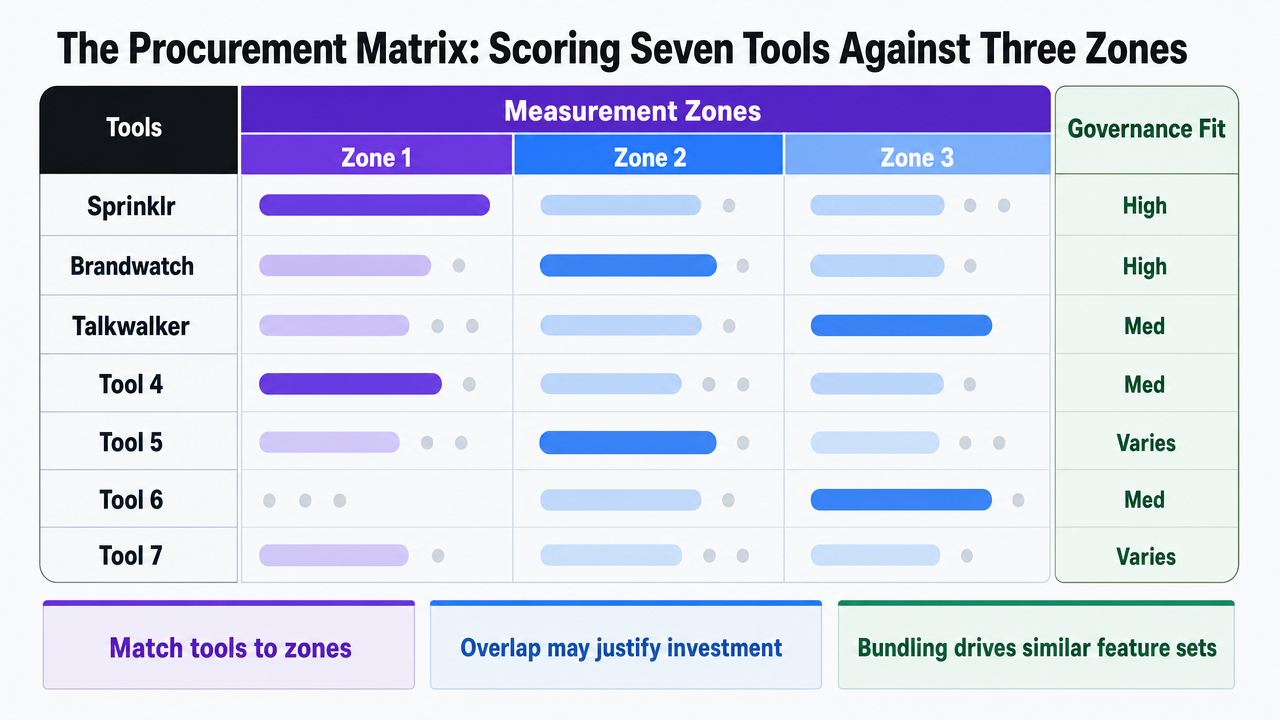 Visualize the three measurement zones and how the seven tools map across them, reinforcing the procurement framework central to this section
Seven Tools, Scored by What They Actually Measure
Semrush and Ahrefs: Classic SERP Share-of-Voice with Early AI Overview Tracking
Semrush and Ahrefs remain industry standards for rank tracking due to their extensive keyword indices, link graphs, and competitive share-of-voice reports. For VPs focused on demand capture and competitive analysis, these tools provide reliable weekly data on visibility, traffic value, and SERP feature ownership.
Their AI overview tracking capabilities are still developing. Both platforms now identify when a tracked keyword triggers a Google AI Overview and indicate which domains are cited within the summary. However, their coverage for other LLMs like ChatGPT, Perplexity, and Claude is either limited or non-existent. This aspect should be considered a partial signal rather than a definitive system of record.
These tools are best used for traditional organic share-of-voice, competitor link velocity, and identifying keyword sets for LLM optimization. They integrate easily with data warehouses, facilitating ROI reconciliation against pipeline data.
Sprinklr and Brandwatch: Social Suites for Competitive Intelligence and Crisis Detection
Sprinklr and Brandwatch represent the consolidated end of the social suite market. They aggregate data from social media, news, forums, and reviews, applying AI for sentiment and topic classification. Their dashboards combine share-of-voice, competitive intelligence, and crisis alerting. Forrester notes that this bundling of competitive intelligence, crisis detection, and campaign measurement into a single platform is a significant market shift1.
For an in-house VP, the value of these suites lies in their enterprise-grade taxonomy, multi-brand rollups, and robust crisis workflows with role-based routing. For example, a large behavioral health network monitoring sentiment across multiple locations benefits from location-level segmentation. Smaller organizations with fewer locations might find a lighter listening tool more cost-effective.
While both tools have incorporated AI summarization and assistant-style query interfaces, these features primarily enhance analyst productivity and do not replace dedicated AI answer surface measurement. Neither platform systematically tracks brand mentions within ChatGPT, Perplexity, or Claude.
Consider Sprinklr or Brandwatch when managing a large crisis surface area and when competitive benchmarking against named peers is a board-level reporting requirement. For other scenarios, a combination of a lighter listening tool and a GEO-native tracker may provide similar intelligence at a lower cost.
Talkwalker: Cross-Channel Listening with Image and Broadcast Coverage
Talkwalker distinguishes itself through its broad source coverage, extending beyond social and news to include broadcast television, podcasts, and image recognition data. This allows for the detection of logo and product appearances within visual content, a valuable feature for consumer brands with significant PR and broadcast exposure.
For B2B service providers, the broadcast and image features may be less critical. Talkwalker's Blue Silk AI engine, however, offers sentiment classification, emerging theme identification, and predictive alerts for conversation spikes. This enables organizations, such as senior living groups, to proactively detect reputation issues before they escalate.
Talkwalker's AI surface coverage mirrors that of Sprinklr and Brandwatch: it shows improvements in Google AI Overviews but remains limited in LLM citation tracking outside of Google. The decision to procure Talkwalker depends on whether its unique image, broadcast, and predictive alerting capabilities justify a suite-level contract. For many in-house teams in service verticals, this is only the case if PR is a primary marketing channel.
Profound and Otterly: GEO-Native Tracking of LLM Citations and AI Answer Surfaces
Profound and Otterly are specifically designed to address the measurement zone that social suites typically do not cover. These tools automate prompt panels against ChatGPT, Perplexity, Claude, Gemini, and Google AI Overviews, reporting which brands and URLs are cited in response to defined buying-stage questions. This generates a share-of-citation metric, analogous to traditional share-of-voice but for AI surfaces.
The methodology for GEO is still evolving. Prompt panels offer a sampled approximation of buyer behavior, not a comprehensive census of all queries. Vendors vary in the models they poll, frequency, geographic scope, and personalization considerations. VPs investing in this area should request written disclosure of prompt design, sampling cadence, and model coverage.
The emergence of this category is driven by the McKinsey finding that 50% of Google searches return AI summaries, while only 16% of brands track AI search performance5. This measurement asymmetry presents a significant opportunity, which Profound and Otterly are designed to address.
Mid-market service operators should consider using these tools in conjunction with Semrush or Ahrefs, rather than as replacements. While classic SEO measures page performance, GEO measures whether the page is cited within AI answers.
Haus and Incrementality Testing Platforms: Geo-Based Lift for Always-On Brand Spend
Haus is a leading tool for geo-based incrementality testing. This method involves holding out media in matched markets, measuring the resulting difference in conversions, and producing a defensible lift estimate for CFOs. For ongoing brand spend, this is the only measurement that definitively answers whether the investment generated revenue that would not have occurred otherwise.
Other platforms in this category include Recast, INCRMNTAL, and modernized legacy Media Mix Modeling (MMM) vendors. The choice among these depends on factors such as data integration capabilities, refresh cadence, and the platform's ability to conduct continuous experiments rather than just quarterly analyses.
A key operational consideration is that incrementality testing requires statistical power, which necessitates sustained spend across a sufficient number of markets to detect a meaningful difference. A single-location practice typically lacks the geographic scope for a credible test. However, a multi-location organization, such as a forty-location DSO or a behavioral health network operating in twelve states, would be well-suited. Below this threshold, geo-based lift may not be appropriate, and VPs should instead rely on matched-market pre-post analysis with clearly documented caveats.
Vectoron: Approval-First Execution with Measurement Feedback into the Content Engine
Vectoron occupies a unique position in the measurement matrix. It does not directly compete with tools like Semrush for rank tracking, Profound for LLM citation panels, or Haus for geo lift. Instead, Vectoron integrates with existing measurement stacks, leveraging their signals to prioritize and recommend content actions. These recommendations are then routed through a Command Center for human approval before execution across content, SEO, social, and call intelligence channels.
This approach addresses the gap identified by McKinsey between generative AI adoption and disciplined measurement: many organizations report benefits but lack the mature governance and measurement practices to validate them3. Visibility tools that do not feed into an execution loop often produce dashboards without generating pipeline.
Vectoron's operational model is built on approval-first automation. AI strategists analyze qualified calls, bookings, cost per lead, and ranking movements to generate ranked recommendations with supporting rationale. No work is shipped without explicit sign-off. For lean in-house teams seeking to reduce agency overhead, Vectoron serves as the execution layer beneath the measurement stack, offered at $599/month after a two-week trial.
Track Brand Visibility Metrics With Full Access
Measure brand impact on real campaigns before committing to a long-term solution.
The Four-Metric ROI Ledger a CFO Will Accept
While a procurement matrix guides tool selection, a robust ROI ledger demonstrates financial returns. Forrester's guidance on marketing analytics emphasizes that the practice must measure campaign, channel, and tactic data against business objectives, with KPIs aligned to leadership's definition of value4. Visibility metrics that do not translate into finance-readable line items risk being cut during budget cycles.
Four key metrics carry this weight, each corresponding to a specific tool category and addressing a direct question a CFO would ask:
Assisted Pipeline : This metric is sourced from the CRM, integrated with organic and social visibility data from tools like Semrush, Ahrefs, or a social suite. It answers: "Of the opportunities created this quarter, how many involved a touchpoint with branded organic, branded social, or a tracked review surface before the demo was booked?" This is not last-click attribution but a touch-coverage count that justifies ongoing spend by illustrating the deal flow influenced by brand visibility.
AI-Citation Share : Derived from GEO-native tools like Profound or Otterly, this metric answers: "Across a defined panel of buying-stage prompts, what percentage of AI answers cite our brand versus named competitors?" Tracking this monthly with a consistent prompt set allows for quarter-over-quarter trend comparison, serving as a leading indicator of compounding GEO investment.
Incremental Lift : Sourced from platforms like Haus, Recast, INCRMNTAL, or matched-market tests, this metric addresses: "Of the conversions attributed to brand spend, how many would not have occurred otherwise?" This is the only metric in the ledger that provides a causal link, making it essential for finance reviews, even if tests are conducted quarterly.
Cost per Visible Impression : Calculated by dividing total brand and content investment by the sum of tracked impressions across SERP, social, and AI answer surfaces. This metric answers: "Are the unit economics of visibility improving, holding, or degrading as spend scales?" A flat or declining cost per visible impression, coupled with rising pipeline, provides a strong argument for program renewal.
Present all four metrics on a single page, refreshed monthly, with the source tool clearly labeled for each line item. This consolidated ledger replaces fragmented dashboards, providing the clear financial narrative that finance teams require.
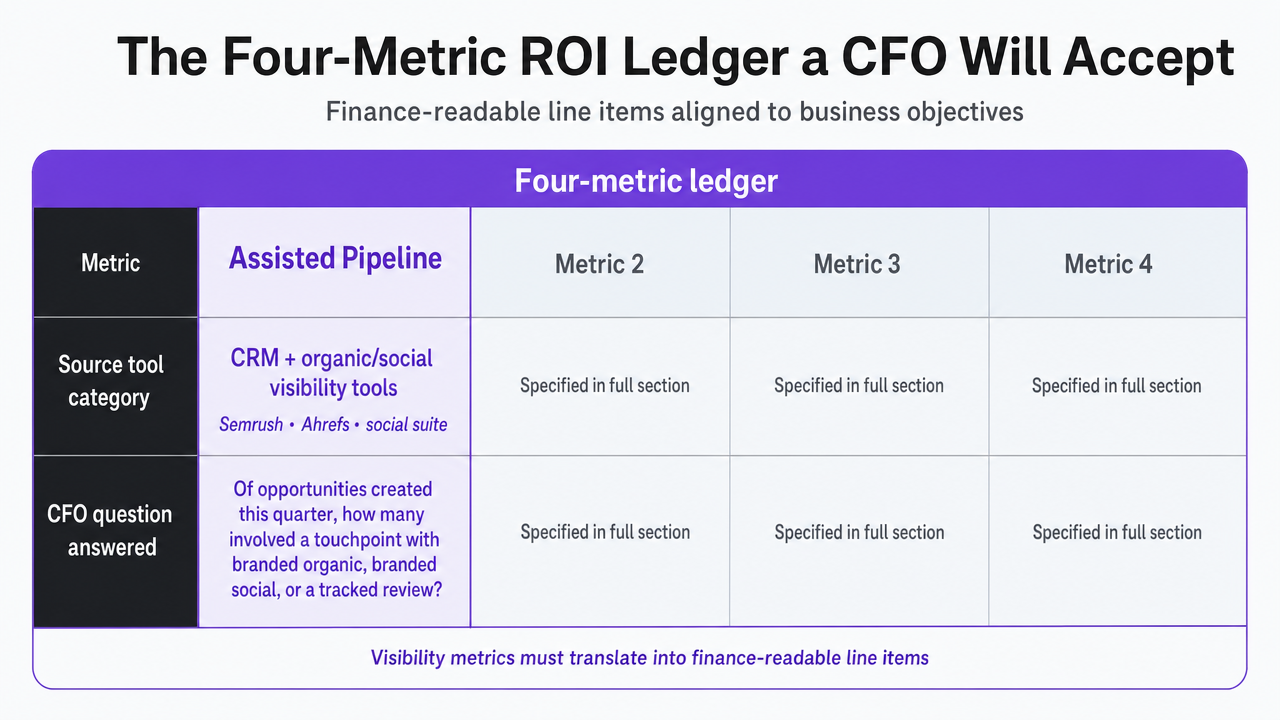 Diagram the four-metric ledger structure described in the section, showing each metric, its source tool category, and the CFO question it answers
What AI Tracking Tools Cannot Do
While AI tracking tools are often marketed as providing automated insights, their capabilities are more constrained. Forrester's assessment of the social listening market, which remains relevant as AI layers have deepened, indicates that these platforms can sense and process information, but they do not autonomously act on their findings. Human intervention is still required to interpret signals and make decisions2. This limitation applies equally to GEO-native tools tracking LLM citations.
Three common limitations persist:
- Prompt panels are sampled, not exhaustive. A share-of-citation report reflects how a specific set of prompts resolved on a given day, not every buyer's query. This metric should be treated as a directional index rather than a complete census.
- Sentiment classification in social and review data can still misinterpret sarcasm, industry jargon, and clinical context. Analysts must spot-check to avoid misclassified mentions.
- These tools do not directly attribute revenue. Visibility data contributes to an attribution model but does not replace it.
The operational implication is that VPs investing in this measurement stack must allocate analyst hours for each tool, rather than assuming AI eliminates the need for human oversight.
If You Manage Multiple Locations, the Math Changes
For VPs managing a single brand from one office, the primary consideration is tool selection. However, for multi-location operators—such as a DSO with forty practices, a behavioral health network across twelve states, or a home services franchise with regional P&Ls—the visibility stack interacts with a different cost structure. The decision between agency and platform solutions becomes more complex when scaled across numerous locations.
Three operating models are common among mid-market service operators, each with distinct cost structures and measurement coverage profiles. The table below uses Vectoron's post-trial price as a fixed anchor, while agency retainers and fully-loaded headcount are presented as variables due to their wide market fluctuations.
| Operating Model | Monthly Cost Structure | Measurement Coverage | Approval Governance | Scalability per Added Location |
|---|---|---|---|---|
| Agency + point tools | Agency retainer $A + tool licenses $T per location | SERP/Social via agency reporting; GEO and incrementality rarely included | Agency-led, VP signs off on deliverables | Linear: retainer scales with scope |
| In-house team + point tools | Senior analyst FLC $S + tool licenses $T per location | SERP/Social and partial GEO; incrementality if analyst has the chops | VP and analyst, slower cycle | Sub-linear if analyst absorbs new locations |
| AI execution platform + measurement stack | $599/mo platform + tool licenses $T | SERP/Social, GEO, and incrementality feedback loop into execution | Approval-first, every recommendation routed to VP | Flat platform cost, marginal tool cost per location |
The crossover point for these models is typically around ten locations, where an agency retainer often remains viable. Beyond twenty locations, the cost-effectiveness of an agency retainer diminishes compared to a platform that maintains a flat platform cost as locations scale. The measurement coverage column highlights a critical difference: agency reporting often lacks coverage for AI answer surfaces or incrementality, meaning two key metrics for CFOs may be absent from deliverables.
See How Leading Teams Quantify Brand Visibility With AI—Down to the Revenue Impact
Request a tailored walkthrough of AI-powered visibility tracking platforms proven to connect share of voice, pipeline, and closed-won revenue—built for agencies and enterprise marketing operations.
Governance for Regulated Verticals: Measure, Test, Monitor
For VPs in regulated sectors such as behavioral health, legal, dental, and senior living, the visibility stack also functions as a compliance surface. AI tools that generate, summarize, or retrieve content for a brand are subject to the same oversight expectations now applied to AI systems generally. The NIST AI Risk Management Framework, updated in 2024 with a generative AI profile, emphasizes the need to govern, map, measure, and manage AI systems7. Furthermore, the FTC's September 2025 inquiry into AI chatbots requires companies to disclose how they "measure, test, and monitor" AI behavior and its downstream impact8.
Translating this into the visibility stack requires three key controls:
- All AI-generated or AI-influenced assets must undergo documented human approval before publication.
- Prompt panels and LLM citation reports must include the date, model version, and prompt set to ensure reproducibility during audits.
- Sentiment and classification outputs pertaining to protected categories—such as patient status, clinical condition, or legal matter type—must be sampled by a human reviewer on a regular basis, rather than being solely trusted as ground truth.
Governance is not a separate task; it is an integral approval layer within the measurement stack.
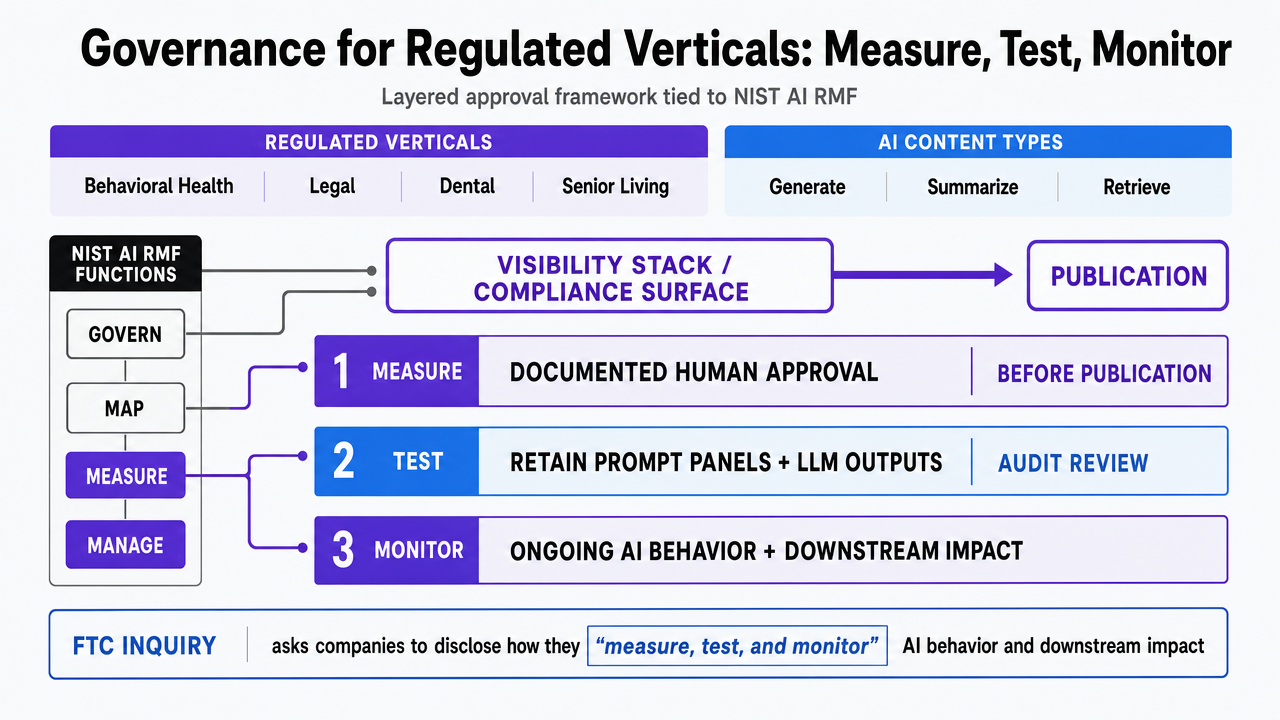 Visualize the three governance controls described in the section as a layered approval framework tied to the NIST AI RMF functions
The Operating Decision in Front of You
The critical buying decision is not about which tool has the most features, but rather which combination of tools can feed a four-metric ledger that a CFO will approve, and which execution layer can translate that ledger into tangible work in the next quarter. The optimal operating model involves one tool per measurement zone, a single, consolidated ledger, and an approval workflow that connects them all.
McKinsey's analysis of generative AI adoption highlights that while organizations report benefits, only a minority possess the mature governance and measurement practices needed for validation3. The teams that successfully bridge this gap in 2025 will not be those with the most dashboards, but those whose visibility data directly informs ranked, approval-gated execution, rather than merely populating slide decks.
For lean in-house teams with pipeline targets, the decision is about strategic sequencing. Prioritize standing up a GEO tracker before renewing a social suite. Select one incrementality partner. Maintain the four-metric ledger monthly. Vectoron serves as the execution layer once the measurement stack is established.
Frequently Asked Questions
References
- 1.Social Suites Mature With New AI Workflows And Expanded Use Cases.
- 2.AI Is Not Your Savior In Social Listening.
- 3.The state of AI in early 2024: Gen AI adoption spikes and the risk of inaccuracy.
- 4.Use Marketing Analytics To Support Your 2023 Marketing Strategy.
- 5.New front door to the internet: Winning in the age of AI search.
- 6.Marketing and sales soar with generative AI.
- 7.AI Risk Management Framework | NIST.
- 8.FTC Launches Inquiry into AI Chatbots Acting as Companions.
- 9.Semantic Search of FDA Guidance Documents Using Generative AI.
- 10.AI-driven disinformation: policy recommendations for democratic resilience.