
Key Takeaways
- Brandwatch brings deep historical social, forum, and review data with retrofitted AI summarization, but lacks native assistant-surface querying, making it a fit for sentiment and share-of-search gaps only.
- Sprinklr offers the strongest consolidation play across marketing, CX, PR, and research consumers of listening data, though it still needs a partner tool to close the share-of-model gap.
- Meltwater anchors on PR and media monitoring with high-fidelity alerting and crisis detection, making it the right pick when reputation defense outweighs buyer-discovery measurement inside assistants.
- Profound is purpose-built for share of model, querying named assistants on a defined prompt taxonomy and producing the cleanest measurement when buyers are shortlisting through ChatGPT, Perplexity, or Gemini.
- Peec AI matches Profound on assistant depth and adds granular competitor citation tracking, useful for teams that want visibility into the third-party sources feeding model recommendations.
- AthenaHQ pairs share-of-model measurement with an optimization layer that surfaces citation gaps to fill, suited to teams with content capacity to act on the data rather than just report it.
- Semrush AI Toolkit extends existing share-of-search reporting into Google AI Overviews as an add-on, making it the consolidation move when keeping search and AI-surface data under one vendor matters.
The category split most VPs miss before they buy
Procurement decks for brand visibility tools usually collapse two different products into one line item. That conflation is where most in-house marketing leaders waste a renewal cycle.
The market has bifurcated. On one side sit legacy social listening platforms—Brandwatch, Sprinklr, Meltwater—that have bolted AI sentiment and summarization onto a stack originally built for Twitter firehoses, review sites, and forums 1. On the other side, a newer class of trackers measures how a brand surfaces inside ChatGPT, Perplexity, Gemini, and Google AI Overviews when a buyer asks a category question. Different data sources, different math, different buyer.
VPs who treat these as interchangeable end up either over-paying for redundant listening coverage or under-measuring the assistant surfaces now intercepting demand before it reaches a SERP. The right question is not which platform leads a G2 grid. It is which measurement gap—share of search and sentiment, or share of model—the team is actually being asked to close this quarter, and which of the seven options below maps to that gap.
Share of search vs. share of model: the two gaps to close
Two leading indicators now define brand visibility measurement, and they sit in different data layers. Share of search—the percentage of category-level branded queries a company captures relative to competitors—remains the most predictive early signal of market share movement, which is why PMG and others position it as a forward-looking complement to MMM and brand lift studies 2. Share of model is its emerging counterpart: the rate at which a brand surfaces, is cited, or is recommended inside ChatGPT, Perplexity, Gemini, and Google AI Overviews when a buyer asks a category question. Same job, different surface.
The social listening category that historically owned share-of-search reporting is still expanding. Coherent Market Insights projects the social media listening market specifically—not the broader AI marketing stack—will grow from USD 11.91 billion in 2026 to USD 29.63 billion by 2033, a 13.9% CAGR 5. That trajectory matters because most VPs already pay for one tool in this bucket and are now being asked whether to expand the contract or redirect budget toward an AI-answer tracker that covers the model surface their incumbent does not.
The operational test is simple. If pipeline is leaking because category buyers are asking assistants for vendor shortlists and the brand is absent from those answers, the gap is share of model. If competitors are dominating branded query growth and review sentiment on traditional channels, the gap is share of search. The seven trackers reviewed below resolve one gap well, the other passably, or attempt both with uneven depth.
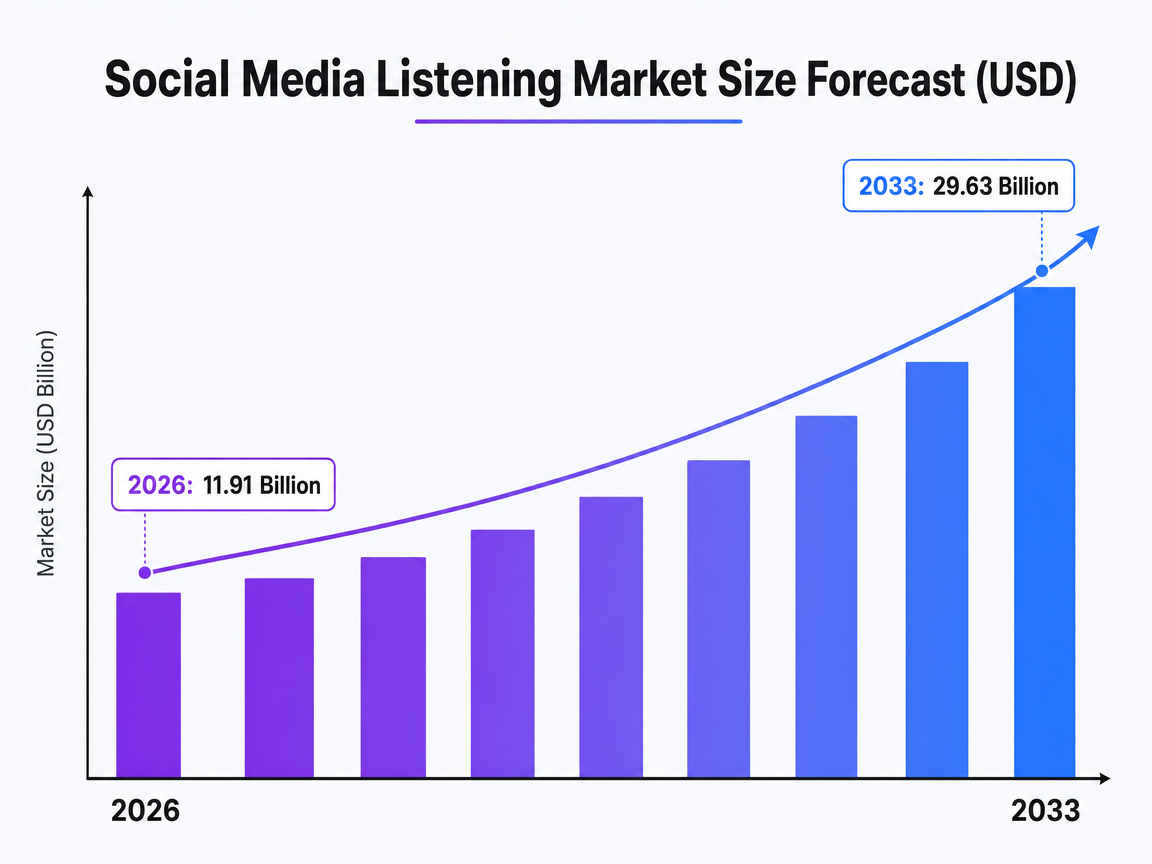 Social Media Listening Market Size Forecast (USD)
Shows the projected growth of the Social Media Listening market from USD 11.91 billion in 2026 to USD 29.63 billion by 2033.
Five operator criteria the shortlist is scored against
Feature checklists from vendor decks make poor procurement evidence. The criteria below were chosen because each one maps to a budget line a VP already defends to a CEO or board: pipeline contribution, headcount avoided, stack rationalization, and risk exposure. Every tool in the next section is scored against these five, and a tool that wins on coverage but loses on pipeline integration is not the same purchase as one that wins on alerting but cannot consolidate the stack.
Coverage breadth across owned, earned, and assistant surfaces
Breadth means the tracker pulls signal from owned channels (site, reviews, branded search), earned channels (social, news, forums, podcasts), and assistant surfaces (ChatGPT, Perplexity, Gemini, Google AI Overviews) without a second contract. The baseline definition of social listening assumes multi-channel monitoring tied to defined keywords and goals 1. A tracker that covers only two of the three surface classes leaves a measurement seam the team has to patch with manual reporting or a second vendor.
AI-surface depth in ChatGPT, Perplexity, Gemini, and AI Overviews
Depth, not just presence. The tracker should query named assistants at a defensible cadence, log brand mentions, citations, and recommendation rank against a competitor set, and separate prompt-level results from aggregate share-of-model scores. Shallow coverage—scraping one model weekly with no prompt taxonomy—produces noise. Depth also means surfacing how AI-generated content shapes those answers, since generative tools have lowered the barrier for misinformation that can contaminate model training and retrieval 8.
Pipeline integration with the measurement stack
A visibility score that lives in a standalone dashboard is a reporting asset, not a revenue input. The tracker should push share-of-search and share-of-model signals into the warehouse, CDP, or BI layer where MMM, incrementality tests, and attribution already run. McKinsey's performance branding work makes the case explicit: a single source of truth on customer data, fed by a CDP, is what lets brand investment connect to performance outcomes 3. Native exports, an API, and a documented schema are table stakes.
Alerting fidelity for sentiment, misinformation, and crisis triggers
Fidelity is the gap between a useful alert and a Slack channel everyone mutes. The bar: configurable thresholds, sentiment classification accurate enough to suppress neutral noise, and detection of emerging false narratives before they propagate. AI-driven reputation tools are now judged on real-time listening, automated sentiment analysis, and instant crisis alerts as a baseline capability set 9, with the response workflow—not just the detection—determining whether the alert actually shortens time-to-containment 10.
Consolidation potential against an existing stack
Most in-house teams inherit two or three overlapping contracts: a social listening platform, a review monitor, an SEO share-of-search tool, sometimes an emerging LLM tracker. Consolidation potential measures how many of those line items a single platform can absorb without degrading coverage for the other enterprise consumers of the data—CX, market research, PR, and product all draw on the same listening feeds 7. A tool that replaces three contracts at parity beats a best-in-class point solution that replaces none.
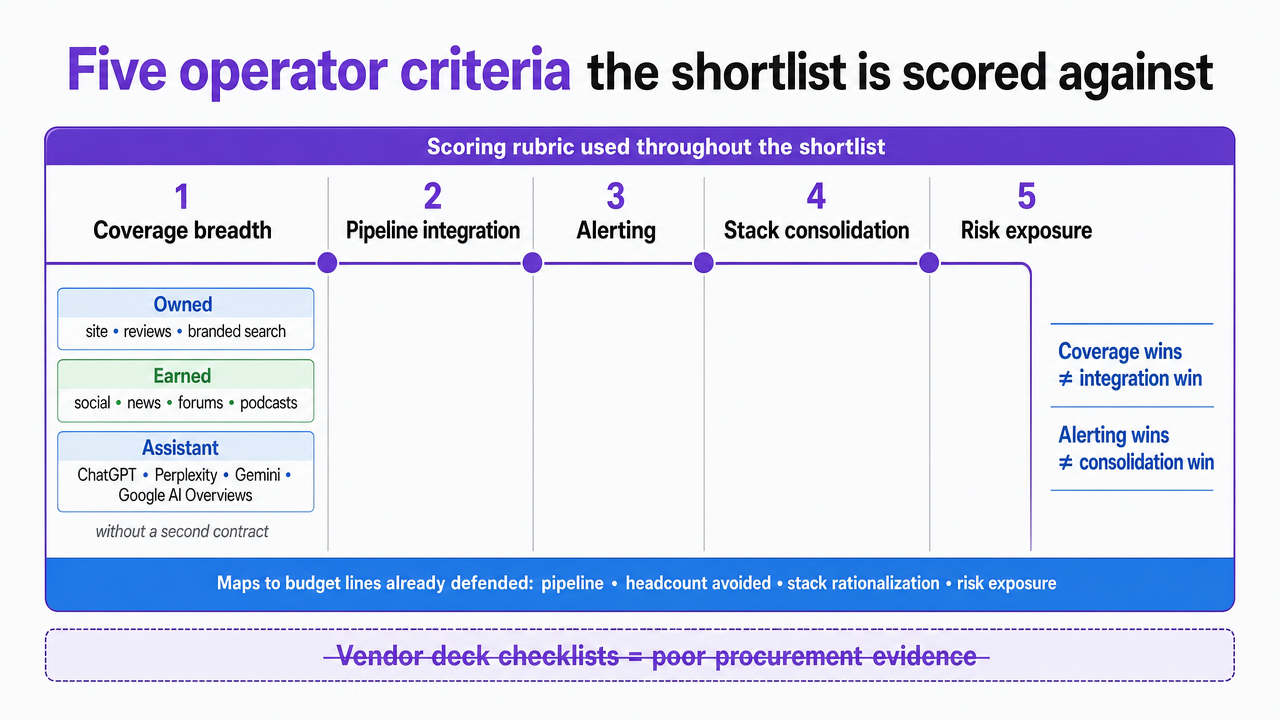 Visualize the five operator criteria as a framework infographic, since this section explicitly defines a scoring rubric used throughout the article
Test AI brand visibility tracking on live channels
Monitor, analyze, and optimize your brand’s visibility with actionable reporting from your own real campaigns.
The seven trackers, scored against the rubric
The shortlist below covers three legacy listening platforms with retrofitted AI layers, three AI-answer visibility specialists, and one hybrid that bridges share of search and AI Overviews. Each entry names what the tool does well, where the rubric exposes a gap, and which measurement gap it actually closes for a VP defending the renewal.
Brandwatch — depth in legacy listening, retrofitted AI features
Brandwatch's core asset is a deep historical index of social, forum, news, and review data—the kind of corpus social listening was built to mine 1. The AI layer adds generative summarization, topic clustering, and sentiment scoring on top of that index, which is useful for trend reporting and competitive narrative work.
Coverage breadth scores high across earned and owned surfaces. AI-surface depth scores low: querying ChatGPT or Perplexity for category recommendations sits outside the product's native data sources, and any answer-engine tracking requires a second tool. Pipeline integration is workable through Iris exports and the API, though most teams end up writing a transformation layer to land the data in a warehouse alongside MMM inputs 3.
The verdict for a VP: a defensible pick if the measurement gap is sentiment, share of search on social, and reputation tracking. Not the answer if the gap is share of model.
Sprinklr — enterprise breadth for multi-stakeholder consumers of visibility data
Sprinklr was built on the premise that visibility data has consumers beyond marketing. Forrester's framing aligns with that pitch: social listening is applicable across data and analytics, customer insights, market research, and PR teams, not only the social media manager 7. Sprinklr's modular suite—Insights, Service, Marketing, Social—lets a single contract feed all four.
That breadth is also the trade-off. Implementation is heavier, governance more involved, and the AI-answer surface remains a coverage gap that requires a partner tool. Coverage breadth and consolidation potential score the highest in the rubric here; AI-surface depth scores in the middle, lifted by Sprinklr AI+ summarization but not by native model-side querying.
The verdict: the strongest consolidation play on the listening side, particularly when CX, PR, and product all have legitimate claims on the listening feed. It does not close the share-of-model gap on its own.
Meltwater — PR-anchored monitoring with sentiment and reputation tilt
Meltwater's center of gravity is media monitoring, which shapes how it scores against the rubric. News, broadcast, podcast, and influencer coverage are first-class data sources, and the AI layer focuses on sentiment classification and reputation signals rather than answer-engine querying.
Alerting fidelity is where Meltwater earns its keep. Configurable thresholds, narrative detection, and the kind of real-time listening and instant crisis alerts that AI reputation tools are now judged on form the spine of the product 9. Edelman's warning that generative AI lowers the barrier to sophisticated misinformation makes that capability more than a nice-to-have for any brand with a recognizable consumer footprint 8.
Coverage breadth is solid on earned media, lighter on community forums and review sites. AI-surface depth is low. The verdict: a strong pick when the gap is PR-led reputation defense and crisis response, not when the gap is buyer discovery happening inside an assistant.
Profound — AI-answer visibility built for ChatGPT, Perplexity, and Gemini
Profound is purpose-built for the share-of-model gap. The product queries named assistants—ChatGPT, Perplexity, Gemini, Google AI Overviews—on a defined prompt taxonomy, logs brand mentions, citations, and recommendation rank against a competitor set, and rolls the prompt-level data into aggregate share-of-model scores.
AI-surface depth scores the highest of any tracker on this list. Coverage breadth scores low: there is no native social, review, or news listening, so the tool does not consolidate an inherited stack. Pipeline integration is improving through API access, which lets a team push share-of-model alongside share-of-search into the same warehouse table that feeds MMM and attribution 3.
Alerting fidelity is competent for prompt-level rank changes, less developed for sentiment or misinformation surfaces. The verdict: the cleanest answer when the measurement gap is buyers asking assistants for category shortlists and the brand is missing from those answers. Pair it with an incumbent listening tool rather than replacing one.
Peec AI — share-of-model tracking for emerging generative surfaces
Peec AI competes in the same bucket as Profound and treats share of model as the headline metric. The product tracks brand visibility across the major assistants and adds competitor benchmarking, citation source analysis, and prompt-cohort segmentation that growth teams can map to category, persona, or funnel stage.
AI-surface depth scores high. The differentiator versus other AI-answer specialists is the granularity of competitor citation tracking—knowing which third-party sources the model is pulling from when it cites a competitor, which informs PR and content placement strategy. Coverage breadth scores low for the same reason Profound does: no native social or review listening.
Pipeline integration is lighter than the legacy platforms, though sufficient for a team that exports to a warehouse on a weekly cadence. The verdict: a defensible alternative when the team wants share-of-model coverage plus visibility into the citation supply chain feeding the models, and already has a listening tool in place.
AthenaHQ — answer-engine optimization paired with citation tracking
AthenaHQ pairs share-of-model measurement with an optimization layer aimed at improving how brands appear in assistant answers. Tracking covers ChatGPT, Perplexity, Gemini, and AI Overviews; the optimization layer surfaces which content assets and third-party citations are driving inclusion, then recommends gaps to fill.
The product's bet is that measurement without an action layer leaves the team with a dashboard and no path to influence the score. That bet maps to McKinsey's performance branding thesis: granular measurement matters most when paired with the operational capacity to act on it 3. AI-surface depth scores high, pipeline integration is improving, alerting fidelity is adequate for rank movements.
Coverage breadth is narrow by design—no social listening, no review monitoring. The verdict: the right pick when the team is willing to act on share-of-model data rather than just report it, and has the content production capacity to close the citation gaps the tool surfaces.
Semrush AI Toolkit — share of search extended into AI Overviews
Semrush is the hybrid on this list. The core SEO platform already covers share of search at scale, and the AI Toolkit extends that coverage into Google AI Overviews and assistant-style answers. For a team that already pays Semrush for keyword and SERP intelligence, the AI Toolkit is an incremental add-on rather than a new contract.
That economics matters. Most VPs already have a share-of-search tool, and PMG's framing of share of search as a leading indicator of market share movement makes that line item hard to cut 2. Adding AI Overviews coverage at the same vendor is the consolidation play in this bucket.
AI-surface depth scores moderate—coverage of ChatGPT, Perplexity, and Gemini is less mature than the specialist trackers. Coverage breadth scores high on search, lower on social. The verdict: a sensible pick when the gap is AI Overviews specifically and the team wants to keep share-of-search and AI-surface reporting under one vendor.
Scorecard: how the seven map against the five criteria
The matrix below applies the rubric from section 3 to each tracker on a 1–5 scale. Scores reflect editorial assessment of documented capabilities against the five operator criteria, anchored to share of search as the leading indicator that organizes the framework 2.
| Tracker | Coverage breadth | AI-surface depth | Pipeline integration | Alerting fidelity | Consolidation potential ||---|---|---|---|---|---|| Brandwatch | 5 | 2 | 4 | 4 | 4 || Sprinklr | 5 | 3 | 4 | 4 | 5 || Meltwater | 4 | 2 | 3 | 5 | 3 || Profound | 2 | 5 | 4 | 3 | 1 || Peec AI | 2 | 5 | 3 | 3 | 1 || AthenaHQ | 2 | 5 | 4 | 3 | 1 || Semrush AI Toolkit | 4 | 3 | 4 | 3 | 4 |
The pattern is legible at a glance. The legacy listening platforms cluster in the top-left quadrant—strong on breadth, alerting, and consolidation, weak on assistant surfaces. The AI-answer specialists invert that profile: 5s on model depth, 1s on consolidation. Semrush sits in the middle as the only entry that scores at least a 3 across every criterion, which is the structural argument for the hybrid bucket. No tool scores 5 across the board, which is the procurement reality a VP should bring to the renewal conversation.
If you manage multiple locations or a brand portfolio: the consolidation math
A note on scope: this section is written for VPs running multi-location service brands, franchise systems, or brand portfolios where the visibility budget is fragmented across location-level tools and a parent-brand stack. Single-brand operators can skim ahead to section 7.
The consolidation question gets sharper at portfolio scale because contracts proliferate per location, per region, and per brand. Forrester's framing helps here: listening data is consumed by data and analytics, customer insights, market research, and PR teams 7, which means a portfolio operator is often paying for the same underlying signal four times under different cost centers. The math below names the line items honestly using variables, then shows what a unified platform actually absorbs versus what stays separate.
The inherited stack: four tools and an agency retainer
A typical inherited stack at a 40-location service brand or three-brand portfolio looks like this: one enterprise social listening platform billed at $L_social monthly, a review monitoring tool billed per location at $L_review × N locations, a share-of-search and SEO platform at $L_seo monthly, and, increasingly, an emerging LLM visibility tracker at $L_llm monthly. On top of that sits an agency retainer at $L_agency monthly for reporting, dashboards, and quarterly readouts that stitch the four feeds into something a board will accept. Five contracts, four renewal cycles, and one analyst-equivalent of internal time spent reconciling definitions across them.
Consolidation table: what a unified platform absorbs
The table below maps which line items a single platform can absorb at parity, using the variables from 6.1. Coverage parity is the bar—replacing a tool that the CX team also draws on requires the replacement to serve that team too 6.
| Line item | Inherited cost | Absorbed by listening consolidator | Absorbed by AI-answer specialist | Absorbed by hybrid ||---|---|---|---|---|| Social listening | $L_social | Yes | No | Partial || Review monitoring | $L_review × N | Yes | No | No || Share of search | $L_seo | Partial | No | Yes || LLM visibility | $L_llm | No | Yes | Partial || Agency reporting | $L_agency | Reduced | Reduced | Reduced |
The honest read: no single platform absorbs all five today.
See How Leading Teams Track and Optimize Brand Visibility at Scale
Request a walkthrough of unified AI-powered brand visibility tracking built for teams managing multiple brands, channels, and client portfolios—no increase in headcount or vendor complexity required.
Where a tracker sits in the measurement stack — and where it doesn't
A common mistake at renewal time: treating a visibility tracker as a measurement system. It is not. Artefact's framing of the modern measurement stack as a golden triangle of MMM, incrementality testing, and attribution makes the distinction clean—those three methods, orchestrated together, are how marketing impact gets quantified at board level 4. A tracker produces inputs to that triangle. It does not replace any vertex of it.
That reframes the procurement conversation. Share of search and share of model belong in the same data layer that feeds the MMM, alongside spend, impressions, and downstream conversion signals. PMG's argument for share of search as a forward-looking indicator of brand relevance only holds when the metric lands in the model that already weighs paid, organic, and macro variables 2. A standalone dashboard, however well designed, sits outside that loop.
The operational consequence: a tracker that cannot push clean, time-stamped signals into a warehouse or CDP forces the team to rebuild reporting by hand each quarter, which is the agency-retainer problem the consolidation play was meant to solve. McKinsey's performance branding work names the precondition directly—a single source of truth, fed by a CDP, is what lets brand investment connect to performance outcomes 3. Buy the tracker for the signal it produces, then judge it on how cleanly that signal lands in the stack the CFO already trusts.
A decision frame: pick the tool that closes your specific gap
Three questions resolve the shortlist faster than any feature comparison. First, which leading indicator is the team being asked to defend next quarter—share of search, share of model, or both? Second, how many of the inherited contracts can the replacement absorb at parity without degrading the feeds CX, PR, and market research already draw from 7? Third, can the tracker push clean signals into the warehouse where MMM, incrementality testing, and attribution already run 4?
The answers route cleanly. Sentiment, reputation, and share-of-search gap on social and earned media: Sprinklr if consolidation is the priority, Brandwatch if depth of historical index matters more, Meltwater if PR and crisis alerting carry the renewal. Share-of-model gap with no listening tool to replace: Profound for the cleanest measurement, Peec AI for citation-supply visibility, AthenaHQ when the team will act on the data rather than just report it. AI Overviews coverage layered onto existing share-of-search reporting: Semrush AI Toolkit, billed as an add-on rather than a new vendor relationship.
The trackers produce signal. The execution layer that consumes that signal—ranking content gaps, routing approvals, shipping the work that moves share of model upward—is a separate purchase. Vectoron sits in that second layer, turning visibility data into approved, executed work across content, SEO, and PR without adding analyst headcount 3.
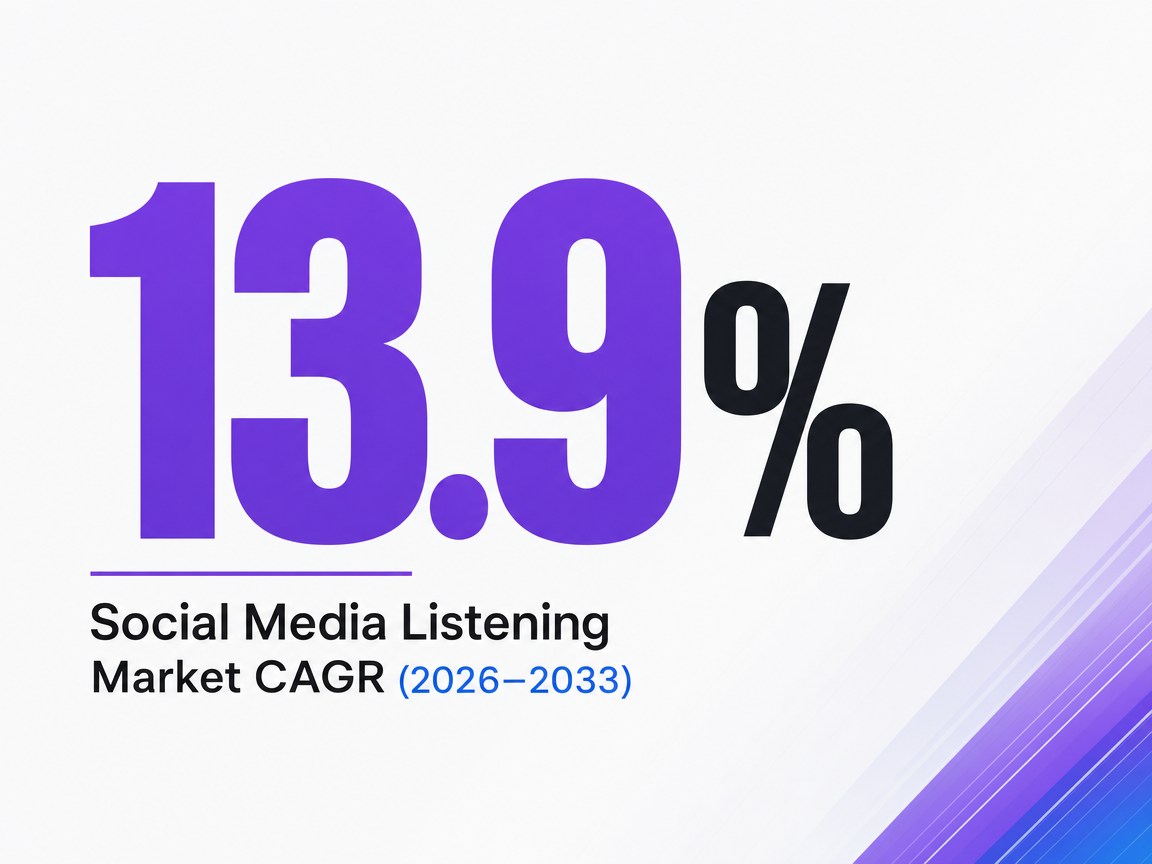 Social Media Listening Market CAGR (2026-2033)
Social Media Listening Market CAGR (2026-2033)
Frequently Asked Questions
References
- 1.Social Listening: Definition, Tools, and Strategies for Business Growth.
- 2.How to Measure the Impact of Brand Marketing.
- 3.Performance branding and how it is reinventing marketing ROI.
- 4.A C-Suite Guide to Marketing Measurement in 2025.
- 5.Social Media Listening Market Forecast, 2026-2033.
- 6.Unleash Social Listening Data's Potential.
- 7.Social Listening Platforms Aim To Serve All User Types.
- 8.How to Manage Brand Reputation in Light of AI-Fueled Misinformation.
- 9.Best AI Tools for Reputation Management to Protect Your Brand.
- 10.The Role of AI in Effective Crisis Communication and Brand Management.