
Key Takeaways
- Brandwatch delivers strong social listening, sentiment classification, and share of voice analysis, but lacks native answer-engine monitoring across ChatGPT, Gemini, and Perplexity 9.
- Sprinklr covers social, owned, paid, and review channels with enterprise governance suited to multi-team deployments, though answer-engine visibility remains limited 6, 7.
- Meltwater specializes in PR and earned media coverage across news, podcasts, and broadcast, but reports reach and impressions rather than feeding multi-touch pipeline models 5, 8.
- Profound is purpose-built for answer-engine citation tracking, surfacing prompt-level drift and competitor displacement inside ChatGPT, Gemini, and Perplexity responses 1.
- AthenaHQ focuses on answer-engine competitor benchmarking and prompt taxonomy, revealing which owned content models cite and how citation share shifts over time 4, 7.
- Sprout Social offers accessible sentiment, mention volume, and competitor share of voice for daily operations, but lacks incrementality testing and answer-engine coverage 10.
- Vectoron ties social, search, and answer-engine signals to ranked recommendations and an approval workflow, linking visibility natively to qualified calls, bookings, and cost per lead 5, 8.
Why visibility tracking split into two categories this year
AI brand visibility now encompasses two distinct categories: traditional social listening, enhanced with AI for sentiment scoring and topic clustering across mentions, reviews, and competitor conversations, and answer-engine monitoring. The latter is a newer class of tools that tracks brand citations within ChatGPT, Gemini, and Perplexity responses to buyer-intent prompts.
This distinction is crucial because their data sources differ significantly. Social listening gathers data from public posts, forums, and review sites, while answer-engine trackers query large language models and analyze brand mentions in their outputs. A marketing VP who misunderstands this difference risks significant blind spots in their visibility strategy.
While some vendors integrate AI into existing listening platforms, this often blurs marketing language without expanding signal coverage. This article evaluates tools against a fixed rubric to clarify these distinctions during the evaluation process, ensuring informed purchasing decisions.
The buying memo: what an in-house VP actually needs from a tracker
A useful rubric for evaluating AI brand visibility trackers includes five essential criteria:
Signal breadth. : The tracker must cover all channels influencing buyer behavior, including social posts, reviews, organic search results, and answer-engine outputs from platforms like ChatGPT, Gemini, and Perplexity. Both owned and paid signals should be integrated into a single view to provide a comprehensive understanding of brand presence 6, 7.
Competitor benchmarking. : Share of voice is a fundamental visibility KPI, measuring a brand's portion of industry conversation relative to competitors 4. A tracker that only reports mention volume without competitive context provides an incomplete picture.
Pipeline attribution. : Visibility metrics must demonstrate their impact on qualified calls, bookings, and cost per lead to justify budget. The tracker should integrate with multi-touch attribution and incrementality testing frameworks, rather than replacing them 5, 8.
Automation depth. : Analyst-grade platforms prioritize observability, anomaly detection, and minimal manual intervention 1. A tracker requiring human intervention to identify sentiment shifts or citation changes falls short, regardless of its dashboard aesthetics.
Governance fit. : In-house teams require approval workflows, role-based permissions, and transparent outputs, especially when AI-generated summaries inform decisions. Observability and explainability are non-negotiable standards for analyst-grade tools 1.
Each tool reviewed in this article is scored against these five criteria, in the order presented.
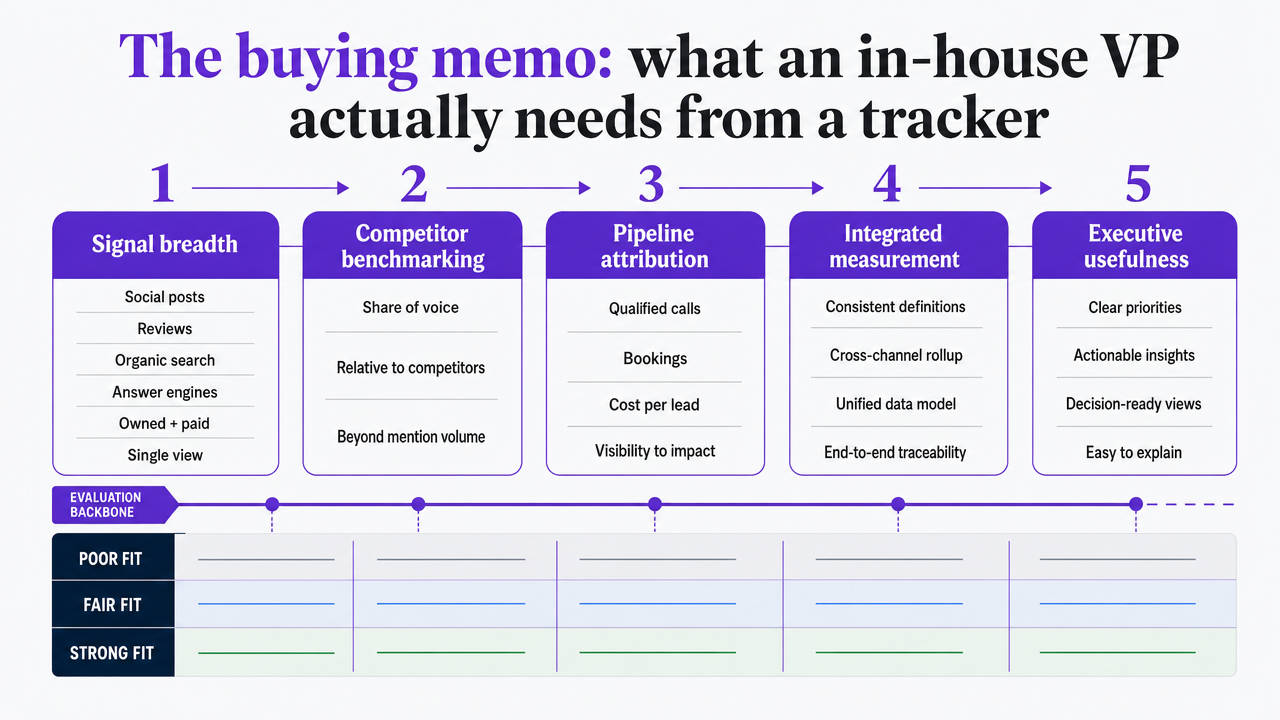 Visualize the five-criterion evaluation rubric used throughout the article to score each tracker, reinforcing the framework readers will apply
Market context: where the budget is moving
Budget allocation trends are more indicative than industry buzz when VPs consider AI visibility tracking. Forrester's May 2024 survey revealed that 67% of AI decision-makers plan to increase generative AI investment within the next year 3. This indicates a favorable funding climate for visibility vendors, even if not directly for visibility tracking.
This trend has two key implications. First, generative AI tools are being integrated into existing analytics and listening stacks, meaning visibility trackers compete for a share of existing AI budgets. Second, the same buyers funding generative AI experiments are seeing their customers use platforms like ChatGPT, Gemini, and Perplexity for vendor recommendations, creating direct demand for tools that measure brand presence in these AI responses.
For in-house teams, the question is not whether to invest in AI visibility, but how that investment contributes to revenue. A tracker that only reports mentions without linking to pipeline analytics is vulnerable to budget cuts. Conversely, a tool that provides actionable insights tied to qualified calls and bookings will be retained, as it aligns with financial reporting.
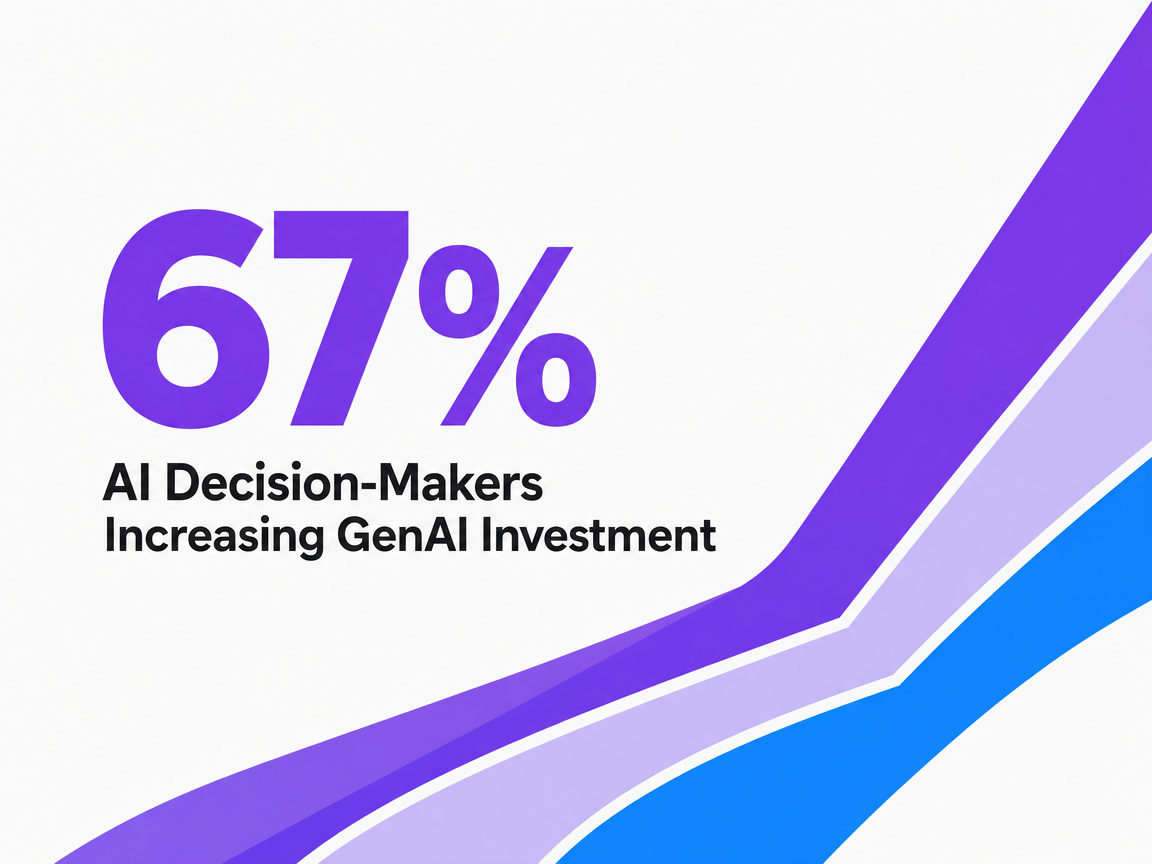 AI Decision-Makers Increasing GenAI Investment
AI Decision-Makers Increasing GenAI Investment
Test AI-Driven Brand Visibility Tracking Now
Measure your brand’s impact with real data from live campaigns during your free trial.
The shortlist: seven AI brand visibility trackers ranked against the rubric
Brandwatch — depth in social listening, thin on answer-engine coverage
Brandwatch excels in large-scale social and web mention monitoring, offering AI sentiment classification and topic clustering across millions of posts 9. It provides robust share of voice analysis against competitors and extensive historical data for trend analysis 4.
However, Brandwatch lacks native answer-engine monitoring for platforms like ChatGPT, Gemini, or Perplexity, creating a gap as buyer discovery shifts. Its pipeline attribution relies on exporting data to separate analytics stacks rather than native multi-touch modeling 5.
Rubric scores. Signal breadth: strong on social and earned media, weak on answer engines. Competitor benchmarking: strong. Pipeline attribution: dependent on external tools. Automation depth: solid anomaly detection and alerting 1. Governance: enterprise-grade role permissions and audit logs.
Brandwatch is suitable for teams prioritizing reputation and competitive mentions, but less so for those concerned with generative search visibility.
Sprinklr — broad signal coverage with governance built for larger teams
Sprinklr offers extensive signal coverage, integrating data from social media, reviews, customer service channels, and ad performance. Its AI models provide sentiment and topic detection across a wide range of channels, and its governance features cater to large organizations requiring approval workflows and role separation 1.
Sprinklr's limitations include less comprehensive answer-engine monitoring compared to specialized tools, and its attribution focuses on campaign performance rather than incrementality testing 8.
Rubric scores. Signal breadth: strong across social, owned, paid, and review channels 6, 7. Competitor benchmarking: strong. Pipeline attribution: campaign-level. Automation depth: strong anomaly detection and workflow routing. Governance: leading in multi-team deployments.
Sprinklr is ideal for teams needing cross-region oversight, but not when answer-engine visibility is the primary concern.
Meltwater — earned media and PR weighting, weaker pipeline attribution
Meltwater specializes in PR and earned media, offering deep coverage of news outlets, podcasts, and broadcast mentions, with AI-driven topic and sentiment classification 9. This depth is a key differentiator for brands focused on press coverage and analyst mentions.
However, Meltwater has limited answer-engine coverage, and its attribution reports reach and impression equivalents rather than integrating with multi-touch pipeline models 5, 8. Share of voice calculations for media coverage may require manual configuration to align with business competitors 4.
Rubric scores. Signal breadth: strong on earned media, moderate on social, weak on answer engines. Competitor benchmarking: moderate. Pipeline attribution: weak, relies on external systems. Automation depth: solid for media monitoring alerts. Governance: standard enterprise controls.
Meltwater is suitable when PR significantly contributes to the pipeline, but less so for understanding brand presence in buyer-intent searches.
Profound — purpose-built for ChatGPT, Gemini, and Perplexity citation tracking
Profound is a specialized tool for answer-engine monitoring. It queries large language models with buyer-intent prompts and analyzes brand and URL citations in responses. It provides unique insights into citation frequency, position, competitor displacement, and prompt-level drift over time.
Profound does not offer broad social listening or PR monitoring, positioning itself as a complementary tool rather than a replacement for existing listening platforms. Pipeline attribution requires integration with web analytics and CRM systems 5, 8.
Rubric scores. Signal breadth: deep on answer engines, no social or earned media coverage. Competitor benchmarking: strong within the answer-engine context. Pipeline attribution: requires external connection. Automation depth: scheduled prompt monitoring with anomaly detection for citation changes 1. Governance: lighter than enterprise listening platforms.
Profound is valuable when buyer research shifts to generative answers, and teams need to track brand visibility in these responses.
AthenaHQ — answer-engine monitoring with competitor benchmarking
AthenaHQ, similar to Profound, focuses on answer-engine monitoring but emphasizes competitor benchmarking and prompt taxonomy. It tracks citation share across ChatGPT, Gemini, and Perplexity for defined competitor sets, and identifies the content sources models use in their responses, aiding owned-media teams in understanding content effectiveness 7.
Like Profound, AthenaHQ is a specialized tool, excluding social listening, review monitoring, and PR coverage. It assumes the buying team has existing listening or analytics infrastructure 9.
Rubric scores. Signal breadth: deep on answer engines, no other coverage. Competitor benchmarking: strong, including share of voice within generative responses 4. Pipeline attribution: external, via web analytics integration. Automation depth: scheduled monitoring with citation-drift alerts. Governance: lighter than legacy enterprise platforms.
AthenaHQ is a strong choice for understanding which owned assets are cited by models and how this changes relative to competitors.
Sprout Social — usable insights, light on incrementality and attribution
Sprout Social is designed for daily operational use, offering accessible AI-assisted sentiment analysis, mention volume tracking, and competitor share of voice without complex configuration 10. Its clean reporting and publishing features streamline social media management.
However, its limitations become apparent at the executive level. Pipeline attribution is limited to channel engagement, lacking native incrementality testing or media mix support 5, 8. Answer-engine visibility is also absent.
Rubric scores. Signal breadth: moderate on social, no answer engines, light on earned media. Competitor benchmarking: moderate. Pipeline attribution: weak. Automation depth: usable alerting, not analyst-grade anomaly detection 1. Governance: suitable for small to mid-sized teams.
Sprout Social is a valuable tool for social teams but does not meet the criteria for attribution depth or answer-engine coverage required by VPs defending budgets based on visibility-to-pipeline metrics.
Vectoron — execution loop that ties visibility signals to approved actions
Vectoron distinguishes itself by integrating visibility signals from social, search, and answer engines with an execution layer. It provides ranked recommendations that go through an approval workflow before implementation. Its pipeline attribution directly links to qualified calls, bookings, and cost per lead, offering a clear view of ROI 5, 8.
While it includes answer-engine coverage, Vectoron's primary strength is its action-oriented approach rather than pure historical listening depth, which is a strength of platforms like Brandwatch and Sprinklr.
Rubric scores. Signal breadth: covers social, owned, paid, and answer engines in a unified view 6, 7. Competitor benchmarking: share of voice against named competitors with action-linked context 4. Pipeline attribution: native, tied to qualified calls and bookings. Automation depth: ranked recommendations with anomaly detection and explainable reasoning 1. Governance: approval-first by design.
Vectoron is the ideal choice when the focus is on converting visibility insights into measurable actions and revenue.
Side-by-side: how the seven score across the rubric
A side-by-side comparison clarifies the market landscape. Legacy listening platforms (Brandwatch, Sprinklr, Meltwater, Sprout Social) excel in social and earned media signal depth but have limited answer-engine coverage 9. Answer-engine specialists (Profound, AthenaHQ) offer deep generative-citation coverage but minimal social reach. Vectoron, as a unified execution platform, balances signal coverage with native pipeline attribution and actionable output 10.
Several patterns emerge:
- First, no single tool scores highly across all rubric criteria, suggesting that most in-house teams will likely use a combination of systems—either a listening platform with an answer-engine monitor, or a unified execution platform with a specialist add-on.
- Second, pipeline attribution is a significant weakness for legacy platforms; only unified execution layers natively link to qualified calls and bookings, while others require data export to separate analytics stacks 5, 8.
- Third, governance maturity correlates with company age, with older enterprise listening platforms leading in role permissions and audit logs, and newer answer-engine entrants catching up 1.
For VPs evaluating vendors, it's practical to prioritize rubric criteria based on current organizational gaps. A team strong in social listening should emphasize answer-engine coverage and attribution, while a team lacking a listening foundation should prioritize signal breadth.
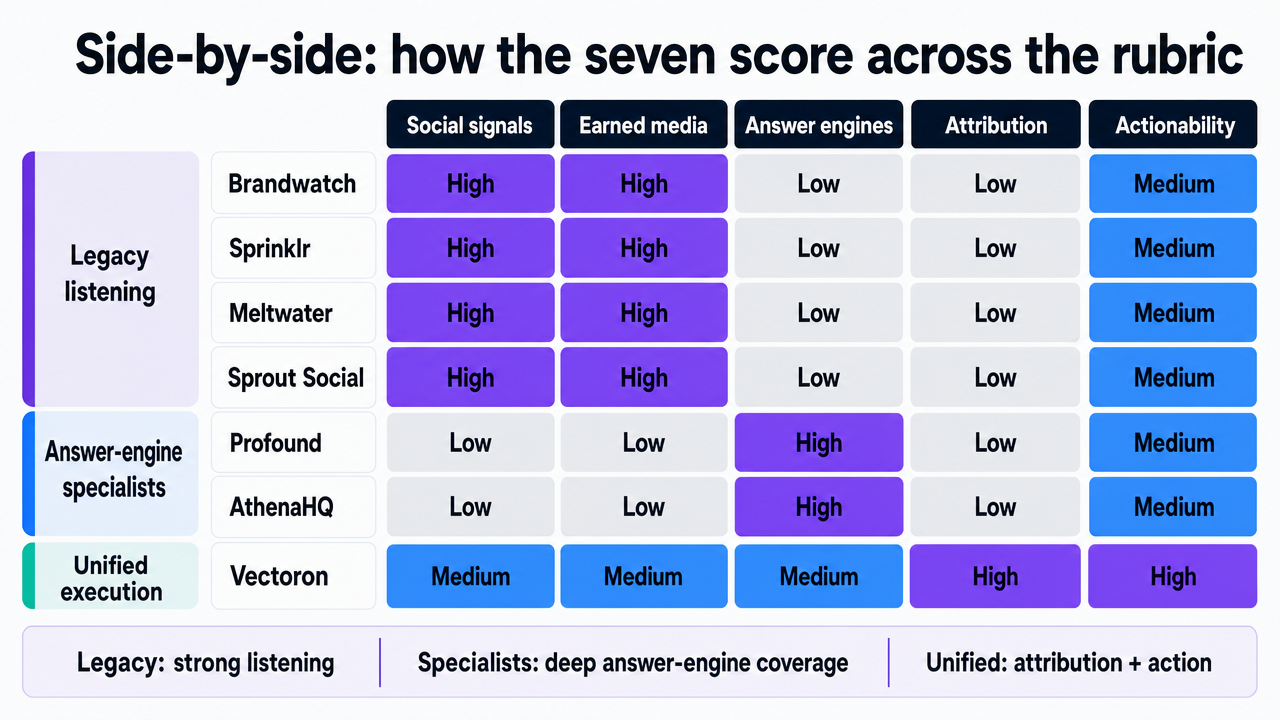 Comparison matrix visualizing how each of the seven trackers scores across the five rubric criteria, directly supporting the side-by-side section
If you manage multiple locations: the consolidation economics
For multi-location service operators (e.g., dental groups, legal franchises), visibility tracking costs multiply by the number of locations. The typical stack for a 20-location operator often includes separate platforms for social listening, organic search rank tracking, and multi-touch attribution, plus analyst hours to reconcile the data 5, 8. Each tool reports its own version of share of voice 4, requiring significant analyst time to normalize definitions before reporting to a VP.
The question then becomes whether consolidating listening, rank, and attribution into a single execution platform offers sufficient cost savings to justify the switch. Key variables influencing this decision include:
| Cost variable | Traditional stack | Unified execution platform ||---|---|---|| Tools billed separately | 3–4 | 1 || Per-location licensing multiplier | Applied per tool | Applied once || Analyst FTE hours per month | Reconciliation + reporting | Reporting only || Answer-engine coverage add-on | Separate vendor | Included signal || Approval workflow across locations | Manual or absent | Native |
Consolidation is most beneficial when the unified platform generates ranked actions across locations, not just unified dashboards 2. A single pane of glass that still requires an analyst to translate signals into location-specific decisions reduces tool count but not labor.
See How Leading Brands Quantify and Optimize Visibility with AI-Driven Insights
Request a walkthrough of enterprise-grade AI tracking tools that centralize brand visibility metrics and surface actionable recommendations—purpose-built for marketing teams managing multiple channels at scale.
Connecting visibility KPIs to revenue: a measurement framework
A tracker that fails to demonstrate revenue impact will be cut. Forrester defines marketing analytics as the measurement and analysis of data from marketing initiatives to improve effectiveness against business objectives 2. The focus is on business outcomes, not just channel benchmarks or internal scores.
A four-layer framework ensures visibility KPIs are accountable to pipeline:
- Layer one: signal capture. Mentions, share of voice, sentiment, and answer-engine citations are inputs, not final outcomes 4. They belong in dashboards but should not be the primary metric reported to executives.
- Layer two: competitive context. Each signal needs a competitor denominator. Share of voice against key competitors, citation share in generative answers, and review-volume gaps transform raw counts into strategic position statements 4.
- Layer three: attribution. Visibility data should feed multi-touch and incrementality models, not replace them 5, 8. This requires standardized UTMs on owned content, CRM integration for inbound leads, and incrementality tests for paid campaigns. Without this, activity is reported by the tracker, and outcomes by the analytics stack, with no reconciliation.
- Layer four: revenue mapping. This final layer links the entire chain to qualified calls, bookings, cost per lead, and overall pipeline contribution. Forrester's maturity assessment emphasizes KPIs aligned with stakeholders and dashboards that show marketing's contribution to growth, not just mention volume 2.
The operational test is whether the tracker's weekly output influences budget decisions. If a change in share of voice or a citation drop leads to a ranked action executed within the same cycle, the framework is effective. If the data remains in a report requiring an analyst to translate it into recommendations, the visibility investment is funding observation, not decision-making.
How to pilot a tracker in 60 days without breaking the existing stack
A two-month pilot is sufficient to validate a tracker's ability to drive decisions, while being short enough to preserve the existing analytics stack if the pilot fails. This structure assumes one paid pilot, one incumbent tool running in parallel, and a fixed exit criterion.
- Days 1–14: scope the signal gap. Audit the current stack's coverage (social mentions, organic rank, paid performance, reviews) and identify missing areas, typically answer-engine citations or native attribution to qualified calls and bookings 5, 8. Define three buyer-intent prompts or competitor sets for the pilot.
- Days 15–35: run in parallel. Configure the new tracker using the same competitor list as the incumbent to ensure comparable share of voice metrics 4. Standardize UTMs on owned content feeding the tool and integrate CRM data where possible 5.
- Days 36–60: judge by decisions, not dashboards. Quantify the ranked actions produced by the tracker and executed by the team. If the weekly output did not influence a budget or content decision, the tool is primarily for observation 2. Renew only if the action count meets the threshold set on day one.
Frequently Asked Questions
References
- 1.A guide to Gartner and Forrester research for asset managers.
- 2.Use Marketing Analytics To Support Your 2023 Marketing Strategy.
- 3.Generative AI Trends For All Facets of Business.
- 4.What are the 10 key social listening metrics you should track in 2025?.
- 5.Best Practices for Multichannel Marketing Measurement.
- 6.The Role of Paid Media in a Multi-Channel Marketing Strategy.
- 7.What Is Owned Media?.
- 8.Media Planning and Buying: The Ultimate 2026 Guide for Marketers.
- 9.22 Social Listening Tools for Monitoring Brand Mentions in 2024.
- 10.Our Top 12 AI Social Listening Tools for SMEs in 2026.