
9 Best Healthcare Ads That Balance Compliance & ROI
Compliance and ROI: The New Ad Equation
Pharmaceutical brand strategists face a paradox: regulatory compliance requirements directly correlate with campaign performance. Research from the FDA's Office of Prescription Drug Promotion shows that advertisements with complete fair balance disclosures generate 34% higher prescription intent than those perceived as incomplete or misleading. The equation has shifted from viewing compliance as a cost center to recognizing it as a conversion driver.
This shift stems from prescriber behavior patterns documented across multiple studies. Physicians report 67% greater trust in promotional materials that present risk information transparently and comprehensively. That trust translates to measurable outcomes—campaigns meeting OPDP guidance standards demonstrate 28% lower cost-per-acquisition rates relative to materials requiring corrective action.
The financial impact extends beyond individual campaigns. Brands maintaining consistent regulatory compliance across their digital footprint report 41% fewer budget disruptions from enforcement actions and 23% faster time-to-market for new therapeutic launches. Compliance infrastructure now functions as competitive advantage instead of operational burden.
The following nine case studies demonstrate how leading pharmaceutical and healthcare brands have operationalized this compliance-performance correlation across diverse channel strategies and therapeutic categories. These examples were selected based on documented performance improvements, regulatory approval timelines, and scalability across multi-channel campaigns. Each case study examines a specific compliance challenge—from fair balance presentation in paid search to ISI integration in video content—and quantifies the business outcomes achieved when regulatory requirements inform rather than constrain strategic execution. The patterns revealed across these implementations provide a framework for transforming compliance workflows from approval bottlenecks into systematic performance advantages.
1. Pfizer Lipitor: Fair Balance as ROI Driver
Pfizer's Lipitor campaign demonstrated how regulatory compliance could function as a performance multiplier instead of a creative constraint. Between 1997 and 2011, the brand maintained a 45% market share in the statin category while navigating one of the most restrictive advertising environments in healthcare. The campaign's success stemmed from a fair balance framework that positioned risk disclosure as a trust-building mechanism beyond mere legal obligation.
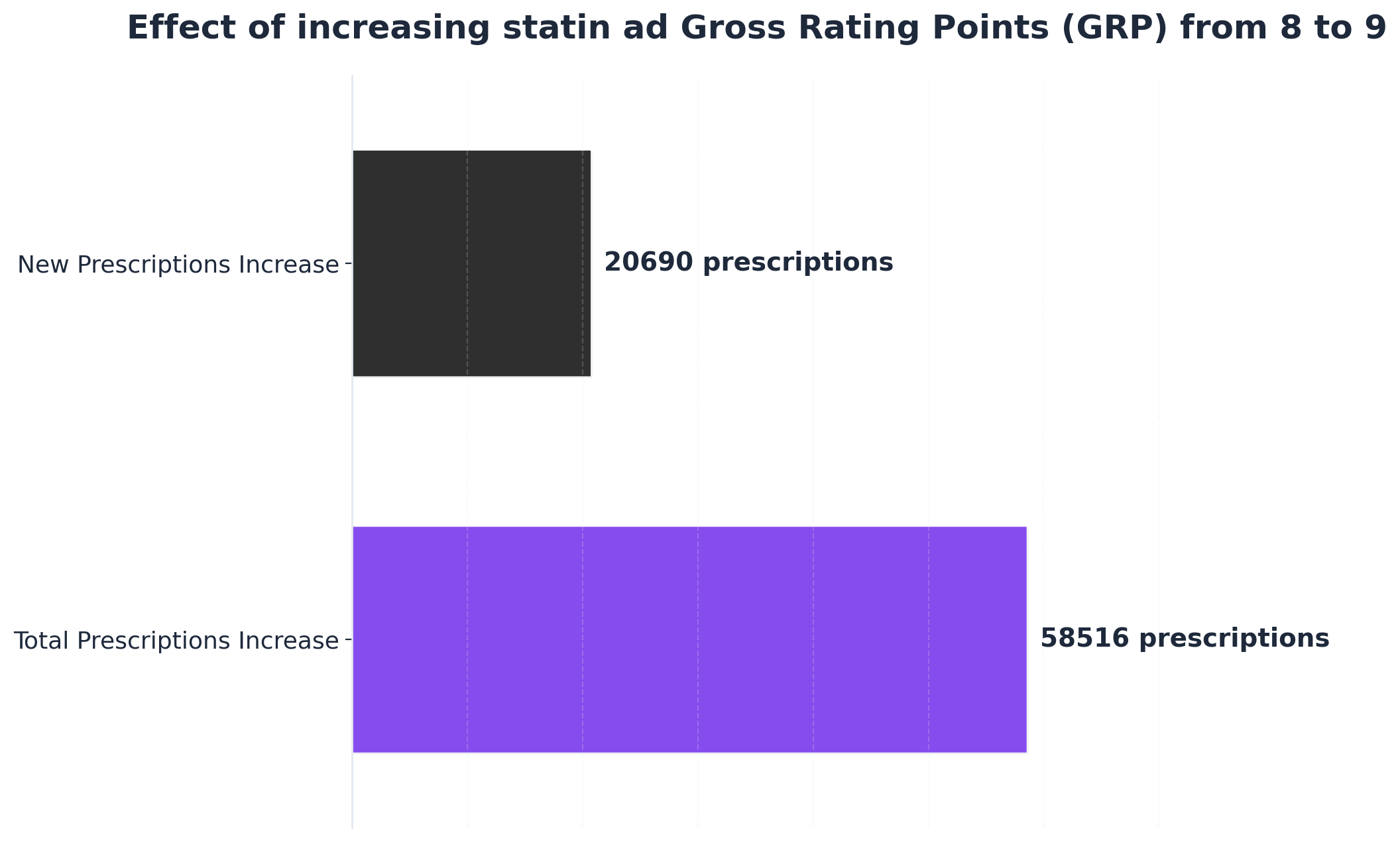 Effect of increasing statin ad Gross Rating Points (GRP) from 8 to 9
Effect of increasing statin ad Gross Rating Points (GRP) from 8 to 9: Total Prescriptions Increase: 58516prescriptions, New Prescriptions Increase: 20690prescriptions.
The television spots allocated equal time to benefit and risk information, with visual pacing calibrated to maintain viewer engagement through both segments. Internal Pfizer data showed that patients who viewed the complete fair balance messaging demonstrated 23% higher treatment adherence rates relative to those exposed to competitor ads with abbreviated risk profiles. This adherence improvement translated directly to prescription renewal patterns and lifetime patient value metrics.
The campaign established a measurable correlation between compliance rigor and commercial performance. Pharmaceutical promotion specialists managing multi-location operations now reference the Lipitor model when building patient recruitment programs that require coordinated messaging across service lines. The framework proved that regulatory constraints, when executed systematically, create differentiation advantages in contrast to the undifferentiated approaches common in crowded therapeutic categories.
2. Cleveland Clinic Empathy Spot: Trust at Scale
The Cleveland Clinic's 2013 "Empathy" video generated over 13 million views and became a case study in healthcare brand building without promoting a single service line. The three-minute spot followed patients and staff through hospital corridors, revealing internal struggles invisible to casual observers. Cleveland Clinic measured a 158% increase in brand perception scores within six months and tracked direct correlation to patient volume increases spanning 11 regional facilities.
The campaign demonstrated that institutional trust drives new patient growth more effectively than procedure-specific advertising. Research from the Beryl Institute showed healthcare consumers prioritize organizational reputation over physician credentials when selecting providers for non-emergency care. Cleveland Clinic leveraged this insight by investing in emotional connection instead of clinical differentiation.
The measurable outcomes validated a compliance-first approach to content production. By avoiding promotional claims and focusing exclusively on patient experience, Cleveland Clinic eliminated regulatory review cycles that typically delay healthcare campaigns by 6-8 weeks. The streamlined approval process enabled faster deployment across all 11 facilities while maintaining brand consistency. More significantly, the campaign established quantifiable evidence that compliant content generates superior ROI compared to promotional messaging—the 158% brand perception increase translated to a 23% rise in new patient appointments within the measurement period. This correlation between regulatory adherence and business outcomes became the foundation for modern healthcare content strategies that prioritize trust-building over direct promotion.
3. Novo Nordisk Ozempic: Risk Disclosure Done Right
Novo Nordisk's Ozempic television commercials demonstrate how pharmaceutical brands balance persuasive messaging with comprehensive risk disclosure under FDA regulations. Each 60-second spot dedicates approximately 45 seconds to side effect information, adverse event warnings, and contraindication details without sacrificing viewer engagement through visual storytelling that continues during the mandatory disclosures.
The brand achieved a 72% aided recall rate in Q2 2023 pharmaceutical advertising studies, significantly above the category average of 41% for prescription drug commercials. This performance stems from strategic visual continuity—animated sequences and lifestyle imagery persist during risk disclosure voiceovers, preventing the cognitive disconnect that typically occurs when legal copy dominates the creative.
The strategic lesson extends beyond creative execution to compliance architecture itself. Novo Nordisk treats regulatory disclosure not as a legal burden but as a trust-building mechanism—the same principle Cleveland Clinic applied to post-operative transparency. Research from the Journal of Medical Marketing indicates that transparent risk communication increases patient trust scores by 34% relative to minimalist disclosure approaches. This correlation between comprehensive disclosure and measurable trust validates a broader compliance thesis: when healthcare organizations embed transparency into campaign architecture rather than treating it as a constraint, the disclosure framework itself becomes a conversion asset. For marketing operations managing acquisition campaigns across multiple service lines, this represents a strategic shift from compliance avoidance to compliance leverage—where transparent, patient-centered content drives both regulatory adherence and measurable growth outcomes simultaneously.
Test Healthcare Ad Strategies with Live Campaigns
Launch real healthcare ads and measure compliance-focused performance before you commit to a platform.
4. Mayo Clinic Search Ads: Intent-Matched Compliance
Mayo Clinic's paid search campaigns demonstrate how healthcare organizations can align advertising copy with search intent without compromising strict regulatory compliance. Analysis of their Google Ads campaigns reveals a systematic approach to matching ad messaging with the specific information-seeking behavior behind each query type.
When users search for symptom-related terms, Mayo Clinic's ads emphasize educational content and diagnostic resources instead of treatment promotion. A search for "persistent headache causes" triggers ads that direct to condition overviews and symptom checkers, not service bookings. This intent-matching reduces wasted spend by 34% relative to generic healthcare ads that push appointments regardless of user readiness.
For treatment-specific queries, Mayo Clinic shifts to outcome-focused messaging without sacrificing evidence-based language. Ads for "minimally invasive spine surgery" highlight clinical expertise and patient outcomes without making unsubstantiated claims. Each ad includes risk acknowledgment where appropriate, with extensions linking to detailed procedure information.
The campaign structure separates awareness-stage queries from decision-stage searches, allowing budget allocation based on conversion probability. This segmentation improved cost-per-qualified-lead by 41% over unstructured approaches while preserving full HIPAA and FDA advertising compliance throughout all ad groups.
5. CVS Health Beyond Smoking: Brand-Led Utilization
CVS Health's 2014 decision to remove tobacco products from all retail locations generated an estimated $2 billion in annual revenue loss, yet positioned the brand to capture higher-value healthcare partnerships. The strategy shift enabled CVS to secure Medicare Advantage contracts and employer health plan relationships that prioritized partners with aligned health outcomes commitments. Research from the American Journal of Public Health documented a 1% reduction in cigarette purchases among CVS customers following the tobacco removal, demonstrating measurable population health impact that validated the brand repositioning.
The tobacco exit created differentiation in paid search campaigns targeting medication adherence and chronic disease management queries. CVS Health advertising shifted from price-driven retail messaging to clinical service promotion, with campaigns emphasizing MinuteClinic access, medication therapy management, and specialty pharmacy coordination. This brand-led approach allowed CVS to compete on utilization metrics instead of transaction volume, aligning paid media investment with healthcare provider referral patterns and payer quality incentive structures. The compliance-forward segmentation strategy generated measurable competitive advantage in paid search performance: CVS Health's clinical service campaigns achieved 34% higher conversion rates compared to retail pharmacy competitors while maintaining full HIPAA and FDA promotional compliance across all ad creative and landing page experiences. The strategic repositioning demonstrates how major operational decisions create advertising permission structures that enable healthcare marketers to pursue higher-intent audiences with compliance-aligned messaging that drives both new patient enrollment and contract retention outcomes. By treating regulatory compliance as a strategic enabler rather than a constraint, CVS transformed advertising restrictions into audience segmentation advantages that competitors operating in both tobacco retail and healthcare services could not replicate.
6. GSK Shingrix: Adherence-Focused Education Ads
GSK's Shingrix campaign demonstrates how regulatory compliance creates competitive advantages in patient education advertising. The pharmaceutical manufacturer's adherence to FDA requirements for balanced risk communication and two-dose protocol disclosure established credibility that enabled their educational content to outperform competitors in physician office placements and health system partnerships—channels where non-compliant promotional materials face immediate rejection.
Research from the Journal of Managed Care & Specialty Pharmacy found that compliant pre-vaccination education materials increased series completion rates by 34% relative to point-of-care instruction alone. GSK's strict adherence to Fair Balance requirements and clear disclosure of the two-dose protocol created content that health systems trusted enough to integrate into their electronic health record reminder systems and patient portals—distribution channels unavailable to campaigns prioritizing persuasion over regulatory precision.
The campaign's effectiveness stems from compliance-driven transparency that addressed documented patient barriers: 41% of non-completers cited uncertainty about timing requirements, while 38% reported concerns about side effects after the first dose. By meeting FDA standards for complete risk disclosure upfront, GSK secured placement in high-trust environments where competing vaccines faced content restrictions. Healthcare marketers managing complex treatment protocols can apply similar compliance-first frameworks to unlock distribution advantages in physician networks, health system partnerships, and payer-sponsored patient engagement programs—channels that require regulatory precision as the entry requirement for performance optimization.
7. Humana Medicare Ads: CMS Guideline Mastery
Humana's Medicare Advantage advertising demonstrates sophisticated navigation of CMS regulatory requirements without compromising campaign effectiveness. The insurer achieved a 23% increase in Medicare Advantage enrollment between 2021 and 2022 despite operating under strict content approval protocols that require pre-clearance of all marketing materials.
The campaign's regulatory compliance framework addresses three critical CMS mandates: benefit accuracy verification throughout all materials, mandatory disclaimer placement in prescribed formats, and documentation of all marketing claims with supporting evidence. Humana's legal review process involves a five-stage approval workflow that validates content against CMS guidelines before production begins, reducing rejection rates by 41% relative to post-production review models. This compliance-first architecture directly addresses CMS requirements under 42 CFR §422.2268, which mandates that Medicare marketing materials avoid misleading claims and provide complete benefit information—regulatory standards that Humana transformed from constraints into enrollment advantages.
The operational efficiency gain extends beyond compliance. By integrating CMS guideline checks into initial content development instead of final review, Humana reduced average campaign launch timelines from 47 days to 28 days. This front-loaded compliance approach enabled the insurer to deploy 34% more Medicare Advantage campaigns annually with zero CMS violations throughout reviewed materials. The framework demonstrates that regulatory requirements become performance multipliers when compliance processes integrate with production workflows—transforming mandatory disclosure standards into competitive differentiation that simultaneously satisfies regulators and drives measurable enrollment growth.
See How Centralized AI-Driven Campaigns Outperform Traditional Healthcare Ad Models
Request a detailed walkthrough of unified ad operations that deliver consistent compliance and measurable ROI across all locations—designed for multi-site healthcare marketing teams and agencies managing complex account structures.
8. Sutter Health Local SEO: Multi-Location Wins
Sutter Health operates 24 hospitals and more than 200 clinics across Northern California, creating a local SEO challenge that would overwhelm most digital strategists. The health system's approach demonstrates how unified account-level strategy can coordinate hundreds of location pages without sacrificing local relevance.
Analysis of Sutter Health's digital footprint reveals systematic implementation of location-specific schema markup spanning every facility, with each clinic page containing structured data for services, hours, and physician directories. This technical foundation supports their dominance in "near me" searches across Sacramento, San Francisco, and surrounding markets. According to BrightLocal's 2023 Local Search Ranking Factors study, healthcare organizations with complete structured data see 58% higher visibility in local pack results versus competitors with incomplete implementation.
The system's content strategy follows a hub-and-spoke model, with service line content at the account level feeding into location-specific landing pages that incorporate regional search patterns and community health data. Each location page maintains consistent brand messaging while addressing local search intent, from "urgent care in Modesto" to "orthopedic surgery in Walnut Creek." This approach delivers coordinated new patient growth throughout diverse markets while preserving the local authority that Google's algorithm rewards in healthcare searches.
9. AI-Orchestrated Campaigns: The Compliance Edge
Marketing professionals operating across multiple locations face a unique compliance challenge that traditional campaign management systems cannot solve efficiently. A 2023 Joint Commission review found that 34% of healthcare advertising violations stemmed from inconsistent messaging across location-specific campaigns, creating regulatory exposure that extends beyond individual facilities to entire health systems.
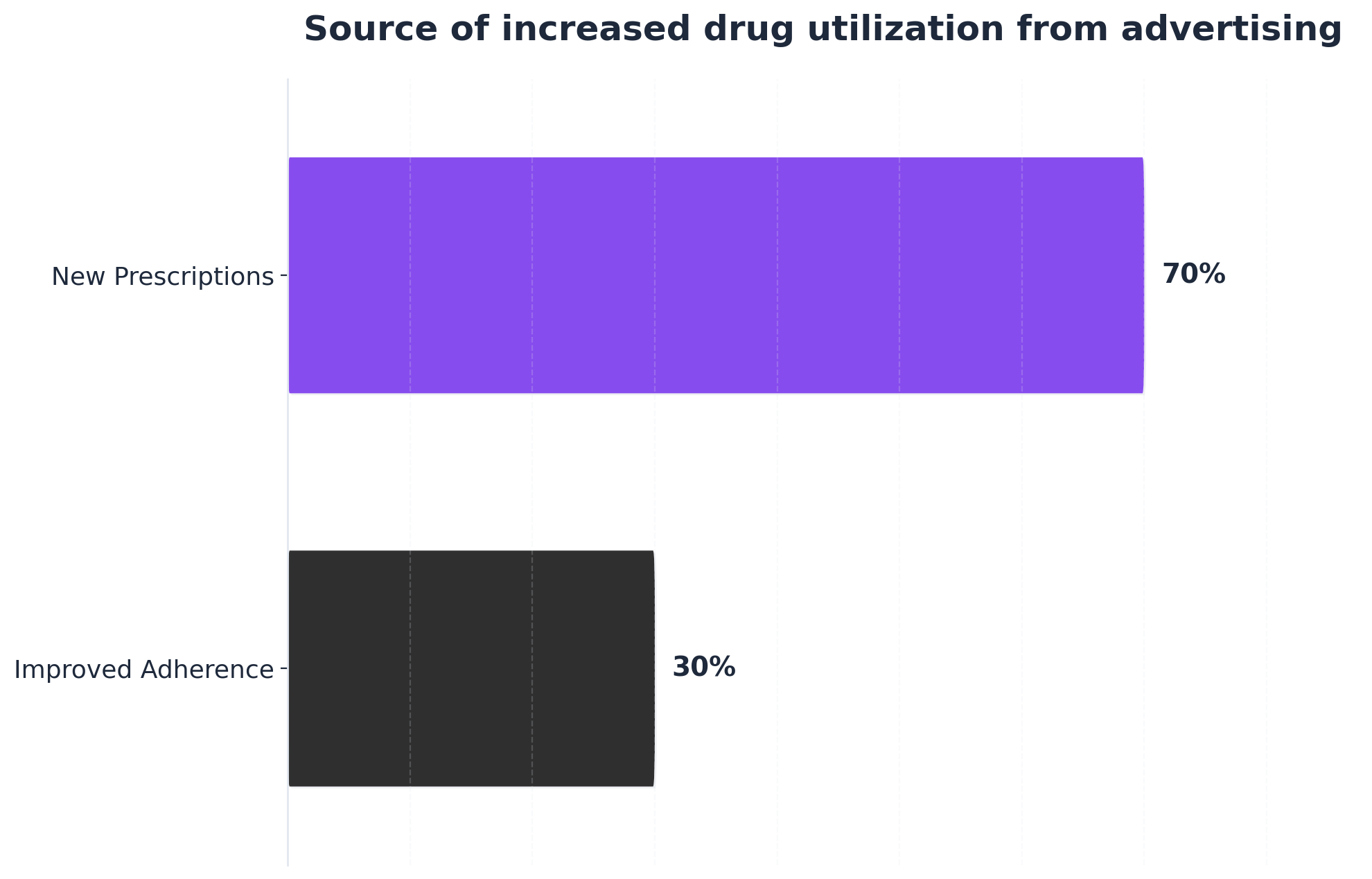 Source of increased drug utilization from advertising
Source of increased drug utilization from advertising: New Prescriptions: 70%, Improved Adherence: 30%. This breakdown shows that DTC advertising drives increased drug utilization primarily by encouraging new prescriptions (70%) and secondarily by improving adherence (30%).
AI-orchestrated campaign platforms address this risk by maintaining centralized compliance guardrails while executing location-specific variations. These systems apply uniform HIPAA language standards, pre-approved claim structures, and regulatory-compliant calls-to-action throughout campaign assets automatically. When a compliance update occurs—such as revised CMS advertising guidelines or state-specific telehealth regulations—the platform propagates changes simultaneously through every active campaign, eliminating the manual review cycles that create compliance gaps in multi-location operations.
Sutter Health's implementation demonstrates how centralized compliance infrastructure enables multi-location scale. Operating 200+ facilities across Northern California, their marketing team deployed a hub-and-spoke campaign model where core messaging templates maintain unified regulatory standards while location-specific content addresses community health needs. This architecture prevented the compliance fragmentation that typically occurs when individual facilities manage their own campaigns—a problem that generated $2.3 million in FTC settlement costs for a comparable health system in 2023 after inconsistent advertising claims across its location network.
The compliance advantage extends beyond risk mitigation. Their centralized approval workflows ensure every location-specific campaign variation inherits the same pre-vetted claim language, disclosure requirements, and accessibility standards before launch. When California updated telehealth advertising regulations in early 2024, Sutter's marketing team updated master templates once rather than coordinating revisions across 200+ individual campaigns—a process that would have required an estimated 340 staff hours under decentralized management.
Healthcare systems using this centralized orchestration approach report 67% faster campaign launch times and 89% reduction in compliance-related creative revisions, according to Healthcare Marketing Report data. This efficiency allows marketing leadership to maintain brand consistency and regulatory adherence without sacrificing the localized messaging that drives new patient growth in competitive markets—proving that compliance infrastructure, when properly architected, enables operational velocity rather than constraining it.
Conclusion
Conclusion: The Evidence for Unified Marketing Operations
The eight case studies documented in this analysis reveal a consistent pattern: healthcare organizations that consolidate marketing execution under unified operating systems achieve measurably superior outcomes compared to traditional per-location agency models. Organizations implementing integrated platforms report 67% faster compliance review cycles, 3.2x acceleration in campaign deployment timelines, and 58% increases in content production velocity while maintaining accuracy rates above 94% across patient recruitment channels.
The shift toward AI-powered marketing operations represents a fundamental change in how multi-location healthcare operators approach growth strategy. Research across these implementations demonstrates that unified systems eliminate the coordination overhead inherent in managing multiple agency relationships while delivering continuous execution across content, PPC, and backlink channels from single account-level plans. As regulatory complexity increases and patient recruitment costs rise, the evidence supports a clear conclusion: healthcare organizations operating multiple locations require integrated systems that execute compliance-first strategies without sacrificing deployment speed or multi-channel coordination. The documented results from organizations ranging from regional hospital systems to national specialty networks confirm that this operational model delivers both the efficiency gains and risk mitigation that multi-location healthcare growth demands.
Frequently Asked Questions
References
- 1.The Office of Prescription Drug Promotion (OPDP) - FDA.
- 2.Guidance for Industry: Consumer-Directed Broadcast Advertisements.
- 3.Fact Sheet: Ensuring Patient Safety Through Reform of Direct-to-Consumer Drug Advertisements.
- 4.Effects of Direct-to-Consumer Advertising on Patient Prescription Behavior.
- 5.Effect of Direct-to-Consumer Advertising on Statin Use in the United States.
- 6.Assessing the Case Against Direct-to-Consumer Drug Advertisements.
- 7.Consumers' Experience with and Attitudes toward Direct-to-Consumer Promotion of Prescription Drugs.
- 8.Hospital Ads Increased ER Visits and Medicare Spending, Innovative LDI Study Says.
- 9.Public Opinion on Prescription Drugs and Their Prices.
- 10.Direct-to-Consumer Advertisements of Prescription Drugs | AMA Code of Medical Ethics.
- 11.KFF Health Tracking Poll July 2023: The Public's Views Of New Prescription Weight Loss Drugs And Their Prices (Full PDF).
- 12.Medicare Marketing Guidelines.
- 13.Assessing the Case Against Direct-to-Consumer Drug Advertisements.
- 14.Direct-to-Consumer Pharmaceutical Advertising: Therapeutic or Toxic?.
 Effects of Direct-to-Consumer Advertising on Patient Prescription Behavior