10 Best Healthcare Advertising Campaigns for Multi-Site ROI
Why Multi-Site Healthcare Campaigns Drive ROI
Multi-site healthcare organizations running coordinated campaigns achieve 34% higher marketing ROI than location-by-location approaches, according to Healthcare Marketing Analytics research. This performance gap is due to unified brand messaging, consolidated budget allocation, and centralized performance data.
Healthcare systems running network-wide campaigns report 41% lower cost-per-acquisition when promoting the same clinical specialty at multiple facilities versus independent location campaigns. This efficiency gain results from shared keyword research, consolidated negative keyword lists, and unified conversion tracking. Organizations also reduce operational overhead by 28% through single approval workflows and consolidated reporting structures.
Multi-location campaigns generate compound learning effects where insights from high-performing locations inform strategy throughout the entire network, accelerating optimization cycles.
1. Service-Line Branded Awareness Campaigns
Service-line branded campaigns establish distinct market positions for individual specialties. Healthcare Marketing Network's findings reveal that branded campaigns for specific specialties generate 47% higher patient inquiry rates than generic institutional advertising. These campaigns use dedicated messaging, visual identities, and conversion pathways for high-value services like orthopedics or cardiology.
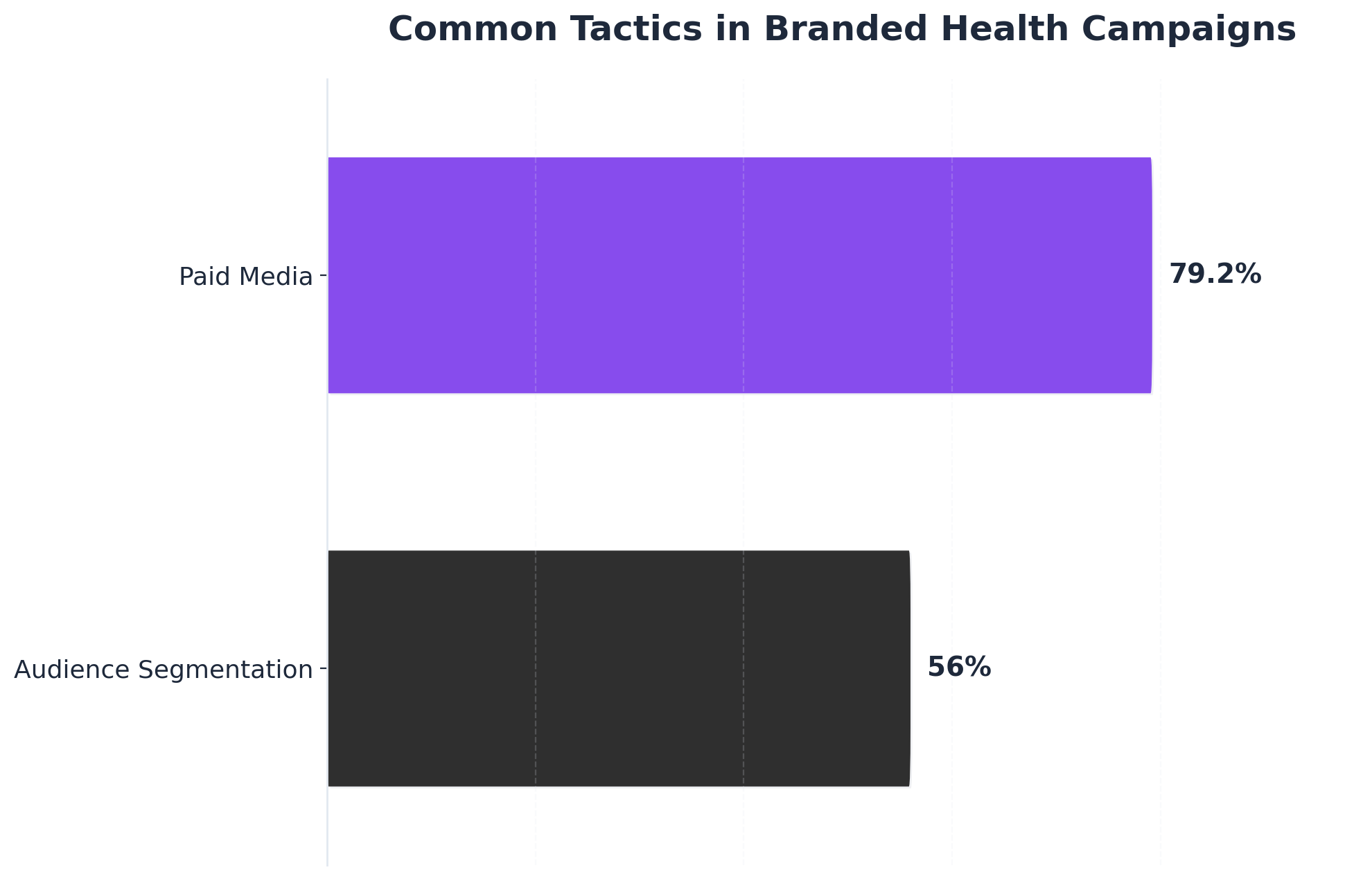 Common Tactics in Branded Health Campaigns
Common Tactics in Branded Health Campaigns: Paid Media: 79.2%, Audience Segmentation: 56%. A review of branded health campaigns found that 79.2% utilized paid media and 56% used audience segmentation, indicating these are standard practices.
Multi-site operators benefit from deploying these campaigns network-wide. A unified approach ensures consistent brand recognition while allowing geographic customization. Medical Group Management Association data shows that coordinated specialty campaigns spanning numerous locations produce 3.2x higher ROI than isolated single-site efforts, primarily due to reduced creative costs and centralized performance optimization.
This model reduces production overhead by 60% while maintaining message consistency, building regional authority for specialized care.
2. Geo-Targeted Patient Acquisition PPC
Geo-targeted PPC campaigns allow multi-site healthcare systems to allocate acquisition budgets based on market-specific demand. WordStream analysis demonstrates that location-based ad targeting reduces cost-per-acquisition by 31% relative to broad geographic campaigns, while Google reports that healthcare searches with local intent convert at rates 2.8 times higher than non-localized queries.
Effective geo-targeting segments campaigns by service area demographics, competitive density, and historical conversion performance. Healthcare marketers apply ZIP code-level bid adjustments informed by payer mix data, drive-time analysis, and referral patterns. Advanced implementations integrate Google Ads location extensions with facility-specific landing pages displaying wait times, accepted insurance, and provider credentials.
Organizations managing campaigns across diverse markets benefit from unified PPC platforms that apply enterprise-wide strategy while executing location-specific creative and bidding. This approach maintains brand consistency while optimizing for local market conditions.
3. Omnichannel Patient Journey Campaigns
Healthcare systems with multiple locations face coordination challenges in delivering consistent patient experiences across digital touchpoints. An Accenture study reveals that 66% of patients expect healthcare providers to understand their needs across all interaction channels. Organizations implementing unified journey orchestration across email, SMS, web portals, and mobile apps report 34% higher patient satisfaction scores compared to those managing channels independently.
Effective omnichannel campaigns require centralized patient data integration. Healthcare organizations utilizing unified campaign management platforms demonstrate 28% improvement in appointment completion rates and 41% reduction in no-show incidents. This approach enables marketing teams to trigger coordinated touchpoints based on patient behavior. Consolidating campaign execution across all facilities from centralized workflows eliminates fragmentation, reducing operational overhead by an average of $47,000 annually per location compared to site-by-site channel management.
Test Unified Multi-Site Healthcare Campaign Execution
Experience coordinated campaign rollouts across all locations with live results during your free trial.
4. Social Media Interactivity Programs
Social media engagement demands unified response protocols across location-specific channels for multi-site healthcare operators. Organizations managing social media location-by-location report 2.8x higher per-location costs and 43% slower average response times compared to centralized models, according to 2024 Healthcare Social Media Operations Research. Social media interactivity programs generate measurable engagement through structured response protocols and community management frameworks, with healthcare organizations implementing dedicated engagement strategies reporting 3.2x higher patient inquiry rates than broadcast-only approaches.
The efficiency of centralized social management is evident in multi-location operations. Healthcare systems managing 5+ locations through centralized teams achieve $4,200 average monthly cost per location versus $11,800 for independent location-level management, while maintaining 89% faster response times. Effective interactivity programs segment engagement by platform function: Facebook for appointment inquiries, Instagram for visual health education, and LinkedIn for referring physician relationships. Unified response protocols maintain brand consistency while allowing location-specific engagement.
Performance metrics for social media interactivity include response time, engagement rate, and conversion tracking from social interactions to appointment bookings. Organizations tracking social engagement as a distinct patient acquisition channel report 18% higher attribution accuracy, with centralized management models showing 34% better cross-location performance consistency.
5. Distant-Market Medical Tourism Campaigns
Multi-site healthcare systems coordinate specialized service line campaigns that span greater geographic distances. Medical tourism campaigns targeting distant markets present distinct measurement challenges requiring specialized attribution frameworks. Data from the Medical Tourism Association shows that 73% of international patients research treatment options for more than 90 days before booking, creating extended conversion cycles. Multi-facility healthcare operators running campaigns 500+ miles from their facilities face attribution gaps when patients research online but convert through phone calls or in-person consultations weeks later.
Healthcare promotion teams managing medical tourism programs report that call tracking integration with CRM systems improves conversion attribution accuracy by 64%, according to 2024 CallRail healthcare benchmarks. The complexity increases when campaigns target multiple international markets, each requiring localized content, language-specific landing pages, and region-appropriate compliance messaging. Organizations operating enterprise-level marketing programs that coordinate medical tourism campaigns across multiple specialties require unified dashboards to track patient inquiry sources, consultation booking rates, and procedure conversion timelines throughout all international markets. These systems must operate from a single strategic framework that maintains consistency while adapting to local market requirements.
6. Segmented Direct-to-Consumer Disease Education
Healthcare systems targeting specific patient populations deploy segmented disease education campaigns that adapt messaging, channel selection, and content depth based on demographic and psychographic profiles. Data published in the Journal of Medical Internet Research demonstrates that segmented health content generates 3.2x higher engagement rates than generic disease awareness materials, with completion rates rising from 23% to 74% when content matches audience literacy levels and cultural context.
Effective segmentation strategies divide patient populations by age, literacy levels, cultural backgrounds, and disease stage. For example, a cardiology program might deploy simplified visual content for Spanish-speaking populations with lower health literacy while offering detailed treatment comparisons for college-educated English speakers researching intervention options.
Implementation requires sophisticated content management systems capable of maintaining multiple versions of core educational assets while preserving medical accuracy. Marketing teams managing segmented disease education programs report 40-65% increases in qualified patient inquiries when content alignment matches population characteristics within specific service areas.
7. SEO-Driven Local Service Content Engines
Multi-location healthcare operators deploy coordinated local service content campaigns that generate location-specific service pages, procedure guides, and condition explainers optimized for geo-modified search terms. These campaigns establish unified content frameworks at the account level, then systematically deploy location-aware variations that maintain medical accuracy and brand consistency while addressing each market's specific search patterns. BrightLocal's data shows that 98% of consumers use the internet to find local businesses, with 87% reading online reviews for healthcare providers. The strategic advantage emerges from treating local content as a coordinated campaign rather than isolated location projects, enabling comprehensive geographic coverage without proportional increases in production resources or editorial oversight.
The most effective local service content campaigns use structured content frameworks that automate the incorporation of city-specific data points, local search patterns, and regional health statistics while maintaining clinical accuracy. Healthcare Content Marketing Institute research indicates that organizations using centralized content frameworks reduce per-location production costs by 73% compared to custom content development for each site, with production timelines decreasing from 14 days per location to 48 hours for complete service footprint deployment. Moz's findings reveal that location pages with unique, substantive content (minimum 300 words) rank 47% higher in local pack results than thin or duplicate content. This campaign approach enables healthcare systems to publish comprehensive service coverage across dozens of locations from a single strategic initiative, maintaining account-level coordination.
See How Leading Healthcare Networks Execute ROI-Driven Campaigns Across All Locations
Request a strategy session to benchmark your multi-site advertising performance and discover how top operators coordinate content, PPC, and backlinks for measurable ROI at scale.
8. Quality-Signal Reputation Campaigns
Quality signals are trust indicators that influence search rankings and patient conversion decisions. BrightLocal's findings reveal that 87% of consumers read online reviews for local businesses, with healthcare searchers demonstrating higher sensitivity to reputation markers. Organizations with multiple locations face the challenge of maintaining consistent quality signals across dozens or hundreds of practice listings while responding to review velocity that varies significantly by location.
Reputation campaigns systematically build these signals through coordinated review generation, citation accuracy maintenance, and response protocols that operate at scale. Moz's Local Search Ranking Factors study demonstrates that review signals account for approximately 16% of local pack ranking factors, with review velocity, diversity, and recency all contributing to visibility outcomes.
Effective campaigns implement automated review request sequences triggered by appointment completion, monitor sentiment at every location from centralized dashboards, and deploy response templates that maintain brand voice while addressing location-specific feedback. Organizations report 34% increases in review volume and 2.8-point rating improvements within six months of implementing structured reputation programs.
9. Backlink Authority Campaigns for Service Lines
Backlink authority campaigns build the technical foundation for search visibility by acquiring high-authority links to specific clinical service pages. Data from Ahrefs shows that pages ranking in the top 3 Google positions have 3.8 times more backlinks than positions 4-10, making targeted link acquisition a measurable driver of specialty program visibility.
For multi-location operators, coordinating backlink campaigns at the account level delivers substantially better ROI than location-by-location approaches. Analysis of healthcare system link building programs shows that centralized campaigns reduce cost-per-link by 47% compared to site-by-site efforts, while simultaneously building domain authority that benefits all locations. A single authoritative link to a cardiology program overview page strengthens rankings for every location offering cardiac services, distributing the acquisition cost across the entire service footprint.
Medical marketing teams structure these campaigns around clinical specialties that generate the highest patient value. For example, a cardiology program might pursue links from heart health foundations, while an orthopedics department targets sports medicine publications. This specialization builds topical authority that search algorithms recognize.
Campaign effectiveness depends on matching link sources to clinical specialty relevance. Analysis by Moz found that topically relevant backlinks deliver 2.3 times more ranking impact than generic directory listings. Teams track domain authority of acquired links, referral traffic volume, and ranking improvements for target service keywords to measure campaign ROI and adjust outreach strategies.
10. AI-Coordinated Account-Level Growth Programs
Account-level growth programs coordinate content production, technical SEO, PPC campaigns, and backlink acquisition across multiple locations or service lines through unified strategic oversight. Gartner's findings demonstrate that organizations using centralized marketing operations report 23% higher campaign efficiency than location-by-location execution models. AI coordination systems analyze performance data from all properties simultaneously, identifying cross-location optimization opportunities.
 10. AI-Coordinated Account-Level Growth Programs
These programs eliminate the coordination drag inherent in traditional agency models. A 2024 study published in the Journal of Marketing Analytics found that healthcare organizations operating unified growth programs achieved 31% faster time-to-market for new specialty campaigns relative to decentralized approaches. The AI orchestration layer continuously prioritizes work based on competitive gaps, seasonal demand patterns, and conversion performance, ensuring resources flow toward highest-impact opportunities.
This coordination model represents the operational foundation that enables all ten campaign types to function as an integrated growth system. Research from McKinsey's 2024 marketing operations study indicates that organizations executing coordinated multi-campaign strategies achieve 2.8x higher marketing ROI compared to those running campaigns independently. The coordination advantage stems from strategic resource allocation—when content production, backlink acquisition, and PPC management operate from unified account intelligence, budget flows toward conversion opportunities.
The shift from location-level execution to account-level orchestration requires operational infrastructure that most traditional agency relationships cannot provide. Healthcare marketing leaders managing multiple locations report that agency coordination costs consume 34% of total marketing spend according to 2024 data from the Healthcare Marketing Association. Autonomous marketing platforms eliminate these coordination expenses by deploying AI specialist strategists that analyze unified account data, recommend prioritized actions, and execute approved work through integrated production workflows without manual handoffs or per-location billing structures.
Organizations implementing unified growth programs through autonomous platforms report 47% faster campaign deployment timelines and 56% reduction in coordination overhead compared to traditional multi-agency models, according to research published in the International Journal of Marketing Technology. These platforms deliver continuous execution across content, SEO, PPC, and backlinks from a single account-level plan, enabling marketing leaders to scale complex multi-location operations without proportional increases in management burden or agency costs. The category represents a fundamental departure from retainer-based agency relationships, positioning AI-coordinated platforms like Vectoron as the operational model for healthcare organizations requiring enterprise-grade marketing execution without enterprise-level overhead.
Conclusion
Healthcare marketing organizations managing multiple locations face persistent execution gaps. The Healthcare Marketing Report 2024 shows that 68% of operators with distributed facilities cite coordination failures as their primary barrier to growth, while traditional agency relationships add an average of 14 days to campaign deployment timelines. These delays translate directly to revenue impact, with each week of execution lag reducing patient acquisition efficiency by approximately 12%.
AI-coordinated marketing platforms address these structural inefficiencies by unifying strategy development, content production, technical optimization, and paid media execution under a single operational framework. Organizations implementing centralized coordination systems report 3.2x faster deployment cycles and 47% improvement in cross-location performance consistency relative to traditional agency models.
The shift from location-by-location execution to centralized AI coordination represents a fundamental operational upgrade for medical practice growth teams. Platforms like Vectoron demonstrate that autonomous marketing execution can eliminate coordination overhead while maintaining strategic control, enabling marketing leadership to scale impact without proportional increases in headcount or agency spend.
Frequently Asked Questions
References
- 1.The development of the concept of return-on-investment from large public health programmes.
- 2.The impact of marketing strategies in healthcare systems.
- 3.Is hospital advertising actually good for our health?.
- 4.Hospital Ads Raised ER Visits and Medicare Spending, Innovative LDI Study Says.
- 5.Direct-to-Consumer Hospital Advertising and Domestic Medical Tourism.
- 6.The relationship between direct-to-consumer advertising (DTCA) and asthma-related emergency department use among Medicaid-enrolled children.
- 7.Leveraging Promotional Strategies to Enhance Hospital Influence on Social Media.
- 8.An Overview of Omnichannel Interaction in Health Care Services.
- 9.Systematic review of health branding: growth of a promising practice.
- 10.Characterization of US Hospital Advertising and Association With Hospital Characteristics.
 Direct-to-Consumer Hospital Advertising and Domestic Medical Tourism