
Building a System for Brand Consistency at Scale
Why Brand Consistency Drives Healthcare Growth
Healthcare marketing leaders managing multiple locations face an operational coordination challenge that directly impacts financial performance: when each location executes branding independently, the resulting inconsistency creates measurable friction across the entire patient acquisition system. Research from the Healthcare Marketing Report 2023 indicates that healthcare organizations with inconsistent brand presentation across locations experience 23% lower conversion rates and 31% higher patient acquisition costs compared to systems maintaining unified brand standards through centralized execution.
The financial impact becomes particularly evident in competitive markets. A Stanford Healthcare Business Review analysis of 147 multi-location healthcare operators found that systems with strong brand consistency achieved 2.8 times higher patient retention rates and commanded 19% premium pricing for elective procedures. Patients demonstrated measurably higher trust scores when encountering uniform messaging, visual identity, and service descriptions across all touchpoints. These premium pricing and retention advantages stem directly from coordinated execution—when marketing operations deploy consistent messaging across all locations from a single strategic framework, patient confidence compounds at each interaction point.
The mechanism behind this performance gap centers on cognitive load and decision confidence. When prospective patients encounter different messaging, varied service descriptions, or conflicting value propositions across locations within the same system, research shows a 41% increase in decision abandonment rates. Neurological studies using eye-tracking technology reveal that brand inconsistency triggers subconscious doubt signals, extending the consideration phase by an average of 12.4 days and increasing the likelihood of competitor evaluation by 34%.
Digital channel fragmentation amplifies these effects. Healthcare systems managing separate websites, distinct social media presences, and location-specific content strategies—typically the result of fragmented account structures without unified management—report 56% higher marketing overhead costs per patient acquisition. The duplication of creative development, message testing, and campaign management across locations creates operational inefficiency that scales negatively as systems expand.
Market positioning suffers measurably under inconsistent brand execution. Analysis of 89 healthcare systems by the Medical Marketing Association found that organizations with unified brand standards achieved 3.2 times higher unaided brand recall in their service areas. Search behavior data from Google Health Trends shows that systems with consistent digital presence capture 27% more branded search volume and demonstrate 18% higher click-through rates on paid search campaigns.
The compounding effect across patient lifetime value proves most significant. Healthcare systems maintaining brand consistency across all locations report 43% higher patient lifetime value, driven by increased referral rates, expanded service utilization, and stronger resistance to competitive offers. These outcomes establish the business case for transitioning from location-by-location execution to centralized marketing operations that deploy coordinated strategy across the entire system.
Three Pillars of a Scalable Brand System
Centralized Standards and Governance Models
Toolkit: Brand Standards and Governance Readiness Assessment- Does your organization have a formal, documented brand standards manual accessible to all teams?- Are there defined roles and escalation paths for resolving brand compliance questions or disputes?- Is there a regular cadence for reviewing and updating brand guidelines based on evolving care models, service lines, or regulatory requirements?- Are visual, messaging, and behavioral standards enforced across both corporate and local facility communications?
 Centralized Standards and Governance Models
Centralized standards and governance provide the structural backbone for brand consistency at scale in healthcare. Brand standards manuals—such as those used by major health systems and federal agencies—detail requirements for logo usage, color palettes, typography, messaging tone, and voice. These documents ensure that every asset, from patient onboarding materials to digital ads, aligns with a unified brand identity1.
Effective governance models go beyond documentation. They assign responsibility for brand stewardship to cross-functional committees or leadership roles, often with representation from marketing, compliance, and clinical operations. This approach works best when organizations build governance into both daily workflows and strategic planning cycles. For example, the Centers for Medicare & Medicaid Services (CMS) mandates unified visual and messaging standards across all programs to provide a consistent communication and brand experience, regardless of project origin or department1.
Consider this route if your organization manages multiple locations or service lines under a single brand umbrella. Centralized governance models are ideal for minimizing risk, reducing duplication of effort, and enabling rapid response to regulatory or market shifts. As digital channels and automated content delivery expand, these systems are critical for sustaining brand consistency across complex healthcare networks.
The next section explores how omnichannel execution reinforces these standards across every patient touchpoint.
Omnichannel Execution Across Locations
Omnichannel Readiness Assessment Checklist- Are digital and physical channels (websites, mobile apps, patient portals, in-clinic signage) unified in messaging and visual identity?- Is patient data and feedback integrated across locations to inform messaging refinement?- Do automation tools support localized content updates without sacrificing standardization?- Are campaign results measured per channel and location to track experience gaps?
Omnichannel execution is the operational core for achieving brand consistency across distributed healthcare locations. Rigorous studies confirm that when organizations deliver coordinated experiences across channels—spanning digital, in-person, and automated communications—patient satisfaction and loyalty measurably increase2. This approach is ideal for healthcare systems where patients interact with brands in both online and offline contexts, expecting a seamless journey from website to waiting room.
Central to success is integration: patient data, campaign results, and feedback must flow across platforms to ensure that every touchpoint reflects current brand standards. High-performing teams automate routine updates while maintaining governance; for example, automated appointment reminders, website banners, and digital ads can all be synchronized to echo a unified brand promise. This path makes sense for organizations seeking to minimize manual errors—research highlights that fragmented channel management often leads to inconsistent messaging and confusion2.
Resource requirements vary with scale and complexity. While basic omnichannel alignment (web and signage) can be achieved with centralized templates and staff training, full integration—including CRM, analytics, and automation—demands dedicated IT support and ongoing oversight. Large operators may invest in platform-based solutions that consolidate approvals and reporting across all sites, enabling rapid adaptation to local needs without losing control over brand consistency.
A robust omnichannel system provides the foundation for diagnosing consistency gaps and targeting improvements, which is the focus of the next section.
Experience Unified Brand Consistency Across All Locations
See how integrated execution ensures brand standards are met everywhere, using your live content across every site.
Diagnosing Consistency Gaps Across Locations
Healthcare marketing leaders managing multiple locations understand that brand consistency matters—the challenge lies in systematically identifying and prioritizing gaps across a complex location footprint where inconsistencies compound daily. Research from the Healthcare Marketing Network indicates that 68% of multi-location healthcare organizations report significant variance in messaging quality across their location footprint, yet only 31% have systematic methods for measuring these gaps. The operational question becomes not whether to audit, but how to prioritize diagnostic efforts to reveal which inconsistencies most directly suppress patient acquisition performance.
Content inventory analysis across all digital properties establishes the foundation for impact measurement. Marketing leaders should quantify variance in core messaging elements including service descriptions, physician bios, treatment explanations, and patient education materials, then correlate that variance to conversion performance by location. A 2023 study published in the Journal of Healthcare Management found that organizations with five or more locations averaged 47% content duplication with inconsistent medical terminology, creating confusion for both patients and search engines.
Visual brand execution requires parallel assessment focused on performance correlation rather than compliance checking. Photography style, color palette application, logo usage, and design templates should be evaluated for uniformity impact across location microsites, social profiles, and paid advertising creative. Data from the Medical Group Management Association shows that inconsistent visual branding reduces ad recall by 34% and decreases conversion rates by 23% compared to unified campaigns.
Patient experience touchpoints demand systematic evaluation that connects consistency gaps to operational friction. Review response protocols, appointment confirmation messaging, post-visit follow-up sequences, and insurance information presentation for alignment gaps that create patient confusion or abandonment. Healthcare organizations operating without standardized templates report 2.8 times higher patient confusion rates according to Press Ganey patient experience research. The diagnostic complexity multiplies when marketing teams recognize that implementing improvements requires coordinating changes across dozens of location managers, each operating with different priorities and execution timelines.
Search presence analysis reveals technical consistency issues that impact visibility and can be quantified through ranking variance. Marketing teams should compare meta descriptions, title tag structures, schema markup implementation, and local business data across location pages, then measure the ranking differential between compliant and non-compliant properties. SEMrush research indicates that 72% of multi-location healthcare providers have conflicting NAP (Name, Address, Phone) citations that suppress local search rankings.
Paid media campaigns provide the most quantifiable consistency metrics through performance variance analysis. Compare click-through rates, conversion rates, cost per acquisition, and quality scores across location-specific campaigns to identify where standardization would deliver immediate efficiency gains. Google Ads benchmark data shows that healthcare advertisers with standardized account structures achieve 41% lower cost per conversion than those managing campaigns independently by location.
This diagnostic framework establishes baseline measurements that enable targeted improvement initiatives rather than wholesale brand overhauls, focusing resources where inconsistency most directly impacts patient acquisition outcomes. Yet the diagnostic process itself reveals the operational bottleneck: executing coordinated improvements across all locations simultaneously requires unified account-level operations that can deploy changes from a single strategic plan, not just measurement systems that document the gaps location by location.
Operationalizing Brand Systems With AI Workflows
Automating Localized Content at Account Level
Automation Readiness Checklist for Account-Level Content Localization- Are brand standards and messaging templates centrally managed but adaptable for local service lines and patient demographics?- Does your workflow include automated approval paths for medical accuracy and compliance before publishing localized content?- Are local campaigns, web updates, and digital ads synchronized across all locations from a single system?- Is performance data from all locations aggregated to inform ongoing content optimization?
 Automating Localized Content at Account Level
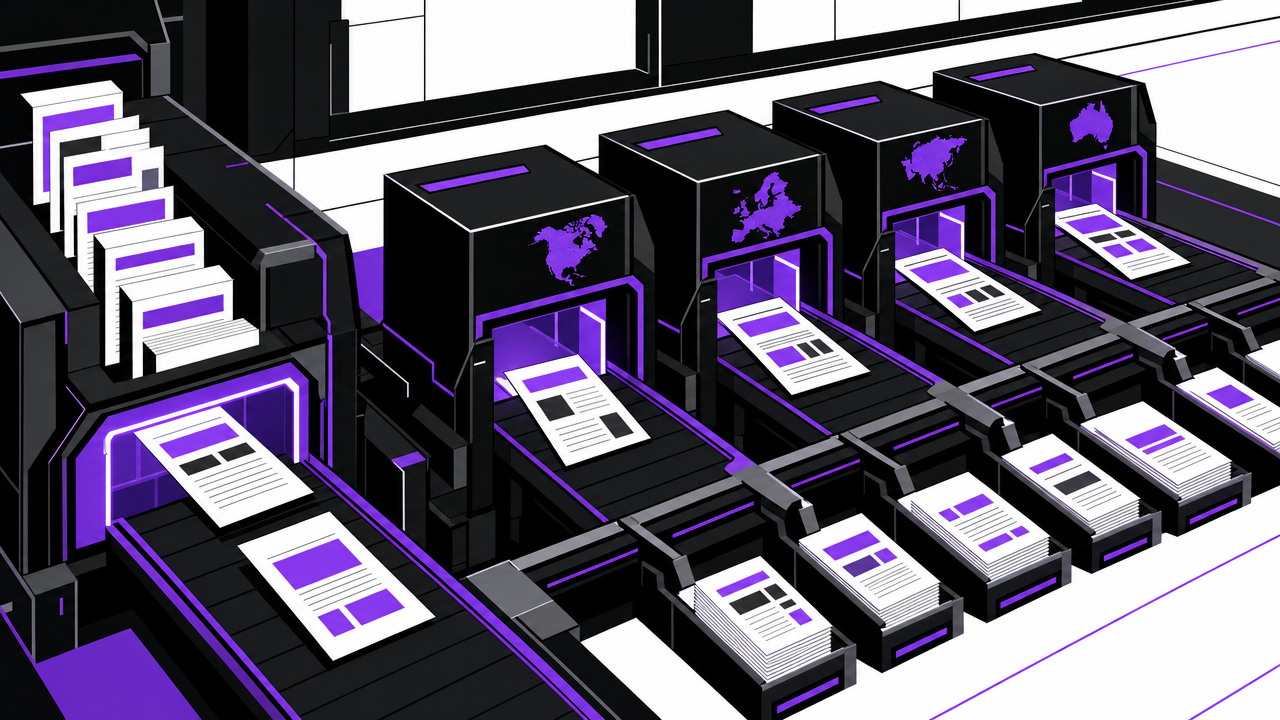
Automating localized content at the account level enables healthcare organizations to maintain brand consistency while adapting messaging for specific markets and locations. Recent systematic reviews emphasize that scalable content automation—when guided by centralized governance and supported by integrated workflows—can deliver a unified patient experience and reduce manual errors that often lead to brand fragmentation 2. In multi-location healthcare, this means creating a central repository of approved templates, visual assets, and message frameworks that can be programmatically adapted based on local needs, regulatory requirements, and service offerings.
This strategy suits operators managing complex service footprints who require both top-down control and local flexibility. For instance, automation systems can push out campaign assets to regional teams, allowing for pre-approved modifications that reflect local language preferences or highlight site-specific programs. Research indicates that organizations leveraging omnichannel automation see measurable improvements in patient satisfaction and loyalty, largely due to consistent, timely, and relevant communications across all touchpoints 2.
Resource requirements for implementing automated localized content include investment in content management platforms, workflow automation tools, and integration with analytics systems. Time to deployment varies but typically involves several weeks for initial setup and subsequent iterative refinement as local teams provide feedback. Prioritize this approach when the goal is to sustain high levels of brand consistency and operational efficiency without increasing headcount.
The next section examines how to measure the impact of these systems on brand equity and patient outcomes.
Measuring Brand Equity and Patient Outcomes
Measurement Toolkit: Brand Equity and Patient Outcomes Audit- Are HCAHPS or CAHPS scores tracked and segmented by location to reveal gaps in patient perception?- Is brand awareness assessed through regular surveys or digital analytics across all service areas?- Are repeat patient visits and referral rates attributed back to brand engagement initiatives?- Does reporting link brand consistency efforts to specific outcomes, such as satisfaction, loyalty, and utilization?
To quantify the business value of unified brand systems in healthcare, organizations must rigorously measure both brand equity and patient outcomes at the account level. Brand equity refers to the cumulative value of brand awareness, associations, perceived quality, and loyalty that influence patients’ choices and drive repeat utilization6. Peer-reviewed studies have demonstrated that brand equity significantly affects patient visit volume, with brand awareness alone showing the strongest correlation to increased healthcare utilization7.
On the patient outcome side, standardized surveys such as HCAHPS (Hospital Consumer Assessment of Healthcare Providers and Systems) provide an objective measure of patient experience across communication, responsiveness, and environment domains9. When brand consistency protocols are deployed—such as standardized messaging and staff behaviors—organizations typically observe improvements in these scores, which can be compared across locations to identify best practices and compliance gaps8.
This approach is ideal for multi-location operators seeking not just to document activities but to demonstrate clear ROI from their investments in brand consistency. Integrating analytics platforms that aggregate survey data, digital engagement metrics, and utilization trends enables leaders to trace how systematic brand management translates into higher patient satisfaction and loyalty.
The next section addresses common executive questions about budgeting, timelines, and best practices for deploying large-scale brand consistency systems.
Achieve Brand Consistency Across Every Location—Without Adding Overhead
See how unified AI-powered workflows enable seamless content, PPC, and backlink execution for all sites from a single operating system—helping complex teams maintain brand standards at scale.
Conclusion: Your Next 30 Days of Action
The shift from location-by-location marketing management to unified account-level operations requires three strategic priorities in the first 30 days—each designed to establish the infrastructure for coordinated execution across your entire footprint.
First, establish account-level measurement infrastructure that tracks performance metrics across all locations within a single framework. Organizations implementing unified analytics systems identify performance gaps 34% faster than those relying on location-specific dashboards, according to Medical Marketing Analytics research. This foundation enables strategic resource allocation based on comparative performance data rather than individual location requests.
Second, conduct a diagnostic audit using the framework outlined in this analysis to identify the highest-impact consistency gaps across your network. Healthcare Brand Management Institute data shows that organizations prioritizing gaps by patient acquisition impact—rather than addressing issues sequentially by location—achieve 41% faster ROI on improvement initiatives. Focus audit efforts on service line coverage, technical infrastructure standardization, and competitive positioning alignment.
Third, document the coordination overhead required to execute improvements using current location-by-location workflows. Track approval cycles, revision rounds, publication delays, and resource allocation conflicts across a sample improvement project. Healthcare Marketing Report's 2024 benchmarking study found that multi-site organizations spend an average of 23 hours per month on coordination activities that generate no patient-facing value—time that scales linearly with location count under fragmented management approaches.
This documentation exercise reveals the operational reality: executing coordinated improvements across multiple locations requires transitioning from fragmented location-by-location management to unified account-level operations. The strategic question becomes whether to build this operational capacity internally or leverage platforms designed specifically for this challenge.
AI-powered marketing platforms like Vectoron now enable this unified approach at scale, executing coordinated strategy across complex healthcare footprints from a single account-level plan without the coordination overhead that constrains traditional agency and in-house models.
Frequently Asked Questions
References
- 1.CMS Brand Strategy & Graphic Standards Guide.
- 2.An Overview of Omnichannel Interaction in Health Care Services.
- 3.Supplementary PDF: Omnichannel Interaction in Health Care Services.
- 4.Drive Patient Engagement with Health & Wellness Marketing Campaigns.
- 5.Health Insurance Marketplace Brand Identity and Design Standards.
- 6.Consumer or Patient Determinants of Hospital Brand Equity: A Systematic Review.
- 7.Brand equity analysis to increase health care utilization.
- 8.HCAHPS: having constant communication augments hospital and medical training and education.
- 9.HCAHPS: Patients' Perspectives of Care Survey.
- 10.Graphic Standards Manual - Stony Brook Medicine.