
Key Takeaways
- Brand guidelines function as the systemic governance layer that determines whether multi-unit marketing scales at decreasing cost or accumulating risk across 50 to 500 locations.
- Consistency within a brand outperforms both location quality and chain scale as a determinant of multi-unit performance, making standardization the highest-leverage corporate investment 1.
- Effective guidelines govern five domains—voice, visual, service behavior, local-adaptation rules, and extension rules—not just visual identity, with each domain mapped to a specific failure mode.
- Encoding standards into templates, portals, and brand-memory systems shifts oversight from per-asset review to exception handling, decoupling enforcement capacity from corporate headcount 2.
The governance layer franchise systems underestimate
Most franchise development teams treat brand guidelines as a creative deliverable owned by marketing, refreshed every three to five years, and circulated as a PDF. That framing understates what the document actually does. In a system of 50 to 500 locations, guidelines are the governance layer that decides whether marketing execution scales at decreasing marginal cost or accumulating marginal risk. Every local Facebook page, every regional radio spot, every grand-opening flyer is either pulling from a codified standard or improvising against one.
Research on multi-unit hotel chains found that consistency within a brand was a stronger determinant of performance than location quality or chain scale 1. The finding is specific to hotels, but the structural lesson travels: when customers experience the same brand across markets, the variance between locations damages equity faster than a weaker location can recover it. Franchising governance research reinforces the point, showing that standards enforcement operates across contractual, relational, and systemic dimensions at once 2. Guidelines sit in the systemic layer, and that is where most franchise development VPs are under-invested. The pages that follow examine what to put in that layer, how to enforce it without bottlenecking corporate, and what the marketing oversight math looks like once it is in place.
What the consistency research actually says
The most cited evidence on multi-unit brand performance comes from a Cornell-affiliated analysis of hotel chains, which found that consistency within a brand was a more decisive determinant of property performance than either location quality or chain scale 1. That hierarchy matters. It means a well-located inconsistent property underperformed a consistently executed one in a weaker location, and that adding more units to a chain did not, on its own, compensate for variance between them. The study was specific to hotels, where guests carry strong cross-property expectations and switching costs are low. Franchise development leaders in dental, home services, behavioral health, and senior living operate under similar conditions: customers compare locations against the brand they encountered last time, not against the local competitor down the street.
The finding does not say location is irrelevant or that scale produces no advantages. It says the marginal return on standardizing experience exceeds the marginal return on real estate selection and unit count, holding the others equal. For a system weighing where to put corporate attention, that ranking is the operative input. Most franchise development teams spend more on site selection analytics and pipeline acceleration than on the governance infrastructure that determines whether the units they open actually behave like the brand once they are running.
A second body of research connects the dots between that consistency and the metrics franchise development teams report on. Customer-based brand equity rises with well-managed, repeatable brand experiences, and that equity in turn drives engagement behaviors, word-of-mouth, and retention across experiential service categories 3. Translation: consistency does not just reduce risk, it compounds the LTV inputs corporate is already trying to lift through co-op spend and national campaigns. Guidelines are upstream of both. The hotel data scopes the size of the effect; the brand equity literature explains the mechanism. The implication for a 50-to-500-location service brand is that the document sitting in a marketing drive is doing more economic work than most operators credit it for, and underinvestment in it shows up later as AUV variance and franchisee complaints about brand traffic, not as a missing PDF.
Five governance domains, not a style guide
Most brand guideline documents over-index on one domain—visual identity—and underweight the four others that actually determine whether a 200-location system behaves like one brand. A useful framework treats guidelines as five governance domains: voice, visual, service behavior, local-adaptation rules, and extension or sub-brand rules. Each maps to a different category of franchisee deviation and a different downstream metric.
- Voice drift shows up in lead quality and ad disapprovals.
- Visual drift shows up in customer recognition.
- Service behavior drift shows up in review scores and repeat-visit rates.
- Local-adaptation gaps show up as either franchisee revolt or a flood of one-off approval requests.
- Extension rules show up the moment a new format launches.
Voice: the messaging layer franchisees deviate from first
Voice is the first domain franchisees stretch, because it is the cheapest to change and the hardest for corporate to spot at scale. A Tulsa location posts a Father's Day promotion in casual slang. A Phoenix unit writes Google Ads copy that promises a service tier the system does not offer. A regional manager rewrites the intake script to sound friendlier and removes the qualifying question that drives conversion. None of these violations trip a visual asset review. All of them erode the consistency that drives customer-based brand equity in experiential services, where engagement and word-of-mouth track directly to how repeatable the brand experience feels 3.
A voice domain that actually governs at scale specifies the audience model, the promise hierarchy, the disqualifying claims, the regulated-vocabulary list for verticals like behavioral health or dental, and the tone parameters by channel. It also defines what voice is not: the off-brand registers, the competitor framings, the emotional appeals reserved for national campaigns. Most systems publish three adjectives and call it done. Three adjectives do not survive a co-op Facebook boost from a franchisee whose nephew runs their socials.
Visual: the layer that gets policed, often at the expense of the others
Visual standards get the most attention because they are the easiest to audit. Logos, color values, typography pairs, photography style, signage specs—these are objectively right or wrong, which is why corporate enforcement budgets gravitate here. The problem is not that visual governance matters too little. It is that visual compliance gets confused with brand compliance. A franchisee can hit every Pantone value and still produce a customer experience that bears no resemblance to the brand on the website.
A visual domain that earns its share of the governance budget covers asset templates by channel, the local-customization fields inside those templates, the photography and video standards including who appears in shots and how spaces are staged, and the deprecation calendar that pulls retired marks out of circulation. The discipline is to treat visual as one column of the audit, not the audit itself.
Service behavior: where authenticity is built or broken
Service behavior is the domain where most franchise systems lose the brand without realizing it. Greetings, intake flow, complaint handling, follow-up cadence, the way a hygienist hands off to a dentist, the way a senior-living tour ends—these moments compound into what customers describe as the brand, even when they cannot articulate a single visual element. Authenticity research treats perceived consistency in brand behavior as a precondition for trust and loyalty, not a soft outcome of it 8. Cross-sensory consistency reinforces the same point: how a location sounds, smells, and paces a visit shapes whether the experience reads as genuine 9.
For franchise development VPs, this is the domain where the standardization-versus-autonomy tension gets real. A scripted greeting reads as corporate to a 25-year operator who has been greeting customers their own way for a decade. The governance answer is not to remove the script. It is to codify which behaviors are non-negotiable because they protect brand equity, which are recommended because they lift conversion, and which are local prerogatives. Service behavior standards work when they include the rationale, the measurement, and the consequence. Without the rationale, franchisees comply slowly. Without the measurement, corporate cannot tell whether compliance is happening. Without the consequence, the standard is a suggestion.
Local-adaptation rules: pre-approved variance
The fastest way to bottleneck corporate marketing is to require approval for every local deviation. The second fastest is to forbid local adaptation entirely and watch franchisees route around the rules. Self-congruity research shows that brand-identity effects vary across customer segments, which means a single national execution rarely fits every market equally well 4. The governance move is to pre-approve the variance: codify which fields franchisees can change, within what range, on which assets, in which channels.
Pre-approved variance typically covers a defined list: local imagery within staging rules, regional offer language within a promotion framework, community-event sponsorships within a category list, market-specific media mixes within co-op spend bands, and language localization within the approved translation set. Anything outside that list routes to exception handling. The decisive shift is moving corporate from per-asset review to range-of-acceptable-variation review. The first scales as O(locations × assets). The second scales as O(exceptions), which is an order of magnitude lower in a well-governed system. Franchise development teams that want to grow past 150 units without adding marketing FTE per cohort have to make that math work.
Extension and sub-brand rules: protecting the parent as formats multiply
Most systems past a certain scale add formats: an express service tier, a premium concept, a mobile unit, a co-branded partnership. Each format pulls on the parent brand's equity while introducing associations the parent did not previously carry. Brand extension research is direct about the risk: extensions that stray too far from established associations dilute the core brand rather than expanding it 5. Without explicit rules governing how extensions borrow from and contribute to the parent, the parent erodes from underneath.
Extension governance defines which equity elements transfer to sub-brands and which do not, the naming architecture and lockup rules, the visual hierarchy that signals relationship without confusion, the messaging boundaries that prevent the extension from over-promising on the parent's behalf, and the sunset criteria for extensions that underperform. It also specifies which decisions sit with corporate brand, which sit with the extension's operating team, and which require board-level review. Treating extensions as a sixth product line without their own rules is how franchise systems end up explaining to customers, and to franchisees, what the brand actually stands for after three formats in.
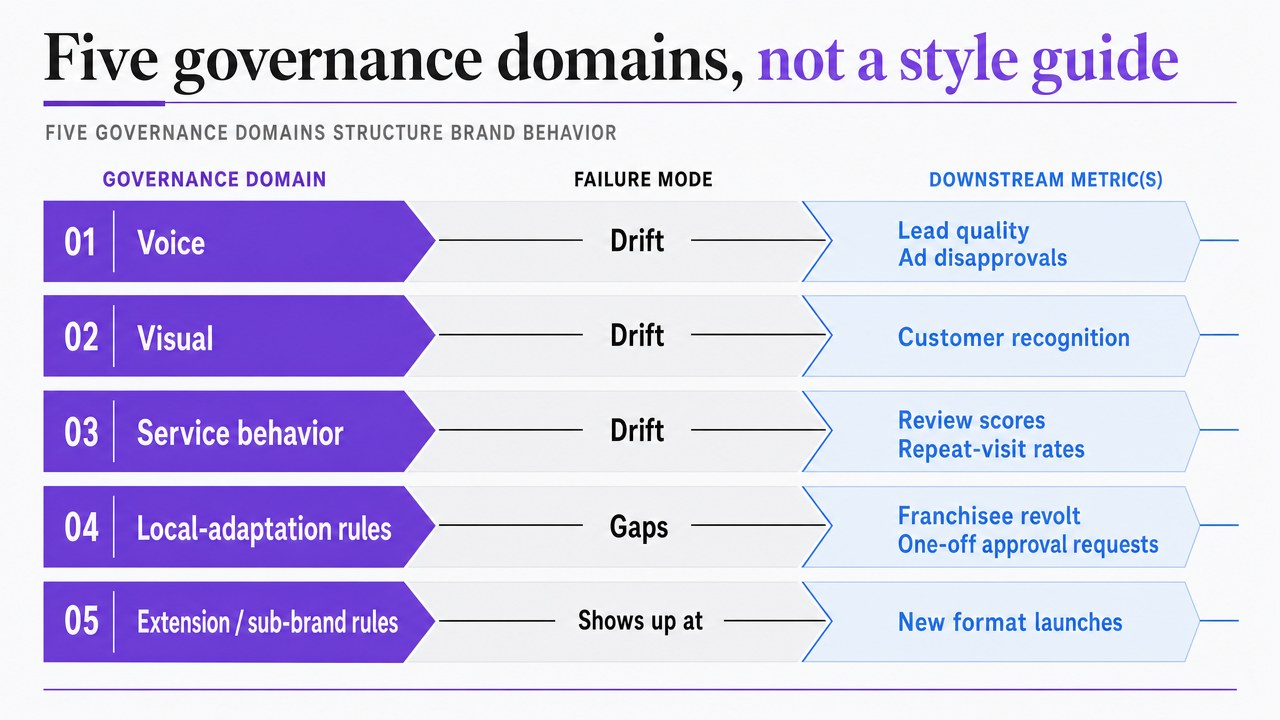 Visualize the five governance domains framework that structures the entire section, showing each domain alongside its failure mode and downstream metric as described in the article
Test automated brand consistency at scale now
Experience hands-on how automated brand guidelines drive consistent, efficient marketing execution across all locations.
Contractual, relational, systemic: how enforcement actually works
Brand standards do not enforce themselves, and the franchising governance literature is explicit that enforcement runs on three interacting layers at once: contractual, relational, and systemic 2. Each layer does work the others cannot. A franchise development leader who misallocates effort across them ends up with a thick FDD, a thin culture, and no operational backstop when a franchisee in a secondary market starts running rogue creative.
The contractual layer is the FDD, the franchise agreement, the brand standards exhibit, and the operations manual incorporated by reference. It defines what compliance is, what the cure period looks like, and what termination requires. The FTC Franchise Rule sets the disclosure floor for that layer 10. The contract is necessary and chronically insufficient, because litigation is the most expensive enforcement mechanism a franchisor has, and most brand violations are not worth invoking it.
The relational layer is field consultants, franchisee advisory councils, peer benchmarking, and the quarterly business review. It runs on trust, reciprocity, and the credible threat that corporate notices. Relational enforcement scales linearly with headcount, which is exactly the constraint a 200-location system runs into. One field consultant cannot review every paid social ad across thirty markets every week.
The systemic layer is where guidelines become enforceable without per-asset human review. Template libraries that constrain franchisee inputs to pre-approved fields. Co-op marketing portals that reject non-compliant uploads at the source. AI-assisted brand memory that flags voice or visual drift before assets reach customers. This is the layer that decouples enforcement capacity from corporate headcount, and the layer Stanford's research on franchisor ownership patterns implicitly identifies as the alternative to owning more outlets outright 7. Corporate decides the standard. The franchisee decides within the permitted range. The system enforces the boundary automatically and routes only the exceptions to a human. That is the decision-rights split a scaled system needs, and it is the one most franchise networks are still building.
The marketing oversight math
The case for codified guidelines becomes concrete the moment a franchise development team writes down what corporate marketing actually spends its hours on. In systems without enforceable standards, the dominant activity is per-asset review: a franchisee submits a flyer, a paid social ad, a landing page revision, a press release, and someone at corporate decides whether it can ship. That work scales with the number of locations multiplied by the number of assets each location produces. At 200 units producing even four marketing artifacts a month, corporate is making roughly 9,600 individual judgment calls a year. The bottleneck is not policy clarity. It is human review capacity.
The math changes when guidelines are encoded into templates, portals, and brand-memory systems that pre-approve the inputs and reject the rest at the source. Corporate stops reviewing assets and starts reviewing exceptions. Stanford's research on franchise reputation found that brands spending heavily on advertising tend to own a higher share of their outlets, a structural workaround for the enforcement-at-scale problem 7. Systemic governance is the other path: keep the franchise-heavy ownership mix, move enforcement into the system.
The table below is a planning worksheet, not a benchmark. The inputs belong to the operator; the structural difference between the two columns is what the franchising governance research 2and the Cornell consistency finding 1argue is worth pricing in.
| Variable | Without codified, enforceable guidelines | With encoded guidelines and systemic enforcement |
|---|---|---|
| Review unit | Per asset, per location | Per exception flagged by the system |
| Oversight scaling | O(locations × assets/month) | O(exceptions/month) |
| Corporate marketing FTE per 100 units | Operator input (typically rises with cohort count) | Operator input (typically flat past initial setup) |
| Hours/location/month on corporate review | Operator input | Operator input, materially lower |
| Variance between locations | Accumulates as units are added | Bounded by template and behavior rules 1 |
| Franchisee wait time on approvals | Linear in queue depth | Near-zero for in-bounds requests |
The variables on the right are the ones franchise development VPs control. The structural shift the table encodes is the one that decides whether a system can clear 300 units without a parallel build-out of corporate marketing headcount.
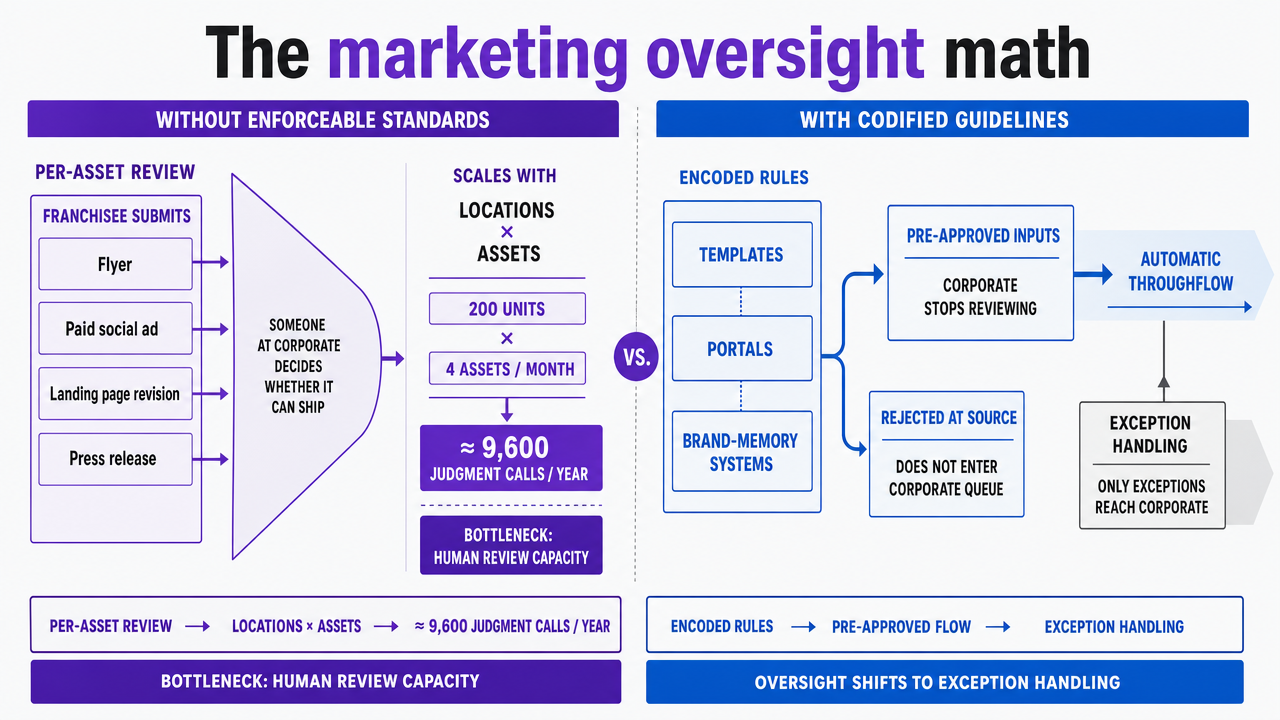 Visualize the comparison table directly from the section showing how oversight scaling shifts from per-asset review to exception handling when guidelines are encoded into systems
Ramp time, AUV variance, and the LTV case for codified standards
Franchise development VPs report on three numbers their boards actually care about: how fast new units reach mature revenue, how tightly AUV clusters across the system, and how much each customer is worth over their relationship with the brand. Brand guidelines do measurable work on all three, and the mechanism is the same in each case—repeatability reduces the variance that drags cohort performance toward the mean of the weakest units.
Ramp time compresses when a new operator inherits a fully encoded execution system instead of reconstructing it locally. Pre-built ad templates, intake scripts, signage specs, and service-behavior standards turn the first ninety days into deployment rather than discovery. The Cornell hotel data already established that consistency outperforms location quality as a performance determinant 1; the operational corollary is that a new unit hitting brand standard on day one beats a better-located unit still finding its voice in month six.
AUV variance is where the consistency research pays its largest dividend. Variance between locations is not a measurement problem—it is the visible output of ungoverned execution. Bounded templates and codified service behavior compress the distribution because the floor rises, not because the ceiling falls.
LTV follows from the same mechanism. Customer-based brand equity tracks to repeatable experiences in experiential service categories, and that equity drives the engagement, word-of-mouth, and retention behaviors that compound into lifetime value 3. Authenticity research adds that perceived consistency in brand behavior is itself a precondition for the trust that sustains repeat visits 8. Guidelines are the upstream variable. The downstream numbers are the ones the board reads.
See How Consistent Brand Guidelines Fuel Scalable Franchise Growth
Request a walkthrough of automated brand guideline management designed for multi-location systems—enabling uniform messaging, faster campaign launches, and measurable efficiency gains across every market.
Ownership intensity versus governance technology
Stanford research on franchisor reputation found that companies spending heavily on advertising tend to own a higher share of their outlets, treating ownership as the enforcement mechanism that protects the brand they are paying to build 7. The logic is straightforward: when corporate writes the check for national awareness, it wants direct control over how that awareness gets cashed in at the unit level. Owning the outlet is the most reliable way to guarantee the standard.
For a franchise development VP, that finding describes a fork in the road. One path is to push ownership intensity higher as advertising investment grows, accepting the capital requirements and the slower unit count that follow. The other path is to keep the franchise-heavy mix and move the enforcement work into governance technology—template systems, brand-memory platforms, co-op portals that reject non-compliant uploads before they ship. The contractual and relational layers do not disappear in either case 2. What changes is which layer carries the load when corporate cannot review every asset by hand.
Governance technology is the newer option, and it is what makes the franchise-heavy path viable at 300 or 500 units without rebuilding corporate marketing as a review factory. The standard gets encoded once. The system applies it everywhere. Corporate spends its hours on the exceptions and the strategy, not on policing a Phoenix franchisee's headline font. Ownership intensity and governance technology are substitutes for each other in the enforcement equation, and the second one scales without tying up balance sheet.
Where the system breaks: the failure modes worth pre-empting
Systems that scale on codified guidelines still break, and the failure modes are predictable enough to design against.
- The first is template rot: a library built two years ago that no longer matches current offers, current channels, or current creative standards. Franchisees stop using it, build their own assets, and the governance layer quietly becomes a museum. The fix is a versioning calendar with deprecation dates, not a quarterly refresh that everyone ignores.
- The second is the exception queue that swallows corporate. Pre-approved variance only works if the exception path is fast. When in-bounds requests get pulled into the same review pile as exceptions, the system collapses back to per-asset review and franchisees learn that compliance buys them nothing. Separate the queues, and staff the exception queue against the contractual and relational layers the governance research identifies as enforcement's other two legs 2.
- The third is silent drift in service behavior—the domain that does not trigger asset reviews and therefore does not get audited. Authenticity erodes through small deviations in greeting, pacing, and handoff that compound across visits 8. Mystery shops, recorded calls, and review-text analysis catch what template enforcement cannot.
A short note for operators running 50 to 500 locations
The franchise development teams that get the next hundred units open without rebuilding corporate marketing as a review factory share one habit: they treat brand guidelines as code, not copy. The standard gets encoded into templates, portals, and brand-memory systems that constrain inputs at the source, route exceptions to a human, and free corporate to spend its hours on strategy and the cases that actually need judgment. The research is consistent on the size of the prize: consistency outperforms location and scale as a determinant of multi-unit performance 1, and that consistency compounds into the engagement and retention behaviors boards read as LTV 3. Vectoron's brand intelligence layer is built for that operating model—encoded standards, exception routing, human approval where it matters.
Frequently Asked Questions
References
- 1.Critical importance of brand consistency in the hotel industry.
- 2.Expanding the conceptual domain of governance in franchising.
- 3.Customer-based brand equity and customer engagement in experiential services.
- 4.Understanding the effect of brand identity driven by consumer self-congruity.
- 5.Practices of brand extensions and how consumers respond to them.
- 6.How Brand Knowledge Affects Purchase Intentions in Fresh Food E-Commerce.
- 7.How Franchisers Protect Brand Reputation.
- 8.Unpacking the effects of brand authenticity on consumer trust and loyalty in nutrition branding.
- 9.The role of octomodal mental imagery and social presence.
- 10.Franchise Rule Compliance Guide.
- 11.Marketing and sales.