
Key Takeaways
- Brand voice stays fixed while tone shifts by audience and situation, so voice can be trained once but tone must be specified per channel, campaign, and journey stage 1.
- Paired-attribute descriptors like 'helpful not condescending' make tone enforceable by naming both the target register and the adjacent failure mode reviewers must flag 5.
- Tone weighted toward competence, sincerity, and excitement produces stronger effects on customer-based brand equity than sophistication or ruggedness in most categories 8.
- Audit tone against Cal Poly's five layers—audience, personality, values, language, and consistency—and treat the consistency layer as load-bearing, especially when AI drafts the first pass 10.
Why tone became a governance problem before it became a creative one
For most of the past decade, brand tone sat inside the creative brief. A senior writer set it, junior writers absorbed it, and a small team kept it stable through proximity. That arrangement quietly broke once content programs scaled past a handful of contributors and started producing across blogs, lifecycle email, support macros, sales enablement, paid social, and organic social in parallel. The bottleneck moved from taste to enforcement.
The shift matters because tone is the layer of brand expression that changes by audience and situation, while brand voice stays fixed. NC State's institutional guidelines describe tone as the unit's current attitude toward the audience or topic, capable of shifting by context while a single voice anchors the brand 1. When one writer holds both layers in their head, the system works. When forty contributors and an AI drafting tool share the work, the situational layer fragments first.
That is the operating reality in-house content marketing managers face now. The job is no longer to write the brand; it is to govern how dozens of people and several models write it. Customer-based brand equity depends on consistent brand knowledge structures built across every touchpoint 9, and inconsistent tone is the most common way those structures erode. Tone, treated as a creative concern, scales poorly. Treated as governance, with documented rules and reference patterns, it survives volume. The rest of this article works through how that codification gets built, what equity outcomes it supports, and where it tends to break.
Brand voice vs. brand tone: the distinction that decides who can write for the brand
Voice is fixed identity; tone is situational expression
The cleanest operational definition comes from institutional brand systems built to govern dozens of writers across hundreds of channels. NC State treats voice as the singular, fixed character of the brand and tone as the unit's current attitude toward the audience or topic, capable of shifting by situation 1. The University of Arizona uses the same split in plainer language: voice is who the brand is, tone is how the brand says it in a given moment, adjusted by audience and context 6.
That two-layer model decides who can write for the brand. Voice is the part that should not flex. A support reply, a quarterly earnings post, a crisis statement, and a paid social caption all carry the same underlying identity. Tone is the part that must flex. The same brand can read patient and clarifying in a support macro, declarative and benefit-led in a sales page, lighter and rhythm-driven on social, and stripped-down and precise in a crisis post.
For content managers, the practical consequence is that voice can be trained once and reused indefinitely, while tone has to be specified per channel, per audience, and sometimes per campaign moment. The University of Arizona's guidelines extend voice beyond writing into visual communications and lived experiences 6, which means tone enforcement cannot live only in a copy deck. It has to reach every surface the brand touches, including the ones produced under deadline by writers who have never met the brand lead.
Paired-attribute descriptors: how documented systems make tone enforceable
Defining tone in adjectives alone produces the same problem every content lead has seen: ten writers read "confident" and ship ten different registers. The Illinois brand guidelines solve that with paired-attribute descriptors that bind each desired trait to the failure mode next to it. Tone is documented as "helpful not condescending" and "confident not arrogant," so each attribute carries its own guardrail 5.
The pattern is enforceable because it does two jobs at once. The first half names the target. The second half rules out the closest adjacent register a writer might drift into under pressure. "Helpful" without a counterweight can slide into talking down to the reader. "Confident" without one can read as posturing. Pinning each trait to its opposite failure narrows the range of acceptable output without scripting every sentence.
The format also gives editors a concrete review criterion. Instead of asking whether a draft "sounds like the brand," a reviewer can ask whether any paragraph crosses into the banned half of each pair. That converts tone review from taste into rule-checking, which is the only form of review that holds up at multi-writer volume or when an AI tool produces the first pass.
Operators building a tone document can copy the structure directly: list four to six paired descriptors, each in the same "X not Y" form, and require every reviewer to flag drafts where the Y side appears 5. The rest of the tone system layers on top of that base.
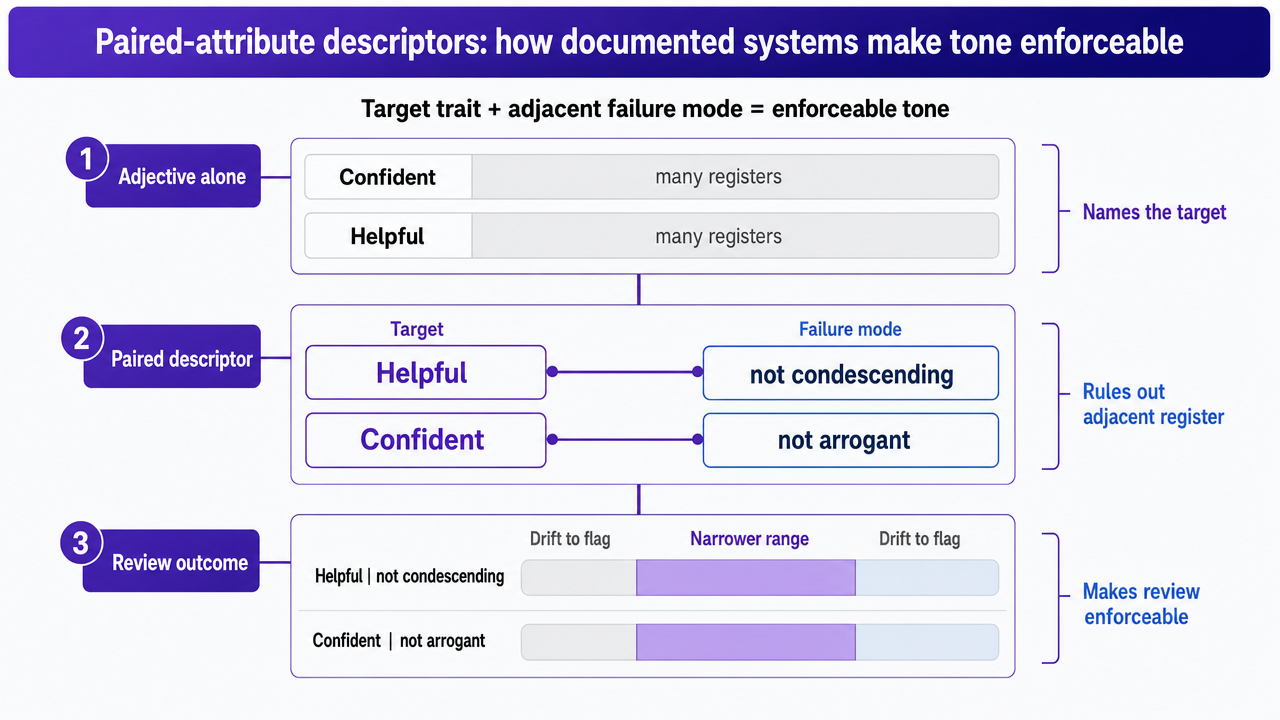 Visualize the paired-attribute descriptor pattern cited from Illinois brand guidelines, showing how each target trait is bound to an adjacent failure mode reviewers must flag
Test Consistent Brand Tone in Live Content
Validate your brand tone impact by publishing real articles during your free trial.
How tone feeds customer-based brand equity
The equity mechanism: brand knowledge structures and differential response
Tone earns its place in a growth conversation through customer-based brand equity, not through subjective polish. Keller's foundational definition treats customer-based brand equity as the differential effect of brand knowledge on consumer response to the marketing of the brand 9. Two readers see the same offer; the one who already holds a coherent set of associations with the sender responds differently. Tone is one of the inputs that builds those associations, repetition by repetition, across email, search results, support replies, and social.
The Harvard Business School overview frames the downstream consequence in plainer terms. Brand equity reflects consumers' collective awareness and knowledge of a brand and influences their willingness to pay for the product 7. Price tolerance, preference at parity, and resistance to competitor offers all trace back to the strength and clarity of those stored associations. A tone that reads competent in one channel and casual-bordering-on-careless in another fragments the knowledge structure rather than reinforcing it.
The mechanism is cumulative, which is why governance matters more than any single piece of copy. A help-center reply written in a register that contradicts the sales page does not just feel off; it adds a competing association to memory. Over thousands of touchpoints, the brand the customer recalls is the average of what they have actually read, not the version on the brand strategy slide. Content marketing managers protecting equity at scale are managing that average. Tone codification is how the average stays close to the intended center instead of drifting toward whichever writer or model produced the loudest volume of content that quarter.
Which personality dimensions tone should emphasize
Not every brand personality dimension contributes equally to equity, and the research gives operators a defensible basis for prioritizing tone attributes rather than picking adjectives by preference. A meta-analysis of brand personality effects on customer-based brand equity found that excitement, competence, and sincerity produce more positive effects on equity than sophistication and ruggedness 8. The ranking matters because tone documents have finite room. Four to six paired descriptors is a workable ceiling; beyond that, writers stop checking the list. Choosing which traits to encode is a budget decision.
The three higher-effect dimensions translate into distinct tonal registers:
- Competence reads as precision, factual density, and the absence of unnecessary qualifiers.
- Sincerity reads as direct address, plain word choice, and acknowledgment of limits or trade-offs.
- Excitement reads as rhythm, momentum, and a willingness to use the active voice and concrete verbs rather than nominalized abstractions.
A tone document that codifies all three gives writers room to flex between them by channel while staying inside the equity-positive range.
The meta-analysis also notes that effects shift over time and may vary by category and culture, which is the operator's caution against treating the ranking as universal 8. A premium category may still need a measured dose of sophistication; an outdoor or industrial brand may legitimately lean rugged. The point is not to ban two dimensions, but to weight the document so the higher-effect traits dominate the descriptor set and the lower-effect ones appear only when category fit demands it.
For content teams auditing an existing tone guide, the diagnostic is simple. Count how many paired descriptors map to competence, sincerity, and excitement versus sophistication and ruggedness. A guide weighted toward the latter two is leaving equity on the table for most consumer and service categories 8.
Emotion, experience, and the behaviors that follow
Equity explains the stored side of the equation. Behavior explains the active side, and the link runs through emotion and experience. A 2022 empirical study on customer experience found that experience mediates the relationship between customers' emotions and their behavioral intentions, including loyalty and word of mouth 2. Positive emotional responses do not convert to behavior directly; they convert through the experience the brand delivers around them.
Tone is one of the more controllable inputs into that experience layer. A support reply that reads patient and clarifying produces a different emotional residue than one that reads procedural and clipped, even when both resolve the issue. A reactivation email that reads sincere produces a different response than one that reads templated. The study's scope is worth noting: it examined customer experience as a mediator in a specific service context, and the authors flag that emotional drivers can vary by industry 2. The mechanism generalizes; the magnitudes do not.
For content marketing managers, the operational takeaway is that tone choices in the highest-emotion touchpoints carry disproportionate weight. Onboarding sequences, support macros, win-back emails, cancellation flows, and crisis communications all sit at moments where the customer's emotional state is already elevated. Codifying tone tightly for those moments, and reviewing drafts against the documented descriptors before they ship, protects the behavioral outcomes the rest of the marketing program is trying to produce.
Codifying tone so volume does not dilute it
The five-layer tone audit: audience, personality, values, language, consistency
A tone document that survives volume needs more than adjectives. Cal Poly's Small Business Development Center frames brand voice as the personality and tone used to communicate a business's values, mission, and offerings, and gives a five-part structure operators can audit against: target audience, brand personality, core values, audience language, and consistency 10. Each layer answers a different question a writer or reviewer asks during drafting.
Audience layer : The audience layer specifies who the writer is addressing in this particular piece, not the brand's audience in the abstract. A retention email targets a different reader than an acquisition landing page, even when both serve the same buyer segment.
Personality layer : The personality layer translates the brand's chosen character traits into paired descriptors a writer can check against.
Values layer : The values layer names the positions the brand is willing to take and the ones it stays out of, which prevents tone drift in opinion-adjacent content.
Language layer : The language layer documents the specific vocabulary the audience uses, including the terms the brand prefers and the ones it avoids.
Consistency layer : The consistency layer specifies how the first four get enforced: who reviews, against what checklist, and at what stage in the production workflow 10.
The audit value comes from running an existing tone guide through all five layers and noting which are documented in usable detail versus which exist only as implicit knowledge held by one or two senior writers. Most in-house guides cover personality reasonably well and language partially. Audience definitions tend to be too broad to guide a specific draft, and the consistency layer is often missing entirely, which is the layer that determines whether the other four hold up at scale 10. Cal Poly's framing of consistency as the mechanism that helps customers know what to expect makes it the load-bearing layer, not the optional one 10.
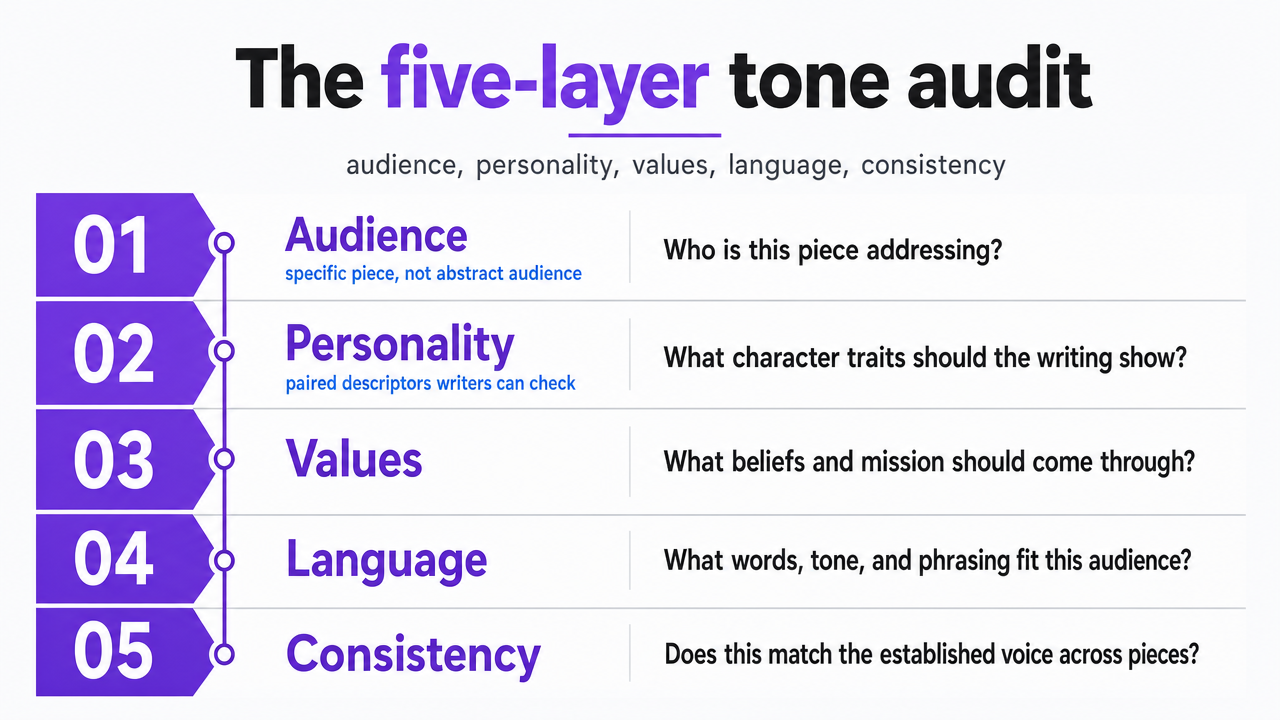 Visualize the five-layer tone codification framework cited from Cal Poly SBDC, showing each layer and the question it answers for writers and reviewers
A tone-maturity diagnostic for in-house programs
The five layers convert into a maturity diagnostic operators can score in under an hour. The exercise produces a defensible read on where the program actually sits, which is usually less mature than the brand strategy deck suggests.
- At the lowest level, tone exists as taste held by individual writers. There is no document, or the document is a single paragraph of adjectives. Drafts pass or fail review based on the reviewer's instinct, and two reviewers will disagree on the same piece. Output is inconsistent across writers, and onboarding a freelancer takes weeks of revision cycles before their drafts read on-brand.
- At the middle level, tone is documented but unevenly enforced. Personality descriptors exist, ideally in the paired-attribute format Illinois uses 5. Audience definitions cover the main segments. Language preferences are partially captured. Consistency enforcement is informal, meaning review happens but against memory rather than a checklist. Output quality varies by reviewer availability.
- At the highest level, all five Cal Poly layers are documented in writing, reviewers work from an explicit checklist tied to those layers, and the checklist is the same one used to evaluate freelancer drafts and AI-generated first passes 10. New contributors produce on-brand work within their first few assignments because the document does the teaching, not the senior writer's calendar.
Content marketing managers running the diagnostic should score each of the five layers independently, since programs rarely mature evenly. Most in-house teams find personality and language ahead of audience and consistency, which points the next quarter's documentation work at the weaker layers rather than at a full rewrite 10.
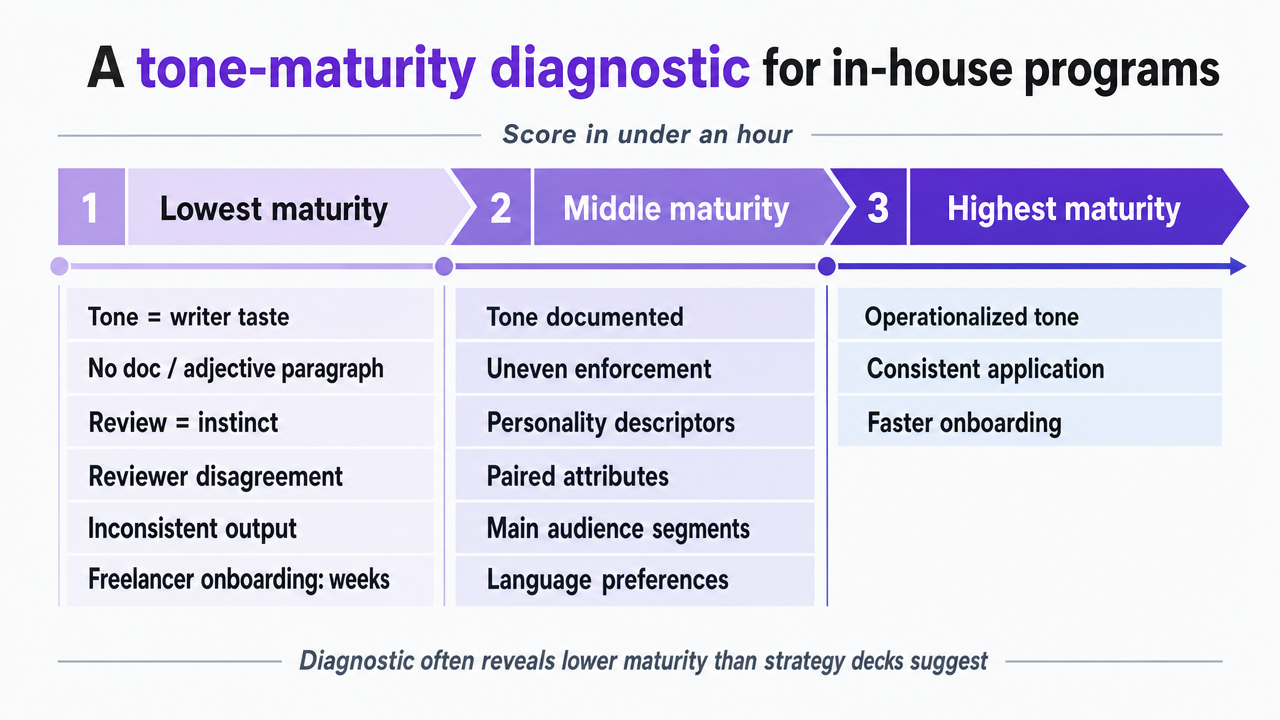 Visualize the three-stage tone maturity model described in the section, helping operators locate their program on a defined progression
Tone governance when AI drafts the first version
AI-assisted drafting changes which part of the tone system carries the load. When a human writer produced the first version, the personality and language layers lived partly in the writer's head, and the document mainly caught edge cases. When a model produces the first version, every layer has to be explicit, because the model has no implicit knowledge of how the brand spoke in last quarter's campaign.
The practical consequence is that tone documents built for human writers tend to fail under AI drafting in predictable ways. Paired-attribute descriptors of the kind Illinois publishes hold up well, because the second half of each pair gives the model a clear exclusion to respect 5. Adjective lists without counterweights produce drafts that read on-brand in some passages and adjacent-to-brand in others, because the model interpolates toward the most statistically common register for the topic rather than toward the brand's specific one.
The consistency layer matters more, not less, in AI-assisted production. Cal Poly's framing of consistency as the mechanism that lets customers know what to expect applies directly: the reviewer's checklist is what catches model drift before it ships 10. The checklist should map one-to-one to the documented layers, so a reviewer can flag a draft as failing the audience layer or the values layer rather than as generically off-brand.
One operational note: tone systems built to govern AI drafts also tend to improve human-written output, because the same explicit rules that constrain a model give freelancers and junior writers a clearer target. The investment compounds across both production modes rather than serving only one.
Accelerate Content Consistency with Data-Driven Brand Tone Automation
Connect with a specialist to see how automated brand tone management can help your team publish at scale, maintain voice integrity, and amplify multi-channel growth—without expanding headcount.
Multichannel consistency and the journey argument
The case for multichannel tone consistency is not aesthetic. It is built into how customer experience converts attention into revenue. McKinsey's work on end-to-end customer journeys finds that leading customer experience companies sustain value partly through motivated employees who embody the customer and brand promise in their interactions 3. That promise has to read the same whether the customer encounters it in a paid search ad, a help-center article, an onboarding email, or a renewal reminder. Each touchpoint either reinforces the stored brand or competes with it.
The journey frame changes how tone documents get organized. A channel-by-channel guide treats blog, email, and social as separate problems. A journey-by-journey guide treats acquisition, activation, support, retention, and reactivation as separate problems, then specifies the tonal register each stage requires across whatever channels touch it. The second structure holds up better because customers experience the brand by stage, not by department.
The downstream effect shows up in equity research on service categories. Customer-based brand equity has a direct positive impact on satisfaction and reputation and an indirect impact on engagement in experiential service settings 4. The study's scope is service contexts, so the magnitudes do not translate to every category, but the mechanism is consistent with the broader literature: coherent brand signals across the journey build the equity that satisfaction and engagement draw on. Tone drift across stages is one of the more controllable ways that equity leaks before customers ever cite a reason.
If teams manage multiple units, locations, or brand sub-systems
A note on scope: this section addresses content marketing managers governing tone across multiple business units, regional teams, franchise locations, or sub-brands operating under a parent identity. Single-team operators can skip ahead. The governance problem here is different in kind, not just in scale, because each unit has its own writers, its own deadlines, and its own local pressures pulling tone away from the center.
NC State's brand system is one of the few publicly documented examples of how a large, distributed organization handles this. The guidelines hold the voice fixed across every unit while explicitly permitting tone to shift by the unit's current attitude toward its audience or topic 1. An admissions team writing to prospective students does not sound identical to a research office writing to grant reviewers, and the framework expects that. What it does not permit is each unit inventing its own voice underneath the tonal flex. The University of Arizona's guidelines take the same position, extending the voice anchor into visual communications and lived experiences so tone variation across teams cannot quietly become brand variation 6.
For in-house operators, the practical structure is a two-tier document. The top tier specifies voice attributes, paired-descriptor personality traits, and values positions that every unit inherits without modification. The bottom tier lets each unit document its own audience definitions, channel-specific tonal registers, and vocabulary preferences, all checked against the top tier before publishing. The Illinois paired-attribute format works well at the top tier because it leaves no ambiguity about which adjacent registers are out of bounds, regardless of which unit is drafting 5.
The economics here are qualitative but consistent. Codified tone reduces freelancer onboarding cycles across every unit, cuts revision rounds when a regional team submits work for central review, and lowers the rejection rate on AI-drafted first passes that any unit produces. None of those savings show up as a line item, but they compound across units. The equity argument is the harder one: customer-based brand equity depends on coherent brand knowledge structures built across touchpoints 9, and a customer who encounters two units of the same parent brand reading in materially different registers stores a fragmented version of the brand rather than a reinforced one. The two-tier document is what keeps the stored version close to the intended one as the org chart grows.
Frequently Asked Questions
References
- 1.Voice and Tone.
- 2.Examining the Mediating Effect of Customer Experience on the Customers’ Emotions–Customers’ Behavioral Intentions Relationship.
- 3.Creating value through transforming customer journeys.
- 4.Customer-based brand equity and customer engagement in experiential services.
- 5.Personality, Voice and Tone - Illinois Brand Guidelines.
- 6.Voice & Tone - University Marketing & Communications.
- 7.Brand Equity Explained: How to Build and Measure Success.
- 8.How has the effect of brand personality on customer-based brand equity changed over time?.
- 9.Conceptualizing, Measuring, and Managing Customer-Based Brand Equity.
- 10.Maintaining a Consistent Brand Voice & Why it is Important.