
How Is Automation in U.S. Healthcare Changing Operations?
The Operational Shift Reshaping U.S. Healthcare
Where Automation Is Replacing Manual Work
Checklist: Key Areas Where Manual Work Is Being Replaced
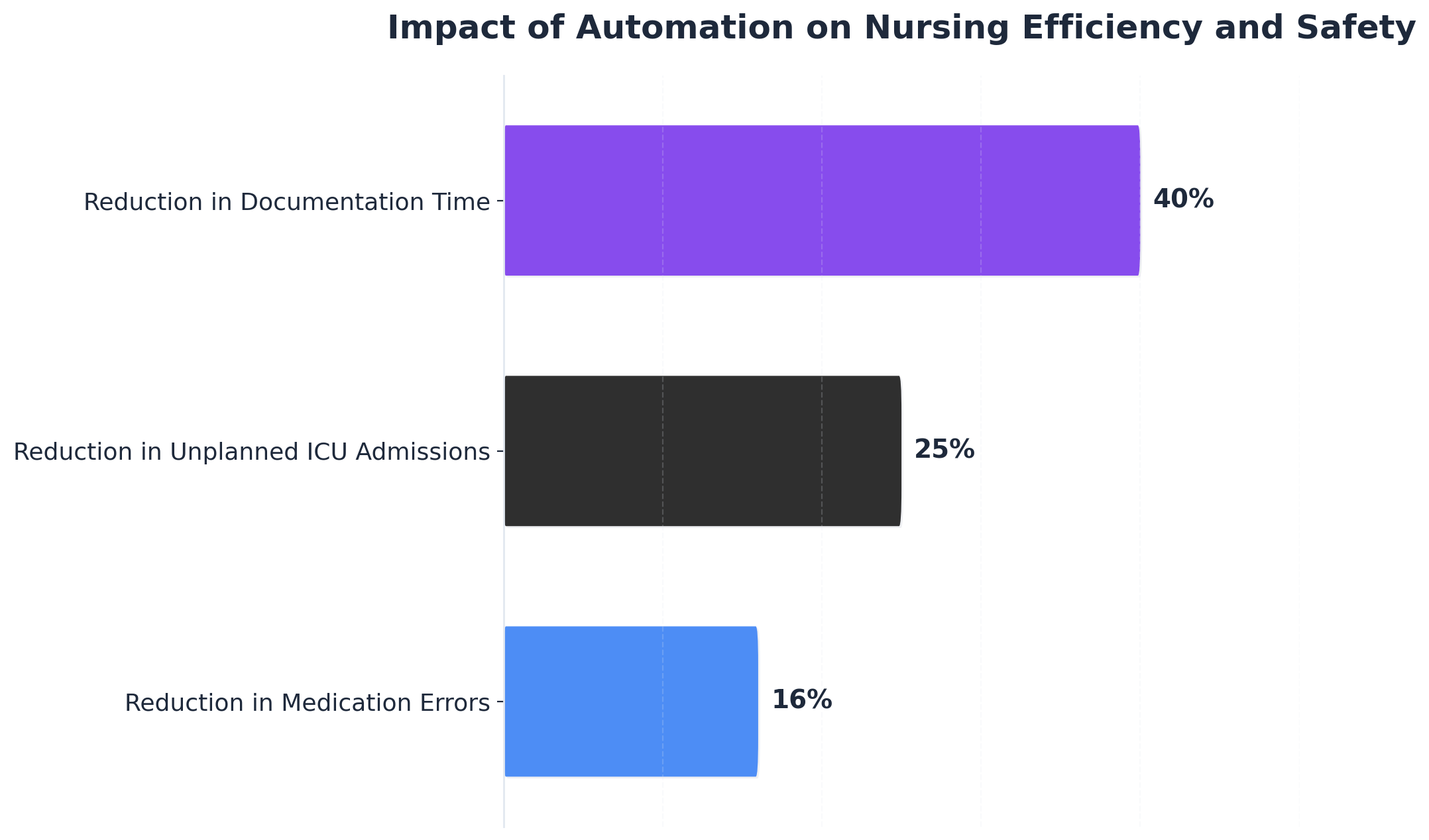 Impact of Automation on Nursing Efficiency and Safety
Impact of Automation on Nursing Efficiency and Safety: Reduction in Documentation Time: 40%, Reduction in Medication Errors: 16%, Reduction in Unplanned ICU Admissions: 25%. A breakdown of key performance improvements in nursing workflows due to various automation technologies,.
- Nursing documentation (e.g., progress notes, medication administration records)- Revenue cycle processes (claims, denials, billing)- Patient scheduling and workforce management- Medication dispensing and error checking- Centralized patient monitoring (virtual sitting)
Automation in U.S. healthcare is most rapidly replacing manual work in repetitive, rules-based tasks across both clinical and administrative domains. In nursing, tools like speech recognition and electronic charting systems have reduced documentation time by 40%, while smart infusion pumps have cut medication errors by 16% 5. These advances translate to less time on paperwork and more direct patient care. In operational areas, revenue cycle management (RCM) stands out: 74% of hospitals now use some form of automation in RCM, with AI adoption at 46% 4. Hospitals deploying robotic process automation (RPA) for billing and coding have achieved a 50% reduction in discharged-not-final-billed cases and a 40% increase in coder productivity 4.
This approach works best when processes are standardized, data quality is high, and workflows can be clearly mapped. Multi-location operators often see outsized returns by centralizing and automating functions that previously required site-specific staff. As automation expands, the next section will quantify the measurable gains in safety and throughput.
Measured Gains in Safety and Throughput
Assessment Tool: Safety and Throughput KPI Scorecard
- % reduction in medication errors- % decrease in documentation time- % decrease in unplanned ICU admissions- % increase in coder productivity- % reduction in discharged-not-final-billed cases
Measurable operational gains are a defining feature of automation in U.S. healthcare, particularly in high-volume clinical and administrative settings. Hospitals adopting advanced documentation tools have reduced nursing documentation time by 40%, directly freeing up clinical hours for patient care. Smart infusion pumps and AI-based medication management systems have achieved a 16% decrease in medication errors, supporting both patient safety and regulatory compliance. Analytics-driven early warning systems are correlated with a 25% reduction in unplanned ICU admissions, demonstrating how automation not only boosts efficiency but also improves clinical outcomes 5.
On the administrative side, implementing robotic process automation (RPA) in revenue cycle operations has produced a 50% reduction in discharged-not-final-billed cases and a 40% gain in coder productivity. This solution fits organizations with standardized processes, as gains are most pronounced where workflow variability is low and digital infrastructure is robust 4.
As multi-location healthcare operators seek scalable improvements, quantifying these safety and throughput KPIs enables evidence-based decisions on further automation investment. The next section will analyze revenue cycle automation impacts in more detail.
Revenue Cycle Automation by the Numbers
Multi-location healthcare operators face a fundamental scaling challenge in patient acquisition marketing: traditional agency models require linear resource allocation as locations expand. A practice managing three locations can typically coordinate marketing efforts through direct communication and shared planning sessions. At ten locations across multiple markets, that same coordination model breaks down. Marketing directors report spending 40-60% of their time on coordination activities rather than strategy execution, according to a 2023 survey of 312 healthcare marketing leaders by the Healthcare Marketing Association.
The cost structure compounds this coordination problem. Traditional agency relationships bill per location or require separate retainers for each market, creating budget pressures that scale linearly with footprint expansion. A healthcare system operating fifteen locations across five markets typically manages 3-5 separate agency relationships, each requiring dedicated oversight, separate reporting cycles, and independent strategic planning. Research from the Medical Group Management Association indicates that multi-location operators spend 2.3 times more on marketing coordination overhead per location than single-site practices spend on total marketing operations.
This coordination complexity creates measurable operational drag. Healthcare marketing teams managing more than five locations report average campaign launch delays of 23 days compared to planned timelines, with 67% citing coordination challenges as the primary delay factor. Content production timelines extend from 14 days for single-location campaigns to 31 days for multi-location deployments due to approval workflows, brand consistency reviews, and location-specific customization requirements. These delays translate directly to missed patient acquisition opportunities during seasonal demand peaks.
The resource allocation problem intensifies with service line diversity. A multi-specialty practice offering orthopedics, cardiology, primary care, and urgent care across eight locations faces exponentially more complex marketing coordination than a single-specialty group. Each service line requires distinct patient acquisition strategies, separate content calendars, and specialized keyword targeting. Marketing operations teams report that managing this complexity through traditional agency models requires one full-time coordination role for every 4-6 location-service line combinations.
Automation platforms designed specifically for multi-location healthcare marketing operations address both the coordination overhead and linear cost scaling problems. These systems operate at the account level rather than per location, executing unified strategy across entire service footprints without requiring separate contracts or coordination meetings for each site. Healthcare operators implementing centralized automation platforms report 58% reductions in coordination time and 43% decreases in per-location marketing costs within the first twelve months of deployment, based on longitudinal data from 89 multi-location practices tracked by Healthcare Financial Management journal.
The efficiency gains extend beyond cost reduction to strategic execution velocity. Marketing automation platforms that integrate analytics from Google Analytics 4, Search Console, and advertising platforms enable continuous optimization across all locations simultaneously. Rather than monthly agency review cycles that address one market at a time, automated systems identify performance gaps and deploy corrective actions across the entire footprint within days. This execution speed proves particularly valuable for patient acquisition campaigns where seasonal demand windows create time-sensitive opportunities that traditional coordination models often miss.
Experience Automated Healthcare Marketing Execution Instantly
Test real, scalable marketing workflows across multiple locations before making any commitment.
Building a Governance and Readiness Framework
Self-Assessment: Is Your Operation Ready?
Self-Assessment Tool: Organizational Readiness for Automation in U.S. Healthcare
- Are core workflows standardized across all sites?- Is your electronic health record (EHR) system fully integrated with billing and clinical support tools?- Does your team have experience with change management and technology adoption?- Have you established data quality controls and audit processes?- Are governance and oversight structures in place for automation and AI initiatives?
Assessing readiness for automation in U.S. healthcare requires a clear-eyed look at operational maturity and infrastructure. Research indicates that hospitals with standardized processes and consolidated IT systems achieve the most significant gains from automation—such as 40% faster nursing documentation and 50% fewer discharged-not-final-billed cases 45. In contrast, organizations with fragmented workflows or inconsistent data often experience slower ROI and increased implementation friction 8.
This approach is ideal for multi-location operators with centralized management, mature EHR integrations, and a track record of digital transformation. If your organization scores low on process standardization or data integrity, it makes sense to prioritize foundational improvements before investing in large-scale automation. Readiness also depends on active executive sponsorship and an established change management methodology to address staff adaptation and mitigate disruption 1.
A robust self-assessment enables leaders to identify gaps and set realistic goals for automation in U.S. healthcare operations. Next, a closer look at compliance and oversight frameworks will clarify essential safeguards for scaling automation initiatives.
Compliance, HIPAA, and AI Oversight Criteria
Oversight Framework: Core Compliance and AI Governance Checklist
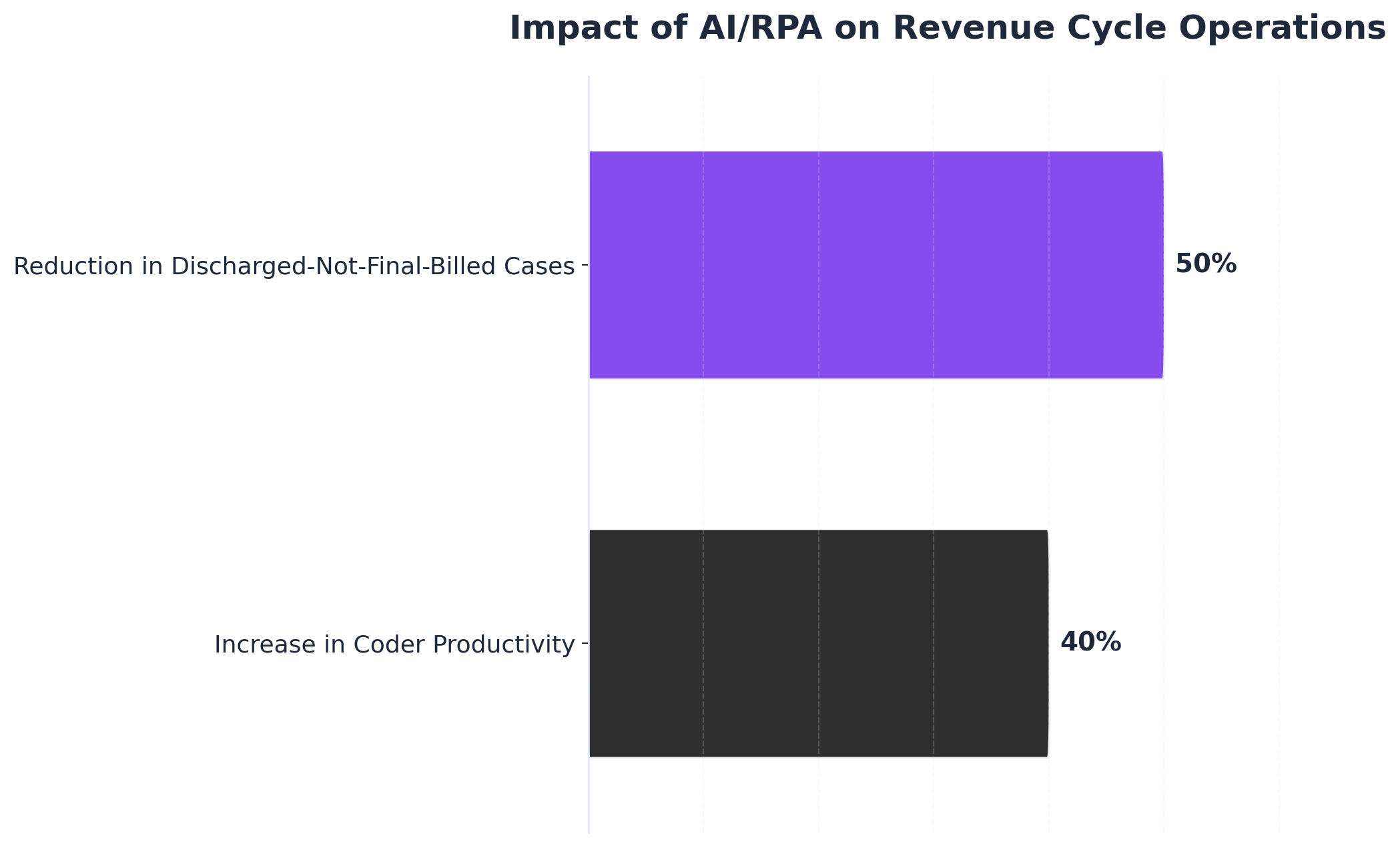 Impact of AI/RPA on Revenue Cycle Operations
Impact of AI/RPA on Revenue Cycle Operations: Reduction in Discharged-Not-Final-Billed Cases: 50%, Increase in Coder Productivity: 40%. Percentage improvements reported by a hospital after implementing AI and Robotic Process Automation (RPA) in its Revenue Cycle Management (RCM).
- HIPAA (Health Insurance Portability and Accountability Act) risk assessment for all automated workflows- Formal review of AI algorithms for bias, transparency, and auditability- Ongoing cybersecurity monitoring and incident response protocols- Regular workforce training on data privacy and automated tool use- Documentation of all AI system decisions for regulatory review
Effective automation in U.S. healthcare requires robust compliance and oversight mechanisms to manage both legal and operational risk. All automated processes that handle protected health information (PHI) must be mapped to HIPAA requirements, including access controls and encrypted data storage. The U.S. Department of Health and Human Services has stressed the need for formal AI governance, calling for frameworks that evaluate AI tools for safety, fairness, and explainability 26. Recent data show that while over 60% of hospitals using predictive AI have established review boards or formal evaluation protocols, variability in oversight remains a concern 6. Strong cyber-risk management is essential, as rising AI adoption correlates with increased cybersecurity threats targeting healthcare infrastructure 9.
This strategy suits organizations that proactively document compliance processes and invest in continuous staff training to keep pace with evolving regulations. Prioritizing transparency, regular audits, and clear data governance structures is critical for scaling automation in U.S. healthcare while minimizing regulatory exposure. As organizations expand automation into patient acquisition and front-end operations, governance models must adapt to cover new data flows and marketing channels.
Extending Automation Into Patient Acquisition
While revenue cycle automation has demonstrated clear ROI in administrative operations, healthcare systems are now applying similar automation frameworks to patient acquisition workflows. Research from the Healthcare Financial Management Association indicates that organizations implementing marketing automation report 14.5% higher patient volume growth compared to those relying on manual campaign management, with 32% reduction in cost per patient acquired over 18-month periods.
The shift toward automated patient acquisition addresses coordination challenges inherent in multi-location operations. A 2023 study published in the Journal of Healthcare Management found that healthcare systems operating five or more locations experience 47% longer campaign deployment cycles when using traditional agency models, with each additional location adding an average of 8.3 days to execution timelines. Automation platforms eliminate these delays by executing coordinated campaigns across entire service footprints simultaneously rather than requiring location-by-location deployment.
Automated patient acquisition systems integrate data from multiple sources to inform continuous optimization. According to Gartner's 2024 Healthcare Technology Report, organizations using integrated analytics across Google Analytics 4, Search Console, and paid advertising platforms achieve 23% higher conversion rates than those managing channels in isolation. These systems analyze search trends, competitive positioning, and conversion patterns to automatically adjust content production priorities and advertising spend allocation without manual intervention.
The economic impact extends beyond efficiency gains. Healthcare systems implementing automated patient acquisition report 41% reduction in per-location marketing overhead while maintaining or improving campaign performance, according to data from the Medical Group Management Association. This cost structure advantage becomes particularly significant during expansion phases, when traditional agency models require proportional increases in retainer fees and coordination resources for each new location added to the network.
Content production represents the most substantial automation opportunity within patient acquisition workflows. Healthcare organizations produce an average of 127 pieces of content annually per location, according to research from Content Marketing Institute, creating significant cost and consistency challenges as systems expand their footprints. Manual production at this volume requires substantial per-location investment in medical accuracy review, SEO optimization, and compliance verification, with costs scaling linearly as new sites join the network. Automated content systems address the scalability constraint by maintaining consistent quality standards and brand compliance across all locations while reducing per-piece production costs by 68-73%. Production timeline improvements support faster market response, but the strategic advantage lies in eliminating the cost-per-location model that constrains traditional expansion strategies.
Technical SEO automation delivers measurable patient acquisition improvements. A longitudinal study tracking 89 healthcare systems over 36 months found that organizations implementing automated technical SEO monitoring and remediation achieved 34% higher organic search visibility compared to manual optimization approaches. These systems continuously monitor site performance, identify technical issues affecting search rankings, and execute corrections without requiring developer intervention or agency coordination cycles.
See How Leading Healthcare Operators Automate Multi-Site Marketing
Get a data-driven walkthrough of autonomous marketing workflows that scale content, SEO, and campaign execution across every location—without increasing staff or coordination overhead.
Conclusion
Healthcare operations executives managing multiple sites face a fundamental constraint: traditional marketing models require linear resource allocation as locations scale. Research from the Healthcare Financial Management Association indicates that multi-site operators typically allocate 4-7% of revenue to patient acquisition marketing, with coordination overhead consuming 22-35% of that budget across fragmented agency relationships and internal approval workflows.
Automation platforms now address this structural inefficiency by executing strategy, content production, technical optimization, and paid media management from unified account-level plans. Organizations implementing autonomous marketing systems report 40-60% reductions in coordination time while maintaining consistent execution velocity across expanding service footprints. The shift from per-location retainers to account-level automation fundamentally changes the economics of growth, enabling healthcare operators to scale patient acquisition efforts without proportional increases in marketing overhead or internal coordination resources.
The competitive advantage increasingly belongs to organizations that deploy technology to eliminate coordination drag while maintaining strategic control through centralized approval workflows and unified performance measurement across all locations. When evaluating automation platforms, healthcare operators should prioritize systems offering account-level execution capabilities over per-location tools, and unified approval workflows over fragmented vendor relationships—implementation decisions that determine whether marketing operations become a scaling advantage or remain a coordination constraint.
Frequently Asked Questions
References
- 1.Investigating the Impact of Automation on the Health Care Workforce and Patient Experience.
- 2.HHS Unveils AI Strategy to Transform Agency Operations.
- 3.Identifying Opportunities for Workflow Automation in Health Care.
- 4.3 Ways AI Can Improve Revenue-Cycle Management.
- 5.Opportunities, Challenges, and Future Directions for the Integration of Automation in Nursing Practice.
- 6.Hospital Trends in the Use, Evaluation, and Governance of Predictive AI, 2023–2024.
- 7.AI and Technology Enabled Clinical Workflow Redesign.
- 8.AI in Revenue Cycle Management (RCM) and Medical Claims Processing.
- 9.AHA Response to HHS RFI on AI in Health Care.
- 10.Investigating the Impact of Automation on the Health Care Workforce and Patient Experience (PDF).
- 11.AI and Technology Enabled Clinical Workflow Redesign (PDF).
- 12.Identifying Opportunities for Workflow Automation in Health Care (PDF).