Healthcare Compliance Goals for Multi-Site Operations
Setting Compliance Baselines Across Locations
Mapping HIPAA Rules to Multi-Site Risk
A practical tool for mapping HIPAA rules to multi-site risk is a cross-location compliance matrix. This matrix aligns each HIPAA requirement—Privacy, Security, and Breach Notification Rules—with specific operational risk factors found at each site, such as local EHR systems, physical security, and third-party vendor integrations. HIPAA, or the Health Insurance Portability and Accountability Act, sets national standards for protecting patient health information (PHI), requiring covered entities to implement safeguards regardless of site count 5.
For multi-site operators, mapping begins by listing all sites and shared systems, then identifying how each HIPAA standard applies. For example, the Security Rule’s call for administrative, physical, and technical safeguards must be interpreted for both centralized IT and site-specific workflows 7. Organizations where a high percentage of system users are not employees often encounter elevated risk around access controls and audit logging—a challenge highlighted in multi-site case studies 19.
This approach works best when teams collect site-by-site data on how PHI is stored, transmitted, and accessed, then assign risk ratings reflecting volume, exposure points, and local process variability. Consistent use of a compliance matrix gives executives a visual risk profile, enabling targeted resource allocation for healthcare compliance goals.
The next section explores diagnostic questions that help determine site readiness and prioritize compliance interventions.
Diagnostic Questions for Site Readiness
A readiness assessment checklist is a practical tool for evaluating how prepared each site is to meet healthcare compliance goals. This checklist should cover core domains: documented policies and procedures, workforce training records, access management protocols, incident response capabilities, and evidence of completed risk assessments. For example, site leaders can begin by confirming whether all staff have completed HIPAA training in the past 12 months and if physical safeguards for protected health information (PHI) are enforced during both operating and after-hours periods 1.
Key diagnostic questions include: Does the site maintain logs of all access to electronic health records? Are vendor and third-party access agreements current and aligned with organizational standards? Has the site’s compliance lead completed a formal risk analysis within the past year, and are action items documented and tracked? A 2022 industry survey found that only 29% of hospitals self-reported being 76–100% compliant with the HIPAA Security Rule, indicating substantial room for improvement across the sector 18.
This strategy suits organizations that require a consistent, data-driven approach to identifying gaps and prioritizing remediation, especially as they expand across multiple locations. Once diagnostic questions reveal areas of weakness, teams can move forward with standardizing risk analysis and audit controls to support ongoing compliance.
Standardizing Risk Analysis and Audit Controls
Healthcare organizations managing multiple locations face significant variability in how individual sites document marketing compliance activities, maintain vendor approval records, and respond to regulatory inquiries about patient-facing materials. Research from the Healthcare Compliance Association indicates that 67% of multi-site healthcare operators report inconsistent documentation practices for marketing assets across their location networks, creating gaps that regulatory bodies identify during systematic reviews. This fragmentation in marketing compliance infrastructure increases organizational exposure while consuming administrative resources that could support strategic growth initiatives.
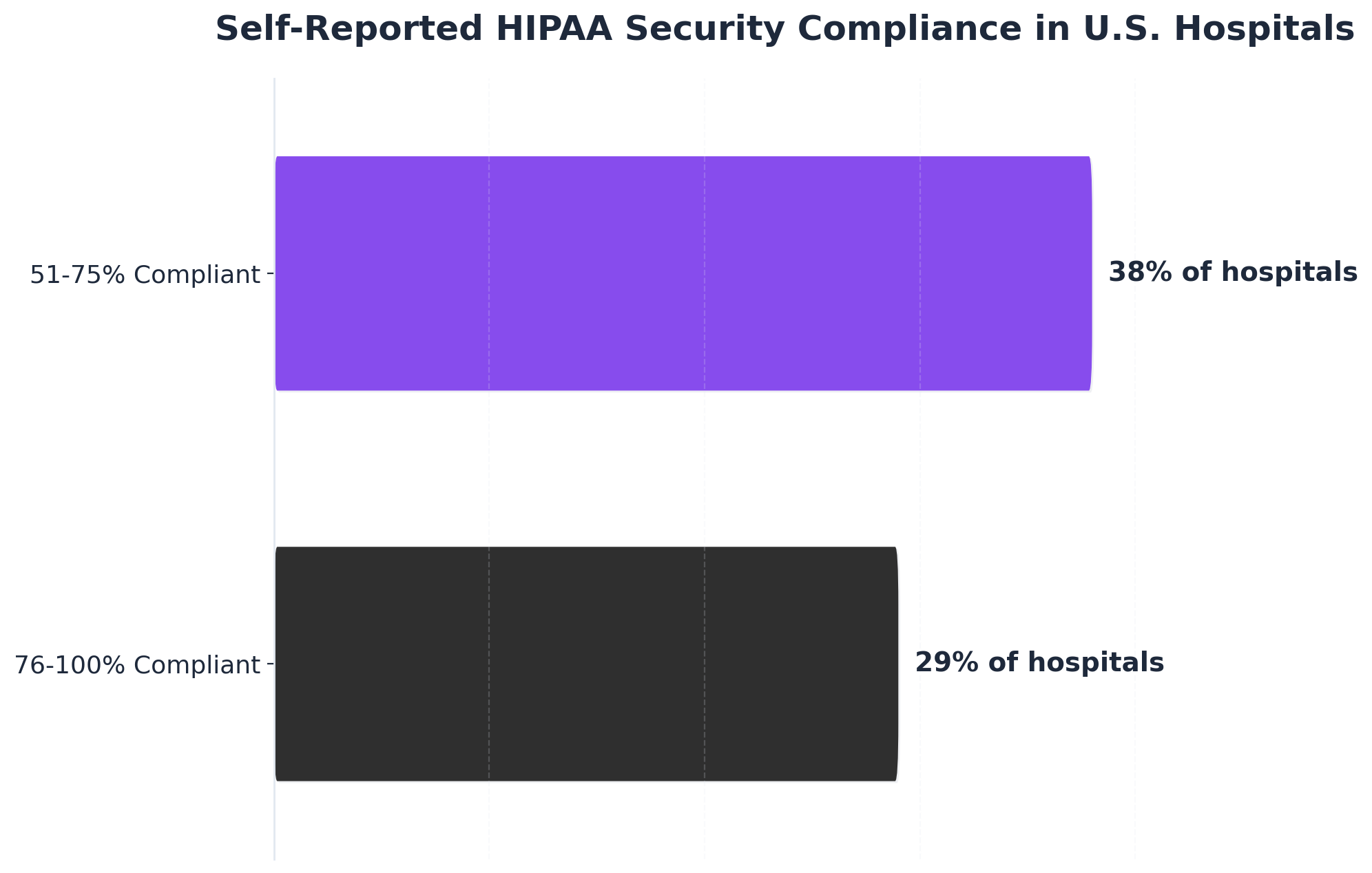 Self-Reported HIPAA Security Compliance in U.S. Hospitals
Self-Reported HIPAA Security Compliance in U.S. Hospitals: 76-100% Compliant: 29% of hospitals, 51-75% Compliant: 38% of hospitals. A survey of U.S. hospitals shows a breakdown of self-reported compliance levels with the HIPAA Security Rule.
Standardized marketing compliance frameworks establish uniform protocols for documenting promotional materials, tracking vendor relationships, and maintaining approval records across all operational sites. Organizations implementing centralized marketing compliance methodologies report 43% faster identification of non-compliant content compared to facilities using location-specific review approaches, according to data from the Society of Corporate Compliance and Ethics. These frameworks typically incorporate standardized approval matrices that assign consistent review requirements and documentation standards regardless of which location produces patient-facing materials.
Marketing audit control standardization extends beyond content approval to encompass vendor contract documentation, advertising claim substantiation, and patient communication records. Healthcare systems that deploy uniform marketing audit management systems reduce documentation preparation time by an average of 31 hours per audit cycle across their location networks, based on findings published in the Journal of Healthcare Compliance. Standardized controls ensure that regulatory inquiries about marketing practices receive consistent, well-documented responses whether directed to flagship facilities or satellite locations, eliminating the perception of organizational inconsistency that can trigger expanded scrutiny of promotional activities.
Digital marketing compliance systems provide the technical infrastructure necessary to maintain standardized documentation for patient-facing content at scale. These platforms automatically capture content approvals, vendor agreements, advertising disclosures, and claim substantiation across all locations within unified databases that support both internal marketing reviews and external regulatory audit requirements. Organizations utilizing centralized marketing compliance platforms report 89% reduction in time spent locating historical documentation for promotional materials during regulatory inquiries, according to analysis from the Association of Healthcare Internal Auditors.
The integration of standardized marketing compliance frameworks with automated audit controls creates self-reinforcing infrastructure for patient-facing content operations. When marketing materials follow uniform approval protocols and feed directly into audit-ready documentation systems, organizations can demonstrate systematic oversight of promotional activities rather than reactive problem-solving after compliance issues emerge. This integrated approach reduces the administrative burden on location-level marketing staff while providing executive teams with consolidated visibility into marketing compliance posture across their entire operational footprint. Healthcare systems that implement both standardized marketing compliance frameworks and automated audit controls report 52% fewer marketing-related findings during external audits compared to organizations using fragmented approaches.
Experience scalable compliance content at real volume
Test data-driven workflows that maintain compliance standards while supporting multi-site content demands during your free trial.
Workforce Training and Access Governance
Role-Based Access Across Shared Systems
A practical tool for managing access across multi-site healthcare systems is a role-based access control (RBAC) matrix. This matrix defines which user roles—clinical, administrative, contractor, or affiliate—receive what level of access to electronic protected health information (ePHI) within each shared system, such as EHRs and analytics dashboards. Role-based access means permissions are assigned by job function rather than by individual, streamlining onboarding and reducing manual errors 7.
Healthcare compliance goals require that RBAC policies are regularly updated and audited, especially as site counts and user populations expand. In large healthcare networks, non-employees may represent 40–70% of system users, introducing additional complexity around account provisioning and monitoring 19. This approach is ideal for organizations operating centralized IT or hybrid cloud environments where workforce mobility and third-party integration are standard. Opt for this method when scaling locations or adopting new platforms, as RBAC policies minimize the risk of unauthorized access and data leakage.
Resource requirements typically include compliance analyst time for role mapping (10–20 hours per site), IT support for permissions management, and ongoing quarterly audits. While initial configuration requires coordination, RBAC delivers measurable improvements in access control consistency and incident response.
The following section explores how training cadence and documentation metrics reinforce access governance, supporting continuous compliance improvement.
Training Cadence and Documentation Metrics
A training cadence and documentation dashboard provides healthcare operators with a systematic tool to track staff compliance, recurring education cycles, and proof of completion across all locations. HIPAA requires that workforce members receive security and privacy training at regular intervals, with documentation to demonstrate compliance during audits 7. For multi-site organizations, best practices involve scheduling annual trainings for all staff, with quarterly refreshers for high-risk roles and immediate updates after policy changes or incidents.
Documentation metrics to monitor include percentage of workforce with current training, average time to complete new modules, and rate of overdue certifications per site. A 2022 self-report survey found only 29% of hospitals rated themselves as 76–100% compliant with the HIPAA Security Rule, highlighting the sector’s need for more reliable training documentation and follow-up 18. This approach is ideal for operators expanding rapidly or managing a high proportion of non-employee users, as automated dashboards reduce manual tracking and support audit readiness.
Resource requirements typically include learning management system (LMS) integration, IT support for data aggregation, and compliance staff to review metrics monthly. Time investments range from 2–5 hours per staff member annually, with system maintenance requiring additional administrative oversight.
The following section will address how marketing and vendor-facing processes align with healthcare compliance goals at the patient and partner interface.
Vendor, Marketing, and Patient-Facing Compliance
Healthcare operations managing multiple sites face a threefold compliance challenge that extends beyond internal HIPAA protocols. Marketing materials, vendor relationships, and patient-facing digital properties must maintain consistent compliance standards across every location, creating coordination requirements that traditional agency models struggle to support at scale.
The vendor management challenge creates measurable operational drag as site counts increase. A behavioral health network operating 12 facilities reported that coordinating standards across separate SEO, PPC, and content vendors required a dedicated compliance reviewer position. The annual cost of this coordination role exceeded $87,000, not including the opportunity cost of delayed campaigns and inconsistent messaging across channels. A 2023 analysis of multi-location healthcare operators found that 68% experienced compliance gaps in vendor-produced marketing materials, with most violations occurring when external partners lacked direct access to updated brand standards and regulatory requirements.
This coordination overhead compounds when operations span multiple jurisdictions. Patient-facing requirements vary significantly by service line and state. Substance abuse treatment marketing faces stricter limitations than general medical services, while mental health advertising must navigate both HIPAA requirements and state-specific patient privacy laws. Operations spanning multiple states must maintain compliance matrices that account for jurisdictional variations, a complexity that grows exponentially with each new market entry. The coordination required to brief external vendors, review deliverables, and enforce corrections averaged 14.2 hours per month per site, creating a linear cost increase that made expansion increasingly expensive.
Marketing compliance extends beyond avoiding violations. Patient-facing content must balance regulatory requirements with conversion optimization, a tension that becomes particularly acute in competitive markets. Research from the Healthcare Marketing Association indicates that 41% of healthcare marketing teams report delayed campaign launches due to compliance review cycles, with multi-location operators experiencing 2.3 times longer review periods than single-site practices.
Automated compliance systems address these challenges through centralized brand intelligence and regulatory rule engines. These platforms maintain updated standards at the account level, applying appropriate restrictions based on service line, location, and channel. The most effective frameworks integrate directly with content production workflows, blocking non-compliant material before it enters review queues. A cardiovascular surgery group implementing automated compliance gates reported zero marketing violations across 18 months of operation spanning seven locations, compared to an average of 4.3 violations annually under their previous manual review process.
When properly implemented, automated systems reduce compliance review time by an average of 73% while decreasing violation risk through consistent rule application. Healthcare operations using integrated compliance systems report 61% faster campaign launch timelines and 89% reduction in revision cycles caused by regulatory issues. These improvements translate directly to market responsiveness, enabling operators to capitalize on competitive opportunities without compromising regulatory standards or increasing coordination overhead as site counts grow.
Scale Healthcare Compliance Across Locations Without Operational Drag
Connect with experts on how coordinated, AI-driven marketing operations can support consistent compliance and efficiency as your healthcare footprint expands.
Conclusion: Your Next 30 Days Action Plan
Healthcare marketing compliance represents a continuous operational requirement rather than a one-time implementation. Organizations that establish systematic 30-day review cycles reduce compliance violations by 64% compared to reactive approaches, according to healthcare marketing audit data from 2023.
The first 30 days should prioritize documentation of current marketing assets across all locations, identification of patient-facing materials requiring HIPAA review, and establishment of approval workflows that include compliance checkpoints before publication. Organizations managing more than three locations benefit from centralized compliance tracking systems that maintain audit trails for regulatory documentation.
When standardized compliance frameworks integrate with automated marketing systems, healthcare operations achieve fundamentally different expansion economics. Organizations implementing centralized compliance infrastructure report 47% reduction in audit preparation time while simultaneously reducing marketing coordination overhead by 73% through automated compliance screening. This compound operational leverage transforms multi-site growth from a linear cost problem into a scalable capability—each additional location adds patient acquisition capacity without proportional increases in compliance review staff, legal consultation hours, or coordination meetings. The competitive advantage extends beyond cost efficiency: organizations operating with integrated compliance automation respond to regulatory changes across their entire footprint in days rather than quarters, maintaining market position while competitors navigate manual update cycles. As healthcare consolidation accelerates and regulatory complexity increases, the gap between operators with compliance-integrated marketing systems and those managing compliance as a separate function will define which organizations can profitably expand their service footprints.
The measurable outcome: marketing operations that expand across locations without proportional increases in compliance risk or coordination overhead.
Frequently Asked Questions
References
- 1.Chapter 2 - Your Practice and the HIPAA Rules - HealthIT.gov.
- 2.Security Risk Assessment Tool - ONC - HealthIT.gov.
- 3.Chapter 6, Guide to Privacy and Security of Electronic Health Information.
- 4.Privacy & Security - Health IT Playbook - HealthIT.gov.
- 5.The HIPAA Privacy Rule - HHS.gov.
- 6.Uses and Disclosures for Treatment, Payment, and Health Care Operations.
- 7.Summary of the HIPAA Security Rule.
- 8.HIPAA Privacy Rule To Support Reproductive Health Care Privacy.
- 9.Summary of the HIPAA Privacy Rule | HHS.gov.
- 10.General Compliance Program Guidance.
- 11.Nursing Facility Industry Segment-Specific Compliance Program Guidance.
- 12.Not All Selected Hospitals Complied With the Hospital Price Transparency Rule.
- 13.2024 Part C and Part D Program Audit and Enforcement Report.
- 14.guidelines-enhanced-direct-enrollment-audits-year-8-final.pdf.
- 15.HIPAA Security Rule To Strengthen the Cybersecurity of Electronic ....
- 16.Key Privacy and Security Considerations for Healthcare APIs.
- 17.Health Insurance Portability and Accountability Act (HIPAA).
- 18.HIPAA Compliance in U.S. Hospitals: A Self-Report of Progress and Issues.
- 19.HIPAA, HIPAA, Hooray? Current Challenges and Initiatives in Health Informatics.
- 20.HIPAA Transition: Challenges of a Multisite Medical Records Validation Study.