
Key Takeaways
- Intent data platforms surface downstream buyers actively comparing vendors, and acting on those signals within 48 hours can drive an 83% lower cost per lead and 4x conversion lift 16.
- ICP and account selection tools rank firmographic and behavioral fit against closed-won data, supporting the 171% lift in annual contract value ABM deployments have shown 12.
- Predictive lead and account scoring turns target lists into ranked work queues, lifting MQL-to-SAL conversion when intent, fit, and activity signals feed a transparent model 14.
- Visitor identification tools convert anonymous website traffic into named target accounts, routing high-intent behavior like repeat pricing-page visits to owners while interest is still active.
- AI content and personalization tools deliver the 29% top ABM impact only when approval workflows govern generated output and suppress accounts already in active sales sequences 9.
- Orchestration suites like Demandbase, 6sense, and Terminus coordinate the middle of the workflow but cannot manufacture signal quality from weak intent, scoring, or personalization inputs 15.
- Account-level attribution tools track engagement, MQL-to-SAL conversion, and pipeline value across buying committees, directly addressing the ROI proof gap cited by 47% of practitioners 10.
Why lead quality in ABM depends on the stack, not the suite
The quality gap between account-based marketing and volume lead generation is now well quantified. B2B companies running ABM programs report a 38% higher sales win rate, 91% larger deal sizes, and 24% faster revenue growth than peers relying on broad lead gen 1. These metrics highlight why ABM is a priority for demand generation teams, yet sales leaders often question why MQL lists remain unchanged.
The core issue often lies with the technology stack. Lead quality in ABM isn't derived from a single platform but from four coordinated functions: identifying in-market accounts, scoring and ranking them, engaging buying committees with governed personalization, and measuring account-level impact. While orchestration suites handle the middle of this workflow effectively, they often fall short on the initial and final stages. Relying solely on a suite can result in a sophisticated campaign layer built upon weak intent signals and unreliable scoring inputs.
This guide organizes seven tool categories around these four essential jobs. Each entry describes the job, representative tools, and a benchmark demonstrating how that category measurably improves lead quality. The aim is to help demand generation managers evaluate categories based on their impact on pipeline, rather than focusing on specific vendor logos, and to allocate budget where it will most effectively enhance lead quality.
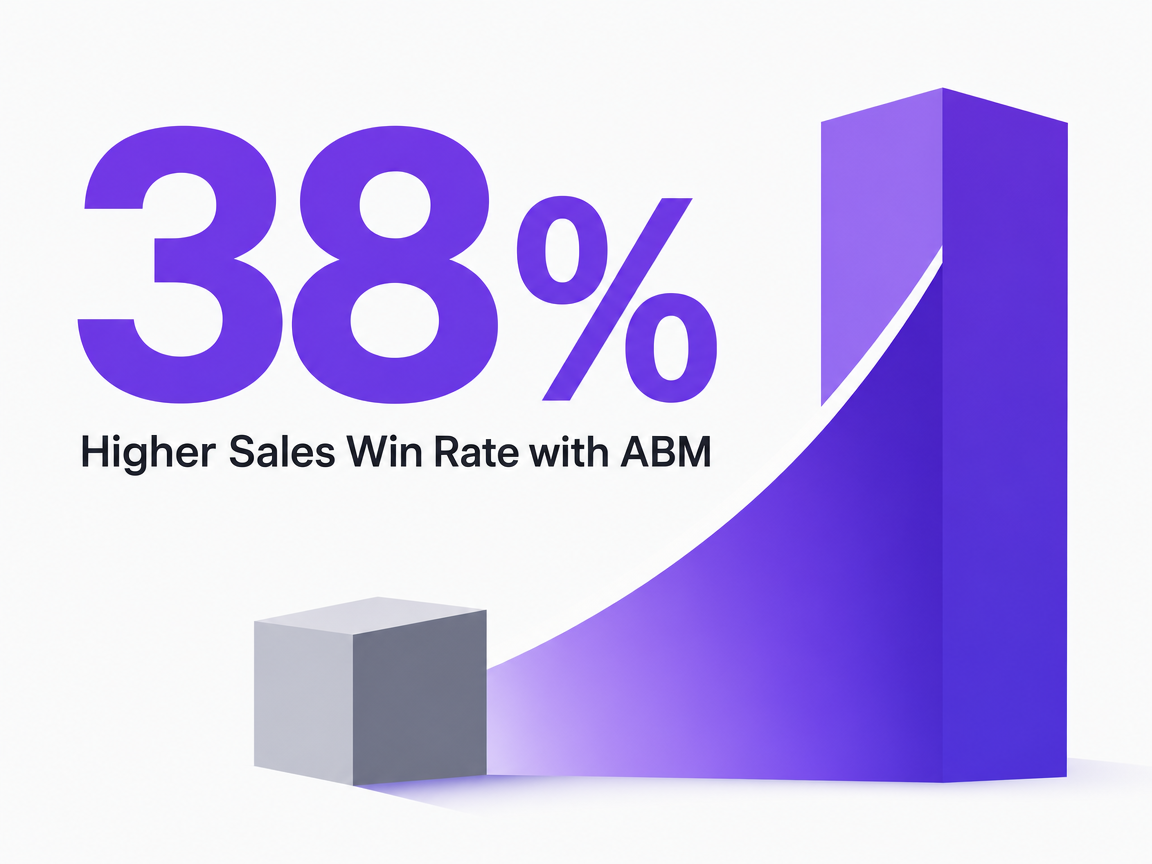 Higher Sales Win Rate with ABM
Higher Sales Win Rate with ABM
The four jobs an ABM stack has to do
Every ABM tool serves one of four critical functions. Proper mapping of these tools ensures a synergistic stack, while misalignments can lead to redundant features that fail to improve lead quality.
Identify : focuses on discovering accounts currently in-market. This includes downstream intent data platforms and ICP modeling tools that refine target lists based on firmographic and behavioral fit 3.
Score : ranks these identified accounts. Predictive lead and account scoring tools leverage historical conversion data and activity signals to prioritize accounts for sales 4.
Engage : involves delivering coordinated ads, emails, sales outreach, and personalized content to buying committees, a response to the increasing complexity of B2B buying groups 13.
Measure : completes the cycle with account-level attribution, tracking MQL-to-SAL conversion, pipeline opportunity value, and account engagement over time, moving beyond simple form-fill counts 5.
The subsequent seven categories align with these four jobs: two for Identify, two for Score, two for Engage, and one for Measure. This weighting prioritizes the front of the funnel, where signal quality is paramount for downstream success.
Job 1: Identify in-market accounts
Intent data platforms that surface downstream buyers
Intent data is crucial for lead quality. The key distinction for demand generation managers is between upstream and downstream signals. Upstream intent indicates general category research, while downstream intent signals specific stakeholders comparing vendors, reviewing pricing, or consuming late-stage content. These downstream signals indicate a much closer proximity to a purchase decision, enabling valuable prospects to be engaged before competitors 3.
Platforms like Bombora, G2 Buyer Intent, TrustRadius, and 6sense (for enterprise) vary in signal sourcing and decay rates within the CRM. Critical evaluation criteria include signal freshness, topic granularity, and the ability to integrate scored intent events directly into existing scoring and routing systems.
Improved lead quality from intent data manifests in reduced costs and higher conversion rates. A case study on focused ABM tactics reported an 83% lower cost per lead, a 2.5x higher form conversion rate, and a 4x conversion lift when target accounts received three or more coordinated touches within 48 hours of an intent signal 16.
This 48-hour window is vital; signal quality only translates to lead quality if the stack can act within this timeframe, which is often a workflow challenge rather than a data problem.
When evaluating intent tools, teams should request latency benchmarks specific to their CRM integration, rather than relying on aggregate accuracy claims, as latency directly impacts the potential for conversion lifts.
ICP and account selection tools
While intent data identifies current market activity, ICP tools determine which of those accounts are truly valuable. Although often conflated in vendor demonstrations, these two functions generate distinct lists and impact lead quality differently.
Account selection platforms, such as Demandbase's ICP module, 6sense's account discovery, and standalone tools like MadKudu or Keyplay, build target lists by scoring firmographic, technographic, and behavioral fit against historical closed-won data. The result is a ranked total addressable market list, not a real-time buying signal. Integrating this list with the intent layer creates the refined shortlist that sales teams actively pursue.
The economic benefit of this step is significant contract value. A 2023 report indicated a 171% lift in annual contract value after ABM deployment, with ABM-sourced deals showing 33% higher ACV compared to non-ABM deals 12. These figures underscore the importance of account selection discipline, as larger contracts stem from targeting accounts structurally capable of such purchases, a capability enforced by ICP modeling.
Key features to look for include:
- transparent scoring inputs,
- the ability to update the ICP as new closed-won data becomes available, and
- seamless integration with downstream scoring layers.
Opaque fit scores that sales teams cannot understand or trust are often ignored, rendering the account list ineffective.
Test Account-Based Campaigns With Live Publishing Access
Publish and measure real ABM content results before making any commitment.
Job 2: Score and prioritize the target list
Predictive lead and account scoring
Scoring transforms a target list into an actionable work queue. Predictive lead and account scoring utilizes historical conversion data, activity signals, and firmographic attributes to rank prospects by purchase likelihood. This data-driven approach replaces the often-subjective point-based rules found in many marketing automation platforms 4. The outcome is a ranked list that sales can confidently use, rather than an arbitrary tiering system.
Tools in this category include MadKudu, EverString (now ZoomInfo), 6sense's predictive scoring, and native scoring within platforms like HubSpot and Marketo. The primary differentiator is not abstract model accuracy, but rather the platform's ability to ingest and interpret activity and firmographic data from a specific tech stack. A predictive model trained on incomplete CRM data can confidently, but incorrectly, rank accounts, which is more detrimental than having no score at all, as sales may blindly trust flawed data.
The improvement in lead quality is evident in MQL-to-SAL conversion rates. When account selection, intent data, and scoring are integrated, ABM-generated MQLs are more likely to convert to SQLs because accounts are pre-qualified before any form submission 14. This highlights the importance of investing in input quality—such as complete engagement history and accurate firmographic data—before focusing on model sophistication.
Practical evaluation criteria include:
- how the model handles accounts with no prior engagement,
- whether score changes trigger CRM routing rules, and
- if sales can view the top three factors influencing any individual score.
Transparency in scoring is not merely a bonus; it ensures continued adoption and trust in the system long after implementation.
Visitor identification and account matching
A significant portion of B2B website traffic remains anonymous. Visitor identification tools—such as Leadfeeder, Clearbit Reveal, RB2B, Warmly, and the account-match layers within 6sense and Demandbase—convert anonymous IP and device signals into named accounts. These identified accounts are then matched against the existing target list in the CRM.
The value proposition here is efficiency, not just volume. A target account repeatedly visiting a pricing page without converting represents a stronger buying signal than a cold form fill from a non-target account. Routing this signal to the account owner while interest is high transforms anonymous traffic into a viable opportunity. Downstream intent platforms further enhance this by confirming that the account is actively comparing vendors elsewhere 3.
When evaluating these tools, pressure-test match rates using your actual website traffic, rather than vendor-provided cohorts. Also, assess how the tool handles remote workers on residential IPs and whether matched accounts provide sufficient context in the CRM for sales to initiate a meaningful conversation. A matched account without a clear reason for outreach simply adds to an unworked queue.
Job 3: Engage across channels with approval-governed personalization
AI content and personalization tools
AI has significantly boosted personalization in ABM. The 2026 ABM Benchmark Survey identified content personalization at scale as AI's top impact area (29% of respondents), followed by account selection (23%) and workflow optimization (19%) 9. However, nearly 70% of practitioners report limited AI effectiveness due to integration gaps and insufficient oversight 10. The most effective tools address this oversight gap.
Platforms like Jasper and Writer for governed content generation, Mutiny and PathFactory for on-site personalization, Regie.ai and Lavender for outbound message assistance, and AI layers embedded in orchestration suites are representative. The key difference isn't model quality, as many share foundational models. Instead, it's the process between a generated draft and a live touch: whether the platform includes human approval, records the reasoning behind variants in the CRM, and suppresses accounts already in active sales sequences.
The risk of ungoverned AI personalization is significant. It can generate high volume without discernment, leading to off-key messages, duplicate touches, or content that contradicts sales conversations. This erodes lead quality, making it difficult for accounts to re-engage effectively.
Demand generation managers should ask vendors two critical questions:
- What percentage of generated content is deployed without human review in typical customer use, and
- can the platform demonstrate which approved variant drove specific account responses?
Tools that provide clear answers to both are achieving the reported 29% lift; others merely generate volume.
Orchestration suites: the category most teams overweight
Orchestration suites, such as Demandbase, 6sense, and Terminus, are often presented as default solutions for enterprise ABM, coordinating ads, email, chat, and sales plays against a shared account list 15. While effective in the middle of the workflow, they frequently disappoint where lead quality is actually determined.
This pattern is evident in budget allocation. Expectations for increased ABM spending rose from 84% to 95% between 2021 and 2023 8, with a disproportionate amount allocated to orchestration seats rather than the critical intent, scoring, and personalization inputs they rely on. A sophisticated campaign layer built on stale intent data and opaque scores will not produce a better MQL; it merely offers a more polished dashboard for the same MQL.
The operational implication is clear: if a team has reliable downstream intent, a robust account scoring model, and a trusted personalization workflow, an orchestration suite can amplify these inputs. However, if any of these inputs are weak, orchestration spend should be postponed until they are strengthened. The suite cannot create signal quality it doesn't receive, and the promised ABM benefits of increased win rates and deal sizes depend entirely on accurate signals entering the campaign layer.
Job 4: Measure account-level impact
Attribution and account-level measurement tools
Measurement is a common failure point for ABM programs. The 2025 ABM Benchmark Survey found that 47% of practitioners struggle with proving ROI, despite 71% running an ABM strategy and 40% integrating it with demand generation 10. This isn't a lack of dashboards, but a misalignment between what ABM influences and what most marketing analytics systems track.
Attribution tools designed for account-level measurement—including Dreamdata, Bizible (now Adobe Marketo Measure), Full Circle Insights, and reporting layers within 6sense and Demandbase—track engagement across the entire buying committee, rather than crediting a single lead. The focus shifts from individual form fills to account-level pipeline movement, providing a framework for demonstrating ABM's value to CFOs.
Specific metrics are crucial. A 2022 Gartner survey highlighted that ABM programs most improved account engagement (28%), MQL-to-SAL conversion rates (25%), and pipeline opportunity value (23%) 5. A measurement tool must accurately report these three areas. If a platform cannot show account engagement trends against target lists, compare MQL-to-SAL conversion for ABM-touched versus non-touched accounts, or roll up pipeline value to account owners, its reporting will likely fail its first quarterly business review with sales.
Before committing, pressure-test:
- how the tool handles multi-touch attribution across ads, content, and sales activities;
- whether it writes account-level engagement scores back to the CRM for sales reps; and
- how it credits accounts that convert months after the last measurable touch.
The answer to the last question determines whether ABM receives proper credit for influenced deals.
See How Leading Teams Operationalize ABM With AI-Powered Precision
Connect with a specialist to benchmark your ABM tech stack, review workflow automation strategies, and identify actionable improvements proven to increase lead quality for high-value accounts.
If you manage multiple locations: the ABM stack consolidation lens
For demand generation managers overseeing multi-location service operators—such as dental DSOs, senior living groups, home services franchises, regional law firms, or behavioral health networks—"accounts" often refer to locations, referral sources, or payer networks rather than traditional enterprise logos. While the tooling logic remains consistent, the purchasing economics change significantly.
A typical point-tool ABM stack for such operations often includes five separate line items:
- an intent data feed,
- a scoring layer,
- an orchestration seat,
- a personalization tool, and
- an attribution platform.
Each is priced per seat, per matched account, or per tracked domain, which scales inefficiently when a single central marketing team supports thirty locations. The challenge of proving ROI, cited by 47% of practitioners 10, intensifies when multiple dashboards each claim partial credit for the same closed deal.
The argument for consolidation is primarily economic. A focused ABM approach with tight signal-to-outreach coordination has been shown to reduce cost per lead by 83% and increase form conversion by 2.5x 16. These gains depend on the four ABM jobs functioning cohesively, not on any single tool.
| Stack line item | Point-tool approach | Consolidated AI execution platform |
|---|---|---|
| Intent + ICP data | Per-account or per-domain variable | Included in unified workflow |
| Predictive scoring | Per-seat variable | Included |
| Orchestration | Per-seat enterprise pricing | Included |
| AI personalization | Per-seat or per-word variable | Included, approval-governed |
| Attribution | Per-tracked-account variable | Included |
| Vectoron trial reference | — | $599/mo after 2-week trial |
Operators should evaluate total cost against MQL-to-SAL lift, rather than focusing solely on individual tool sticker prices.
Selection criteria: how to pressure-test any ABM tool before you buy
Vendor demonstrations often obscure critical questions that predict lead quality outcomes. Ask these questions directly before initiating a trial.
- Assess the input data quality from your actual CRM, not a reference customer's. Predictive scoring, intent matching, and attribution all degrade with incomplete historical closed-won data or firmographic fields 4. Request a data readiness assessment using your real records.
- Determine how the tool integrates with existing sales systems. If matched accounts, score changes, or intent signals don't appear within a rep's daily workflow, the tool will generate reports, not pipeline. Downstream intent value is entirely dependent on routing latency into that workflow 3.
- Clarify the governance layer between AI-generated output and live touches. While 29% of practitioners cite personalization at scale as AI's top ABM impact, nearly 70% report limited effectiveness 9. This gap often stems from a lack of approval controls and transparency in reasoning.
- Can the platform report MQL-to-SAL conversion for its touched accounts compared to a control group? Without this, the ROI discussion with sales will lack concrete evidence 10.
Where Vectoron fits in an approval-governed ABM workflow
The common thread across all seven categories is governance. Intent signals, predictive scores, personalized touches, and account-level attribution only yield results when a human decision layer mediates between AI-generated recommendations and live execution. This is precisely where the 29% personalization lift and the nearly 70% limited-effectiveness reality diverge 9. Vectoron functions as an AI marketing team of specialist strategists who interpret live signals, prioritize across content, SEO, paid, and outreach, and route every recommendation through a Command Center approval workflow before deployment. For demand generation managers aiming to consolidate an ABM stack without increasing headcount, this approval-first model addresses the gaps left by most orchestration suites. A two-week trial is available for $599/month thereafter.
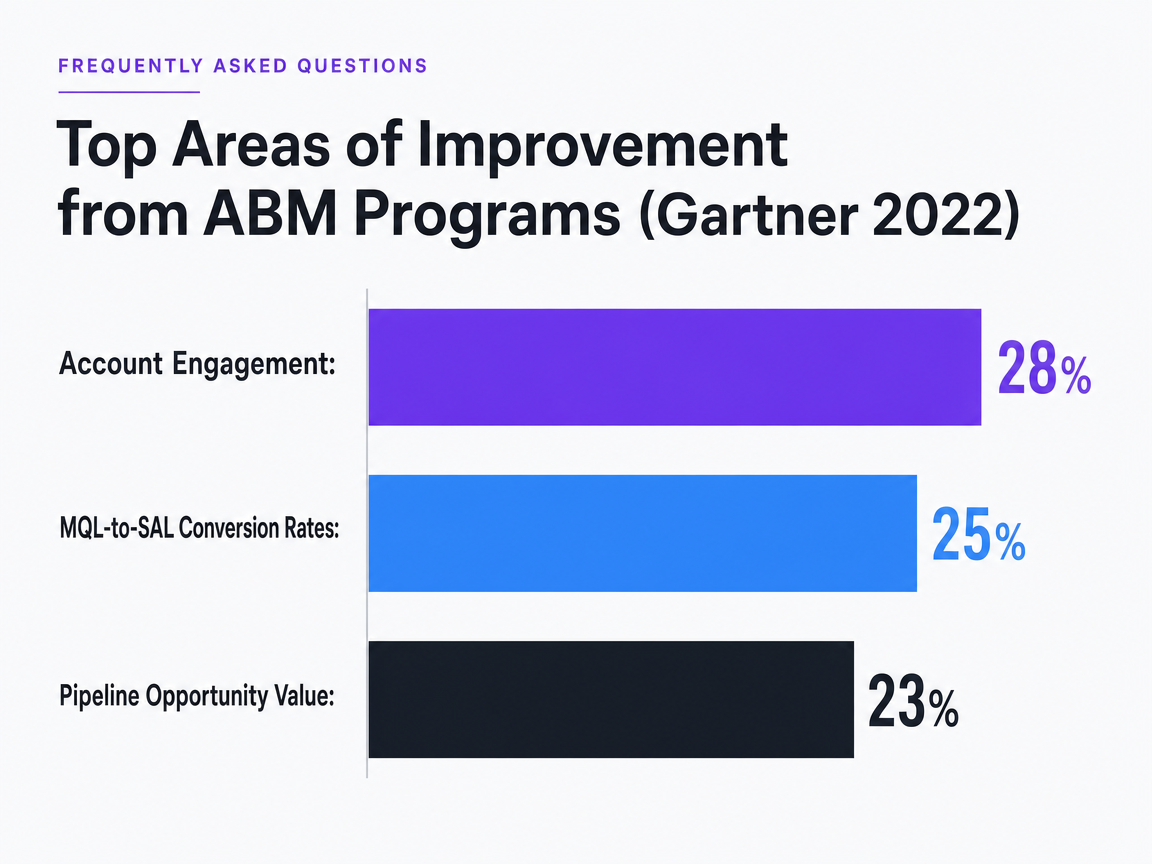 Top Areas of Improvement from ABM Programs (Gartner 2022)
A 2022 Gartner survey shows the top three areas where ABM programs delivered the most improvement.
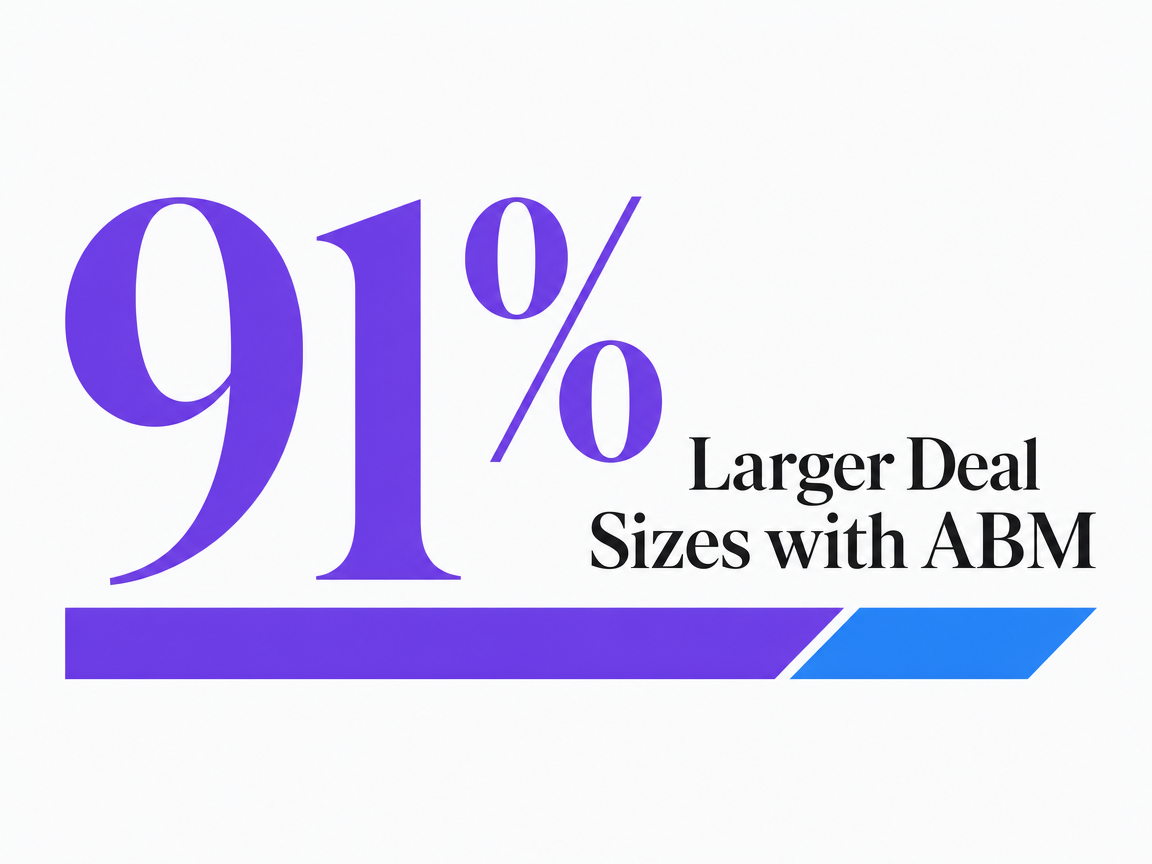
Larger Deal Sizes with ABM
Frequently Asked Questions
References
- 1.Account-Based Marketing (ABM) - Salesforce.
- 2.Account-based marketing vs. lead generation: What's the difference?.
- 3.7 Ways to Use ABM and Intent Data Together.
- 4.What is Predictive Lead Scoring?.
- 5.How to Use Account Based Marketing to Win High-Value Deals.
- 6.Where Does Generative AI Meet Account-Based Marketing?.
- 7.B2B Account Based Marketing Guide.
- 8.111 Account-based marketing statistics you need to know in 2025.
- 9.2026 ABM Benchmark Survey: AI's Biggest Impact Is Personalization ....
- 10.2025 Account-based Marketing Benchmark Survey.
- 11.Account-Based Marketing vs. Lead Generation.
- 12.21 Key Account-Based Marketing Statistics for 2023.
- 13.ABM Benchmark Report Webinar Slides 2024.
- 14.How ABM Enhances MQL Qualification.
- 15.16 best account-based marketing tools in 2026.
- 16.ABM Techniques That Drive Results.