
Key Takeaways
- Pipeline-grade AI marketing runs as a closed loop: live signals feed ranked recommendations, human approval routes them, automated execution ships, and KPI feedback sharpens the next decision.
- Technology contributes roughly 20% of an AI initiative's value while redesigning the work around it delivers the other 80% 5, which is why tool purchases rarely move CAC or sales cycles.
- Audit the decisioning layer first when results stall—personalization and generative production amplify whatever scoring and routing logic sits underneath, for better or worse 7.
- Sequence FY26 investment from data plumbing outward: instrument signals, prove one decisioning use case, add approval-first governance and generative production, then expand personalization and consolidate vendors.
Why most AI marketing programs stall before they touch pipeline
Most AI marketing programs generate activity, not pipeline. The dashboards fill up. Output volume climbs. Yet cost per qualified lead, time-to-publish, and pipeline contribution barely move. The gap is rarely a model problem. It is a wiring problem.
McKinsey's analysis of generative AI in marketing and sales puts the realistic upside at 3–15% revenue uplift and 10–20% sales ROI uplift, but flags that the largest gains come when AI is embedded in end-to-end customer journeys rather than bolted onto siloed tools 1. Most programs sit in the second category. They generate blog drafts, ad variants, and email subject lines while the data, scoring, and routing layers that decide which buyer hears what next remain untouched.
Deloitte's CMO Survey shows AI and martech moving to the center of growth plans even as headcount stays flat 2. That combination pushes VPs toward tool purchases when the binding constraint is workflow design. A content factory does not produce qualified demand. A connected loop between live business signals, ranked recommendations, approved execution, and KPI feedback does. The rest of this piece works through what that loop looks like and where it tends to break.
The 80/20 rule that decides whether AI moves revenue
PwC's 2026 AI predictions put a sharp number on a pattern that VPs already sense: technology contributes roughly 20% of the value of an AI initiative, while redesigning the work around it contributes the other 80% 5. The split is not a metaphor. It is the reason two companies running the same models on the same martech stack produce wildly different pipeline outcomes.
McKinsey's cross-industry read on AI in marketing and sales sits inside the same logic. Adopters are seeing revenue uplifts in the 3–15% range and sales ROI uplifts of 10–20%, but those bands describe companies that wired AI into end-to-end journeys—targeting, outreach, scoring, optimization—not companies that licensed a generative tool and pointed it at a content calendar 1. The upside envelope exists. The question is what fraction of it a given operating model can actually capture.
For a VP staring at FY26 budget lines, the practical read is this. A six-figure spend on a new AI suite, layered on top of a campaign-centric workflow and a fragmented data layer, will tend to deliver the 20%. That looks like faster draft production, more ad variants, a quieter content backlog. It rarely looks like a lower cost per qualified lead or a shorter sales cycle.
The 80% shows up when the work itself changes—when signals from booked consultations, qualified calls, and pipeline stage start triggering ranked recommendations, when approval becomes a routing step rather than a meeting, and when KPI feedback loops back into the next decision automatically. That is a workflow project that uses AI, not an AI project that hopes to find a workflow.
The closed-loop operating model: signals, recommendations, approval, execution, feedback
A pipeline-grade AI marketing program runs as a loop, not a stack. Five stages, each with a defined input and output, each instrumented against the same revenue metrics the CFO already tracks.
- Stage one is signals. Live business data—qualified calls, booked consultations, cost per lead by channel, pipeline stage progression, win rates by source—flows in continuously, not in a Monday report. Without that telemetry, every downstream stage degrades into guesswork dressed up in generative output.
- Stage two is ranked recommendations. The system reads the signals and surfaces what to do next, ordered by expected pipeline impact: shift budget from a saturated keyword cluster, refresh a landing page where booking conversion just dropped, sequence a follow-up to leads whose qualified-call scores spiked this week. Ranking matters more than ideation. A list of fifty things to do is not a recommendation; it is a backlog.
- Stage three is human approval. A marketer reviews each recommendation with the reasoning attached—what signal triggered it, what outcome is expected, what gets measured. Approval is a routing decision made in minutes, not a status meeting. This is also where brand judgment, legal review, and channel sequencing get enforced before anything ships.
- Stage four is automated execution. Once approved, the work is produced and published across the relevant channels without a second briefing cycle. This is where the time-to-publish compresses from weeks to days.
- Stage five is KPI feedback. The outcome of every approved action—did CPL drop, did booked consultations rise, did the email lift pipeline—routes back into stage one as a new signal. The next round of recommendations is built on what just worked or just failed, not on a quarterly retro.
Designing for this loop now is not premature. BCG projects that autonomous forms of AI will handle more than one-fifth of marketing's total workload within two to three years, shifting marketers toward higher-value strategic work and away from execution tasks current agency models were built around 10. Teams that wire the loop in 2025 will be running it at scale by the time that workload shift arrives. Teams still buying point tools will be retrofitting it under pressure.
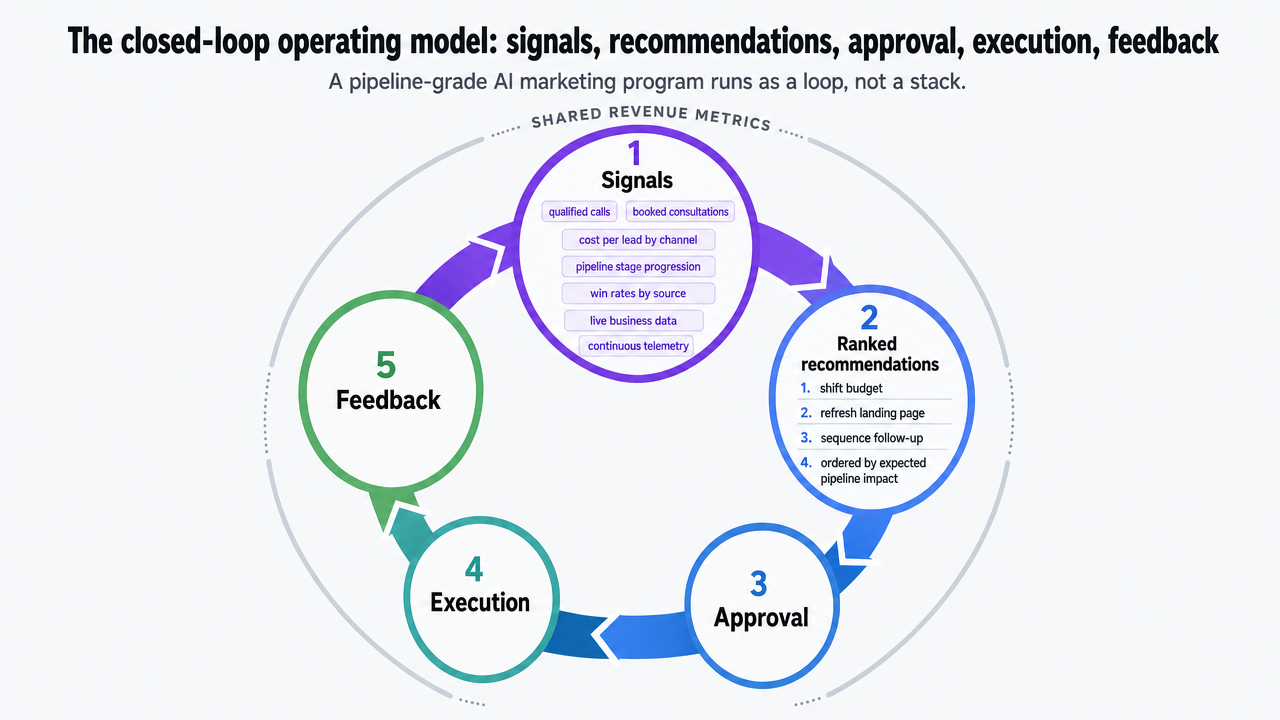 Visualize the five-stage closed-loop operating model that is the structural backbone of the article
Where AI actually generates qualified demand
Three layers of an AI marketing program do most of the pipeline work: personalization that adjusts what each buyer sees, generative production that compresses test-and-learn cycles, and a decisioning layer that decides where attention and budget go next. Each is measurable. Each fails in a recognizable way when the loop in the previous section is missing.
Personalization as a pipeline mechanism, not a content tactic
Personalization is usually discussed as a content tactic. The numbers describe a pipeline mechanism. McKinsey's explainer puts the impact in CFO-legible terms: personalization marketing can reduce customer acquisition costs by as much as 50%, lift revenues 5–15%, and increase marketing ROI 10–30% 7. Its companion analysis on the multiplying value of personalization sits in the same band—10–15% revenue lift typical, with company-specific results spanning 5–25% depending on sector and execution capability—and reports that companies excelling at personalization generate 40% more revenue from those activities than average performers 6.
Scope matters before a VP wires those numbers into a forecast. The McKinsey figures describe outcomes for companies that built the data, analytics, and decisioning capabilities to act on customer-level signals, not for those that added first-name tokens to email subject lines. The 40% advantage for leaders is a maturity gap, not a tooling gap.
For a multi-location service business, the pipeline mechanism is concrete. A returning visitor who already booked a consultation should not see the same hero offer as a first-touch prospect from a paid search ad. A lead whose qualified-call score dropped should trigger a different nurture path than one whose intent signals strengthened. Each of those branches is a routing decision, executed by automation, that compounds across thousands of journeys per month. Done well, it pulls CAC down and lifts booking conversion in the same quarter. Done poorly, it spends model budget on personalization that the customer reads as surveillance.
Generative production and test-and-learn at machine speed
Generative AI changes what a marketing team can test in a quarter. McKinsey's analysis of gen AI in consumer marketing describes the shift directly: models can analyze behavior, preferences, and demographics to produce personalized content and messaging at a volume that traditional creative pipelines cannot match, with measurable gains in customer experience and growth 8.
The pipeline implication is in the test-and-learn cycle, not the asset count. Ayelet Israeli's work at Harvard Business School, discussed in MIT Sloan Management Review, examines generative AI's role as a substitute for human participants in certain marketing experiments—shrinking the time and cost of validating offers, headlines, and segment hypotheses before they hit a live audience 4. The research flags external-validity limits: AI-simulated responses are not a clean stand-in for real buyer behavior, and live experiments still settle the question.
The operating consequence is straightforward. A team that runs four landing-page variants per quarter on a single hypothesis becomes a team that runs forty across a dozen hypotheses, validated cheaply against simulated responses first, then narrowed to the variants worth spending real traffic on. Time-to-publish compresses. The cost of a failed test drops. The number of bets a VP can place against pipeline targets goes up without a headcount line.
Scoring, routing, and the decisioning layer that decides what gets attention
The decisioning layer is where AI marketing automation either earns its keep or quietly becomes expensive content production. McKinsey's personalization explainer is explicit that the building blocks are not just data and analytics but integrated decision engines that score propensities and coordinate the next-best action across channels 7.
In practice, that means a model is constantly answering three questions: which prospect is worth attention right now, what action is most likely to move them, and through which channel. Inputs include intent signals, channel history, pipeline stage, qualified-call scores, and outcome data from prior actions. Outputs are ranked instructions—suppress this audience from a retargeting pool, escalate this lead to sales, send this offer to that segment tomorrow morning.
When scoring is wrong, every downstream stage amplifies the error. Personalization gets sharper but aimed at the wrong people. Generative production gets faster but feeds a higher volume of irrelevant outreach. The decisioning layer is what makes the rest of the program a pipeline system rather than a high-throughput content operation. Audit it first when results stall.
Test AI-driven campaign execution in real time
Experience live pipeline growth by deploying and measuring actual content across channels for one full week.
Approval-first governance as a pipeline accelerant
Most governance conversations frame human review as a brake on AI execution. In a pipeline-grade program, it is the opposite. Approval-first design is what makes the speed safe enough to actually use at scale.
The failure mode without it is familiar. A generative system produces a hundred ad variants, fifty landing-page modules, and a personalized nurture stream across every segment. Some of it is sharp. Some of it is off-brand, off-claim, or aimed at the wrong audience. By the time a marketer catches the misfires in a weekly review, the cost-per-lead damage is already in the dashboard and the brand cleanup is a separate workstream. McKinsey's analysis of generative AI in consumer marketing flags the same risk directly: the productivity gains require governance and guardrails to prevent off-brand or biased outputs, because automating creative and messaging decisions amplifies whatever judgment is missing upstream 8.
Approval-first inverts the sequence. Recommendations surface with the reasoning attached—what signal triggered it, what outcome is expected, what gets measured. A marketer approves or rejects in minutes, not meetings. Execution then ships without a second briefing cycle. The governance step is a routing decision, not a bottleneck, because it happens before production rather than after publication.
The pipeline consequence is velocity with fewer reversals. Time-to-publish compresses because the queue moves continuously. Brand and legal risk drops because nothing ships unreviewed. And the KPI feedback loop stays clean, because every executed action carries an approval record tied to the original signal and the predicted outcome. That audit trail is what turns a marketing operation into something a CFO can defend.
The leader–laggard gap and how it compounds
BCG's joint maturity study with Google, which scored marketers across four stages from foundational capability to a fully transforming marketer-AI flywheel, found that leaders using AI-powered marketing achieve up to 60% greater revenue growth than their peers 9. The figure describes leaders relative to other marketers in the same study—not the whole market—and BCG is explicit that no company has yet reached the top stage. The gap is between teams progressing through the model and teams stuck at stage one.
What compounds the gap is not model access. It is the loop. A leader running live signals into ranked recommendations, approved in minutes and executed across channels, gets a cleaner read on what worked every week. Each cycle sharpens scoring, tightens segmentation, and retires the variants that failed. A laggard running the same models against quarterly reports gets one usable learning per planning cycle, if that.
The practical read for FY26 planning is to benchmark against stage progression, not tool count. A VP who can name which signals trigger which recommendations, who approves them, and how outcomes route back into the next decision is operating closer to the leader curve. A VP whose AI investment lives inside a content tool is funding the 20% while peers compound the 80%.
If you manage multiple locations: the consolidation economics
A note on scope before this section develops. The main reader of this piece is a single-org VP of Marketing. The next two subsections narrow the lens to operators running marketing across multiple locations—DSO networks, multi-site behavioral health groups, regional home services brands, senior living portfolios, and similar structures. The economics here behave differently because vendor sprawl, briefing cycles, and time-to-publish compound by site count, not by spend.
Where the fragmented stack actually costs you
Multi-location marketing budgets rarely fail at the line-item level. They fail at the seams between vendors. A typical portfolio runs a retainer agency for strategy, a separate SEO vendor, a paid-media shop, a content freelancer bench, a social scheduling tool, and a call-tracking platform—each invoiced cleanly, each producing reports that do not reconcile to a single pipeline view.
The cost shows up in three places the CFO eventually asks about:
- Coordination hours: every location multiplies the briefing cycles, status calls, and approval threads required to ship a campaign.
- Time-to-publish: a localized landing page that should take days takes weeks because three vendors and a regional manager sit between the signal and the page.
- Attribution drift: when six tools own slices of the funnel, cost per booked consultation by location becomes an estimate, not a number.
BCG's analysis of the shift from campaign-centric to business-value-centric workflows lands directly on this fracture. Current agency commercial models, it argues, were not designed to incorporate AI productivity gains, and that misalignment limits the value a multi-location operator can realize even when individual vendors adopt AI tools internally 10. The savings stay with the vendor. The pipeline view stays fragmented.
A side-by-side view: fragmented vendors versus unified AI execution
The comparison below uses variables rather than invented dollar figures. The directional benchmarks are sourced; the operational variables are what each operator should plug in from their own books.
| Dimension | Fragmented vendor stack | Unified AI execution model ||---|---|---|| Vendor relationships | 5–7 (agency, SEO, PPC, content, social, call tracking, analytics) | 1 platform, in-house owner || Monthly cost structure | Sum of retainers + tool licenses + freelance variable | Single platform fee + internal approval hours || Briefing cycles per location | Multiple per channel, per month | One approval queue per location || Time-to-publish (localized asset) | Weeks | Days || Approval/oversight hours | Distributed across vendor threads | Consolidated in one queue || Pipeline attribution | Reconciled across tools, with gaps | Single signal-to-outcome loop || CAC trajectory | Variable by vendor performance | Personalization can cut CAC by up to 50% when wired to decisioning 7|| Workload automation ceiling | Bounded by vendor capacity | >20% of marketing workload automatable within 2–3 years 10|
The table is illustrative, not prescriptive. Two reads matter for a multi-location operator. The directional savings on CAC are real but conditional—McKinsey's up-to-50% figure describes companies that built the decisioning capability, not those that swapped vendors 7. And the workload automation ceiling is a planning horizon, not a current-state number. The operators who model both correctly in FY26 budgets are the ones who consolidate before the autonomous workload shift arrives, not after.
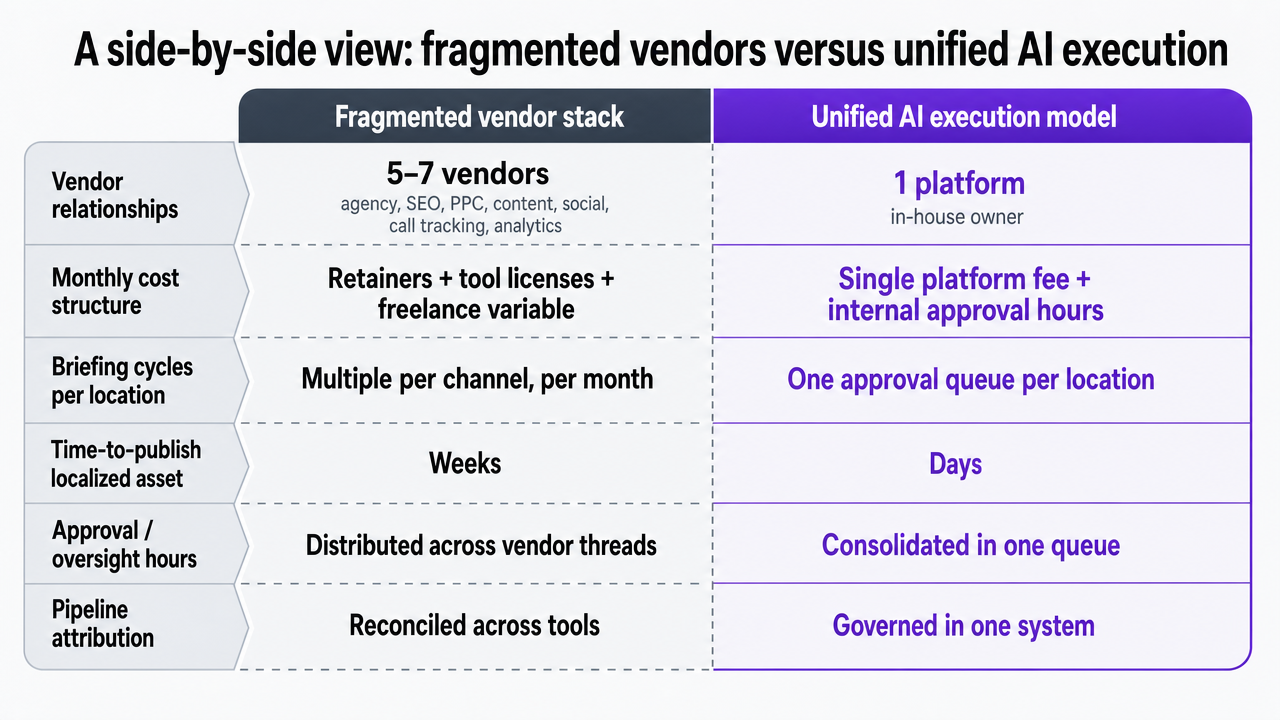 Render the comparison table from the section as a clean side-by-side visual contrast
See How AI-Powered Automation Delivers Measurable Pipeline Gains
Request a data-backed walkthrough of unified AI marketing execution. Discover benchmarks on conversion lift, workflow efficiency, and pipeline reliability for multi-channel teams managing complex campaigns.
Sequencing the investment: what to do in the next two quarters
FY26 planning rarely fails on ambition. It fails on sequence. A VP who tries to wire signals, personalization, decisioning, generative production, and governance in the same quarter ends up with a half-built loop and a board update full of activity metrics.
The order that works runs from data plumbing outward. Quarter one: instrument the signals. Qualified calls, booked consultations, cost per lead by channel, pipeline stage progression, and win rates by source need to flow into one place, refreshed continuously. Without that input, every downstream model is making decisions on a quarterly snapshot. Deloitte's CMO Survey makes the constraint explicit—AI and martech are central to growth plans while headcount stays flat 2, which means the signal layer has to be automated, not staffed.
Quarter one also picks one decisioning use case with a clean outcome metric. Lead scoring tied to booking conversion is a defensible first target. Channel budget reallocation against cost per qualified lead is another. The point is to prove the loop on a narrow surface before scaling it.
Quarter two: add generative production and approval-first governance to the proven loop. This is where time-to-publish compresses and brand risk gets contained in the same motion. Personalization expands next, because it depends on the signal layer and the decisioning layer already working. McKinsey's data on personalization—up to 50% CAC reduction and 10–30% marketing ROI lift for companies that built the underlying capability 7—describes the payoff for teams that sequence correctly, not for teams that buy a personalization tool first.
What does not belong in the first two quarters: a vendor consolidation project, a full agency RFP, or a custom model build. Those follow the loop. They do not precede it.
Where AI marketing automation still breaks down
Three failure modes account for most of the underperformance in AI marketing programs, and none of them are model quality.
- The first is data readiness. McKinsey's analysis flags that many organizations chase AI value before customer data, channel data, and outcome data are reconciled in one place, which limits realized gains and produces uneven impact across business units 1. A scoring model fed by stale CRM exports and disconnected ad platform pulls will rank the wrong leads faster, not better.
- The second is trust. Harvard's Professional & Executive Education work on AI in marketing raises the ethics question directly—personalization that crosses into intrusive territory erodes the brand equity the program is supposed to build 3. McKinsey's personalization research lands in the same place: getting it wrong burns trust quickly enough to offset the revenue lift the model produced 6.
- The third is measurement drift. PwC notes that many AI projects lack clear value metrics tied to P&L, which leaves leadership unable to defend the spend when the next budget cycle arrives 5.
Fix these three before scaling. They do not resolve themselves with more compute.
The operator's bottom line
AI marketing automation is not a content category. It is an operating model. The VPs who pull pipeline out of it in 2026 are the ones who treat live business signals as the input, ranked recommendations as the output, human approval as the routing layer, and KPI feedback as the closing edge of the loop. Everything else—generative production, personalization, channel orchestration—earns its keep inside that structure or quietly inflates activity metrics outside it.
The sequencing follows from the structure. Instrument the signals. Prove one decisioning use case against a clean pipeline metric. Add governed generative production. Expand personalization once the decisioning layer is trustworthy. Consolidate vendors after the loop runs, not before. That is the work Vectoron was built to compress.
Frequently Asked Questions
References
- 1.Marketing and sales soar with generative AI.
- 2.2026 CMO Survey | Deloitte US.
- 3.AI Will Shape the Future of Marketing.
- 4.Marketing With Generative AI: Harvard Business School's Ayelet Israeli.
- 5.2026 AI Business Predictions.
- 6.The value of getting personalization right—or wrong—is multiplying.
- 7.What is personalization?.
- 8.How generative AI can boost consumer marketing.
- 9.The Blueprint for AI-Powered Marketing.
- 10.From Campaigns to Business Value: How AI Will Transform Marketing.