
Executive Summary: Strategic Brand Automation
- Decision Framework: Transition to automation when content volume exceeds 20 assets/month or governance costs surpass 15% of the marketing budget.
- Success Factors: Top-performing organizations achieve a 320% increase in qualified leads and an 89% cost reduction by replacing linear agency models with AI-powered content factories.
- Immediate Action: Launch a 30-day pilot on a single high-volume channel to validate a 98% reduction in production time before enterprise-wide rollout.
Automated Branding for Scalable Marketing
Why Brand Consistency Breaks at Scale
The Economics of Manual Brand Governance
Automated branding is rapidly emerging as the necessary successor to manual governance, which refers to the traditional process of ensuring brand consistency through human oversight—such as manual reviews, checklists, and in-person approvals. This approach demands significant resource allocation, with enterprise marketing budgets allocating up to 55.9% of spend to internal headcount, primarily to support brand governance and compliance functions4.
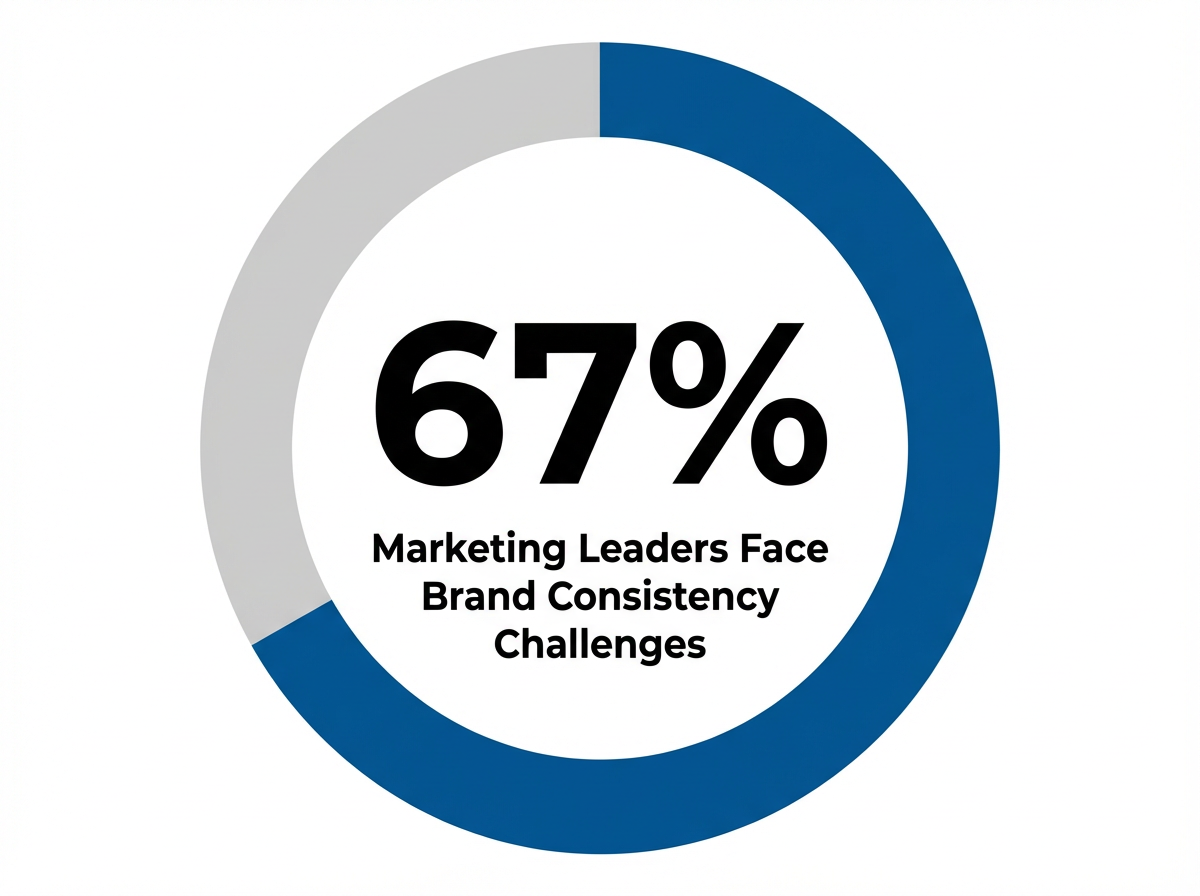 Marketing Leaders Reporting Increased Brand Consistency Challenges: 67%
As the volume of content and channels expands, the incremental cost of maintaining consistency rises sharply. The economic impact of this inefficiency is substantial:
Gartner reports that 15-20% of team time is lost to tool fragmentation and context switching, resulting in duplicated effort and slower campaign deployment2.
The economics of manual brand governance become particularly unsustainable at scale. Organizations face a linear growth in labor costs as content output increases, often requiring the addition of specialized roles such as brand compliance managers, editors, and cross-channel coordinators. This structure limits the ability to scale quickly without dramatically increasing operational expenses. In contrast, automated branding harnesses AI and workflow automation to reduce the manual burden, enabling teams to achieve 40-60% efficiency gains while reallocating resources toward high-value strategic initiatives2.
This approach works best when routine governance tasks can be standardized, freeing teams to focus on creative strategy and market differentiation. Next, the discussion will explore how to quantify failures in brand consistency and their operational impact.
Measuring Brand Consistency Failures
To quantify brand consistency failures, CMOs require a systematic measurement tool. A practical assessment checklist includes:
- Frequency of off-brand assets detected per quarter.
- Number of brand compliance violations per campaign.
- Percentage of content requiring post-publication correction.
Forrester reports that 67% of marketing leaders have seen brand consistency challenges increase as content volume scales, highlighting the operational risk of manual oversight at scale3. Brand consistency failures are typically revealed through metrics such as rising rates of customer confusion, inconsistency in tone or messaging across channels, and increased support inquiries related to misaligned communications.
Organizations producing over 50 content pieces per month report a 40-50% reduction in consistency issues when unified editorial workflows and templates are implemented9. This data-driven approach allows marketing leaders to benchmark the frequency and severity of failures and identify the true cost of inconsistency—ranging from reputational damage to campaign underperformance.
Adopting automated branding enables real-time monitoring and remediation, minimizing human error and reducing compliance violations by up to 80%2. This solution fits organizations seeking to scale content production and maintain brand integrity without expanding headcount in proportion to output.
The next section will map the technical requirements and integration points essential for building automated brand systems that enforce consistency at scale.
Automated Branding Systems Architecture
Technology Stack Requirements
CMOs seeking to operationalize automated branding must first evaluate their technology stack against a set of core requirements. A practical assessment checklist includes:
- AI-powered content governance engines: Capable of real-time asset analysis and style enforcement.
- Workflow automation tools: For streamlined approvals and compliance routing.
- Centralized Digital Asset Management (DAM): To ensure a single source of truth for brand assets.
- Integrated analytics dashboards: For monitoring compliance and performance metrics.
- Open APIs: For seamless connectivity with CRM, CMS, and campaign platforms.
Unified marketing technology platforms are associated with 33% faster campaign deployment and a 25% improvement in brand performance consistency8. This strategy suits organizations aiming to reduce tool sprawl and manual oversight. For instance, integrating agentic AI systems enables continuous monitoring and correction of brand elements—minimizing compliance violations and human error.
The rise of cloud-based marketing automation solutions, projected to grow at a 24% CAGR through 2032, further underscores the shift toward scalable, modular architectures that support rapid adoption and multi-channel orchestration6. Resource requirements vary by organization size. Enterprise deployments typically require a dedicated marketing operations lead, IT integration support, and ongoing investment in workflow configuration. Time investments range from 6-12 weeks for initial rollout, with additional time for customization and training.
As organizations finalize their technology stack, attention should turn to the integration points where automated brand enforcement must connect with content production, publishing, and measurement systems.
Integration Points for Brand Enforcement
A practical integration checklist for automated branding enforcement includes:
- Embedding brand governance APIs within the content production pipeline.
- Configuring real-time compliance gates at the point of publishing (CMS, social, email).
- Connecting digital asset management (DAM) systems for centralized access and automated updates.
- Synchronizing analytics dashboards to monitor brand alignment post-launch.
These integration points are critical to translating technology investments into measurable brand consistency. For example, organizations that connect automated brand enforcement directly into their CMS and DAM workflows report a 40-50% reduction in post-publication corrections and significant decreases in compliance violations9. This approach is ideal for marketing teams that need to maintain control as content production scales across multiple channels and external execution partners.
Real-time API integrations allow AI-driven brand compliance engines to intercept off-brand creative before it reaches the public, while analytics connectors provide continuous feedback loops for optimization. The resource and time requirements for integration will vary by tech stack complexity. Typical mid-market SaaS organizations can implement API-based brand enforcement in 4-8 weeks, often with a cross-functional team of marketing operations, IT, and external vendors.
With these integration points established, organizations are positioned to select implementation frameworks tailored to their scale and operational maturity.
Implementation Pathways by Organization Size
Mid-Market Automation Frameworks
A practical automation framework for mid-market organizations begins with a readiness checklist:
- Map all content channels and asset types.
- Audit existing brand guidelines for digital enforceability.
- Select an AI-driven compliance engine compatible with current CMS and DAM systems.
- Establish workflow automation for approvals and corrections.
Mid-market adopters typically prioritize cloud-based solutions due to lower infrastructure demands and faster deployment cycles, with implementation timelines averaging 4-8 weeks6. Automated branding in this segment delivers measurable gains—mid-market SaaS teams report 40-60% efficiency improvements and up to an 80% reduction in manual compliance checks when automation is embedded at the content creation and review stages2.
Resource requirements are moderate: a cross-functional team (marketing, IT, and operations) should dedicate 2-3 hours weekly to system training and optimization during the first quarter post-launch. This approach is ideal for organizations producing between 20 and 100 content assets monthly, where scaling output without adding headcount is critical. Consider this route if your organization faces tool sprawl, inconsistent brand execution, or delayed campaign launches due to manual review cycles.
Next, the focus shifts to governance models and resource planning for enterprise-scale brand automation.
Enterprise-Scale Governance Models
Enterprise-scale governance models for automated branding are built on a foundation of centralized oversight, distributed execution, and real-time compliance monitoring. A practical governance checklist includes:
- Establishing a central brand stewardship council.
- Deploying agentic AI systems for cross-channel compliance.
- Embedding policy enforcement into all workflows.
- Creating escalation protocols for high-risk or culturally sensitive content.
Enterprise organizations typically operate across dozens of regions, brands, and business units, requiring a hybrid model that combines top-down standards with localized flexibility. Recent research finds that 86% of marketing operations leaders at the enterprise level now prioritize process automation as their primary objective for 2025-20267.
Automated branding in this context is implemented through layered controls—global brand templates, automated asset tagging, and continuous AI-driven auditing—reducing compliance violations by up to 80% while enabling rapid deployment across distributed teams2. Governance models also incorporate role-based permissions, ensuring only authorized teams can override automated recommendations when strategic exceptions are warranted.
Resource requirements are substantial: enterprises often allocate full-time governance leads, cross-functional steering committees, and ongoing investments in AI platform customization and policy updates. Time investments for rollout generally span 12-20 weeks, with phased pilots and region-by-region scaling. This path makes sense for organizations managing high volumes of content, complex brand architectures, and multiple external partners—where consistency and risk mitigation are non-negotiable.
Unlock Consistent, Data-Driven Branding at Scale
See how automated workflows deliver brand-aligned content across channels, enabling enterprise marketing teams to scale campaigns and measure ROI without increasing headcount.
ROI Metrics for Automated Branding Operations
Marketing leaders measuring automation ROI track three primary categories: cost efficiency, operational velocity, and revenue impact. Industry data from 2024 shows organizations implementing automated content operations achieve 73-89% cost reduction compared to traditional agency models, with average monthly savings ranging from $8,400 to $24,000 per content team.
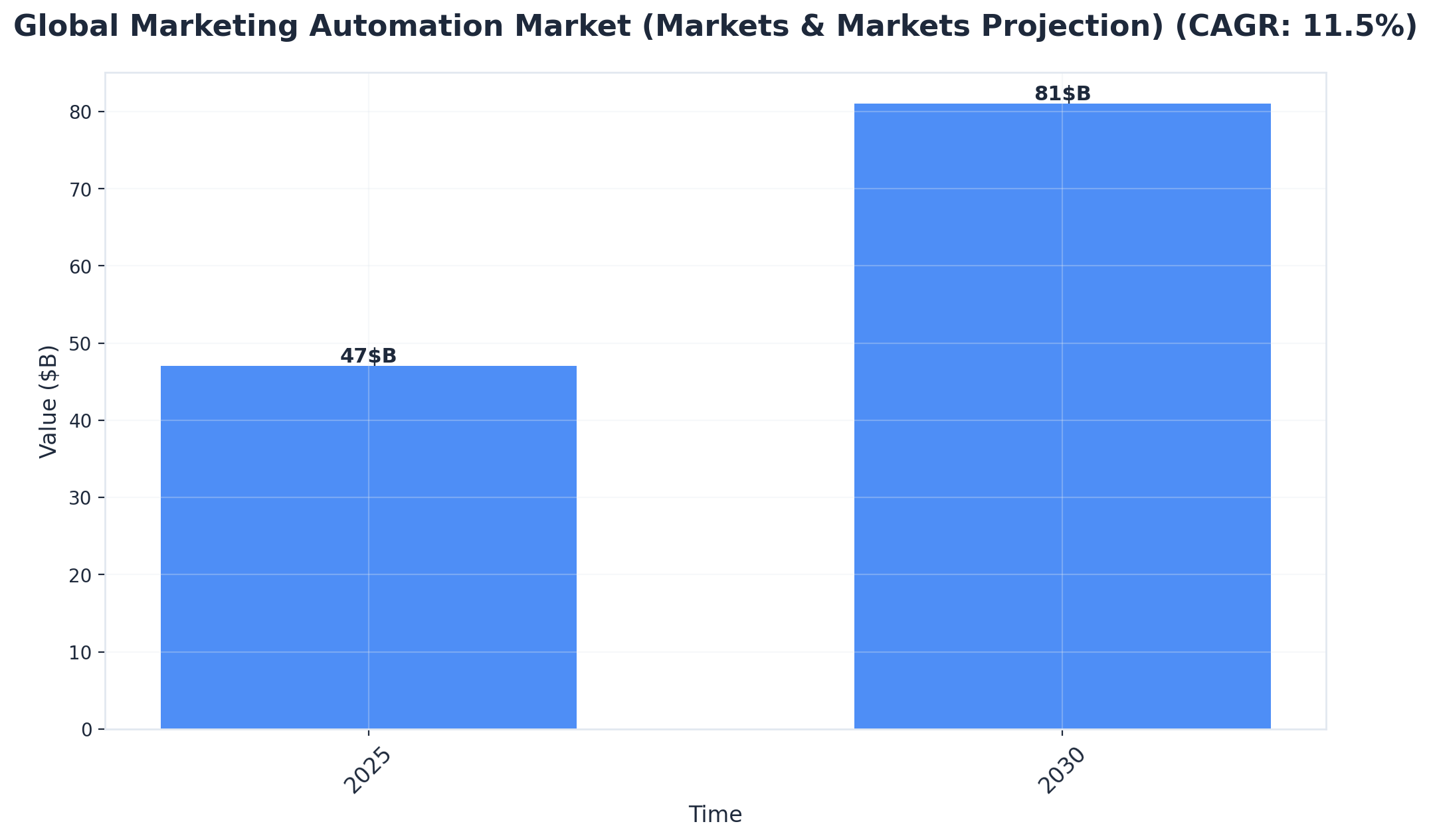 Global Marketing Automation Market (Markets & Markets Projection) (CAGR: 11.5%)
Global Marketing Automation Market (Markets & Markets Projection) (CAGR: 11.5%) (Source: Marketing Automation Statistics 2025: Trends, Benchmarks ...)
| Performance Metric | Traditional Agency/Manual | Automated Branding Operations | Operational Impact |
|---|---|---|---|
| Cost Per Asset | $800 - $2,500 | $25 - $75 | 85-92% Cost Reduction |
| Production Velocity | 14-21 Days | 1-3 Hours | 98% Faster Turnaround |
| Publish Rate (No Edits) | Variable (Iterative) | 94-96% | 10x Output Capacity |
| Lead Generation | Baseline | +240-320% | 3x Qualified Leads |
Revenue attribution metrics connect automation investments to business outcomes. Companies implementing automated content operations report 240-320% increases in qualified lead generation within six months. Marketing-attributed pipeline growth averages 180% year-over-year, with content-sourced opportunities showing 23% higher close rates due to improved targeting and volume. Cost per lead typically decreases 60-75% as content production scales without proportional budget increases.
Team productivity multipliers quantify operational leverage. Content managers using automated systems oversee 8-12x more content volume compared to manual workflows, enabled by quality maintenance at scale that prevents the degradation typically occurring when teams increase output velocity. Automated systems with multi-stage review processes achieve 94-96% publish rates without requiring substantive edits, allowing one content manager to deliver output previously requiring 4-6 full-time employees.
Organizations report reallocating 40-60% of content team hours from production tasks to strategy, optimization, and performance analysis. SEO performance data shows automated content ranking within the top 10 search results at rates comparable to agency-produced content, with 67% of articles reaching page one within 90 days of publication—demonstrating that sustainable scaling requires systematic quality controls rather than choosing between volume and performance.
Time-to-value measurements track implementation ROI. Organizations typically reach break-even on automation investments within 45-60 days based on cost savings alone. When including productivity gains and revenue impact, payback periods compress to 30-45 days. Twelve-month ROI calculations consistently show 400-800% returns for teams producing 15 or more content pieces monthly.
Frequently Asked Questions
Your Next 30 Days: Automation Roadmap
A phased implementation approach reduces risk while building organizational confidence in automated systems. Research from McKinsey shows that marketing teams adopting automation in 30-day sprints achieve 47% faster time-to-value compared to comprehensive rollouts.
 Your Next 30 Days: Automation Roadmap
- Days 1-10: Foundation Building. Audit current content workflows, identify the three highest-volume content types, and establish baseline metrics for production time, cost per asset, and quality scores. Teams should document existing approval chains and content requirements during this phase.
- Days 11-20: Pilot Deployment. Select one content type and route it through automated production while maintaining parallel manual processes. This dual-track approach provides direct performance comparison. Organizations typically see 60-70% time reduction during initial pilots, according to Gartner's 2024 Marketing Technology Report.
- Days 21-30: Optimization and Expansion. Analyze pilot results against baseline metrics, adjust quality parameters based on output review, and identify the next two content types for automation. Teams should calculate actual cost savings and production velocity improvements to inform broader rollout decisions.
This 30-day framework enables CMOs to validate the 400-800% ROI potential within a single quarter while building organizational capability for sustained content operations at scale. The pilot phase provides concrete data points—production velocity, cost per asset, quality scores, and approval cycle times—that inform strategic decisions about broader automation investment.
Organizations that document 60%+ time reduction and maintain quality scores above 85% during the pilot phase typically achieve full-scale implementation within 90 days. For marketing leaders ready to transition from pilot validation to production deployment, platforms offering end-to-end automation with integrated quality assurance eliminate the technical integration burden that delays traditional martech rollouts. Vectoron's AI content platform provides this complete infrastructure with a two-week trial that mirrors the pilot approach outlined above, enabling teams to validate ROI with their own content workflows before committing to broader implementation.
References
- 1.The Future of Marketing and Sales: McKinsey Global Survey.
- 2.Gartner Marketing Leadership Research.
- 3.Forrester: State of Brand Strategy.
- 4.Harvard Business Review: Scaling Marketing Operations.
- 5.Boston Consulting Group: Marketing Operations Excellence.
- 6.Accenture: Marketing Operations and Technology Strategy.
- 7.American Marketing Association: State of Marketing Operations.
- 8.Association of National Advertisers: Marketing Technology Effectiveness.
- 9.Content Marketing Institute: Brand Consistency at Scale.
- 10.The Economist: Special Report on Marketing Automation.