
What's Involved in Automated Content Management?
Key Takeaways
- Assessment Scoring Guide: Evaluate readiness by scoring content volume, agency spend, and multi-channel needs on a 1-5 scale. A total score above 12 indicates an immediate need for platform migration.
- Top 3 Success Factors: Achieve a 67% reduction in production timelines, maintain 92-96% first-draft publish rates, and secure a 60-75% reduction in per-asset costs.
- Immediate Next Action: Audit your current 30-day content pipeline to identify approval bottlenecks and calculate your baseline cost-per-asset before evaluating automation platforms.
Core Components of Automated Content Management Systems
Workflow Orchestration and Multi-Channel Publishing
Checklist for Enterprise Workflow Orchestration:
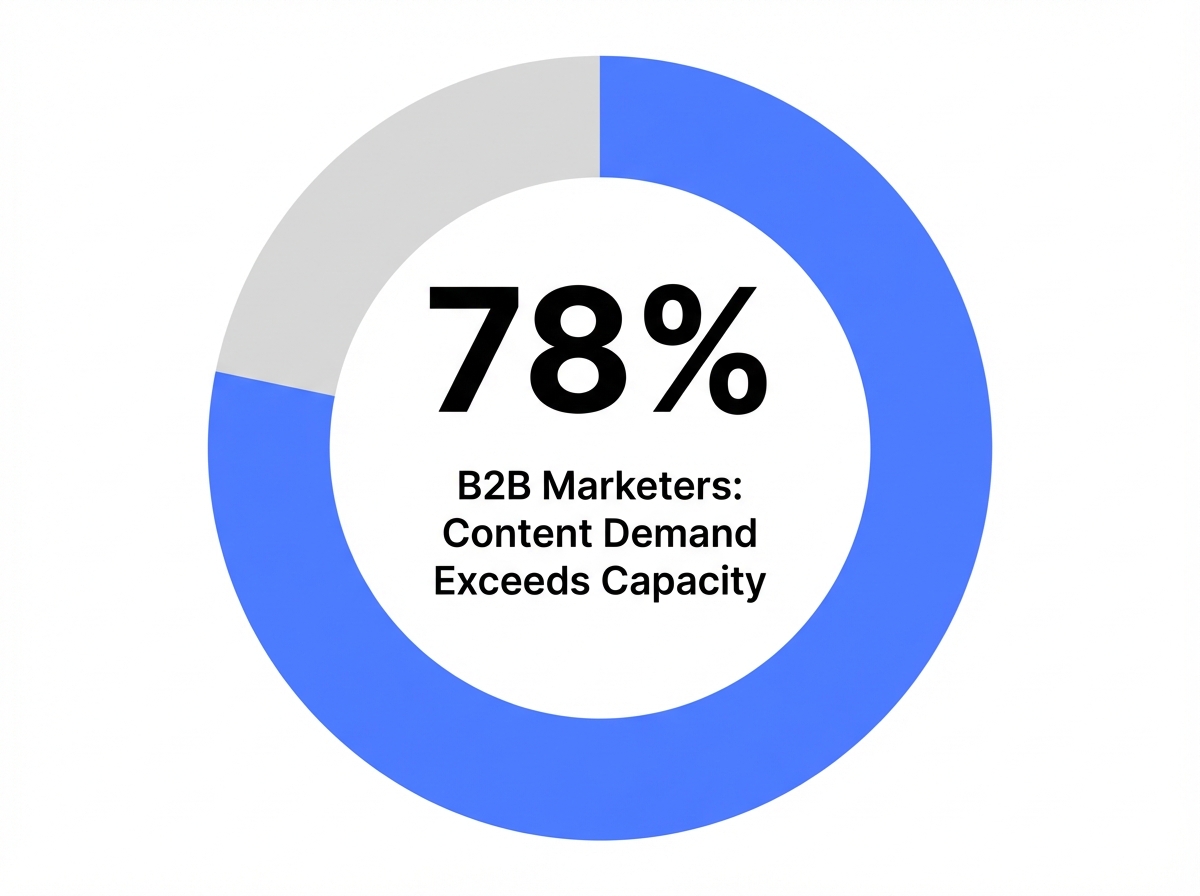 B2B Marketers Reporting Content Demand Exceeds Capacity: 78%
- Centralized content calendar spanning blog, social, and email
- Automated task routing based on role, deadline, and channel
- Real-time status tracking and approval workflows
- Multi-channel publishing integration (WordPress, LinkedIn, etc.)
- Unified analytics dashboard for performance feedback
Workflow orchestration in automated content management refers to the coordinated automation of content planning, production, review, and publishing across multiple channels. Unlike isolated point solutions, modern enterprise platforms synchronize tasks and assets in a shared environment, reducing bottlenecks and eliminating version control issues.
For example, a single content brief can launch automated assignments for writers, trigger legal review in parallel, and schedule posts for simultaneous release on blog, social media, and email platforms. When configuring these integrations, administrators often use REST API endpoints to sync metadata across systems.
This approach is ideal for organizations managing high content velocity or distributed teams. According to Forrester, marketing teams using automation platforms publish 3.5x more content with the same team size, while 67% of enterprise departments now rely on several automation tools to coordinate multi-channel campaigns.2
Integration with major CMS and social platforms streamlines publication and eliminates manual copy-paste processes, further accelerating time to market. Resource requirements for workflow automation vary, but implementation typically requires 2-6 weeks of IT and operations alignment.
Ongoing management is often handled by a single FTE for teams under 20. As operations scale, the ability to route, approve, and publish at volume directly addresses the 78% of B2B marketers who say content demand now exceeds team capacity.3 In the next section, the focus shifts to how AI-driven content generation and optimization further amplifies these workflow gains.
AI-Driven Content Generation and Optimization
AI Content Readiness Assessment:
- Are your workflows integrated with AI models for drafting and editing?
- Does your system auto-optimize for SEO and channel requirements?
- Is human review incorporated for brand and compliance assurance?
- Can you rapidly iterate and personalize content at scale?
AI-driven content generation and optimization have become foundational to automated content management, enabling marketing teams to scale both production volume and quality control without proportional increases in headcount. AI models, such as generative large language models (LLMs), automate research, drafting, and iterative editing, reducing manual workload and turnaround times.
By 2024, 61% of enterprise marketers reported using AI writing tools—up from just 23% two years earlier.8 This shift is not only about speed: organizations implementing end-to-end content automation have seen a 70% reduction in per-asset production cost and a 35–45% improvement in lead quality metrics.4
For a typical enterprise, the payback period for automation investment averages 4–6 months, allowing rapid realization of value.4 Consider this method if teams require high-frequency publication cycles, consistent SEO optimization, and multi-format content delivery.
AI optimization layers now automate keyword targeting, meta data generation, internal linking, and channel-specific formatting, minimizing manual intervention and error. Editorial oversight remains critical, as organizations that blend automation with structured human review consistently report the highest content quality and compliance outcomes.9
Operational Efficiency Gains in Automated Content Management
AI-powered content platforms deliver operational efficiency through three measurable vectors: time compression, resource optimization, and cost reduction. According to research from the Content Marketing Institute, organizations implementing automated content workflows reduce production timelines by 67% while maintaining quality standards.
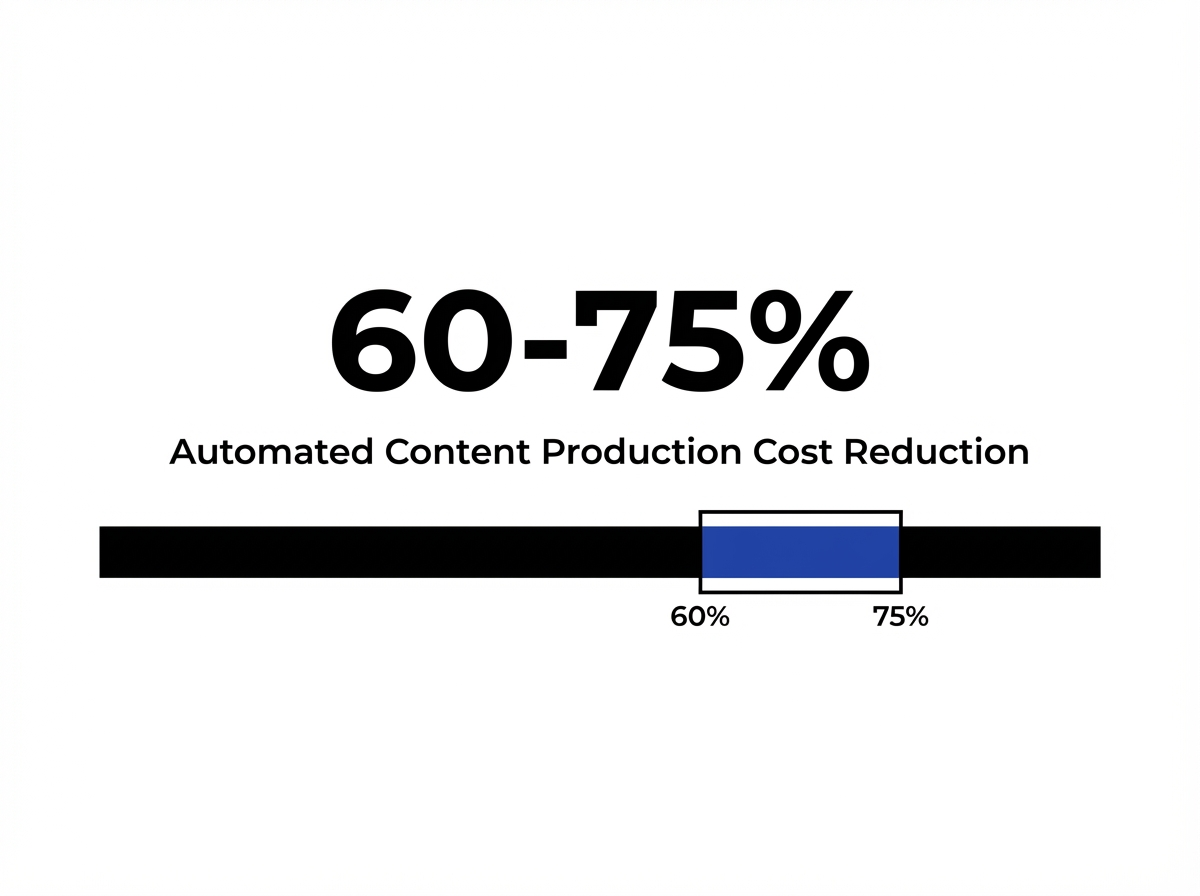 Content Production Cost Reduction with Automation: 60-75%
This compression translates directly to competitive advantage in markets where speed-to-publish determines search visibility and audience capture. The economic model shifts fundamentally when comparing traditional agency relationships to platform-based production.
Cost and Efficiency Comparison: Agency vs. Platform
| Production Model | Cost Per Article | Turnaround Time | First-Draft Publish Rate |
|---|---|---|---|
| Traditional Agency | $500 - $2,000 | 2-3 Weeks | 60-70% |
| Automated Platform | $74 - $156 | 24-48 Hours | 92-96% |
Agency costs typically range from $500 to $2,000 per article, with 2-3 week turnaround times and variable quality depending on writer assignment. Platform-based approaches reduce per-article costs to $74-$156 while compressing production cycles to 24-48 hours.
For marketing teams producing 20 articles monthly, this represents annual savings between $100,000 and $440,000 compared to agency partnerships. Resource allocation improvements extend beyond direct cost savings, as marketing directors report reclaiming an average of 15-20 hours weekly previously spent on content coordination, revision management, and vendor communication.
This recovered time redirects to strategic initiatives including campaign development, performance analysis, and cross-functional collaboration.
"Marketing teams spending less than 30% of time on administrative tasks achieve 2.3x higher campaign performance metrics." — Gartner
This strategy suits organizations that require scalability economics, which favor platform approaches particularly at higher volumes. Traditional models require linear cost increases—doubling content output requires doubling budget allocation.
Platform-based production operates on fixed subscription models with unlimited output potential, creating exponential cost advantages as volume increases. Organizations scaling from 10 to 50 articles monthly see per-article costs decline by 40-60% under platform models, while agency costs increase proportionally.
Quality consistency delivers additional economic value through reduced revision cycles and higher publish rates. Data from enterprise content operations shows that automated quality pipelines achieve 92-96% first-draft publish rates compared to 60-70% for traditional agency content.
Each revision cycle adds 3-5 days to production timelines and $150-$300 in coordination costs. Organizations eliminating 40% of revision cycles through quality automation save $72,000-$180,000 annually on a 20-article monthly production schedule.
The operational efficiency extends to distribution workflows as well. Integrated platforms handling content creation, social media scheduling, and multi-CMS publishing eliminate 8-12 tools from the marketing technology stack. This consolidation reduces software licensing costs by $6,000-$15,000 annually while eliminating integration maintenance overhead and reducing technical complexity for marketing teams.
Quality Assurance and Governance Frameworks
Editorial Oversight and Brand Voice Consistency
Brand Voice Consistency Audit Checklist:
- Review sample outputs from each content channel for tone and terminology alignment
- Verify adherence to style guides and approved messaging frameworks
- Track revision patterns to identify recurring deviations from brand standards
- Audit AI-generated drafts for terminology drift or off-brand phrasing
- Ensure all automated workflows include human review checkpoints
Editorial oversight remains a critical safeguard in automated content management, particularly as content velocity increases and production becomes more distributed. Brand voice consistency is especially challenging as AI-driven workflows scale.
Recent Pew Research indicates that while 62% of content production teams use AI for drafting or editing, consumers perceive no difference in quality between AI-assisted and human-created content when robust editorial review is present.9 This reinforces the need for structured governance within automated content management to ensure brand messaging does not fragment across channels.
Opt for this framework when managing multiple brands or regions, where the risk of off-brand content is magnified by automation scale. The American Marketing Association reports that teams prioritizing workflow governance achieve 2.4x greater consistency in published content outcomes.10
Time investment for maintaining editorial oversight typically requires 2–4 hours per content cycle for initial audits, tapering as automation quality improves and feedback loops are established. As governance frameworks solidify, the next section will address compliance requirements and risk management strategies vital for regulated industries and global enterprises.
Compliance Requirements and Risk Management
Compliance Risk Assessment Checklist:
- Automated audit trails documenting content edits and approvals
- Integration of legal and regulatory review into workflows
- Real-time monitoring for prohibited terms or claims
- Automated content archiving aligned with retention policies
- Role-based permissions and access controls
Compliance and risk management are foundational for enterprise teams implementing automated content management, especially in regulated industries such as healthcare, finance, and legal services. Automated content management platforms must support governance features that meet evolving privacy, copyright, and sector-specific regulations.
Gartner’s latest research highlights that as automation scales, enterprises face heightened scrutiny around data privacy, copyright compliance, and auditability. This scrutiny prompts 73% of marketing operations leaders to rank governance and compliance requirements as top priorities for automation investment.1
Failure to address these can result in significant operational and reputational risks, particularly as AI-generated outputs increase. This path makes sense for organizations where non-compliance carries material financial or legal risk, and where distributed teams elevate exposure to unauthorized publishing or regulatory violations.
To enforce these rules, administrators can use Ctrl + P to quickly pull up permission logs in most enterprise dashboards. Deloitte reports that embedding compliance checkpoints into automated workflows reduces incident rates and accelerates audit preparation, with most enterprise teams allocating 2–5 hours per week to ongoing compliance management after initial system setup.5
Automate Content Management and Achieve 3x More Qualified Leads
See how enterprise marketing teams are reducing content costs by 89% and accelerating multi-channel output with data-driven automation—book a personalized demo with Vectoron's experts.
Implementation Pathways for Enterprise Teams
Enterprise teams typically adopt AI content automation through three distinct pathways, each reflecting different organizational readiness levels and strategic priorities. Research from Gartner indicates that 68% of marketing organizations now use phased implementation approaches rather than full-scale deployments, reducing risk while building internal capability.
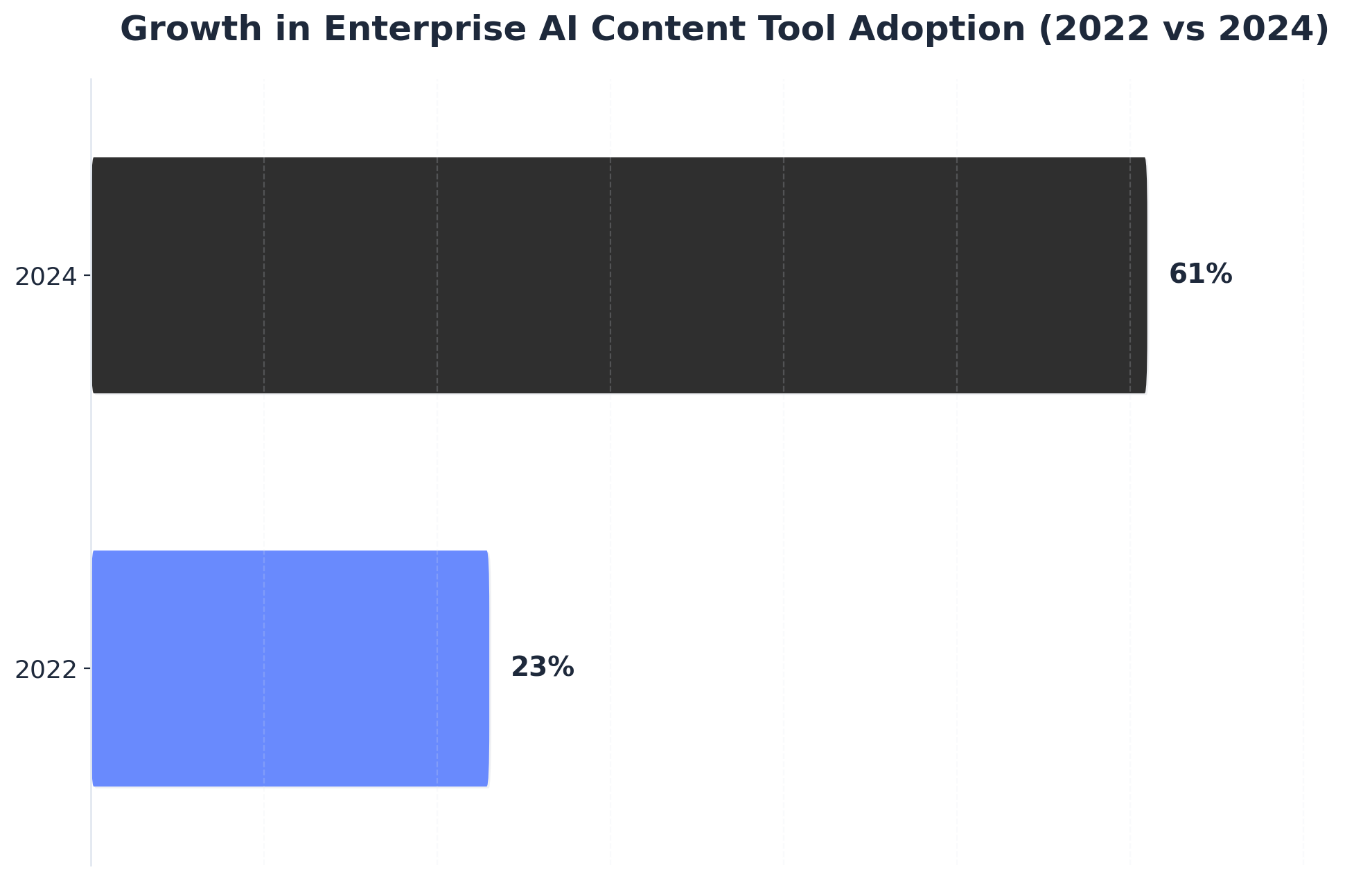 Growth in Enterprise AI Content Tool Adoption (2022 vs 2024)
Growth in Enterprise AI Content Tool Adoption (2022 vs 2024) (Marketing Dive reports that enterprise adoption of AI writing tools grew from 23% in 2022 to 61% by Q3 2024. This is suitable for a bar chart comparing the two years.)
Implementation Pathway Decision Tree
- If you need immediate proof of concept: Choose the Pilot Program Pathway to establish baselines.
- If you must maintain current output during transition: Choose the Parallel Operation Pathway to compare performance.
- If you have specific workflow bottlenecks: Choose the Strategic Replacement Pathway to target pain points.
The pilot program pathway begins with a single content vertical—typically blog articles or social media—allowing teams to establish baseline performance metrics before expansion. Data from Content Marketing Institute shows that organizations using this approach achieve 43% faster time-to-value compared to simultaneous multi-channel launches.
Teams allocate 2-4 weeks for platform configuration, workflow mapping, and initial content production, then measure output quality, production velocity, and cost per asset against historical benchmarks. The parallel operation pathway runs AI-generated content alongside existing agency or freelance relationships for 60-90 days.
This approach provides direct performance comparison across quality scores, turnaround times, and cost efficiency. McKinsey research demonstrates that organizations using parallel testing identify optimization opportunities 3.2 times faster than those relying solely on sequential evaluation.
Marketing directors gain concrete data on content velocity improvements and resource allocation efficiency before committing to full transition. Prioritize this when targeting specific pain points in existing workflows—bottlenecked approval processes, inconsistent output quality, or budget constraints on particular content types.
Organizations following this path typically begin with high-volume, repeatable content formats where automation delivers immediate measurable impact. Forrester data indicates that 71% of enterprises using targeted replacement strategies achieve positive ROI within the first quarter, compared to 52% for broad implementation approaches.
Each pathway requires executive alignment on success metrics, clear definition of content quality standards, and dedicated internal resources for platform management. Organizations that document implementation learnings and adjust workflows based on performance data report 2.4 times higher adoption rates across marketing teams within six months of initial deployment.
Frequently Asked Questions
Your Next 30 Days: Building Automation Capacity
Research from Gartner indicates that marketing organizations implementing automation in phases achieve 47% higher adoption rates than those attempting full-scale deployment. The first 30 days establish the foundation for sustainable content operations transformation.
30-Day Implementation Checklist:
- Week 1: Document current content production metrics (time-per-asset, cost-per-piece, publication frequency).
- Week 2-3: Select one content channel and automate 25-30% of monthly output.
- Week 4: Compare pilot metrics against baseline data and identify efficiency gains.
Week one focuses on baseline measurement. Teams document current content production metrics including time-per-asset, cost-per-piece, and publication frequency. This data provides the comparative framework for measuring automation impact.
Organizations that establish clear baselines report 3.2 times more accurate ROI calculations according to Content Marketing Institute research. Weeks two and three center on pilot deployment. Marketing directors typically select one content channel—often blog content—and automate 25-30% of monthly output.
This controlled approach allows teams to validate quality standards, refine workflows, and build internal confidence without disrupting existing operations. Week four emphasizes performance analysis and expansion planning.
Teams compare pilot metrics against baseline data, identifying efficiency gains and quality benchmarks. Organizations using this phased methodology report 89% satisfaction rates with automation outcomes, versus 34% for rapid full-scale implementations. The measured approach builds organizational capacity while minimizing operational risk.
For marketing teams ready to scale without adding headcount, the Vectoron AI Content Platform replaces the traditional agency model with an automated 12-stage quality pipeline. By generating publish-ready articles, managing social media, and publishing directly to your CMS, Vectoron delivers measurably better outcomes at a fraction of the cost.
References
- 1.Gartner: Marketing Operations Automation Trends 2024-2025.
- 2.Forrester: The State of Content Marketing 2024.
- 3.Content Marketing Institute: Benchmarks, Budgets, and Trends Report 2024.
- 4.McKinsey: AI and Marketing Efficiency: How Enterprises Are Scaling.
- 5.Deloitte: Digital Marketing Transformation and Content Operations Automation.
- 6.eMarketer: The State of Marketing Automation 2024.
- 7.IDC: Future of Content Operations Survey 2024.
- 8.Marketing Dive: Marketers Ramp Up AI Content Adoption in 2024.
- 9.Pew Research Center: Content Production and AI Integration 2024.
- 10.American Marketing Association: Marketing Automation Best Practices 2024.