
Key Takeaways
- Treat agency SEO delivery as a six-stage production pipeline with two human approval gates: brief sign-off before drafting and pre-publish QA before deployment.
- Automate the load-bearing tier—log file analysis, template-level schema and metadata, internal linking rules, and recurring reporting—where work is rule-driven and continuous 9.
- Keep E-E-A-T inputs, strategic prioritization, and the approval queue human, since client-verified credentials and judgment determine whether scaled output adds value or triggers spam policy 5, 12.
- Focus next on three integration points—a unified data layer, a context-rich brief queue, and a validated publish layer—rather than acquiring a separate SaaS tool for every pipeline stage 8.
Why agency SEO delivery is breaking at current headcount
Retainers are flat, but client expectations are not. The demands on SEO agencies have expanded significantly, now including AI Overview visibility, comprehensive schema coverage, log-level crawl reporting, and a viewpoint on Generative Engine Optimization (GEO). While Google's June 2026 guidance clarified that generative AI features still rely on core ranking systems and established SEO best practices remain paramount, the delivery problem persists due to capacity constraints, not strategic misdirection. Search Engine Journal echoed this, stating that AEO and GEO are fundamentally still SEO 2, 13.
The issue lies in capacity. A senior strategist managing 8 to 12 accounts cannot simultaneously audit log files, regenerate schema across template changes, monitor canonical drift, brief writers on experience-led content, and handle client calls. Agency owners analyzing the 2026 guidance agree: the most effective strategy is to reinforce technically sound sites and experience-backed content, rather than investing in new AI SEO product lines 11. This raises a critical operational question: if deliverables are increasing but teams are not, which aspects of SEO production should be systematized, and which require human expertise?
The production pipeline model: six stages, two approval gates
Consider agency SEO delivery as a manufacturing line, not a creative studio. It involves six stages:
- Signal detection (identifying changes in rankings, crawl behavior, SERP composition, or client revenue)
- Prioritization (deciding which signals warrant action)
- Brief construction (detailing the production spec)
- Drafting (creating the page, schema, or technical fix)
- Technical QA (validating against rules for schema, internal linking, and indexability)
- Publish/measure (deployment and attribution)
Each stage has defined inputs and outputs, a prerequisite for automation.
Two human approval gates are intentionally placed within this pipeline. The first gate is between brief construction and drafting, where a strategist approves the angle, source material, author byline, and experience claims. The second gate is between technical QA and publishing, where a human reviews the final output, schema payload, and metadata before deployment. Google's spam guidance explicitly states that using generative tools to produce many pages without adding value may violate its scaled content abuse policy. Human-understandable context around automation is crucial for distinguishing acceptable AI-assisted publishing from low-effort scaled output 12. These approval gates address that policy directly.
Aggressive automation can be applied to everything between these gates. Signal detection can continuously run against rank data, GSC exports, and server logs. Prioritization can use agency-defined scoring rules. Drafting and technical QA can execute based on templates and rule sets. These gates are not bottlenecks; they are points where senior judgment significantly impacts downstream actions. Agencies that adopt this six-stage model shift their focus from tool acquisition to encoding rules, leading to more productive discussions.
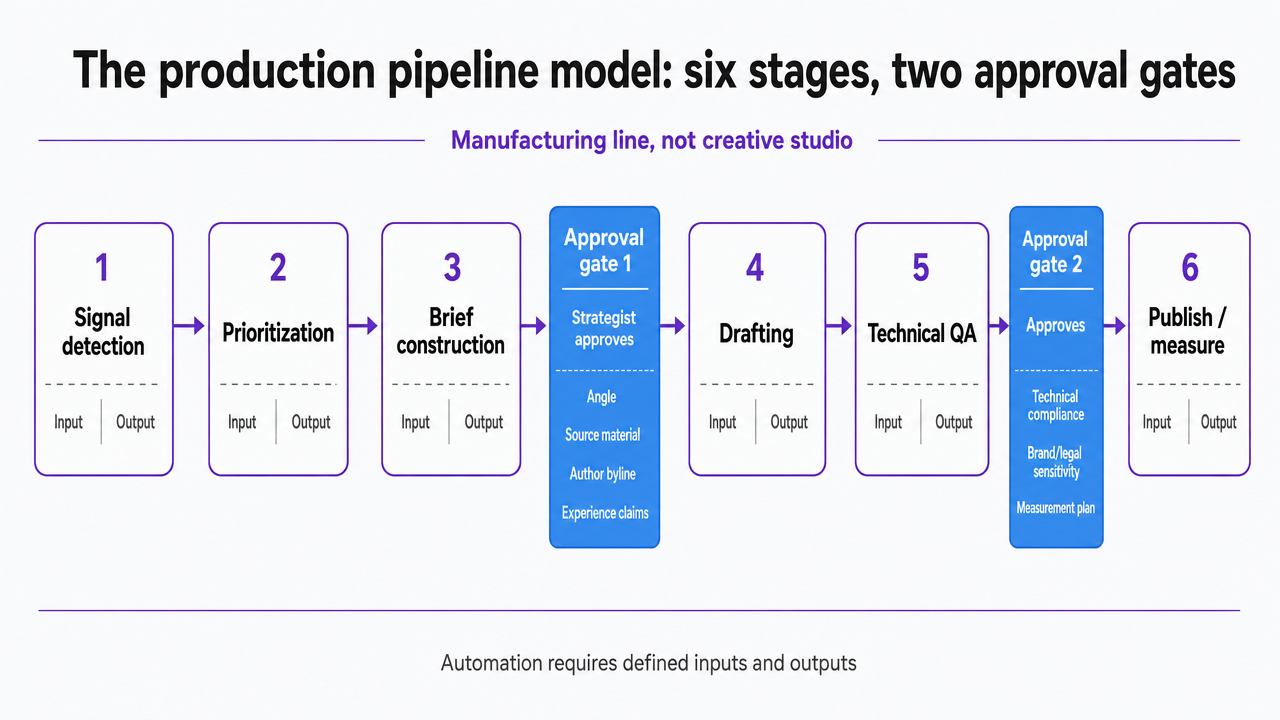 Visualize the six-stage SEO production pipeline with the two human approval gates described in the section
What to automate: the load-bearing tier
Three categories form the operational backbone of an automated SEO system: technical monitoring, template-level metadata, and reporting/signal detection. These areas are suitable for aggressive automation because they are rule-driven, continuous, and produce outputs that a senior strategist would inspect rather than create from scratch. Enterprise guidance for 2026 identifies this as a minimum automation floor, encompassing monitoring for technical breakages post-deployment, template-level schema and metadata generation, and crawl and index monitoring, including log file analysis 9. Modern enterprise SEO platforms now integrate large-scale keyword tracking, technical audits, content optimization, workflow management, and automation, setting a baseline for agency stacks without requiring bespoke development 8.
This "load-bearing tier" is not where an agency earns its retainer, but it is essential for profitability. Each subsection below details a work category, its governing rule set, and the failure mode that arises when the work is performed manually across multiple clients.
Technical monitoring and log file analysis
Server logs offer the only true perspective of a site as Googlebot sees it 6. Crawl tools simulate, and analytics track user behavior post-render. Logs, however, record specific URLs requested by user agents, their frequency, response codes, and order. For agencies managing numerous accounts, this distinction is crucial for detecting canonical regressions immediately, rather than discovering them during a quarterly audit.
The automation rule set for log analysis is straightforward: ingest logs continuously for each client and flag deviations from a baseline. This includes:
- Sudden spikes in 4xx or 5xx responses
- Drops in Googlebot hit rates on revenue-generating templates
- Crawl budget waste on parameterized or paginated URLs that should be canonicalized
- Orphaned URLs receiving crawl attention without internal links
This pipeline also monitors for technical breakages post-deployment, which the 2026 enterprise guidance mandates as a non-negotiable automation baseline alongside crawl and index monitoring 9.
Manual log analysis often becomes an unfinished quarterly project. Automated, it transforms into a daily alert feed for a strategist to triage exceptions. The senior judgment shifts from performing the analysis to deciding which anomalies require client communication.
Template-level schema, metadata, and internal linking
Schema and metadata should be applied at the template level, not individually per page. The 2026 enterprise guidance explicitly states that schema and metadata should be generated at the template level, with internal linking rules codified rather than manually adjusted for each URL 9. For a multi-location client with hundreds of service-area pages, manual schema implementation is a quality risk, as each manual touch introduces potential for deviation from the canonical structure.
The automation rule set encodes the schema type per template (e.g., LocalBusiness, FAQPage, Article, Product, Service), required fields, source fields in the CMS or business data layer, and validation rules to prevent publishing if a required field is empty. Internal linking follows similar logic: parent-child relationships defined by template, anchor text patterns derived from page intent, and link velocity caps to prevent any single template from dominating the link graph. Google's June 2026 guide confirms that generative AI features do not require special AI-specific markup, emphasizing the importance of maintaining clean and consistent standard structures across all client sites 13.
The failure mode here is often silent: broken schema may not trigger errors but can prevent rich result eligibility for extended periods.
Reporting, audits, and signal detection
Reporting often consumes significant billable hours for agencies, despite being an area ripe for automation. Enterprise SEO practices have shifted towards automated, scalable reporting because manual decks are unsustainable across a growing client base 7. This principle also applies to recurring technical audits and the signal detection layer that populates the brief queue.
The automation rule set covers three workflows:
- Reporting pulls ranking, traffic, conversion, and crawl data into client-specific dashboards on a fixed cadence, allowing strategists to add commentary rather than rebuild entire decks.
- Audits run on a schedule against a predefined checklist (indexability, Core Web Vitals, schema validation, broken internal links, canonical drift), producing a delta report against the previous run instead of a new 80-page PDF.
- Signal detection monitors rank movement, GSC query expansion, SERP feature changes, and competitor publishing velocity, surfacing ranked opportunities into the brief queue.
The distinction between what enterprise platforms automate and what requires human judgment is clear. Technical monitoring, schema and metadata generation, internal linking rules, and crawl/index monitoring (including log file analysis) are firmly within the automation floor 9. Content drafting can be AI-assisted but requires human gating. Strategic prioritization and E-E-A-T signals remain entirely human. This division allows for effective staffing rather than ongoing debate.
Test Automated SEO Workflows on Live Campaigns
Validate automated SEO processes by executing real client tasks and measuring impact during your trial.
What stays human: E-E-A-T, judgment, and the approval queue
While automation handles scalable tasks, human expertise is crucial for work that compounds with experience. Three categories remain firmly on the human side: E-E-A-T signals, strategic prioritization, and the approval queue. Attempting to fully automate these areas can lead to issues with both Google and clients.
E-E-A-T is often misunderstood. It is not a content quality score for AI tools to optimize, but a set of verifiable signals about content creators and trustworthiness. The practical checklist includes:
- Named authors with credentials
- Structured data linking content to authors
- Evidence of first-hand experience
- External mentions confirming authority
- Visible trust markers 5
An agency can automate the schema that exposes these signals, but not the underlying facts. Inputs like a lawyer's bio, a clinician's case experience, or a contractor's job photos are client-supplied and strategist-verified, not model-generated. Google's AI content guidance emphasizes that AI-assisted content performs well only if it is helpful, original, and meets E-E-A-T standards. The March 2024 Core Update specifically targeted low-value AI content that failed these criteria 4.
Strategic prioritization is the second human tier. While signal detection identifies opportunities, a senior strategist determines which ones a client should pursue. A ranking drop on a high-intent commercial template requires a different response than one on a top-of-funnel explainer. The 2026 agency-owner analysis of Google's guidance reinforces this: the strongest approach combines technically sound sites with experience-backed content, which is a judgment call about resource allocation, not an automated workflow 11.
The approval queue is the third human element. Both pipeline gates—brief sign-off and pre-publish QA—feed a single queue managed daily by a senior strategist. This queue should provide context for each item: the signal that triggered the brief, the template used, the schema fields generated, and E-E-A-T claims requiring client verification. Approvals are efficient when context is readily available; they become bottlenecks when reviewers must reconstruct the rationale. The queue scales senior judgment by recording decisions and reusing them as rules for future cycles.
Where Google's scaled-content policy actually bites
The risk in an automated SEO system isn't Google detecting AI-assisted drafting, but the agency losing the human context that differentiates valuable publishing from scaled content abuse. Google's spam guidance specifies that using generative tools to produce many pages without adding user value violates the policy 12. The key is "adding value," not "using AI." Google's February 2023 clarification similarly stated that AI content is not inherently against guidelines if it is useful, original, and meets E-E-A-T standards 3.
Three patterns typically cross this line, especially when automation lacks the approval gates described in the pipeline:
- Template flooding involves creating hundreds of near-duplicate pages where only a location token or keyword varies.
- Brief-free drafting occurs when a model generates content from a keyword list without source material, author byline, or verifiable experience claims.
- Publish-without-review happens when technical QA ensures clean schema and indexable URLs, but no senior strategist confirms the page genuinely answers the query better than existing content.
The March 2024 Core Update demonstrated the consequences of these patterns, measurably penalizing sites that scaled low-value AI content 4. The solution is not to slow automation but to implement the approval queue between drafting and publishing, log strategist reasoning for each item, and ensure human-supplied inputs—author credentials, source documents, client-verified facts—are attached to every brief. This transforms scaled production into scaled value, aligning with Google's policy enforcement.
Operator economics: production hours per client across three tiers
The rationale for codifying SEO delivery into a pipeline is economic, addressing a capacity math problem. The 2026 enterprise guidance outlines a specific automation floor: technical breakage monitoring post-deployment, template-level schema and metadata generation, internal linking rules, and crawl and index monitoring, including log file analysis 9. Each of these tasks, when manual, consumes significant senior strategist hours but is a prime candidate for the load-bearing automation tier. The question then becomes how much capacity is freed once this automation floor is implemented.
The table below illustrates per-client monthly hour allocation across three operational tiers. While hour ranges are variables dependent on account complexity, the distribution pattern is key.
| Task category | Manual delivery | Partial automation (reporting + audits) | Full pipeline automation |
|---|---|---|---|
| Technical monitoring & log analysis | 4–8 hrs | 3–5 hrs | 0.5–1.5 hrs (exception triage) |
| Schema, metadata, internal linking | 3–6 hrs | 2–4 hrs | 0.5–1 hr (template review) |
| Recurring audits & reporting | 5–10 hrs | 1–2 hrs | 1–2 hrs (commentary only) |
| Signal detection & brief queue | 3–5 hrs | 2–4 hrs | 1–2 hrs (prioritization) |
| Approval gates (brief + pre-publish) | included above | 2–3 hrs | 2–4 hrs |
| Per-client monthly total | 15–29 hrs | 10–18 hrs | 5–10 hrs |
Two notable patterns emerge. Approval-gate hours increase as other tasks are compressed, as this is where senior judgment is concentrated. The most significant reduction in hours occurs in recurring audits and reporting, reflecting the shift in enterprise SEO towards automated, scalable reporting as a baseline 9. The primary benefit is not just cost savings, but unlocked capacity per senior strategist—effectively enabling them to manage 20 accounts instead of 8 at comparable quality, with the approval queue absorbing judgment work previously spread across manual production.
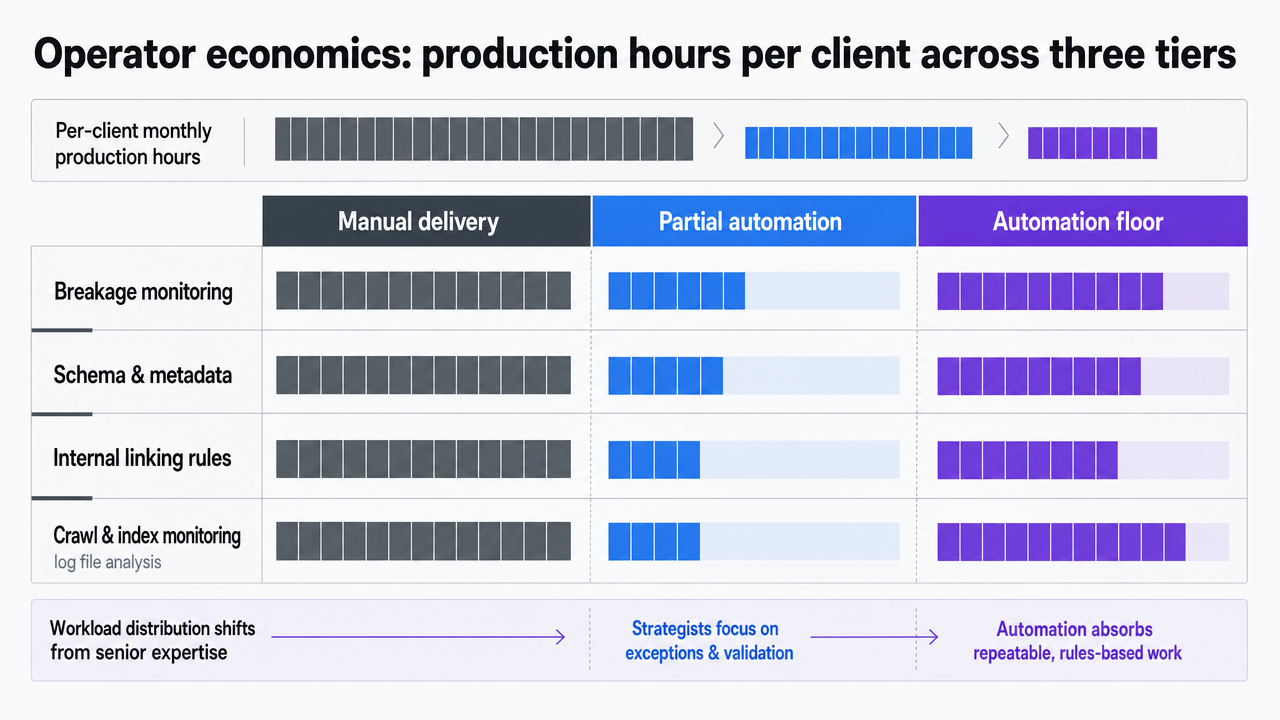 Compare per-client monthly hour totals across the three operational tiers cited in the article's table
See How Automated SEO Systems Drive Measurable Efficiency Gains
Connect with our team to benchmark your agency’s current SEO workflow and discover data-backed strategies for automating routine tasks without sacrificing oversight or client outcomes.
If you manage multi-location or portfolio clients
The economics discussed above assume a single-domain client. For multi-location operators—such as DSO groups with 40 practices, law firms with 12 office pages, or home service brands with 200 service-area URLs—the nature of the work changes, requiring pipeline adjustments. This section is particularly relevant for agency owners whose client mix includes accounts with numerous near-identical pages rendered from the same template, where local intent drives revenue.
At portfolio scale, three pipeline rules shift:
- Template-level schema and metadata become essential. Manually writing LocalBusiness or Service schema for hundreds of location pages inevitably leads to inconsistencies. Encoding schema at the template level and sourcing required fields from the business data layer is the only sustainable approach, especially through CMS migrations or brand-wide updates 9.
- Canonical and parameter rules gain importance because location pages often generate faceted variants (filters, service combinations, ZIP-radius views) that can waste crawl budget on URLs that should be consolidated. Log analysis is critical for detecting such issues, as symptoms appear in Googlebot's crawl behavior before affecting rankings 6.
- Exposure to scaled-content policies increases. Multi-location publishing fits the pattern Google flags when location tokens are the sole variation between pages, without genuine local value 12.
The approval queue serves a dual purpose here. Each location's content needs at least one verifiable local input—a named practitioner, a real address, a service-specific photo, or city-specific intake details. The strategist's role at the brief gate is to confirm these inputs exist before page generation. The E-E-A-T checklist applies per location, not just per brand 5. Agencies that effectively implement this approach can typically have one senior strategist manage 3 to 5 multi-location accounts with the load-bearing tier in place, a stark contrast to the limited capacity of those relying on manual processes.
Building the stack without buying a new SaaS for every gap
When codifying the pipeline, there's a temptation to acquire a separate tool for each stage, often resulting in a fragmented stack of rank trackers, crawlers, content optimizers, schema generators, reporting builders, log analyzers, and project boards that don't communicate. However, the 2026 enterprise platform feature set is converging towards integrated systems that combine large-scale keyword tracking, technical audits, content optimization, automation, workflow management, and integrations into a single solution 8. The key question isn't which tool is best in each category, but which integration points are essential for the pipeline to operate autonomously between approval gates.
Three integration points are critical:
- The data layer must unify crawl, log, rank, GSC, and conversion data into a single client view, enabling signal detection to operate with a complete picture.
- The brief queue must expose the upstream signal, target template, and E-E-A-T inputs necessary for strategist sign-off 5.
- The publish layer must push schema, metadata, and content into the CMS with validation rules that prevent deployment if required fields are empty.
Other considerations are preferences. Agencies that prioritize mapping these three integrations to existing tools, and only acquire new tools to fill genuine gaps, tend to consolidate their stack to two or three platforms plus a coordination layer. Approval-first execution platforms like Vectoron are designed to serve as this coordination layer, allowing agencies to encode rules once rather than maintaining a custom stack for each client.
Frequently Asked Questions
References
- 1.A new resource for optimizing for generative AI in Google Search.
- 2.Google's New AI Search Guide Calls AEO And GEO 'Still SEO'.
- 3.Is AI- content No Longer against Search Guidelines? Google Clarifies.
- 4.Google and AI Content: What to Know (& What to Do).
- 5.An EEAT Checklist for AI Search.
- 6.Log File Analysis: A Must-Have for SEO Pros.
- 7.What is Enterprise SEO? A Marketer's Guide to Search Optimization.
- 8.Enterprise SEO Platforms: Compare the 5 Best Tools 2026.
- 9.The Enterprise Guide to Winning in SEO & AI Search.
- 10.Optimizing for AI Search: Google's New Guidelines and What They Mean.
- 11.Google's New AI Search Guidance: What Agency Owners Should Know.
- 12.Google Search's guidance on using generative AI content on your website.
- 13.Optimizing your website for generative AI features on Google Search.