
Key Takeaways
- Automated SEO reporting is a delivery-model decision, not a tooling upgrade; faster PDFs leave the hours-per-client floor intact unless the surrounding loop is redesigned.
- The four-stage loop—assemble, rank, approve, execute—lets automation absorb data work while human judgment owns prioritization and sign-off, producing an auditable record clients can defend.
- Reclaimed strategist hours should flow into ranked content briefs, deferred technical debt, and conversion testing on pages already ranking—not into more internal meetings or expanded call time.
- Retire average position, search volume, and aggregate keyword counts before automating reports 6; tie metrics to qualified pipeline and AI answer visibility so governance becomes a sales asset in enterprise RFPs.
The Delivery-Model Question Hiding Inside the Report
Automated SEO reporting is usually pitched as a tooling upgrade. For agency leaders running 40, 80, or 200 client accounts, it is something else entirely: a delivery-model decision that determines how many clients each strategist can hold, how much of that strategist's week reaches actual optimization work, and how defensible the recommendations look when the account director walks into a renewal conversation.
The wrong framing produces faster PDFs and unchanged margins. The right framing rewires the workflow that surrounds the report.
Most agencies are sitting on the same structure they used five years ago. A strategist pulls data from Search Console, GA4, Semrush, and a Looker Studio dashboard, drops it into a deck, writes commentary, and presents it on a monthly call. Automating the assembly step compresses one task. It does not change the hours-per-client floor, because the deck was never the bottleneck. The bottleneck is the loop the deck sits inside: gather, narrate, recommend, wait for approval, execute, repeat.
Gartner's CMO Spend research shows marketing budgets have settled at 7.7% of company revenue, down from a pre-pandemic 11%, and clients are pushing that pressure onto their agencies 2. Buyers want fewer activity recaps and more evidence that the work changed an outcome. A monthly deck that summarizes last month's rankings does not survive that conversation.
The question worth answering is not how to produce an automated SEO report. It is how a Head of SEO redesigns delivery so that automated reporting becomes the first node of a governed loop, not a polished artifact at the end of a manual one.
Why Faster PDFs Do Not Move Agency Margin
The Hours-Per-Client Ceiling on Growth
Every agency has a number it rarely writes down: the hours a strategist spends per client per month before any optimization work begins. That number is the actual growth ceiling. It sets how many accounts a senior strategist can hold, how thin junior support has to spread, and how much room the P&L has for a new logo before delivery quality starts slipping.
Manual reporting eats a meaningful share of that number. Pulling Search Console exports, reconciling GA4 against a Looker Studio dashboard, cross-referencing Semrush position data, writing commentary, formatting slides, and prepping the call narrative all sit upstream of the work that actually moves rankings. Agencies that automate only the assembly step shave hours off one task while leaving the surrounding loop intact.
The math is unforgiving. If a strategist spends a fixed share of monthly capacity assembling and narrating reports, the only paths to higher throughput are hiring, offshoring, or stretching the existing roster thinner. Each option compresses margin. Forrester's automation research points the same direction: process optimization is now distributed across roles, but most teams still lack the tooling and training to capture the gains 7.
Faster PDFs do not change the hours-per-client floor in a way that scales. They change the cosmetics of one deliverable. The leverage sits in what the reclaimed hours produce next, which depends on whether the loop downstream of assembly has been redesigned.
What Clients Now Expect From a Monthly Deck
Client expectations have moved faster than most agency reporting templates. The monthly deck that worked in 2019 is now a liability. Buyers are no longer impressed by a recap of rankings, traffic deltas, and a backlog of completed tasks. They want to see what changed in the business, what the agency did about it, and what the recommendation is for next month, ranked by expected impact.
The pressure behind that shift is financial. Gartner's CMO Spend research shows average marketing budgets have fallen to a post-pandemic low of 7.7% of company revenue, down from a pre-pandemic average of 11% 2. Every line item, including agency retainers, is being asked to justify itself against pipeline, revenue, or qualified demand. A deck that summarizes activity without connecting it to outcomes reads as overhead.
Marketing budget as a share of company revenue: pre-pandemic average 11% vs. post-pandemic 7.7% 2.
Enterprise buyers have raised the bar further. Forrester's Wave on marketing measurement describes leading platforms as systems that unify performance data across channels and deliver always-on, scenario-based recommendations to support budgeting and optimization decisions 5. Agency clients who use those platforms internally now expect their SEO partner to match the format. A static monthly export will not.
The practical implication is that the deck has to do three things the old one did not:
- tie SEO movement to a business metric the CFO recognizes,
- surface ranked recommendations rather than observations, and
- make the underlying data inspectable on demand rather than once a month.
Agencies that ship that format hold renewal conversations from a stronger position. Agencies that ship a faster version of the old deck are defending a deliverable the buyer has already outgrown.
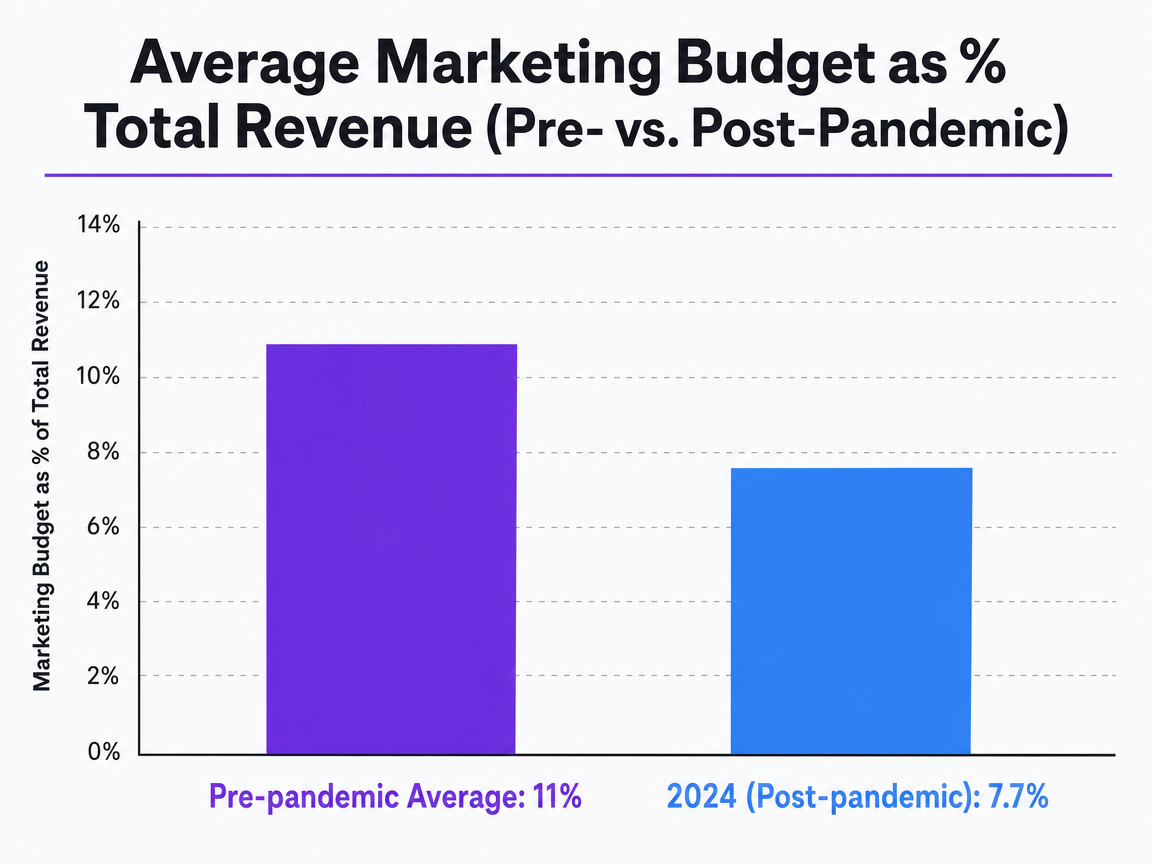 Average Marketing Budget as % of Total Revenue (Pre- vs. Post-Pandemic)
A Gartner CMO Spend survey for 2024 shows a decline in average marketing budgets as a percentage of total revenue from a pre-pandemic average of 11% to a low of 7.7%.
The Four-Stage Loop: Assemble, Rank, Approve, Execute
Assembly: Where Automation Earns Its Keep
Assembly is the stage every agency tries to automate first, and for good reason. It is the most repetitive, the most error-prone, and the easiest to standardize. A strategist pulling Search Console queries, joining them against GA4 sessions, reconciling Semrush position tracking, and dropping the result into a Looker Studio dashboard is doing data engineering, not SEO.
The work that automation should absorb at this stage is narrow and well-defined:
- API pulls from Search Console, GA4, Bing Webmaster Tools, the rank tracker of choice, and the backlink index.
- Normalization of date ranges, market segments, and brand-versus-non-brand splits.
- Anomaly flags for traffic drops, indexation changes, and Core Web Vitals regressions.
- Standardized output formatting so the same view appears for every client, every month, without a strategist rebuilding it.
Gartner's analytics research identified inconsistency and difficulty of access as two of the top reasons marketing leaders fail to use the data their teams produce 1. An automated assembly layer addresses both directly. It produces the same view on the same cadence with the same definitions, which is the precondition for anyone, strategist or client, to trust the numbers underneath.
What assembly does not produce is judgment. A dashboard that shows organic sessions fell 14% week-over-week is not a recommendation. It is a prompt for one. Agencies that stop the automation project at this stage have built a faster pipe to the same monthly call. The hours saved are real, but they sit isolated unless the next stage of the loop is also redesigned.
Ranking: Turning Data Into Prioritized Recommendations
Ranking is the stage where most agency automation projects stall. Assembling the data is a tooling problem. Ranking what to do about it is a judgment problem, and judgment is where strategist hours quietly disappear.
A useful ranking layer takes the assembled signals and produces a short, ordered list of recommendations tied to a business metric the client tracks. Not 47 technical findings. Five to ten ranked moves, each with an expected impact estimate, an effort estimate, and the reasoning behind the order. A canonicalization fix on a 200,000-URL ecommerce catalog ranks differently than the same fix on a 40-page services site. The ranking layer has to know the difference.
This is the stage where Forrester's analyst guidance becomes operational. Top measurement platforms now deliver always-on, scenario-based recommendations rather than static reports, and enterprise clients have started expecting the same posture from their agencies 5. A ranked recommendation list is the format that posture produces.
The honest constraint is that ranking quality depends on the data architecture upstream. If the assembly layer cannot distinguish brand traffic from non-brand, or cannot tie keyword movement to a conversion event, the ranking layer ranks the wrong things confidently. Agencies that skip the data hygiene work and try to bolt AI-driven prioritization onto a messy pipeline produce recommendations that look credible and direct strategist hours toward the wrong moves. The ranking layer earns trust only when the inputs underneath it are clean.
Approval and Execution: The Gates That Protect Judgment
Approval is where agency delivery either compounds or collapses. Ranked recommendations move from a list to a workflow only when someone with authority decides what ships, what waits, and what gets sent back for more analysis. That gate is the difference between a reporting tool and a delivery system.
The structural case for automation has scope worth stating plainly. McKinsey's work on AI and labor estimates that 60 to 70 percent of today's global work hours could be automated in some scenarios, a figure that spans all knowledge categories rather than SEO specifically 11. Directionally, recurring assembly and ranking work falls inside that envelope. The strategic decision of whether a recommendation matches client priorities, brand voice, and risk tolerance does not.
Four-stage delivery loop: Assemble → Rank → Approve → Execute. Automation absorbs assembly and ranking; human judgment owns approval; execution runs against approved direction. McKinsey estimates 60–70% of global work hours could be automated in some scenarios, scoped to all knowledge work rather than SEO specifically 11.
Execution is the stage that closes the loop. An approved recommendation triggers the work: a content brief routed to production, a technical ticket queued for development, a redirect rule staged for deployment. Execution status feeds back into the next assembly cycle, which now measures whether the approved move produced the expected outcome.
Agencies that build the approval gate well end up with a defensible record of every decision and its result. That record is what holds up in renewal conversations and enterprise procurement reviews. It is also what makes the strategist's job recognizably senior again, because the hours spent assembling slides are now spent deciding what ships.
Test Automated SEO Reporting on Live Projects
Evaluate automated SEO workflows on real campaigns before making any long-term commitment.
Operator Math for a 40-Client Agency
Consider a mid-market agency managing 40 active accounts with a senior SEO strategist holding 12 of them. The variables below are agency-supplied inputs, not industry benchmarks. The point is the structure, not the specific numbers.
H : the hours a strategist spends per client per month on reporting work: data pulls, dashboard reconciliation, deck assembly, commentary writing, and call prep.
R : the strategist's fully-loaded hourly cost.
Across 40 clients, the monthly reporting sink equals 40 × H × R. That figure never appears on a client invoice. It is absorbed into the retainer.
| Stage | Hours per client / month | 40-client monthly total | Monthly cost |
|---|---|---|---|
| Agency-supplied variables: H = manual reporting hours, A = automated assembly hours, R = strategist fully-loaded hourly rate | |||
| Manual reporting workflow | H | 40 × H | 40 × H × R |
| Automated assembly + ranking | A (fraction of H) | 40 × A | 40 × A × R |
| Reclaimed strategist capacity | H − A | 40 × (H − A) | Redirected to optimization, not saved |
The mistake most agencies make is treating 40 × (H − A) × R as a cost saving and dropping it to the bottom line. That move caps growth at the current client count and leaves the strategist roster idle on the back half of every month. The leverage shows up only when reclaimed hours flow into optimization work the old loop did not have room for: content briefs ranked by expected impact, technical debt cleared from a backlog that has been growing for two quarters, conversion testing on the pages that already rank.
The second-order math matters more than the first. If reclaimed hours produce measurable optimization wins, the agency can either hold the same roster and raise retainer value, or hold retainer value and absorb new logos without hiring. Keith Pieper's argument for tech-first delivery lands here: clients should brief on business goals and KPIs, and automation should optimize toward them rather than billing time against them 9. The agencies pricing on time and materials cannot capture this. The agencies pricing on outcomes can.
The honest caveat is that H and A are specific to each agency's tooling, client mix, and reporting standards. A boutique with five enterprise accounts has a different H than a performance shop with 200 SMB retainers. The structure holds. The inputs do not transfer.
Redesigning the Measurement Framework Before the Reports Go Stale
The automation project assumes the metrics being automated are still the right ones. That assumption is breaking. Forrester's analysts have already told SEO teams to reduce reliance on average position and search volume as generative AI reshapes how users formulate queries and consume answers 6. An automated report built on a 2019 metric set will produce confident charts of declining relevance.
The redesign question is not which dashboards to build first. It is which numbers belong on the deck at all. Average position across a 5,000-keyword tracker tells the strategist less every quarter, because the SERP it measures is being interleaved with AI overviews, conversational answers, and zero-click panels. Search volume estimates from third-party tools were always directional; in a generative environment, they describe a behavior that is fragmenting in real time.
A defensible 2025 framework keeps the metrics that still tie to revenue and replaces the ones that no longer do. Organic-driven qualified pipeline, branded versus non-branded conversion velocity, and visibility inside AI answer surfaces hold up. Position-weighted impression share and aggregate keyword counts mostly do not. The substitution is uncomfortable because the old numbers were easy to automate and the new ones require cleaner conversion plumbing.
Heads of SEO who run this audit before the next reporting build avoid a predictable failure: shipping a faster pipeline to metrics the client's CFO has already stopped funding decisions against. The work is to retire the obsolete fields, lock the definitions of the surviving ones, and only then point automation at the result.
The Buyer Sophistication Curve Agencies Are Now Competing Against
The buyer on the other side of the renewal call is not the buyer from three years ago. Enterprise marketing teams have been quietly arming themselves with the same category of tooling agencies use, and the gap between in-house sophistication and agency deliverables has been closing from both directions.
The enterprise SEO platforms market sat at $4.38 billion in 2024 and is projected to reach $12.5 billion by 2032, a 14% compound annual growth rate 8. That money is flowing toward platforms that centralize crawl data, rank tracking, content scoring, and reporting under one pane. The implication for agencies is direct: the client's in-house team is increasingly looking at the same Semrush, Conductor, or BrightEdge view that the strategist is reformatting into a slide.
Enterprise SEO platforms market projection: $4.38B in 2024 to $12.5B by 2032, at a 14% CAGR 8.
When the buyer already has the data, the agency's role narrows to interpretation, prioritization, and execution. A monthly deck that reformats what the buyer can already pull on demand reads as low-value work. A ranked recommendation set, tied to the buyer's pipeline metrics and routed through a visible approval gate, reads as the thing they cannot produce internally.
The agencies that keep winning enterprise accounts at the top of this curve are the ones whose reporting layer matches the buyer's platform sophistication and whose delivery model produces decisions the in-house team cannot stand up on its own.
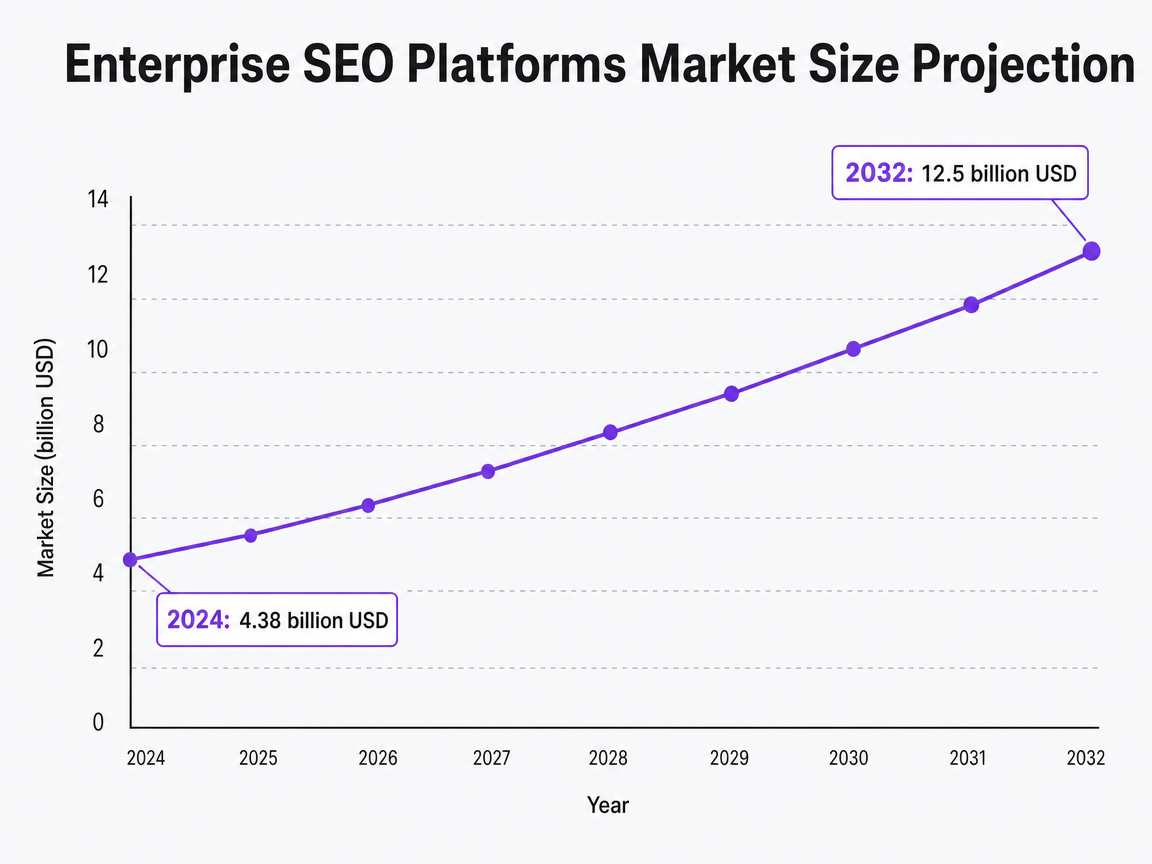 Enterprise SEO Platforms Market Size Projection
The enterprise SEO platforms market is projected to grow from $4.38 billion in 2024 to $12.5 billion by 2032.
See How Automated SEO Reporting Scales Client Delivery Without Added Overhead
Connect with our team to discover how integrated, approval-driven SEO reporting can streamline workflows, maintain quality, and deliver measurable results across your entire client portfolio.
Governance as a Competitive Wedge, Not a Compliance Footnote
Governance gets filed under risk in most agency operating plans. That filing is wrong. For agencies competing on enterprise accounts, the approval architecture around automated reporting is now a sales asset, not a legal one.
Deloitte's enterprise AI research found that 66% of organizations report productivity and efficiency gains from AI adoption, while governance of autonomous AI agents remains immature and only about 34% of organizations feel highly prepared across infrastructure, data, risk, and talent 12. That gap is the wedge. Enterprise procurement teams have read the same report. They are now asking agencies how recommendations are generated, who signs off before anything ships, and what the audit trail looks like when a campaign decision needs to be reconstructed six months later.
An agency that can answer those questions in operational detail wins business that competitors lose in legal review. The answer is not a policy document. It is a workflow: every automated recommendation carries the reasoning behind it, every approval is logged with the strategist's name and timestamp, every executed change traces back to the data view that triggered it. That record is what enterprise buyers mean when they ask for explainable AI.
McKinsey's global survey reinforces the same point from a different angle. Nearly nine in ten organizations use AI regularly, but most remain in experimentation rather than scaled deployment, with 64% citing AI as an innovation enabler 10. The agencies pulling ahead are the ones treating approval gates as the feature that makes scaled deployment defensible, not as friction to engineer out. Heads of SEO should write the governance layer into the delivery model before the next enterprise RFP arrives, because the buyers asking these questions are not waiting.
Reallocating Reclaimed Hours Without Inflating Headcount
The reclaimed hours from automated assembly are not a windfall. They are a budget that has to be allocated, and the allocation decision determines whether the agency captures the value or wastes it.
Three destinations produce measurable return.
- First, content briefs ranked by expected impact, written by the strategists who used to format slides.
- Second, technical debt cleared against a backlog that has been deferred for two or three quarters because manual reporting absorbed the calendar.
- Third, conversion testing on the pages already ranking, which is where the fastest revenue lift hides for clients with traffic but flat pipeline.
The wrong destination is more meetings. Heads of SEO who reclaim hours and route them into expanded internal syncs or longer client calls have rebuilt the old overhead under a new label.
McKinsey's State of AI 2025 found that nearly nine in ten organizations regularly use AI, while most remain in pilot phases rather than scaled deployment, with 64% citing AI as an innovation enabler 10. The agencies that scale past pilots are the ones whose strategists spend reclaimed hours on optimization that compounds, not on tasks the automation was meant to eliminate.
Holding headcount flat while raising retainer value or absorbing new accounts is the outcome the redesign was built to produce. That is the math Vectoron's approval-first model is designed to support.
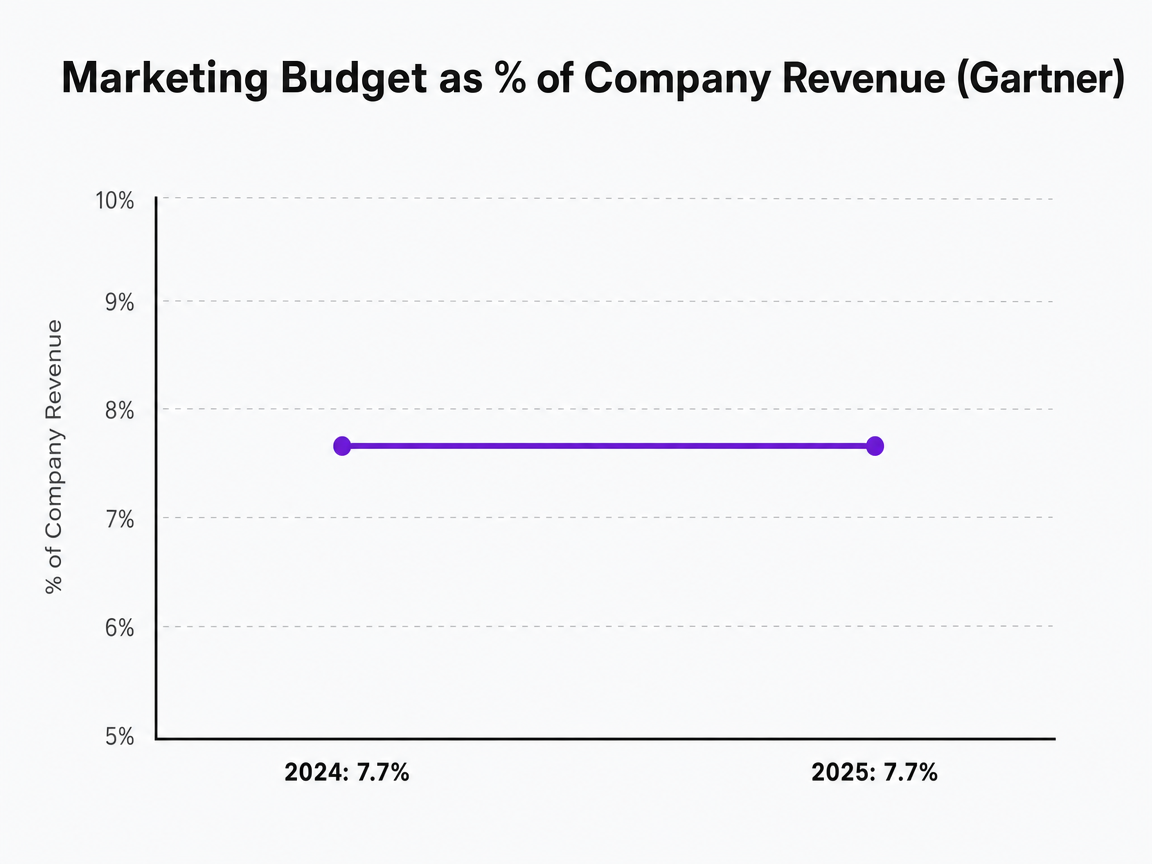 Marketing Budget as % of Company Revenue (Gartner)
Gartner's 2025 CMO Spend Survey indicates that marketing budgets have flatlined, remaining at 7.7% of overall company revenue for the second consecutive year.
Frequently Asked Questions
References
- 1.60% of CMOs to cut marketing analytics teams by 2023, Gartner says.
- 2.Gartner CMO Spend & Strategy Survey 2024: "Do More With Less".
- 3.Gartner: CMO Spend Survey Reveals Marketing Budgets Have Flatlined.
- 4.The CMO Survey: Highlights and Insights Report – Fall 2024.
- 5.The Forrester Wave™: Marketing Measurement and Optimization, Q3 2023.
- 6.Generative AI Has Answers, But SEO Practitioners Are Still Guessing.
- 7.The Results Are In: Insights From Forrester’s 2023 Global Digital Process Automation Survey.
- 8.Enterprise SEO Platforms Market Size, Share and Forecast 2032.
- 9.Agencies Must Shift to Tech-First Delivery.
- 10.The State of AI: Global Survey 2025.
- 11.AI: Work partnerships between people, agents, and robots.
- 12.The State of AI in the Enterprise.
- 13.2024 Cloud and AI Business Survey.