
Key Takeaways
- AI Overviews now trigger on roughly 48% of tracked queries, so tool selection has moved past data depth to whether the stack protects retainer margin as clicks stay on the results page 13.
- Evaluate automation across three layers—signal, orchestration, and execution—because each moves a different line on the P&L and a stack strong in one can quietly leak margin elsewhere.
- Treat signal tools like Semrush, Ahrefs, and Screaming Frog as a research utility with sub-linear seat growth, not as the answer to the delivery bottleneck across a growing retainer book.
- Use orchestration to route signals into approvals, reporting, and client-ready deliverables; it compounds across retainers but only moves work faster, not further.
- Execution-layer platforms are the hinge because they retire scheduled production hours rather than trim them, aligning with the 66% productivity and 57% cost-savings figures reported by AI-agent adopters 11.
- Weigh consolidation against production hours per retainer, not sticker price, since displacing a mid-level specialist across a 25-client book makes tool cost a rounding error on the salary line.
- Score platforms on data integration and audit trail, approval controls, multi-client permissioning, and AI-surface coverage, because those four axes map to the risks that actually break retainers.
- Match automation depth to pricing model: signal plus orchestration fits fixed-scope retainers, while outcome-based contracts turn the execution layer into the primary margin lever 6.
The Margin Math Has Changed Under Agency SEO
Agency owners are not asking whether automated SEO tools work. They are asking whether the current stack can hold a retainer's gross margin above 50% when a growing share of clicks never leave the results page.
The pressure is not theoretical. AI Overviews now trigger on roughly 48% of tracked queries, and Gartner has forecast that traditional search query volume could fall by about 25% by 2026 as chat and answer engines absorb demand 13. That reshapes the deliverable: the same ranking report reads differently when the ranked page is being paraphrased above it.
At the same time, the category is consolidating around platforms rather than point tools. The enterprise SEO platforms market is projected to move from USD 4.38 billion in 2024 to USD 12.5 billion by 2032, a compound annual growth rate near 14% 14. Buyers are voting for integrated execution over another dashboard login.
For a 5–75 person agency running retainers between $2K and $25K, the practical question is where automation displaces production hours, and where it only trims them. Signal, orchestration, and execution each move a different line on the P&L. The rest of this piece treats tool evaluation as a stack decision tied to that math, not a feature bake-off.
Why Tool Selection Criteria Shifted in the AI Overviews Era
Two years ago, tool selection was mostly a question of data depth: whose keyword database was larger, whose crawler surfaced more issues, whose rank tracker updated fastest. Those criteria still matter, but they no longer decide whether a retainer pays for itself.
The change is measurable. BrightEdge data compiled in a 2026 statistics roundup shows AI Overviews now trigger on roughly 48% of tracked queries, up from about 30% a year earlier, and Gartner has forecast traditional search query volume could decline near 25% by 2026 as chat and answer engines absorb intent 13. These figures describe tracked query sets, not the entire web, but the direction is clear enough for agency owners to price into their delivery model.
When roughly half of monitored queries surface an AI summary above the organic list, a tool that reports position 3 without reporting whether the page was cited, paraphrased, or ignored in the AIO is measuring the wrong thing. Salesforce's SEO guide frames this bluntly: AI-era tooling has to cover keyword patterns, content optimization, and user-behavior signals across surfaces, not just blue-link rank 15.
Three evaluation criteria have moved up the priority list as a result:
- Coverage of AI surfaces—whether the tool tracks citations inside AI Overviews and answer engines, not only classic SERP positions.
- Content-optimization depth—whether recommendations shape passages the way generative retrieval prefers them.
- Workflow integration—whether outputs feed the production queue that ships the work, or die in a PDF report a client skims once.
Feature-checklist comparisons that ignore these three axes will overstate what a legacy stack still delivers.
The Three-Layer Stack: Signal, Orchestration, Execution
Most tool comparisons flatten a nested decision into a single grid. The more useful frame separates SEO automation into three layers, each answering a different question on the agency P&L: what should we work on, how does the work move through the shop, and who actually produces it.
Signal tools tell the agency what to do. Orchestration tools govern how the work moves across clients and reviewers. Execution tools produce the deliverable. A stack can be strong at one layer and empty at another, which is where margin quietly leaks. The sections below walk each layer with the tools most commonly named in practitioner reviews and the roles each layer touches.
Layer One: Signal Tools That Inform, Not Deliver
Signal tools are the research and monitoring stack: keyword databases, backlink indexes, technical crawlers, and rank trackers. Semrush, Ahrefs, Screaming Frog, and dedicated rank monitors sit here, and practitioner roundups still lead with them because the underlying data is genuinely hard to replicate 7, 16.
What signal tools do not do is ship anything. They surface a fixable issue, a keyword gap, a lost link, or a Core Web Vitals regression, and then hand it back to a human to decide, brief, and produce. Zapier's roundup notes that stacking more point solutions at this layer often introduces data fragmentation rather than clarity 16.
For an agency, this layer is close to a fixed cost. Whether the shop has ten retainers or forty, the seat count grows sub-linearly and the intelligence generated is roughly the same per client. The margin problem starts one layer up, where that intelligence has to be turned into scheduled work across every account without a project manager reading dashboards all day. Treat layer one as a research utility and stop expecting it to solve the delivery bottleneck.
Layer Two: Orchestration That Governs Multi-Client Workflow
Orchestration is where signals become tasks, tasks become approvals, and approvals become client-ready deliverables. Agency-specific tools like AgencyDashboard and the reporting layer in seoClarity live here, along with the internal Notion, Asana, or ClickUp boards most shops assemble by hand 16, 18.
The function of this layer is governance, not production. It routes an audit finding to the right specialist, holds the deliverable in a review queue, logs the client sign-off, and packages the monthly report. AgencyDashboard describes this as automating reporting and ranking checks so staff can focus on strategy and client relationships 18. Enterprise marketing automation platforms extend the same pattern across lead scoring and multi-channel analytics 8.
Orchestration compounds well: every additional retainer added to a properly configured workflow costs marginally less to service than the last one. The catch is that orchestration only moves work faster, not further. It does not reduce the number of hours required to write the brief, edit the draft, or fix the schema. That is the layer three problem, and it is where the productivity claims start to become real numbers on the balance sheet.
Layer Three: Agentic Execution That Displaces Production Hours
Execution is the layer where the deliverable actually gets made. A signal tool identifies a thin cluster of service pages; an orchestration tool assigns it to a reviewer; an execution layer drafts the pages, applies internal linking, updates schema, and pushes changes to staging for approval. This is the layer that displaces billable hours rather than trimming them.
The economic case for this layer is the empirical hinge for the whole automation argument. PwC's survey of 300 senior executives across business functions reports that 79% say AI agents are already being adopted in their companies, 66% of adopters report increased productivity, 57% report cost savings, and 88% plan to increase AI-related budgets within the next 12 months 11. The same survey notes that 18% of respondents report no AI agent use, most often citing a lack of clear use case—which is another way of saying the operator has not yet mapped agents to a production step they can measure 11.
Surfer, Jasper, and content-optimization tools sit at the edge of this layer. Full agent platforms—including Vectoron in the same category discussion—sit further in, where specialist agents draft, optimize, and route work through an approval queue rather than a passive dashboard 12, 17. Demand Gen Report describes this shift as AI agents moving from task-level automation to strategic execution across content and go-to-market work 12.
For an agency, the practical test at layer three is whether the tool retires a scheduled hour on the production calendar. If a workflow still requires the same brief, the same draft cycle, and the same QA pass, it is orchestration in disguise.
Test Automated SEO Workflows on Live Campaigns
Experience measurable SEO process improvements by running real content through automated systems before making a commitment.
Running the P&L: Consolidation Economics for a 5–75 Person Agency
Tool cost is rarely the number that decides this. Production hours per retainer is. A shop running 25 retainers at an average of 18 production hours per client per month is buying 450 hours of delivery capacity, which at a loaded rate of $75 per hour represents roughly $33,750 of monthly cost sitting between revenue and gross margin.
The table below sizes the three-layer options against that production math. Third-party figures are shown as public ranges or quote-based where vendor pricing is not disclosed; the AI-agent execution row uses the only brand-owned number available, Vectoron's disclosed $599/month post-trial price.
| Stack tier | Monthly tool cost | Production hours displaced (H) | Approval governance included ||---|---|---|---|| Point-tool stack (Semrush + Ahrefs + Screaming Frog + rank tracker + reporting) | ~$800–$2,000 combined public list ranges 7, 16| Low: research and audit hours only | No || Enterprise SEO platform (seoClarity-tier) | Quote-based, enterprise pricing 14, 16| Medium: research plus reporting and workflow | Partial (workflow, not execution) || AI-agent execution platform | From $599/mo (Vectoron trial pricing) plus per-seat variants across category peers | Higher: research, optimization, and drafting hours; magnitude tracks the 66% productivity and 57% cost-savings figures reported by AI-agent adopters in PwC's survey of 300 senior executives 11| Yes, when the platform is approval-first |
The breakeven question is straightforward. If layer three retires enough production hours per retainer to displace one mid-level specialist across a 25-client book, the tool cost is a rounding error against the salary line. If it only trims hours without retiring a role, the agency is still paying for the headcount and adding software on top. That is the test to run before signing anything.
An Evaluation Rubric That Actually Reflects Delivery Risk
Feature checklists reward vendors with the longest spec sheets, not the platforms that hold up under a 25-client production load. A better rubric weights four criteria against the risks that actually break retainers: dirty data, unreviewed output, permission mistakes, and blind spots on AI surfaces. The subsections below define each criterion and what to test during a trial.
Data Integration and Audit Trail
The first question is what the tool sees. A platform disconnected from Google Search Console, GA4, and the agency's ranking data will hallucinate priorities, and practitioner reviews single out data hygiene as the difference between useful automation and confident nonsense 7. Native connectors to the sources of truth matter more than dashboard polish.
The second question is what the tool remembers. Every recommendation, every edit, every publish action should leave a timestamped record tied to a user. Enterprise marketing platforms treat this audit trail as a governance requirement, not a nice-to-have, because it is what makes multi-channel analytics defensible to a client asking why a page changed 8. During a trial, export the log and see if it reconstructs the last 30 days of work without a project manager narrating.
Approval Controls and Human Oversight
Automation that publishes without a human in the loop is a liability in regulated verticals and a trust problem in every other one. Salesforce's SEO guide is explicit that AI improves efficiency and scale, but human oversight remains essential for content quality, brand voice alignment, and ethical use 15. The tool should enforce that principle, not depend on staff discipline to remember it.
Test three things during evaluation:
- Can a reviewer see the reasoning behind a recommendation, not just the recommendation itself?
- Can approvals be routed to different reviewers by client, page type, or risk level?
- Can nothing ship to production without a recorded sign-off?
A platform that answers yes to all three converts automation from a speed feature into a governance feature, which is what an agency principal actually needs to defend to a client-side stakeholder.
Multi-Client Governance and Permissioning
A tool that works beautifully for one brand can fail badly at ten. Agency-facing platforms are built around multi-client reporting and task separation for exactly this reason, and roundups of agency automation tools name permissioning as a core feature category rather than an add-on 18. The failure mode is not dramatic; it is a junior specialist accidentally pushing a schema change to the wrong client at 4 p.m. on a Friday.
Evaluate three controls:
- Client-scoped workspaces that prevent cross-contamination of data, prompts, and templates.
- Role-based permissions that distinguish strategist, editor, and publisher rights.
- White-label reporting that presents the work to each client without exposing the shared production environment behind it.
Zapier's comparison notes that enterprise-tier platforms build these controls in, while lighter tools push the burden back to the agency 16.
AI-Surface Coverage Beyond Blue Links
The last criterion is the one most legacy tools quietly fail. If AI Overviews trigger on roughly 48% of tracked queries and answer engines are absorbing a growing share of intent, a platform that only tracks position 1 through 20 in classic SERPs is reporting on half the picture 13. Coverage of AI surfaces has moved from a differentiator to a baseline requirement.
During a trial, run three checks:
- Does the platform detect when a client's page is cited, paraphrased, or omitted inside an AI Overview?
- Does it recommend passage-level structure that generative retrieval prefers, not just title-tag rewrites?
- Does reporting distinguish clicks from impressions inside AI-driven results?
A tool that cannot answer these questions is measuring a shrinking slice of the demand the retainer is being paid to capture.
Where Automation Already Earns Its Keep: Content and Optimization Workflows
Content production is where the automation math stops being theoretical for most agencies. Ascend2's 2025 survey of marketing professionals found that content creation and enhancement leads AI adoption at 37%, followed by email marketing optimization at 36% and social media management and ad targeting at 35% 9. Peers are not experimenting at the edges. They are deploying AI against the exact production categories that eat retainer hours.
For an SEO retainer, that maps to four workflows:
- keyword clustering into topic pillars
- brief generation
- on-page optimization
- internal linking
Practitioner reviews describe these as the highest-yield automation targets because the inputs are structured (query data, competitor SERPs, existing page inventory) and the outputs are constrained enough for a specialist to edit rather than rewrite 7, 17. TheStacc's review of automated SEO tools notes that content briefs and on-page recommendations can be generated in bulk, cutting manual production time meaningfully while preserving a human editing pass 17.
The caveat matters. Salesforce's SEO guide is direct that AI improves efficiency and scale, but human oversight is essential for content quality, brand voice, and ethical use 15. In regulated verticals—law, behavioral health, dental, senior living—that oversight is not optional, and the tools that hold up are the ones that route drafts through named reviewers before anything reaches staging.
The operational takeaway is narrower than the vendor pitch. Automation earns its keep where the workflow is repeatable, the input data is clean, and a specialist still owns the final read. Everywhere else, it is still a research aid.
See How Leading Agencies Leverage Automated SEO to Eliminate Production Bottlenecks
Request a walkthrough and discover data-driven workflows proven to streamline SEO execution, improve margins, and maintain full oversight—purpose-built for high-volume agency environments.
Matching Automation Depth to Your Retainer Model
The right layer of automation depends less on client vertical than on how the retainer is priced. A shop billing for deliverables treats tool spend as a production overhead line. A shop billing for outcomes treats it as a capacity multiplier. The two economics diverge quickly, and the mismatch shows up in the next quarter's margin report.
Hourly and Deliverable Retainers: Signal Plus Orchestration
Under an hourly or deliverable retainer, the client is paying for a defined scope: two blog posts, one technical audit, a monthly report. Revenue is capped by scope, so tool spend has to stay proportional to what the scope generates. Loading a full execution-layer platform onto a $2,500 retainer with eight deliverables inverts the math.
Signal plus orchestration is usually the right depth here. The research stack surfaces the work, and an agency-facing workflow tool routes it to specialists and packages the monthly report 18. Practitioner reviews describe this pairing as the baseline for small-team production without added headcount 7. The specialist still writes the brief and the draft, but the reporting and rank-check hours disappear. That is the margin recovered under a fixed-scope contract.
Outcome-Based Retainers: Execution Layer Becomes the Margin Lever
Outcome-based retainers change the equation. When the client pays for qualified leads, ranked positions on a defined keyword set, or booked revenue, the agency captures upside from every hour of production time it removes without reducing output. That is exactly the economic profile Mordor Intelligence points to when it flags outcome-based SEO contracts as the fastest-growing segment of the services market at an 18.4% CAGR 6.
At this pricing model, execution-layer automation stops being a cost center and becomes the margin lever. If a specialist agent drafts and optimizes the service pages that used to take a mid-level content producer twelve hours, the delta flows directly to gross margin. Demand Gen Report frames this transition as AI agents moving from task-level assistance to owning strategic execution 12. The catch is governance: outcome contracts assume the work still meets brand and quality standards, which is why approval-first workflows matter more here, not less.
If You Manage a Multi-Location or DSO Portfolio
Scope shift: this section is for agency principals whose book skews toward multi-location operators—DSOs, senior living portfolios, home services franchises, and regional law firm networks. The evaluation criteria above still apply, but the volume of pages and the governance model change what any tool actually has to do.
A 40-location DSO with three service lines per site is 500-plus location-service permutations before content variants. Signal-layer tools generate a longer defect list than any team can work through by hand, which is why enterprise crawlers and platforms with large-scale auditing are named as the baseline for high-page-count sites 19. The question is not whether to run the audit. It is what happens after.
Orchestration has to enforce brand consistency across locations without flattening local relevance. Multi-client permissioning translates directly to multi-location workspaces: each site scoped, each reviewer role explicit, each report white-labeled to the operator's regional structure 18. Without that, one specialist edits schema for the wrong practice and the parent brand hears about it.
Execution-layer economics get sharper at this scale. If drafting and on-page optimization retire even four production hours per location per month across a 40-site portfolio, that is 160 hours the retainer no longer has to staff. The PwC adopter data cited earlier frames the ceiling; the location count decides how fast that ceiling is reached.
A 90-Day Evaluation Plan Before You Rip and Replace
Swapping a stack mid-quarter is where most agencies lose a client. A staged 90-day evaluation keeps the current retainer running while proving whether a new platform actually retires production hours.
- Days 1–30: instrument the baseline. Pick five representative retainers and log actual production hours per workflow—research, briefing, drafting, on-page, reporting. Without this baseline, any productivity claim from a vendor is unfalsifiable. The PwC adopter figures of 66% productivity gain and 57% cost savings are averages across 300 senior executives spanning business functions 11; the number that matters is the delta on your own five files.
- Days 31–60: run a shadow pilot. Deploy the candidate execution-layer platform against two of those five accounts in parallel with the existing process. Route every output through the same reviewer who edits current drafts. Measure edit time, rejection rate, and cycle time to publish. Practitioner reviews consistently flag data-integration gaps and hallucinated recommendations as the failure modes to catch here 7.
- Days 61–90: decide on the retire-or-return question. If the pilot displaces enough hours across the two accounts to project a role-level saving at 25 clients, expand. If it only trims hours, keep the incumbent stack and revisit in two quarters.
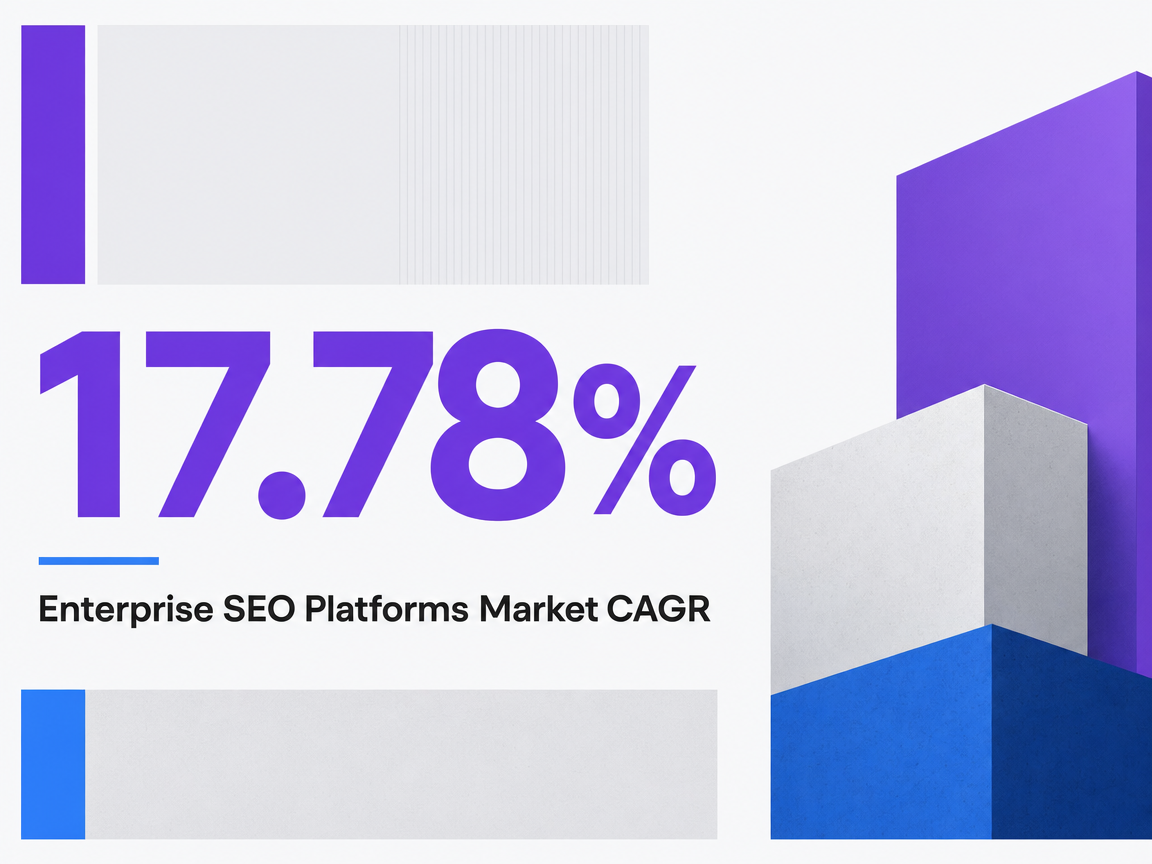 Enterprise SEO Platforms Market CAGR
Enterprise SEO Platforms Market CAGR
Frequently Asked Questions
References
- 1.Enterprise Seo Platforms Market Share, Size, Trends | 2035.
- 2.AI SEO Tools Market Research Report 2034 - Dataintelo.
- 3.SEO Software Market Size, Share & Growth Report | 2026-2035.
- 4.SEO Software Market Statistics, Key Players | Forecast.
- 5.SEO Market Size, Trends | Forecast Report [2026-2035].
- 6.SEO Services Market Size, Share, Industry Report 2031.
- 7.13 best SEO automation tools I'm using in 2026 | Marketer Milk.
- 8.Enterprise Marketing Automation: Benefits, Strategy, and Tools.
- 9.The Evolution of AI in Marketing 2025.
- 10.28 AI marketing statistics you need to know in 2025 - SurveyMonkey.
- 11.AI agent survey: PwC.
- 12.AI Agents Revolutionized B2B Marketing in 2025: From Automation ....
- 13.AI SEO Statistics (2026): 57+ Data Points on Zero-Click Search, AI Overviews & Generative Experiences.
- 14.Enterprise SEO Platforms Market Size, Share and Forecast 2032.
- 15.AI for SEO: Your Guide for 2026.
- 16.The 11 best SEO tools.
- 17.10 Best Automated SEO Tools in 2026: Content, Audits & Publishing.
- 18.4 SEO Automation Tools for Agencies That Save Time.
- 19.Enterprise SEO Tools.